Pye-Barker Fire & Safety has acquired Fire Alarm Services (FAS), Inc. in Arvada, Colorado. The purchase was finalised in March and expands Pye-Barker Fire’s service capabilities across the state.
FAS is a full-service fire protection company that has established a strong presence over its 20 years in business. With 140 employees at the time of the acquisition, FAS covers the state’s major regions, including the Denver metropolitan, Northern Colorado, the Central and Plains areas, and the Rocky Mountains. Through the integration of FAS into the team, Pye-Barker Fire will be able to expand its fire alarm and fire sprinkler services across the state.
FAS was owned and operated by its founders, husband and wife team Shannon and Connie Smith. Although Connie is retiring, Shannon will remain on as Regional Manager to keep leading his team to continued success.
“We are now excited to become part of the Pye-Barker Fire family, who truly understands the importance of the long-term relationships we have built with our customers and employees,” shared Shannon. “Together we look forward to continued success and growth with a new and exciting partnership.”
Pye-Barker Fire is focused on growing its core markets while adding strategic new territories as opportunities arise. The Company’s main focus is to acquire market-leading businesses with a solid historical financial performance to join its impressive and expanding footprint. Pye-Barker Fire values its culture and promotes an entrepreneurial environment where individual performance is recognized. The Company works with sellers to develop a post-close plan that aims to minimize business disruptions while offering professional employee development into the future.
Firefighters & EMS Fund is once again taking a stand for first responders across the U.S. In a strong statement, Executive Director Nile Porter commented, “We understand that determining who will be given priority for the coronavirus vaccine is a complex task. States and local governments must weigh their supply against which groups are the best candidates to be inoculated immediately.
“But the fact remains that Firefighters, EMS, and other first responders are going out into their communities on a daily basis and consistently risking exposure to the virus, putting themselves and their families in danger. It is in the best interest of departments and the communities who depend on them that first responders are able to receive vaccines to prevent illness and maintain safe levels of service.”
There is not a uniform policy nationwide to determine who will be first in line, and while the government has recommendations, it is ultimately up to state officials to determine when and to whom a vaccine will be given. The CDC’s recommendations for who should be vaccinated first follows the logic of who is most at risk. “CDC recommends that initial supplies of COVID-19 vaccine be allocated to healthcare personnel and long-term care facility residents. This is referred to as Phase 1a.” Phase 1b suggests vaccinating frontline workers, such as first responders.
However, some states are pushing frontline workers back and deprioritizing firefighters and EMS personnel. Firefighters & EMS Fund continues to urge all states to adhere to the CDC guidelines and make sure our first responders are prioritized and protected. “We owe them a huge debt of gratitude for the work they have done over the past year,” concluded Mr. Porter. “One of the best ways we can thank them is by ensuring that they are protected from the coronavirus.”
Emergency lighting experts Command Light explain the fundamentals of scene lighting in fire trucks
Numerous light studies show fire truck light masts provide more usable light than portable or truck-mounted lights. Even the most basic fundamentals back the advantages of elevated scene lighting. And yet, all too often, these masts are deemed an option. Rarely the standard. Still, they are an important choice that fire departments can make and advocate for when purchasing their apparatus, which brings us back to those fundamentals.
There are three basic scene lighting principles, all backed by various light intensity findings, worth considering — clustering, elevation and placement.
FUNDAMENTAL #1 — LIGHT CLUSTERING
When it comes to nighttime vision, light uniformity (even lighting across the scene) is more important than intensity (extreme illumination of a particular area within a scene) because intensity can cause a breakdown of the eyes’ rhodopsin, a light-sensitive protein that activates the retina’s rod cells, which aid in nighttime vision. Moreover, this strain increases when a person’s eyes continually adjust from dim to bright lighting. This is where grouping lights on a light tower can be beneficial.
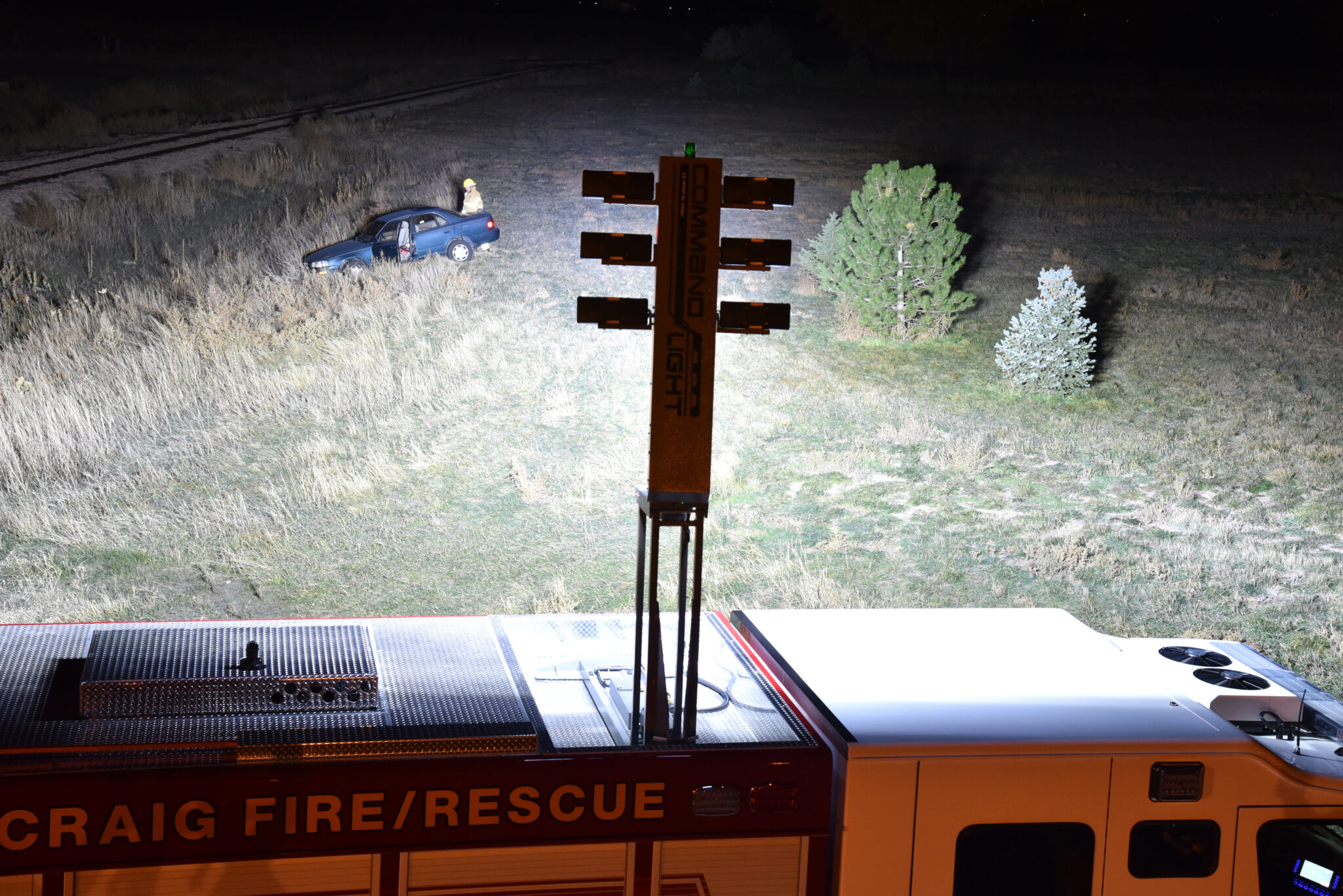
Think of stadium lighting at your favorite sports arena. Much like a fire truck light mast, arena lights are clustered together to gather and direct light to create uniform lighting across the entire arena. The same holds true for the fire truck lighting. Let’s compare a six-head tower to two different perimeter light scenarios. With perimeter lights, only half of the truck-mounted lights are directed at the scene, creating unlit areas and sub-par lighting. With the six-head tower, uniform lighting can be achieved.
“The whole thing about lighting is to make sure it’s usable,” says Roger Weinmeister, President of Command Light, which manufactures light towers for departments around the globe. “The moment you fix lighting to the side of your truck is the moment you lose half the light, which is not a great investment given the expense of LEDs.”
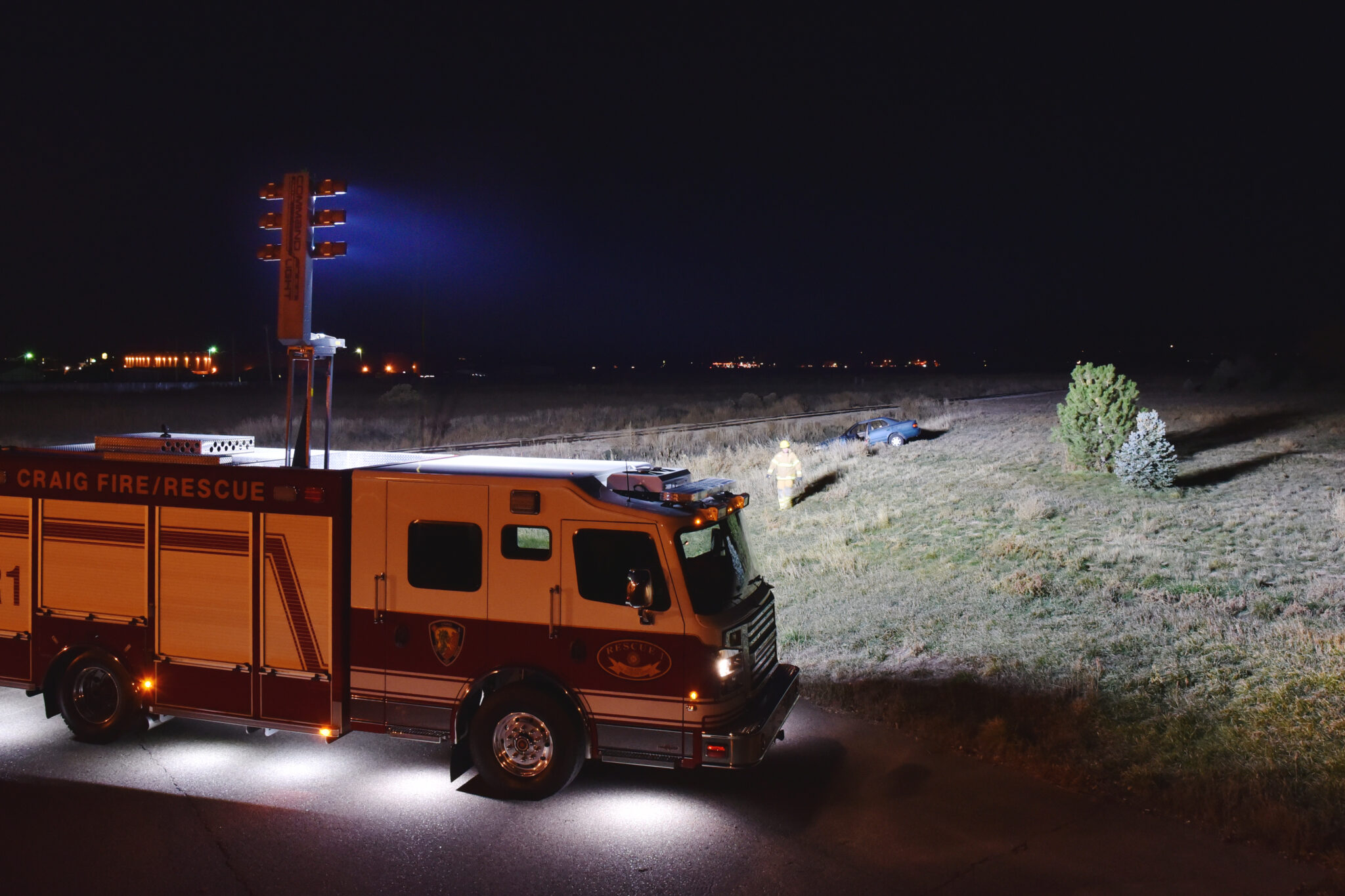
Meanwhile, light towers not only cluster these fixtures, Weinmeister adds, but they can be rotated and angled into endless positions to illuminate ditches, mountain slopes and other terrain. Some towers, like Command Light, offer backlighting capabilities to illuminate dual scenes.
FUNDAMENTAL #2 – LIGHT ELEVATION
Like the first fundamental, our second lighting principle builds on human anatomy.
“Humans have evolved to work with the sun shining down from overhead,” explains Sam Massa, HiViz President and Chief Technologist for HiViz LED Lighting, a manufacturer of specialty scene lighting. “Here’s the science: Humans have two eyeballs, each recessed into a socket on the frontal bone of the skull. Above that socket, there is a bony structure called the supraorbital ridge over which the eyebrows typically align. When the sun shines down, this bony structure casts a shadow that typically occludes the eye, preventing the sun from shining directly into a person’s eyes as he or she works.”
In short, our bodies, and more specifically our skulls, are built to mitigate this glare. However, at night, if the truck’s lights are fixed directly to the apparatus, all of this goes to the wayside. Massa stresses that it is important to select scene lighting options that will place fixtures high overhead to reduce this very glare.
But how high is too high? The intensity of light decreases the farther it is away from an object. Light intensity findings can help you pinpoint optimal height. For example, through research we carried out, we found that a documented light tower produces 20 meters of usable light. This is achieved by elevating the cluster of lights 9 meters above the truck. Meanwhile, the telescopic mast raises the lights 10 meters high but only produces 15 meters of usable light, while the pole light kit had even less reach because the lights were not clustered together, stressing Fundamental #1.
FUNDAMENTAL #3 — LIGHT PLACEMENT
With light comes shadows, but shadows can often be avoided if a light is properly positioned. Take for instance a stepped pumper body. If a light is mounted above the pumper’s stepped ledge, the light’s optics will hit a portion of the ledge, which in turn will cast a shadow on the work area below. That’s where a light tower light Command Light comes in handy. This tower can be positioned to overhang on the side of the apparatus in a “streetlight” position.
But the work area extends beyond the truck. Vehicles, property and even terrain, like ditches or ravines, are all work areas that have shadowed obstacles. However, when light is elevated, rotated and angled, these shadows can be managed, and there’s no better way to control the placement of light than with a mast.
To test light intensity, we placed a vehicle roughly 10 meters from the apparatus light source. Here, both height and light angle impacted the amount of usable light inside the vehicle.
This is a good point to talk about the difference between lux and lumens. Lumens is the total amount of light a fixture produces. However, this number does not represent lux — the amount of light that reaches the scene, or in this case inside the vehicle. As we’ve already addressed, a lot can factor in how many lumens make it to the fireground.
“Every scene is different, so it’s important lighting is versatile,” Weinmeister concludes. “And when you have the ability to control light and how it’s grouped, placed and elevated, your apparatus will become an even more powerful tool.”
And so, with a little urgency, light towers can be more than just an option. They can be a necessity.
“When you’re out at night, saving lives and protecting property, there shouldn’t be a substitute,” Weinmeister says. “And just because it’s not the standard, departments can insist it become one.”
Oshkosh Corporation, a leading innovator of mission-critical vehicles and essential equipment, today announced that it has been named one of the 2021 World’s Most Ethical Companies by Ethisphere Institute, a global leader in defining and advancing the standards of ethical business practices.
Oshkosh Corporation has been recognised for six consecutive years and is one of only eight honorees in the Industrial Manufacturing industry. In 2021, 135 honorees were recognised across 22 countries and 47 industries.
“Being named one of the World’s Most Ethical Companies is truly a testament to the amazing individuals who work at Oshkosh Corporation,” said Ignacio A. Cortina, Oshkosh Corporation Executive Vice President, General Counsel and Secretary. “Everything we do is guided by our core values and this recognition is only possible because of our 14,000 team members around the world who embody our values each day and grow our ethical culture.”
“While addressing the tough challenges of 2020, we saw companies lead with resilience and with a commitment to ethics and integrity,” said Ethisphere CEO, Timothy Erblich. “Oshkosh Corporation and the other World’s Most Ethical Companies honorees continue to demonstrate an unwavering commitment to the highest values and positively impacting the teams, customers and communities they serve. Congratulations to everyone at Oshkosh Corporation for earning the World’s Most Ethical Companies designation.”
With methodology grounded in Ethisphere’s proprietary Ethics Quotient®, the World’s Most Ethical Companies assessment process includes more than 200 questions on culture, environmental and social practices, ethics and compliance activities, governance, diversity and initiatives to support a strong value chain. The process serves as an operating framework to capture and codify the leading practices of organisations across industries and around the globe.
This year, the process was streamlined and question set expanded to gauge how applicants are adapting and responding to the global health pandemic, environmental, social, and governance factors, safety, equity and inclusion and social justice.
In addition to being named one of the World’s Most Ethical Companies, Oshkosh Corporation has also been named one of FORTUNE’s World’s Most Admired Companies, one of America’s Most Responsible Companies by Newsweek and is listed on the Dow Jones Sustainability World Index.
Airbus and Atlas Telecom, a UAE-based communications technology integration and security solutions company, signed a strategic partnership agreement at the ongoing IDEX 2021 to combine their local and global expertise and reinforce collaboration among public safety agencies in Abu Dhabi.
The cooperation will lead to the integration of Airbus’ Tactilon Agnet, Everus Manpack and Tactilon Dabat into Atlas Telecom’s solutions for defense and security applications.
Tactilon Agnet brings terminal radio and smart device users together, allowing real-time sharing of voice, data, and video and location information. Embedded in Tactilon Agnet, the portable Everus Manpack LTE tactical bubble enables voice and video services, and gives users a direct link to the headquarters.
In addition, Airbus’ Tactilon Dabat device allows users to switch between Tetra or LTE network services, according to availability, thanks to its state-of-the-art hybrid roaming feature.
In the frame of the agreement, Airbus will also provide the TW1m Tetra modem, which will unlock the capabilities of Atlas Telecom’s E-passport tracking device, an advanced compact and intelligent vessel tracker.
“Atlas Telecom always emphasises the need to provide a reliable and secure critical communication infrastructures for reinforced collaboration between security forces and personnel across sectors. Through our new partnership, we can further strengthen our capability to deliver secure and modern devices for efficient exchange of data, voice, and information.” Samer, Jammoul, Managing Director of Atlas Telecom, explained.
“In the Middle East, where we have strong market presence, our collaboration with Emirati companies such as Atlas Telecom allows us to jointly deliver better products and services. It results in an engagement that brings economic benefits.
“This reflects our commitment to introduce technology-driven solutions to the region, especially in the UAE where we are witnessing a rapid upgrade of infrastructure and security as it bids to become a leader in the global security and safety industry.” Added Selim Bouri, Head of Middle East North Africa & Asia Pacific regions for Secure Land Communications at Airbus.
A firefighter and paramedic were injured in a drive by shooting whist responding to a medical emergency in California on Saturday.
Emergency response teams were called to the area of Auto Center Drive and Sycamore Drive in Antioch at around 9 p.m.
The firefighter, who works with Contra Costa County fire department, was shot in the foot, and a paramedic was shot in the leg officials have said. Both are now believed to in a stable condition in a local hospital.
Joe Ottolini, fire prevention captain with Con Fire, told local news outlet The Chronicle: “”While units were on scene — fire was on scene with EMS — a drive-by shooting occurred.”
There have been few comments made on the shooting, however, Antioch Police Department is now investigating the incident.
Victaulic, the world’s leading manufacturer of mechanical pipe joining, fire protection and flow control solutions has purchased a 220,000 square foot Waupaca manufacturing plant in Lawrenceville, PA.
When operating at full capacity, Waupaca manufacturing plant will increase Victaulic’s foundry production capacity by 70 percent in the U.S. and allow for future growth as Victaulic’s business demands increase. The facility, including two foundry molding lines, will also enable Victaulic to produce larger scale products.
“The addition of Waupaca’s Lawrenceville foundry will provide the scale and capacity necessary to continue our growth plans and most importantly service our valued North American customers. Additionally, Victaulic is doing its part to add vital manufacturing jobs within Pennsylvania,” commented John F. Malloy, Chairman of Victaulic.
He concluded: “A major aspect of our business strategy has always been to manufacture products in close proximity to our customers.” Victaulic anticipates adding new jobs to Tioga County in the near future. It is expected many of the new positions will be filled by local talent from the area’s skilled workforce.
New hires will join the current Victaulic team of more than 1,600 Pennsylvania employees and approximately 4,500 people globally. “Victaulic’s investment in Tioga County is a testament to the company’s incredible track record of growth, vision and passion for the communities they serve,” commented State Representative Clint Owlett.
“I look forward to welcoming this family-owned business with Pennsylvania roots to our community along with the jobs it will bring to our hard-working residents.” Victaulic, headquartered in Easton PA, has nearly a thousand employees in the Lehigh Valley and remains one of the region’s largest employers of steelworkers, with plants in Northampton and Lehigh counties.
“Victaulic greatly appreciates the support of Develop Tioga, Tioga County, the Tioga County Commissioners, and its local elected officials, particularly Senator Cris Dush and State Representative Clint Owlett,” commented Rick Bucher, Victaulic President and CEO. “We are dedicated to building a long-term, mutually beneficial partnership with the region and its hardworking residents.”
The company is also nearing the completion of an additional 400,000 square foot light assembly operations facility in Lower Nazareth, which is expected to be fully operational in 2021.
Firefighters from some of the areas hardest hit by wildland fires are training on a new tool for their response efforts. The Team Awareness Kit is a mobile application that harnesses wildfire situational awareness data.
Team Awareness Kit is a geospatial mapping and common operating picture program developed for the military special operations community. The civilian version is available on the Google Play Store and is easily adapted to the wildland fire service. During the 2020 fire season, it was used to share live tracking information from the Fire Integrated Real-Time Intelligence System (FIRIS) program on the Blue Ridge and Silverado Fires in California. The tool helped the local communities contain the fire threat and manage evacuations using the real-time perimeters and fire forecasts delivered from FIRIS. Delivering FIRIS data to TAK users on the ground provided cutting edge integration of information.
“DHS S&T is committed to providing firefighters the tools they need to communicate with each other, especially as they battle the increasing threats of the wildland fire season. Putting Team Awareness Kit in the hands of all wildland firefighters enables these first responders to communicate with voice and data whenever and wherever possible,” explained S&T Program Manager Denis Gusty.
DHS S&T collaborated with the California Governor’s Office of Emergency Services (Cal OES), FIRIS, Intterra, and the WIFIRE Lab at University of California-San Diego to provide this training for 20 firefighters from Southern California wildfire response communities covering Los Angeles, San Diego and San Bernardino Counties, in addition to other support agencies.
The training was done in conjunction with FIRIS and the City of Corona Fire Department. The session also leveraged national interagency wildfire efforts, including a nationwide Team Awareness Kit server hosted by the U.S. Forest Service and the Colorado Center of Excellence for Advanced Technology Aerial Firefighting, the same Team Awareness Kit server that supported the 2020 fires in Colorado and California. The City of Corona, the Colorado Center of Excellence and City of Boulder also brought their field experience using Team Awareness Kit for firefighting.
“We are very pleased with the success of this first training. We hope that the Team Awareness Kit tool will see more widespread use to help first responders precisely identify, track and coordinate locations and resources during wildfire incident response,” said Gusty.
The National Fire Protection Association (NFPA) has announced that the 2020 edition of the Educational Messages Advisory Committee (EMAC) Desk Reference is now available, featuring new chapters and updated messaging on multiple fire and life safety issues. Revised every two years, the EMAC Desk Reference serves as the foundation for all NFPA public education messaging, while providing fire and life safety educators with accurate and consistent language they can deliver to their communities.
“Ensuring that the EMAC Desk Reference reflects timely public education messages requires an investment of time and energy from a dedicated team of fire and life safety, injury, and healthcare professionals,” said Andrea Vastis, senior director of public education at NFPA. “Our collective goal is to ensure that the fire and life safety information within the document is consistent, accurate, and fully addresses the risk factors faced by today’s public.”
The 2020 edition of the EMAC Desk Reference includes new chapters on pet fire safety and youth firesetters, in addition to updated messaging on the following issues:
Carbon monoxide messaging in relation to boating and marina safety
Home fire escape messaging for people who are deaf or have hearing loss, use a mobility device, and are blind or have low vision
Fire safety around peer-to-peer hospitality; motor homes, camper and recreational vehicle safety; safety in places of public assembly; and car fire safety
Cooking safety when using microwave ovens and gas grills
Electrical safety messaging for pools, hot tubs, and spas; heating equipment; marina and boating safety
Candle safety, including how to burn a candle and religious/ceremonial use of candles in homes
Outdoor burning, including campfire safety, fire pit safety, and other recreational fire uses
Flammable and combustible liquid and gases, including propane gas safety, propane appliance maintenance, and gel fuel safety
Battery safety specific to 9-volt batteries and battery disposal
Topics within the EMAC Desk Reference are written in a self-contained manner, so that all the information on a particular subject is provided within that category. In the latest edition, the table of contents has been hyperlinked, making it easier to find information on each topic, as needed. The French version of the document will be available in the coming months.
The EMAC meets periodically to review NFPA’s fire and burn safety education messages and to provide recommendations to NFPA public education staff for messaging updates and revisions. Submission of comments, proposed revisions, and new messages from a wide variety of professionals and public audiences occurs on an ongoing basis. The EMAC Desk Reference report of all submissions considered for the 2020 edition is available for review.
MSA’s Globe Products is sponsoring the National Volunteer Fire Council (NVFC) course Grant Writing for the Fire and Emergency Services through August 15. That means all members of the fire and emergency services can take the course free of charge to help them prepare their grant applications. The timing coincides with the application period for several key fire and emergency service grants.
NVFC course to be available on demand
The course, available on demand in the NVFC Virtual Classroom, educates fire and emergency services personnel on how to write a successful grant narrative in an effort to secure funding for their local fire/EMS department. Participants will also learn about available funding opportunities, including government and private grants.
The course will be beneficial to help fire and EMS personnel apply for any number of grants. Currently, there are several grant application periods open, including the following:
MSA’s and DuPont’s Globe Gear Giveaway – Eligible volunteer fire departments can apply for four sets of turnout gear and four helmets to enhance the safety of their firefighters. Deadline: June 1
FEMA’s Fire Prevention and Safety (FP&S) grant – Fire departments and national, regional, state, local, tribal, and nonprofit organizations can apply for funding to support projects that enhance the safety of the public and firefighters from fire and related hazards. Deadline: February 26
SAMHSA’s Rural Emergency Medical Services Training Grant program – Rural EMS agencies operated by a local or tribal government as well as nonprofit EMS agencies can apply for funding to help with recruiting and training EMS personnel in rural areas. Deadline: March 18