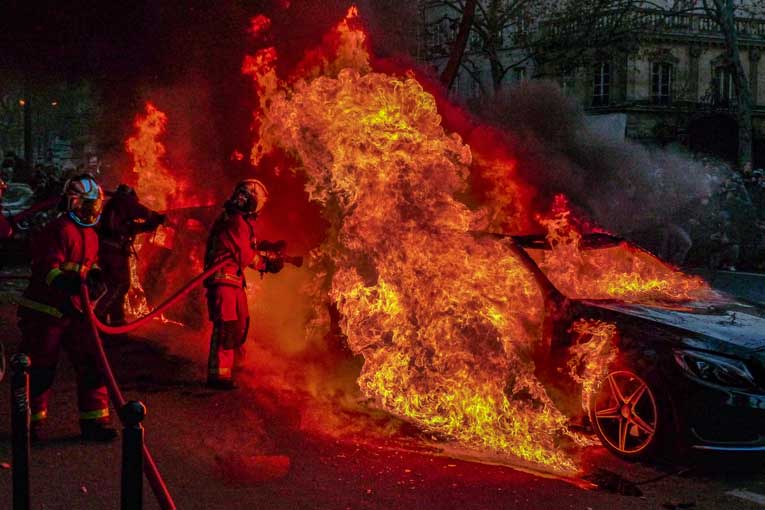
NFPA’s international development director for Latin America, Jaime Gutierrez, has said that the Ciudad Juárez migrant station incident “should not have happened and should not happen again.”
The deadly fire broke out in a detention centre located in Ciudad Juárez, south of El Paso, Texas, resulting in the death of at least 39 migrants.
The incident has been deemed as one of the deadliest fires in recent history in Mexico. In response, the National Fire Protection Association (NFPA) has emphasised the importance of implementing measures in detention and correction facilities to prevent future incidents.
Although codes and standards, such as the NFPA 101 Life Safety Code provide guidance for ensuring fire safety in detention or correctional facilities, destructive fires continue to occur in such occupancies globally. For example, a fire in an Iranian prison just six months ago killed eight people and left dozens more injured.
Gutierrez highlighted the need for detention and correctional facilities to take better precautions and use guidance from organisations such as the NFPA to ensure the safety of those in their care. He said that the incident in Ciudad Juárez underscores the importance of maintaining safe conditions in these facilities, particularly for vulnerable populations.
Lack of safety measures
Detention facilities must provide staff members with the ability to release detainees in emergency situations, according to NFPA 101. The code also requires automatic sprinkler systems in new facilities if free egress isn’t available. It is unclear if these measures were in place at the Ciudad Juárez facility, which caught fire on Monday, killing at least 39 migrants.
Footage taken of the incident shows smoke and flames quickly engulfing a cell while a person in uniform walks by. Witnesses alleged that guards at the facility did not release detainees after the fire broke out. Mexican authorities have reportedly opened an investigation into eight employees for potential criminal charges.
Officials believe the fire began after some detainees lit their mattresses on fire to protest recent immigration delays and deportations. The facility, located near the U.S.-Mexico border, often detains migrants from South and Central America who have attempted to enter the United States. At the time of the fire, 68 men were held in the section that burned down.
In the wake of the tragic incident, fire safety experts from NFPA are advocating for better measures to keep individuals in detention and correctional facilities safe from fires.
The Extinguishing Section of Euralarm has released an updated version of its guidance document on the periodic inspection of containers used in fixed gaseous fire extinguishing systems.
The document is intended to provide recommendations on critical areas of periodic testing that are often not fully understood, and to avoid serious safety issues during hydrostatic testing.
The guidance note also aims to clarify confusion on when fire extinguishing agent containers should be submitted for periodic testing under relevant standards such as the Pressure Equipment Directive (PED), the Transportable Pressure Equipment Directive (TPED) and the Agreement concerning the International Carriage of Dangerous Goods by Road (ADR).
The document covers aspects such as moisture control, the reuse of container valves and the recertification of containers, and includes a useful checklist to ensure safety is maintained during periodic inspection and filling.
The updated guidance document is available for download from the Euralarm website.
The Fire Sector Federation (FSF) has published a new Industry Benchmark Standard for Fire Risk Assessors to provide practical guidance for assessors who want to understand the application of fire risk assessment across a range of buildings.
The aim is to support the delivery of comparable standards across the sector. The standard has been developed by the Federation’s Fire Risk Assessors Working Group and identifies criteria reflecting individual competency at three distinct core levels, Foundation, Intermediate and Advanced.
The standard offers increasing levels of skill, knowledge, experience and behaviour to form a competency-based progression route for fire risk assessors, spanning a clear career pathway for individuals from entry through continuing personal development to the highest levels of competency achievable.
It is unique in that it also seeks to match the three core levels of competency to the fire risk presented in three general types of buildings.
Dennis Davis, Executive Officer at the Fire Sector Federation, who leads the working group said: “This Benchmark Standard has been developed by the Federation’s Fire Risk Assessors Working Group to expand and complement our previous work on competency. It supports the need for a systematic assessment of fire risk followed by the implementation of recommended appropriate controls, mitigation and continuous management of fire safety.
“Our aim is to raise the professional status of the important work undertaken by fire risk assessors. We also wish to engage with all those proficient assessors, operating without formal or recognised competency assurances, to help them seek appropriate independent accreditation.”
The document is available to download in the fire risk assessment section of the Federation’s website here.
The work undertaken by the Federation’s working group will shortly move on into a new phase of development through BSI’s new Competence in the Built Environment Committee CPB/1 to create a British Standard Code of Practice.
Lithium-ion batteries (LIBs) are widely used in portable electronics and electric vehicles (EVs), and they are now a part of everyday life.
Lithium-ion batteries offer a number of advantages, but if damaged, mishandled or poorly manufactured, they can suffer stability issues and be subject to what is called a ‘thermal runaway‘.
Thermal runaway is a chain reaction within a battery cell that can be very difficult if not impossible to stop once it has started.
It occurs when the temperature inside a battery reaches a point that causes a chemical reaction to occur inside the battery.
This chemical reaction produces even more heat, which drives the temperature higher, causing further chemical reactions that create more heat.
In thermal runaway, the battery cell temperature rises incredibly fast, often within seconds and the energy stored in that battery is released very suddenly and violently.
This chain reaction creates extremely high temperatures and if the right conditions exist, significant explosions.
The associated hazards then are fire, explosion, electric arc flash, highly toxic gases/fumes, chemicals, potentially high voltage, potentially high currents.
In addition to the super high temperatures generated by a Thermal Runaway incident, the “smoke” emanating from a lithium-ion battery fire is actually a vapour cloud containing a cocktail of highly toxic acids.
This includes hydrogen cyanide, hydrogen fluoride, and hydrogen chloride as well as gases such as methane and ethane and other toxic organic compounds such as benzene, styrene and acrolein.
This cloud is lethal to an unprotected person.
The thermal runaway phenomenon is well recognised, and it can be mitigated against providing awareness and prevention actions are taken.
The aim of training is to raise awareness of the hazards of lithium-ion battery systems, and to assist and support employees to work safely around LIB battery systems and to educate people of the risks within their own homes.
What’s Being Done to Combat Lithium Ion Battery Fires?
Electric Scooter Lithium Ion Battery. Image credit: Unsplash
Considerable research is being undertaken to determine why thermal runaway occurs and how it can be prevented.
LIB manufacturers are also looking to build detection and extinguishing capacity into LIBs, but all this will take time and considerable cost.
This is why as Fire Safety specialist we feel training is essential in the interim period.
We have also, with our associates, produced thermal material sacks and thermal blankets with built in detection until LIBs are safer and easier to extinguish.
Training on Lithium Ion Battery Dangers
JGS Fire Safety has been working with the world’s leading scientists, fire experts and energy engineers.
Their aim is to develop a series of online Lithium-ion Battery Safety courses for personnel who handle, store, transport or work in the vicinity of lithium-ion batteries and those who may have to extinguish the fires or deal with an incident.
In addition, with more people working remotely, the potential risk for incidents within the home is increasing and these types of incidents are routinely being reported in the media around the world.
We work with companies who provide risk assessment and risk mitigation in high-threat environments and LIBs were being recorded as having started fires, or gassed off, in these environments.
Very few people were aware of the thermal runaway phenomenon at the time, so they set about finding out about the associated risks because many clients were using LIBs.
In doing so, they realised that an LIB incident is particularly hard to deal with and that many Fire Services had not, at the time, set up any Standard Operating Procedures to deal with them.
Currently there are no ISO’s for dealing with lithium ion battery dangers and most British Standard/EU Standards, or sector specific guidance, deals only with the construction of batteries.
They also realised no awareness courses existed.
Thus, they identified the problem and then implemented practical operational solutions and training to mitigate the risks to our clients.
Who Are the Courses For?
The courses are for people who handle, store, transport or work with lithium ion battery powered devices such as laptops, mobile phones, tablets, tools, appliances or energy storage equipment and electric vehicles.
This could be in their workplace, in their homes, travelling or during leisure time.
Currently people that are doing courses come from the maritime Industry, waste services, e-bike providers, fire safety managers, H&S Inspectors, mining, transport providers, cadet corps and school children.
They are in discussions with a local authority Fire & Rescue Service to provide courses to their Protection Officers initially.
These officers liaise directly with businesses within their areas and following the initial courses it is proposed to offer the courses to all operational and non-operational staff.
They offer greatly reduced course rates for the Emergency Services as a way of giving back to the people who gave me my opportunity in fire safety and who continue to do such great work for us all.
What Do the Courses Cover?
Module 1
Awareness of LIBs – ensures that students will be able to understand the hazards and dangers of lithium ion batteries, identify warning signs for lithium-ion battery incidents – especially potential vapour cloud explosion and thermal runaway fires and recall initial action if you are the first person on scene at a potential gas venting or fire.
Module 2
Dealing with LIBs Incidents – ensures the students understand the hazards and risks lithium ion battery fires pose; understand how you can potentially prevent and/or spot a LIB overheating; the initial actions you must take if you are the first trained person on scene; various techniques you can use to fight a lithium-ion battery fire and what to expect if the fire is out, but the battery is in thermal runaway; understand the structure of operational response (bronze) and tactical response (silver); and ways in which you can prevent a lithium-ion battery fire from occurring, looking at best practice.
Module 3
Strategic Management of LIBs – aims to build on the learning from our level 1 and 2 courses which considered the hazards and how to deal with lithium battery incidents.
The assumption is that anyone undertaking this course has completed at least one of these previous courses and has a working knowledge of the risks.
The learning aims of this course focus on how a student would assess and deal with a significant lithium ion battery fire in their business or organisation.
It stresses the importance of developing proper procedures for dealing with the dangers and challenges their staff could potentially face.
The course focuses on three areas of priority:
early Information and detection (EI)
early Intervention (EI)
Operational Handover to emergency services (OH).
By the end of Module 3 the student will be able to: understand the risks – and understand the importance of EI, EI, OH, and what systems can be adopted to implement a successful fire strategy, deploy a solution, understand ways to contain Lithium-Ion battery fires, especially the importance of textile solutions and textile innovation, and understand the post incident actions to take following a thermal runaway incident.
Why Should People Undertake the Training?
At this time LIB fires are extremely difficult to extinguish safely and the gasses that are given off are extremely poisonous.
The fire is intense and at times explosive.
Fire spread is rapid and containment is challenging.
For these reasons JGS Fire Safety provide the courses that will help reduce the risk to the workplace, the home, and anyone who may have to deal with an incident.
Why wouldn’t you want to undertake this training?
We all have a duty of care, both to ourselves and to others.
This article was originally published in the March edition of IFSJ. To read your FREE digital copy, click here.
About the Author
Guy Solly is the Director at JGS Fire Safety Limited.
he joined the Fire Service in January 1986 aged 19 and little did he know the impact it would have on his life.
He served his whole fire service career within Essex, starting as a firefighter in Tilbury, before moving to Orsett when the Tilbury Station was closed.
Afterwards he got promoted and moved to serve in Grays, where finally after a total of 25 years riding fire appliances operationally he got promoted into the Technical Fire Safety Department as an Inspecting Officer.
This role gave him a greater insight into fire safety as a whole and provided the training and knowledge to assist others during his time within that department and then also following his retirement in October 2016.
He established JGS Fire Safety Ltd when he retired, with the aim to provide guidance, assistance, and support to clients and to raise the awareness of the fire safety issues which impact on everyone’s workplace and home environments.
They work with individuals and companies who are working on new ways to address the potential issues with lithium-ion batteries.
They are developing new ways of mitigating the effects of an incident and ways of dealing with a fire situation quickly, effectively, and safely.
UL Solutions, The International Association of Fire Fighters (IAFF) and United States Department of Energy (US DOE) have joined forces to address concerns with new technologies with enhanced energy performance when installed in residential properties.
Leveraging the safety science experience and industry relationships, UL Solutions and the IAFF initiated a joint project in 2022 under an agreement with the US DOE. The project will focus on two separate and important initiatives related to energy efficiency in residential buildings.
Initiative 1 — Fire Performance on Energy Efficient Exterior Walls
The first initiative of the project addresses concerns surrounding new technologies with enhanced, energy-efficient exterior walls installed on residential properties. The concerns of fire travel extending vertically or laterally were examined.
The IAFF and UL Solutions established a Project Advisory Panel and held several virtual meetings to present information on previous fire testing conducted by the UL Solutions Fire Research & Development team and the Fire Safety Research Institute of UL Research Institutes.
The panel discussed the development and goals of the earlier PNNL project, and then they developed a test plan.
Initiative 2 — Firefighting Tactics in Residential Properties with Building Energy Storage Systems
The second aspect focuses on the fire service response to Residential Battery Energy Storage System (RBESS) incidents. Again, the IAFF and UL established a Project Advisory Panel with several firefighters who have responded to BESS incidents, representatives from the battery industry, and engineers involved in designing commercial BESS fire and explosion protection solutions.
Next steps
Testing is complete for Projects 1 and 2, the advisory team will continue to analyse results and determine what next phase of tests will take place.
A report of this work will be released to the DOE and made available through IAFF and UL Solutions platforms.
To help ensure firefighters’ safety when handling lithium-ion batteries in a variety of situations and scenarios, the NFPA has revealed that the theme for 2023’s Safety Stand Down campaign, which will take place across 18-24 June, is “Lithium-Ion Batteries: Are You Ready?”
The awareness drive will cover topics relating to lithium-ion battery response and safety, which will be broken down into five daily focus areas: recognition of hazards, firefighting operations, firefighter safety, post-incident considerations, and public education.
Held each year during the third week of June, the campaign works to reduce the number of preventable injuries and deaths in the fire and emergency services.
Responder agencies are encouraged to suspend all non-emergency activities during the campaign week to focus on training and education related to lithium-ion battery safety awareness and education.
Resources and training videos will be made available at www.safetystanddown.org in advance to help departments plan for and implement Safety Stand Down strategies.
In addition, NFPA will host the Fire Service Safety Stand Down Quiz to raise awareness and foster a greater understanding of this year’s theme – everyone who completes the online quiz will be automatically entered into a sweepstakes; 200 randomly selected participants will win a commemorative Safety Stand Down challenge coin.
Pye-Barker Fire & Safety, the fully integrated fire protection, life safety and security services provider, has announced its acquisition of Shiver Security Systems, Inc., a security, monitoring and fire alarm company serving southwestern Ohio and northern Kentucky.
With this addition, Pye-Barker gains its 150th and 151st branches, its first in Ohio. These milestones reflect the company’s aggressive acquisition activity and geographic growth as it moves into its 34th state.
It follows the acquisition of Amherst Alarm, an industry-leading fire alarm, security and monitoring provider in Western New York, last week.
Shiver Security, dba Sonitrol of SW Ohio, is a provider of integrated security solutions, access control, CCTV, intrusion detection, fire detection and 24/7 monitoring. The company serves customers from two locations: Cincinnati and Dayton, Ohio.
Chip Shiver, Shiver Security Owner, commented: “I partnered with Pye-Barker because the organization shares similar culture, and will move our legacy forward, care for our current team and continue our growth. As I transition toward the next stage of my career, I feel confident with Pye-Barker’s guidance.”
Bart Proctor, Pye-Barker CEO, said: “Shiver Security is well-respected in the industry, and we’re honored to carry on the work of the Shiver family. Shiver Security will play an important role in Pye-Barker’s continued expansion in the Midwest and dominance within the U.S. market.”
The UK government has announced funding to support recruitment and training of Building Control Inspectors and Fire Inspectors working with the Building Safety Regulator.
More than £42 million over the next three years will support the delivery of tough new standards for managing building safety for higher-risk buildings brought in by the landmark Building Safety Act.
The package consists of a £16.5m grant to Local Authority Building Control (LABC), the representative body for local authority building control in England and Wales, and £26m to support the Fire and Rescue Services in England and the National Fire Chiefs Council.
The grant funding has been allocated to enable local regulators to recruit, train and employ new Building Control Inspectors and Fire Inspectors. These local partners will support the work of the new Building Safety Regulator in overseeing the safety and standards of the design, construction and management of higher-risk buildings, as well as strengthening the sector as a whole.
Around 110 Building Inspectors and 111 new Fire Protection Officers across England will be recruited and receive high-quality training over a three year programme designed to direct skills and resources to areas with a greater distribution of high-rise buildings.
‘Making buildings safer’
Minister for Building Safety, Lee Rowley said: “The Government is delivering important reforms under the Building Safety Act, including introducing the new Building Safety Regulator to oversee building safety and performance. This taxpayer funding will give additional resource to local regulators who will support the work of the Regulator in making buildings safer.”
Peter Baker, Chief Inspector of Buildings at the Health and Safety Executive said: “Local Authority and Fire and Rescue Services are vital to the delivery of the new safety regime for higher-risk residential buildings. I welcome the work to quickly increase capability and capacity so our regulatory partners can deliver their important roles. Our common goal is ensuring the success of the new regime in keeping residents safe in their homes, now and in the future.”
LABC Chief Executive, Lorna Stimpson said: “We are delighted to have secured this funding to provide much needed additional resources for our local authority members in England. Building control surveyors are a scarce commodity and so it’s important that we start to invest in this previously underfunded but vital public service role. We welcome the role that local authority building control will have as part of the new building safety regulator’s multi-disciplinary teams, and in helping to implement the reforms recommended by Dame Judith Hackitt.”
NFCC Chair, Mark Hardingham said: “NFCC welcomes confirmation of the three-year funding for fire and rescue services to recruit additional staff to support the new Building Safety Regulator. We will be working collectively with others to ensure that the new Regulator delivers on the policy intent set out by Dame Judith Hackitt, and as part of that, establishes a sustainable funding model for fire and rescue services that goes beyond the initial financial package.”
Under the new regime, Building Control Inspectors, Fire Inspectors and Fire Engineers will be the local partner regulators of the new Building Safety Regulator in the Health and Safety Executive (HSE).
The Building Safety Regulator will have new powers and responsibilities to ensure the safety of all buildings and will have additional responsibilities for how higher-risk buildings should be constructed and safely maintained.
Euralarm has welcomed the position adopted by the European Parliament’s Committee on Industry, Research and Energy (ITRE) on the revision of the Energy Performance of Buildings Directive (EPBD) after long negotiations.
The compromise amendments contain significant changes and Euralarm especially welcomes recommendations to better address fire safety of buildings.
Better performance
Euralarm noted that better performing buildings also means safer and more secure buildings. It said that every year, EU countries experience major fires in residential, commercial, and industrial buildings, taking lives of thousands of European citizens and creating considerable environmental damage – damage which can be avoided with the deployment of integrated fire safety and security technologies.
Better performing buildings also implies new technologies – such as Battery Energy Storage Systems – that can increase fire risk. Euralam said that significant changes in fire safety and security requirements are required and they must be carefully evaluated by qualified people and companies.
Incentivised approach
Beyond the recommendations proposed by the ITRE Committee, Euralarm has called on EU decision makers and Member States to create incentives for all renovated buildings to be fitted with the latest technologies in terms of fire safety and security.
The European Parliament will vote on the draft position during the 13-16 March plenary meeting, sealing the EP position for the following trialogue negotiations.
Euralarm said has full confidence in the European political institutions to take the right decisions which will strengthen the cohesion of the European Union, revive our economy, and ensure for all citizens a sustainable future, be it in terms of environment, energy, use of natural resources as well as safety and security.
A survey of over 200 construction professionals has found that over half (51%) of architects say that liability when it comes to fire safety is one of the biggest challenges their company faces.
Meanwhile, 43% said that they are constantly worried about liability when it comes to the specification of systems for fire safety – even if they do not personally specify the products – according to the new research from Siniat.
The survey also found that two thirds (66%) of architects worry about liability for fire safety either all – or, at least some – of the time, while only a quarter (26%) say that it isn’t a regular concern to them.
Robert Cridford, technical manager at drywall manufacturer Siniat, said: “Since the tragedy of Grenfell, the pressure to do what’s right and ensure our buildings are safe has only increased – and rightly so. Most recently, this has meant that the fire safety guidance in Approved Document B (ADB), specifically the removal of the national classification system for construction products (BS 476 series), is once again under consultation.
“Architects are often the first to feel the pressure of changing legislation and while this update could require some changes of practice, in the long-term it will provide clarity when it comes to some of the grey areas that currently feature in the guidance. However, regardless of the outcome, the best thing for architects to do if they are feeling uncertain is engage early with the manufacturer and check whether EXAP classification is required.”
He added: “It is not only government officials who have admitted that the ‘faulty and ambiguous’ guidelines played a role in the tragedy of Grenfell Tower, many in the industry have said the same. Confusing and contradictory footnotes in ADB have allowed for numerous projects to proceed without adequate fire safety, but this issue isn’t a historical one. In fact, many still feel that, as it stands today, ADB remains unclear.
“This is not surprising. Exemptions, references, and changing rules for system detailing continue to cause confusion and some still see these as loopholes that allow them to proceed with previous ways of working. However, at Siniat, we don’t think the guidance is negotiable. There is no longer any room for reliance on grey areas.
“Everyone in the industry should be following guidance to the letter in order to ensure our buildings are safe. This means that while manufacturers have a responsibility to follow EXAP and provide official third-party classification reports, architects need to request them. Failing that, the manufacturer should be able to provide technical support on any project that is concerning an architect, so the most important thing to do is to ask.”