EV battery fires response method earns European innovation recognition

Cobra response method for EV battery fires recognised in Europe

Cold Cut Systems has received a European innovation award for its Cobra Response Methodology for electric vehicle (EV) battery fires.

The company said the methodology was recognised at the first DIREKTION Awards for Innovation in Disaster Resilience, held during the CERIS Disaster Resilience Days in Athens, Greece.

According to the organisers, the DIREKTION Awards aim to highlight innovative solutions that address capability gaps in disaster resilience and meet the operational needs of first responders.

Cold Cut Systems said the recognition reflects its ongoing work to develop safer, cleaner and more efficient firefighting tactics, particularly for emerging risks such as EV battery fires.

The company thanked the award jury and extended congratulations to other finalists recognised for contributions to European emergency response.

Method designed to interrupt fire propagation

Cold Cut Systems explained that the Cobra Response Methodology provides a tactical way to interrupt fire propagation in EV battery incidents.

It said the approach is based on the Cold Cut Cobra high-pressure cutting extinguisher, combining over two decades of operational firefighting experience.

The company stated that the method tackles key capability gaps in EV battery incidents, including firefighter safety, cooling efficiency, and environmental impact.

It enables external firefighting intervention, allowing responders to pierce a vehicle’s battery casing and cool internally to prevent further propagation.

According to the company, the Cobra system operates at around 60 litres per minute, reducing both water use and toxic runoff compared with conventional suppression tactics.

Cold Cut Systems confirmed that the system is validated through live fire testing, real deployments and collaboration with fire professionals, researchers and civil contingency agencies.

Operational advantages for complex fire incidents

The company said the methodology addresses the growing challenge of managing thermal runaway and fire propagation in lithium-ion battery packs.

Traditional methods, it explained, often require vehicle submersion or large volumes of water over extended periods.

Cold Cut Systems stated that Cobra provides a tactical option where high-voltage components, limited access or structural constraints make conventional suppression difficult.

It added that the method is applicable not only to EV fires but also to residential and confined-space incidents where internal cooling is required.

According to the company, the system’s Technology Readiness Level (TRL) is rated at nine and is already in use by fire services in more than 40 countries.

Innovation rooted in training and tactical evolution

Cold Cut Systems said that while Cobra’s core technology has been used for over 20 years, its adaptation for EV battery fires represents a tactical evolution rather than a new invention.

The company explained that the innovation lies in how the method is applied, combining field data and structured training to support safe and consistent use.

Cold Cut Systems is currently the only organisation offering structured training in cold cutting technology for firefighting.

It said this training ensures crews can correctly apply the methodology under operational conditions, bridging the gap between equipment capability and tactical implementation.

The company stated that ongoing updates to the method integrate real-world experience and research findings from collaborating fire services worldwide.

Supporting firefighter safety and sustainability goals

Cold Cut Systems said the method supports firefighter safety by enabling crews to act from a safer distance.

By applying Cobra through a structure or battery casing, crews can suppress fires earlier and limit exposure, flashover risk and physical strain.

The company added that the method helps reduce environmental impact through lower water consumption, limiting runoff and property damage.

Cold Cut Systems said its ambition is to promote wider adoption of the methodology and foster collaboration among international fire services.

According to the company, the aim is not to promote a single tool but to advance safer, resource-efficient firefighting practices for EV-related and complex incidents.

Relevance for fire and safety professionals

The Cobra Response Methodology for EV battery fires is relevant for fire and rescue services, training organisations and emergency response managers.

It introduces a structured, field-tested approach to suppressing lithium-ion battery fires, an area where many services still lack defined tactics.

The method enables responders to cool battery modules internally and act at a safer distance, reducing the need for full vehicle submersion and limiting environmental impact.

With a Technology Readiness Level of nine and deployment in over 40 countries, the methodology offers a validated option for operational integration and training programmes.

Its structured training component may also inform curriculum design for fire academies and agencies addressing emerging vehicle technology risks.
IFSJ Exclusive: A safer approach to wind-driven fires with Cold Cut Systems

Bernie Higgins, Head of Strategic Business Development at Cold Cut Systems UK, discusses a safer approach to wind-driven fires

Many of you will have seen, either in person or online, a demonstration of Cobra Ultra High Pressure Lance (UHPL) firefighting equipment. These demonstrations were usually undertaken using fire behaviour containers with a time and temperature indicator clearly visible, this enabled observers to see how quickly the temperature within the container dropped. This type of demonstration emphasised the value of using the Cobra Method also known as SAVE Scan Attack Ventilate Enter involving use of a Thermal Imaging Camera to scan, use of Cobra to cool and use of a Positive Pressure Ventilation – PPV – fan to clear away the residual steam and fire gases. This enables firefighting crews to gain safe access to a compartment fire.

It is also a very useful method for showing how Cobra works and the effect gained by the water droplets turning to steam within the fire gas plume.

However, Cold Cut Systems have been looking at more cost effective ways of both demonstrating Cobra and evaluating it against the types of firefighting risks that our customers (predominantly Fire and Rescue Services) want to protect Firefighters from.

To that end, we have been working closely with West Midlands Fire and Rescue Service (WMFRS), firstly to understand their risks, their response model and their success criteria and then to offer them the opportunity to evaluate Cobra UHPL as a risk mitigation tool. In undertaking this, we make it clear that Cobra is a tool in the modern-day Firefighters’ toolbox and it can be used to great effect in conjunction with other tools to enhance Firefighter safety as well as reduce water consumption and water damage.  However it will not do everything and its effectiveness is, in many ways, down to the knowledge skills and attitudes of the operators/crews.

The Evaluation

We undertook these evaluations at WMFRS’ Oldbury Training Centre – an excellent training facility where a significant range of fire conditions can be created in firehouses rather than in fire behaviour containers. Oldbury has very accurate and reliable temperature monitoring facilities for the safety of site users, and these were used during the evaluations as a means of measuring the effect of firefighting using the Cobra Method.

Initially, we ran some initial evaluations on ventilated and under ventilated compartment fires as well as a high rise fire scenario where Cobra was used from an aerial appliance cage to very good effect.

We wanted to give Cobra a bit more of a test and broaden our own understanding of what it can do so we decided to evaluate Cobra on a simulated wind driven fire. A wind driven fire is described in UK National Operational Guidance (NOG) as:

 ”….one where external wind or ventilation-forced pressure causes strong air movements, affecting the severity of firespread.”

Whilst wind driven fires can occur anywhere where there is a strong prevailing wind, they are particularly hazardous when they occur in high rise buildings. Many firefighters will have experienced the fierce fire spread at a high rise fire where an external window or opening has failed allowing the wind to blow into the fire compartment. These conditions are very hazardous for firefighters and the advice from the National Institute for Science and Technology (NIST) in the USA is:

”…. in a wind-driven fire, it is most important to use the wind to your advantage and attack the fire from the upwind side of the structure, especially if the upwind side is the burned side. Interior operations need to be aware of potentially rapidly changing conditions.”

We felt that Cobra could be used to good effect on a wind driven fire as a means for facilitating a window of opportunity for Firefighters to enter the fire compartment under safer conditions.

We planned the event with WMFRS carefully, undertaking site visits as well as individual and joint risk assessments and ensuring that we had plans in place to deal with any emergency situations that might arise for real on the day. Safety crews and radio communications were all in place and tested before the evaluation commenced.

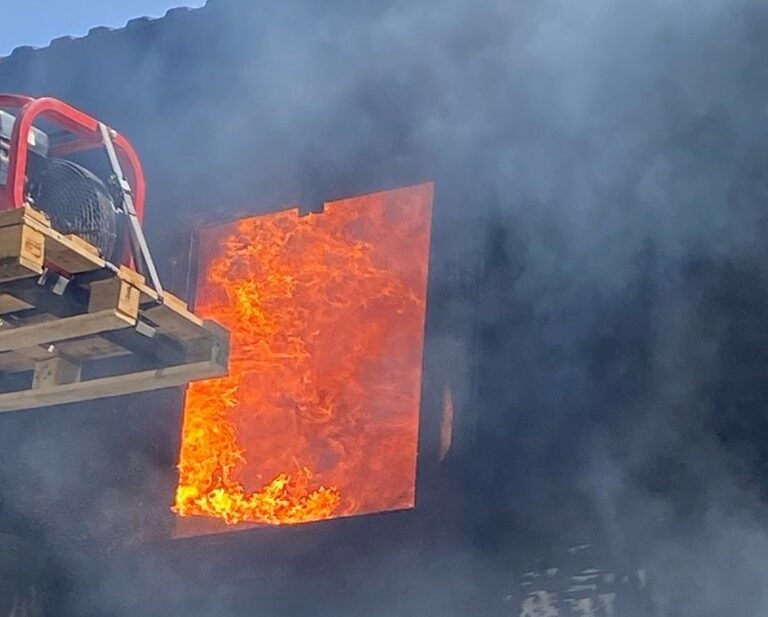
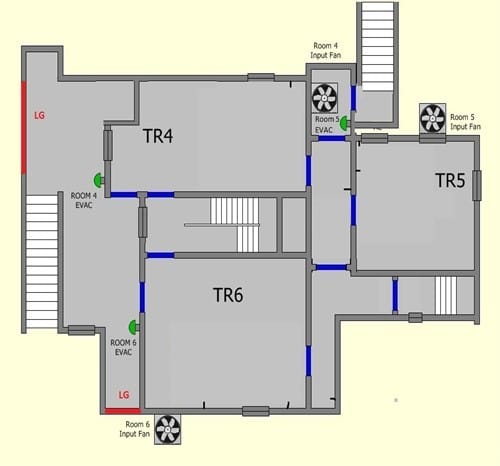
As can be seen from the picture below (figure 1), the wind driven fire was created using a PPV fan through a window into a fire compartment. Figure 2 shows the floor plan for the top floor of the firehouse. The window in TR6 was open to allow an outlet (exhaust) for the fire gases, (as shown by the red arrows). The firefighting crew, supplied by Cold Cut Systems, consisted of one Cobra Operator and one Cobra Senior Instructor with a further Cobra Operator acting as Cobra pump operator.

Figure 1

The fire compartment was room TR5 on the floor plan below (figure 2) with the fan going in through the window to the right of the compartment as you look at it on the plan. (Pale blue arrow)

Figure 1

The crew undertook a scan using a thermal imaging camera (TIC) before entering the building and decided to attack the fire using Cobra from the staircase adjacent to room TR5 (see the yellow arrow which is the Cobra access point on the plan at Figure 2). This gave the crew a high level of protection from the severe heat from the fire which was measured at 581 degrees centigrade before Cobra was used. It also gave protection against contamination from the fire gases and products of combustion. As can be seen from the temperature graph below, the temperature drop was quite dramatic going down to around 280 degrees quite quickly before briefly increasing and then dropping down to roughly around 160 degrees – a much better temperature to enter in order to fully extinguish the fire. It was interesting to note also, the change in temperature in the adjacent room (TR4) which showed a very similar temperature pattern to the fire compartment. The layout of the building offered few opportunities for a safe internal attack on this fire away from the flow path of the super-heated gases. Cobra was used for around eight minutes in total (including piercing) giving total water used at around 480 litres.

There were two key reasons for the success of Cobra in this scenario – firstly the skill and knowledge of the Cobra Senior Instructor and Cobra Operator which was used to good effect in deciding where to make the attack. Secondly, the over-pressurisation of the compartment as the water mist turned to steam – this worked well against the wind to allow the water mist to stay in the compartment for longer and so effectively cool the fire gases rather than being forced out along the flow path.

Please see the temperature readouts from the first floor rooms – Figures 3, 4 & 5 for details. Please note that there is an acknowledged discrepancy in the timings for the temperature readings, however the actual temperatures within the rooms were accurately measured.

The Cobra crew came out of the building and closed down their BA sets, they were able to report that they had not had to work in any high temperatures or in the presence of smoke/fire gases.

If you would like to discuss this article further or if you require further information on Cobra Ultra High Pressure Lance firefighting equipment, please contact Bernie Higgins on bernie.higgins@coldcutsystems.com

This article was originally published in the November edition of IFSJ. To read your FREE digital copy, click here.