Redefining fire forensics with Black Rainbow

In a rapidly evolving world of crime and technology, Nikki Moscrop explains how Black Rainbow‘s Nimbus will revolutionise fire investigations

Enter Black Rainbow, a company that stands out by merging technology and hands-on experience.

We recently spoke with Nikki Moscrop, Head of Law Enforcement & Government and Sales Director about how in a rapidly evolving world of crime and technology, Black Rainbow’s Nimbus promises to keep law enforcement one step ahead in fire investigations.

Founded in 2017, Black Rainbow started with a simple idea: bring together a team with a shared background in law enforcement and create solutions that the market really needs.

As Moscrop put it: “We’re a group that came together with a common goal: To design products that truly cater to our users.”

The team’s agility and dedication to working closely with their clients set them apart.

Revolutionising investigations

Nimbus is more than just a product; it’s Black Rainbow’s answer to modern challenges in investigations.

“Our aim with Nimbus was clear: create the best investigation management platform out there that helps catch wrongdoers more efficiently,” Moscrop explains.

Starting with a focus on case management, especially in the forensic field, the team recognised the need for technology that’s not just smart, but also user-friendly.

Moscrop notes: “Today’s tech has to work seamlessly with other systems and be adaptable. But most importantly, it needs to be easy for users.”

The choice to bring in developers from the gaming industry was a strategic one.

“They have experience in creating software that users can easily interact with,” she explains.

Prioritising user experience

“Putting the user first isn’t just a slogan for us; it’s a core development strategy,” says Moscrop.

While many companies resist change due to concerns about potential disruptions, Black Rainbow views it as an opportunity to enhance user adoption.

Moscrop elaborates: “Rather than enforcing change, our aim is to make sure users willingly adopt Nimbus because they find it intuitive and effective.”

To achieve this, Black Rainbow consistently engages with user groups, including both seasoned Nimbus users and potential clients, to understand the current user experience and future needs.

By visually modelling and rapidly prototyping based on this feedback, they ensure the software is efficient whilst actually resonating with its audience.

This commitment extends to details as fundamental as terminology.

Given that different law enforcement units can have varying jargon, Nimbus allows for easy tweaks to its interface.

“A user shouldn’t have to adjust to a system; the system should adjust to them,” Moscrop asserts.

Accessibility is another area where Black Rainbow shines. Whether it’s custom themes or compatibility across devices, Nimbus offers users the flexibility to work their way.

“From dark mode to corporate colours, we want our users to view the software in a light that’s comfortable for them.

“Moreover, the ability to operate seamlessly between desktops and mobile devices ensures that officers have the tools they need, whenever and wherever,” adds Moscrop.

Simplifying the Submission Process

Beyond user experience, Nimbus also excels with its evidence submission portal.

The goal here is straightforward: make evidence submission as smooth and logical as possible.

By providing users with a step-by-step process, Black Rainbow ensures investigators capture all the necessary information without backtracking.

“We’ve designed it in such a way that investigators don’t have to fumble around. They’re led through the process, with pre-populated fields ensuring accuracy and efficiency,” said Moscrop.

The dynamic nature of the system also means that choices are contextually relevant, ensuring that the user doesn’t get overwhelmed with unnecessary options.

Recognising the immediacy of law enforcement work, Nimbus is optimised for on-the-go submissions.

Moscrop stresses: “Officers shouldn’t have to wait to get back to the office. If they’re on a scene, they should be able to submit evidence right then and there.”

Optimised collaboration

Collaboration is at the heart of what Nimbus does.

The essence of an investigation lies in the collective intelligence and seamless integration of multiple departments working in tandem.

When talking about cross-departmental coordination, Nimbus stands out as a benchmark. Its advanced workflow engine ensures that processes transition smoothly across departments.

From an officer at a scene to an analyst in a lab or an officer at a remote location, the software guarantees a seamless exchange of information. Such coordination helps maintain the integrity and continuity of an investigation.

But with such vast data inflow, how does Nimbus prevent against user error? The simple answer is automation and data reuse.

“By minimising manual data entry, which is notorious for causing errors, and auto-populating fields from previously entered data, Nimbus vastly reduces the possibility of human error,” Moscrop explains.

Not only does this make processes efficient, she says, but it also ensures that data is consistent across reports and summaries.

Another integral feature of Nimbus is its real-time updates.

With live dashboards and instant data representation, senior officers and analysts get to view emerging patterns and actionable intelligence instantly.

“It’s akin to watching a live feed of an investigation,” she points out.

“Decisions can be made on the go, leading to a rapid response. In a world where time is of the essence, this feature is indispensable.”

It is heartening to see Nimbus taking consultation from professionals at the forefront of high-profile investigations, including Matt Bonner the Senior Investigating Officer of Operation Northleigh, established to investigate the Grenfell fire.

By combining the insights from these experts with advanced tech like machine learning, Nimbus is setting a new standard in investigative technology.

“Imagine the power of having machine learning summarise complex data streams into actionable bullet points for an investigator,” she tells.

While many software tools aim for efficiency, Nimbus appears to take a holistic approach, marrying technology with human expertise.

The emphasis is on smooth workflows, minimising errors, providing real-time insights, and ensuring that investigations move with the momentum they deserve.

Scalability and beyond

Moscrop’s foresight in creating Nimbus is evident in its built-in scalability.

In today’s dynamic environment, organisations demand flexibility, particularly in how they deploy their technology infrastructure.

Moscrop explains: “When we first started, all our customers were on-site, but they’ve slowly started moving to the cloud.

“Nimbus is compatible across all platforms which enables it to be scaled up easily.”

The robust foundation of Nimbus is clear in its underlying technologies.

“It’s a web-based application. It can run on all sorts of devices. We’ve built it with an SQL Server, using MS, and there’s a service engine around it for cloud deployments, and various other technologies to help us adapt to that scalability or volume increase of data,” Moscrop details.

But the Nimbus journey is not a static one.

A primary focus for Moscrop and her team is the continuous integration of cutting-edge features: “One of the new product developments is Nimbus Intelligence.”

This feature aims to revolutionise the way intelligence is managed and developed across various sectors, from law enforcement to corporate investigations.

By weaving together existing functionalities, Nimbus aims to ensure that intelligence flows seamlessly from the onset, through investigations, and back into the intelligence cycle again.

Black Rainbow at ESS

For those keen to experience Nimbus in action, Moscrop invites readers to come and visit Black Rainbow at the upcoming Emergency Services Show on 19-20 September at the NEC in Birmingham.

“We’re going to be co-located in the Emergency Tech show part, opposite the tech bar on stand D32,” she notes.

“It’s an opportunity to come and actually see Nimbus, talk to the team behind the scenes… and maybe even get the opportunity to play around with it yourself.”

The Nimbus journey, as described by Moscrop, is a testament to the merging of advanced technology with deep insights from the field.

Whether it’s about scaling to new heights, integrating intelligent solutions, or engaging with the community, Nimbus is shaping the future of investigative technology.
This exclusive article was originally published in the September 2023 issue of International Fire & Safety Journal. To read your FREE digital copy, click here.

Lithium Ion Battery Dangers: Understanding the Risks

Lithium-ion batteries (LIBs) are widely used in portable electronics and electric vehicles (EVs), and they are now a part of everyday life.

Lithium-ion batteries offer a number of advantages, but if damaged, mishandled or poorly manufactured, they can suffer stability issues and be subject to what is called a ‘thermal runaway‘.

Thermal runaway is a chain reaction within a battery cell that can be very difficult if not impossible to stop once it has started.

It occurs when the temperature inside a battery reaches a point that causes a chemical reaction to occur inside the battery.

This chemical reaction produces even more heat, which drives the temperature higher, causing further chemical reactions that create more heat.

In thermal runaway, the battery cell temperature rises incredibly fast, often within seconds and the energy stored in that battery is released very suddenly and violently.

This chain reaction creates extremely high temperatures and if the right conditions exist, significant explosions.

The associated hazards then are fire, explosion, electric arc flash, highly toxic gases/fumes, chemicals, potentially high voltage, potentially high currents.

In addition to the super high temperatures generated by a Thermal Runaway incident, the “smoke” emanating from a lithium-ion battery fire is actually a vapour cloud containing a cocktail of highly toxic acids.

This includes hydrogen cyanide, hydrogen fluoride, and hydrogen chloride as well as gases such as methane and ethane and other toxic organic compounds such as benzene, styrene and acrolein.

This cloud is lethal to an unprotected person.

The thermal runaway phenomenon is well recognised, and it can be mitigated against providing awareness and prevention actions are taken.

The aim of training is to raise awareness of the hazards of lithium-ion battery systems, and to assist and support employees to work safely around LIB battery systems and to educate people of the risks within their own homes.

What’s Being Done to Combat Lithium Ion Battery Fires?

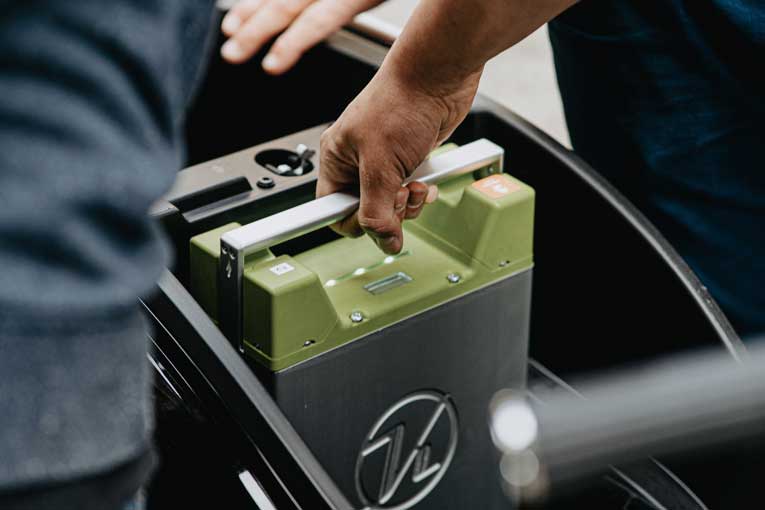
Electric Scooter Lithium Ion Battery
Electric Scooter Lithium Ion Battery. Image credit: Unsplash

Considerable research is being undertaken to determine why thermal runaway occurs and how it can be prevented.

LIB manufacturers are also looking to build detection and extinguishing capacity into LIBs, but all this will take time and considerable cost.

This is why as Fire Safety specialist we feel training is essential in the interim period.

We have also, with our associates, produced thermal material sacks and thermal blankets with built in detection until LIBs are safer and easier to extinguish.

Training on Lithium Ion Battery Dangers

JGS Fire Safety has been working with the world’s leading scientists, fire experts and energy engineers.

Their aim is to develop a series of online Lithium-ion Battery Safety courses for personnel who handle, store, transport or work in the vicinity of lithium-ion batteries and those who may have to extinguish the fires or deal with an incident.

In addition, with more people working remotely, the potential risk for incidents within the home is increasing and these types of incidents are routinely being reported in the media around the world.

The courses are the only ones approved by the Institute of Fire Safety Managers (IFSM) and have CPD accreditation.

They are also accredited with the Nautical Institute for the maritime environment.

At JGS Fire Safety, they consider it essential that clients have training ratified by external independent accreditors.

Why Were Online Courses Developed?

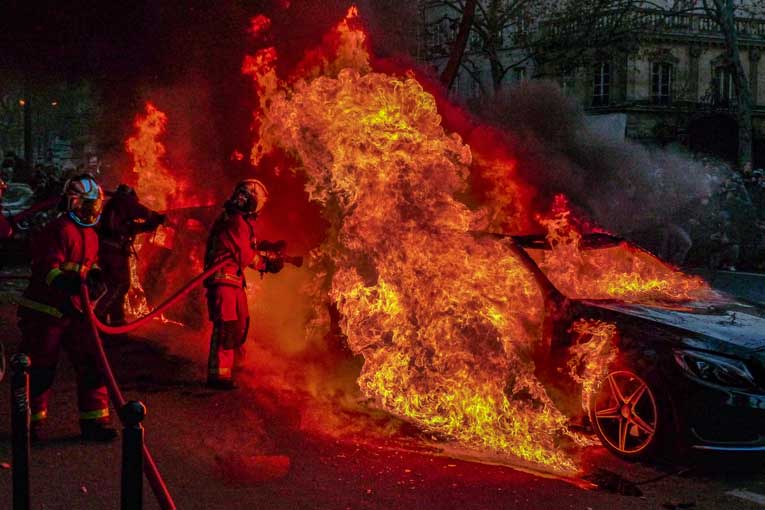
Firefighters Extinguish Burning EV
Firefighters Extinguish Burning EV. Image credit: Pexels

We work with companies who provide risk assessment and risk mitigation in high-threat environments and LIBs were being recorded as having started fires, or gassed off, in these environments.

Very few people were aware of the thermal runaway phenomenon at the time, so they set about finding out about the associated risks because many clients were using LIBs.

In doing so, they realised that an LIB incident is particularly hard to deal with and that many Fire Services had not, at the time, set up any Standard Operating Procedures to deal with them.

Currently there are no ISO’s for dealing with lithium ion battery dangers and most British Standard/EU Standards, or sector specific guidance, deals only with the construction of batteries.

They also realised no awareness courses existed.

Thus, they identified the problem and then implemented practical operational solutions and training to mitigate the risks to our clients.

Who Are the Courses For?

The courses are for people who handle, store, transport or work with lithium ion battery powered devices such as laptops, mobile phones, tablets, tools, appliances or energy storage equipment and electric vehicles.

This could be in their workplace, in their homes, travelling or during leisure time.

Currently people that are doing courses come from the maritime Industry, waste services, e-bike providers, fire safety managers, H&S Inspectors, mining, transport providers, cadet corps and school children.

They are in discussions with a local authority Fire & Rescue Service to provide courses to their Protection Officers initially.

These officers liaise directly with businesses within their areas and following the initial courses it is proposed to offer the courses to all operational and non-operational staff.

They offer greatly reduced course rates for the Emergency Services as a way of giving back to the people who gave me my opportunity in fire safety and who continue to do such great work for us all.

What Do the Courses Cover?

Module 1

Awareness of LIBs – ensures that students will be able to understand the hazards and dangers of lithium ion batteries, identify warning signs for lithium-ion battery incidents – especially potential vapour cloud explosion and thermal runaway fires and recall initial action if you are the first person on scene at a potential gas venting or fire.

Module 2

Dealing with LIBs Incidents – ensures the students understand the hazards and risks lithium ion battery fires pose; understand how you can potentially prevent and/or spot a LIB overheating; the initial actions you must take if you are the first trained person on scene; various techniques you can use to fight a lithium-ion battery fire and what to expect if the fire is out, but the battery is in thermal runaway; understand the structure of operational response (bronze) and tactical response (silver); and ways in which you can prevent a lithium-ion battery fire from occurring, looking at best practice.

Module 3

Strategic Management of LIBs – aims to build on the learning from our level 1 and 2 courses which considered the hazards and how to deal with lithium battery incidents.

The assumption is that anyone undertaking this course has completed at least one of these previous courses and has a working knowledge of the risks.

The learning aims of this course focus on how a student would assess and deal with a significant lithium ion battery fire in their business or organisation.

It stresses the importance of developing proper procedures for dealing with the dangers and challenges their staff could potentially face.

The course focuses on three areas of priority:

  • early Information and detection (EI)
  • early Intervention (EI)
  • Operational Handover to emergency services (OH).

By the end of Module 3 the student will be able to: understand the risks – and understand the importance of EI, EI, OH, and what systems can be adopted to implement a successful fire strategy, deploy a solution, understand ways to contain Lithium-Ion battery fires, especially the importance of textile solutions and textile innovation, and understand the post incident actions to take following a thermal runaway incident.

Why Should People Undertake the Training?

At this time LIB fires are extremely difficult to extinguish safely and the gasses that are given off are extremely poisonous.

The fire is intense and at times explosive.

Fire spread is rapid and containment is challenging.

For these reasons JGS Fire Safety provide the courses that will help reduce the risk to the workplace, the home, and anyone who may have to deal with an incident.

Why wouldn’t you want to undertake this training?

We all have a duty of care, both to ourselves and to others.

For more information on JGS’s training courses contact info@jgsfiresafety.co.uk or visit the JGC Fire Safety website: at www.jgsfiresafety.co.uk.

This article was originally published in the March edition of IFSJ. To read your FREE digital copy, click here.

About the Author

Guy Solly is the Director at JGS Fire Safety Limited.

he joined the Fire Service in January 1986 aged 19 and little did he know the impact it would have on his life.

He served his whole fire service career within Essex, starting as a firefighter in Tilbury, before moving to Orsett when the Tilbury Station was closed.

Afterwards he got promoted and moved to serve in Grays, where finally after a total of 25 years riding fire appliances operationally he got promoted into the Technical Fire Safety Department as an Inspecting Officer.

This role gave him a greater insight into fire safety as a whole and provided the training and knowledge to assist others during his time within that department and then also following his retirement in October 2016.

He established JGS Fire Safety Ltd when he retired, with the aim to provide guidance, assistance, and support to clients and to raise the awareness of the fire safety issues which impact on everyone’s workplace and home environments.

They work with individuals and companies who are working on new ways to address the potential issues with lithium-ion batteries.

They are developing new ways of mitigating the effects of an incident and ways of dealing with a fire situation quickly, effectively, and safely.

Exclusive: Keeping fire suppression in proportion

IFSJ sat down with Frank Preiss, Managing Director at FireDos GmbH, to discuss the development of proportioning systems and extinguishing monitors for fire suppression

Over twenty years ago, FireDos developed and established the proportioning concept consisting of a water motor and piston pump and with it the environmentally friendly and cost-effective testing of the proportioning rate, without the production of foam or premix. Since then, it has delivered more than 14,000 units to municipalities and industrial customers around the world.

In 1979 the technology was initially developed and used in industrial dosing systems. In 1994, the first proportioners were used by fire brigades. In the following year the proportioners were optimised for use for stationary fire protection. In 2013 FireDos made the decision to expand the product portfolio and a range for fire extinguishing monitors was developed. The focus was put on big flow volumes, extended reach, and remote control, but product for mechanical operation with small water flows are available.

“Our focus is on customer service, including technical training and quick response to any industry inquiries,” says Frank Preiss, Managing Director at FireDos. “We have the products certified by globally recognised institution such as FM Approvals and VdS and are certified according to ISO 9001 (Quality Management System) and 140001 (Environmental Management System). All of the systems that leave our plant have been 100% tested over the complete operating range at our state-of-the-art test bench.”

Proportioning systems

Foam, says Preiss, has proven to be the best medium to extinguish fluid fires. It consists of water, foam concentrate and air. The foam concentrate is mixed with the extinguishing water at a precisely defined rate. Air is then added to this premix to generate the foam.

NFPA 11, a standard written be the internationally recognised US National Fire Protection Association, describes various types of foam concentrate proportioning equipment. There are three technologies that are most commonly used: the bladder tank in combination with mainly venturi proportioners, the driven proportioning pumps with flow meter and the water motor with proportioning pump.

Preiss says that whilst there are various differences and advantages and disadvantages for all technologies, tight limits for the proportioning of foam concentrate apply to all of them. He explains: “The proportioning rate must not be less than the permitted values – i.e. 3% for a 3% foam concentrate or 6% for a 6% foam concentrate.

“The proportioning rate must not exceed 30% or an absolute maximum of 1% above the permitted value i.e. 3,9% for a 3% foam concentrate or 7,0% for a 6% foam concentrate. And to guarantee correct proportioning, the proportioner, including the proportioning rate must be tested at least once per year and its correct functioning must be checked.”

FireDos has decided to focus on water motors with proportioning pumps, Preiss tells. “We have engineered a proportioning system specifically for firefighting foams. All other technologies are using pumps that have been designed for various liquids, but we see that with our in-house developed and optimised water motor coupled with a piston pump specifically designed for foam concentrates we get the best results over a wide range of foam concentrate viscosities and operating ranges.

“The operating ranges being system pressures and extinguishing water flow rates. In addition, the system is purely mechanical, and the proportioning rate can be tested without creating foam or premix. This is cost-effective and eco-friendly.”

When selecting a proportioning system, Preiss advises first to decide on what foam concentrate to use. Once this has been decided the suitable fire protection concept, including alternative scenarios, must be developed. Only then, he says, should the decision be made on which proportioning system is to be used.

Extinguishing monitors

Extinguishing systems typically consist of a fire pump, a proportioning system and tank for the foam concentrate, discharge devices such as foam nozzles, sprinklers, foam pipes or fire monitors and the corresponding piping.

Firefighting monitors are discharge devices mounted stationary on pillars or towers or mobile on vehicles or trailers and available in many sizes. They are suitable to discharge water to extinguish regular class A (solid combustible materials) fires or foam, e.g., to extinguish flammable liquids such as a surface fire in an oil storage tank. The extinguishing agent flow rate can be over 50 000 l/min and the reach can be up to 180m if the pressure of the fire pumps is sufficient.

The main advantage of using firefighting monitors, says Preiss, is their ability to allow you to place the water or foam on a specific location, opposed to fixed extinguishing systems such as sprinklers, that can only act in their immediate vicinity. In addition, they have far throwing ranges that allow the firefighting personnel to stay outside of danger zones.

The most important consideration, he says, is the question on what must be protected and what functionality is necessary to do this: “Here the minimum and maximum water flow and the maximum required throwing range are important factors.

“For this the available maximum pressure of the fire pump, the pressure drop of the hose system and the pressure drop within the monitor is essential. Here FireDos is especially proud to have engineered their fire monitors using special hydrodynamic modelling that resulted in the innovative, flow-optimised ‘Oval Flat Design’, that ensures minimum pressure loss which in return guarantees maximum throwing ranges.”

Since the introduction of the FireDos proportioning technology over 14,000 units have been installed in over 45 countries worldwide. The installations range from small proportioning systems with a maximum water flow of 500 l/min protecting facilities such as a distillery to an installation with 5 pieces of FireDos FD20000 with a combined flow of up to 100,000 l/min protecting the tank farm of an international airport.

Recently, the company installed its biggest proportioner, an FD25000, in a Methanol plant in the US. Elsewhere for a project in the Middle East at an oil storage facility it supplied the proportioners and firefighting monitors for a mobile extinguishing system.

In recent years, Preiss says he has seen an increasing number of customers combining the FireDos proportioners and firefighting monitors as well as an increase in the quantity of remote-controlled monitors coupled with heat detection systems.

“The early fire detection system allows the full-surface monitoring of large areas using panoramic thermal imaging,” he says. “Combined with intelligent analysing software, this enables the precise localisation of a fire source. The remote-controlled FireDos monitors can then be automatically activated and used for pinpointed extinguishing of a hot spot with water or foam. This reduces the damage a fire can do and helps avoid lengthy and costly system downtime and collateral damage with little effort.”

What’s next for fire protection?

Preiss says that FireDos is seeing is a continued demand for quality extinguishing components and systems: “The industry has seen a lot of fires over the last years that have sensitised the awareness for the need of functioning and reliable fire extinguishing technology. We are also seeing a drive in the recycling and waste management facilities towards modern technology.

“In addition, the transition in a lot of countries from older, fluorine containing foam concentrates to new fluorine free and more environmentally friendly products has opened the door for rethinking the technology that has been used to date.

“Firefighting is essential for all industrial applications, and we anticipate seeing a continued demand for our technology. It will though remain to be seen if we will have a global recession in 2023 and what effect this will have on all safety related installations.”

For FireDos, Preiss says they will continue to be a world class leader in the development and production of innovative and reliable proportioning systems, extinguishing monitors and trailers for firefighting. The company will concentrate on two product lines: “For one the enhancement of our remote-controlled monitor technology in combination with early fire detection and the improvement of automatic fire extinguishing and for the other the expansion of our smart proportioning technology.

“This will allow remote monitoring of our mechanical proportioners to optimise the maintenance process through predictive analysis, allow remote troubleshooting and ultimately increase the equipment reliability and reduce costs.”