The Fire Brigades Union (FBU) has called on the Trades Union Congress (TUC) to lead a campaign of “mass non-cooperation and non-compliance” with the Minimum Service Levels bill, opposing the anti-strike laws being pushed through parliament by the Conservative party.
The Union said that an emergency congress of the TUC must be called in order to launch a campaign of defiance and civil disobedience against the bill if it becomes law.
The union’s governing executive council has already passed a resolution calling on the TUC to adopt the strategy, and to build a mass movement to resist the legislation, and said that national demonstrations and sustained mass mobilisations will be needed to defeat the bill.
Non-compliance with the bill would be one of the most significant attempts by unions to defy employment law since the 1984-85 miners’ strike.
‘A draconian attack on rights’
FBU general secretary Matt Wrack said the strategy of non-compliance was needed, as there was “no obvious route to challenge this attack through the courts”.
Wrack called the Minimum Services Level bill ‘One of the most draconian attacks on the rights of working people in decades’
Wrack said: “It’s a pernicious piece of legislation that’s in keeping with authoritarian regimes around the world. The government is deliberately attempting to strengthen the position of employers and severely weaken the position of workers. They are doing this for one purpose – to drive down wages.
“Ministers are bulldozing this anti-worker legislation through parliament, and riding roughshod over the democratic process by seeking to avoid scrutiny. The Fire Brigades Union will fiercely resist this onslaught on our democratic rights, but it’s an attack on all workers.”
Wrack said that a mass movement of non-compliance will be needed to challenge and defeat the ‘attack on working people’ by making the legislation unworkable.
He added: “The TUC can lead this movement of resistance, first by calling an emergency congress, followed by a national demonstration, and a sustained campaign of non-cooperation.”
The Fire Brigades Union (FBU) has won a reversal of cuts of £2m to the fire service in Nottingham. The cuts which were announced in autumn 2022 would have seen West Bridgford fire station closed at night whilst London Road and Stockhill stations would have lost firefighters and fire appliances.
The victory is the result of a campaign of lobbying by the FBU. On 23 September 2022, members of the union attended a meeting of the Combined Fire Authority, which is chaired by Cllr Michael Payne where they called for the proposals to be shelved and called for the authority and the chief fire officer to join with members of the union in calling for greater investment. The fire authority moved the proposals through with only a few notable objectors voting against.
following the meeting members of the FBU, alongside Cllr Steve Battlemuch, began to mobilise more widely, with firefighters and supporters having a presence on the streets of Nottinghamshire campaigning against the proposed cuts.
The FBU also made the case for further investment in Westminster, demanding that the government increase funding to protect frontline services. The lobbying concluded with a meeting attended by MPs from across the county, alongside the FBU leadership, union members, the chief fire officer and the chair of the authority.
It has now been confirmed that the cuts will not take place.
‘A fantastic result’
Ben Selby, Assistant General Secretary elect of the Fire Brigades Union said: “This is a fantastic result for the people of Nottinghamshire. These cuts would have inevitably increased fire service response times, putting the lives of those that live and work in the affected areas at an increased risk.
“Since 2010, budgets have been attacked by central governments, with fire authorities doing little to protect their communities from cuts that can cost lives.
“This result is testament to the tireless work of members and officials of the FBU in Nottinghamshire. They knew what losing these services would mean for their communities, and fought to save them with everything they had.
“When many policy-makers and onlookers doubted that our members could secure additional funding, they ignored them and cracked on with their campaign. They should be immensely proud of the result.”
Fire Brigades Union general secretary Matt Wrack has responded to the government announcement that is set to introduce minimum service requirements for the fire and rescue service and make it possible for unions to be sued over these.
Minimum service requirements cam restrict trade union members’ right to strike and restrict the likelihood of effective strikes.
Wrack said: “The Tories are clearly hellbent on criminalising and victimising trade unions with this latest threatened onslaught on the right to strike.
“Britain already has among the most restrictive anti-trade union laws in the western world.
“It’s already a democratic outrage that workers have to pass numerous tests for of strike that don’t apply in local government or to MPs elected to Parliament.
“To allow exploitative and vindictive bosses to pursue trade unionists in the courts would be a highly authoritarian move, and more in keeping with the actions of a dictatorial regime.
“The Tories are badly misjudging the public mood with these attacks on the pay and conditions of key workers, who kept Britain going during the pandemic.
“Firefighters were among Britain’s Covid heroes.
“However, like millions of others, they are increasingly struggling ot pay the bills as a result of the cost of living crisis caused by the Tories.
“Wages in the UK have stagnated for more than a decade and government policy has helped to deliver this.
“The government wants to continue to drive down wages and now wants to attack the rights of workers who stand up for themselves.
“The FBU and the entire trade union movement will fight this pernicious attack on workers by all means available to us.”
The Fire Brigades Union has formally issued notice of ballot after pay discussions ‘failed to reach any resolution’. Firefighters and control staff have been offered a 5% pay increase, which they rejected in a consultative ballot as annual CPI inflation currently stands at 11.1%, meaning the offer reflects a real-terms pay cut.
The strike ballot is set to be open from Monday 5 December to Monday 30 January. The ballot will take place only through the post.
FBU said that any member who believe their postal address has changed or think it might be wrong, to contact membership services.
If a national strike were to take place, it would be the first national strike since pension action between 2013 and 2015 (which did not include control), and the first on pay since 2002-2003.
Matt Wrack, Fire Brigades Union general secretary, said: “This is an historic ballot for firefighters and control staff. We are rarely driven to these lengths. Nobody wants to be in this position. But after years of derisory pay increases and a pay offer that is well below inflation firefighters’ and control staff’s living standards are in peril. We have firefighters using foodbanks – we know that because FBU officials have had to sign off on members going to them. “
Firefighters and control staff worked throughout the pandemic and firefighters took on extra duties including moving the deceased. They have now been given a below-inflation pay offer. It is utterly disgraceful to call people “key workers” and then treat them like this.
“Strike action is always a last resort, but we are left with no other option. We asked for a pay increase that takes into account the cost of living crisis and did not receive it. The ball is still in the employers’ and government’s court. We urge them to provide a decent pay offer and help bring this dispute to an end.”
Whilst UK governments have no direct role in pay negotiations they provide a substantial amount of the funding for fire and rescue services.
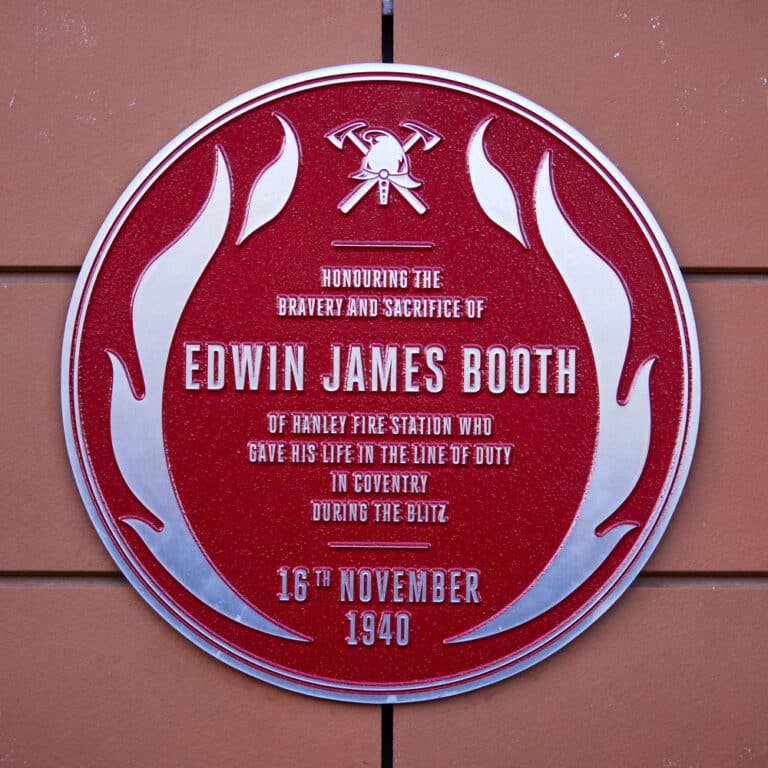
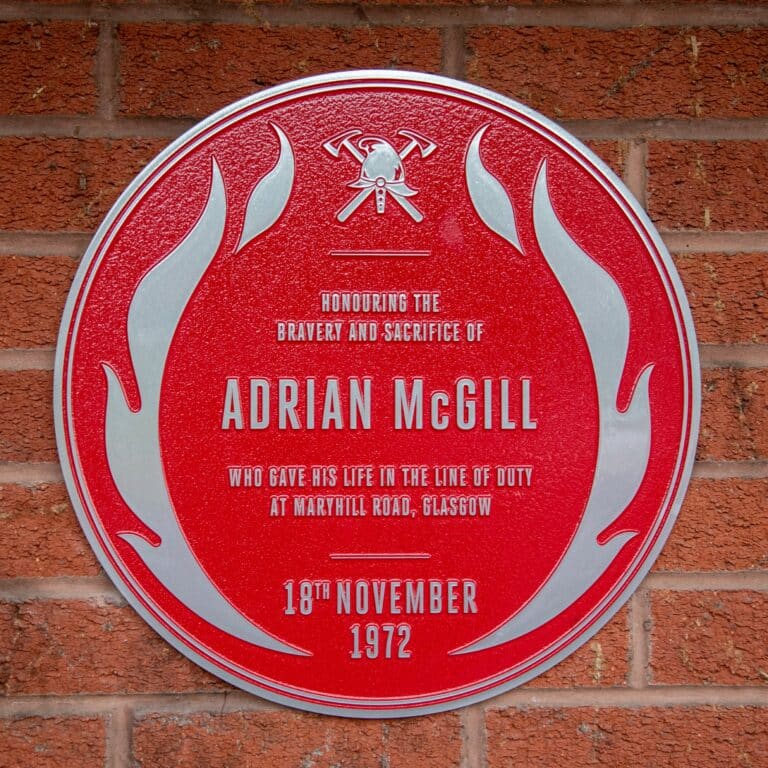
The Fire Brigades Union has unveiled three new plaques for fallen firefighters as part of the Red Plaque Scheme, funded by the weekly Firefighter 100 Lottery.
Edwin James Booth
Edwin James Booth was a Stoke firefighter who was deployed to fight fires in Coventry on 14 November 1940. He was injured, along with several members of his crew, and never regained consciousness. He passed away two days later, on 16 November 1940.
Over half of Coventry’s homes (43,000) were either damaged or destroyed in the massive air raid of 14 November 1940. It has been called the ‘single most concentrated attack on a British city in the Second World War’ and lasted for 11 hours. The plaque is being unveiled at Hanley Community Fire Station in Stoke-on-Trent. Edwin was a firefighter in Hanley.
Jack Lee, FBU Staffordshire brigade chair (acting), said: “The Blitz was a horrific time in our country’s history, and 14 November was utterly devastating for Coventry. These would have been extremely challenging circumstances for firefighters to work in, and the bravery of Edwin and his colleagues will have saved many lives. His courage was part of a huge, vital effort in a time of tumultuous conflict. It is vital that we remember individual sacrifices like Edwin’s when we remember the wider horror of wartime, just as it is vital that we remember the wider context of Edwin’s sacrifice when we focus on it.”
The red plaque unveiling at Hanley fire station, Hanley, Stoke-on-Trent for Edwin james Booth he gave his life in service in the Blitz in 1940, attended by his decedents Jeff and Su Cotton
Adrian McGill
Adrian McGill, aged 34, was attempting to rescue a trapped woman in a fire at Maryhill Road in Glasgow, and it is thought that in an attempt to save her life he gave her his oxygen mask. His body was later found with signs of carbon monoxide poisoning. Tragically, the woman also died. The incident took place on 18 November 1972.
The plaque was unveiled at Maryhill Fire Station (775 Maryhill Rd, Glasgow G20 7TL), on Friday 18 November at 13:30-14:15. At the time of his death Mr McGill was married with three children, with his youngest child being just eight months old. He was the eighth Glasgow firefighter to die in a fire in three months, with seven firefighters dying in the Kilbirnie Street textile warehouse blaze in August, and the 27th to have lost their life in the previous 12 years.
“Adrian McGill made a split-second decision out of care for someone else, a stranger who he had never met before, and a decision which he would have known came with huge risk. It is self-sacrifice on an almost indescribable scale. There’s a quote that states that there is no more stirring symbol of our humanity towards others than a fire engine. Adrian McGill and what he did personify that.
“This plaque will ensure that the Glasgow community knows about the sacrifice that Adrian McGill made, and it will help Glasgow’s firefighters remember one of their own.”
Image Credit: Fire Brigades Union, Craig Maclean
Leonard McCartney and Lexi Wylie
Leonard McCartney and Lexie Wylie were killed when the building they were fighting a fire in, the Meville Hotel on Foyle Street, Derry/Londonderry, collapsed onto them.
A message sent to the fire service control room shortly after said “no action for rescue is possible as all upper floors collapsed without warning” and that “all five floors and attics severely damaged by fire… Leading Fireman McCartney and Leading Fireman Wylie were last seen in the ground floor corridor at the front of the building”. It took 17 hours for the bodies to be located and removed from the rubble of Melville Hotel. The plaque was unveiled at the location where the incident took place on 21 November 1971.
Leading Fireman Leonard McCartney was 42 years of age and lived in Violet Street. He had been a firefighter based in Northland Road Fire Station for 20 years and was survived by his wife Mary and three children Audrey, Robert and Alan.
Leading Fireman Lexie Wylie was 35 years old and had been in the fire service for 14 years, also serving at Northland Road Fire Station. He lived with his mother and sister at their family home in Galliagh.
Jim Quinn, FBU executive council member for Northern Ireland, said: “Leonard McCartney and Lexie Wylie were firefighters who did everything they could do to serve their communities for years. They fought fires and carried out rescues during a very dangerous period in our country. They carried out their duties with real bravery and lost their lives in a huge and tragic incident. It is absolutely vital that we remember them and their contributions across their time in the fire and rescue service. This plaque will go a long way to ensuring that that happens.”
Firefighters and fire control staff are being balloted over to whether accept a 5% pay offer from employers.
The Fire Brigades Union’s executive council has recommended that members vote to reject the offer, which it said represents a significant real-terms pay cut and follows a decade of real-terms pay cuts in the fire and rescue service.
This is a consultative ballot on the pay offer itself, with rejection not automatically leading to strike action.
Online and postal ballots are being sent out today Monday 31st October, with the ballot closing on Monday 14 November.
Matt Wrack, Fire Brigades Union general secretary, said: “We are a democratic union led by our members. It is firefighters and control staff who will decide any action that the union takes on pay.
“Firefighters have been treated appallingly by their employers, and by the government over the last decade. Pay is down by nearly £4,000 in real terms and that is why the union’s executive council is recommending that members reject this latest offer.
“Our members worked throughout the pandemic to help protect their communities. They delivered food, moved the bodies of the dead and delivered other vital extra duties. To try and thank them with a massive real-terms pay cut is absolutely disgusting. Our members have had enough.”
The Executive Council of the Fire Brigades Union (FBU) has voted unanimously to reject the 2% pay offer. The employers will now be informed of this.
The Council met yesterday to consider the results of discussions with FBU members on the employers’ proposed increase in pay.
It agreed that plans should be urgently prepared to develop our campaign for decent pay, including the need to prepare for strike action. All FBU members are asked to fully participate in such discussions; all voices need to be heard.
The FBU’s statement said: “Firefighters have never taken industrial action lightly but nor can we allow this pay insult to pass without challenge. The employers’ proposal would mean a further cut to our real wages and further hardship for our members and their families. That is unacceptable in the face of the cost of living crisis.”
When the pay increase was proposed last month, Matt Wrack, FBU general secretary said: “This is utterly inadequate and would deliver a further cut in real wages to firefighters in all roles in the midst of the cost of living crisis. This latest insulting proposal follows 12 years of government-imposed reductions in real wages.”
In its consultation response submission the union criticised a range of elements to what it termed “a coordinated attack on firefighters’ pay and conditions and the fire and rescue service, in the middle of a cost of living crisis”.
It said these elements include an attack on firefighters’ right to have a say on their pay and conditions, including many conditions relating to safety and proposals that could result in industrial action – a last resort to protect the fire service and firefighters’ pay and conditions – being weakened or undermined.
The FBU claimed that the white paper’s attacks on the fire and rescue service more broadly comes in the form of a lack of any direct plans or resources to improve the service the public receives, together with plans to boost chief fire officer powers, including over areas that have a direct effect on the service the public receives such as reducing the number of firefighters, how quickly fires are responded to, reducing night cover and shift systems.
Next week firefighters are set to visit parliament in an attempt to persuade MPs to stop the government removing their voice, and to protect their pay and conditions, with many more set to follow during the course of this campaign.
Matt Wrack, general secretary of the Fire Brigades Union, said: “It is absolutely scandalous that the government has launched this coordinated attack on the pay and conditions of hard-working firefighters, and on the fire and rescue service itself. Apparently it is not enough that firefighters, like everyone else, are going through a cost of living crisis ultimately of the government’s making. Instead, the government thinks that now is the right moment to try and strip them of hard-won rights that protect their pay and conditions. We have firefighters struggling to pay bills and pay the mortgage. These changes would only make things worse for them.”
“Firefighters go to work to save lives. They risk their health, safety and sometimes their own lives in doing so. The very least they deserve is to be free from coordinated attacks on their livelihoods and safety, and to be paid properly and treated fairly.
“When it comes to the fire and rescue service itself we are clear. Chief fire officers cannot be trusted to get it right on their own, especially on vital matters such as how quickly we respond to fires and the number of firefighters in each service. Debacles such as chief fire officers standing by whilst deep cuts were made to their services, and wasting millions of pounds of public money on equipment that didn’t work or wasn’t suitable, show that to be the case. More power for them over matters like the number of firefighters, attendance times or night cover will make the public’s fire and rescue service worse – the evidence on that is absolutely clear.”
The Fire Brigades Union has written to the UK government, asking decision makers to rethink the rejection of a key Grenfell Tower Inquiry recommendation concerning the evacuation of disabled residents of high-rise buildings.
The inquiry recommended that “that the owner and manager of every high-rise residential building be required by law to prepare personal emergency evacuation plans (PEEPs)” for all disabled residents.
In a letter to Lord Greenhalgh dated 6 June 2022, Minister of State for Building Safety, Fire and Communities, Matt Wrack, Fire Brigades Union general secretary wrote that the FBU was ‘disappointed’ with the Westminster government’s decision to downgrade work towards ensuring residents with disabilities are provided with Personal Emergency Evacuation Plans (PEEPs)
The letter read: “The [government] statement claims that implementation would involve significant issues with practicality, proportionality and safety. The FBU argues that resident safety is paramount, so there is a greater safety issue in declining to implement PEEPs. As for proportionality, the Inquiry has found the introduction of PEEPs to be a proportionate strategy, and the FBU agrees.
“Some reasons given for the refusal seem poorly evidenced, for example stating that if a PEEP advised the purchase of an evacuation chair, there would be an “impact on the good relations between disabled residents and non-disabled residents if disproportionate costs were passed on to the latter. Building owners should carry the costs.”
“The government’s decision is a negative, backward step, and the FBU stands with disability campaigners, the Grenfell campaign groups and the LGA in asking you to reconsider.”
The Fire Brigade Union (FBU) has written to Cumbria Police and Crime Commissioner Peter McCall to ask him to drop plans to become Police, Fire and Crime Commissioner (PFCC) after the public rejected the proposal in a consultation as ‘bundling fire and police helps no one”.
Ed Burrows, Fire Brigades Union North West regional secretary, said: “The consultation response was clear: Cumbria fire and rescue service should not be run by a PFCC. We fully expect McCall that will follow through on this consultation by taking the next step and withdrawing the plan.
“Bundling fire in with the police helps no one. It could lead to cuts that affect the fire and rescue service disproportionality, and lead to three fire station closures.”
Of the 363 public and stakeholder responses to the consultation less than half (46%) of respondents said they would like to to see a PFCC in Cumbria, whilst 54% preferred the option of a Combined Fire and Rescue Authority.
The Fire Brigades Union has criticised McCall’s plan to become PFCC on various grounds, including the fact it could lead to three fire station closures, putting 18 jobs at risk.
The station closures have been predcited as stations in Frizington, Arnside and Stavely have previously been threatened with closure, and the FBU said there are financial concerns over a future PFCC having the latitude to implement cuts that impact fire disproportionately relative to the police, and requiring funds to bulk up his office to administer the fire and rescue service, which could come out of the fire and rescue budget.
The letter also said “We also note that the financial issues surrounding any takeover of governance have still not been provided, we request that this information is shared with us when produced”.
To date, no financial assessment for viability of a change to a PFCC has been produced.