Latest Red Plaques to be unveiled for Dundee firefighters

New commemorative plaques to mark the sacrifice of two Dundee firefighters who died in the line of duty are to be unveiled in Dundee as part of the Fire Brigade Union’s Red Plaque Scheme.

The ceremony will take place at 1pm on 13th April at Blackness Road Fire Station, just over 60 years after their deaths.

John Jamieson Buist died at a fire at Grants Jute Warehouse, Dundee on 13th April 1962, after being trapped by burning bales of jute. His colleagues attempted to rescue him from the burning debris for over two hours. He lived with his wife, a former firewoman, and young son at the Northern Fire Station. He was 53 and had 30 years’ service. 

The second firefighter to be commemorated is William Carnegie, who was fatally injured less than three months later while attending a fire on Mains Road, Dundee, on 14th June 1962. He sustained severe head injuries after falling 30 ft from the roof of a two-storey tenement at 58 Mains Road. He was taken to hospital and died of his injuries on July 8th, at 44 years of age and was survived by his wife and their 17 year old son. 

The ceremony will be attended by senior FBU officials, Scottish Fire and Rescue Service senior officers, an FBU piper and Lord Provost, Bill Campbell, on behalf of Dundee City Council.

These Red Plaques are part of a scheme set up by the Fire Brigades Union during its centenary to commemorate firefighters who died in the line of duty. Read more about the scheme in this exclusive interview with Tam McFarlane, Fire Brigades Union National Officer.

IFSJ Exclusive: Behind the Red Plaque Scheme

Tam McFarlane, Fire Brigades Union National Officer talks about the project commemorating the lives of those lost in the line of duty

What is The Red Plaque Scheme?

The Red Plaque Scheme is a project designed to ensure that firefighters who have lost their lives in the line of duty are remembered through a permanent memorial. This is designed as a striking red plaque which bears the firefighters name. It is normally placed either at the scene of the fire, where the firefighter lost their life, or at the fire station from where they were based.

It was established as part of the Fire Brigades Union’s centenary, which took place in 2018. It is part of a Firefighters 100 Lottery project which was put in place to come up with memorials for fallen firefighters.

In 2017, in the lead up to the centenary, it struck a group of us, that there should be a similar scheme as the blue plaques they have in London, placed on houses where people of historical significance lived. But for real heroes – firefighters who have lost their lives in the line of duty.

We then engaged with different designers to come up with the design for the red plaque before putting it forward to the executive where it was agreed upon. It has been entirely funded by the Firefighters 100 Lottery, which was launched at the same time as the centenary. Since it began, the Scheme has really caught the imagination of firefighters and communities right across the country.

We have set up a website for the project. People are encouraged to make applications to have a red plaque put in place. To date we’ve got over 70 plaques that have been unveiled, that carry the names of over 180 firefighters – some plaques have more than one firefighter that lost their life in the line of duty. We’ve got a whole list of pending plaques that are under consideration at this time.

How has the FBU chosen which firefighters to recognise?

It is specific to firefighters who have lost their lives in the line of duty. We’ve got a team in place in the Fire Brigades Union (FBU) and they consider all applications on their own merits. We assess the name against the firefighters’ memorial trust records, and if the name is registered then that is taken as appropriate. If it’s not there, we undertake an investigation to see if it’s viable.

Can you give details of some more notable examples?

Every firefighter that gets a plaque laid in their memory is notable. It would be wrong to pick out one name. Every plaque I’ve attended has been notable in its own way.

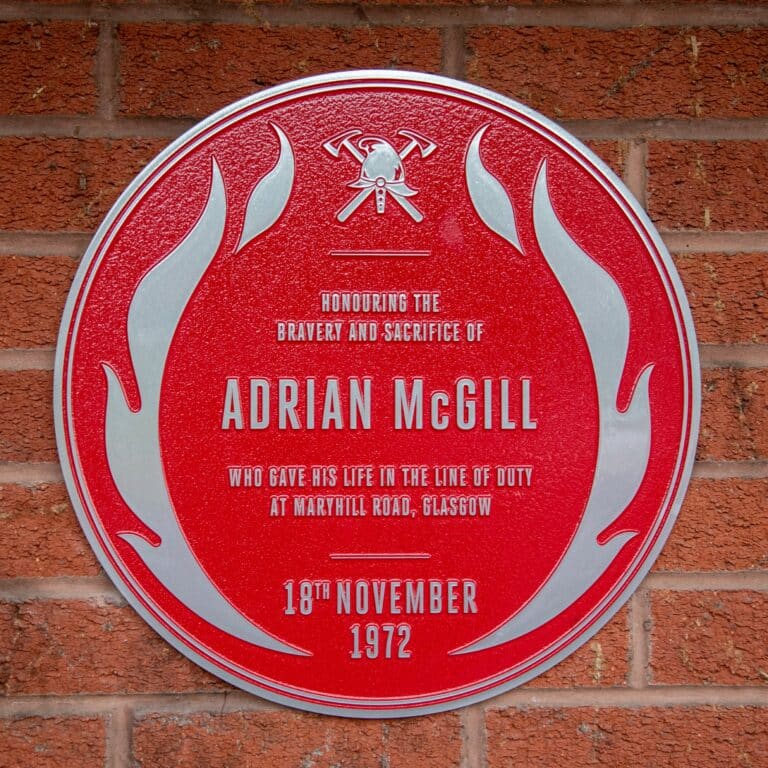
Recently there was a red plaque unveiled at Maryhill Fire Station, where a firefighter called Adrian McGill had lost his life in the line of duty on 18 November 1972. In many ways Adrian’s red plaque is typical of the courage and bravery shown by firefighters on a daily basis.  He was attempting to rescue a trapped woman in a fire at Maryhill Road in Glasgow, and it is thought that in an attempt to save her life he gave her his oxygen mask. Unfortunately, both died in the incident.

It is that sort of real courage that defines the service in many ways and is what we think is so important to remember. We hope when the public see the red plaque they’ll see the sacrifice that firefighters have made over the years in service to their communities.

This project has primarily been driven by serving firefighters: the Red Plaque Scheme has come to their attention and they know of instances within their own brigade where firefighters have lost their lives. It only takes one or two people at a station to research that person, make an application and drive forward the process.

The majority of these plaques are driven by firefighters, which I think shows a real connection between the service of firefighters today and their recognition and understanding of the sacrifice that colleagues who built the fire service have made in the past.

Firefighters know their history. We understand the legacy that has been left to us and its driven home to us whenever we are on duty. We understand the sacrifice of previous generations, whether that be in building the service, improving the service, and developing safe policies, procedures and practices. We understand our history and we know how important it is that it is recognised at a wider level across communities. That’s what the Red Plaque Scheme is all about.  

How can people support the Red Plaque Scheme?

I’d ask people who would like to participate in the project to go to the Red Plaque website (redplaque.org.uk) where you can see a list of all the plaques that we’ve laid so far and make an application for a new plaque. Every single plaque is funded in its entirety by the proceeds of the Firefighters 100 Lottery. That’s only a pound a week to buy a lottery ticket, and a portion of the proceeds from each ticket goes to good causes, including the Red Plaque Scheme.

The project is going from strength to strength, but behind every plaque there is a personal tragedy. People are always surprised by the number of firefighters that have lost their lives in the line of duty – well over 2000 in the UK – and I think there’s a real desire to see these heroes recognised, which this project is designed to do. 

This article was originally published in the January edition of IFSJ. To read your FREE digital copy, click here.
FBU unveils more plaques for fallen firefighters

The Fire Brigades Union has unveiled three new plaques for fallen firefighters as part of the Red Plaque Scheme, funded by the weekly Firefighter 100 Lottery.

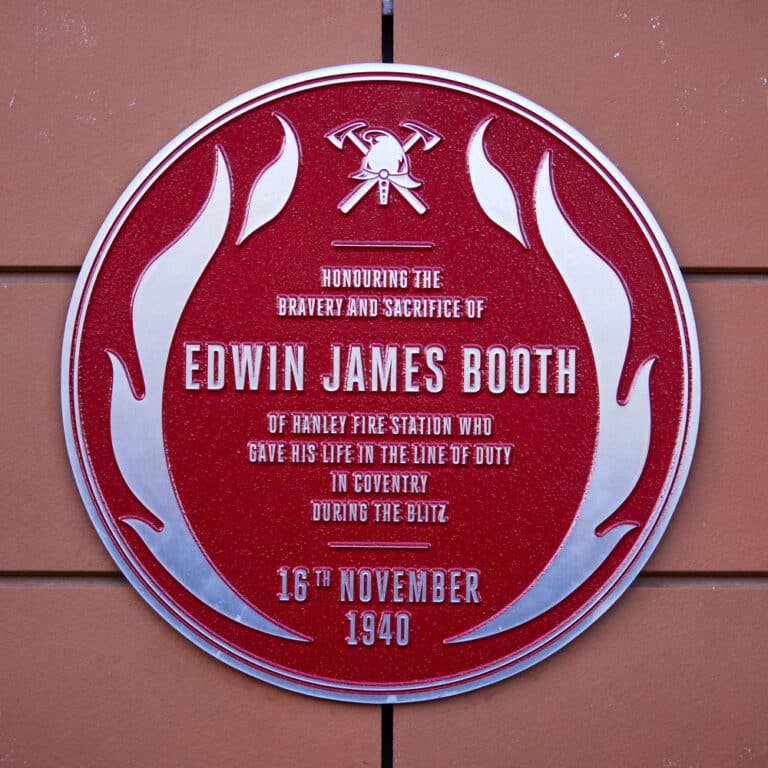
Edwin James Booth

Edwin James Booth was a Stoke firefighter who was deployed to fight fires in Coventry on 14 November 1940. He was injured, along with several members of his crew, and never regained consciousness. He passed away two days later, on 16 November 1940.

Over half of Coventry’s homes (43,000) were either damaged or destroyed in the massive air raid of 14 November 1940. It has been called the ‘single most concentrated attack on a British city in the Second World War’ and lasted for 11 hours. The plaque is being unveiled at Hanley Community Fire Station in Stoke-on-Trent. Edwin was a firefighter in Hanley.

Jack Lee, FBU Staffordshire brigade chair (acting), said: “The Blitz was a horrific time in our country’s history, and 14 November was utterly devastating for Coventry. These would have been extremely challenging circumstances for firefighters to work in, and the bravery of Edwin and his colleagues will have saved many lives. His courage was part of a huge, vital effort in a time of tumultuous conflict. It is vital that we remember individual sacrifices like Edwin’s when we remember the wider horror of wartime, just as it is vital that we remember the wider context of Edwin’s sacrifice when we focus on it.”

The red plaque unveiling at Hanley fire station, Hanley, Stoke-on-Trent for Edwin james Booth he gave his life in service in the Blitz in 1940, attended by his decedents Jeff and Su Cotton

Adrian McGill

Adrian McGill, aged 34, was attempting to rescue a trapped woman in a fire at Maryhill Road in Glasgow, and it is thought that in an attempt to save her life he gave her his oxygen mask. His body was later found with signs of carbon monoxide poisoning. Tragically, the woman also died. The incident took place on 18 November 1972.

The plaque was unveiled at Maryhill Fire Station (775 Maryhill Rd, Glasgow G20 7TL), on Friday 18 November at 13:30-14:15. At the time of his death Mr McGill was married with three children, with his youngest child being just eight months old. He was the eighth Glasgow firefighter to die in a fire in three months, with seven firefighters dying in the Kilbirnie Street textile warehouse blaze in August, and the 27th to have lost their life in the previous 12 years.

Seona Hart, FBU Scotland Regional Treasurer, said:

“Adrian McGill made a split-second decision out of care for someone else, a stranger who he had never met before, and a decision which he would have known came with huge risk. It is self-sacrifice on an almost indescribable scale. There’s a quote that states that there is no more stirring symbol of our humanity towards others than a fire engine. Adrian McGill and what he did personify that.

“This plaque will ensure that the Glasgow community knows about the sacrifice that Adrian McGill made, and it will help Glasgow’s firefighters remember one of their own.”

Image Credit: Fire Brigades Union, Craig Maclean

Leonard McCartney and Lexi Wylie

Leonard McCartney and Lexie Wylie were killed when the building they were fighting a fire in, the Meville Hotel on Foyle Street, Derry/Londonderry, collapsed onto them.

A message sent to the fire service control room shortly after said “no action for rescue is possible as all upper floors collapsed without warning” and that “all five floors and attics severely damaged by fire… Leading Fireman McCartney and Leading Fireman Wylie were last seen in the ground floor corridor at the front of the building”. It took 17 hours for the bodies to be located and removed from the rubble of Melville Hotel. The plaque was unveiled at the location where the incident took place on 21 November 1971.

Leading Fireman Leonard McCartney was 42 years of age and lived in Violet Street. He had been a firefighter based in Northland Road Fire Station for 20 years and was survived by his wife Mary and three children Audrey, Robert and Alan.

Leading Fireman Lexie Wylie was 35 years old and had been in the fire service for 14 years, also serving at Northland Road Fire Station. He lived with his mother and sister at their family home in Galliagh.

Jim Quinn, FBU executive council member for Northern Ireland, said: “Leonard McCartney and Lexie Wylie were firefighters who did everything they could do to serve their communities for years. They fought fires and carried out rescues during a very dangerous period in our country. They carried out their duties with real bravery and lost their lives in a huge and tragic incident. It is absolutely vital that we remember them and their contributions across their time in the fire and rescue service. This plaque will go a long way to ensuring that that happens.”