Fogmaker International acquires Siveb Oy’s Assets, bolstering Finnish market presence

Fogmaker International expands Finnish market presence with strategic acquisition

Fogmaker International AB, a prominent supplier of fire suppression systems for engine compartments and enclosed spaces, announced a major expansion into the Finnish market with the acquisition of Siveb Oy’s assets through its subsidiary, Fogmaker Finland Oy.

This acquisition, completed on December 1st, 2023, represents a significant stride in strengthening Fogmaker International’s market influence in Finland​​​​.

A strategic move for market expansion

The acquisition is poised to broaden Fogmaker International’s reach in Finland, integrating the valuable expertise and experience of Siveb Oy’s team.

This move aims to enhance service to a more diverse customer base and drive further growth in the region.

It also aligns with the company’s vision of creating safer environments globally through advanced fire suppression solutions.

This strategic acquisition is expected to cater to the evolving needs of customers by delivering tailored industrialized solutions​​​​.

Leadership perspectives on the acquisition

Lars Alrutz, CEO of Fogmaker International, expressed enthusiasm about the acquisition, citing it as a crucial step in reinforcing the company’s regional presence and advancing their global vision of safety.

Kristian Lindström, owner of Siveb Oy, also shared his excitement about joining the Fogmaker International family, emphasizing the potential for delivering more innovative solutions and value to customers.

Lars Fredin, Group CEO of Dacke Industri and Chairman of Fogmaker International, highlighted the strategic expansion and alignment with growth ambitions, foreseeing a continued success trajectory for Fogmaker International​​​​.

About Fogmaker International AB

Fogmaker International, a subsidiary of Dacke Industri since 2022, operates from Växjö, Sweden, with approximately 100 employees and an annual turnover of around SEK 400 million.

The company is recognized for its high-pressure water-based mist fire suppression systems, catering to sectors like Buses, Mining, Material Handling, Forestry, Trucks, Construction Equipment, Agriculture, and Airports.

Their systems are known for their reliability, efficiency, and environmental friendliness​​​​.

About Dacke Industri

Dacke Industri, the parent company of Fogmaker International, focuses on investing in innovative technology companies with development potential.

It operates under a decentralized model, ensuring autonomy and independent operation of its subsidiaries.

With a portfolio of 18 subsidiaries across four divisions, nearly 1500 employees globally, and net sales of SEK 4.3 billion, Dacke Industri emphasizes technological focus, development expertise, and quality execution in its operations, with a commitment to environmentally sustainable products and production​​​​.

IFSJ Comment

The acquisition of Siveb Oy’s assets by Fogmaker International AB represents a significant advancement in the fire safety and suppression industry.

This strategic move not only expands Fogmaker’s market presence in Finland but also strengthens its global footprint.

By integrating Siveb Oy’s expertise and experience, Fogmaker International is positioned to offer more comprehensive and advanced fire suppression solutions, aligning with the evolving safety needs of various sectors.

This development underscores the importance of innovation and strategic partnerships in enhancing safety standards and solutions in the fire and safety industry.

As companies like Fogmaker International continue to expand and innovate, they contribute significantly to creating safer working and living environments worldwide.

A blanket approach to battery fires

Why Li-Fire’s collaboration with Fireaway Inc. could pave the way for effect EV extinguishing

As the electric vehicle (EV) market continues to burgeon so too does the danger of lithium-ion battery fires.

These fires, deep-seated and stubborn, have traditionally demanded massive water quantities for suppression or been left to burn themselves out.

Neither solution is optimal, considering the environmental impact and potential danger to responders and bystanders.

Enter the recent partnership between Li-Fire Suppression Solutions and Fireaway Inc., crafting a trailblazing solution to this fiery problem.

Combining Li-Fire’s state-of-the-art fire blankets with Fireaway’s innovative Stat-X First Responder condensed aerosol fire suppression tool, this alliance promises a safer, more efficient approach to handling EV lithium-ion battery fires.

According to Bricen Miller, CEO of Li-Fire, the problem stems from various factors, including manufacturing defects, thermal runaway due to overcharging or overheating, and physical damage.

These fires have raised alarms about the safety of lithium-ion batteries, which are commonly used in e-bikes, smartphones, laptops, EVs, and energy storage systems.

The response from manufacturers, researchers, and regulatory bodies has been swift, focusing on improving battery safety through better manufacturing processes, enhanced safety features, and stricter testing standards.

The blanket approach

Miller introduces Li-Fire’s groundbreaking solution to this problem: a specialised fire blanket designed to combat lithium-ion battery fires in EVs.

The Li-Fire blanket can be deployed in two main ways.

Firstly, it can be used to cover a burning car directly.

Secondly, and crucially, it can isolate the surrounding area from a catastrophic fire in an EV.

“For example, if one car catches fire while charging, it’s very important to isolate as quickly as possible,” explains Miller.

This approach has shown very positive results, particularly in preventing the spread of fire to adjacent vehicles.

Li-Fire’s fire blanket is designed not just as a means of direct fire suppression, but as a critical tool in fire containment and prevention in scenarios involving lithium-ion battery fires.

Miller notes that Li-Fire’s fire blankets are tailored for a broad range of electric vehicles (EVs), from e-bikes to large vehicles such as 18-wheelers and city buses, emphasising Li-Fire’s commitment to quality and standards: “All of our blankets are manufactured to the highest standards and follow all ISO9001:2015 standards.”

This adherence to international standards ensures that the fire blankets are both versatile in terms of size and reliable and effective across various EV models.

Environment impact

Miller highlights the significant environmental impacts of traditional fire response methods for EV fires.

These methods, which can often involve the use of up to 10,000 gallons of water, foam, or dry chemical agents, are, he deems less effective and pose additional environmental risks.

Miller also points out that extinguished fires have re-ignited in towing yards up to a week later, leading to further property damage, air quality issues, and additional demands on fire services.

The current guidelines, including Tesla’s advice to “just let it burn out, or use enough water to cool,” underscore the challenges faced in controlling EV fires.

These traditional methods can negatively affect air quality and contribute to hazardous wastewater runoff, making them less sustainable.

Li-Fire’s fire blanket is designed to offer a more environmentally friendly solution that addresses these challenges, reducing the need for large volumes of water or chemical agents and mitigating the risk of re-ignition and subsequent environmental hazards.

The EV challenge

The rise in EV use has escalated the frequency and severity of lithium-ion battery fires, posing new challenges.

Traditional methods like extensive water use or allowing fires to burn out have significant downsides.

Li-Fire’s recently struck up a partnership with Fireaway Inc., was a bid to enhance lithium-ion battery fire safety solutions.

The collaboration merges Li-Fire’s innovative fire blankets with Fireaway’s Stat-X First Responder condensed aerosol fire suppression tool, addressing the growing concern of lithium-ion battery fires in EVs, creating a solution that is designed to provide professionals with a means to both contain and suppress lithium-ion battery fires in a wide range of vehicles.

The partnership’s solution reduces collateral damage, minimises water usage, and limits smoke and toxic gas production, enhancing fire scene safety and reducing environmental impact.

The Stat-X agent is environmentally friendly, effective in confined spaces, and complements Li-Fire’s blanket in suppressing fires safely.

This groundbreaking collaboration promises a significant impact across sectors, providing a much-needed solution for safely combating the increasing challenge of EV fires.

This combination, he says, has proven to be effective in drastically reducing temperatures during a fire incident.

“Our testing has shown a reduction of temperature inside the car from over 1000°C to less than 200°C in 3 seconds,” Miller tells.

This rapid cooling capability could prove pivotal in extinguishing fires quickly and reducing collateral damage and ensuring safety for surrounding areas and people.

When talking about the development process of this combined solution, Miller reflects on his extensive background in business development within novel battery technologies: “Through my exposure in this industry, I started to understand the major issues with Li-ion battery fires,” he says.

He believes deep understanding has been crucial in guiding the development of Li-Fire’s innovative solution, tailored to address the specific challenges posed by lithium-ion battery fires.

Looking at the potential applications of Li-Fire’s product, Miller identifies a diverse range of sectors and industries where their fire blanket could be indispensable.

These include fire fighters, tow operators, parking garages, charging stations, junkyards, airports, military bases, cargo ships, and disaster relief operations.

The wide array of industries underscores the versatility and necessity of Li-Fire’s solution in various scenarios where lithium-ion battery fires pose a significant risk.

By targeting these sectors, Miller says that Li-Fire aims to provide a crucial tool in fire safety and prevention, potentially transforming the way such fires are handled across different industries.

This article was originally published in the December2023 issue of International Fire & Safety Journal. To read your FREE digital copy, click here.

Euralarm addresses EU’s proposal to restrict PFAS in firefighting applications

In response to the European Chemical Agency’s (ECHA) proposal for the restriction of Per- and Polyfluoroalkyl Substances (PFAS) across the European Union, Euralarm has submitted a detailed position.

The proposal, initiated by Germany, the Netherlands, Denmark, Sweden, and Norway, covers an extensive range of PFAS applications, spanning across 1780 pages and incorporating 14 different sectors, including firefighting gases.

Understanding the Proposal’s Scope

ECHA’s proposal includes a variety of fluorinated gases and their blends, which are used in firefighting and covered under EN 15004 or ISO 14520.

Among these are gases like HFC-227ea, HFC-125, FK-5-1-12, and HB-55, which have wide-ranging applications in firefighting.

The sector of ‘Applications of fluorinated gases,’ which incorporates these firefighting gases, constitutes only 3% of the total applications in this category, a relatively minor fraction compared to other uses such as refrigeration and foam blowing.

Firefighting Applications and Derogation

Annex E of the restriction proposal acknowledges the unique requirements of firefighting applications.

It recognises that while alternatives to F-Gases exist, there are specific scenarios where these alternatives might not be viable, citing potential risks to human life and cultural assets.

Consequently, the proposal suggests an 18-month transitional period after its entry into force (EiF), followed by a 12-year derogation from the ban for firefighting applications.

PFAS regulation: The timeline ahead

The public consultation for this proposal commenced on 22 March 2023 and concluded on 25 September 2023.

The process involves opinion development in ECHA’s committees, a draft opinion consultation, and a legislative process in the European Parliament and Council, leading up to the EiF.

It’s anticipated that the EiF for legislation won’t be implemented before the end of 2025, indicating that fluorinated gases, not restricted by the F-Gas regulation, would be available at least until mid-2039.

Euralarm’s stance and future outlook

Euralarm supports ECHA’s position that the current proposal does not intend to mandate the removal of installed systems.

The organisation closely monitors the development process and has committed to keeping interested parties regularly informed about changes.

With over 5600 comments received from more than 4400 organizations, companies, and individuals during the consultation period, the stakeholder feedback will significantly influence the final opinions of ECHA’s Committee for Risk Assessment (RAC) and Committee for Socio-economic Analysis (SEAC).

IFSJ Comment

The proposed ECHA regulation on limiting PFAS use in firefighting contexts marks an important moment in the EU’s approach to environmental and public safety policy.

Acknowledging the environmental concerns associated with PFAS, the proposal also highlights the challenge of aligning environmental goals with the practical requirements of fire safety.

The 12-year exemption for firefighting uses suggests a balanced approach, acknowledging situations where alternatives are currently unavailable and the critical need for protecting human lives and property.

Euralarm’s reaction, which calls for a transition period and maintaining existing systems, reflects the industry’s effort to adapt to new regulations while maintaining a focus on safety and reliability.

This development is notable for its role in demonstrating how environmental policies can be integrated with specific industry needs, aiming to maintain both ecological health and public safety.

Class is in session: Inside Fomtec’s International Foam School

As the fire suppression sector undergoes rapid changes, Fomtec sets a new benchmark with its International Foam School

In the ever-evolving landscape of fire safety, leading foam solutions provider Fomtec is pioneering change not just in products, but in knowledge sharing and education.

Established in 2001, the company has made its mark with a customer-centric approach, a relentless pursuit of innovation, and a strong commitment to sustainable alternatives to traditional fire suppression systems.

Now, they are taking a bold leap forward, launching their inaugural International Foam School programme in Helsingborg, Sweden.

This initiative represents a significant step towards collective advancement in the industry, underscoring Fomtec’s commitment to equipping professionals with the knowledge and tools needed to face the future of fire safety.

In this exclusive interview with John Ottesen, Owner of Fomtec, IFSJ delves into the genesis of the programme, its curriculum, participant experiences, and the learnings gleaned from its inaugural run, and how the International Foam School is set to shape Fomtec’s future growth and the fire safety industry at large.

What inspired Fomtec to create the International Foam School programme?

The inspiration for creating the International Foam School programme stemmed from my personal experience.

Early in my career, I attended a foam school that deeply influenced me.

This experience not only shaped my professional journey but also played a crucial role in founding Fomtec.

Much of what we teach in our programme has been influenced by what I learned in that school.

We integrated many elements from the materials provided there into our own manual, refining and expanding upon them.

The significance of foam schools in my personal growth inspired me to establish something similar, but uniquely tailored by Fomtec.

The knowledge and tools I acquired from that school stayed with me for decades.

The manual I received during that training remained on my desk for 30 years until we crafted our own.

Now, our comprehensive manual has taken its place, embodying our extensive research and expertise.

At Fomtec, we firmly believe in a fact-based approach when it comes to firefighting and designing fire suppression systems.

Without an in-depth understanding of the foams, the guiding standards for system design, and the diverse applications of foam systems, it is challenging to effectively utilise data.

Our Foam School aims to provide that solid foundation for professionals in this field.

What is on the curriculum at Fomtec’s International Foam School?

Foam School allowed me to realise an ambition I’ve held for many years: creating a comprehensive Foam Manual.

We’ve produced a 500-page manual which delves deep into topics ranging from foam concentrates, hardware, and design standards to pertinent applications, inclusive of calculation examples and design data.

Our Foam School curriculum is structured around this manual, which we’ve aptly named “The Foam Manual.”

The manual I had from earlier served as an inspiration or a template for what I aimed to create.

While the fundamental issues in the world and the applications remain unchanged, the ways we address these issues and the products we use have evolved, especially on the chemistry side.

On the hardware end, much of the old equipment persists, but there’s new technology now as well.

There’s been an evolution in both equipment and foam over the years.

The applications we aim to safeguard remain consistent.

My approach in crafting this manual was to focus on these applications.

We constructed the manual systematically, chapter by chapter, discussing protection strategies for each specific application.

I drew a lot from the older manual’s essence, updating it to be relevant to 2023, including aspects like fluorine-free foam.

The manual is a substantial binder.

Inside, there are chapters dedicated to foam concentrate and hardware.

It delves into specific applications, offering readers clear guidance.

For instance, if a student wishes to design a sprinkler system, they’ll find a step-by-step guide on the process and references to the relevant standards to make their design appropriate and effective.

Our main goal with Foam School is comprehensive education.

We’re aware there’s a vast amount of information to grasp.

While we don’t expect students to remember everything immediately, we aim to equip them with the tools to facilitate continuous learning.

Through our program, they learn to execute relevant calculations and are pointed towards pivotal resources like NFPA standards to navigate further.

What are your aspirations for foam school attendees?

Foam School aims to provide comprehensive training in a relatively short period – three days, to be precise.

While this is undoubtedly a brief duration, our role is to guide students in the right direction.

We conduct in-depth presentations, working alongside students through each application, engaging in hands-on calculations to ensure they grasp the core concepts.

The methodology we employ is similar to that which I experienced in my training 30 years ago.

Although one doesn’t master everything immediately, it’s the consistent revisitation of materials, particularly the manual and industry standards, that fosters deepened understanding.

This repetitive process, which I found invaluable in my own learning, is something we hope our students will adopt.

Foam School is not simply about experimenting with foam in a simulated environment.

It’s centred on imparting knowledge on designing real-world foam systems, both portable and fixed, strictly based on established design standards.

Our curriculum offers a holistic exploration of firefighting with foam.

It begins with an introduction to foam concentrates, covering their varied properties, delving into environmental considerations, discussing PFAS transition topics, and explaining system design standards.

The course goes into detailed examinations of all primary applications, incorporating design exercises, and culminating in an examination.

Our aspiration is for students to leave Foam School proficient in using The Foam Manual and industry standards to execute impeccable system designs.

Can you share some key insights or takeaways from the first iteration of the programme?

One of the primary realisations was the sheer volume of content to be addressed within the span of 3 days.

Despite this, the overwhelming feedback was that students left with an enriched understanding, irrespective of their initial expertise.

It’s noteworthy that the Foam School immerses students into the latest data, with SFFF being the principal product demonstrated across our calculation examples.

We extensively leverage the findings from the Fomtec Enviro Programme, encompassing over 2000 fire tests and the subsequent approvals we’ve garnered.

While the learning trajectory proved steep for some participants, we confidently met our core objective: guiding students towards a data-driven comprehension of foam and its associated systems.

How have participants responded to the International Foam School programme?

The feedback has been overwhelmingly positive from every student.

While it might be premature to make extensive assessments, my strong perception is that Foam School has reshaped many students’ perspectives on the subject and will influence their future professional approaches.

As a supplementary initiative, Fomtec plans to host follow-up webinars targeting specific areas of interest for the cohort.

Was Fomtec’s “data not opinion” mindset influential in developing the programme?

At the heart of Foam School’s curriculum lie the NFPA standards and FM Data pages, serving as the foundational pillars for our foam systems design approach.

What’s advantageous about this framework is the alignment in thinking between NFPA, FM, and us at Fomtec – the shared belief in a fact-driven, holistically approved methodology.

We then apply our products to practical examples spanning all pertinent applications, ensuring their utilisation remains within documented and approved limits.

For many participants, it’s a revelation to see how intricately everything interlinks and how even minor data omissions can compromise an entire design.

Does the school tackle to the industry transition away from PFAS-containing foam?

Foam School plays a pivotal role in this transitional phase.

While there’s a widespread desire for direct drop-in replacements, the reality is such replacements aren’t feasible.

With our new SFFF products not having the same leniency as traditional PFAS-based foams, the necessity for comprehensive knowledge becomes paramount to ensure a safe shift away from PFAS-laden solutions.

Relying on data and practices that are several decades old is untenable.

This is where Foam School becomes invaluable in the PFAS transition journey.

Ignoring this reality poses a grave risk, with potential consequences for both life and property.

How does the International Foam School fit into the future of Fomtec?

The Foam School is set to be a cornerstone in our future endeavors, with plans to introduce new classes approximately every six months.

As we progress and engage with diverse batches of students, we intend to tailor the curriculum to cater to specific audiences, such as Distributors, Contractors, End Users, Consultants, and Insurers, among others.

Our overarching goal is to unify everyone under a common vernacular concerning foam, emphasising a discourse rooted in data, not opinion.

In many ways, this is a language school, and we want as many people in the industry as possible to speak Fomtec.

This article was originally published in the October 2023 issue of International Fire & Safety Journal. To read your FREE digital copy, click here.
Scotland reviews the use of sprinklers in converted historic buildings

The Scottish Government has announced the establishment of an expert working group to evaluate the necessity of installing sprinkler systems in historic buildings that undergo transformation into hotels.

The motivation behind the sprinklers decision

This move follows the tragic Cameron House Hotel fire at Loch Lomond in December 2017.

Two individuals lost their lives in this catastrophe.

An inquiry into these deaths revealed that sprinklers might have “significantly slow the spread of flame and would extend the margin of safety for available escape time”.

The investigation further stated: “It was a real or likely possibility that if sprinklers had been installed and had worked to inhibit the extent and spread of the fire and smoke, Mr Midgley and Mr Dyson would have been able safely to escape the building”.

Subsequent to this inquiry, the Scottish Government initiated a preliminary group to assess the proposed measures.

They have now endorsed the formation of an expert group “to review the mandating of automatic fire suppression systems where historic buildings are being converted into hotels”.

BAFSA’s involvement and perspective on sprinklers

Ali Perry, the Chief Executive of the British Automatic Fire Sprinkler Assocaition (BAFSA), commented on the development: “BAFSA has been engaging with Scottish Building Standards on this issue and we hope to be involved in further discussions going forward”.

Further insights regarding this topic are to be revealed in an upcoming case study titled ‘The Cameron House Hotel Fire – Lessons Learnt’ authored by BAFSA’s Stewart Kidd.

Kidd is also set to present his findings to BAFSA members at their AGM afternoon seminar, scheduled for Thursday, 9th November at The Liverpool Marriott City Centre Hotel.

IFSJ Comment

The devastating Cameron House Hotel fire shed light on a critical gap in fire safety for historic buildings repurposed as hotels.

Ensuring these structures, with their unique architectures and histories, are equipped with modern fire suppression systems like sprinklers can significantly enhance safety margins.

The Scottish Government’s move to convene an expert group for reviewing this is a positive stride towards safeguarding not just the rich heritage these buildings carry, but more importantly, the lives that reside within them.

The discussions and outcomes of this group will likely set a precedent for similar architectural treasures across the globe.

BIOEX introduces eco-friendly alternative to traditional firefighting foam

Global transition to fluorine-free firefighting foam

In response to environmental and safety concerns, there’s a global shift underway in the fire safety industry. This shift sees industries and fire departments transitioning from traditional Aqueous Film Forming Foam (AFFF), typically used for combating hydrocarbon fires, to fluorine-free foams. However, compatibility issues can arise during this transition, particularly in terms of foam viscosity and the impact on existing firefighting equipment. Often, fluorine-free foam tends to be more viscous than its predecessor, leading to complications in the proportioning and discharge of the foam.

ECOPOL 3N – a novel, green solution for hydrocarbon fires

Drawing on extensive experience in the development of efficient fluorine-free foam, BIOEX has launched ECOPOL 3N. This new firefighting foam is specifically engineered for tackling class B hydrocarbon fires, such as those involving crude oil, gasoline, and kerosene, and has a similar viscosity to traditional AFFF foams. It has been certified under the EN1568-3 standard v2018, proving its effectiveness.

How ECOPOL 3N works

When mixed with water and air, ECOPOL 3N forms a durable foam blanket that insulates the fuel source from air supply, effectively suppressing the fire. Its quick and efficient coverage on the surface of flammable liquids ensures rapid extinguishment. In addition, the adhesive nature of the foam allows it to adhere to vertical surfaces for an extended duration, preventing re-ignition due to its long-lasting foam blanket.

Application and environmental impact of ECOPOL 3N

ECOPOL 3N is highly versatile, working effectively with fresh water, brackish water, and saltwater, at all hardness levels. It’s formulated to be used at 3% concentration in both low and medium expansion applications and is also protected against frost. The liquid formulation means that it’s compatible with most existing foam equipment, negating the need for any equipment modifications during the transition to fluorine-free alternatives.

As an ecological solution, ECOPOL 3N contains no fluorinated derivatives or Persistent, Bioaccumulative and Toxic substances. It’s also easily biodegradable, causing no harm to the environment. Consequently, both industrial companies and fire departments are confident in using ECOPOL 3N for tank fires and structural fires, making it an ideal choice in the drive towards more environmentally conscious firefighting practices.

Perimeter Solutions releases Sustainability Accounting Standards Board factsheet

Perimeter Solutions, a global manufacturer of high-quality firefighting products and lubricant additives, has announced the issue of its inaugural Sustainability Accounting Standards Board (SASB) Standard Factsheet.

The newly announced report provides insight into Perimeter Solutions’ multi-faceted approach to enhance, advance and regularly communicate its sustainability strategy and environmental, social and governance (ESG) performance.

It is available to view online. 

Edward Goldberg, CEO of Perimeter Solutions, explained: “Perimeter Solutions is an innovative and evolving organisation. In order to remain successful, we realise the importance of embedding strong sustainability priorities within our business operations.

“Over the past two years, our senior management team has worked to enhance our ESG strategy to align with the broader transformation of our company. Publishing this Factsheet demonstrates our commitment to transparency and accountability in our environmental, social and governance performance.” 

Highlighted in the report are the three key tenets of Perimeter Solutions’ ESG strategy, which guide the company’s sustainability efforts: 

Environmental: Perimeter Solutions’ focus on environmental stewardship is integral to the work it does every day. Wildfire control products developed by Perimeter Solutions save tens of thousands of hectares of forest every year, helping these forests to continue to sequester carbon and reduce the amount of greenhouse gases released into the atmosphere. Perimeter Solutions fire safety products also require dramatically less water to be effective, reducing the amount of water customers use while protecting a valuable natural resource. Internally, Perimeter Solutions has taken steps to increase recycling, made capital investments to reduce the amount of energy used in its manufacturing process, and increased the use of e-records to reduce the Company’s carbon footprint. 

Social Impact: Perimeter Solutions is committed to providing equal employment opportunities. All recruiting, payment, performance, and promotion decisions are based on merit, without discrimination on the basis of gender, sexual orientation, age, family status, ethnic origin, nationality, disability, or religious belief. Women represent approximately 19% of Perimeter Solutions’ total workforce. Members with diverse backgrounds comprise 33% of the Company’s Board. At the community level, Perimeter Solutions devoted 500,000 hours of dedicated service to forest fire remediation. The Company’s focused on contributing to the creation of a better world through its strategic nonprofit partnerships, volunteerism, and philanthropy. 

Corporate Governance: Perimeter Solutions emphasises a culture of accountability and conducts its business in a manner that is fair, ethical, and responsible to earn the trust of its stakeholders. Perimeter Solutions has corporate governance policies and structures in place to support its culture of accountability and transparency. The Company continues to focus on diversity and independence at the Board level and its current Board includes a majority of independent directors.

IFSJ Exclusive: Know your viscosity with FIREMIKS

Per Aredal International Sales Director at FIREMIKS AB, sheds light on the proportioning systems suitable for the transition to synthetic fluorine-free foam

During the market transition from AFFF (Aqueous Film Forming Foam) to SFFF (Synthetic Fluorine Free Foam) concentrates it is important to know the viscosity of the SFFF concentrate to choose the right type of proportioner.

FIREMIKS is a water driven volumetric pump proportioner for firefighting – for fixed installations connected to a concentrate tank with gravity feed to the dosing pump. Extinguishing water drives the volumetric water motor, which in its turn drives the positive displacement pump that doses the correct amount of concentrate in the extinguishing water exiting the water motor.

As the regulatory authorities now are pushing for soonest possible transformation from PFAS-containing concentrates, towards SFFF concentrates, many proportioning systems are re-evaluated to ensure compatibility with the new concentrates. Different concentrate manufacturers offer a variety of foams which comes in a wide range of viscosities, including very high viscous concentrates. To be able to select an appropriate proportioner one needs to know the properties of the concentrate.

FIREMIKS is uniquely positioned to offer two types of dosing pumps, Gear and Piston (plunger), combined with our sturdy multi-vane motor that offers optimal reliability based on +30 years of experience in the market. Among several important factors, besides flows and pressures, we always gather info from the customer regarding the concentrate type and viscosity before we propose which type of pump that will match the customers need.

Proportioners with Gear Pump

Water motor driven pump proportioner equipped with a Gear pump are particularly suited for operating in the higher range of a systems maximum flow rate, such as deluge and large fire monitor systems. They are also most suited for high and very-high viscosity concentrates.

For example, we have with excellent result tested one of our Gear pumps models with a Fluorine-free foam with 8,040 cP (Brookfield Viscometer Spindle #4 at 30 rpm). The reason Gear pumps works well with these very-high viscous concentrates is that they are equipped with counter rotating gears which seals better with high viscosity fluids and creates an even flow that does not agitate the concentrate.

Proportioners with Piston Pump

Water motor driven pump proportioners equipped with Piston (plunger) pumps are on the other hand particularly suited for use in systems with low start-up flows in relation to the systems maximum flow rate, for example sprinkler systems. They are also very suited for low and medium viscosity concentrates.

Important to know is that Piston pumps have a limit upwards to high viscosity concentrates, normally around 4,000-4,500 cP (Brookfield Viscometer Spindle #4 at 30 rpm) due to the Piston pump reciprocating principle; for each revolution, the plunger sucks concentrate and then presses it out and the concentrate goes from zero to full speed twice per revolution in a very tight pump design. If the static viscosity is too high with non-Newtonian concentrates, the concentrate will not flow smoothly and therefor the correct dosing rate might not be achieved.

Important for all systems is that one should ensure that diameter on the foam supply piping is large enough for the concentrate delivery and to avoid longer concentrate lines. Recommendations are specified in our data sheet for each model. We are always available to guide you with more specific recommendations if needed for your specific project.

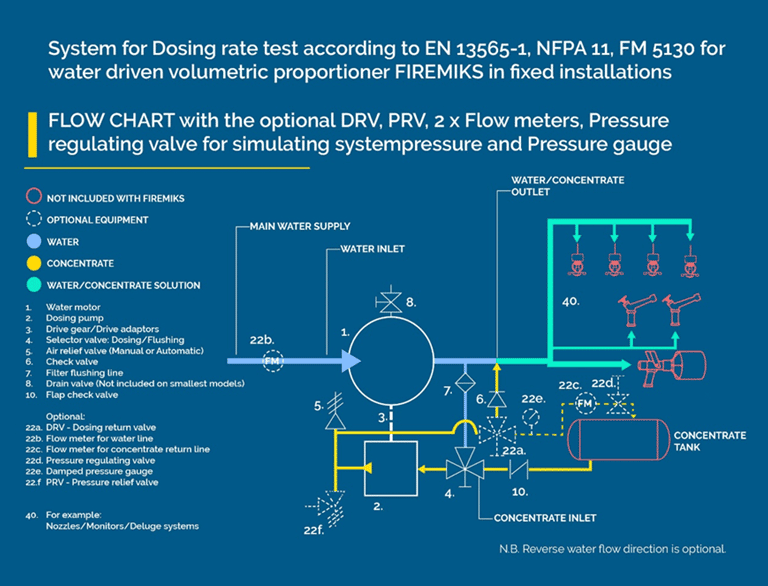
Verifying dosing rate according to EN 13565-1, NFPA 11 and FM 5130 on water driven volumetric pump proportioners.

To measure and verify the dosing rate on a proportioning system according to regulations and standards, at the commissioning and yearly maintenance, is an important task.  The aim is to ensure that the installed firefighting system proportion the correct amount of the concentrate into the firefighting water flow, as intended and designed.

To be able to easily test and verify the correct proportioning the FIREMIKS unit needs to be equipped with an optional Dosing return valve (DRV) (no 22a.) that directs the concentrate back to tank instead of being induced into the water flow. This allows for testing the system without mixing the concentrate. A Pressure relief valve (PRV), (no 22f.) is included with the DRV to eliminate the risk for over-pressure if return line to tank is closed/blocked by mistake.

Furthermore, one needs to install two calibrated Flow meters; one for main water line (22b.) and one electromagneticflow meter for concentrate return line (22c.), combined with a Pressure regulating valve (or a regular valve which can be partly closed to regulate the backpressure, e.g. globe valve) (22d.) to simulate system pressure, displayed by a Pressure gauge (22e.).

Environmentally and economically beneficial testing system

This described dosing test system ensures that it is possible to practise and test dosing rate without consuming the concentrate. It gives also substantial savings over the years with no cost for cleaning or destruction of dispersed solution after the test. With the growing strict environmental regulations, this advantage has become even more important today.

The accurate way of verifying dosing rate

Verifying dosing rate equals to verifying the correct volumetric function of both the water motor and dosing pump with two independent calibrated flow meters and calculate to this formula, in accordance with EN 13565-1, NFPA 11, FM 5130:

(Concentrate flow) / (Water flow + Concentrate flow ) x 100 = Dosing rate %

Revolution counter method – the limits

The revolution counter method which is also presented on the market assumes the correct working of the water motor, this means it gives only an estimateof water flow.

The is not an approved method to verify dosing rate as described by
EN 13565-1, NFPA 11 and FM 5130, who each require the use of a separate flow meter to measure water flow. Quote from FM Approval guide ref. rpm method: “May be used to provide a general estimate of the extinguish water flow”.

Revolution counting with handheld tachometer

The estimated water flow can also be measured with handheld tachometer (contact or non-contact) to ensure that the unit is not over-speeding, i.e. working within the upper rpm = flow limit specified in the Data sheets of each FIREMIKS model.

Measuring concentrate flow

An alternative method to measure the pumped concentrate is to pass it into a separate container after the pressure regulating valve (22d) and weigh the amount used from the tank during a defined time and then converting it to the corresponding flow rate.

In our experience, magnetic flow meters work well for measuring concentrate flows. Even so, it is even better to be able to establish a known weight or volume of concentrate used in a known time interval, because even approved magnetic flow meters are not tested on all concentrates available.

Handling and monitoring on site or remote

The flow meters, valves and pressure gauge described above can either be handled, monitored and read on site, or connected to remote handling, monitoring and readings. Independently of this – the most important factor is to ensure that data is measured accurately and according to standards to ensure that the installed firefighting system proportions the correct amount of the concentrate into the firefighting water flow.

This article was originally published in the January edition of IFSJ. To read your FREE digital copy, click here.

Small space suppression system launched by Fike

Fike Corporation, a global manufacturer and supplier of fire protection systems, has launched its latest product, Fike Small Space Suppression. This new technology uses a flexible pneumatic tube, which is strategically routed through small applications to detect and suppress fires at their source using 3MTM NovecTM 1230 Fire Protection Fluid.

Fike Small Space Suppression comes in two configurations: direct and indirect.

The direct system is engineered for electrical cabinets, as heat-reactive tubing is routed through the confined space. Any fires in the space will melt a hole in the tubing, which is pressurized with nitrogen and will open the suppression cylinder. Agent will then be released from the hole and directly onto the fire.

The indirect system is designed for CNC machines and uses heat-reactive tubing. However, rather than the agent flowing through the hole in the tubing, the agent will flow through UL-listed suppression nozzles for 3MTM NovecTM 1230 fluid.

The system is available in 1kg, 2kg, 4kg, 6kg, 9kg and 18kg cylinders to ensure the most cost-effective size is selected for the unique application. Each cylinder comes fitted with a proprietary valve designed specifically for Fike Small Space Suppression. The ball valve is integrated into a stainless-steel body to reliably deliver agent into the tubing network and prevent leaks.

Amos Leap, Fike Fire Suppression Product Manager commented: “We are excited to add Fike Small Space Suppression to our comprehensive line of fire protection products. This new system ensures hard-to-reach assets are protected 24/7 and supported with unmatched customer service and technical support for which Fike is known.”

Market Analysis: Rising demand for firefighting foam

International Fire and Safety Journal analyses the state of the suppression market

According to Grand View Research, the global fire suppression system market size was valued at USD 16.8 billion in 2021 and is expected to witness a compound annual growth rate of 4.8% from 2022 to 2030. Suppression is an umbrella term that for this statistic refers to the critical systems installed in buildings or establishments, playing a vital role in safeguarding properties and infrastructure in the event of a fire accident.

Suppression also encompasses the firefighting foam, for which the global market size was valued at USD 4.95 billion in 2021 by Grand View Research and is anticipated to witness a CAGR of 3.6% from 2022 to 2030.

The rise for firefighting foam across the forecast period is to be driven by increasing fire incidents such as wildfire, fuel-based fires and fires due to electrical failure among other causes. Firefighting foam has experienced a rise in demand from industries such as oil and gas, automotive, chemical, aviation, marine, and mining among others.

The report attributes the rising popularity of firefighting foam to innovation around its properties, such as higher expansion ratios, foam stability, resistance to higher temperatures, and efficiently disrupting the oxygen supply to suppress the fire.

The PFAS problem

Both the US Environmental Protection Agency and the European Commission have put forward plans to ban a key component of foam solutions: PFAS.

Foam manufacturer Fomtec said that the firefighting foam and foam system market for the next ten years will be totally driven by the transition away from PFAS containing foam to synthetic fluorine free foam thanks to legislation strengthening globally. Whilst some sectors will be given a longer period to make the transition, unlike Halon, it is unlikely that any sectors will be given an exemption.

Fomtec said: “Similar to the Halon 1301 alternatives the new SFFF’s are NOT drop-in replacements and the transition may involve adopting new operational tactics, changing discharge devices or at the other end of the scale having to change the design of a system to address an increase in the flow rate required. In many cases a holistic approach to the transition will be required based on how the hardware and foam agent work in combination. Having verifiable data on performance of the hardware and agent will be more important than ever as the SFFF technology evolves.

“Around the transition new opportunities exist for the cleaning of existing systems and the safe removal and disposal of old hardware and foam. At present how clean is clean is a little bit of a grey area and the whole industry would welcome more guidance on this area of the transition.” Industrial suppression

According to Grand View Research, the oil and gas segment dominated the global industry in 2021 with a maximum share of more than 20.85% of the overall revenue likely because highly flammable liquids and gases can lead to intense fire incidents, causing heavy property damage, pollution, and risk to human life. Oil[1]well fires result in the loss of millions of barrels of crude oil per day and can cause huge economic losses.

Combined with the ecological difficulties caused by the large amounts of smoke and unburnt petroleum along with the enormous fuel supply, oil-well fires are highly difficult to extinguish than regular fires. Hence the product demand has increased in recent years from the oil and gas industry. We are expected to see a similar trend during the forecast period. Fire accidents involving chemicals are the second-largest segment after oil and gas.

Regional breakdown

The Asia Pacific saw the biggest market share of the global firefighting foam industry in 2021, accounting for more than 33.50% of the overall revenue. Grand View Research attributed this to the rapid growth of industries, such as chemical, marine, automotive, aviation, and others, across economically emerging countries, such as China and India.

The Asia Pacific accounts for a major share of the global chemical production and fire accidents are common in the region due to a of lack of proper industrial safety. Dry weather conditions across various countries in the region also raise the risk of fire accidents, resulting in wildfires.

North America is the second[1]largest region, in terms of global consumption of the product, with demand from countries including the US and Mexico. Increasing fire-related accidents and wildfires in the US and Mexico due to climatic changes and human negligence are predicted to drive the regional market over the forecast period.

This article was originally published in the November edition of IFSJ. To read your FREE digital copy, click here.