Essential fan ventilation considerations 

PPV fan specialists Super Vac discuss the main factors to consider when choosing  fan ventilation equipment 

Every fireground is different. When it comes to fire ventilation — the planned and systematic removal of heat, smoke and gases from a structure, followed by the introduction of fresh, cool air — there’s no one-size-fits-all ventilation tactic. Should your crew take out a window on the fire floor for horizontal ventilation, send the ladder company to the roof for vertical ventilation or opt for mechanical ventilation, like power venting or positive- or negative-pressure tactics? Compound these choices with the dynamics of the scene — building size, room geometry, interior contents and construction materials — and you can see ventilation is an art that requires the right tools.  

So, what tool(s) are right for your department? Today, we’re going to take an in-depth look at PPV fans and some of the factors your crew may want to consider when selecting this equipment. Firstly, how do you plan on powering your fan? We have outlined some considerations below to take into account before deciding how you plan to power your fan.  

Battery fans 

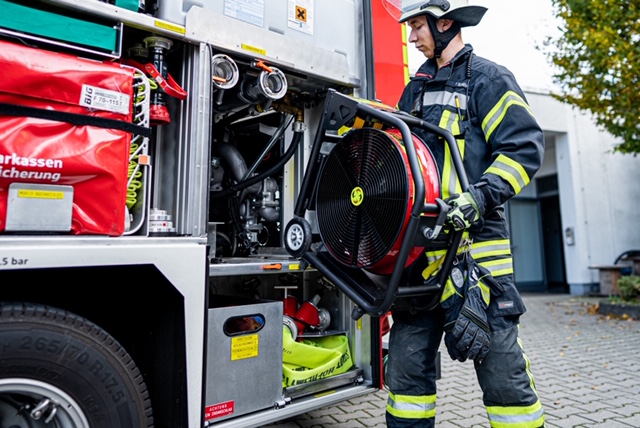
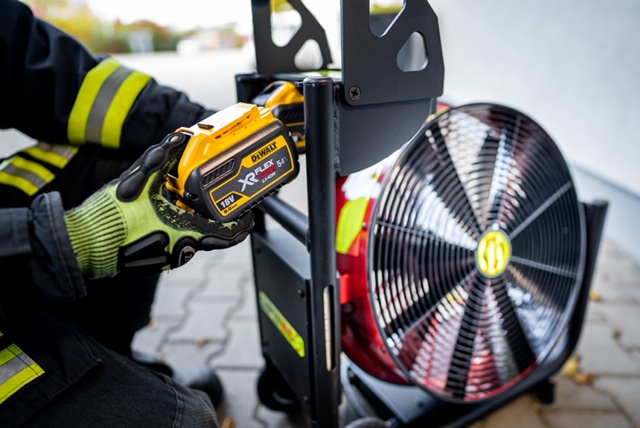
Battery fans are a great choice for quick ventilation jobs. They are compact and lightweight, and many of these fans deploy and store easily. Moreover, select manufacturers, like Super Vac, work with name-brand batteries (like DeWalt and Milwaukee), which create cross-compatibility with other battery tools giving the user more flexibility.  

Many battery fans provide more than 30 minutes of runtime, depending on battery selection. Meanwhile, optional AC power provides additional versatility and reliability. As you evaluate different fan airflows, be sure to look for third-party certified data!  
https://supervac.com/

Electric fans 

Electric fans provide a reliable and perfectly clean airstream with some models being intrinsically safe for hazardous locations. Additionally, electric fans are quieter and lighter than their gas counterpart. Look for fold-down handles and flat-proof tires that make these fans easily maneuverable.  

Electric fans require some setup as cords and generators are necessary to power these PPVs. Electric fans are also bulkier and heavier than battery fans but typically smaller and lighter than gas fans. A Super Vac battery fan can be equipped with AC power for a compact electric option.  

Petrol fans 

Petrol fans provide the highest airflows, making them a preferred choice for large structures. Petrol fans also set up more quickly than electric fans making it a go-to PPV for many first trucks at the scene. These fans are the largest, starting at 40cm and going up to 76-200cm diameter.  

Although petrol fans are powerful, they can add byproducts of combustion into the airstream, if not equipped with a catalytic converter. Additionally, these fans require gas, oil and maintenance, and because they re engine powered, petrol fans are louder than battery or electric fans.  

Water Turbinefans 

Water turbine fans run without the use of electricity or gasoline, making these PPVs great in explosive locations with unknown gases. Available in 76cm, this is the largest portable PPV safe for these environments, making this fan a favorite for docks and shipping facilities.  

Water turbine fans require more setup, including 7-17 bar water supply. Due to this high consumption (250 or 500 lpm, depending on model), it’s recommended the water be recirculated. This fan also has less tilt than some battery and electric models.  

Ensure you pick the right size fan 

Size is another key factor, especially when space comes at a premium on most fire apparatus. Petrol blowers and high-capacity electric fans require considerable storage and are often relegated to support apparatus. But modern battery PPV fans are smaller. At just 21 kgs and 66cm x 66cm x 30cm, the Super Vac battery fan is compact and can actually be stored on its side in shelf-style compartments.
Meanwhile, Super Vac also offers the largest breadth of PPVs, spanning from the 20cm diameter confined space Nano to the trailer-mounted 200cm diameter BFF, which produces approximately 1.25 million cubic meters of air per hour, ideal for ventilating tunnels, airports and other large structures. To help narrow down your selection, consider how much room you have on your truck to store your fan, evaluate the size and types of structures in your jurisdiction and decide how much output you need from your fan.  

Once you’ve identified your power source and a general fan size, you can select your preferred motor or engine. Do you need single- or variable-speed functionality? Do you need to spec an ATEX motor for hazardous locations? Pneumatic motors feature compressed air and make these fans intrinsically safe for hazardous environments. Pneumatic- and water-powered motors, which use intrinsically safe power sources, are another option in hazardous environments.  

Avoid noise pollution effecting communication  

Another consideration … noise pollution. Noise is one of the major drawbacks associated with mechanical ventilation, which is especially true of petrol-powered fans. Noise pollution can adversely affect fireground communication, both in close proximity to the fan and within the structure itself. However, noise is no longer an issue for battery fans. The decibel reading for Super Vac’s V18-BD fan produces an 85 dB reading at 1 meter in front of the fan, and 75 dB from 3 meters, which is only slightly louder than the sound a shower makes. With these quieter fans comes improved communication. (Tack on the fact battery fans produce less airborne cancer-causing agents and you can see why battery technology is growing in popularity.)  

Finally, decide what PPV add-ons you need to add more functionality to your fan. Select fans can be equipped with accessories that create light, foam, mist or even heat to aid in rescue and rehab efforts. Different fan guard options give crews the ability to adjust fan-entryway setback, while a door bar / hanger kit allows the fan to be mounted in a doorway to elevate airflow. Meanwhile, smoke curtains can be used to help control oxygen while maintaining door control and mitigating smoke damage, and spiral ducts are perfect for helping move large quantities of air into hard-to-reach places, like confined spaces. For gas fans, consider spec’ing an exhaust hose extension to remove emissions away from the PPV intake, or a catalytic convert to significantly reduce emissions.  

NFPA celebrates milestone with 125th Anniversary Conference Series

The Association will also launch a virtual 125th Anniversary Conference Series.

The National Fire Protection Association (NFPA) is celebrating its 125th anniversary this year and plans to commemorate the momentous milestone through a series of events and initiatives that reflect the steadfast commitment to fire, electrical, and life safety by the Association. Key to the celebration is the launch of a virtual 125th Anniversary Conference Series that replaces the traditional in-person 2021 NFPA Conference & Expo. The online conference series runs from May 2021 through March 2022.

“This is a year of celebration and education,” said NFPA President & CEO Jim Pauley. “We created a year-long virtual conference series to be able to offer a more tailored and personalized experience for participants. From comprehensive workshops to discussions on the latest advancements in fire technology, what participants learn in these sessions will improve safety around the globe.”

The conference series features 10 one-day programs for building, electrical, and life safety professionals and practitioners that collectively offer more than 100 informative education sessions, engaging content, industry roundtable discussions, networking opportunities, live chat sessions, and exhibitor demonstrations. Led by leading industry experts, program sessions cover a broad range of topic areas from the impact of new technology on codes and standards and the use of data to drive safety, to community risk reduction and public education strategies aimed at protecting people and property. The sessions are designed to help professionals adjust to changing industry needs and more effectively and efficiently perform their daily work.

Since 1896, NFPA has furthered safety by facilitating the development of codes and standards, research, and education for fire and related safety issues. The Association has seen success through the tireless work and support of its more than 250 technical committees comprised of approximately 9,000 volunteers from 42 countries, its more than 40,000 global members, and countless professionals who use NFPA resources to fulfill the mission of reducing loss.

“Just about anywhere people go, the impact NFPA has on their safety is ever-present in their daily lives,” said Pauley. “From cultural icons and industrial and energy storage plants to entertainment venues, libraries, marinas, homes, and businesses, NFPA codes and standards provide critical safety benchmarks to ensure people and property are protected from harm.”

The 125thConference Series will kick off on May 18 with an Empowering Electrical Design, Installation, and Safety” one-day program. Participants can take advantage of two learning tracks and nine sessions that focus on issues related to design and installation, new and emerging technology, and workplace safety in the electrical landscape.

Find more information about the NFPA 125th Anniversary, Conference Series, and the electrical program at nfpa.org/conferenceseries.

FEMA to host webinars on wildfire threats

In response to Colorado’s devastating wildfires in 2020, FEMA and the State of Colorado are hosting a series of webinars to help residents understand increased threats to their homes, lives and property following the Cameron Peak and East Troublesome fires and prepare for the upcoming wildfire season. 

Discussion topics will include wildfire preparation and recovery, increased flood risk, agricultural recovery and understanding insurance options. Panelists will answer questions and provide informative resources to help residents with their recovery.

To participate please follow the link to register for a specific webinar session:

These presentations will be available in closed caption and ASL format. If you require an alternative format of available information, please submit your request to Region8AccommodationRequest@fema.dhs.gov.

ClorDiSys offers grant for vehicle disinfection equipment

In efforts to provide necessary health and safety equipment to first responders, ClorDiSys Solutions, Inc, headquartered in Branchburg, NJ, partnered with EMSGrantsHelp to expand its grant funding assistance program to include ClorDiSys’ ultraviolet light disinfection equipment.

Through this program, ClorDiSys can aid EMS, Fire and Rescue, Law Enforcement, and Local Government receive free assistance from industry professionals. The amount of grant dollars available has remained strong across the country, however navigating through the grant application process can be challenging.

Departments often fail to be awarded a grant due to inexperience in this area. ClorDiSys is dedicated to helping organizations receive assistance for the time-consuming work involved in creating a compelling application to secure funding for disinfection equipment and keep themselves and their patients safe.

Through ClorDiSys’ sponsorship program, first responders can obtain customized grant help for grant research, grant alert notices and grant application reviews from EMSGrantHelp. The item of highlight is ClorDiSys’ Lantern. It is a UV-C disinfection unit designed specifically for ambulances after the firm’s involvement with providing UV-C devices for University of Nebraska Medical Center during the 2014 Ebola crisis. 

The Lantern serves first responders well as a lightweight, durable unit that is easily portable from rig to rig and can be used both in the upright or inverted positions to maximize light exposure. The device is calculated to get a 99% reduction of bacteria and viruses within 1 minute and spores, like C. diff, within 3 minutes for a vehicle setting. The UV-C bulbs are also validated to deactivate the SARS-CoV-2 virus.

First responders provide critical services, so it is essential for their environment to be as safe as possible and pathogen free. This allows patients to be treated in a safe environment and to help maintain the health and well-being of those on the front lines. Since financial challenges are spread throughout the entire nation, ClorDiSys hopes this grant assistance program will help alleviate that area of concern. 

Established in 2001, ClorDiSys Solutions, Inc is a New Jersey based business that manufactures sterilization and disinfection equipment and provides decontamination services. Its ultraviolet light disinfection line of products was initiated in 2014 and devices have been used across all industries to prevent or eliminate the spread of pathogens. 

First Arriving and netDuty help simplify scheduling for emergency response

First Arriving, a leader in providing technology and marketing services for fire, EMS, and law enforcement agencies has partnered with netDuty, an online workforce management system for emergency response agencies, to deliver streamlined scheduling solutions through First Arriving’s Digital Dashboards.

netDuty delivers an easy to use, yet powerful solution for managing the complex scheduling needs of emergency response agencies. It also meets the challenges that first responders face and has custom tools to overcome the complexities of scheduling and time tracking, minimising paperwork and increasing efficiency. 

First Arriving’s integration with netDuty shows a daily roster right on each customer’s Digital Dashboards. It also allows for personnel assignments, events, notes, and a sign-up feature to be displayed front and center.

“The integration between netDuty and First Arriving provides our shared users another channel of communication for daily operations,” said Allen Fremier, President, netDuty Online. “Together, we ensure relevant and timely information is easily available to department personnel in a consistent, accessible manner.”

“Partnering with netDuty has simplified scheduling for First Arriving’s Digital Dashboard customers,” said Ross Hopkins, Product Director, Digital Dashboards, First Arriving. “This integration saves departments valuable time and resources by bringing time-consuming processes online.”

First Arriving’s Digital Dashboard systems service fire departments, EMS, law enforcement, courts, and local governments. From small volunteer departments to some of the nation’s largest public safety agencies, First Arriving’s Dashboards now serve departments in more than 30 states coast-to-coast.

To learn more about First Arriving’s Digital Dashboards, visit: firstarriving.com/dashboards.

National Fallen Firefighters Foundation releases 2020 Report

The National Fallen Firefighters Foundation (NFFF) has launched its 2020 Annual Impact Report.  This year’s impact report outlines how, through continued support, NFFF have been able to continue their efforts to honor and remember America’s fallen fire heroes, assist their families, and to reduce firefighter line-of-duty deaths and injuries.

Congress created the 501(c)(3) non-profit NFFF in 1992, located in Emmitsburg, Maryland, the home of the National Fallen Firefighters Memorial. The Foundation relies on support from caring individuals, organisations, and corporations, to support programs such as the Fire Hero Family Network, the Hal Bruno Camps for Kids, Fire Hero Family Wellness Conference, Peer Support, Scholarship Programs, the National Fallen Firefighters Memorial Weekend, and the Everyone Goes Home program.

While COVID-19 may have restricted the NFFF’s ability to carry out its programs in-person in 2020, the Foundation’s pursuit of its mission never waned. Virtual gatherings replaced in-person events and the Foundation continued to serve our Fire Hero Families and firefighters.

COVID-19 caused some interruption to fundraising efforts, but the continued support of our corporate partners, donors, and volunteers, helped the NFFF to continue to fulfill its mission.

The NFFF will continue to carry out its mission in 2021, and will continue to assist the families of fallen firefighters and the fire service.

A copy of the NFFF’s 2020 Annual Impact Report can be downloaded at https://firehero.org/2020-impact.

First Due launches tech in the fire service survey

First Due is partnering with Fire Chiefs across the U.S to help shape an all-encompassing guide software in the Fire Service built for 2021. All results and data will be collected anonymously.

The team at First Due is calling on leadership at agencies across North America to contribute their experiences and perspectives to the Fire & EMS Leader’s Guide to Software 2021. “Our goal is to learn from chiefs and deliver an analysis of the challenges agencies are facing related to software” explains First Due Head of Marketing, Ron Kanter.

More about the Survey:

  • The survey can be completed in less than 5 minutes.
  • All results will be tabulated, and data will be released within the Fire & EMS Leader’s Guide to Software 2021.
  • All survey submissions and results will be kept anonymous. Your information will not be shared with any third parties and always kept confidential.
  • Two weeks after survey completion participants will receive the first copies of the Fire & EMS Leader’s Guide to Software 2021.

WHAT WILL BE IN THE 2021 GUIDE?

  • In-depth analysis of the status quo in Fire & EMS software.
  • A summary of anticipated technology adoption trends.
  • Insights into Command Staff software priorities, and the strengths and weaknesses of common technology environments.

To take the survey, please follow this link and get started.

Bill to provide payment to families of first responders approved

A bill that would see families of first responders killed in action receive a one off payment of $50,000 has moved a step closer.

The Nebraska bill, first introduced by Senator Matt Hansen has moved to the final stage after it was approved by Senator Michael Flood.

Should the bill pass the final stage, it would mean that families would be eligible to apply for compensation within the first year of the death of their family member.

A bill that is already active includes payments for families of fallen police officers, firefighters and public ambulance service members.

Supporting First Response to Large-Scale Biological Events

The Bipartisan Commission on Biodefense will premiere a virtual meeting on Tuesday, March 23. Titled, Holding the Line on Biodefense: Supporting First Response to Large-Scale Biological Events, leaders from the International Association of Fire Chiefs and the National Association of State Emergency Medical Services Officials will be among those discussing their response to COVID-19 and how the federal government can better support first responders during a biological incident.

“Police, fire, emergency medical services, hazmat, dispatchers and other first responders form the backbone of local government efforts to react to biological threats,” said Commission Co-Chair, former Senator Joe Lieberman. “The federal government has left the Nation’s first responders ill-equipped and underinformed when it comes to addressing events like the ongoing COVID-19 pandemic. We look forward to hearing from these outstanding national leaders who can provide valuable insights into what steps the federal government must take to prevent similar problems during future biological events.”

Among those scheduled to present are Dia Gainor, Executive Director, National Association of State Emergency Medical Services Officials and Rob Brown, Executive Director, International Association of Fire Chiefs.

“First responders require resources and information so that they can effectively manage the biological threat, keep the public informed, and make decisions about using medical countermeasures themselves,” said Commission Co-Chair, former Governor Tom Ridge. “The Commission’s 2018 report that focused on state, local, tribal and territorial governments uncovered vulnerabilities for first responders. The pandemic reminds us that these aren’t some fictional scenarios we must plan for, but real-time crises that require strong support from the federal government.” 

The meeting will be held virtually on March 23 beginning at 10am. To register, and for a full list of participants, please visit the events page on the Commission website, www.biodefensecommission.org/events/.

Firefighters & EMS Fund calls for better cancer protection

Currently, North Carolina firefighters only receive presumptive protection benefits against three types of cancers. This means that there are only three forms of cancer- – that the North Carolina government acknowledges as occupational hazards and cover as guaranteed benefits for firefighters. Firefighters & EMS Fund, a grassroots political organisation, is standing with North Carolina firefighters that are putting pressure on elected officials to pass a House Bill 520 that would label 9 types of cancer as occupational diseases and be covered by health care under the Workers’ Compensation Act.

As of now, North Carolina is the last state in this country without comprehensive cancer coverage for firefighters. Without this coverage, if firefighters get cancer they are left footing the bill themselves. And Asheville Fire Chief Scott Burnette said cancer is the leading cause of line-of-duty deaths among firefighters. His department lost two firefighters to cancer in the past three years. This is a pervasive risk and safety concern for our firefighters, even after retirement, and it should not drive these men and women into bankruptcy to have their health cared for appropriately.

“The link between these types of cancers and working in the fire industry are well documented and known, and have been for quite some time,” Firefighters & EMS Fund Executive Director Nile Porter commented. “With this clear understanding, it should be common and guaranteed that the state government would acknowledge the danger cancer poses to firefighters and put benefits in place that cover the medical bills.”

“We understand the state wants to save money, but firefighters were owed this protection from day one. It is past time for the elected representatives of North Carolina to step up and provide this basic protection to the heroes that risk their own lives and safety to keep our communities safe,” concluded Mr. Porter.