“RapidDeploy has entered a stage of hypergrowth, and with the trust of major companies in public safety and telecommunications like Samsung and Ericsson, we are well-positioned to assist public safety officials across the country as they transform their 9-1-1 centers,” said Steve Raucher, CEO and co-founder of the company. “Over the last two years, we have fulfilled statewide contracts in Arizona, California, and Kansas, while implementing our platform in over 650 9-1-1 Centers across America. This investment allows us to continue our trajectory and make data-driven Unified Critical Response the industry standard.”
Since the National Emergency Number Association (NENA) set its initial goals for Next-Gen 9-1-1 services in 2001, states have slowly adopted a new system of emergency services IP networks, software services and data management processes connected directly to equipment in the public safety answering points (PSAPs). RapidDeploy’s products, including RadiusPlus, Eclipse Analytics and Nimbus CAD, represent a major step forward for local, regional and state governments.
“The future of emergency services is in data, which creates a faster, more responsive 9-1-1 center,” said Mark Dyne, Founding Partner at Morpheus Ventures, who just recently joined the company’s Board of Directors. “We believe that the platform RapidDeploy has built provides the necessary breadth of capabilities that make the dream of Next-Gen 9-1-1 service a reality for rural and metropolitan communities across the nation and are excited to be investing in this future with Steve and his team.”
Through its integrated mapping platform, RadiusPlus, RapidDeploy delivers data from smart phones, vehicles, home security systems and more directly to 9-1-1 telecommunicators working in one of America’s 6,000+ PSAPs. Through Eclipse Analytics, RapidDeploy offers customizable reporting and analytics on real-time call data that supports data-driven, operational performance improvements. Finally, RapidDeploy’s Nimbus CAD delivers a comprehensive, highly configurable, web-based dispatch platform that uses sophisticated location mapping and real-time data to ensure rapid and informed response.
RapidDeploy has integrated supplemental emergency data from the most trusted names in technology and public safety, including AT&T, Apple, Google, Microsoft, and OnStar among other integrations in RapidDeploy’s Unified Critical Response ecosystem.
Rave Mobile Safety (Rave), the critical communication and collaboration platform customers count on when it matters most, today announced that the company will celebrate Smart911 Day on April 30, dedicated to encouraging communities and residents to participate in the Smart911 program.
The Smart911 national registry is a free service that allows individuals and families to create Safety Profiles online and provide key information to 9-1-1 dispatchers during an emergency. Smart911 Day is a great way to support 9-1-1 dispatchers and first responders as we close out 9-1-1 education month and National Telecommunicator Week.
Created in 2009, Smart911 has been proven to supply critical background information and situational context to first responders so they can provide the most informed emergency response. Residents can quickly and easily create a Safety Profile for themselves and their households at www.smart911.com or on the Smart911 App that includes any information they want 9-1-1 and response teams to have in the event of an emergency. When a resident makes an emergency call, their Safety Profile is automatically displayed to the 9-1-1 call taker, allowing them to send the right response teams to the right location with the right resources. Profiles include pertinent information that can help first responders provide a more personalized response, such as:
Emergency contact information
Medical history, including medications, medical conditions and mental health history
Property details, layouts and utility information
Number of people and pets living on the property
“Smart911 has given our first responders a leg up when responding to an emergency, giving them the information needed to arrive on scene prepared with the right resources,” said Dennis Darouse, Director at Tangipahoa Parish, LA 9-1-1. “Seconds and details count in emergency situations, and Smart911 plays a critical role in ensuring the best outcomes for those in our community.”
Smart911 has been a lifesaving resource in critical situations. The tool has been credited with positively impacting emergency outcomes including:
A missing elderly resident with dementia, in which the person’s photo and physical description were immediately available to 9-1-1 and responders
A heart attack victim where an address and medical notes allowed responders to be dispatched to his location quickly
A child with autism who was having a mental health crisis, whose condition was noted in a Safety Profile allowing first responders to walk into the situation prepared
Travis King, who has autism, was six years old when he walked out of his house and could not be found. His mother, Threasa, called 9-1-1 and Travis was eventually found unharmed in an irrigation ditch. Threasa feared what would happen the next time her son disappeared and made it her mission to find a way for 9-1-1 dispatchers and first responders to know about Travis’ condition and history.
To help first responders better respond to and prepare for emergencies involving those with disabilities, Threasa is spearheading efforts around the Travis Alert Act. This legislation enables the disabled to document their conditions through 9-1-1 systems enhanced with programs like Smart911 so dispatchers will instantly know about a person’s disabilities when a 9-1-1 call about them is made.
“Smart911 has proven to be a life-saving resource, not just for those with autism, but for anyone who finds themselves in an emergency situation,” said Threasa King, mother of Travis King. “With Smart911, first responders are immediately provided key details that allow them to walk into emergency situations more prepared and informed. I urge and encourage everyone to sign up for Smart911 – the details provided through this important program can be life-saving, for those with autism and beyond.”
Smart911 is currently available in all 50 states and more than 3,500 municipalities across the country.
All information included in a Smart911 Safety Profile—from addresses and vehicle details, to pets in the home and emergency contacts—is optional, and the resident can choose what details they would like to include.
The Smart911 App is available on the Apple Store or Google Play. Individuals are encouraged to create their Safety Profile with Smart911 today to have their information immediately available to 9-1-1 and to receive emergency notifications. Smart911 is private and secure, is only used for emergency responses and only made available to the 9-1-1 system in the event of an emergency call.
Organizations and residents who want to advocate to setup Smart911 for their community can find more information here. Public safety officials who want to learn more about getting Smart911 for their community can learn more here.
Javier Castro, General Manager, EMEA at Perimeter Solutions outlines why recent developments mean a transition to FFF is happening faster than anticipated
The industry has been eager to find alternative options to synthetic Aqueous Film Forming Foams (AFFF) and Alcohol-Resistant Aqueous Film Forming Foam (AR-AFFF), which contain perfluoroalkyl and/or polyfluoroalkyl substances (PFAS) to comply with newer environmental regulations, but fluorine-free firefighting foams (FFF) simply have not been able to meet the performance level of AFFF and AR-AFFF in certain fire situations, so making a complete transition has not been possible up to this point. But, that’s changing. At Perimeter Solutions, we compared fluorine-free foam to AFFF in testing conducted in 2016 and then again in 2021, and the results show that FFF is quickly closing the performance gap.
2016 – First Round Goes to AFFF
In 2016, we were curious to find out what the limitations were, if any, with FFF compared to AFFF, so we put FFF to the test.
At the time of testing, we felt that the ideal situation would be that FFF would show the same performance and properties of AFFF, but the testing didn’t bear that out. We tested five different AFFF products and compared them with five different FFF products (from six manufacturers). Three of the FFF products were 3×6, one was 3×3, and a fifth was a 3% type (non-AR). Meanwhile, three of the AFFF products tested were 3×3 and two were 3×6. Selection was based on the technology that was available from the selected manufacturers at the time of testing.
Reviewing the results of Fire Control Performance, AFFF foams were able to control flames started by diesel fuel (flash point between 52-96 degrees Celsius) seven percent faster, on average, than the FFF. With heptane (flashpoint -4 degrees Celsius), AFFF controlled flames six percent faster compared to FFF, on average. The real differences were seen with Jet Fuel (flashpoint 40 degrees Celsius), where AFFF controlled the fire 50% faster, and with gasoline (flashpoint -40 degrees Celsius), where the control time for AFFF was 60% quicker than FFF.
FFF products had a harder time when compared to AFFF with Extinguishment. All AFFF and FFF selections were successful in extinguishing flames started by diesel fuel. In fact, all AFFF varieties were successful in extinguishing flames started by Heptane and Jet A1 fuels, and only one was late in putting out a fire started by Gasoline.
Not one FFF was successful in extinguishing a fire started by Jet A1 fuel, and only three were successful on heptane
Not one FFF was successful in extinguishing a fire started by Jet A1 fuel, and only three were successful on heptane (one of which was late in dousing the fire). Results on gasoline were a little more encouraging for the FFF entries. Two of the manufacturers’ products were able to control fires started by gasoline. Again, all of the AFFF products successfully controlled the flames, and three of the AFFF varieties easily outperformed the two fluorine-free foams that could actually contain the flames.
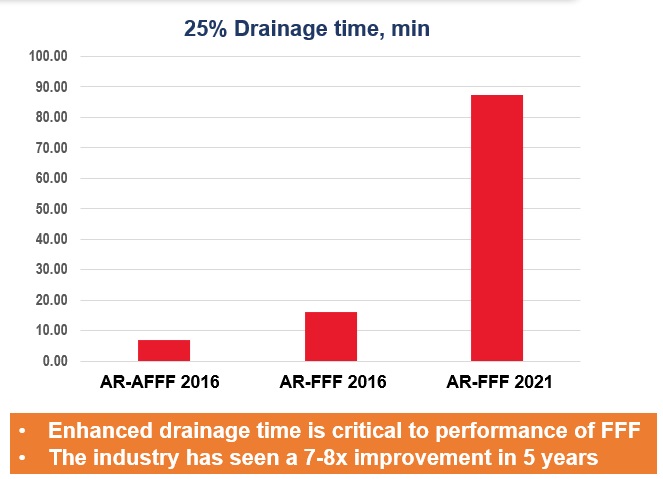
In 2016, FFF compared favorably to AFFF when considering viscosity. The five fluorine-free foams tested had 35% higher viscosity than the AFFF varieties, on average. Higher viscosity increases the stability of the foam, slowing drainage time, which improves extinguishment time.
The tests concluded that FFF were not nearly as effective as AFFF in controlling or extinguishing certain types of fires.
2021 – It’s getting better all the time
Earlier this year, we put FFF to the test again to determine whether five years of technological advancements helped the foam to catch up with AFFF. This time around, we were able to put four 3×3 versions of FFF to the test. The results were promising.
Regarding fire control performance, we witnessed dramatic improvement over the last five years. Recall in 2016 that not one FFF could extinguish flames started by Jet A1 fuel. In 2021, all four FFF tested successfully extinguished the flames. Meanwhile, only two FFF could extinguish fires started by gasoline in 2016—but again—all four FFF tested in 2021 put the fire out. What is more, the control time reduced significantly for both gasoline and Jet A1 fires, and based on the gains made since 2016, the performance of FFF should be equivalent with AFFF in short order and could potentially surpass it.
Looking at viscosity, in some cases manufacturers have brought 3×3 products to market with lower viscosities than there were in their 3×6 counterparts from five years ago. This has led to reduced use on polar solvents and dramatically lowered costs, while improving handling and use.
The results of the more recent round of testing demonstrate the progress fluorine-free has made, and why it continues to gain wider acceptance
The results of the more recent round of testing demonstrate the progress fluorine-free has made, and why it continues to gain wider acceptance. In addition to California’s Senate Bill calling for the state to transition to fluorine-free foam , Heathrow, Copenhagen, Schiphol airports in Europe have transitioned to FFF along with 27 major airports across Australia and most airports in New Zealand. At Perimeter Solutions, we have helped numerous airports transition to FFF, including Schiphol Airport in Amsterdam, Copenhagen Billy Bishop City Airport in Toronto and Lehigh Valley Airport in Pennsylvania (USA).
Looking Ahead
New rules and regulations are being introduced around the world that are moving the industry toward greater use of fluorine-free foams. As our testing demonstrated, there is still room for growth, but FFF was able to catch up with AFFF over the past five years.
As a case in point, we just introduced SOLBERG® AVIGARD™ 3B and 6B for the aviation market, and SOLBERG® VERSAGARD™ AS-100 for oil & gas and general firefighting applications. The latter is a 3×3 fluorine-free foam concentrate that contains no intentionally added PFAS chemicals and is designed for extinguishing and securing both Class B and deep-seated Class A fires. We will continue to invest to advance fluorine-free foams and introduce new solutions as the industry gets closer to fully transitioning away from AFFF and AR-AFFF solutions.
Fire Prevention Program Manager Online Training Series
In recent weeks, massive building under construction fires have occurred in Las Vegas, Nev., Dallas, Tex., and Everett, Wash., underscoring NFPA research which shows an average of 3,840 fires in structures under construction and 2,580 fires in structures under major renovation per year. Building under construction fires cause an average of four civilian deaths, 49 civilian injuries, and $304 million in direct property damage annually, while fires in buildings undergoing major renovation cause an average of eight civilian deaths, 52 civilian injuries, and $104 million in direct property damage annually.
“We need to enhance safety on construction sites by ensuring that more building owners, contractors, trade workers, and code enforcers are informed about construction site fire prevention and protection strategies,” NFPA President and CEO Jim Pauley said. “This new online learning, centered around NFPA 241, was developed in the spirit of the NFPA Fire & Life Safety Ecosystem, which emphasizes the importance of applying referenced standards, investing in safety, and a skilled workforce.”
Although NFPA 241 calls for a fire prevention program manager, credentials for the role are virtually non-existent in the market today. To help construction company leaders, building owners, job site supervisors, code officials, fire marshals, facility managers, and fire protection engineers have the skills needed to ensure the safety of buildings under construction, NFPA developed the new five-hour, five-part online learning series, assessment, and digital badge based on the anticipated job performance requirements (JPRs) for fire prevention program managers proposed for the next edition of NFPA 241.
The training covers general fire protection awareness for all people on construction sites and the role of fire prevention program managers on a construction project with an emphasis on:
Building safety and fire protection systems
Hazard protection
Inspections, permits and procedures
This NFPA online training series is intended for fire prevention program managers who are new to the role. The course is designed to help learn how to actively manage a fire prevention program for a typical construction project. Find out more about the new online learning here.
Addressing Fire Safety Challenges During Construction Webinar
The NFPA webinar scheduled for April 15 will feature a panel of industry experts discussing key considerations for construction site fire safety, including fire risks and the role of the fire prevention program manager, with time allotted for a robust Q&A session.
Webinar panelists providing perspective on the topic include:
Jim Begley, PE, FSFPE, CFM, TERPconsulting, principal
Matthew Bourque, PE, WS Development, director of Fire Protection and Construction Operations
Dick Davis, PE, FM Global, AVP, senior engineering technical specialist
Nicholas Dawe, division chief/fire marshal, Cobb County (Ga.) Fire and Emergency Services
National Volunteer Week is coming up on April 18-24, and this is a great time to both recognise the volunteers in your department and recruit new members. The National Volunteer Fire Council (NVFC) is also marking the occasion with a series of initiatives to support the volunteer fire, EMS, and rescue community.
Throughout National Volunteer Week, the NVFC will be sending out eblasts and information highlighting special opportunities available to members of the volunteer fire and emergency services. You can get an advance look at some of these initiatives here. Additional opportunities will be announced during the week. If you do not currently receive the NVFC’s Dispatch newsletter and eblasts, sign up now to make sure you receive these notices.
Also tune in for some special events happening in honour of volunteers. On April 20, renowned speaker Neen James will be presenting a webinar to discuss how to achieve more with less time, a topic particularly useful for volunteer firefighters who typically have many competing priorities. On May 4, the NVFC will recognise International Firefighters’ Day with a special Facebook Live discussion featuring volunteer firefighters from across the globe.
For departments looking to use National Volunteer Week to recruit new members, check out the new recruitment materials now available in the Make Me A Firefighter campaign department portal. It is free to register, and you can use the materials generator to create and customize a variety of outreach materials, including social media posts, flyers, postcards, table tents, and more. Remember to add your volunteer opportunities to the national database so prospective volunteers can find you when they go to www.MakeMeAFirefighter.org.
In addition, you can learn tips for recruiting new members by watching this Facebook Live discussion on Fire Service Recruitment Solutions During COVID-19 and Beyond.
National Volunteer Week is also the perfect time to thank the volunteers in your department for the hard work and dedication they put in all year. Recognition can take many forms, such as a press release to local media, a post on your department’s web site and social media, a proclamation through the city or town council, handwritten thank you notes to all your volunteers, or small tokens of appreciation. Find more ideas for volunteer recognition from Fire Corps and Points of Light. To give your volunteers national recognition, your department can become a certifying organization for the President’s Volunteer Service Award.
The National Fire Protection Association and State Farm has announced the recipients of the 2021 Wildfire Community Preparedness Day Project Awards.
Preparedness Day encourages people and organizations to come together on a single day to take action to raise awareness and reduce wildfire risks, and it provides a platform to share information and offer guidance to residents as they make changes to improve the survival of their homes and neighborhoods. Given that in-person gatherings are limited or on hold in many areas, this year’s event focuses on what people can do on and around their home to help protect against the threat of wildfire. Thanks to generous support from State Farm, 150 communities across 24 states will receive project funding awards of $500 each to support their wildfire mitigation activities on Preparedness Day. See the list of winners.
“As the largest home insurer in the U.S., it is important that we take a leadership role in helping homeowners stay safe and better protect their property,” said Vickie Hodges, P&C Underwriting Analyst at State Farm. “Since working with NFPA on the first Preparedness Day event in 2013, we have seen an increase in the number of grant applications each year. We are pleased to provide 150 communities with a grant to help fund wildfire risk reduction activities on May 1.”
Over the past decade, the U.S. has witnessed a steady rise in wildfire activity. Experts predict this trend will continue. Despite the $2 to $3 billion per year to support wildland fire suppression efforts, the number of homes lost in wildfires per year has increased by more than 160 percent.
“Voluntary individual and community actions remain a key component to reducing wildfire risk around homes and neighborhoods,” said Lorraine Carli, NFPA vice president of Outreach and Advocacy. “Preparedness Day serves as a reminder to homeowners about the simple but effective steps they can take to prepare ahead of a wildfire. It is inspiring to see the great work these communities are doing to reduce their risk.”
There is still time to make homes and communities safer from wildfire. NFPA and State Farm encourage people to get involved by planning a project and participating on May 1. Take the first step with the help of NFPA’s free Wildfire Community Preparedness Day Toolkit.
Anheuser-Busch and the National Volunteer Fire Council (NVFC) are teaming up for the third year to provide critical hydration to volunteer fire departments responding to wildfires through the Emergency Drinking Water for Wildland Firefighters program.
The program is an expansion of Anheuser-Busch’s longstanding tradition of providing emergency drinking water and supplies for disaster relief efforts. Anheuser-Busch is continuing its commitment in 2021 by pledging to donate 1.5 million cans of clean drinking water to help keep wildland firefighters hydrated as they protect and strengthen their communities. Since the program began in 2019, over 3.2 million cans of water have been distributed to more than 520 departments in 47 states.
“Hydration is a vital component to firefighter health and safety, and an important part of keeping firefighters functioning at their best during response,” said NVFC chair Steve Hirsch. “We appreciate Anheuser-Busch’s ongoing commitment to support our volunteer boots-on-the-ground responders. This is an invaluable program that provides a critical resource to volunteer departments, so they can use their limited budgets on other necessities.”
“Our emergency drinking water program is a tremendous source of pride for all of us at Anheuser-Busch as our way of recognizing the efforts of those who help us build stronger, more resilient communities in times of need,” said Julio Suárez, senior director of community affairs at Anheuser-Busch. “Providing these critical hydration resources to our nation’s brave firefighters is our way of saying thank you for their efforts and sacrifices for the continued safety of our communities.”
To apply for the emergency drinking water, departments must be located in the U.S., annually respond to wildfires, be over 50 percent volunteer, and serve a population of 25,000 or less. Departments in declared emergencies due to wildfire will also be able to request water outside of the application period to help with their immediate wildfire response needs.
The application period is open through April 23 or until all water has been allocated. Visit www.nvfc.org/water to apply and for additional information about the program.
The National Fire Protection Association (NFPA) and the Phoenix Society for Burn Survivors have introduced an additional, final video interview of its Faces of Fire/Electrical series, which features personal stories of people impacted by electrical incidents and demonstrates the need for continued education and awareness about electrical hazards in the workplace and at home.
In August 2004, Don Johnson, an electrician from Florida, was at work connecting a client’s backup generator for use during an impending hurricane when a failure of his rotation tester or a loose clip shorted out in a 4,000 amp/480-volt switchgear section he was working on, creating an arc flash event that destroyed much of the equipment and blew him against a wall nearly killing him. Johnson survived but suffered third-degree burns on his face, neck and arms, and spent years recovering from his injuries.
Arc flash, also known as flashover, is the light and heat produced as part of an arc fault, and a type of electrical explosion or discharge that results from an unintended electrical connection through the air to ground or another phase of the electrical system. An arc flash is one of the most devastating and deadly electrical hazards present in today’s workplace; it can produce temperatures as high as 35,000 degrees Fahrenheit and cause severe burns, hearing loss, eye injuries, skin damage from blasts of molten metal, lung damage, and blast injuries. An NFPA report estimates that five to 10 arc flash incidents occur every day, and more than 2,000 people are treated annually in burn centers with arc flash injuries.
“Electrical professionals face numerous hazards every day on the job, including shock, electrocution, arc flash, and arc blast, therefore it is critical that employers and workers take a shared responsibility for safety protection including the creation and implementation of an electrical safety program,” said Lorraine Carli, NFPA’s vice president of Outreach and Advocacy. “The Faces of Fire/Electrical campaign reminds us that ignoring even basic safety rules can lead to serious injuries and death.”
Both shock and arc flash, in addition to other electrical hazards have been the focus of NFPA 70E®, Standard for Workplace Electrical Safety® and OSHA standards since the late 1970s. NFPA 70E emphasizes the importance of performing a solid risk assessment that examines all aspects of the hazards to which employees are exposed and provides a valuable tool to determine how best to mitigate the potential danger.
Faces of Fire/Electrical features personal stories of electrical burn survivors whose lives have been forever altered and how more understanding, training, and a change in work culture could have significantly impacted these outcomes. Woven into these stories of resilience is an additional interview with a physician dedicated to the complete physical and emotional healing of patients suffering from a burn injury. A recent NFPA Podcast features three renowned doctors whose research and work with electrical burn patients helps explain what a powerful shock can do to the body, the treatments available, and how an understanding of these injures is continuing to evolve. Through these interviews, written profiles, and related information, Faces of Fire/Electrical is a resource for electrical and non-electrical workers, and the general public to learn more about the importance of electrical safety.
While many electrical injuries prove fatal, those that are not can be particularly debilitating, oftentimes involving complicated recoveries and lasting emotional and physical impact. The Faces of Fire/Electrical campaign ultimately works to help build a safer world by teaching others and supporting the burn survivor community in advancing lifelong healing, optimal recovery, and burn and injury prevention.
Since his injury, Johnson has returned to his company as a service manager and continues to advocate for electrical workplace safety.
A group of 31 legislators has reintroduced the Helping Emergency Responders Overcome (HERO) Act, HR 1480, in the U.S. House of Representatives.
The HERO Act looks to address the need for increased mental health resources within the fire service. The act was originally introduced the IAFF, who have held a long-standing dedication for the mental wellbeing of first responders.
Speaking after the announcement, General President Harold Schaitberger said: ““The HERO Act will help ensure emergency responders receive necessary resources to assist in detecting, treating and preventing mental health challenges.”
According to the IAFF, the HERO act will allow them to bolster their commitment by establishing a new grant program to train fire fighters as peer counselors, develop new guidance for fire departments on identifying and preventing post-traumatic stress disorder, provide information to mental health professionals on the culture within fire departments and evidence-based therapies to treat psychological issues common to fire fighters, and create a database to compile statistics on suicide among public safety officers.
Safety and emergency app Harbor have announced the launch of Harbor Premium, a paid subscription service within the app that adds critical features to help families during real-time emergencies. Harbor has partnered with ADT, a leader in safety and security, to integrate ADT’s proprietary mobile safety platform and industry-leading professional monitoring services into a new feature called HarborHELP.
This new feature allows users to be quickly connected to ADT’s professional monitoring team. ADT will contact the user, alert authorities, and share their location, as well as other user-provided, personally identifiable information to help emergency responders locate and identify them.
The subscription also includes a family access feature, allowing users to add an unlimited number of family members to their readiness plan to ensure everyone is in sync with where to go and what to do in the event of an emergency.
Harbor is a platform designed to help people be and feel safer in their everyday lives, through data-driven, hyper-personalised risk management tools, and step-by-step plans that make disaster preparedness easy and accessible. Harbor builds actionable readiness plans for everything from hurricane prep to food storage by analysing household details, NOAA, FEMA, and USGS data points, land maps, building codes, and other private data sources.
“Harbor looks at what causes stress and uncertainty in our lives, and gives users the tools they need to be resilient and prepared for the unexpected,” said Dan Kessler, Harbor CEO. “In any scary situation, we know so many of our users’ top priority is the safety of their family and loved ones — so Harbor Premium offers family features that ensure everyone from your 8-year-old to your mother-in-law will have access to the information they need to stay safe. Our users rely on us in emergency situations, and ADT gives us the confidence that when our users need help, they’ll quickly receive the right security resources and assistance.”
Harbor Premium adds new real-time risk mitigation features to Harbor’s emergency readiness platform, which recently announced enhanced risk assessment capabilities to offer highly personalised recommendations.
Features of Safety and emergency app Harbor Premium include:
HarborHELP: A simple slide of the HarborHELP button quickly initiates an S.O.S. and sends an alert to ADT. ADT will contact the customer, alert authorities, and share their location, as well as other user-provided, personally identifiable information to help emergency responders locate and identify them. HarborHELP users can chat directly with an ADT agent to report a disaster, fire, injury, gas leak, or security concern.
HarborFAMILY: Premium users can add an unlimited of number of family members to their account – granting each full access to premium features. Added members can access Harbor’s offline features and family emergency plans, get personalised risk assessments and action plans, and utilise ADT’s emergency response capabilities in the event of an emergency. This allows families to share important emergency information to everyone who might be in your home – from children and significant others to babysitters and in-laws.
HarborOFFLINE: Harbor users unlock access to hundreds of expert emergency guides as well as their personalised plan to help them navigate emergencies during cell tower and power outages.
Tapping into America’s largest network of security professionals
Harbor has partnered exclusively with ADT to integrate its proprietary mobile safety technology and 24/7 professional monitoring into HarborHELP. ADT will provide emergency assistance to HarborHELP users who feel unsafe, allowing them to connect – by voice or SMS chat – with ADT.
“ADT is dedicated to helping protect and connect people and the things they love most,” said Leah Page, Vice President, Mobile Security & Strategic Projects at ADT. “Harbor customers now have more options than ever to stay safe wherever they are, backed by America’s most trusted security company.”
Harbor Premium will roll out starting in February for less than $11 per month covering unlimited accounts — enabling users to protect family and loved ones for just dollars a day. Download the app now or learn more at helloHarbor.com and www.adt.com/partners/harborapp.