Product spotlight: RDS Connected Fleet

What is the status of my operational fleet? Which vehicles are ready for operation? What condition are they in? Where are the vehicles now? What and how much operating and extinguishing agents (water, foam, etc.) do they have on board? RDS Connected Fleet provides this and all other information required to prepare for operations.

RDS Connected Fleet is the further development of the proven service4fire vehicle management system with new hardware, new user interface and new functions. It not only provides real-time information on the “state of health” of an operational fleet, but also logs all vehicle-related data including error messages for post-operational briefings. Fire departments, therefore, have a complete overview of their vehicle fleet at all times and can manage it digitally with Connected Fleet. Easy, quick and efficient.

Complete operational documentation
RDS Connected Fleet produces complete operational documentation for each vehicle. As soon as it leaves the station and until it returns after an operation, the data is recorded and evaluated. In addition to driving parameters such as speeds, brake actuations, engine speeds, distances traveled, and live positions, et cetera, this also includes information such as when the warning devices were switched on, when the vehicle arrived at the operational site, when it left the installation position or the defined area of operation (geofencing), when firefighting work began and how much water or foam and what pump pressure was used to extinguish the fire, to name but a few.

Securing the operational readiness
RDS Connected Fleet monitors the technical condition and operational readiness of the vehicle at the same time. Any malfunctions, faults or defects that occur are recorded in real time, described in detail and pro-actively reported to the vehicle operator. Service planning and management is also largely automated with RDS Connected Fleet providing information on upcoming service dates, for example, the next maintenance date for the built-in pump or portable pump, creating lists of defects and documenting maintenance work in the process. The various operating manuals will be stored in Connected Fleet.
RDS Connected Fleet

New hardware and software
New, high-performance telematics modules form the interface in the vehicle that docks onto the CAN-Bus. They serve as Connected Hubs for GPS and internet and open up the possibility of setting up a secure WLAN and improving remote services (e.g., remote diagnosis). The Connected Hubs are already integrated in new Rosenbauer vehicles, and there will be a retrofit package for older models. A separate module is available for third-party vehicles and vehicles without CAN-Bus, as well as for vehicles that are to be retrofitted with a GPS connection (e.g., to display the live position).

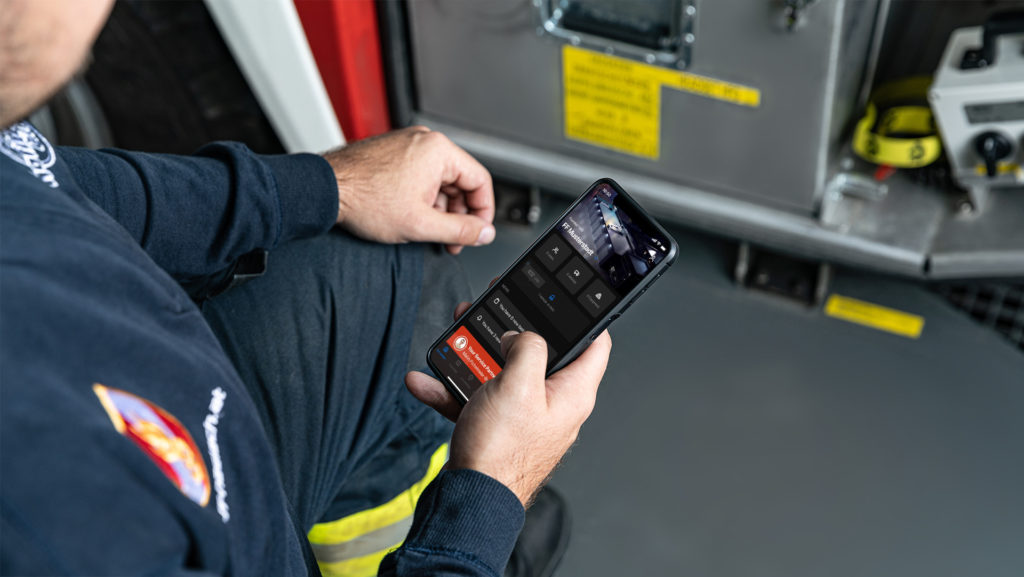
The software and the user interface (UI) were also revised. RDS Connected Fleet can now be used with all common web browsers (Chrome, Safari, Firefox) and mobile operating systems (iOS, Android). It is consistently intuitive to use. The operating routines have been simplified, the interactive design (User Experience/UX) optimised for smartphones and the symbol language of the new Rosenbauer control system RFC LCS adopted. This ensures a uniform operating environment from vehicle control to fleet management. The software can also be used without hardware, for example, to keep a logbook.

More safety and speed
The latest encryption techniques ensure the greatest possible security in data traffic. In addition, the data is hosted on the cloud computing platform Microsoft Azure and, therefore, in Europe. This also ensures a higher speed. In addition, GPS and error messages are now sent with priority and are always available in real time.

Numerous fire departments have participated in the development of RDS Connected Fleet, tested the range of functions and, above all, contributed their feedback to the optimisation of the user interface. First and foremost the Vienna professional fire service, which has been using the Rosenbauer vehicle management system for many years now to manage a fleet of some 80 vehicles. Live operation of RDS Connected Fleet will start on December 15. All development partners will switch to the new system this year and all other existing customers from January 2021 onwards free of charge. Further digital solutions are in the works and will be available in the course of the coming year to continually simplify the daily work of fire departments.

Andy Lake of Pyroguard states the case for using timber for its fire safety properties

Andy Lake, UK Sales Director, Pyroguard, explains exactly why timber is such a reliable building material and how its strong fire safety properties make it a suitable option across all construction projects.

The world of construction has changed so much in the past few decades. From new tools, to new methods of construction, the sector is constantly evolving and modernising its processes.

Despite all this upheaval some things stay the same; timber being one of the best examples. Thanks to its durability, sustainability, timeless aesthetic and cost-effectiveness, timber remains an important building material, which is routinely specified across some of the world’s most exciting developments and projects.

Unfortunately, in recent times, some building professionals have developed a diminished view of timber over its perceived poor fire performance. This perception is misguided, as it can provide excellent performance in a fire – when used as part of a certified system – and is able to achieve the highest levels of protection.

In fact, with the right testing and assessments, those using it are able to accurately predict how the material will perform in a blaze. In turn, this allows project teams to put together more robust fire escape plans for building occupants.

All types and associated densities of timber have their own specific charring rate, which can be used to indicate fire resistance in the event of an incident. As a result, architects and specifiers are able to work with fire safety glass experts to design glazing frames to the right thickness, to ensure that they offer the level of protection required for the build.

With the right guidance, timber is able to achieve an EI60 fire rating, which guarantees a minimum of 60 minutes Insulation and Integrity against an ongoing blaze.

As well as ensuring long-term, robust fire performance, timber fire-rated systems are also more effective at retaining their shape and structure when exposed to high levels of heat. To this end, fire test results indicate how stable timber can be when subjected to fire situations.

Unlike some other materials, such as steel, timber does not warp, twist or distort in a blaze. Instead, this sturdiness helps to ensure that the fire safety glass solution remains secure within its frame.

Additionally, thanks to their more flexible nature, timber frames are easier to adapt on-site. As a result, project teams using the material can deal better with any structural opening variations that might have occurred.

When compared to other building materials, timber is also able to offer exceptional aesthetic value and can be used to create designs unimaginable with other options. As well as exuding a natural beauty, timber can be stained and designed more ornately than alternative materials.

Similarly, in an industry, which is increasingly concerned about protecting natural resources and attaining lofty environmental targets, timber represents a truly sustainable building choice. In adopting timber, architects and specifiers are choosing an easily recyclable, long-lasting solution with a significantly lower embodied carbon footprint than other popular choices.

More than ever before, people are becoming concerned with the fire safety performance of the buildings that they live and work in. This change has been driven by a number of tragic events, which have shaken the sector to its core.

Whilst scrutiny is important, it’s essential that those in the industry don’t jump to unfounded conclusions about the fire safety performance of certain materials, like timber. With a wealth of research to support its use, the material has emerged as an obvious choice when looking to achieve strong performance.

However, to get the most from the material it must be properly specified, which will require the assistance of a fire safety glass expert, such as Pyroguard. By following this advice, architects and specifiers can continue creating beautiful, high-performing and sustainable buildings, which provide exceptional performance in a fire

Rosenbauer International secures €170 million syndicated loan

Rosenbauer International AG has brokered its first syndicated loan. The debut transaction is for €170 million, with the option of increasing the amount.

The term is three years, with the option of twice extending the agreement by a further year each time. In taking this step, the Rosenbauer Group is optimising the maturity profile of its existing bank facilities and securing the refinancing of its existing liabilities.

“The impact of the COVID-19 pandemic is also being felt on the debt capital market. So I’m all the more pleased that we were able to successfully implement this syndicated loan,” says Sebastian Wolf, Chief Financial Officer of Rosenbauer International AG.

“This, combined with the equally successful placement of a promissory note loan last year, has allowed us to strengthen the financial foundations for the further development of our Group. This gives us planning reliability in the medium to long term.”

The transaction was arranged by UniCredit Bank Austria AG and Raiffeisen Bank International AG, who acted as joint coordinators, mandated lead arrangers and bookrunners. The banking syndicate also includes Commerzbank AG, Erste Bank AG, RLB Oberösterreich AG and Sparkasse Oberösterreich AG.

Fire equipment manufacturer LEADER launch MIX 2000

The fire equipment manufacturer LEADER has launched a new version of autonomous proportioning system: LEADER . With its patented mechanical and automatic mixing system, the new LEADER MIX 2000 fits for different firefighting scenarios, ensure reliable and optimum operation with low operational cost.

A new version which completes the range of autonomous proportioner until then limited to 1000 l/min.!

Designed and patented by the R&D team of the LEADER company, its unique system based on a venturi system achieve an automatic accurate aspiration of foam concentrate required to mix with water. Several fixed mixing ratios from 0.1% to 6% are available.

Simple and easy to use, the firefighter just has to turn a manual selector to immediately set up and adjust the mixing ratio. Ideal equipment for various fire interventions, the LEADER MIX 2000 is suitable for a wide flow range from 300 to 2000 l/min.

It realises real-time adjustment, without human intervention, of current water flow and in case of flow variations. On large scale fire requiring high flow, it is possible to combine several LEADER MIX 2000 to go up to even larger flows.

By coupling two LEADER MIX 2000, you achieve flow ranges of 600 to 4000l/min. The LEADER MIX 2000 handle all foam concentrate types, including AR-types (wetting-foaming agents, fluorine-free foam concentrate, AFFF, AFFF-AR, proteinic foam, etc.), whether their viscosity: liquids foams (Newtonian fluids) or highly viscous foams (pseudoplastic).

The equipment has been tested and calibrated for an accurate dosing, particularly for highly viscous pseudoplastic foam concentrates proportioned at 1% and 3%. The quality and performance of the produced foam are greatly related to the equipment used.

With the LEADER MIX 2000, get an accurate foam and water mix for successful firefighting and avoiding to waste water and precious stock of foam concentrate. The control panel allows to select the intervention position: water, foam or flush.

The “water” position (by-pass) reduces pressure loss in the water supply when foam injection is not necessary. The “flush” position allows the dosing system to be rinsed and clean up for the next operation. The simple interface is easily understandable for fast and flawless action.

As key part of the foam fire extinguishing system, the LEADER MIX 2000 foam proportioner is a 100% mechanical system, reliable and autonomous. It stand-alone and is ready to produce foam immediately.

It operates without electronics and without external power supply, unlike electronic foam proportioning technologies. No periodic maintenance is required. The absence of a metering pump increases the reliability of the system and allows dry operation if the end of the tank is reached.

This equipment has very low operational cost. All parts and components are corrosion resistant. This foam proportioning system is suitable for municipal fire departments, as well as for petrochemicals plants, industrial plants, logistics warehouses, waste treatment plants applications. Matching project specific requirements, the LEADER MIX 2000 mixing system can be easily installed in a centralized foam extinguishing system (foam pourer, deluge system, high expansion foam generator…) or on a fire fighting vehicle in its “fixed” version.

In its “portable” version, it can be placed on the ground close to the foam concentrate storage or on remote locations. Its “plug & play” robust construction as well as its extremely compact and light format (less than 35kg) give him maximum flexibility

FIA publish its 12th Market Conditions Review

The Fire Industry Association (FIA) has published its 12th Market Conditions Review. The report serves as an annual ‘snapshot’ to review how the fire industry market is performing.

It is based on a survey conducted by the FIA of both FIA member and non-member companies across the UK. In the current year, they pay particular attention to the influence of COVID-19 on the industry and compare the results with our survey in Spring that focussed on the impact of COVID-19.

This year’s market conditions survey reflects how Brexit has impacted the industry in the short, medium and long term. It also delves in to recruitment, training and invitations to tender.

To gain access to the full report go to the Fire Industry Association website.

National Foam to discontinue foam concentrate in 2021

National Foam have announced that it will discontinue the sale of all PFAS based foam concentrates into the State of California effective January 1, 2021.

National Foam UniversalF3 Green® 3% X 3% synthetic fluorine free foam concentrate has proven to be the replacement of choice for end-users in the Industrial, Chemical and Oil & Gas sectors. UniversalF3 Green® offers UL/ULC and LASTfire listings on both hydrocarbon and polar solvent in fresh and saltwater.

The only fluorine free foam currently available with this breadth of third party listings. UniversalF3 Green® foam concentrate has proven to be effective in both legacy and new fixed systems with numerous hardware cross listings, including bladder tanks, proportioners, foam making sprinklers and various discharge devises.

National Foam

UniversalF3 Green® is one of the first fluorine free foam concentrates to be third party GreenScreen™ certified providing independent assurance to end-users that the product is PFAS free and avoids other known chemicals of concern.


National Foam MuniF3 Green Plus® 3% synthetic fluorine free foam concentrate has been designed specifically for the Municipal firefighting sector.

MuniF3 Green Plus® offers UL/ULC listings on hydrocarbon fires and covers various blends of gasoline, from unblended (i.e. sport racing) through E5, E10 and up to E15 (i.e. 15% ethanol/gasoline blend) and can be used with fresh and brackish water.

MuniF3 Green Plus® can also be used as a wetting agent on class A (Wildlands) fires, cross listed with the JS-10 handline nozzle and is GreenScreen™ certified.


National Foam “RED ALERT®” service, with warehousing facility located in California, has removed all PFAS based foam concentrates and will support the Industrial, Chemical and Oil & Gas sectors with its UL/ULC and LASTfire listed UniversalF3 Green® foam concentrate.

Rosenbauer release new EN 1846-2 compliant forest firefighting vehicle

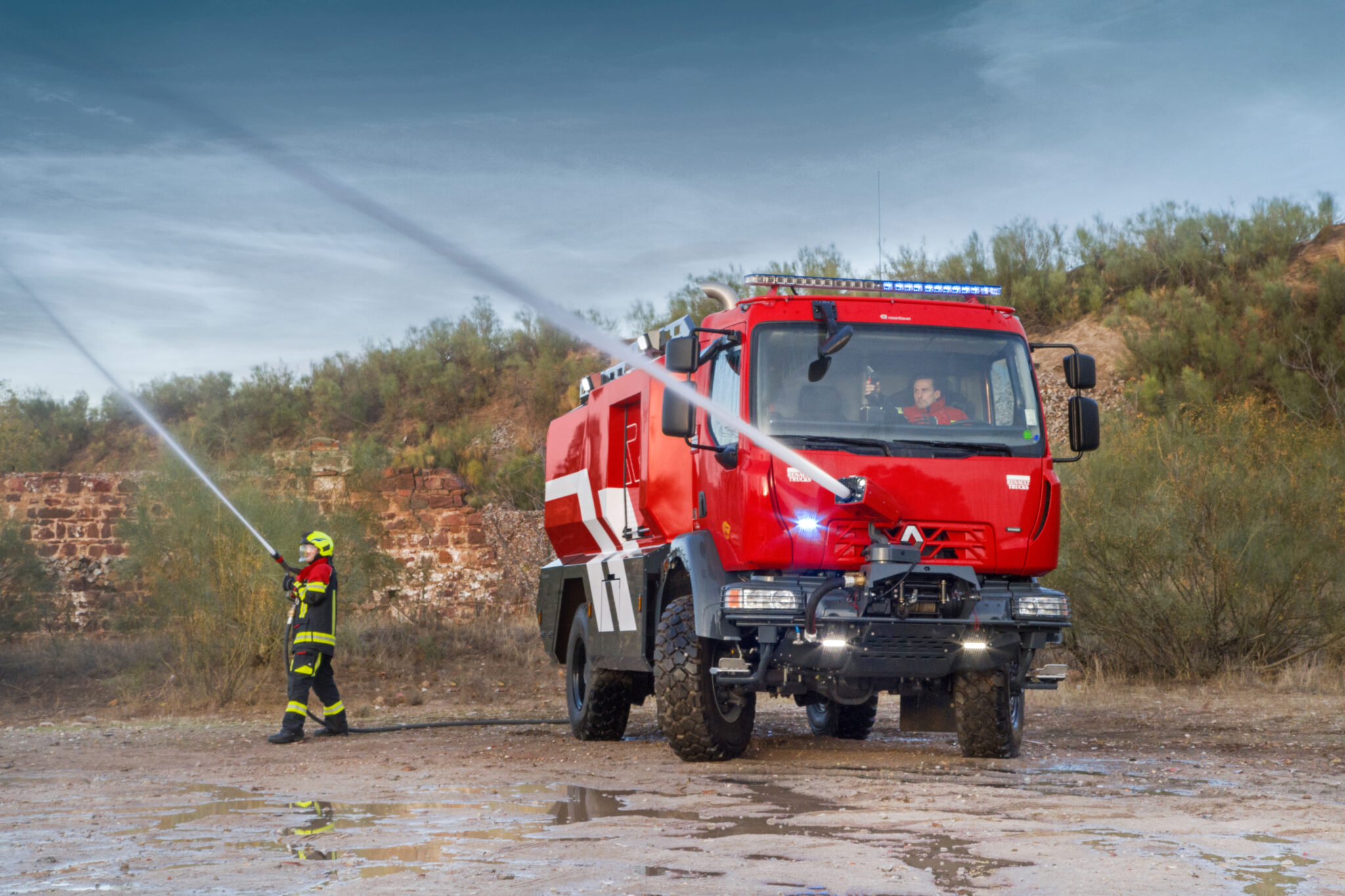
Rosenbauer has presented a new forest firefighting vehicle to the global market. It meets both category 3 of EN 1846-2 for all-terrain firefighting vehicles and specific requirements for the protection of the vehicle crew, as defined for example in the French standard NFS 61-517 or NFS 61-518.

This includes a thermal self-protection system and driver’s cab equipped with a rollover cell. With its compact dimensions, low center of gravity and single tires, the all-wheel drive vehicle is ideally suited for use in rough terrain.

The special firefighting equipment on board makes the extinguishing agents extremely cost-effective and efficient. Plus, the crew can fight the fire using a turret mounted on the bumper and controlled from the cab without having to exit the vehicle.

Robust lightweight superstructure
The new forest firefighting vehicle is built on a 2-axle chassis from Renault with a total permissible weight of 14 tons. The all-wheel drive can be switched and the 6-cylinder diesel engine (Euro-6) has an output of 206 kW (280 hp). With a length of 6,900 mm and a wheelbase of 3,350 mm, the vehicle is extremely compact and maneuverable. The large underaxle clearance and a tipping angle of 25° increase off-road capability.

new forest firefighting vehicle

The firefighting body consists of two parts, a tank module made of polypropylene and a pump room module behind it made of a self-supporting aluminum sheet/profile construction.

The flexible and also high-strength body provides optimum load distribution and lateral stability for operation under off-road conditions – the consistent use of lightweight materials ensures a high loading capacity. 

The vehicle water tank has a capacity of 3,500 l (500 l of which is for the self-protection systems); the separate foam tank holds 100 l. The additional equipment required for forest firefighting operations (fire swatters, firefighting backpacks, backpack sprayers, etc.) is housed in three spacious equipment compartments with dust-tight roller shutter closures.

Two are located on the sides of the vehicle; another is installed across the entire width in the rear. The built-in pump, foam proportioning system and rapid intervention hose reel are also accessible through this compartment.

Firefighting equipment for forest firefighting
The firefighting equipment of the new forest firefighting vehicle consists of the combined NH25 normal/high pressure pump and the direct injection foam proportioning system RFC Admix Variomatic.

The pump has a capacity of up to 2,500 l/min at 10 bar (FPN 10-2000) and up to 400 l/min at 40 bar (FPH 40-250). In high-pressure operation, the supply of extinguishing water on board can be used very sparingly because the fine atomization causes more water to evaporate than under normal pressure, thus achieving a high extinguishing effect.

In addition, the kinetic energy of the firefighting water allows it to be driven deep into the forest floor, which means that even hot spots can be extinguished efficiently.

The RFC Admix Variomatic also produces wetting agents, light, medium and heavy foam, and the proportioning ratio is infinitely variable between 0.1% and 6%.

With the smallest proportioning quantity, the surface tension of the firefighting water is reduced to such an extent that it can penetrate deep into the flammable material and an excellent extinguishing effect can be achieved with minimal water consumption.

The suffocating effect of firefighting foam is used at higher proportioning ratios. The foam compound is injected directly into the pressure outlets and thus the water pump remains free of foam compound and does not have to be flushed after each use. In addition, water and another mains water or foam can be discharged simultaneously at one outlet or several injection points can be operated with different proportioning ratios.

Crew safety
A system of spray nozzles protects both the crew cab and the substructure of the vehicle. The water for this comes from a secured tank segment and is pumped by a separate, electrically driven pump.

If the vehicle is trapped by fire during a forest fire, this system allows the crew to drive over a burning fire border and reach safety.

The Rosenbauer DWD Driver Warning System enhances off-road driving safety. This measures the vehicle inclination as well as the axial lateral and longitudinal forces and alerts the driver with visual and auditory signals if the vehicle is at risk of tipping over.

A rollover cell made of high-strength steel is also integrated into the cab structure to protect the crew in all situations.

The vehicle is also equipped with a light package consisting of high-performance LEDs and a front cable winch with a tractive force of 5,400 kg. An optional fresh air system which creates an overpressure in the cabin to prevent the penetration of fire gases can also be installed. We also have our own protective devices for the battery and electrical equipment.

The vehicle is being built at Rosenbauer’s Linares Forest Fire Competence Center in Spain. It is built to meet, in particular, the technical and tactical requirements of French, Spanish and Portuguese fire departments. It combines everything that is necessary for efficient and safe forest firefighting.

E2S Warning Signals upgrades its signalling beacons

E2S Warning Signals is committed to a programme of continuous product improvements in response to technology advances, regulatory changes and customer feedback.

The latest products to be upgraded are the B350TLA traffic light warning signal beacons that feature a compact 100 x 140mm housing, ideal for space constrained applications or for mounting directly onto machinery.  

The larger 140 x 177mm B450TLA units have also been upgraded. The light engine for both is an array of 18 high output white LEDs, which give super-bright outputs up to 356 Candela.

The ultrasonic welded diffused lens determines the output light colour: Amber, Blue, Clear, Green, Red, and Yellow are standard, enabling on-site reconfiguration of colours and greater flexibility in inventory management. There are now seven flash patterns, including a temporal pattern for greater effectiveness, in addition to a steady output for status indication.

The included connector enables multiple units to be assembled into stacks and dual pluggable terminals simplify cable installation for looped installations.

The operating voltage are ranges are 10-14VDC/16-33VDC and 48-260VAC/DC, the 1Hz flash operating current is only 88mA @ 24Vdc and the operating temperature is a wide -40°C to +70°C.

Also upgraded with the latest 18 white LED array light source are the STA and STB families of customisable stack signals, UL approved for general signalling applications such as status indication, security and process control.

The STA stacks have a SONF1 compact 100dB(A) alarm horn sounder to give an integrated audible/visual unit; the STB family are beacon-only arrays.

Both versions are available with two, three or four units in a stack array which are terminated in a common junction box via a factory-fitted internal wiring loom to give a single external interconnect point. The UV stable PC lenses are available in Amber, Blue, Clear, Green, Magenta, Red and Yellow.

For more information E2S Warning Signals products visit the website

Streamlight release one of their brightest and versatile lights, the ProTac® 90

Streamlight Inc., a leading provider of high-performance lighting devices offer a range of high-quality products built with precision and performance especially for law enforcement, sporting goods, fire & rescue, hardware/tools and the military.

Streamlight believe in a hands-on, real world experience for all its customers, this approach leads to new ideas, innovations and Brilliant Thinking that set Streamlight apart.

With a range of new products available, Streamlight continues to ensure that new product development is at the fore of all they do, ensuring that they offer their customers the latest technology.

“The combination of its light output, size and multi-fuel technology make the ProTac® 90 one of the brightest and most versatile tactical lights on the market today”, said Streamlight Vice President, Sales and Marketing, Michael F.Dineen

ProTac® 90 offers versatility

“With its 90 head and multi-function clip designed to fit MOLLE and other gear, it provides a variety of wearing options for tactical professionals, sports enthusiasts and others requiring hands free operation. Users can choose between several different battery options to suit their need or preference.”

The ProTac® 90 is a superb bright, ultra-compact, right angle tactical light featuring the convenience of multi fuel technology. Other features include TEN-TAP® programmable switch for user selected operation, a specialised optic produces a blended beam and an impact resistant borofloat glass lens.

Fabricated from machined aircraft aluminum with a black anodized finish, The ProTac® 90 features a multi-function, push button tactical switch that permits one handed operation.


ProTac® 90
Product Features:

Lumens: – 300 lumens
Battery: – (1) 3V “CR123A” lithium or (1) “AA” alkaline/lithium
Size: – 3.78” x 1.05 x 86” (9.6 x 2.67 x 2.18 cm)
Weight: – W/CR123A 2.8 oz (79g)
– W/ALKALINE 3.1 oz (88g)
– W/LITHIUM 2.7 oz (77g)
Colour: – Black

The ProTac ® 90 has an MSRP of £53 and comes with the Streamlight Limited Lifetime Warranty.

Survival solutions provider Survitec launch offshore EBS

Global safety and survival solutions provider Survitec have created a new compressed air Emergency Breathing System (EBS) for offshore helicopter passengers and crew. It has been designed to offer personnel a greater chance of survival in a water impact scenario.

Survitec’s new bespoke Category A EBS has already been integrated into the company’s Halo aviation lifejacket and can be deployed in a single action, using one hand.

It features a mouthpiece with an integrated nose clip, a braided low-pressure hose and a reinforced carbon composite compressed air cylinder. The EBS weighs 949g which is 30% lighter than competing systems.

Survitec

“The most striking aspect of the new cylinder design, is its high air capacity,” Mark Lutman, Survitec’s Technical Sales Manager for lifesaving appliances (LSA), attests.

“In a water impact scenario, the short window for escape can be a limiting factor when escaping a submerged helicopter. We designed the bespoke EBS to deliver 80% more air than that required by CAP 1034, increasing the chances of survival for those escaping a ditched, capsized or submerged helicopter.”

The Civil Aviation Authority CAP 1034 guidelines (Development of a Technical Standard for Emergency Breathing Systems) to which Lutman refers were developed in 2013 after a spate of fatal helicopter accidents. It states that EBS should provide sufficient air supply for 60 seconds of breathing time at a depth down to 2m.

Over the last 20 years, EBS technology has evolved significantly. Originally, they were classed as rebreathers, these were superseded by hybrid rebreathers and finally, the compressed air systems that we see today. All of which have their advantages and disadvantages.

Nigel Parkes, Head of Lifejacket Design, Survitec, explains. “One of the first EBS was the rebreather system, ostensibly a counter-lung allowing the wearer to breathe back in their own expelled breath. These need to be orally inflated prior to submersion and are not effective when personnel have to escape from depths of more than a few metres.”

The rebreather style system evolved to a hybrid rebreather. This incorporated a cylinder of compressed air containing the equivalent of a lungful of air that is automatically released into the counter-lung on submersion.  

“The addition of an air cylinder does provide the user with air to breathe if there is little time to take a deep breath, but again, this type of system is less likely to be effective at depths of more than a few metres. The increased air capacity can also increase overall buoyancy of the lifejacket, impacting the means of escape,” said Parkes, before commenting on the advantages of a compressed air EBS.

“With these new systems, they are more suited for underwater deployment and can be used at depth because pressurised air is supplied on demand.

“Imagine you’re evacuating a submerged helicopter. It’s dark. Water is flooding in. You don’t know whether up is down or down is up and panic is setting in. The last thing you want to worry about is remembering to take a deep breath.”

“Further to this, sudden exposure to cold water can induce the cold water shock response, which can significantly affect the individual’s ability to hold their breath.”

Indeed, a primary reason for developing the new EBS was to take into consideration the additional air capacity required by someone under extreme stress. When people panic, their breathing is rapid and air supplies can be quickly depleted.

Parkes said: “The introduction of a 310 bar cylinder allows us to substantially increase the amount of breathable air available for use by the user in a water impact scenario. By combining composite materials within a pocket shielded and reinforced for impact protection, our design teams have also delivered a much lighter, more resilient CA-EBS.”

This new bespoke EBS is a key integrated feature of Survitec’s Halo lifejacket, launched in September last year.

Halo, the first aviation lifejacket to utilise Fusion 3D technology, allows for a much more ergonomic lifejacket that adapts to the shape of the wearer for enhanced comfort.

This, combined with the lifejacket’s slimline profile and the reduction in EBS size, takes into consideration the restrictive space and movement within the helicopter cabin – allowing for greater freedom of movement for the wearer during transit.