Better crew training needed for CO2 firefighting systems

Survitec discuss the need for better crew training needed for CO2 firefighting systems.

Fire is the most common and most dangerous emergency at sea. Yet while the International Maritime Organization’s FSS Code provides engineering and design standards for all types of fire extinguishing systems, there are no mandatory regulations governing their installation, commissioning, operation and maintenance, only recommendations.

Although recommendations and guidelines are in place, and which should be followed to obtain certification from classification companies and flag state authorities, there have been several incidents in recent times where fixed fire extinguishing systems have failed.

For instance, in May last year, the accidental release of CO₂ aboard a 69,121dwt bulk carrier during routine checks of a CO2 firefighting system during repair work at shipyard, resulted in the death of ten seafarers and the hospitalisation of a further 19. The ensuing incident report found the system itself to be faultless, but it was incorrectly operated by the crew.

Similarly, an incident report published in 2015 by the Marine Accident Investigation Report (MAIB) in to the 2004 fire aboard a fishing vessel found the lack of training in the use of CO2 firefighting systems to be of significant concern.

Lack of knowledge of Co2

“The CO2 system did not operate effectively because it was poorly maintained, the crew were unaware of the correct operating and compartment isolation procedures, and there were no system-specific operating instructions posted….The crew were also unfamiliar with the safety procedures required for re-entry following use of CO2…. If the CO2 had been successfully discharged, then it is highly likely that fatalities would have resulted when re-entry was made to the engine room,” cited the report.

The 2004 fire aboard a 11162gt passenger ship also highlighted flaws in the crew’s knowledge, experience and training in the use of the CO2 system, with the MAIB concluding: “Despite instructions to release the CO2 having been carried out, unbeknown to the officers and crew at the time, no CO2 was released into the engine room to fight the fire.”

The vessel’s CO2 system was neither checked nor made secure after the fire, and during the investigations after the vessel’s arrival in Southampton, CO2 from a bank of cylinders was accidentally released into the engine room. Three crew members were lucky to escape without loss of life or serious injury.

Investigators concluded that officers misunderstood the system and how to operate it effectively. But what was also interesting about this incident, was that the investigators found that the system had been incorrectly installed. Only 51 cylinders would have activated instead of all 66.

Problems with the installation and commissioning of the fixed firefighting system were also found aboard a general cargo vessel. Inspectors discovered the system had “not discharged completely as one of the bottles had been installed incorrectly”.

“While it is difficult to put a number on all the fire related incidents where incorrect installation, operation or maintenance of a fixed firefighting system has resulted in system failure, injury or death, the above investigations do offer a difference perspective on the effectiveness of the current regulations and guidelines,” says Mats Hestmann, Survitec Group QHSE Manager.

“Fire safety systems are inherently designed to protect and save lives. However, if these systems are incorrectly used, installed or insufficiently inspected and maintained, the consequences can be severe. These can range from time delays and port penalties for non-compliance to serious injury or even fatality,” says Hestmann.

MSC.1/CIRC 1318, the Guidelines for the Maintenance and Inspections of Fixed Carbon Dioxide Fire-Extinguishing systems was released in June 2009 and have been adopted by most Flag states, but some are still following their own set of standards. Hestmann, believes that it would be beneficial for MSC.1/CIRC 1318 to become even more structured as is the case with MSC 1432, clearly defining what should be inspected. Once the majority of flag states have adopted an MSC circular, it then becomes a resolution making it mandatory.  

Hestman adds: “Great improvements to safety have come as a result of IACS Z-17 Service provider approvals. However, it’s not the failure of the firefighting system that is resulting in so many incidents, but rather the lack of system knowledge and poor operator training.

There should be more effective rules governing system training; because a crew member is familiar with one firefighting system doesn’t mean they are appropriately trained to use another manufacturer’s system or even a different system configuration. While the product itself might be standard, the layout of the system, the location of valves, cylinders, and vents and so on will differ from ship to ship. Certainly, crews need to be better trained in the use, operation and maintenance of these systems.”

Erik Christensen, Technical Director Fire Fighting says: “We have seen a number of incident reports where human error in the use of firefighting systems has been a common factor. Valves have been closed when they should have been open, ventilation flaps left open with main generators still running during the fire.

“Carbon Dioxide is a dangerous gas and any system that has been incorrectly installed, maintained or operated could not only fail to extinguish the fire but be very harmful to the crew.”

Colourless with a slightly astringent smell, CO2 is about 50% heavier than air and therefore highly effective in smothering a fire in a relatively short time. However, split seconds after its release, the covered space concentration level is life threatening. Therefore, to allow personnel time to escape, from the moment the CO2 alarm is activated, time delays delaying the release of CO2 are present on CO2 systems. Time delays can be programmed ranging from 20 seconds up to 2 minutes depending on the system.

Any re-entry into the space should only be once the space has been thoroughly vented and the air quality tested.

“As the market leader and a champion of maritime safety initiatives, it is important we foster greater fire safety and systems awareness,” says Christensen. “We have already issued advice offering our recommendations and we are nearing the final cut of an informative video to raise wider awareness of the need to ensure firefighting systems are correctly installed, regularly maintained, serviced and that crew operating the systems are trained and understand how to use the specific system.”

Survitec recommends that:

•             Fixed firefighting systems are commissioned by the Original Equipment Manufacturer or an OEM-approved and certified technician after installation

•             Systems are inspected regularly in line with the routine inspection regime detailed in the system manual. These are monthly checks and should be carried out by trained individuals.

•             Ships’ crews undergo basic systems configuration training and personal protective equipment training by the OEM.

•             Inspections and maintenance works are carried out by a trained systems technician in accordance with Maritime Safety Committee Circulars 1432 (Firefighting Systems) and 1318 (CO2 systems), or special flag/class requirements, in order to receive renewal of the Safety Equipment Certificate.

“We want to ensure that operators and crews have a much better understanding of how fixed firefighting systems operate and the importance of regular, properly carried-out maintenance. With greater knowledge, they will be able to overcome many of the operational challenges they face and prevent system failure when it is required in an emergency.

“Crews can be better equipped to fight fires more effectively, more safely, but any initiative needs to work in harmony with the rules, some of which could do well to be revised.”
High volume pumping incidents – which garments are best?

Whilst high volume pumping (HVP) incidents aren’t the most common call out for firefighters, they still require specialist support from brigades. So, what conditions do firefighters face on these types of jobs? And what garments are best for firefighters to wear to handle these conditions?

Reece Buchner, technical sales manager at FlamePro, a British specialist manufacturer of life-saving garments for firefighters, details everything you need to know about HVP incidents and which garments should be worn on the job in his guest blog for Fire Product Search.

What conditions do firefighters face at High volume pumping incidents?

More often than not, HVP will be used during a flooding accident. Whether this is caused by a river bursting its banks or high volumes of rain overwhelming roadside drainage systems, they usually involve firefighters spending hours wading around in inches or even a few feet of water.

High volume pumps can also be utilised when a significant amount of water needs to be moved quickly – such as the incident at Whaley Bridge in Derbyshire last year, where the reservoir dam wall threatened to collapse due to heavy rainfall. Several HVPs were deployed, as 150 firefighters battled to remove 70,000 litres of water a minute from the reservoir.

What is the best PPE for HVP incidents?

HVP incidents are unique in the sense that firefighters do not need protection from extreme heat and flames, unlike the majority of other call-outs. However, it is still important that firefighters can be easily identified on these jobs, given the number of emergency services that will likely be present.

It is important to note that HVP operatives are different to those that will be wearing dry suits in deeper water; the HVP is usually situated on dry ground, but the prevailing conditions are wet and the work is active, meaning lightweight, waterproof garments are the order of the day.

Therefore, the best type of kit for these jobs is a single-layer, waterproof and lightweight suit, to allow firefighters to move around easily and comfortably. Ensuring the kit is waterproof is essential as standard turn-out gear will become soggy and heavy from rainfall, compromising a firefighter’s mobility.

The lightweight nature of the garments is also essential, due to the physical nature of these jobs; manning pumps, unrolling kilometres of hoses and packing everything away once the job is complete.

The conditions also mean that waterproof and rubber boots are a must, given the high volumes of water firefighters are required to trudge through. Boots used in a standard turn out kit are often described as ‘waterproof’, but, these are designed only to resist splashes when tackling fire with hoses. Therefore, having rubber boots ensures firefighters will still have dry feet at the end of the job.

Whilst HVP incidents are far from the most common call out, as the colder and wetter months now approach, it is more and more likely fire brigades will be involved in such an incident. That’s why it is essential that firefighters are prepared and equipped with the right PPE now, for whenever an incident may arise.

Lloyds Building Installs MxPro 5 Panels Advanced Fire Protection

A network of 10 MxPro 5 fire panels from Advanced, have been installed to protect London’s famous Lloyds Building.

About Lloyds Building

Also known as the Inside-Out Building, the Lloyds Building is located in the City of London’s main financial district and is a leading example of radical Bowellism architecture in which services for the building such as ducts and lifts are located on the exterior to maximize space in the interior. Built-in 1986, commercial office development became the youngest structure ever to obtain Grade I listing in 2011.

The state-of-the-art Advanced fire panels, which were installed as part of a phased upgrade to the fire system, cover all areas of the 14-storey building, include BMS integration for graphics and are linked to over 3200 Hochiki devices, including wireless devices installed within the building’s towers.

Installation Of Fire Panels

Undertaking phase one, the design, installation, and commissioning of the fire panels and graphics system at the Lloyds Building were Kent-based Pacific Security Systems Ltd.

Kirk Short, Director at Pacific Security Systems Ltd, said “Our client’s brief was to retain the existing Hochiki devices and wiring while upgrading the panels and graphics system on site. The system also needed to be both user-friendly and reliable.”

“Advanced’s MxPro 5 panels were able to tick all of the boxes. Its network performance is particularly good, no matter the size of the system or complexity of the site Advanced’s products have the capability to deliver complete protection.”

“Our customers are always happy with the product and find the panels very easy to operate with limited technical understanding.”

Custom-Built Fire Safety Products

As part of the work for phase two of the upgrade, a custom-built annunciator for sprinkler, wet riser, and plant status control will be designed and manufactured by the Advanced’s AdSpecials department.MxPro 5 fire system is certified by FM Approvals to the EN 54 standard

Regional Sales Manager at Advanced, Ken Bullock, said: “It’s a pleasure to be able to support Pacific Security Systems Ltd with the equipment needed to protect such an iconic London landmark, and as a high performance yet a user-friendly solution, the MxPro 5 just makes sense.”

“Our industry-leading fire panel offers the ideal solution for this project, where an intuitive interface that the end-user can easily operate and superior networking capabilities that can deliver protection across a large area, are crucial. Pacific Security Systems Ltd will also benefit from the MxPro 5’s built-in false alarm management software, AlarmCalm, enabling the configuration of the building’s investigation delays and double knock procedures with ease.”

Multiprotocol Fire System

MxPro 5 is the fire industry’s multiprotocol fire system solution and is certified by FM Approvals to the EN 54 standard. It offers four detector protocols and a completely open installer network, backed up by free training and support.

MxPro 5 panels can be used in single-loop, single-panel format or easily configured into high-speed networks of up to 200 panels covering huge areas. Its ease of installation and configuration as well as its wide peripheral range make it customizable to almost any application

Amthal Adds DHF Membership To Its Credentials

Amthal has become a full member of the prestigious Door & Hardware Federation (DHF,) highlighting its ongoing commitment to health and safety across its automated gates, product and service portfolio.

The DHF is a not for profit trade association for companies associated with Locks & Building Hardware; Doorsets; Industrial Doors & Shutters; Domestic Garage Doors and Automated Gates.

Regarded as a Centre of Excellence, they offer specifiers and end users of individual and commercial buildings, alongside domestic customers a single source for technical expertise, information, knowledge, and advice.

DHF the go-to association for influencing the future of technical security

Says Jamie Allam, CEO Amthal Fire & Security: “DHF is undoubtedly the go-to association when it comes to influencing the future of technical security, helping organisations understand and comply with latest health and safety legislation, relevant to our industry.

“Our membership aligns us with an organisation that represents the agreed, best and most effective way of delivering a product and service. As a business, we are looking forward to receiving first-hand the latest developments on our industry, whilst presenting our customers with a portfolio of automated gate products that achieves DHF requirements for, safety and compliance.”

Amthal will now be able to present its membership of DHF with the use of its logo on all printed and digital media; to demonstrate its dedication to an organisation associated with quality, credibility and raising industry standards.

Nick Perkins, Training & Compliance Officer added: “At DHF, in our role as an industry leading trade association, we provide the knowledge that members use to enable them to put a safe a compliant product on the market. We sit on various standards committees throughout the UK and Europe and are at the forefront of safety and compliance. Our aim is to advance standards to improve the quality and safety of products, services and systems. We welcome new members on their journey to demonstrate commitment to best practice.”

NFPA release guide for structural fire fighting

NFPA have released NFPA 1700 Guide for Structural Fire Fighting, the first NFPA document connecting fire dynamics research to response strategy, tactics, and best practices for firefighters controlling fires within a structure. 

In 2014, NFPA received a new standards project request from a retired Kansas City fire chief asking for the development of a guide that filled the gap between the fire science community and the fire service. The request, which was eventually endorsed by the International Association of Fire Chiefs (IAFC), National Institute for Safety and Health (NIOSH), UL Firefighter Safety Research Institute, the International Society of Fire Service Instructors (ISFSI) and others, sought to ensure that the methods utilised by the fire service for fire control were based on science and not past fire service traditions or practices.

The 13-chapter guide provides standard operating procedure (SOP) recommendations for responding to a structure fire based on recent large scale testing and line of duty death findings. 

Recognised research efforts complement fundamental occupancy, building construction, and building service references within NFPA 1700, while addressing the health and safety of firefighters by reinforcing the need for personal protective equipment (PPE) and methodologies for contamination control. 

The Technical Committee on Fundamentals of Fire Control Within a Structure Utilising Fire Dynamics looked at basic fire science, fire dynamics, PPE, equipment, extinguishment, staffing needs, and ways to adopt these strategies into practice and train the fire service – all in the interest of public and first responder safety.

The 27-member Technical Committee is made up of representatives from the fire service and insurance industry, as well as subject matter textbook publishers, special experts, and stakeholders actively engaged in fire dynamics research; they hail from the United States, Canada, Germany and Belgium.

NFPA 921 Guide for Fire and Explosion Investigations served as a model for how to translate fire dynamics findings in practicable, applicable ways.

Fire Truck Doors: Hinged Vs. Roll-Up Doors

As fire departments think about the components required on a custom fire truck, one anticipated decision involves choosing between hinged or roll-up doors for fire truck compartments.

The choice of either hinged and roll-up doors depends on the type of missions a fire department responds to, and the required compartmentation’s functional and operational needs.

Part of this decision often includes a review of the following questions:

  • What is the difference between hinged and roll-up doors?
  • What are the construction differences?
  • What safety and operational considerations are important?
  • What additional door features should be considered?
  • What is the look or appearance desired?

Learn construction, safety and operational details, and common questions regarding hinged and roll-up doors below.

What is a Hinged Door?

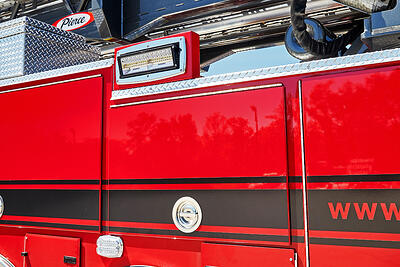
A hinged door on a fire truck compartment is a flat, double pan door that opens with a hinge secured on either the vertical or horizontal side of the door as a point of connection to the apparatus or chassis body.

Hinged doors may also be referred to as lap doors, double pan doors or traditional compartment doors.

Hinged doors can be installed on both the driver and officer side of the apparatus, on the rear of the fire truck and covering compartments on top of the apparatus. Hinged doors cover all compartments that have been designed to maximize storage for the unique needs of a fire department.

Hinged Door Construction

Hinged doors are sized and constructed to match a fire department’s compartment specifications. Manufactured by Pierce to match the body construction, hinged doors can be made using aluminum, stainless steel or galvanneal, and offer solid protection with a clean, smooth finish.

Each hinged door includes:

  • Double pan sheet metal construction to provide two pans of prefabricated metal on the exterior and interior surface.
  • Reinforcement C-sections between the inner and outer panels to provide additional strength.
  • Nearly 2.0 inches of door thickness to improve impact resistance and compartment protection.
  • Door locking mechanisms that are fully enclosed within the door panels to prevent fouling of the lock in the event equipment inside shifts into the lock area.
  • Painted exterior and interior surfaces for additional protection.

Hinged doors are opened using a rotating D-ring mechanism, which can be operated with a gloved hand. Pneumatic cylinders or a positive door holder bracket, with a spring-loaded sliding tube, keeps the door in the open position when firefighters need to remove gear or work at an emergency scene.

Another feature is the doors have a closed cell rubber gasket around the surface that laps onto the body. A second heavy-duty automotive rubber molding with a hollow core is installed on the door framing that seals onto the interior pan, to ensure a weather resisting compartment.

Benefits of Choosing a Hinged Door

A red hinged fire truck door with a black stripes is shown in the closed and locked position.

Smooth, Clean Look. Many fire departments select hinged doors for the smooth, clean appearance and because they offer a more traditional look for fire apparatus. In many instances, fire departments are accustomed to hinged panel doors because that is what has been used historically and choose to maintain the same look and feel with new apparatus selection.

Easy Operation and Functionality. With a hinge construction, fire departments have little to worry about in regards to operational efficiencies, because of the intuitive construction and ease of operation.

Minimal Maintenance. The simple, clean construction of a hinged door with lock-tight screws means maintenance is minimal. Washing the doors regularly with warm, soapy water and lubricating the hinges to maintain smooth open and close functionality are the only maintenance required.

Minor Equipment Interior Mounts. With a smooth interior door finish, a fire department can opt to include minor equipment attachments on door interiors. An axe, bolt cutter, rope, cord or other lightweight tools can be mounted to the interior door panel to optimize storage space.

Maximum Storage Space. The ability to use the full compartment, floor to ceiling.

Operator and Vehicle Safety

Hinged doors offer some unique operator and safety benefits, including:

  • Hinged doors open up or out and require operator understanding of the amount of space required to open and move around the door. As part of strategic response planning, firefighters must be cognizant of their compartment door type and place the truck appropriately on-scene.
  • Off-road, woodland and rough terrain are not a problem for hinged doors, with sturdy hinges and closure systems to appropriately protect the contents inside.
  • Hinged doors that lift up with a horizontal hinge have been used to provide shade for firefighters in warm climates. The ability to quickly erect a shading solution at an emergency scene is an added benefit of a hinged door.

Hinged door construction offers many benefits and added features that make it a great option for fire departments seeking a more traditional, clean and sleek appearance. How do hinged doors compare to roll-up doors? Keep reading to learn more.

What is a Roll-Up Door?

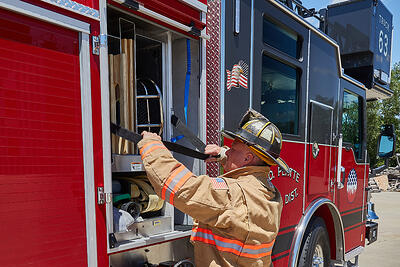
A roll-up fire truck door is constructed of a series of double-sided extrusions that are sealed together to open vertically and gather in a roll at the top of the compartment out of sight.

Roll-up doors are sometimes referred to as shutter-style doors.

Roll-up doors can be used on the driver and officer side of the fire truck, as well as the rear of the vehicle. Roll-up doors offer quick and efficient access to equipment at an emergency scene.

Roll-Up Door Construction

Roll-up doors are constructed of aluminum extrusions that are joined together to create a solid, yet flexible protective door. Each door rolls up on a spring-loaded roller take-up spool and disappears into the header at the top of the compartment opening.

The extrusions run through tracks on either side of the compartment opening and are sealed from top to bottom to prevent water, dirt and debris from getting stuck in the tracks.

Roll-up doors can include a lift-bar with contoured bottom flange cut-outs to allow for easy opening and closing even with gloved hands.

Some additional features of roll-up doors include:

  • A smooth interior wall that provides protection against equipment hang-ups.
  • Individual extrusions that can be removed and replaced easily.
  • Highly durable seals with resistance to UV light and designed to perform in both extreme cold and hot temperatures.

Benefits of Choosing a Roll-Up Door

A firefighter at an emergency scene opens a compartment roll-up door to access equipment inside. There are many benefits to choosing a roll-up fire truck door.


Modern Look. The more modern look of sleek roll-up doors is something many fire departments are drawn to. Doors can be painted to match the apparatus or can include custom designs.

Fast Access to Equipment. Firefighters can quickly and easily open roll-up doors at an emergency scene, knowing they spool up in the header and not in the way when accessing equipment.

Full Sight Lines at an Emergency. Roll-up doors are rolled up at the top of the compartment opening, which means there are no visual barriers around the perimeter of the apparatus.

Bracket-Free Interiors. Some fire departments prefer the bracket-free interior that comes with roll-up doors. The compartment interior is clear, and equipment can be accessed easily.

Operator and Vehicle Safety

Roll-up doors offer some unique operator and safety benefits.

  • Roll-up doors allow compartments to be opened in parking bays to air-out or dry gear between calls. There is never a concern about hitting a door upon exit or damaging the firehouse walls.
  • Strategic apparatus placement at the fire scene can be more forgiving. The doors roll-up into the header and are easy to access and open in even the tightest rescue scenarios. This makes truck roll-up doors particularly suited to perform in busy highway rescue operations and the narrow roadways of urban areas.
  • The area around the truck can become crowded at an emergency scene. With rollup doors, firefighters maintain lines of vision around the apparatus and don’t have to move around any barriers to access equipment or gear.
  • Additional Compartment and Door Safety Features

Additional Fire Truck Door Features 

Whether a fire department decides to choose a hinged or roll-up door, there are several additional features that Pierce Manufacturing is proud to offer customers as they build a custom apparatus, including:

  • Manual and electric locks
  • Keyed locks
  • Door ajar switches
  • Door pull-straps

As you determine the right type of door for the missions of your department, reach out to one of our trusted dealers with further questions.

Which type of compartment door does your fleet use? Why do you love it?

Originally posted by Pierce

Safe Fleet to donate KN95 masks to first responders

Safe Fleet will donate tens of thousands of KN95 masks to fire departments and law enforcement agencies across the US.

“In the early days of the COVID-19 pandemic, we wanted to show our support and care for our extended First Responder family,” explained John Knox, Safe Fleet’s Chairman & CEO. 

“Since we are in the business of supplying fleet safety equipment to help protect the lives of firefighters, law enforcement officers, bus drivers, and commercial vehicle operators, we used our strong existing global supply chain to quickly source and secure shipment of the masks.”

The protective masks will be shipped to Safe Fleet’s Long Island and Houston facilities and then distributed to first responders that expressed an urgent need to replenish their mask supplies.

Thousand of KN95 masks to be donated

Safe Fleet previously donated 800 surgical masks they had on hand at their Belton, MO facility to the local Belton fire department, Belton Missouri Police Department, and Belton Regional Medical Center.

“Keeping people safe is in our DNA,” adds Knox. “It’s why we exist as a company. It’s not surprising that our employees would think first of how we could find new ways to help keep people safe on the front lines of this pandemic.

“We will continue to look at additional solutions and capacity to support those facing the pandemic and to help keep fleets transporting essential workers and delivering essential goods on the road safely.”

NFPA announce newest addition to NFPA LINK

NFPA has announced the 2021 edition of NFPA 70E, Standard for Electrical Safety in the Workplace as the latest addition to NFPA LiNK.

The Association’s new information delivery platform that will include codes and standards, supplementary content, and visual aids for building, electrical, and life safety professionals and practitioners.

Originally developed at OSHA’s request, NFPA 70E helps companies and employees avoid workplace injuries and fatalities due to shock, electrocution, arc flash, and arc blast.

With the addition of NFPA 70E to NFPA LiNK, users have instant access to requirements for safe work practices that reduce a worker’s exposure to major electrical hazards.

In September, NFPA introduced the platform with the four most recent editions of NFPA 70, National Electrical Code (NEC), the most widely used code in the United States and referenced around the globe.

One of the great aspects of NFPA LiNK is that it can be accessed via mobile devices, tablets, laptops, or other preferred device. It will become a “living library” for users that offers:

NFPA Link will be a “living library” for users

  • The ability to work alongside the NEC and NFPA 70E by adding personal notes, assigning colors, and saving to custom collections for quick and easy reference
  • A broader understanding of code requirements through access to expert commentary, visual aids, and helpful resources
  • Collaboration features to share code sections, work across teams, and ensure everyone knows what is required
  • Navigation tools that enable users to quickly locate the information they need based on the situations they encounter

There’s so much more about NFPA LiNK you don’t want to miss! Check out the NFPA LiNK weekly “video blog series” where we break down and discuss some of the key features and functionalities of the platform.

Our first video in the series highlights the Dashboard and publications functions. In the second installation, we discuss Bookmarks and the MyLiNK features. The latest video features situational navigation.

As an NFPA LiNK subscriber, you will get access to continuous updates, features and functions, and new editions of NFPA codes and standards as they are released. 

NFPA will soon expand the collection of codes and standards within the application to include the more than 300 that NFPA offers.

Learn more about how NFPA LiNK can help you in your work. Find more information about the platform, a timeline of additional codes and standards that will be coming to NFPA LiNK, and a product introduction video all at nfpa.org/LiNKPurchase or try NFPA LiNK by visiting the website.

How safe are fire doors?

Fire safety at student accommodation has featured a lot in the news recently, and it’s a topic that Work Smart Fire Door Inspection discussed in their latest blog.

How safe are the fire doors at your student accommodation?

There’s been a lot about the safety of students in the news lately. Fresh faces are arriving at their new student accommodation for the new term. One thing people don’t ever seem to mention though, is whether fire doors in student accommodation are fit for purpose?

Much of the news coverage has focused on Covid-19 and the effects of being locked down. However, we would like to open a discussion about the safety of the buildings that students are living in.

Do student accommodation providers take fire safety seriously enough?

According to a recent study by the Higher Education Policy Institute (HEPI), there are some 660,000 students living in PBSA during term time. These are split almost evenly between university residences and private sector purpose built student accommodation (PBSA).

These are great places for students to live, especially in their first year. It’s easy to meet people. They have all the necessary facilities to hand. And most importantly, accommodation managers are visible and easy to contact.

There is always a great deal of responsibility in providing living accommodation to people, no matter who they are or the type of accommodation.

However, in this situation, where there may be hundreds of students living in one building, with dozens of kitchens, hundreds of appliances and people who may not be fire risk aware, fulfilling that responsibility is very complex.

student accommodation

Fire Door Inspections in Student Accommodation

We have inspected fire resistant doors in 3 PBSAs in Scotland over the last couple of months. Thankfully, we have found it really encouraging to be liaising with several of these PBSAs.

However, what we have discovered has been mixed. Most fire doors at student accommodations we have inspected have needed attention of some sort. There have even been one or two that would be described as critically flawed.

The most alarming (but not surprising) thing we found are doors that have been incorrectly installed or modified. This includes FD30 fire doors fitted where an FD60 fire door had been specified.

This means someone has fitted a fire door that can only last for 30 minutes in place of one that can last for 60 minutes.

Misinformation and confusion could cost the lives of students or fire fighters if there was to be a blaze.

student accommodation

Book a Fire Door Inspection at your Student Accommodation

We need to take Fire doors seriously. This is especially true in the world of student accommodation. Students have a right to live in a safe environment. Landlords and accommodation providers have a duty of care to ensure fire doors are up to standard.

We hope others can now start to follow the example of the providers we have been in contact with recently.

These doors are safety critical, life saving devices – essential components of your fire safety strategy. If they fail, then so does the strategy.

Here’s a few basic things you can do to help you decide if your fire doors need attention –

  • NEVER wedge or block a fire door open.
  • Does your door close completely, unaided, even when only opened slightly.
  • Are the gaps around the door the right size? Use a £1 coin – it’s about 3mm thick, the perfect size for the gap.
  • Are the fire & smoke seals (strips around the door or frame) in good condition?

For more information on fire door safety you can visit the Work Smart Fire Door Inspection website here: https://worksmartfiredoorinspection.co.uk/2020/10/02/fire-doors-student-accommodation-fit-for-purpose/

Ensuring the operation of your fire alarm system during loss of primary power

In their latest blog, NFPA discuss ensuring the operation of your fire alarm system during loss of primary power.

We rely on a fire alarm system to constantly monitor for hazardous conditions (such as fire, smoke, carbon monoxide, and even combustible and toxic vapors) within a building, and notify the occupants so they can exit the building safely, notify first responders, and even activate systems to mitigate the hazard such as fire suppression or ventilation.

The fire alarm system needs to be able to operate continuously during the life of a building, this includes times in which primary power to the building is lost.

Secondary Power Supply

Fire alarm systems are provided with a secondary source of power in order to remain operational after loss of primary power. The most common forms of secondary power supplies are batteries or an emergency generator.

Secondary power supplies are designed to provide enough capacity to power the entire system for 24 hours on standby and then operate the system for at least 5 minutes under emergency conditions (15 minutes for mass notification systems).

If a generator is used for secondary power, batteries are still required, but only need to provide capacity for 4 hours, this gives time to get the generator operational if there is an issue.

In order to ensure that the secondary power supply is always available, the fire alarm system itself is able to monitor for the presence of voltage and monitor the battery charging system, and will then annunciate a trouble signal if there is an issue with the power supply or charging system.

Battery Inspection Testing and Maintenance

Although the system can monitor some aspects of the secondary power supply, there is some inspection, testing, and maintenance (ITM) that needs to be completed to ensure that the secondary power supply is reliable. For ITM specific to the generator, refer to the blog that I wrote on Maintaining your Emergency Power Supply.

Batteries need to be inspected semiannually to confirm that the connections are tight and there is no corrosion on the connections. When inspecting, the batteries need to be checked for damage such as cracks in the case, bulges, or leaking.

The batteries need to be marked with the month and year of manufacture (not the date of installation), this information is important for tracking the batteries age. If the battery’s age exceeds the manufacturer’s replacement date, the battery needs to be replaced.

The batteries and charger need to be tested semiannually; these tests include:

  • Measuring the temperature to ensure that the battery is not 18F (10 C) above ambient temperature
  • Measure the voltage to ensure that the battery and charger are still operational
  • Measure the voltage at each cell of the battery to confirm each cell is greater than 13.26 volts
  • Measure the internal ohmic value of each battery and compare to previous tests to ensure that the battery does not have 30% or more conductance or 40% or more resistance or impedance than previous tests or is outside the manufacturer’s acceptable ranges.

Every three years the batteries need to either be replaced or a load test needs to be conducted. Load tests are conducted by putting a known load on the battery for a given time (found from the battery manufacturer).

The battery is discharged until it reaches its end voltage. Based on the known load and the time taken to discharge you can then calculate the capacity of the battery and apply any adjustments for temperature. The battery must be replaced if the capacity is less than 80% of its rated capacity.

Secondary Power Operation

All the requirements for ITM above focused on the batteries themselves, but there are some tests that need to be completed in order to make sure that the entire system will operate under secondary power.

First, if the system is supplied by an emergency generator, power will need to be transferred to the generator monthly to ensure that the transfer switch and generator will be able to supply the fire alarm.

Additionally, all primary power to the system needs to be disconnected annually so the required standby and alarm current to the system can be measured and compared to the available battery capacity.

Remember, these batteries need to be able to provide the 24 hour standby and 5 (or 15) minutes of alarm or 4 hours of standby if there is also an emergency generator. Finally, the system needs to be operated under secondary power in alarm for at least 5, or 15 minutes depending on the system type.

Do you have any instances in which you needed to replace the fire alarm batteries because they failed testing? Was there a time in which you relied on the secondary power during an outage? Let me know in the comments below.

If you found this article helpful, subscribe to the NFPA Network Newsletterfor monthly, personalized content related to the world of fire, electrical, and building & life safety