Northern bans all e-scooters, hoverboard and e-skateboards from trains and stations

Northern has introduced a ban on all e-scooters, hoverboards and e-skateboards across its trains and stations in the North of England. The ruling, which came into effect on 1 December 2022, is due to the potential fire risk posed by the lithium batteries in these devices, which can overheat and catch fire.

Electric wheelchairs and e-bikes are exempt from the ban, as are mobility scooters for those with access needs, as long as they are registered with the train operator’s Mobility Scooter Permit Scheme, which checks devices by a range of criteria to make sure they are safe to use on-board.

Tricia Williams, chief operating officer at Northern, said: “The safety of our customers and staff is our number one priority.

“As these devices have become more and more popular, so have the horror stories of lithium batteries overheating and catching fire.

“Most of these devices are not actually approved for use in the UK – and from 1 December our staff will refuse travel to anyone attempting to board one of our trains, or access one of our stations with such a device.”

Northern is the second largest train operator in the UK, with nearly 2,000 services a day to more than 500 stations across the North of England.

IFSJ Exclusive: Strategies for winning fire safety tenders

Jason Cooney, Director of Tsaks Consulting, a global bid and tender writing consultancy based in London, talks fire safety tender strategy.

For fire safety professionals looking to secure private or public-sector contracts, the process of writing a winning bid submission can be both time consuming and costly. We outline below some useful strategies and tips to help your company win more fire safety tenders.

Understanding the client’s needs and requirements

When you’re looking to secure a fire safety tender, or any tender for that matter, it is important to understand the clients needs and meet all requirements set out in the tender documentation. What specific need do they have or problem do they need solved?

For example, do they need adequate fire safety training for staff, for better protection of site guests. Or do they require something more technical, like the provision and installation of fire sprinkler systems, fire extinguishers and ancillary products.

If their concern is with location or accessibility, study schematics or diagrams to plan and suggest how you will meet and exceed all requirements and concerns. You may also spot some new or potential concerns which you can bring to light.

It is also important to read between the lines when it comes to the requirements of a fire safety tender. For example, does the fire maintenance service need to integrate with the whole of building facilities management service? Another point to consider with a fire maintenance tender is whether or not it is complex enough to warrant appointing a specialist fire maintenance company or is it designed for an electrician to be able to deliver?

Accreditation and equipment

It is assumed that all fire safety providers applying for fire safety tenders are accredited and certified by relevant fire industry bodies. That being said, it is important to list, in detail, all relevant certifications (e.g., LPS 1197, ISO 9001, LPS 1048, and BAFE).

Ensure all accreditations are up to date and documented correctly. Even if the tender documentation doesn’t recommend adding them to your response, it is recommended that you have them ready and organised should they be asked for by the client during the tender process.

List all the latest technology and equipment you use, detailing how you store and maintain it. Where there is a strategic advantage in adopting the technology you use, ensure this is clearly communicated in the tender response.

For example, you may use a fire panel with a 45 second alarm verification facility to address the issue of false alarms. This can be an advantage to clients who have a large amount of false alarms and call outs. It is important to illustrate how you will adopt this innovation and if so, how you will do it in a manner that doesn’t compromise safety.

Training and qualifications of staff

Provide details of what qualifications and experience your staff have. Include evidence of licenses and certificates, ensuring they are all up to date. Detail the commitment you have to the ongoing training and professionalism of you staff, including regular upskilling and courses you have scheduled throughout the year.

When you list your staff qualifications, it is also important to illustrate your team’s experience and present them as fire safety specialists. There is a difference between a tradesperson who specialises in fire safety and a generalist tradesperson.

It is one thing to have your sprinkler fitters licence, and another to have your licence as well as ten years experience fitting sprinklers. Make sure when you present your team, you present a team of highly experience fire industry professionals with the correct licences and know-how to deliver the project.

Commitment to health, safety, and environment

Robust WHS processes are critical and the right supporting documentation is just as important. When putting forward WHS risk assessments, it is important to tailor your proposed assessment and system for the proposed project. List the risks you have identified based on what you know about the project so far – thereby demonstrating that you and your team have thought through the project.

Clients want to ensure that workers on both sides will be safe, with the safe execution of services throughout the lifespan of the project. Also you have the opportunity to leave behind a set of safety procedures and a culture for continued safe work practices once you have finished the project — enhancing your company’s reputation and chances of securing future tenders.

Articulating your claims in a well-written bid document

Once you have considered all requirements of the documentation and are satisfied you not only meet them, but can fulfil them, it’s time to develop a quality bid submission.

You’re applying for a service which, if not done to the highest standards, can have enormous health, environmental, and legal repercussions. Evaluators want to be sure they have the most qualified and suitable fire safety service provider.

Not only is it important to demonstrate your professionalism through your experience, equipment, staff, and qualifications. It is also important to strengthen your submission with high quality bid writing strategies and techniques which will put you ahead at every stage of the bidding process. Particularly when competing against companies with similar services and prices.

The writing you use is important, and it should be concise and positive. Furthermore, it should be customised to the project you are tendering for and backed up by relevant information and evidence.

Congress passes bipartisan Bill to protect firefighters from PFAS chemicals

A bipartisan bill to provide guidance for federal, state, and local fire departments to prevent firefighters from being exposed to harmful PFAS chemicals that are frequently used in firefighting equipment has been passed by the US House of Representatives.

The bill passed the Senate last summer, where it was authored by Sen. Gary Peters (D-MI), and co-sponsored by Sens. Dan Sullivan (R-AK), Maggie Hassan (D-NH) and Thom Tillis (R-NC). The Protecting Firefighters from Adverse Substances (PFAS) Act, sponsored by Rep. Debbie Dingell (D-MI), now awaits President Joe Biden’s signature.

Once this legislation is signed into law, the Department of Homeland Security (DHS) and the United States Fire Administration (USFA) will have one year to publish training guidance.

The curriculum is required to include ways to reduce or eliminate exposure to PFAS from firefighting foam and PPE, strategies for preventing the release of PFAS from firefighting foam into the environment, and provide emergency personnel with information on alternatives to PFAS equipment and foams.

The International Association of Fire Fighters (IAFF) expressed its support for all efforts to reduce exposures to PFAS and other carcinogens. IAFF General President Edward Kelly said: “PFAS is all around us. It is in our bunker gear, our PPE, and training foam. Until PFAS can be removed and replaced with safer alternatives, we must incorporate all preventative measures. I am grateful that our elected officials are taking action and look forward to continuing to work with them to extinguish cancer from the fire service.”

The Environmental Working Group (EWG) applauded the House for passing the bill. Jay Lucey, EWG’s legislative director for government affairs commented: “Firefighters are among those most exposed to harms from PFAS, but many local fire departments lack the resources and guidance to switch to PFAS-free alternatives.”

SFPE releases Guide to Fire Risk Assessment 2nd Edition

The Society of Fire Protection Engineers has announced the release of a new engineering guide: SFPE Guide to Fire Risk Assessment, 2nd edition.

The new edition of the guide provides guidance to qualified practitioners in developing, selecting, and using fire risk assessment methodologies for the design, construction, and operation of buildings, facilities, or processes.

The guide also addresses fire risk acceptability, the role of fire risk assessment and fire risk management in the fire safety design process, and associated communication/monitoring of fire risk. The guide includes a new flow chart that outlines the risk-assessment process, along with new information related to: risk perception, F-N curves, risk communication, residual risk management, risk monitoring and sensitivity analysis

Chris Jelenewicz, PE, FSFPE, Chief Engineer, Society of Fire Protection Engineers, commented: “Understanding the topic of fire risk assessment is essential to gaining insight into and characterizing fire-related risks to better inform the wide range of decisions that should be made concerning a building, facility, or process as part of the design, construction, or operation.

“As a result, implementing a fire risk assessment can lead to a safer, more efficient, and more cost-effective design — especially for fire engineers implementing a performance-based strategy, as it explicitly ad­dresses unique aspects or uses.”

The 160-page guide is available in various formats from SFPE. Institutional licensing options are available to academic, government, and corporate entities from SFPE.

Blackline Safety sets the standard for lone workers with certified gas detector

Blackline Safety has unveiled the G7c personal wearable, the world’s first connected gas detector and lone worker safety monitor certified to the newly-upgraded BS 8484:2022, the standard that underpins the UK’s lone worker safety leadership.

Lone workers are those who work by themselves without close or direct supervision. Employers have a legal obligation to manage any health and safety risks before their employees can work alone.

Natalie Hays, QHSE & Compliance Manager, at Blackline Safety Europe Ltd, a fully-owned subsidiary of Blackline Safety Corp, said: “Considering employee safety, wellbeing and security at a strategic level leads to a culture of safety at work at the operational level

“BSI (British Standards Institution) states that ‘lone worker protection might be a consideration for both safety and security strategies. It contributes to the organisation’s governance, management of risk and compliance with both company policies and legal obligations.’

Hays added: “The UK’s thorough safety regulations help ensure we consistently achieve success in keeping people safe while at work.

“The BS 8484:2022 standard underpins the UK’s safety leadership by providing lone worker product and service providers with a code of practice that allows the despatch of a police Level 1 response,” she explained. “Blackline Safety Europe, Ltd are very proud to be among the first businesses in the UK to be accredited to the new upgraded BS8484:2022 standard.”

British Safety Council calls for more time for EU regulation review

The British Safety Council has called on the Government to allow more time for departments to review and decide what to do with the thousands of EU regulations it is proposing to revoke, revise or retain under the Retained EU Law Bill, or businesses will face a legal “black hole” from the end of next year.

The leading health, safety and wellbeing charity has urged the Government to rethink the deadline in its legislation, of 31 December 2023, for all EU regulations to be automatically repealed unless a Minister decides otherwise.

Many of the areas covered by the Retained EU Law Bill underpin and define protections, standards, and regulations that may be taken for granted in workplaces, shops and communities, as well as health and safety. These regulations determine everything from PPE provided to protect people in work, to working at height, manual handling, and dealing with asbestos.

Peter McGettrick, British Safety Council chairman, said: “Having left the European Union, it is right that the UK should set its own laws. But the Government’s Retained EU Law Bill allows too little time for too little scrutiny on changes to regulations which govern our safety, health and wellbeing. It risks opening a legal black hole, which will leave businesses in the dark and expose people to greater risk.

“The Government’s Bill creates huge uncertainty for UK businesses at a time when they already face other significant challenges, including sharply rising costs, a slowing global economy and continuing market turbulence.

“The current timetable on this Bill is unrealistic given the vast amount of work required by Government departments to review and then potentially replace many thousands of pieces of regulation with new secondary legislation.”

McGettrick continued: “While improvements could no doubt be made to some existing regulations, the sweeping way the Government is going about this risks leaving businesses, workers and the UK public open to future abuse, harm and unreasonable change. British Safety Council does not believe this is acceptable either to people in work or their employers who will have to manage the level of risk this creates for them and their businesses.”

Workers in the UK will still be covered by the Health and Safety at Work Act (1974), as well as common law but the Bill creates uncertainty as to exactly what will and will not remain in UK law covering huge swathes of employment practice beyond the end of 2023.

Regulators will also be under increased pressure and may require more resource to fulfil their remit without a workable regulatory framework.

Peter McGettrick added: “There is a danger of big gaps being created in our regulatory landscape and divergence between businesses selling into Europe, which still need to comply with EU law, and those which do not.

“We also know that regulators are already struggling to fulfil their expanded roles following Brexit, with a lack of resource and recruitment challenges meaning businesses and consumers are already facing increased safety risks.”

Ford recalls over 600,000 vehicles globally due to fire risk

Ford Motor Co is to recall 634,000 sport utility vehicles (SUVs) worldwide over fire risks from possible cracked fuel injectors and will urge owners to have their cars inspected, Reuters reported.

Ford said when engines in the SUVs covered by the latest recall are operating, a cracked fuel injector could cause fuel or fuel vapor to accumulate near hot surfaces, potentially resulting in fire under the hood. Once repairs are available dealers will update vehicle software to detect whether a fuel injector is cracked and provide a dashboard message to alert drivers.

The automaker said the recall covers 2020-2023 model year Bronco Sport and Escape SUVs with 3 cylinder, 1.5 litre engines, including many also recalled in April because an oil separator housing could crack and develop a leak that could cause an engine fire.

Vehicles repaired under the earlier recall will still need the new recall fix, the National Highway Traffic Safety Administration said.

Ford said it has 54 total reports of 1.5 liter under-hood fires, including four with cracked fuel injectors. About 13 others were probably caused by a leaking fuel injector.

“If a pressure drop in the fuel rail is detected, engine power will automatically be reduced to minimize any risk, while also allowing customers to drive to a safe location and stop the vehicle and arrange for service,” Ford said.

Dealers will also install a tube draining fuel from the cylinder head and away from hot surfaces and check for excessive fuel odor near the top of the engine. The recall covers about 520,000 vehicles in the United States and about 114,000 in other countries. Ford said it is not telling owners to stop driving vehicles under this recall. The company projects a low failure rate for fuel injectors experiencing external leaks.

IFSJ Exclusive: A safer approach to wind-driven fires with Cold Cut Systems

Bernie Higgins, Head of Strategic Business Development at Cold Cut Systems UK, discusses a safer approach to wind-driven fires

Many of you will have seen, either in person or online, a demonstration of Cobra Ultra High Pressure Lance (UHPL) firefighting equipment. These demonstrations were usually undertaken using fire behaviour containers with a time and temperature indicator clearly visible, this enabled observers to see how quickly the temperature within the container dropped. This type of demonstration emphasised the value of using the Cobra Method also known as SAVE Scan Attack Ventilate Enter involving use of a Thermal Imaging Camera to scan, use of Cobra to cool and use of a Positive Pressure Ventilation – PPV – fan to clear away the residual steam and fire gases. This enables firefighting crews to gain safe access to a compartment fire.

It is also a very useful method for showing how Cobra works and the effect gained by the water droplets turning to steam within the fire gas plume.

However, Cold Cut Systems have been looking at more cost effective ways of both demonstrating Cobra and evaluating it against the types of firefighting risks that our customers (predominantly Fire and Rescue Services) want to protect Firefighters from.

To that end, we have been working closely with West Midlands Fire and Rescue Service (WMFRS), firstly to understand their risks, their response model and their success criteria and then to offer them the opportunity to evaluate Cobra UHPL as a risk mitigation tool. In undertaking this, we make it clear that Cobra is a tool in the modern-day Firefighters’ toolbox and it can be used to great effect in conjunction with other tools to enhance Firefighter safety as well as reduce water consumption and water damage.  However it will not do everything and its effectiveness is, in many ways, down to the knowledge skills and attitudes of the operators/crews.

The Evaluation

We undertook these evaluations at WMFRS’ Oldbury Training Centre – an excellent training facility where a significant range of fire conditions can be created in firehouses rather than in fire behaviour containers. Oldbury has very accurate and reliable temperature monitoring facilities for the safety of site users, and these were used during the evaluations as a means of measuring the effect of firefighting using the Cobra Method.

Initially, we ran some initial evaluations on ventilated and under ventilated compartment fires as well as a high rise fire scenario where Cobra was used from an aerial appliance cage to very good effect.

We wanted to give Cobra a bit more of a test and broaden our own understanding of what it can do so we decided to evaluate Cobra on a simulated wind driven fire. A wind driven fire is described in UK National Operational Guidance (NOG) as:

 ”….one where external wind or ventilation-forced pressure causes strong air movements, affecting the severity of firespread.”

Whilst wind driven fires can occur anywhere where there is a strong prevailing wind, they are particularly hazardous when they occur in high rise buildings. Many firefighters will have experienced the fierce fire spread at a high rise fire where an external window or opening has failed allowing the wind to blow into the fire compartment. These conditions are very hazardous for firefighters and the advice from the National Institute for Science and Technology (NIST) in the USA is:

”…. in a wind-driven fire, it is most important to use the wind to your advantage and attack the fire from the upwind side of the structure, especially if the upwind side is the burned side. Interior operations need to be aware of potentially rapidly changing conditions.”

We felt that Cobra could be used to good effect on a wind driven fire as a means for facilitating a window of opportunity for Firefighters to enter the fire compartment under safer conditions.

We planned the event with WMFRS carefully, undertaking site visits as well as individual and joint risk assessments and ensuring that we had plans in place to deal with any emergency situations that might arise for real on the day. Safety crews and radio communications were all in place and tested before the evaluation commenced.

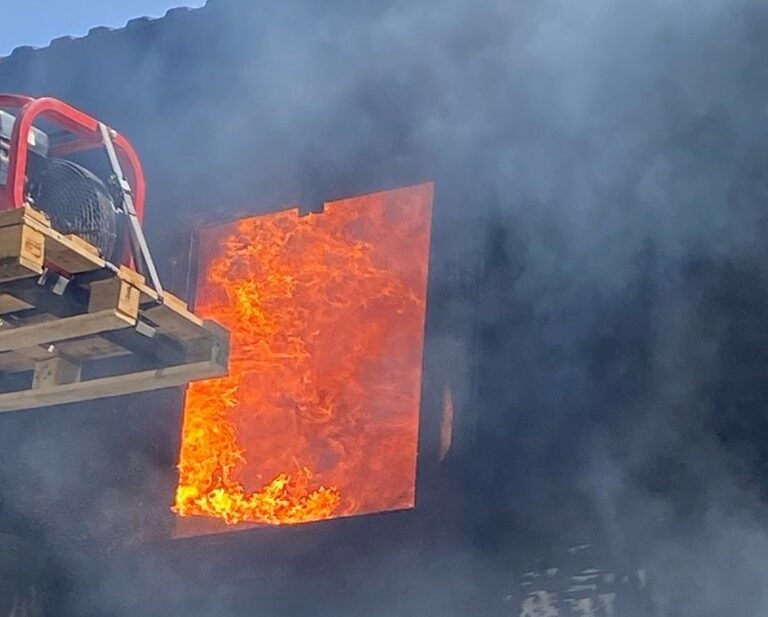
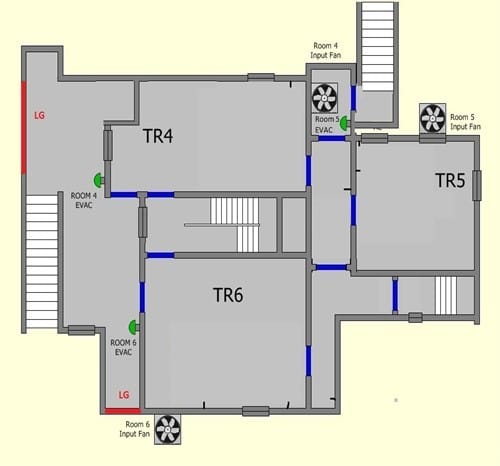
As can be seen from the picture below (figure 1), the wind driven fire was created using a PPV fan through a window into a fire compartment. Figure 2 shows the floor plan for the top floor of the firehouse. The window in TR6 was open to allow an outlet (exhaust) for the fire gases, (as shown by the red arrows). The firefighting crew, supplied by Cold Cut Systems, consisted of one Cobra Operator and one Cobra Senior Instructor with a further Cobra Operator acting as Cobra pump operator.

Figure 1

The fire compartment was room TR5 on the floor plan below (figure 2) with the fan going in through the window to the right of the compartment as you look at it on the plan. (Pale blue arrow)

Figure 1

The crew undertook a scan using a thermal imaging camera (TIC) before entering the building and decided to attack the fire using Cobra from the staircase adjacent to room TR5 (see the yellow arrow which is the Cobra access point on the plan at Figure 2). This gave the crew a high level of protection from the severe heat from the fire which was measured at 581 degrees centigrade before Cobra was used. It also gave protection against contamination from the fire gases and products of combustion. As can be seen from the temperature graph below, the temperature drop was quite dramatic going down to around 280 degrees quite quickly before briefly increasing and then dropping down to roughly around 160 degrees – a much better temperature to enter in order to fully extinguish the fire. It was interesting to note also, the change in temperature in the adjacent room (TR4) which showed a very similar temperature pattern to the fire compartment. The layout of the building offered few opportunities for a safe internal attack on this fire away from the flow path of the super-heated gases. Cobra was used for around eight minutes in total (including piercing) giving total water used at around 480 litres.

There were two key reasons for the success of Cobra in this scenario – firstly the skill and knowledge of the Cobra Senior Instructor and Cobra Operator which was used to good effect in deciding where to make the attack. Secondly, the over-pressurisation of the compartment as the water mist turned to steam – this worked well against the wind to allow the water mist to stay in the compartment for longer and so effectively cool the fire gases rather than being forced out along the flow path.

Please see the temperature readouts from the first floor rooms – Figures 3, 4 & 5 for details. Please note that there is an acknowledged discrepancy in the timings for the temperature readings, however the actual temperatures within the rooms were accurately measured.

The Cobra crew came out of the building and closed down their BA sets, they were able to report that they had not had to work in any high temperatures or in the presence of smoke/fire gases.

If you would like to discuss this article further or if you require further information on Cobra Ultra High Pressure Lance firefighting equipment, please contact Bernie Higgins on bernie.higgins@coldcutsystems.com

This article was originally published in the November edition of IFSJ. To read your FREE digital copy, click here.
IFSJ Exclusive: Quelfire talks firestopping compliance

IFSJ spoke to Craig Wells, Sales Director at Quelfire, to discuss firestopping compliance

Tell me a little about Quelfire?

Quelfire is a manufacturer and supplier of passive fire protection with a primary focus on service penetration seals. We were established in 1977 as a family business and are still family[1]managed today. Since then, we have grown into one of the key providers of passive fire protection solutions and influencers of the market. Along with the products we manufacture and distribute, we put a huge emphasis on both technical support and education.

The culture within the organisation is very much: If we’ve got a tested solution we can sell it, if we don’t then we have to walk away. A large proportion of our annual investment goes into testing our products to achieve a larger scope of application based on feedback from our customers and the industry at large.

We supply specialist fire stop contractors, main contractors, builders, and all the trades in between – from dry-lining contractors to mechanical electrical contractors, anyone with an interest in passive fire protection we’re willing to engage with.

What exactly is firestopping compliance and why is it important?

Building regulations Approved Document B essentially states that all gaps and all penetrations must be suitably sealed. Compliance as a minimum is meeting the requirements of Approved Document B: to install and maintain products which have been tested to the correct standard for the particular application.

 It is important because it quite literally saves lives. A lot of people will be familiar with the Stay Put policy. There has been some criticism around that because of the events at Grenfell, but the policy is effective if the compartmentation is maintained using the correct products, installed in the correct way.

What recent developments have you seen around compliance?

The Grenfell Tower fire first raised the issue of compliance and consequently, this has raised the standards the industry must work to. The Building Safety Act, which received Royal Assent in April, has changed things certainly from the main contractor perspective. We hope this will continue. Fire stopping has historically been regarded as one of the smaller value packages that is implemented on a project towards the end. They will build walls and floors, run all the services through and then ask the fire stopper to come and firestop using the products.

What we’re seeing now is a change in the right direction. People are asking: what do we want to build, how do we want to build it, and is there a tested solution available. They’re now identifying the tested solution, working out what the parameters of that test evidence are and designing around it. The key thing then is sticking to the plan as we move through the installation stage.

There are some very positive changes which are being spring boarded by the introduction of the Building Safety Act, but also just a strong desire within organisations to do the right thing and we are glad to support this.

What should be done to improve compliance throughout the design and installation process?

The buzzwords, and rightly so, are early engagement and cross-party communication. These have got to be encouraged. The fire stop itself is only ever as good as the installation, as the substrate that it’s installed into, and as the actual services that are installed. You’ve got dry liners, mechanical contractors, electricians – maybe other specialist installation trades as well as the wall manufacturers and installers. All these things directly impact the effectiveness of the whole system, so it is important that we’re bringing everyone together at an early stage and designing the building using the tested solutions that are available.

How can parties work together to ensure compliance?

An early engagement meeting is critical. We get everyone together on the same page right from the start, making sure that everyone is involved from the early stages so there are no hiccups along the way. It requires regular meetings with all parties as the slightest change from one party could have quite a massive impact on another. There are also practical steps that we can take, such as Toolbox Talk training sessions. These are on-the-job training sessions conducted by manufacturers like ourselves.

The construction industry can be fairly complacent in terms of thinking that everyone is competent. If we take simple things like installing putty pads into electric socket boxes – you’ve got a qualified electrician that’s used to wiring up socket boxes and is then being asked to put a fire stopping device into the socket. It’s not hard to install a putty pad, but does that individual know why they are installing it? Do they just think it’s a gasket and regard it as a nuisance getting in the way of their wiring? Or do they understand that this is a life[1]safety critical element?

The other suggestion is to install physical sample walls. What you establish at that stage is exactly what is expected in terms of the installation; the writing can be on the wall in terms of expectations. From then on it becomes the benchmark. Anyone onsite can see what’s expected and can measure their work against this benchmark. There can also be that cross-party scrutiny, where one party can say ‘shouldn’t X be doing this because that’s what the demo wall shows?’

How do you make sure that the correct products are being installed?

 By promoting the message that help is available. Competency is knowing what you don’t know and it is really important for people to understand that there are manufacturers and system suppliers like ourselves who are willing to help and provide support. People should not think that they have to go it alone.

Technical support services in the construction industry have tended to be an email address that is monitored once every couple of weeks. We aim to respond to emails within one working day. People should understand that help is available and it’s not wrong to not know the answer to your solution.

There are people out there that can support you and provide you with an evidence-based solution. This has been a challenge in the industry – people have been afraid to go into the level of detail that’s required at an early stage because they think it is going to be hard work to get it out of the manufacturer. But, as I say, things are changing and for us that is one of the main reasons why persons choose to work with us along with our huge, tested scope of application of products.

Quelfire is hosting a panel discussion at London Build this month*, what is its focus and why should people attend?

The discussion is called ‘The Journey to Achieving Fire Stopping Compliance’. There are two strands to the journey aspect of it. One is understanding that it is a journey – from the early stages working out what is needed to achieve compliance and then the various stops along the way which need to be introduced to ultimately achieve compliance at the end of the project.

The other side is that for a lot of people, this is a massive cultural change, and cultural change does not happen overnight. There has been a historic attitude of ‘leave it to the end, leave it to the installers’ but really to achieve compliance it is a case of ‘take control and work out what’s needed, and dictate to the relevant people that this is what we need along the way.’

The discussion will focus on the importance of early engagement, designing the building using tested solutions and all the steps and tools that can be used along the way to make sure that all the parties are aligned and, ultimately, the building is constructed compliant and safe. We’ll also touch on the things that can be done to meet the requirements of the changing legislation and the emphasis on the Golden Thread.

*The Journey to Achieving Firestopping Compliance, led by Quelfire, took place at London Build on 16th November at 2.30pm on the Fire Safety Stage.

This article was originally published in the November edition of IFSJ. To read your FREE digital copy, click here.
UK to continue recognising CE marking for two more years

The UK government has announced plans to introduce legislation to continue recognition of the CE marking and reversed epsilon marking until 31 December 2024. This will apply to most goods being placed on the market or put into service in Great Britain as part of new ministers’ commitment to reduce burdens for industry.

The government has said it will also continue with the measures on retesting and labelling announced in June. The timescales will be amended to reflect the extension.

The move aims to reduce labelling costs by continuing to allow businesses to affix the UKCA marking, and to include importer information for products from EEA countries (and in some cases, Switzerland) on an accompanying document or a label until 31 December 2027.

It is also intended to reduce re-testing costs for UKCA certification by allowing conformity assessment activities for CE marking undertaken by 31 December 2024 to be used by manufacturers as the basis for UKCA marking, until the expiry of the certificate or until 31 December 2027, whichever is sooner.

These measures are being implemented to provide businesses with more flexibility and reduce regulatory burdens for businesses. The government said it will use the UK’s regulatory autonomy to help businesses navigate the current global economic and supply chain challenges whilst prioritising growth. In parallel, the government said it will also consider how it can reduce costs and burdens associated with the UK regulatory framework in the longer-term, including opportunities under the Product Safety Review.

Rules remain different for medical devices, construction products, cableways, transportable pressure equipment, unmanned aircraft systems, rail products, and marine equipment. Departments responsible for these sectors are making sector specific arrangements.