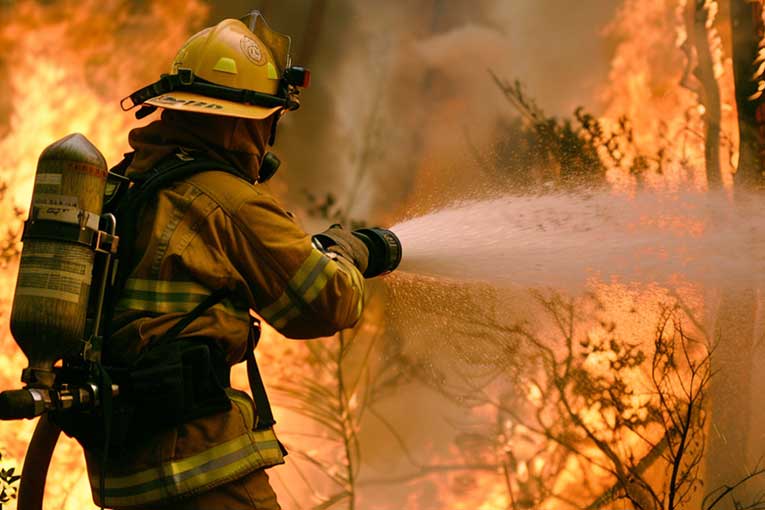
James Perriss, Director of Product Management at Perimeter Solutions, evaluates fluorine free foam adoption for petrochemical teams
Petrochemical facilities operate under constant threat of fire.
Large volumes of highly flammable liquid fuels are stored in massive atmospheric tanks, exposed to extreme operating conditions such as high temperatures, heavy mechanical stress and ever-present ignition risks such as static discharge and lightning strikes.
In this environment, even a minor error or ignition source can escalate into a potentially catastrophic incident within minutes.
In fact, earlier this year, a major fire broke out at the Al Hamriyah fuel depot in Sharjah, UAE.
Thankfully, no lives were lost, but the event once again underscored the critical importance of preparedness and high-performance firefighting resources in the petrochemical sector.
Rapid containment was possible thanks to the expertise and readiness of the on-site emergency response team.
Incidents like these highlight the importance of using the right resources to quickly control and suppress liquid fuel fires in high-risk petrochemical environments.
As the oil and gas industry embraces more sustainable and environmentally responsible practices, the transition from fluorinated firefighting foams to fluorine-free formulations is accelerating.
While some firefighting veterans have expressed concerns about whether these foams are as effective as the fluorinated solutions they replace, firefighters are starting to gain firsthand experience on the continued high level of performance of leading fluorine-free foams.
This article examines the real-world adoption of fluorine-free foam in petrochemical fire protection, highlighting practical considerations for implementation, application rates, foam logistics, large-scale product testing and certifications and real-world examples of facilities successfully using these solutions.
Planning for petrochemical facility fires
The first step in preparing for a potential incident is determining the appropriate application rate based on hazard, fuel and requirements in conjunction with the available equipment and systems at a facility.
From there, facilities can determine the optimal foam formulation and design the logistics needed to ensure fast, effective deployment if a fuel spill or fire occurs.
Successfully containing and extinguishing fires at petrochemical facilities requires careful logistical planning and coordination, as well as premium products and well-trained fire emergency teams.
Engineered fixed systems are often the primary protection, integrated with emergency mobile, high-volume firefighting resources, including large flow monitor trailers, high-volume pumps and submersible pumps, tanker trucks, hose lines and foam proportioning equipment.
Access to vast amounts of water is equally important—especially for large-scale incidents involving storage tanks, fuel bunds, or process units.
That water is needed to mix with foam concentrate to apply as finished foam to control and suppress fuel spills, vapour control and extinguishment.
For example, in some scenarios, delivering more than 40,000 liters per minute (10000 GPM) of foam solution through a single high-flow mobile monitor may be necessary to cover the largest tank on site.
Modern fluorine-free foams like SOLBERG® VERSAGARD™ AS-100 and SOLBERG® RE-HEALING™ 3×3 SP-100 operate at application rates of 3%, while SOLBERG® VERSAGARD™ 1×3 AR-SFFF has proven through significant testing to work effectively as low as 1% foam to 99% water.
This means that sites must plan not only for foam performance, but also for storage, resupply and delivery of the foam concentrate and the logistics for staging these large flow mobile monitor systems.
In large incidents involving vapour suppression and fully involved tank fire, this has often required hundreds of intermediate bulk containers (IBCs) and high-capacity pumping systems to be deployed
As these large fires can quickly deplete foam stocks, it is also important to consider the application rates for tank fire protection with portable, mobile and semi-fixed monitor systems, as outlined by the National Fire Protection Association in NFPA 11, which further illustrates the scale of the resources involved.
The standard recommends a minimum of 6.5 lpm/m2 for fixed roof storge tanks containing hydrocarbons for a minimum discharge time of 50 to 65 minutes (depending on hydrocarbon fuel type).
In addition, NFPA 11 clarifies that flow calculations shall include consideration for potential foam solution losses due to wind and other ambient conditions, stating a factor of 1.5 additional foam application rate used to compensate for these factors, bringing the NFPA 11 minimum design application rate to ~9.8 lpm/m2 for monitor application on fixed roof storge tanks.
Most emergency response teams handling large tank fires prefer 1×3 foam concentrates due to their efficiency and lower concentrate demand.
In large-scale incidents around the world, this has led to sites needing to stage approximately 100 IBCs of 1×3 foam.
In contrast, if a 3% foam is required, that number could triple.
While many organisations are inclined to use 3×3 foams, it’s critical to fully understand the logistical implications, particularly around storage, delivery and resupply before making a final selection.
Perimeter Solutions offers both a one percent (SOLBERG VERSAGARD 1×3) and three percent solutions (SOLBERG® RE-HEALING™ 3×3 SP-100 and SOLBERG® VERSAGARD™ AS-100) to support these incidents.
Fluorine-free solutions for oil & gas
Perimeter Solutions is a leading developer of fluorine-free firefighting foam solutions specifically designed for petrochemical environments.
Perimeter’s SOLBERG VERSAGARD series of fluorine-free foams also offers highly effective performance for petrochemical firefighting.
SOLBERG VERSAGARD AS-100 3×3 AR-SFFF (along with its counterpart SOLBERG VERSAGARD AS-100 Freeze Protected) and SOLBERG VERSAGARD 1×3 AR-SFFF Multipurpose Foam Concentrates are non-persistent, siloxane-free and contain no intentionally added PFAS.
Capable of suppressing Class B and deep-seated Class A fires, these biodegradable products have passed multiple large-scale fire testing programs and hold key certifications, including:
• LASTFIRE
• UL 162 Listed
• EN-1568:2018 – parts 1,2, 3 & 4
• International Maritime Organisation (IMO) MSC.1/Circ.132
• ICAO Level B
• GESIP
SOLBERG® RE-HEALING™ 3×3 Fluorine-Free SP-100 was the industry’s first UL-listed fluorine-free 3×3 foam concentrate with the full complement of hardware and sprinkler listings, including non-aspirated standard sprinkler heads.
Like the SOLBERG VERSAGARD line, it is a non-persistent, siloxane-free solution that contains no intentionally added per- or polyfluoroalkyl substances (PFAS).
Designed to extinguish and secure both Class B (hydrocarbon and polar solvent fuel) and deep-seated Class A fires, it is UL-listed, FM 5130 Approved and certified to ICAO Level B.
They are also GreenScreen® Certified Silver, reflecting their strong environmental profiles.
The performance of the SOLBERG fluorine-free Foam concentrates has made them a trusted solution for fire management teams around the world, including those at major oil companies in the Gulf, Asia Pacific region, Australia, Africa, Europe and the U.S.
One example is the selection of SOLBERG VERSAGARD 1×3 by a UK-based petrochemical facility seeking to move away from aqueous film-forming foam (AFFF).
A diversified energy company, it had long intended to transition to a fluorine-free foam.
However, despite the desire to make the switch, they had not yet found a fluorine-free option that matched the performance of their existing AFFF.
That changed with the introduction of SOLBERG VERSAGARD 1×3, which met their logistics and fuel needs with a high-performance tested alcohol-resistant synthetic fluorine-free foam (AR-SFFF).
Working with distributor Hawkes Fire and Perimeter, representatives from the energy company travelled to Perimeter’s testing facility in Spain to evaluate the performance of the alcohol-resistant concentrate.
Additional testing with LASTFIRE was also conducted at the customer’s site in the UK, to verity the performance in larger-scale tests.
Satisfied with the results, the company moved forward with the transition.
Looking ahead
Perimeter Solutions continues to develop new technology, expanding the capabilities of fluorine-free firefighting foam.
While not focused on the petrochemical space, Perimeter Solutions developed the world’s first Mil-Spec fluorine-free foam – SOLBERG® 3% MIL-SPEC SFFF, and recently introduced SOLBERG® Evolution 3% SFFF, another ground-breaking Newtonian product used for aircraft rescue fire suppression through sprinkler applications.
It is the world’s first fluorine-free foam concentrate with Mil-Spec approval for hydrocarbon fuel fires using standard sprinkler heads.
UL-162 listed, BSS7432 and ICAO B certified with FM 5130 certification pending, it delivers fast knockdown and extinguishment of fuels, including gasoline, Jet A and Jet A-1.
Our solutions will continue to evolve along with fire safety needs for the petrochemical sector.
We remain committed to advancing the efficacy of fluorine-free foam technology and setting the benchmark for sustainable fire suppression.