Designing for SFFF: The proportioning challenge with Firemiks

Per Aredal of Firemiks AB explores proportioning challenges in transitioning to fluorine-free firefighting foams

The phase-out of fluorinated foams and the move towards synthetic fluorine-free firefighting concentrates (SFFF) is one of the most significant material shifts the fire protection industry has navigated in decades.

For those specifying or operating fixed suppression systems, the change raises an important and often underestimated question – not just which concentrate to use, but whether the proportioning system in place can handle what comes next.

Per Aredal, International Sales Director at Firemiks AB, makes the case that getting the proportioning system right is where future-proofing the installation begins.

Water driven volumetric proportioning

At its core, a water driven volumetric pump proportioner is ingeniously self-regulating.

The system relies on positive displacement for both its water motor and concentrate pump.

The water motor – driven entirely by the flow of extinguishing water – powers the concentrate pump, which injects the correct amount of firefighting concentrate into the water stream.

The dosing ratio is determined by the volumetric relationship between the two components, requiring no electricity, engines or power take-off (PTO) units.

This autonomy has direct operational consequences.

Start-up and commissioning are straightforward, and the system is less susceptible to the failure modes that come with dependence on external power or fuel.

Installation can be decentralised (placed close to the hazard) which can meaningfully reduce response times in demanding environments.

Four decades of refinement

The FIREMIKS system is rooted in the volumetric water motor design first developed in the late 1970s by the grandfather of the company’s current management.

What began as an innovative mechanical concept has been continuously refined over more than four decades, yielding a wide operating range across both flow and pressure.

The self-regulating nature of the system is one of its defining characteristics.

It accurately tracks flow changes and oscillations in real time, remaining largely unaffected by pressure variations across its operating range.

A single unit can cover varying fire area sizes or service multiple simultaneous fires and does so without requiring recalibration when conditions or concentrates change.

The concentrate storage arrangement adds further flexibility.

An atmospheric tank configuration makes it easy to inspect concentrate levels, take samples, and replenish or swap tanks even during active firefighting operations.

Fixed and mobile tanks – including IBC containers or tank trailers – can be combined for uninterrupted operation.

For installations requiring periodic performance verification, the optional Dosing/Return Valve (DRV) with dual flow meters allows accurate testing without releasing any concentrate to the environment, reducing both cost and disposal concerns.

Certified for variable viscosity

Perhaps the most significant aspect of the FIREMIKS range is its FM approval classification as a “Variable Viscosity Pump Proportioner.” Under FM Standard 5130 (May 2021), eighteen 3% models across seven flow sizes – 450, 800, 1800, 2400, 4000, 6000 and 8000 lpm – have been certified to maintain accurate dosing across a very wide viscosity range: from 1 cP up to 7,288 cP at a shear rate of 5 1/s.

This is particularly relevant as the industry transitions to SFFF concentrates, many of which are non-Newtonian and exhibit higher viscosity than their AFFF predecessors.

Unlike bladder tank systems, which are typically designed around a narrow viscosity window and require recalibration if the concentrate or its properties change, a FIREMIKS unit does not need recalibration when a different concentrate is introduced, provided its viscosity falls within the certified envelope.

The shear rate curves approved for our different FM-approved models are as follows:

Shear rate 1/sViscosity (cP)
450 & 800 lpm1800, 2400 & 4000 lpm6000 & 8000 lpm
5393464227288
10214135453942
20115719452110
50529882959
100302497533
60080128132

If a concentrate’s shear rate curve falls at or below the figures for a given unit size, it will perform within approved dosing tolerances, including the latest generation of fluorine-free concentrates.

For installations requiring flows above 8,000 lpm, two units can be configured in parallel, either on a base skid or in a “double-decker” arrangement, to reach 12,000 or 16,000 lpm.

Why proportioning system choice matters

The shift to SFFF is not a simple one-for-one swap.

It involves regulatory compliance, environmental assessment, logistics and equipment compatibility – each link in a long chain.

Firemiks focuses specifically on one critical link: ensuring that the proportioner can deliver the correct dosing rate regardless of viscosity, within approved limits.

The practical implications are straightforward.

A variable viscosity system means no need to replace or recalibrate the proportioner when switching concentrate suppliers or brands.

It means minimal downtime if a change becomes necessary for operational, commercial or regulatory reasons.

And it means reliable performance even as concentrate viscosity shifts due to ageing, temperature fluctuations or batch variation – provided the concentrate remains within the approved viscosity envelope.

For specifiers and end users planning installations that may span several decades, this is not a trivial consideration.

The concentrate landscape is still evolving, and future-proofing an installation against that uncertainty is a sound engineering decision.

Matching the pump to the application

One further differentiator in the FIREMIKS range is the availability of two concentrate pump types – piston and gear – each suited to distinct application profiles and viscosity characteristics.

Piston pump models use a reciprocating mechanism in which the plunger draws in and then expels concentrate in each revolution, taking the fluid from zero to maximum shear rate twice per cycle.

For low-viscosity or mildly non-Newtonian concentrates this works well, and the piston configuration performs particularly effectively in applications with low start-up flows relative to maximum flow, such as sprinkler systems.

The wide operating range makes it a versatile choice across many installation types.

Gear pump models take a different approach.

Counter-rotating gears generate a smooth, consistent flow without agitation, which makes them well-suited to handling very high-viscosity fluids -particularly those that exceed the shear rate envelope verified by FM approval for the piston pump models.

This characteristic makes gear pumps the preferred option for deluge systems, large fire monitor installations, and any application operating at the higher end of the maximum flow range.

When advising clients, Firemiks prioritises understanding the concentrate type and viscosity alongside flow and pressure requirements before recommending a pump type – ensuring that the specified system performs reliably across its full operating life.

Per Aredal is International Sales Director at Firemiks AB, with more than 35 years of experience in the design, production and global delivery of water driven volumetric pump proportioners. He can be reached at per.aredal@firemiks.com, +46 76 139 70 34, or via www.firemiks.com.
This was originally published in the April 2026 Edition of International Fire & Safety Journal. To read your FREE copy, click here.

FIREMIKS expands FM-approved range for Intersec 2026 appearance

Firemiks to present approved systems in Dubai

Firemiks will present its expanded FM-approved product line at Intersec 2026 in Dubai, where visitors will be able to review water-driven volumetric pump proportioners across seven flow sizes.

According to FIREMIKS AB, the range includes products approved under FM 5130 (May 2021) and recognised as Variable Viscosity Pump Proportioners.

The portfolio includes 18 FM-approved models, with flow sizes ranging from 450 to 8000.

Visitors will be able to learn more about the systems and their applications at the Swedish Pavilion in Hall 8, stand C30, and at the Solas Safety & Fire stand in Hall 4, B38.

Product range covers viscosity and installation requirements

Firemiks stated that the systems are designed to provide accurate proportioning across a wide viscosity range.

The proportioners can handle foam concentrates from 1 cP to 7288 cP, including non-Newtonian fluorine-free SFFF concentrates.

The range is available with different water motor configurations, including hard-anodised aluminium units with PTFE coating and nickel-aluminium bronze models for marine and offshore environments.

Stainless steel pump head options are also available.

Configurations support varied flow demands

Firemiks said water motor connections range from 2-inch DN50 to 8-inch DN200 depending on the model.

For installations requiring larger flows, systems can be installed in parallel configurations to achieve capacities up to 12,000 or 16,000 litres per minute.

The Intersec presentation will give visitors a chance to review the scope of the range and the applications described by the company.

FIREMIKS system installed at Lamor recycling plant in Finland

FIREMIKS installation at Finnish recycling plant

A Firemiks firefighting system has been installed at the Lamor Oy chemical and plastic recycling plant in Kilpilahti, Porvoo, Finland.

Firemiks AB announced that the site has been equipped with a FIREMIKS 6000-3-PP-F-ALU-DRV water-driven volumetric pump proportioner to support fire protection operations.

The facility is described as the first plant of its kind in Finland.

The system has been installed within a dedicated container at the site.

It provides a maximum flow capacity of 6,000 litres per minute and delivers a precise three percent dosing of fluorine-free foam concentrate.

Testing setup and project delivery

According to Firemiks AB, the installation also includes a Dosing Return Valve (DRV) and a complete Dosing Rate Test System with two independent flow meters.

This arrangement allows operators to carry out regular system testing without consuming foam concentrate.

It also removes the need to clean up dispersed foam after tests.

Firemiks said the configuration supports straightforward system verification and reduces operating costs and environmental impact over the lifetime of the installation.

The project was delivered in collaboration with Oy Veljekset Kulmala Ab, FIREMIKS’s sole distributor in Finland.

The science behind consistent dosing with Firemiks

Per Aredal, International Sales Director at Firemiks AB, discusses innovative pump proportioning systems for fluorine-free foams and high-viscosity concentrates

Firemiks AB, originally established in 1979 as a Swedish family-owned business, is now operated by the third generation in collaboration with strong industrial partners. Over the years, our focus has been on developing, manufacturing and distributing our proprietary water-driven volumetric pump proportioning systems globally.

We pride ourselves on offering custom solutions tailored to the unique needs of each client’s project while also delivering standardised models that meet rigorous international certifications, such as FM Approvals.

Proportioning innovation

The FIREMIKS proportioning system operates on the principle of positive displacement for both the water motor and the concentrate pump. The water motor, driven solely by the extinguishing water flow, powers the concentrate pump, which injects the concentrate into the water flow. The dosing is determined by the volumetric relationship between the water motor and the concentrate pump. This ratio is unaffected by viscosity, within specified limits as outlined in the unit’s data sheet.

“The dosing is determined by the volumetric relationship between the water motor and the concentrate pump.”

Per Aredal, International Sales Director at Firemiks AB

The volumetric water motor design, conceived by the grandfather of the current management in the late 1970s, is notably compact for the flow it can handle. For example, on a typical 3% unit, the water motor can process approximately 30 times the volume of the concentrate pump, yet its size remains only slightly larger.

Since its inception, we have continuously refined the design to enhance performance and reliability. As with any pump design, attention to detail and precise execution are key. Additionally, our system’s flexibility allows us to quickly adapt and match the water motor with a wide range of high-end concentrate pumps, each with its own unique specifications to consider.

Customised systems

We offer a wide range of models to meet various flow capacities and proportioning needs. Our smallest model has a maximum flow rate of 150 liters per minute (lpm), while the largest single model can handle up to 10,000 lpm. For flows exceeding this, we provide parallel-installed FIREMIKS systems, either on a base skid or as “double-decker” units, capable of reaching up to 20,000 lpm.

Our three standard skid models include: 12,000 lpm (2 x 6,000 lpm), 16,000 lpm (2 x 8,000 lpm) and 20,000 lpm (2 x 10,000 lpm). For fixed proportioning, we typically offer 1% and 3%, with the option to customise dosing rates such as 0.1%, 0.3%, 2%, or 6% upon request. Additionally, models with selectable proportioning are available, including combinations like 0.3-0.6-1% and 1-2-3%, or, for selected flow sizes, 0.5-1-3%.

Ensuring accuracy

FM approval designates our system as the “Variable Viscosity Pump Proportioner,” meaning that as long as the specified minimum and maximum flow rates in the data sheet are followed, FIREMIKS can accommodate viscosity changes across a wide flow and pressure range. The dosing remains within the approved tolerance limits specified in the standards (e.g., 3.0-3.9%). This offers the significant advantage of eliminating the need for recalibration whenever there is a change in concentrate or viscosity—unlike bladder tanks, which often require recalibration and create critical downtime during replacement.

The FM approval we have received (Standard: 5130 – May 2021) for eight of our 3% models, across three flow sizes—1800, 2400 and 4000 lpm—confirms that the FM-approved FIREMIKS units provide accurate dosing and can handle concentrates ranging from 1 cP to high-viscosity concentrates (up to 6422 cP at a shear rate of 5 1/s).

The specific curve approved for our FM-approved models is as follows:

Shear rate 1/sViscosity (cP)
56422
103545
201945
50882
100497
600128

This means that if a concentrate has a shear rate curve that aligns with or falls below the specified figures, it will perform well with our FM-approved FIREMIKS models. This applies even to the new generation of fluorine-free SFFF concentrates, which are often non-Newtonian.

To ensure optimal dosing performance at maximum viscosity for the three FM-approved sizes, the required concentrate delivery hose/pipe dimensions and height are as follows: a maximum length of 2.5 meters, a diameter of DN 65 or larger and a gravity feed height of 0.5 meters or higher.

Addressing regulatory shifts

Regulatory bodies are driving the transition from PFAS-containing concentrates to SFFF concentrates, prompting a re-evaluation of many proportioning systems for compatibility. Manufacturers offer SFFF foams with a broad range of viscosities, including very high-viscosity concentrates. To select the right proportioner, understanding the concentrate’s properties is essential.

“With the new SFFF concentrates, which are often non-Newtonian, accurately predicting flow behaviour has become more complex.”

Per Aredal, International Sales Director at Firemiks AB

In the past, engineers could calculate concentrate flow with confidence, but with the new SFFF concentrates, which are often non-Newtonian, accurately predicting flow behaviour has become more complex.

For proportioners that require calibration, the dosing may be accurate under specific conditions, but even small changes in variables can cause the system to fall out of calibration. In such cases, it’s better to rely on a system, like FIREMIKS, that is designed to handle a wide viscosity range without the need for recalibration.

Catering to all viscosities

FIREMIKS distinguishes itself by offering two types of dosing pumps—Piston and Gear pumps—coupled with a robust multi-vane motor, built on over 35 years of market experience. When working with clients, we prioritise understanding the concentrate type and viscosity, in addition to considering flow and pressure, before recommending the most suitable pump type and providing tailored installation advice.

It’s important to note that all Piston pump systems on the market have a viscosity limit due to the reciprocating principle of the Piston pump. During each revolution, the plunger sucks in concentrate and then presses it out, causing the concentrate to go from zero to full speed twice per revolution. If the static viscosity of non-Newtonian concentrates is too high, the concentrate may not flow smoothly, resulting in an inaccurate dosing rate.

Our Piston pump models typically excel in systems with low start-up flows relative to their maximum flow rate, making them ideal for applications like sprinkler systems and offering versatility across a wide flow range.

On the other hand, our Gear pump units are highly effective for handling high-viscosity fluids. Their counter-rotating gears create a consistent, non-agitating flow, ensuring reliable sealing with such fluids. Gear pump models are also particularly efficient in applications operating at the higher end of the maximum flow rate, such as deluge and large fire monitor systems.

What’s next for firefighting foam?

The ongoing market shift from AFFF (Aqueous Film Forming Foam) to SFFF (Synthetic Fluorine-Free Foam) concentrates, which is expected to continue for at least the next 10 years, presents challenges for both existing and new foam systems. This transition will drive the need to upgrade many current systems. We are also seeing increased interest in lower dosing rates, such as 1% and even lower concentrations like 0.3% or 0.5%. Additionally, developing effective systems for extinguishing Li-Ion battery fires remains a significant challenge for the entire firefighting industry. Firemiks AB is well-positioned to support this shift and is prepared to further develop our systems as needed to meet varying concentration requirements.

About the Author

Per Aredal is International Sales Director at Firemiks AB, with + 35 years of experience of producing and delivering water driven volumetric pump proportioners worldwide. For more information contact Per Aredal vie email: per.aredal@firemiks.com, phone : +46-76-139 70 34, or visit www.firemiks.com.

This article was originally published in the January 2025 issue of International Fire & Safety Journal – to read your FREE digital copy, click here.

The Last Word with FIREMIKS AB

Per Aredal, International Sales Director at FIREMIKS AB shares insights into water driven volumetric proportioners

Can you give a brief introduction to FIREMIKS?

Originally founded in 1979 as a Swedish family-based business – Firemiks AB is operated by the third generation, together with strong industrial partners.

Throughout the years, our focus has been to develop, manufacture and distribute our own line of water driven pump proportioning systems worldwide.

Our work method is to have the possibility to produce custom solutions to the individual needs of each client project, while also delivering regular models in accordance with international standards.

Can you explain how FIREMIKS foam proportioners work?

The proportioning of the FIREMIKS is based on the principle of positive displacement for both the water motor that is driven by the extinguishing water flow and the concentrate pump that is driven by the water motor and which injects the concentrate into the extinguishing water flow.

In this manner, the dosing relation is established by the volumetric relation of the water motor and the concentrate pump.

This dosing relation is not affected much by viscosity, up to a limit of course as is detailed in the units’ performance data.

The concentrate pump is connected to an atmospheric concentrate tank with gravity feed to the dosing pump.

Solely the extinguishing water is required to power the whole dosing system.

How do FIREMIKS systems accommodate the varying viscosities of firefighting foams?

The volumetric water motor design was conceived by us in the late seventies, and it is very compact for the flow it can take.

On a typical 3% unit, the water motor will take roughly 30x the volume of the concentrate pump, yet it is barely bigger.

Since the start we have constantly refined its design for better performance and reliability.

Like all pump design, it is all about the details and the execution.

Important is also our flexibility to adapt the design and sizing, so we can quickly match the water motor up correctly with a wide variety of concentrate pumps, each of which also has its specifics to take into account.

What viscosity handling challenges are there when transitioning to SFFF?

Regulatory bodies are driving the shift from PFAS-containing concentrates to Syntheitic Fluorine-Free Foam (SFFF) concentrates, prompting a reassessment of many proportioning systems for compatibility.

Various manufacturers offer SFFF foams with a wide range of viscosities, including very high-viscosity concentrates.

To select an appropriate proportioner, understanding the concentrate’s properties — whether it falls within a viscosity range of 1cP to around 5-6000 cP (measured using a Brookfield Viscometer Spindle #4 at 30 rpm) — or if it’s classified as very high viscosity is crucial.

In the past engineers have relied on being to calculate the flow of concentrate, but with these new SFFF that are often non-Newtonian in their nature, accurately and reliably calculating the flow behavior is much harder.

On devices that need calibration, the dosing might work in a specific set of circumstances, but as soon as one variable changes, it could fall out of calibration.

Then it is much better to rely on a system that by design can accommodate a wide viscosity range, like FIREMIKS.

How is FIREMIKS preparing for further advancements in firefighting foam technology?

Apart from the important transition from AFFF to fluor-free SFFF, which we expect will last for at least another 5-10 years.

We see more interest in lower dosing rates as 1% and even lower for example 0,3, 0,5% etc.

Also, the challenges to create good system capable of extinguishing Li-Ion batteries in an effective way is a major challenge for the whole fire-fighting industry.

Firemiks AB is well-prepared in this process to further develop our system if necessary to meet different concentrates requirements.

This article was originally published in the March 2024 issue of International Fire & Safety Journal. To read your FREE digital copy, click here.

Proportioning precision

Per Aredal, International Sales Director at FIREMIKS AB, discusses the advantages of water driven variable viscosity proportioners

The current shift in the market from AFFF (Aqueous Film Forming Foam) to SFFF (Synthetic Fluorine-Free Foam) concentrates poses challenges for both existing and new foam systems.

One critical aspect is the proportioning in a firefighting solution, where understanding the viscosity of the new SFFF concentrates is key in selecting the appropriate proportioner.

The FIREMIKS concept is a water-driven volumetric pump proportioner designed for fixed installations, connected to an atmospheric concentrate tank with gravity feed to the dosing pump.

The system requires solely the extinguishing water to power a volumetric water motor, which, in turn, operates a positive displacement pump.

This pump accurately doses the required concentrate into the extinguishing water across a broad flow and pressure range.

Notably, no additional energy source is necessary for its operation.

Regulatory bodies are driving the shift from PFAS-containing concentrates to SFFF concentrates, prompting a reassessment of many proportioning systems for compatibility.

Various manufacturers offer SFFF foams with a wide range of viscosities, including very high-viscosity concentrates.

To select an appropriate proportioner, understanding the concentrate’s properties—whether it falls within a viscosity range of 1cP to around 5-6000 cP (measured using a Brookfield Viscometer Spindle #4 at 30 rpm)—or if it’s classified as very high viscosity is crucial.

FIREMIKS stands out by offering two types of dosing pumps—Piston and Gear pumps—alongside a robust multi-vane motor based on over 30 years of market experience.

When working with clients, apart from considering flows and pressures, we prioritize understanding the concentrate type and viscosity, a quite complicated subject, before recommending the suitable pump type.

Piston Pump Proportioners

Our models equipped with Piston pumps are classified as “Variable viscosity proportioners” in FM approval terminology.

They maintain precise dosing rates within approved tolerances across a broad viscosity spectrum—from low viscosity to around 5-6000 cP (dependent on variables like temperature, concentrate type and brand).

Important to know is that all Piston pumps systems on the market have a limit upwards on handling viscosity concentrates, due to the Piston pump reciprocating principle; for each revolution, the plunger sucks concentrate and then presses it out and the concentrate goes from zero to full speed twice per revolution.

If the static viscosity is too high with non-Newtonian concentrates, the concentrate might not flow smoothly and therefore the correct dosing rate may not be achieved.

Typically, our Piston pump models excel in systems with low start-up flows relative to the maximum flow rate, ideal for applications like sprinkler systems, providing versatility across a wide flow range.

Water motor-driven pump proportioners equipped with Gear pumps are well-suited for handling high and very-high viscosity concentrates.

We have successfully tested Gear pump models using Fluorine-free foams with a viscosity of up to 8,040 cP (Brookfield Viscometer Spindle #4 at 30 rpm).

Gear pumps excel with high-viscosity fluids due to their counter-rotating gears that create a consistent, non-agitating flow, ensuring effective sealing with such fluids.

Our Gear pump models are particularly efficient in applications operating at the higher end of the maximum flow rate, such as deluge and large fire monitor systems.

For all systems dealing with higher viscosity concentrates, ensuring adequate foam supply pipe diameter, good gravity feed, and minimizing concentrate line lengths are crucial.

Our datasheets specify recommendations, and we’re available for more tailored guidance for your project.

Catering to any flow size

FIREMIKS offers a diverse range of models catering to various flow sizes and proportioning requirements.

Our smallest model has a max flow of 180 lpm and the largest single model a capacity of 10000 lpm flow.

To achieve larger flows, up to 20000 lpm, we offer parallel installed FIREMIKS, on a base skid or mounted as” double-deckers”.

Our three standard models are: 12000 lpm (2 x 6000 lpm), 16000 lpm (2 x 8000 lpm) and 20000 lpm (2 x 10000 lpm).

For fixed proportioning we offer 1% and 3% as standard.

We may also supply units with special dosing rates, for example 0,1%, 0,3% 0,5%, 2%, 2,75% and 6%, on customer’s request.

Models with selectable proportioning are available with 0,3-0,6-1% and 1-2-3% (For selected flow sizes 0,5-1-3%).

Economical and environmentally beneficial testing with FIREMIKS is easy with optional Dosing/Return valve (DRV) and two separate flow meters.

If requested we may offer a complete dosing rate testing system that follows the guidance of EN 13565-1, NFPA11 and FM 5130.

Advantages of FIREMIKS Variable viscosity proportioners over Bladder tank systems

FIREMIKS ensures an uninterrupted foam supply as long as water and concentrate are available.

Adding more concentrate is as simple as connecting another container/drum.

In contrast, Bladder tank systems experience downtime when the bladder needs refilling.

As a Variable viscosity proportioner FIREMIKS Piston pump models handles concentrates from 1 cP (like wetting agents) up to around 5-6000 cP without the need of calibration.

A Bladder tank system is often designed for one specific concentrate viscosity and needs to be recalibrated and balanced to fit a new concentrate with another viscosity, adding crucial down-time for this replacement or recalibration.

To change foam type or brand concentrate, including to another viscosity is also a simple task with FIREMIKS if an IBC-container is used as foam concentrate supply, just exchange the IBC-container to another with the new/other concentrate within the approved range.

In comparison, to exchange foam concentrate in a rubber bladder may be a challenging task, including cleaning or replacement of the bladder.

In summary the FIREMIKS-system is a straight-forward system, easy to understand and to install, handle, maintain and test.

About the author

Per Aredal is International Sales Director at Firemiks AB, with + 30 years of experience of producing and delivering water driven volumetric pump proportioners worldwide.

For more information contact Per at per.aredal@firemiks.com, on mobile: +46-76-139 70 34.

For more information, go to www.firemiks.com.

This article was originally published in the January 2024 issue of International Fire & Safety Journal. To read your FREE digital copy, click here.

IFSJ Exclusive: Know your viscosity with FIREMIKS

Per Aredal International Sales Director at FIREMIKS AB, sheds light on the proportioning systems suitable for the transition to synthetic fluorine-free foam

During the market transition from AFFF (Aqueous Film Forming Foam) to SFFF (Synthetic Fluorine Free Foam) concentrates it is important to know the viscosity of the SFFF concentrate to choose the right type of proportioner.

FIREMIKS is a water driven volumetric pump proportioner for firefighting – for fixed installations connected to a concentrate tank with gravity feed to the dosing pump. Extinguishing water drives the volumetric water motor, which in its turn drives the positive displacement pump that doses the correct amount of concentrate in the extinguishing water exiting the water motor.

As the regulatory authorities now are pushing for soonest possible transformation from PFAS-containing concentrates, towards SFFF concentrates, many proportioning systems are re-evaluated to ensure compatibility with the new concentrates. Different concentrate manufacturers offer a variety of foams which comes in a wide range of viscosities, including very high viscous concentrates. To be able to select an appropriate proportioner one needs to know the properties of the concentrate.

FIREMIKS is uniquely positioned to offer two types of dosing pumps, Gear and Piston (plunger), combined with our sturdy multi-vane motor that offers optimal reliability based on +30 years of experience in the market. Among several important factors, besides flows and pressures, we always gather info from the customer regarding the concentrate type and viscosity before we propose which type of pump that will match the customers need.

Proportioners with Gear Pump

Water motor driven pump proportioner equipped with a Gear pump are particularly suited for operating in the higher range of a systems maximum flow rate, such as deluge and large fire monitor systems. They are also most suited for high and very-high viscosity concentrates.

For example, we have with excellent result tested one of our Gear pumps models with a Fluorine-free foam with 8,040 cP (Brookfield Viscometer Spindle #4 at 30 rpm). The reason Gear pumps works well with these very-high viscous concentrates is that they are equipped with counter rotating gears which seals better with high viscosity fluids and creates an even flow that does not agitate the concentrate.

Proportioners with Piston Pump

Water motor driven pump proportioners equipped with Piston (plunger) pumps are on the other hand particularly suited for use in systems with low start-up flows in relation to the systems maximum flow rate, for example sprinkler systems. They are also very suited for low and medium viscosity concentrates.

Important to know is that Piston pumps have a limit upwards to high viscosity concentrates, normally around 4,000-4,500 cP (Brookfield Viscometer Spindle #4 at 30 rpm) due to the Piston pump reciprocating principle; for each revolution, the plunger sucks concentrate and then presses it out and the concentrate goes from zero to full speed twice per revolution in a very tight pump design. If the static viscosity is too high with non-Newtonian concentrates, the concentrate will not flow smoothly and therefor the correct dosing rate might not be achieved.

Important for all systems is that one should ensure that diameter on the foam supply piping is large enough for the concentrate delivery and to avoid longer concentrate lines. Recommendations are specified in our data sheet for each model. We are always available to guide you with more specific recommendations if needed for your specific project.

Verifying dosing rate according to EN 13565-1, NFPA 11 and FM 5130 on water driven volumetric pump proportioners.

To measure and verify the dosing rate on a proportioning system according to regulations and standards, at the commissioning and yearly maintenance, is an important task.  The aim is to ensure that the installed firefighting system proportion the correct amount of the concentrate into the firefighting water flow, as intended and designed.

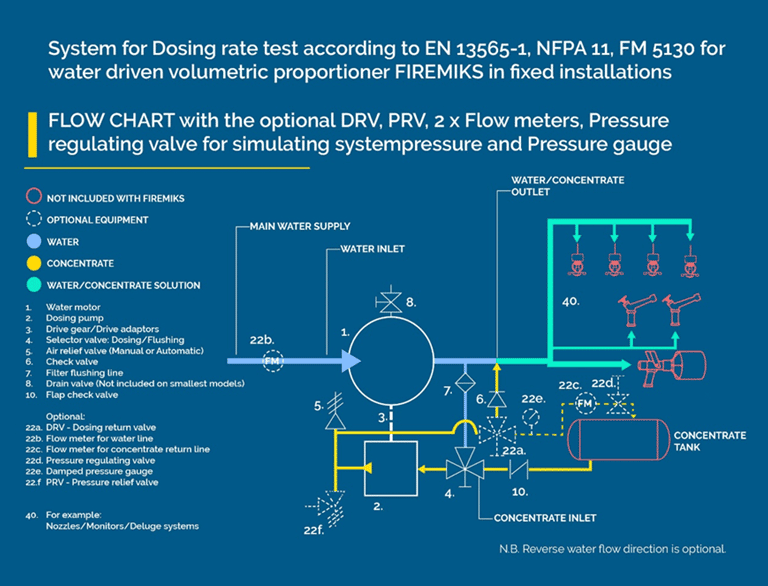
To be able to easily test and verify the correct proportioning the FIREMIKS unit needs to be equipped with an optional Dosing return valve (DRV) (no 22a.) that directs the concentrate back to tank instead of being induced into the water flow. This allows for testing the system without mixing the concentrate. A Pressure relief valve (PRV), (no 22f.) is included with the DRV to eliminate the risk for over-pressure if return line to tank is closed/blocked by mistake.

Furthermore, one needs to install two calibrated Flow meters; one for main water line (22b.) and one electromagneticflow meter for concentrate return line (22c.), combined with a Pressure regulating valve (or a regular valve which can be partly closed to regulate the backpressure, e.g. globe valve) (22d.) to simulate system pressure, displayed by a Pressure gauge (22e.).

Environmentally and economically beneficial testing system

This described dosing test system ensures that it is possible to practise and test dosing rate without consuming the concentrate. It gives also substantial savings over the years with no cost for cleaning or destruction of dispersed solution after the test. With the growing strict environmental regulations, this advantage has become even more important today.

The accurate way of verifying dosing rate

Verifying dosing rate equals to verifying the correct volumetric function of both the water motor and dosing pump with two independent calibrated flow meters and calculate to this formula, in accordance with EN 13565-1, NFPA 11, FM 5130:

(Concentrate flow) / (Water flow + Concentrate flow ) x 100 = Dosing rate %

Revolution counter method – the limits

The revolution counter method which is also presented on the market assumes the correct working of the water motor, this means it gives only an estimateof water flow.

The is not an approved method to verify dosing rate as described by
EN 13565-1, NFPA 11 and FM 5130, who each require the use of a separate flow meter to measure water flow. Quote from FM Approval guide ref. rpm method: “May be used to provide a general estimate of the extinguish water flow”.

Revolution counting with handheld tachometer

The estimated water flow can also be measured with handheld tachometer (contact or non-contact) to ensure that the unit is not over-speeding, i.e. working within the upper rpm = flow limit specified in the Data sheets of each FIREMIKS model.

Measuring concentrate flow

An alternative method to measure the pumped concentrate is to pass it into a separate container after the pressure regulating valve (22d) and weigh the amount used from the tank during a defined time and then converting it to the corresponding flow rate.

In our experience, magnetic flow meters work well for measuring concentrate flows. Even so, it is even better to be able to establish a known weight or volume of concentrate used in a known time interval, because even approved magnetic flow meters are not tested on all concentrates available.

Handling and monitoring on site or remote

The flow meters, valves and pressure gauge described above can either be handled, monitored and read on site, or connected to remote handling, monitoring and readings. Independently of this – the most important factor is to ensure that data is measured accurately and according to standards to ensure that the installed firefighting system proportions the correct amount of the concentrate into the firefighting water flow.

This article was originally published in the January edition of IFSJ. To read your FREE digital copy, click here.