IFSJ Exclusive: Pacific Helmets talks safety without compromise

Pacific Helmets’ Sales and Development Manager, Lee-Anne Glanville-Rothman, talks about Haloflex technology, helmet maintenance and the company’s international ambition

Pacific Helmets was established back in 1982 by David and Marion Bennett with the ambition of getting New Zealand Governments to mandate a safety standard for riding bicycles. David’s passion for safety drove the business forward moving from non-emergency services’ head protection into the realm of emergency services and technical rescue.

The first large scale tender which Pacific Helmets won for structure firefighting helmets was for the London Fire Brigade. This tender was the pivotal point in the company’s manufacturing evolution and the reason it continues to deliver quality products without compromising the end users’ safety.

We spoke to Lee-Anne Glanville-Rothman, Sales Development Manager, at Pacific Helmets to find out about the company’s new products and why “Safety without compromise” is the manufacturer’s mantra that it lives and breathes.

Tell me about your role at Pacific Helmets?

I was born and raised in South Africa and moved to New Zealand in 2017. I’ve always had a knack for technical applications and had developed a good understanding of the technical world when I moved. I joined Pacific Helmets in October 2021 which has served as my introduction into the fire and safety world. It’s been a great challenge and one that I’ve really enjoyed.

My role at the company is Head of Sales, Marketing and R&D. I work with a group that I’m lucky to have in my charge because we go head-to-head with some of the biggest competitors around the globe.

What is Pacific Helmets’ current focus?

We have a new product launching in the first quarter of 2023: the F20, with Haloflex™ technology. Everything in this helmet moves away from your traditional approach of the internal padding and soft components and suspension points. Our focus was full decontamination, ease of use and weight reduction. We’ve spent countless hours reading and listening to the studies which are available and ensured that our pursuit and design addressed as many of the concerns and requirements as possible.

The F20 has a ‘quick clip-in clip-out’ comfort padding system. You can disassemble and reassemble the soft components within 60 seconds. The design focused on ‘tool-free maintenance’ with the components that need to be changed out often. This approach aimed at reducing the necessity of a repair agent servicing the helmet, and the user being without their helmet for a period.

The repair works can be brought inhouse with training provided to guarantee the helmet’s integrity is not compromised. We’ve also reduced the weight of the helmet by 100-150 grams (depending on the standard) and we look forward to hopefully reducing that more in future developments. Haloflex marks the new innovative way forward for our company. We’re wanting to make waves in the industry and we’re going to be incorporating it into more of our product range.

What other new products have you been working on?

In our structural fire range, we have the one touch eye protector (OTEP™). You don’t have to pull it down manually. You push it up and it deploys. There is a small grub screw which allows for height adjustment to suit the individual wearer. The new rescue eye protector (Rescue EP) designed for our R6 rescue range will be available in the first quarter of 2023. The methodology of modular connection provides flexibility to end users to add and replace accessories if and when required. The Rescue EP moves away from the current attachment method towards a ‘retrofit’ which end users can complete themselves or our distributors before shipping the products out. A key focus of the design was adjustability – it’s not just a stationary eye protector. You can shift it forward and back to the wearer’s face, easily accommodating many face shapes and spectacles.

What advice do you have for firefighters with regards to longevity?

It is important to make sure that the chemicals or materials you’re using to clean the helmets comply with the manufacturer’s suggestions. This is normally within a specific pH range and we have that in our user information guides (UIG). We also, depending on the material you have internally for lining, suggest you clean and disinfect your internal soft components in accordance with the UIG or manufacturers guidelines.

You recently appointed Venari Group as your UK distributor – how did that come about?

Venari’s Oliver North and John Purdy approached us to open a conversation around the potential to supply Pacific Helmets products into the UK market. John, an ex-fireman, knew of the Pacific Helmets brand and thought the partnership would be a great match. I am excited to see what we will achieve together in the Fire and technical rescue market. The aim is to be accessible and visible while rebuilding our brand recognition with Venari.

What are Pacific Helmets’ plans for the future?

Our goal is to improve our market share and presence within the US. Our brand is well recognised and asked for by name, which is a great position to be in, specifically when your aim is to gain a larger share of the market.

The digital strategy project will provide an improved presence, not only through the US but globally to our current and future end users. The aim is to improve product data availability, easy access to technical documents, increase our distributors presence and locations, and build a space that improves the positive word of mouth advertising from impressions.

Our business has grown to this point from word of mouth. We have an opportunity to reach across multiple platforms, globally, to showcase what we offer and who we are. That’s what I am aiming at: building and becoming a ‘First responders’ brand of choice’.

Finally, what sets Pacific Helmets apart from other manufacturers?

We are head protection experts. Our focus and drive are bringing the best products and innovative designs to life. This platform provides ample room to think outside the box and in a few instances, we have been first to market with our products designs.

What we deliver to the end user brings them home safely. We do not skimp on quality or cut corners when it comes to making sure that out helmets pass and exceed standards. That’s been the driving heartbeat at Pacific Helmets, and it will forever beat strongly.

This article was originally published in the November edition of IFSJ. To read your FREE digital copy, click here.
IFSJ Exclusive: Put your best boot forward with HAIX

Simon Ash, UK & Ireland Sales Manager at global footwear specialist HAIX, talks innovation, the Fire Eagle 2.0, and firefighting boot maintenance and longevity

What is HAIX working on just now?

For fire specifically, we’ve recently launched the Fire Eagle 2.0. The original Fire Eagle has been our hero product for the last five to six years. During research and development, we looked at the changing role of the firefighter, considering that as fewer house fires break out, more firefighters are supporting with wildfires and road traffic accidents and need footwear that can handle the evolving demands of the job. We also wanted to respond to customers who were looking for a structural fire boot and a moorland fire boot and asked if we have anything that does both.

We launched the original Fire Eagle in 2015 at INTERSCHUTZ, the world’s leading trade fair for the fire and rescue services, civil protection, safety and security solutions. We wanted the entire typical safety features one would expect in a HAIX boot combined with less weight, more flexibility and greater comfort. The boot has seen recognition worldwide, with the Bavarian fire service among the first to test the boot and compare it to “a comfortable sports shoe”.

The most critical difference between the original boot and its successor, the Fire Eagle 2.0, is an updated design and a new, innovative quick-fit fastener system which is a world first. The RAPIDfit system gives firefighters the quickest way to pull a boot on and fits to the individual foot in just one movement, critical when a call comes in and every second counts. 

We’ve also just launched a wildfire boot, the Missoula 2.0. With wildfire firefighting, firefighters are on their feet for a long time. Walking miles and miles across moorlands and challenging terrain requires footwear that feels like a hiking boot. While a lot of wildfire firefighters wear the Fire Eagle because it is comfy, our wildfire boot is best for all terrains and offers a classic lacing system.

HAIX footwear is a premium product, how do you overcome the cost barrier?

There may be cheaper boots out there, but HAIX boots will last longer HAIX footwear also offers advanced postural support, meaning less time off sick. And ultimately, a happier firefighter.

We understand that budgets are tight in all industries, and we will be as competitive as we can. But not all PPE is created equal, and we cannot fall into the false economy of buy cheap, buy twice. Firefighters deserve more than uncomfortable boots that could leak and need replacing after a year.  This is particularly an issue when departments only do a tender every five to seven years, and boots aren’t replaced unless they have become contaminated or need to be issued to new recruits.

Long-lasting quality has been the HAIX ethos since its founding in 1948 by Xaver Haimerl. Xaver’s son, Ewald, had risen to the rank of deputy chief of Mainburg fire service while working as a certified master shoemaker in his father’s factory. In 1992, when finding that he and his colleagues weren’t satisfied with the rubber boots they had to wear on duty at the time, Ewald decided to design a collection of functional leather firefighting boots for his colleagues that would set new standards of functionality, protection and comfort. The boots were so well regarded that HAIX began selling them, expanding into developing footwear for rescue workers and the police the following year.

Do you have any tips for boot maintenance?

Decontamination is key. Fires produce a cocktail of toxic, irritant and carcinogenic chemicals in the form of aerosols, dusts, fibres, smoke and fumes or gases and vapours, thereby increasing cancer risks and lung deterioration. Decontamination and cleaning procedures enroute to, during and after a fire can reduce, minimise or eliminate exposure hazards.

Wearers exposed to hazardous chemicals and pathogens need to follow the relevant cleaning and decontamination precautions in line with legal regulations to limit exposure and risk of harm to themselves and others. Anyone involved in the handling, sorting, bagging, transporting and laundering of contaminated footwear must wear utility gloves and appropriate PPE to prevent exposure.

We work with The Boot Repair Company to support our customers with proper decontamination or replace the boot in part or in whole. Regularly inspecting safety boots is particularly important for emergency service workers to avoid unnecessary injury. However, while a sole is vulnerable to wear and tear, a nicely broken-in upper can escape virtually unscathed and have tons of life left in it. We’ve found that HAIX boots can be re-soled around three times because the thick upper leather is so strong.

Our partner, The Boot Repair Company, can repair, stitch and welt each boot by hand using original HAIX components, which are 100% manufactured in Europe to meet socially responsible guidelines. A full resole offers renewed grip and posture and can double the life expectancy of HAIX footwear.

From a boot care perspective – wearers should use proper polish, wash them down, keep the leather nourished, and avoid over-drying them by exposing them to prolonged heat as the leather might crack.

Why should firefighters invest in their footwear?

Selecting safety footwear should be taken seriously, considering both the long-term benefits and potential impacts incorrect choices can have. From a financial perspective, buying quality items saves money – even if the initial expense is higher.  But you can’t put a price on health and safety. Ill-fitting or poor-quality footwear can leave firefighters vulnerable to developing or worsening musculoskeletal disorders (MSDs). Research has shown that at least 50% of workers are exposed to the risk of MSDs due to spending prolonged hours standing at work.

Firefighters can reduce the risk by choosing footwear designed with superior cushioning technology and constructed from smarter materials. Modern materials used in the interior lining of boots can help prevent blisters and soft-tissue injury by reducing friction and pressure. Discomfort, whether from ill-fitting footwear or from friction injuries such as blisters, can lead to changes in natural body posture while standing or walking.

When suffering such injuries, we may tend to ‘favour’ weight bearing on a non-injured foot (limping, for example), or standing in an unnatural position to avoid pain or discomfort. This can lead to strain or injury in turn, or if left uncorrected longer term can potentially lead to more serious musculoskeletal disorders. It is important to invest in boots with a climatic control system that regulates temperatures within the boot because damp feet are more likely to experience friction injuries. Quality is also vital to ensure longevity.

Every outside component of a HAIX firefighter boot must survive ten seconds of flame treatment without damage or burning and be able to withstand 250°C for 40 minutes without major damage to the sole. Although laboratory testing and development is a foundation of any high-quality product, HAIX’s commitment to wearer trials takes things a step further.

Testers are equipped with boots for months at a time to use during their day-to-day routine activities to ensure boots are built to last. Ultimately, investing in high-quality footwear provides a long-term investment that supports wearer health as well as safety.

This article was originally published in the November edition of IFSJ. To read your FREE digital copy, click here.

Bollé Safety Platinum technology sets the anti-fog standard

At the ExpoProtection exhibition, Bollé Safety revealed the results of the tests carried out on its Platinum technology: an exclusive anti-fog and anti-scratch coating applied on both sides of the lenses of its premium range of products.

The safety glasses’ market is regulated in Europe by the EN166 standard. If lenses are marked with the letter K – resistance to abrasion – and the letter N – resistance to fogging – this means that the equipment guarantees the wearer resistant protection against fog and (micro) scratching. The Bollé Safety brand called upon the independent laboratory POURQUERY to evaluate the effectiveness of its Platinum technology.

The representative sample of Bollé Safety glasses tested resists the appearance of fog for 15 minutes above a source of steam. A figure 100 times higher than the requirements defined within the EN166 standard.

The representative sample of Bollé Safety glasses tested retains its properties (K & N) even after 100 cleanings. The coating also responds positively to the autoclave resistance test, a product disinfection often used in clean rooms. The coating starts to degrade but still remains effective after 30 autoclave cycles of 20 minutes at 121°C.

It was found that out of the 9 most used chemicals in industry, PLATINUM is resistant to 8 of them and retains its K and N properties after being in contact with these products.

Bollé Safety will be present at ExpoProtection, the exhibition of prevention and management of professional risks from November 15th to 17th on the stand P50. For 3 days, the brand will exhibit the Platinum models of each of its market segments (industry, health, cleanrooms, tactical, defense). As the international leader in PPE eye protection, Bollé Safety continues its technological innovations to offer workers more comfort and safety daily.

Image Credit: Copyrights Frédéric Bourcier pour Bollé Safety

Growth ahead for global protective clothing market

The Global Protective Clothing Market size, which was valued at USD 9.1 billion in 2021, is expected to reach USD 15.2 billion by 2030 according to a new report.

The research report, published by Spherical Insights & Consulting, said that Global Protective Clothing Market Size will grow at a compound annual growth rate (CAGR) of 5.9% during the forecast period. 

As workers become more aware of how important keeping safe is as the industrial sector continues to grow, protective clothing will be in high demand in all industries because of the many complex dangers involved.

Due to strict safety rules in place in all industrial sectors, markets are growing in many end-use industries, such as construction and oil and gas. Asia- Pacific is expected to grow the fastest during the forecast period, followed by North America and Europe.

Based on end use, the protective clothing market is categorized into Oil & Gas, Military and Defense, Construction and Manufacturing, Pharmaceuticals/Medical, Firefighting, and others.

The construction and manufacturing segment is to hold a higher CAGR during the forecast period. The building and construction industry bought the most protective clothing because it was strong, durable, and resistant to abrasion, organic solvents, and high temperatures. In this end-use industry, the most important thing driving the market is that Europe and North America are putting strict health and safety rules in place. In a short amount of time, it is expected this market segment will grow.

Thermal garments are expected to hold higher CAGR during the forecast period as thermal protection apparel needs to be comfortable in addition to having properties such as resistance to fire and oil, simplicity of washing, and integration of seamless fabric.

Stricter fire safety rules and recommendations for lessening the likelihood of a fire breaking out in an industrial setting contribute to expanding the global market for protective apparel.

International Brand Group to distribute Totectors safety footwear

International Brands Group (IBG) has agreed nationwide distribution for Totectors brand of safety footwear brand through Travis Perkins the Nationwide Timber and Builders Merchants.

Totectors has been synonymous with safety footwear since 1944. The original safety toe boots worn by military, industrial and construction personnel across the world. The boots are made to be strong and dependable, just like the men and women and women that wear them.

75 years on Totectors has been designed to Challenge Status Quo, gone are the heavy, bulky, old-school styles, replaced with sleek, lightweight styles you’ll be happy to keep on your feet at the end of the working day.

Glen Richards, Commercial Director of IBG commented: “It was our plan to make Totectors available to Tradespeople up and down the country, we recognise Travis Perkins as the most reputable timber and building merchants, so we are therefore delighted to have secured Nationwide Distribution through their extensive branch network.”

Industry Expert: MSA Bristol’s Marko de Klein talks fire protective clothing

Marko de Klein, Executive Sales Manager at MSA Bristol, weighs in on the comfort and design of fire protective clothing

Having joined the youth fire brigade at the age of 10 and been working in the fire industry for his entire professional career, it is safe to say that Marko de Klein, Executive Sales Manager at MSA Bristol is passionate when it comes to protecting the lives of firefighters. With a career which saw his involvement in the field of emergency site hygiene and the preparation and maintenance of protective clothing, de Klein joined MSA in October 2021 and has been responsible for the development of protective clothing in the fire protection sector and sales of MSA Bristol fire protection clothing in Germany, Austria and Switzerland.

His long career in the fire protective clothing market is, he says, founded on a very basic, very important principal: “Firefighters need protection.” The market has evolved over the years as the role of the firefighter has diversified beyond typical scenarios such as house fires. Today, he says, technical rescue situations are becoming more and more prominent due to environmental pressures such as increasing numbers of wildfires and extreme flooding situations which in turn are driving innovation and diversity in what has previously been a one-size-fits-all market.

Until recent years, wildfires were uncommon in Germany, Austria and Switzerland. de Klein says that the fire industry had been forewarned by the weather service of temperatures rising, increasing the risk of wildfire as seen in neighbouring countries and overseas, but the fire industry was slow to catch on with a lack of personal protective equipment (PPE) specifically designed for wildfire scenarios.

A stumbling block for development, de Klein tells, was the market demand to have one suit for everything. “This is changing,” he says. “They are also heading in the direction that recognises one suit is not suitable for all fires, as structure fires and grass fires are very different physical environments.”

Another key driver for change in the market has been the recognition of the occupational exposure of firefighting as carcinogenic. “Fire cancer is a growing concern,” says de Klein. “There are rules and standards that are coming and have influences on the PPE. Even if you look at boots the manufacturer is thinking more about decontamination. Firefighters, both male and female, must be protected against everything.”

One-size-fits-all?

For the German market, de Klein says there has long been the idea that there must be one suit for all situations. One obvious problem for this is that a suit which is warm for the winter will also be warm for the summer. Another is that not all firefighters are built the same, and so with the rising temperatures and growing number of wildfires, he says that customers have been calling for change.

“We have one million volunteer firefighters, but not everyone is built the same way with varying levels of fitness. We have firefighters who might not be fit or slim and there have been reports of accidents with heat stress and fitness issues due to PPE,” he tells. “The customers are saying it is too warm.”

As a result, de Klein says they have moved towards lighter, more flexible material. “People are talking about more comfortable shields,” he says. “This is really important for customers.” Whilst less important, aesthetic consideration are also a factor: “It must be a perfect design and look nice. If you have the old block style fire jacket next to something modern and reflective with stripes firefighters are more likely to go for the modern version.”

Then there is comfort: “If you have the feeling that something is stopping you or uncomfortable or physically restrictive then that is a problem. Layer combinations are becoming lighter and more flexible and in recent years because of the hygiene aspect we are washing more than ever before. Every washing cycle wears down the PPE, so it needs to be stable and durable against water and mechanical washing.”

Regional differences

On the topic of regional considerations, de Klein says that colour is a significant player. He gives the example of high-visibility PPE: “If you are going to the market in central Europe with high vis material they will simply say ‘I’m not working for the waste disposal service’ or ‘I’m not the repair service for cars’,” explaining that specific colours are regionally recognised for specific jobs. “These are not really big arguments, it is just coming from the traditional market. If you come from outside these countries you can open it a little but sometimes in people simply might think ‘this colour is not mine’.”

Different countries will have PPE components. de Klein sauts that in some regions you will see high class, premium layer combinations adapted with details like integrated rescue systems such as a belt-like a harness. “The rescue belt is only something for the German market but all other countries are not using it,” he notes.

Another interesting regional difference are the presence of pockets. “If you go into the German market and say this my new suit and we have no pockets because it is easier for hygienic and maintenance aspects, the German firefighters would say ‘go away’,” de Klein laughs.

The process of buying new suits also varies across regions, with some making a bulk order in the thousands for firefighters, such as the Munich fire department’s recent order of 8000 suits, to others making smaller orders for as few as 40 suits at a time.

As a result, delivery times can be a critical factor: “People who decide to become a firefighter don’t want to wait one year to get their suit – they would like the suit now,” he says. “If you can’t deliver the suit in a few months they might go and do something else.” Fortunately, delivery times are improving.

de Klein adds: “MSA Bristol has existed in the market for 20 years with clean and care concepts. Everything we do is to improve the standard of firefighter protective clothing. We are focused on developing a new pattern, style, pockets and knowledge of all the things that will break over the years from washing and cleaning.”

MSA Safety opens new manufacturing facility in Bristol

MSA Safety Incorporated, a global leader in firefighter safety equipment and technology, has opened a newly expanded, state-of-the-art facility for producing firefighter protective apparel in Yate, near Bristol, UK. 

The modernised facility provides new and enhanced work areas for MSA associates and much needed space for future growth and international expansion. Celebrated this morning with a ribbon-cutting event, the building establishes MSA Bristol’s Yate campus as a global centre of excellence for fire protective clothing design, production and service. 

“We are incredibly excited to be opening this expanded and improved facility in Bristol,” said Jason Traynor, General Manager of MSA’s Global Fire Service Products.  “It marks a significant investment in the business that supports our growth aspirations and our desire to enhance the overall work environment for our staff and visitors.”  

MSA Bristol’s new Yate Campus brings together its central offices, Cutting Unit, Western Service Centre, and International Distribution Centre. The modern campus offers the company’s 153 staff an improved workplace environment and excellent transport links, and will serve as a hub for all MSA Bristol activity.

The safety company acquired Bristol Uniforms in January 2021 and has outlined ambitious growth plans, including making significant investments in the business to enhance the company’s facilities and firefighting clothing portfolio.

Traynor continued: “MSA Bristol’s central offices and Western Service Centre were previously based at our premises in Staple Hill, Bristol, but we’ve outgrown that site and need space to expand.

“The Yate campus includes improved office spaces and meeting rooms, modern and more comfortable break-out areas and expanded parking areas for staff. It also showcases MSA’s cutting-edge products for all that visit the facility. MSA Bristol’s PPE is world renowned, and we are investing in the future.”

Among those attending the official opening was Bob Leenen, President of MSA’s International Business Segment.  Leenen commented: “The opening of this expanded facility represents a new chapter for MSA Bristol and demonstrates our commitment to the Bristol brand,  our people and the region.  The new facility, combined with our three regional service centers across the UK, represent a platform for overall growth in fire service, both within the UK and across other parts of the world.”

Simon Shilton, Avon Fire and Rescue’s Chief Fire Officer, said he was honoured to take part in the opening ceremony where he saw first-hand the improved and expanded facilities during a tour of the site.

Shilton said: “I am delighted to have been invited to attend the grand opening of MSA Bristol’s new facility in Yate. MSA Bristol, formerly Bristol Uniforms as we’ve known them over the years, have and continue to be a key local employer, providing us with uniform and other safety and protective clothing. 

“As an organisation we’re committed to supporting local businesses and in turn the local economy. MSA Bristol plays an integral part in keeping our staff safe and working together in partnership supports our organizational objectives of Making our Service Stronger and Making our Communities Safer.”

IAFF calls on Environmental Agency to regulate toxic chemicals

The International Association of Fire Fighters (IAFF) has joined the call at a rally in Washington, DC, demanding that federal agencies do more to regulate toxic chemicals devastating communities and killing fire fighters.

The SAFE EPA rally was held just steps between the White House and the US Environmental Protection Agency (EPA) and was designed to call out federal lawmakers and policymakers from both political parties for “putting profits ahead of people” and allowing corporate interests to use and dispose of deadly toxins.

IAFF General President Edward Kelly addressed those assembled at Freedom Plaza talking about the scourge of occupational cancer impacting the fire service. He noted that during the recent Fallen Fire Fighter Memorial Ceremony in Colorado Springs, Colorado, nearly 75 percent of the line of duty deaths honoured were from occupational cancer.

Kelly said: “For many years we thought our cancers were caused by smoke, off-gassing from burning combustibles, building debris. Now, we know our own gear is part of that problem. The very thing that is supposed to be keeping us safe is costing us our lives.”

He spoke about PFAS (or per- and polyfluoroalkyl substances) and their use in the protective layers of fire fighter turnout gear and are now known to cause cancer. PFAS is a human-made ‘forever chemical’ that cannot be broken down and has been found in groundwater, animals, and humans.

Kelly credited Diane Cotter – who was at the rally with her husband, Worcester, MA Local 1009 fire fighter Paul Cotter – for doggedly pursuing answers after suspecting that turnout gear was behind Paul’s cancer diagnosis in late 2014. Her efforts led to a study, conducted by Notre Dame nuclear physicist Graham Peaslee, Ph.D., that found dangerous levels of carcinogens in the protective gear.

“We need to extinguish cancer and the threat of PFAS for everyone,” said Kelly.“The oath we took was to protect all of you. [But] our fight is to save the lives of everybody, not just fire fighters, everybody…including our own children, our own grandchildren.”

Also at the rally was Jason Burns, current fire fighter and former president of Fall River, MA Local 1314, who said several members of his affiliate have developed and succumbed to occupational cancer: “We have a problem in the fire service and it’s not just my local, it’s happening all over the country.

“Fire fighters are dealing with cancer at rates we have never seen. I have seen too many widows and too many fatherless children now. I am no longer going to tolerate having these chemicals in my gear.”

The Biden administration has classified PFAS as hazardous material and the EPA recently issued guidance drastically limiting the amounts of PFAS acceptable in drinking water. “President Biden’s actions will help us protect our communities,” said Kelly.

He urged the EPA to ban the production, sale, and importation of PFAS chemicals.

The IAFF continues to advocate on behalf of its members’ health and safety. In August, the IAFF and the Metropolitan Fire Chiefs Association (Metro Chiefs) issued a joint safety advisory with recommended protocols designed to limit fire fighter exposure to PFAS. The IAFF is also urging manufacturers to develop next-generation turnout gear made without PFAS chemicals.

The union’s Division of Health, Safety, and Medicine has benefitted from the appointment of its first-ever chief medical officer (Dr. Danny Whu, MD, MPH) and a new director of science and research (Neil McMillan). Delegates also adopted a resolution at the IAFF’s 56th Convention in August earmarking $500,000 annually to cancer research.

IFSJ Exclusive: Behind the scenes of PPE Managed Services

MSA Bristol has opened a third in-house Service Centre, located in Scotland, in response to growing demand for Managed Services in the UK.  Service Operations Director, Edward Shepherd, takes us behind the scenes in the new centre and explains why the provision of managed services has become integral to firefighter health and safety.

Over the last 20 years, the fire industry in the UK has experienced a profound step-change in attitudes towards the cleaning and maintenance of PPE.  When our first Service Centre opened in Bristol back in 2000, most fire and rescue services (FRSs) were cleaning their own kit at the station. The offer of professional managed services provided a convenient means of cleaning kit off-site so that firefighters could focus on the job in hand. 

Today, our in-house service operations have grown exponentially and account for a significant proportion of our business in the UK, with most FRSs now regarding professional managed services as an essential requirement.  So much so, that we have recently opened a brand-new Centre in Livingston, for servicing firefighter PPE in Scotland and the North of England.

This increase in take up of Managed Services packages in the UK has been fuelled partly by convenience and competitive pricing but is also in direct response to health concerns surrounding the effect of smoke particles on the body. 

Firefighter health concerns

Over the years, evidence has emerged that toxic smoke particles are not only harmful to health when inhaled, but can also be absorbed through the skin, and that the mishandling or continuous wear of soot-contaminated PPE can pose a threat to the long-term health of firefighters.

In response, the Fire Brigades Union (FBU) has taken steps to disseminate practical information and advice on how to reduce the threat of contaminants, such as using wet wipes to clean the face and neck immediately after an incident, showering and changing after removing PPE, and always ensuring PPE is properly cleaned and in good condition before use.

All UK Fire & Rescue Services now follow strict guidelines and procedures for removing garments after fire-related incidents, and the historical perception of soot-covered uniforms as a ‘badge of honour’ for firefighters has thankfully become a thing of the past.

Setting the standards of PPE decontamination

National and international standards have also been developed to provide guidance and to outline best practice on cleaning PPE. In 2019, The British Standards Institute (BSI) published a new Code of Conduct: BS8617: 2019 Personal protective equipment for firefighters – Cleaning, maintenance and repair. It has the status of a standard and provides clear guidance on the cleaning, maintenance and repair of firefighters’ PPE (garments, helmets, gloves, footwear and fire hoods), to reduce the potential health and safety risks associated with poorly maintained, contaminated, or damaged equipment.

In addition, in April this year the International Standards Organisation (ISO) published a new international standard for the cleaning and repair of PPE, with MSA Bristol’s Compliance Manager Richard Ballheimer appointed as Joint Project Leader. ISO 23616 Cleaning Inspection & Repair of Firefighters PPE covers garments, helmets, gloves, footwear, fire hoods and importantly, respiratory protection devices, which are particularly susceptible to contamination. 

MSA Bristol has been a leading designer and manufacturer of specialist firefighting PPE for more than 60 years, so we are well-placed to take care of the garments we produce, and have the expertise to professionally clean, decontaminate, inspect and repair each item to ensure it is fit for purpose.  

We supply more than two thirds of fire services in the UK with PPE via the Collaborative Framework alone, and the majority have chosen to access our Managed Services as part of their contract.  These are serviced by our specialist Service Centres in Bristol and London, and now also in Scotland.

Collect, clean, inspect, deliver

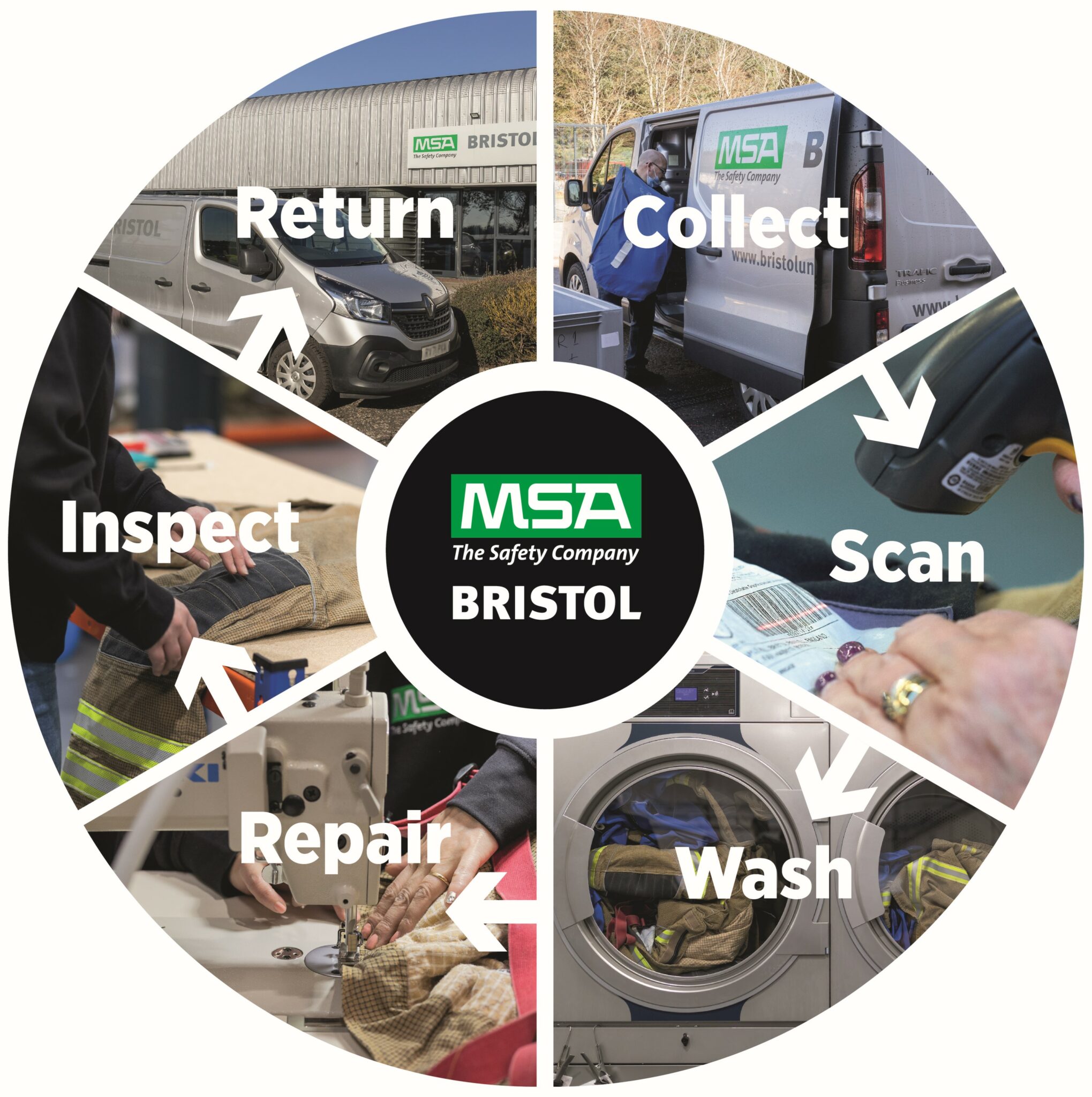
Scottish FRS is the UK’s largest Fire and Rescue Service with 6,660 firefighters operating out of 365 stations, and is the first to make use of our new Scottish Service Centre.  As part of our service we provide collection, cleaning, decontamination, inspection, maintenance, garment tracking, delivery, stock support and online ordering via a Wardrobe Management System, in a continuous cycle:

  • MSA Bristol delivery drivers collect soiled or damaged kit from key service hubs around Scotland in a fleet of liveried vans. 
  • The garments are transported to the Scottish Service Centre in Livingston where they are professionally washed and dried.
  • Contaminated PPE which has been exposed to toxic or hazardous materials is cleaned in a specially controlled environment.
  • Each garment is thoroughly inspected, and any imperfections or damage repaired by our team of skilled sewing machinists.
  • The garments are checked again, and if they pass the inspection, and are fully fit for purpose, they are returned to Scottish FRS.
  • A service history log is completed for each item of PPE, recording all cleaning, repairs, decontamination and inspections. Unique bar codes enable the tracking of each item’s life-journey including the date of manufacture, and the specific rolls of fabric that were used to create it.
  • Collection to delivery is undertaken within seven days.

The Service Centre features top-of-the-range commercial 33kg capacity Electrolux washers and driers, which are digitally-controlled and draw from a pre-heated water supply system to reduce cycle times and electricity usage. Thanks to this swift and efficient new technology, the Centre has the capacity to handle up to 900 garments per week, with the service history of each and every item tracked via a unique bar code.

Smooth operations

Our new team at the Service Centre, headed up by Manager, Anton De Klerk, has been working very closely with Scottish FRS to gradually implement all these systems and ensure the processes are running smoothly. Roddy Mackinnon, Equipment Manager at Scottish Fire and Rescue comments: “Regular cleaning, decontamination and repair of PPE is essential for providing firefighters with suitable protection.

“We have been using MSA Bristol’s managed services since March 2021 and are delighted that these services are now being delivered within Scotland.  The team have worked closely with us throughout the transition to ensure that the high levels of service and quick turnaround times are maintained.”

At MSA Bristol we firmly believe our fully managed services provide the gold standard of care and maintenance throughout the lifetime of a PPE garment.  As a company, our ultimate goal is to offer PPE that provides maximum protection against all potential hazards and risks to firefighters. Whilst we are proud to be a world leader in the design and manufacture of high-quality PPE, it is just as important that our kit is well-maintained and regularly cleaned, so that it gives the very best protection at each and every call out.

This article was originally published in the September edition of IFSJ. To read your FREE digital copy, click here.

Expert Insight: Weaving protection into the fabric of firefighting

IFSJ sat down with Amanda McLaren, Managing Director at Hainsworth Protective Fabrics to find out about the technical side of its flame-resistant fabrics

Let’s start at the beginning: can you tell me about the history of Hainsworth?

Hainsworth Protective Fabrics is a leading manufacturer of PPE fabrics, based at our Mill in West Yorkshire. Its parent company AW Hainsworth & Sons was established in 1783 as a manufacturer of protective woollen uniform cloth for the British army. Hainsworth cloth is synonymous with UK military history, and the iconic scarlet fabric is still worn by the Queen’s Guards outside Buckingham Palace today. Hainsworth now manufactures premium woollen textiles for a wide range of markets, including fashion, leisure and transport interiors, but it is through our Protective Fabrics brand that we continue to develop our expertise designing and developing world-class flame-retardant textiles for emergency services professionals.

At what point during its extensive history did Hainsworth become involved with the fire industry?

Hainsworth has been supplying fabric for firefighter uniforms since the earliest days of the fire service. In the 19th century, the most flame-retardant fabric on the market was Wool Melton, which was manufactured by Hainsworth for the British army. Naturally, when Eyre Massey Shaw established the London Fire Brigade in the late 1800s he selected Wool Melton to be used for the firefighters’ protective uniforms.

We continued to supply Wool Melton to UK fire brigades throughout the early 20th century up until the 1970s, when we introduced PPE textiles woven using man-made flame-resistant fibres to the market. From there we continued to develop fabrics that delivered greater and greater levels of flame protection, working closely with firefighters to make sure we understood the changing requirements of their role. Today Hainsworth Protective Fabrics are worn by firefighters around the World, and our amazing Product Development Team continue to push the boundaries of innovative fabric technology.

What are the main uses for Hainsworth fabrics in the fire market?

We have designed and developed fabrics for use across multiple firefighting scenarios, including: structural; wildland; electric arc; urban search and rescue; water rescue; and road traffic collisions.

Our hero product is our TITAN fabric system. TITAN is a fibre structure from which we have developed a range of outer shell fabrics for garments across the emergency services. TITAN fabrics range from TITAN 1241 – a lightweight textile for use in technical rescue and riot police coveralls, where flexibility is paramount – to TITAN 1220, a highly breathable yet strong fabric designed to reduce the risk of heat stress for structural firefighters. Our TITAN 1260 is a premium outer shell fabric woven using Aramids and PBI fibres, increasing thermal integrity while remaining flexible and wearable, and is worn by today’s London Fire Brigade – a far cry from the Wool Melton they started out with.

We also offer a pioneering fabric solution for wildland firefighting PPE – ECO-DRY Shield. The fabric was developed following the introduction of new wildland standards in Australia, and is designed to provide the high mobility and flexibility needed for prolonged call-outs in external environments. ECO-DRY Shield is now the fabric of choice for wildland firefighters in South Australia, which sees some of the harshest firefighting conditions in the World. We recently also started supplying the fabric to firefighters in the UK for the first time.

All of our fabrics are created with the specific needs of the end user in mind and we take the time to listen to firefighters when developing any new products. For example, our AGILE fabric structure was developed in response to firefighter concerns about chemical contamination and exposure to carcinogens. AGILE weaves together protective fibres in a tight structure that provides maximum resistance to liquid penetration and prevents harmful particles from being absorbed into the garment. It is also incredibly strong and durable, allowing for the firefighter to wash their kit over 100 times and still have it perform as well as if it were new.

Can you talk a little about the technical aspects of Hainsworth fabrics?

At Hainsworth we have an unrivalled knowledge of the unique qualities of different fibres and how they can be woven together to maximise their benefits, built up over 250 years of textile manufacturing.

An example of this would be the AGILE fabric structure I described above. We used our long history of fabric knowledge to weave together flame-retardant fibres in a structure inspired by the twill used in classic raincoats, resulting in a fabric that allows for maximum water runoff and protects from harmful liquid chemicals.

We call our approach to textile development Fibre Positioning Technology – the unique placement of fibres resulting in fabric greater than the sum of its parts.

This methodology applies to every product we develop. TITAN was designed as an open and breathable structure that allows for the flow of perspiration moisture, helping the wearer to stay cool and clear-headed. The insulating pockets of air created as a result of this process also increase the wearer’s protection from heat and flame.

In addition to knowing where to position fibres, we also have an innate understanding of how to combine different materials to meet the specific requirements of the wearer. ECO-DRY Shield, for example, is a unique mixture of synthetic flame-resistant fibres and premium merino wool. Nomex and Lenzing FR provide thermal stability, keeping the wearer protected, while wool wicks away moisture and allows for a consistent body temperature. The different fibres combine to create a flexible, comfortable, yet flame retardant textile perfect for the modern wildland firefighter.

Finally: tell me little about your own background and your future plans for Hainsworth?

Since 1989, I have been working within the Engineering Sector; focusing on my chosen career path – Operations and Supply Chain Management. During 1999, I took my first step into the Textile Sector, working as a Supply Chain Manager and subsequently as the Operations Director, for James Heal & Company – a Global Leader of Textile Testing Equipment.

In 2008, I left the Business in to explore Directorship positions within larger Manufacturing environments – covering both the Automotive and Leisure Sectors., each one of them a leading UK Brand. However, I missed Textiles and returned to James Heal in 2014, to support the Owner to complete a Business Sale – subsequently succeeding him as the new Managing Director of James Heal in 2014, under the ownership of Battery Ventures – a VC Company based in Boston, USA. During the following 6 years’, I was fortunate enough to travel to many Countries, visiting our Agents and end Customers’ – which of course, were often Textile Mills. The top and bottom line grew to plan and I learned a lot about running a successful Business.

In late 2020, I noted AW Hainsworth were looking for a new Managing Director for their Business – AWH was actually a Customer and Supplier to James Heal, so I was more than familiar with the Mill and the amazing Products produced. It was ‘hand in glove’ as a fit and as such, given the challenging post-pandemic and Brexit environment, I was thrilled to be appointed into this exciting role, in April 2021.

Since then, with the support of both the shareholders and a highly competent and experienced Team, I have been able to redefine our growth strategy and determine a number of new opportunities for the Business. We exceeded last year’s Business Plan and have set out a new 3-year plan, which demonstrates growth through an ongoing investment programme. We have already invested in a state-of-the-art R&D and Quality Control Laboratory and have placed orders for new Raising & Cropping Machinery, along with a new Loom for our Leisure Business. We have full commitment to a Sustainable Business Model; putting our people at the centre of investment strategy – this includes a newly defined Apprenticeship Model and investment in existing skills, to ensure a multi-skilled workforce for the future. All in all, it is a very exciting time for the company and I am thoroughly enjoying steering the ship.

This article was originally published in the September edition of IFSJ. To read your FREE digital copy, click here.