Wärtsilä has announced the completion of large-scale testing of its Active Ignition Mitigation System (AIMS), designed for battery energy storage.
How to Test Smoke Alarms Properly
A smoke alarm is one of the most important safety devices in the home, yet they’re often overlooked until it’s too late.
If you have one installed, testing your smoke alarm regularly is a simple task that can save lives.
To test a smoke alarm, press and hold the test button on the front panel until you hear a loud, continuous sound.
If the alarm does not sound, replace the battery. If it’s a sealed unit, speak to a specialist to replace the alarm.
You can also use a smoke detector test spray or safe smoke source to check the sensor, following the manufacturer’s guidance.
Our article explains exactly how to test your smoke alarm properly, how often you should test it, what to look out for, and what to do if something’s not right.
Whether you’re a homeowner, renter, or responsible for a business premises, this guide will leave you better informed and safer.
What is a smoke alarm and do I need one?
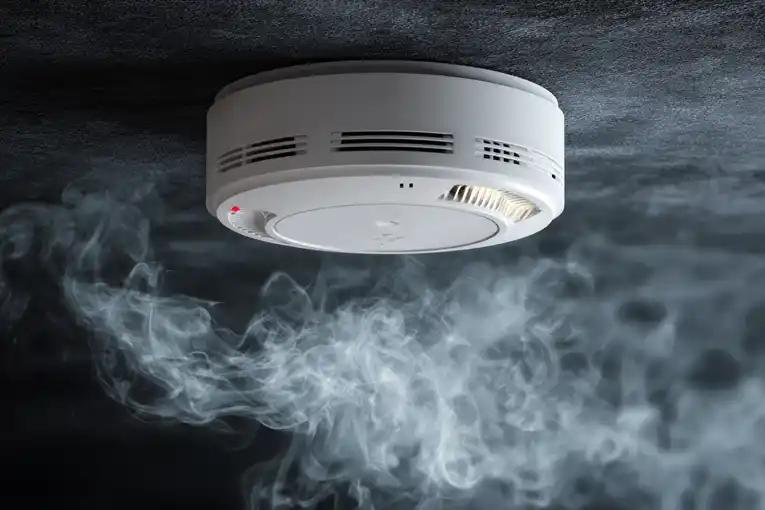
Smoke alarms are devices specifically designed to detect smoke (a primary indicator of fire), and sound an audible warning to alert people in the building.
Most smoke alarms operate using either ionization sensors, which respond to fast, spreading fires, or photoelectric sensors, which are better at detecting slow, smoldering fires.
Some units combine both technologies for a more comprehensive coverage.
Every single building, residential or commercial, needs a smoke alarm – bar none!
In most countries, having at least one working smoke alarm on every level of a home is a legal requirement.
In the United States for example, the National Fire Protection Association (NFPA) recommends smoke alarms are fitted inside each bedroom, outside each sleeping area, and on every level of the home, including the basement.
In the UK, Australia, and many other countries, similar laws and recommendations also exist.
Why Test Your Smoke Alarms?
Testing your smoke alarm is the only way to know its working properly.
Even if the unit appears in good working order, components inside can degrade over time.
Batteries can die. Dust or insects can clog the sensors. Wiring can loosen.
A malfunctioning smoke alarm is essentially useless in an emergency.
Fire statistics consistently show that the risk of dying in a home fire is cut in half when working smoke alarms are present.
Regular testing ensures you and your family are alerted in time to escape.
How Often Should I Test My Smoke Alarms?

Experts recommend testing your smoke alarms once a month.
This frequency ensures that any battery issues, sensor faults, or connectivity problems are identified before a real emergency happens.
Here’s some additional maintenance recommendations to remember:
- Battery-powered alarms: Replace batteries at least once a year, unless the alarm uses a 10-year sealed battery.
- Hardwired alarms: These are connected to your home’s electricity supply but typically still have a backup battery that needs yearly replacement.
- All smoke alarms: Replace the entire unit every 10 years, or sooner if the manufacturer recommends it or if the unit fails testing.
Marking these tests on your calendar or making them a part of your monthly routine is an easy way to stay safe.
How to Test a Smoke Alarm

Testing a smoke alarm is a very straightforward process, but it varies slightly depending on the type of smoke detection unit you have installed.
Battery Units
- Locate the test button: This is usually visible on the front face of the alarm.
- Press and hold the button: After a few seconds, the alarm should emit a loud, high-pitched sound.
- Listen for consistency: The sound should be continuous and strong. If it’s weak or erratic, replace the battery immediately.
- No sound? Replace the battery first, then test again. If there’s still no response, replace the entire unit.
Hardwired Units
- Locate the test button: Press and hold the test button exactly as you would on a battery-operated alarm.
- Interconnected alarms: If your home has interconnected alarms, pressing the test button on one unit should cause all the alarms to sound. This is normal and confirms they’re correctly linked.
- Backup battery: Even though these alarms are connected to mains power, always check the battery backup. If the alarm fails the test and replacing the battery doesn’t fix it, call an electrician to inspect the wiring or replace the unit.
Optional Sensor testing
If you want to test the smoke sensor itself (not just the loudspeaker or battery), you can use a smoke detector test spray.
This creates a safe, simulated smoke environment.
Unless advised by the manufacturer, avoid using real smoke such as candles or matches, as this can contaminate and damage the sensor.
Troubleshooting
If your alarm fails the test or behaves strangely, here’s what to do:
- Weak or chirping sound: This usually indicates a low battery. Replace it and retest.
- No sound at all: Try a brand new battery. If still silent, the unit may be faulty.
- Frequent false alarms: Dust, steam, cooking fumes, or insects can all cause false triggers. Clean the alarm with a vacuum cleaner or soft brush. Avoid using sprays or solvents.
- Random beeps: Some units beep to signal end-of-life, often every 30 to 60 seconds. Check the label on the back for the recommended replacement date.
Safety Tips
- Always test your alarms after a vacation or extended period away.
- If you’re hearing impaired, install smoke alarms with strobe lights or vibration alerts.
- Avoid painting over smoke alarms since this can block sensors.
- For rental properties, landlords are usually responsible for installing alarms, but tenants should still test them regularly.
- Don’t ignore chirps or unusual sounds, since they’re indicators telling you something’s wrong.
Key Takeaways
Testing your smoke alarms is one of the simplest ways to protect everyone in your home.
It takes less than a minute, but it could be the difference between life and death in the event of a fire.
Make it a habit, stay informed, and stay safe.
When testing, press and hold the test button monthly to check your smoke alarm’s function.
Replace all batteries at least annually, or sooner as needed.
Alarms should be fully replaced every 10 years, even if they seem to function properly.
Use some test spray for a more thorough check of the smoke sensor if desired.
And address any beeping, silence, or false alarms promptly. Don’t ignore them.
Walls that work under pressure: Why EN 13501-1 changes everything
Joe Ragdale, Technical Director at Wetherby Wall Systems, explores how EN 13501-1 redefines external wall testing and what developers need to do now
BS 476, the UK’s long-standing fire testing standard, is being phased out, and by September 2029, it will no longer be recognised under building regulations.
On the surface, that might feel like a distant deadline, but the reality is that the transition has already begun.
Waiting too long to adapt can result in costly redesigns, project delays, or compliance issues that are far more challenging and expensive to resolve once construction is underway.
The transition to EN 13501-1 has already started
The switch to EN standards isn’t something that’s coming.
It’s already happening.
Since March 2025, BS 476 has started being gradually removed from Approved Document B, signalling a clear move towards EN 13501-1 as the new fire classification benchmark for external wall systems.
By 2029, EN 13501-1 will be the only accepted standard.
That means all external wall build-ups, including cladding, insulation, cavity barriers and fixings, will need to be tested and classified as a full system.
This is a major shift away from the old approach, where materials were tested separately using small-scale tests like BS 476 Parts 6 and 7.
This change is part of a broader effort to strengthen building safety regulations in response to fire safety concerns and ongoing remediation issues.
Since the Grenfell tragedy in 2017, regulatory bodies, industry professionals and government departments have been working to create a more robust, accountable framework that addresses the risks caused by complex wall systems, not just their individual components.
While BS 476 focused on how individual materials behaved in test conditions, EN 13501-1 looks at how everything performs together in a real fire.
What makes EN 13501-1 different?
EN 13501-1 focuses on how the full wall system performs, rather than just the individual materials.
It introduces Euroclass ratings such as A1 or A2-s1,d0, which take into account things like how easily something burns, how much smoke it gives off, and whether it produces flaming droplets.
All of these can make a big difference to how a fire spreads and how safe the building is for people inside.
But ticking off those ratings isn’t enough.
What really matters is how the full wall performs when everything is installed together.
That includes the insulation, cavity barriers, fixings, sheathing boards and final finish.
If one part of that system hasn’t been tested in combination with the others, it may not meet the requirements.
In other words, using A2-rated insulation on its own isn’t enough.
If that insulation hasn’t been tested as part of a complete wall system, it won’t be considered compliant under EN 13501-1.
Why system-level testing matters
Fire doesn’t move in straight lines or follow neat paths.
It spreads in unpredictable ways, and the way materials interact can make a big difference to how a fire develops.
That’s why testing materials separately only tells part of the story.
Just because every product in a wall passes testing on its own, that doesn’t mean the finished wall will perform safely.
A cladding panel and insulation board might both be A2-rated, but without being tested together, with the right barriers and fixings, there’s no way to guarantee they’ll be safe when installed on a building.
That’s where EN 13501-1 comes in.
It requires large-scale testing, typically using BS 8414, to see how fire behaves across a full wall system.
For internal walls and floors, tests like BS EN 1364-1 and 1365-1 are used to assess how well fire is contained within the building.
Joe Ragdale, Technical Director at Wetherby Wall Systems, works with developers across the UK to design fire-safe façades.
He says: “We’re seeing a major shift. It’s not enough to know your materials are rated A2.
“You need to show how the whole system behaves when it’s built.
“That’s the level of detail the new rules demand.”
System-level testing also gives designers and contractors a clearer picture of risk.
Something as simple as the wrong cavity barrier or an off-spec fixing can create a weak point that allows fire to spread.
These are the kinds of issues that wouldn’t show up in small-scale tests.
It also helps to spot inconsistencies in installation that could compromise safety, which is why choosing well-supported systems with full technical guidance is key.
The cost of falling behind
Even though the new standards are already in motion, many buildings are still behind.
As of early 2025, only 46% of high-rise buildings that applied to the Building Safety Fund for non-ACM cladding work had completed the job.
That’s despite the fact that the industry has known this change was coming for a while.
Some developers are still working off outdated assumptions, relying on material-only assessments and thinking they’ll still be allowed a few years from now.
But once BS 476 is fully removed, these systems will no longer be recognised.
That could lead to massive costs.
The total bill for cladding remediation has already passed £16 billion, and government schemes like the Cladding Safety Scheme are now pushing more of the financial responsibility onto the original developers and contractors.
If your design isn’t compliant now, you could end up having to pay for it later.
It’s also worth noting that delays due to non-compliance can hold up planning approval, stop a project mid-build, or trigger retrospective rebuilds, all of which come with a serious price tag.
And if your product or system choice later turns out to fall short, you may not be able to rely on previous approvals as a defence.
Accountability is rising too
On top of the technical changes, the legal framework is tightening as well.
The Building Safety Act 2022 introduced new rules that make Principal Designers, Contractors and other key parties more accountable for safety decisions.
One of the biggest changes is the 30-year retrospective liability period.
That means if something goes wrong years down the line, those involved in the original design and construction could still be held responsible.
There’s also the new requirement for a digital record of safety decisions, known as the “golden thread”.
This includes everything from fire testing data and installation notes to product specifications and maintenance guidance.
Without it, proving compliance will be a lot harder if questions arise in the future.
What developers should be doing now
If you haven’t started preparing for EN 13501-1 yet, now is the time to get moving.
Leaving it until the last minute could result in delays, cost increases and limited access to testing facilities and qualified help.
Start by making sure the external wall systems you specify have been tested as full assemblies.
Look for systems that already meet A1 or A2-s1,d0 ratings, with test evidence covering the insulation, cavity barriers, cladding, fixings and other components all working together.
Make sure you’re working with manufacturers and suppliers who can provide full documentation, including test reports, classification certificates and detailed installation guidance.
This is what will protect your project and your reputation if it’s ever called into question.
As Ragdale says: “This isn’t just a box-ticking exercise.
“It’s about building something that stands up to scrutiny, now and in the future.
“Getting it right today protects your project, your reputation and your business.”
It’s also worth reviewing your internal processes.
Are your design teams fully up to speed with the latest test standards? Is there a clear process for documenting system selection, supplier evidence, and on-site installation details?
Building these habits now will help future-proof your work.
This was originally published in the August 2025 Edition of International Fire & Safety Journal. To read your FREE copy, click here.
Mitie acquisition of Marlowe expands fire and compliance services in UK
Mitie expands UK fire services with Marlowe acquisition
Mitie has confirmed its acquisition of Marlowe Plc, expanding its service offering in fire compliance, security systems and environmental services.
According to Mitie, the purchase positions it as the UK’s largest provider of Testing, Inspection and Certification (TIC) services.
The firm said the transaction creates a combined capability that spans facilities management, transformation and compliance.
It stated that Marlowe’s maintenance-driven model will complement Mitie’s existing project-based approach, offering a full-service compliance solution.
Mitie confirmed that this acquisition supports increasing demand for compliance amid updated fire safety and environmental legislation in the UK.
Fire safety, security and water compliance offerings extended
Mitie said the acquisition will enhance its fire and security service provision, offering active and passive systems for fire protection.
It added that its expanded compliance business will support over 27,000 customers across regulated sectors, including healthcare, infrastructure and retail.
According to the company, its fire safety offering now includes detection, alarms, suppression systems and fire stopping.
Security systems, air hygiene, asbestos management, and sustainable waste services are also included in the expanded portfolio.
The firm noted that water management services are part of the integration, with capabilities spanning licensed water retail, effluent treatment, and end-to-end drainage support.
Combined operating model to support new compliance structure
Mitie stated that it operates with a primarily project-based delivery model, while Marlowe’s services are mostly maintenance-led.
According to the company, this combination will create a more flexible service model across its facilities compliance offering.
It explained that clients will be able to access both long-term maintenance and project-based delivery from a single provider.
The company said this would support evolving customer requirements driven by new safety and environmental regulations.
Mitie added that this structure reinforces its positioning as a national compliance services provider.
Leadership and workforce expansion following transaction
Mitie confirmed that 2,700 Marlowe employees will join its existing 76,000-person workforce.
Phil Bentley, Chief Executive Officer at Mitie, said: “I’m delighted to welcome our new Marlowe colleagues and customers to Mitie. Together, we’re creating a powerhouse in Facilities Compliance – combining deep expertise, national reach, and a shared commitment to excellence in compliance.
“This marks a major milestone in our journey from being the UK leader in Facilities Management to the leader in technology and project-led Facilities Transformation and, from today, a leader in Facilities Compliance.
“From fire safety and water hygiene to sustainability and smart systems, we’re shaping the future of high-performing buildings, creating better places and thriving communities.”
Mitie said it will maintain its focus on colleague development, supported by tools, training and structured pathways.
It added that it has been recognised as a UK Top Employer for seven consecutive years.
Acquisition aligns with longer-term growth strategy
Mitie stated that the acquisition of Marlowe aligns with a strategy that has included previous purchases in engineering, data, fire and sustainability.
It explained that past acquisitions, such as Interserve, helped it become the UK’s largest Facilities Management provider.
According to the company, these efforts have expanded its capacity to deliver complex, technology-led solutions across critical infrastructure.
It added that the integration of Marlowe builds on this by addressing compliance challenges introduced by new regulatory standards.
The firm said the deal reflects its ambition to support safe and efficient buildings through integrated services.
Mitie acquisition of Marlowe expands fire and compliance services in UK: Summary
Mitie has acquired Marlowe Plc.
Mitie said the acquisition expands its capabilities in fire, security, and environmental compliance.
The company stated that it is now the largest UK provider of Testing, Inspection and Certification (TIC) services.
Mitie confirmed that the combined company will serve over 27,000 customers.
According to Mitie, the acquisition responds to increased legislative requirements in fire safety and environmental compliance.
The company explained that it will now offer fire detection, suppression, and stopping systems, along with water and air hygiene services.
Mitie said it will integrate Marlowe’s 2,700 employees into its existing workforce of 76,000 people.
Phil Bentley, CEO of Mitie, said the deal creates a national Facilities Compliance provider.
Mitie added that this acquisition supports its strategy to deliver high-performing, compliant buildings across the UK.
France establishes joint fire resistance research lab for aircraft safety
Safran collaborates with French institutions on fire resistance research
Safran Group has announced the launch of a joint research laboratory in France focused on fire resistance in aerospace engineering.
According to Safran, the new facility – called Flames (Fire Laboratory for Assembly, Metal and Composite Engineering & Safety) – is a partnership between Safran Nacelles, the Insa Rouen Normandie, the University of Rouen Normandie and the CNRS.
The four-year initiative aims to support future developments in aircraft nacelle design by improving knowledge in fire resistance and related safety technologies.
Laboratory supports development of future nacelle systems
Safran stated that the research carried out at Flames will feed into the early stages of nacelle system development.
It explained that the programme is designed to anticipate changes in regulatory and technical requirements, with the findings intended to enhance fire protection measures in aircraft design.
Safran Nacelles, which leads the nacelle design and integration activities within the Safran Group, will use results from the Flames laboratory to inform its upcoming engineering work.
Research hosted in specialist university laboratories
The Flames laboratory is based within two facilities – the Materials Physics Group (GPM) and the Interprofessional Research Complex in Aerothermochemistry (Coria) – which operate under joint supervision by CNRS, the University of Rouen Normandie and Insa Rouen Normandie.
The laboratory is equipped to carry out full test campaigns using representative samples and will support the development of simulation models and optimised physical testing processes.
Fabienne Lacorre, Technical Director at Safran Nacelles, said: “This partnership with the Insa Rouen Normandie will enable us to work on complex problems, combining Safran Nacelles’ technical and industrial expertise with the academic excellence of the teams at the GPM and Coria laboratories.
“Flames strengthens our ability to innovate and meet tomorrow’s technical challenges.”
Collaboration includes engineers and researchers
The Flames team includes engineers from Safran Nacelles, researchers from CNRS, and teacher-researchers from the Insa Rouen Normandie and the University of Rouen Normandie.
Safran confirmed that Insa Rouen Normandie will also recruit one engineer and one teacher-researcher to enhance the team’s capabilities.
Mourad Boukhalfa, Director of the Insa Rouen Normandie, said:
“We are delighted that the work carried out in simulation and experimentation on combustion in turbojet engines has been extended to new areas, in particular the behaviour of innovative materials subjected to extreme thermal conditions in the aeronautical industry.
“This collaboration involves two research laboratories of excellence, Coria and the GPM, both co-founders of the Labex EMC3 and the Institut Carnot ESP, alongside Safran Nacelles, a leading industrial player.”
France establishes joint fire resistance research lab for aircraft safety: Summary
Safran Group has launched a fire resistance research laboratory in France.
The project is a partnership with the Insa Rouen Normandie, the University of Rouen Normandie and the CNRS.
The laboratory is named Flames, standing for Fire Laboratory for Assembly, Metal and Composite Engineering & Safety.
It will run for four years.
The aim is to improve fire resistance understanding for aircraft nacelle development.
The research will support early-stage aerospace engineering and regulation compliance.
Flames is based at GPM and Coria, two laboratories under CNRS and local university supervision.
Testing capabilities will enable physical and simulated fire resistance assessments.
Safran Nacelles engineers will work alongside university researchers.
Two new staff will be hired by Insa Rouen Normandie to expand the team.
Findings will feed directly into future Safran Nacelles designs.
The programme contributes to aerospace fire safety research in France.
Serco merges Climatize and ExperienceLab into +impact advisory business
Advisory restructure strengthens Serco’s consultancy offer in the Middle East
Serco has confirmed that Climatize and ExperienceLab have been incorporated into its advisory arm +impact.
The company said the integration will expand its capabilities in user-centred design, operational transformation and sustainability consulting.
According to Serco, the full transition of Climatize into +impact in the United Arab Emirates is expected by the end of 2026.
It noted that the integration has already been completed for operations in Saudi Arabia and international markets.
Leadership changes reflect new structure
Serco stated that the transition has involved internal leadership changes to support its service delivery.
Rena Baba, previously Director of ExperienceLab Middle East, has been appointed as Director of Experience Design and Innovation at +impact in the Middle East.
Engi Jaber, who leads Climatize, will now serve as Associate Partner – Sustainability at +impact.
The company said these changes highlight the importance of both individuals in shaping the advisory business’s future direction.
Background to +impact and integration process
+impact was launched by Serco in September 2024 to bring together consultancy services across multiple disciplines.
Serco explained that +impact is led globally by Phil Malem, who also serves as CEO of Serco Middle East.
The company noted that Climatize was acquired by Serco in February 2024 and is now being fully merged into the +impact brand.
It added that this reflects a consolidation of services under a single identity aimed at regulated industries, government and critical infrastructure clients.
Quotes from senior leaders on integration plans
Phil Malem, CEO of +impact and Serco Middle East said: “Integrating Climatize and ExperienceLab into +impact reflects our commitment to continuously evolving and strengthening the way we help clients achieve lasting transformation.
“This move allows us to blend creative design with operational insight, ensuring that our advisory services are not just strategic, but also deeply actionable.
“It will also enable us to continue bringing our end-to-end capabilities to the Middle East to empower governments and businesses to achieve their environmental, social and governance (ESG) goals and impact a better future.”
Malem added: “In essence, we are creating a ‘first in market’ offering, blending the best of our capabilities and expertise with the specialist skills and real-world operational experience of ExperienceLab and Climatize.
“By combining this diverse expertise, we’re positioning ourselves to offer tailored, impactful solutions that help clients to adapt and thrive in an ever-changing world.”
Paul Bogan, +impact Partner said: “Climatize and ExperienceLab have both played a pivotal role in shaping the region’s approach to customer experience, sustainability, and human-centred design.
“By integrating their expertise into +impact, spearheaded by Rena and Engi, we are strengthening our ability to help clients navigate complex challenges with practical, real-world solutions.
“This move consolidates our advisory offering under one brand, ensuring we continue to deliver transformative, people-centred, sustainable and innovative climate-orientated solutions at scale for the citizens and communities in which we support.”
Serco merges Climatize and ExperienceLab into +impact advisory business: Summary
Serco has confirmed that Climatize and ExperienceLab will be integrated into its +impact advisory division.
The transition has already taken place in Saudi Arabia and other international markets.
Full integration of Climatize in the UAE is scheduled to be completed by the end of 2026.
Rena Baba has been appointed Director of Experience Design and Innovation at +impact.
Engi Jaber will serve as Associate Partner – Sustainability.
+impact was launched by Serco in September 2024 as a consolidated advisory business.
It is led globally by Phil Malem, who is also CEO of Serco Middle East.
Climatize was acquired by Serco in February 2024.
Serco said the integration enhances its capacity to deliver design-led, sustainability and operational consultancy services.
The company stated that the move supports its work with governments, regulated businesses and critical infrastructure providers.
Fire research testing developments at FPA: Supporting UK safety and construction strategy
FPA expands UK fire research testing to meet construction and safety demands
The Fire Protection Association (FPA) has expanded its fire research testing capacity to meet the growing needs of UK insurers, regulators, manufacturers, and fire engineers.
According to the Fire Protection Association, its Gloucestershire-based Fire Testing Laboratory – accredited by UKAS – now offers testing aligned with multiple British Standards including BS 8414 for cladding, BS 8458 for watermist systems, and several fire resistance standards for building components.
The FPA explained that its expanded facility is designed to support experimental fire testing, full-scale reconstructions and fire simulation research. The organisation stated this research plays a role in supporting new safety strategies across government, construction, and the fire and rescue sector.
Technical director highlights the importance of experimental fire testing
George Edwardes, Technical Director of the FPA, said the association’s expanded research testing supports fire safety and industry adaptation.
Edwardes said: “Research and experimental fire testing is going to play a critical role in enabling net zero construction.”
Edwardes added: “We are pleased to have further expanded our capabilities with our dedicated research team who can support the needs of the industry in shaping fire safety strategies, improving building resilience and informing regulatory and insurance practices.”
The FPA stated that its new facility can support tests involving fires up to 8 MW, with features including integrated suppression systems, overpressure vents and environmental controls for smoke extraction and wastewater management.
Research into external cladding systems informs safety practices
The FPA said its fire research is primarily carried out through its RISCAuthority research programme, which is funded by UK insurers and supports sector-specific working groups.
The organisation explained that it recently published a guide on fire risks associated with green and living walls. This guidance was produced in collaboration with living wall suppliers and insurers including Vertical Meadow, Viritopia, Biotecture, ABI, Growing Revolution and Scotscape.
The FPA added that it also developed a new fire test method for cladding systems, known as RISC 501, in response to identified shortcomings in BS 8414 and BR 135 testing. The FPA stated the new approach was created with the University of Central Lancashire, insurers and consultants to improve assessment reliability and limit fire spread.
Ongoing projects aim to improve fire resilience in changing construction methods
The FPA stated that its future research initiatives focus on enabling safe use of modern construction materials and technologies.
The association reported plans to examine fire safety in timber-framed buildings, insulation installation, photovoltaic panel use, and lightweight steel structures.
It added that other work will include compiling a database on combustible product behaviours, and developing a fire safety classification system for buildings that could integrate with BIM platforms.
The organisation also plans to carry out horizon scanning for emerging fire risks.
Fire research testing developments at FPA: Summary
The Fire Protection Association (FPA) has expanded its fire research testing facility in Gloucestershire.
The facility supports British Standard-aligned testing, fire reconstructions and simulations.
FPA’s Technical Director George Edwardes stated that experimental fire testing supports net zero construction.
The new facility includes suppression systems, overpressure vents, smoke extraction, and wastewater treatment.
Research projects are conducted via RISCAuthority, a UK insurer-funded programme.
Recent studies include fire risk guidance for green walls and development of the RISC 501 cladding test.
Collaborating organisations include Vertical Meadow, Viritopia, ABI, Biotecture, Growing Revolution and Scotscape.
FPA plans future research on safe use of timber, insulation, photovoltaic panels and steel framing.
Other aims include a combustible materials database and building classification system.
The research will feed into fire strategy development and BIM integration.
Horizon scanning for future risks is also part of the FPA’s 2025 research priorities.
Warringtonfire inaugurates new fire resistance testing laboratory
Facility launch marks expansion in fire resistance testing
Warringtonfire, part of Element Materials Technology, has opened a new fire resistance testing facility at Birchwood Park, Warrington.
Over 150 guests attended the opening event, including customers, academics, trade bodies, media representatives, and local dignitaries.
The event featured a tour of the facility and discussions led by experts in fire resistance and construction safety.
Speakers included Element’s CEO Jo Wetz, Warringtonfire’s technical specialists, and keynote speaker Paul Morrell OBE, former Chief Construction Adviser to the UK government.
Industry leaders highlight need for improved collaboration
During the event, Warringtonfire’s Technical Policy Manager, Peter Barker, and Paul Morrell addressed the importance of industry-wide collaboration.
They called for a stronger understanding of due diligence in construction and emphasised the need to prioritise safety in decision-making.
The event also included a ribbon-cutting ceremony conducted by the Deputy Mayor of Warrington, Councillor Mo Hussain.
Investment in fire testing infrastructure
The new fire resistance laboratory represents a $30 million (£24 million) investment and covers 101,000 sqft.
It is one of the largest fire resistance testing facilities in Europe and began operations on 2 January 2025.
The facility is equipped with five fire resistance testing furnaces, with plans to expand to seven.
According to Jason Dodds, VP of Built Environment at Element Materials Technology: “The launch of this state-of-the-art fire resistance laboratory is a significant investment for our company and a major step forward for the industry as a whole.”
Sustainability and future plans
The facility incorporates several sustainability measures to minimise environmental impact.
It features advanced smoke abatement systems, energy-efficient power supply units, and infrastructure that can accommodate green gas and hydrogen mixes once they become available.
The site also uses low-energy lighting and heating systems to reduce overall energy consumption.
Dodds stated that the expansion aligns with anticipated growth in the construction sector and increasing regulatory demands: “With growth in the construction industry forecasted over the next two years by the Construction Products Association, coupled with an increasingly complex regulatory landscape, this new facility helps us meet the needs of our customers.”
Warringtonfire opens new fire resistance testing facility in the UK: Summary
Warringtonfire has opened a new fire resistance testing facility at Birchwood Park, Warrington.
The laboratory spans 101,000 sqft and represents a $30 million (£24 million) investment.
It is one of the largest fire testing sites in Europe and became operational on 2 January 2025.
The opening event was attended by over 150 guests, including industry professionals and local dignitaries.
Speakers discussed fire safety challenges and called for improved industry collaboration.
The facility houses five fire resistance testing furnaces, with plans to add two more.
Sustainability measures include smoke abatement systems, energy-efficient power units, and infrastructure for future green gas use.
Warringtonfire aims to support the industry in meeting regulatory requirements and advancing fire resistance testing capabilities.
Warringtonfire’s Birchwood Park laboratory enters final stages before opening
New laboratory at Birchwood Park nears completion
Warringtonfire has made substantial progress on its new $30 million laboratory located at Birchwood Technology Park, now entering the ‘third fix’ stage of construction.
The facility, which covers 101,000 square feet, is poised to significantly expand the company’s capacity for fire resistance testing of essential fire safety products and systems.
Currently, four of the seven planned state-of-the-art fire resistance testing furnaces are installed and ready to begin the commissioning phase.
Technological advancements and environmental considerations at the forefront
The new laboratory boasts a suite of advanced technology designed to manage air quality during and after fire resistance tests.
This includes sophisticated air handling and high-performance ventilation systems, as well as systems for extracting both cold and hot smoke.
As part of these efforts, Element specialists conducted a thorough Environmental Impact Assessment, covering aspects such as acoustics, air quality dispersion, and emissions monitoring.
Strategic increases in testing capacity and future plans
By January 2025, when the laboratory is scheduled to open, it will feature two vertical and two horizontal furnaces, with an additional indicative furnace ready for testing.
Plans include the installation of two more furnaces by the end of 2026, ultimately increasing the testing capacity by 80% compared to the current facility in Holmesfield Road, Warrington.
The existing facility is set to become a centre of excellence focused on reaction to fire tests after the new laboratory’s inauguration.
Dafydd Llewelyn-Jones, the project manager at Element Materials Technology, highlighted the rapid progress: “We are on track with our progress and are actually seven weeks ahead of schedule in terms of the furnaces themselves.
“We are now moving swiftly along to fitting out all the office areas and control rooms, commissioning the building services, and completing the test bay preparation areas.”
He also expressed his enthusiasm for the project’s advancements: “It is brilliant to see this project coming together.
“We have put a significant amount of money into making this new laboratory truly one of the best in Europe, if not the world.”
Commitment to sustainability and state-of-the-art facilities
In addition to its technological prowess, the new laboratory is being developed with a strong focus on sustainability.
Efforts to reduce the site’s carbon footprint include installing energy-efficient fans and power supply transformers, which are optimised to use minimal electricity when idle.
The site will also feature electric vehicle infrastructure, such as EV forklifts and charging stations, and is designed to utilise a blend of clean hydrogen and natural gas in the future.
Leigh Hill, Director of Built Environment Europe, commented on the project’s scope and sustainability: “Our new laboratory will be the largest state-of-the-art fire testing and certification facility worldwide, and one of the most environmentally conscious too.
“We have made substantial investments in procuring the most cutting-edge building service equipment available today, reinforcing our position as industry leader and ensuring sustainable operation for years to come.”
IFSJ Comment
The development of Warringtonfire’s new laboratory at Birchwood Park marks a significant milestone in the enhancement of fire safety testing capabilities in the UK.
The integration of advanced testing furnaces and environmental technology reflects a forward-thinking approach to both safety and sustainability.
The increased capacity and focus on rigorous standards will undoubtedly contribute to the development of safer fire safety products and systems, benefiting the industry and public safety alike.
UL Solutions opens major new fire resistance testing lab in Gloucestershire
A major new fire resistance testing laboratory at Blockley, Gloucestershire, has opened in response to the urgent demand for more fire testing facilities in the UK. The lab features two of the largest furnaces of their kind.
UL Solutions, a global leader in applied safety science, in partnership with the FPA, opened the new fire resistance testing laboratory for building products and systems, doors and windows, fire stopping, joint systems, and related fire resistance products.
The facility, which was funded by UL Solutions and features fire resistance test furnaces that will benefit manufacturers from the UK, Europe and worldwide who require independent fire testing and certification, is located at the FPA’s testing laboratory in Blockley, Gloucestershire.
The testing capabilities at the laboratory, which will be performed by the FPA, will be beneficial to manufacturers seeking UKCA and CE marking services (UK Conformity Assessment and Conformité Européenne markings).
The two new furnaces complement the FPA’s existing UKAS-accredited BS 8414 test rigs. The large 4-metre-by-3-metre wall furnace can accommodate larger test samples, and more systems can be tested simultaneously, allowing UL Solutions to provide customers with expedited results.
Karine Johnfroe, vice president and general manager of the Built Environment group at UL Solutions, commented on the opening: “This new laboratory offers much-needed extra capacity for fire resistance testing, and we’re delighted to have worked with the FPA on this project.
“The partnership between the FPA and UL Solutions demonstrates our shared mission of working for a safer world. With the Blockley laboratory and by offering services to help meet regulatory and code requirements, we are able to provide trust and confidence to code authorities while supporting contractors and building owners that building products they use to meet regulatory and code requirements.”
Although the fire resistance laboratory has been developed primarily to support UK-based manufacturers, it will also serve as a resource for businesses outside the UK wishing to access the post-Brexit UK market, who can use it to confirm that their products meet UK requirements and standards.
Jonathan O’Neill OBE, the FPA’s managing director, commented: “The FPA is delighted to be part of this dynamic collaboration with UL Solutions that will further enhance capacity and capabilities at our Blockley site.
“A UL Solutions Certification is universally recognised as providing trust and confidence to code authorities that products meet code requirements. Now, as a result of our work together, manufacturers and system providers will not only have access to the tests and certifications required by UK regulations but will also be able to satisfy the requirements of regulators around the world.”
The Blockley facility complements the existing UL Solutions testing and certification services provided in the UK, covering facades, cladding building envelope systems, and door hardware testing, including testing to a wide range of North American and European standards.