Bronto Skylift appoints Tri-Lift as Canada distributor

TRI-Lift has been appointed as Bronto Skylift’s distributor in Canada. TRI-Lift is a division of TRI-Crane, which was founded by three partners, Jason Hanna, Mark Williams and Aaron Hanna in March 2019 and is based in Ontario. TRI-Lift was established in 2020 and will be carrying out sales, service, spare parts and rentals of Bronto Skylift’s non-insulated aerial platforms.

Mark Williams, Partner, TRI-Crane said: “When we got to know Bronto Skylift we did some background research and saw great potential in the Canadian market. We have good experiences of the European OEM’s. I know how Finns do business and really look forward to the co-operation.”

TRI-Lift and Bronto Skylift were brought together by Jason Darnell, Sales Manager of Bronto Skylift, who knew the crew from his previous career. In addition to selling and renting the non-insulated models of Bronto Skylift aerial platforms, TRI-Lift will provide full maintenance and spare part services for Bronto aerials. First 230-foot model, the S230XR is already ordered and will be available for demonstration and rentals in March 2021.

Jason Darnell, Sales Manager, Bronto Skylift commented: “I look forward to working with the TRI-Lift team; I believe they are one of the industry leaders who know the market in this country. I also feel this team is well respected within the industry so customers will take their new partnership with Bronto Skylift as serious as they do.”

Extensive knowledge from the lifting industry

TRI-Lift crew truly enjoys working hands-on in the industry’s most difficult projects and going the extra mile for their customers. Jason Hanna, Partner, TRI-Crane said: “It’s our passion to always find a solution even for the most difficult projects, that nobody else wants to do. When others turn away, we go there.”

Being able to provide Bronto aerial platforms gives TRI-Lift the flexibility to cover multiple industries and complicated projects in filming industry, the wind sector and other applications. Aaron Hanna, Partner, TRI-Crane added: “We are very excited about the distributorship. There are a lot of industries and applications that this kind of equipment can be utilised.”

All three, Mark, Jason and Aaron, have an extensive career in the lifting and rental industry. Mark is a third-generation family business owner and has grown into the industry from a young age. Jason has been in the industry from the late 80’s and served as a crane operator and various managerial roles before coming the President of TRI-Crane and TRI-Lift. Aaron Hanna is the Vice President of Sales at TRI-Lift and brings in 20 years of sales experience in the industry. Aaron also started as a crane operator, so there is vast knowledge about the daily operations in the lifting industry.

“With their extensive knowledge, partners of TRI-Lift enable us to explore and expand our market in Canada.” added Janne Pulkkinen, Vice President, Bronto Skylift Inc

Current distributor, Hycotec Inc, will also continue to operate as a Bronto Skylift distributor in Canada.
Global Fire Equipment discontinue the JUNIOR V4

Global Fire Equipment have announced that they will no longer offer the JUNIOR V4, following the launch of the G-One panel.

A statement on the company’s website stated: “As we announced earlier, our JUNIOR V4 addressable fire alarm control panel will be obsolete starting from the beginning of this new year.

“We will no longer have JUNIOR V4 panels in stock, so you should choose one of our other addressable fire alarm control panels, such as OCTO+, GEKKO or the newest one G-ONE.

“GFE will continue to provide our customers with full support and inspection/repairing of faulty goods and part exchange boards when applicable.”

For further support or to find out new alternatives, please contact our sales team by email: sales@globalfire.pt.

Halma acquires Static Systems Group

Static Systems Group have announced that it has been acquired by Halma. Halma, headquartered in the UK, is driven by a clear purpose to grow a safer, cleaner, healthier future for everyone, every day which is highly aligned with Static Systems’ values, strategy and culture.

Static Systems Group will be joining Halma’s Medical division and will benefit from the expertise and international reach of the global group while maintaining autonomous day-to-day operation of the business and the strong connections it has with employees, customers and suppliers.

“We are looking forward to being part of such a successful and purpose-driven group that can help take the company to the next level of growth, comments Static Systems Group Commercial Director, Chris Turner.

“Our life-critical alarm and communication solutions sit perfectly alongside those of the other companies in the Halma group. Our advanced nurse call solutions, for example, have seamlessly integrated for some time with CenTrak’s Real-Time Locating Systems (RTLS), helping to enhance the patient experience, keep patients and staff safe, and empower care teams.

“We also have long-standing supply relationships with Apollo Fire Detectors and Advanced, with the latter providing most of our fire alarm panels. With Static Systems’ design expertise, project management and installation experience, supported by comprehensive service and maintenance offering, we see this being a perfect relationship to holistically grow our fire alarm presence.”

Bill Stoval, the new Chair for Static Systems Group comments: “Static Systems’ culture of working in partnership with customers to build long-term relationships focused on mutual success provides a platform to invest in and explore new ways to create safer, healthier environments. We see new opportunities to help users of our systems address their challenges through deeper technical and clinical integration, with the capability to provide bespoke solutions tuned to specific needs.”

Halma employ over 7,000 people in 20 countries, with major operations in the UK, Europe, the USA and Asia Pacific.

UK firefighters step up COVID-19 response

The National Fire Chiefs Council have released a range of updated risk assessments which will allow UK firefighters and other staff to continue work on COVID related activities – while taking on more.

To support this, 10,000 lateral flow tests a week will be provided by the government to fire services, meaning up to 5,000 firefighters could soon be supporting the UK-wide vaccination programme now underway. 

These tests will help keep UK firefighters who are undertaking vital COVID work safer – and is in line with other emergency services testing procedures

The updated risk assessments will allow UK firefighters to support the ambulance service with driving ambulances, community vaccination work, delivering PPE, transferring COVID patients, providing training on infection, protection and control, non-blue light driver training, and the movement of bodies.

NFCC Chair Roy Wilsher said: “Fire and Rescue Services across the country stand shoulder-to-shoulder with the NHS, nurses, paramedics and care workers in the fight against COVID-19. Firefighters have extensive first aid, trauma care qualifications and experience and want to play their part.

“It is in the DNA of a firefighter to assist where help is needed the most; I know staff will not sit behind the red doors of their fire station, when their help is needed in the communities they so ably serve. They will not wait for the pandemic to pass them by; they are ready, willing and able to continue to be at the heart of the response.

“The safety of firefighters is vitally important to every Chief Fire Officer. These risk assessments clearly set out how we will keep our people safe while carrying out this work.

Mr Wilsher pointed out since March the UK FRS has provided a wide-range of support to date. Latest figures show there have been more than 400,000 addition activities,

These include delivery of more than 125,000 essential items to vulnerable people; 7,370 NHS and clinical face masks fitted; assembled more than 68,000 singe use face masks; trained 273 people to drive ambulances; transferred 1,456 COVID patients to and from hospital and moved 3,196 bodies.

Phi Garrigan, national COVID lead and NFCC COVID Committee Chair, added: “Firefighters in many services are already supporting the vaccination effort and the lateral flow tests mean all fire services can support the vaccination programme is now a reality. This will provide much-needed support to our NHS colleagues who are facing unprecedented pressure as the impact of the new strain of COVID becomes a reality, we are ready to answer the call from NHS and local resilience partners.”

Firefighters & EMS Fund petition hits 20,000 signatures

A petition set up by the Firefighters & EMS Fund to stop fire department cuts across the U.S has reached 20,000 signatures.

The petition was set up in retaliation to departments being hit hard last year with budget cuts and not enough resources. According to the Firefighters & EMS Fund, poor funding and reduced budgets have led to unsafe working environments, layoffs, and equipment shortages which have created adverse results for the safety of communities. Because of these cuts, over 50% of firehouses in the US do not meet safety standards.

Firefighters & EMS Fund’s petition reads, “…it’s time for ordinary citizens, like you, that respect and appreciate our first responders and believe in the important services they provide to stand up for our fire departments. Firefighters and Emergency Responders will do everything they can to arrive first for you and your family when you need them most, now is the time for all of us to repay the debt.

If you support your local fire department, now is the time to stand with them and show your support. Help end the fire department budget cuts that are killing America’s local fire departments.”

Executive Director Nile Porter said in a statement: “Thank you to all of the concerned citizens across the country who want to put an end to the financial burdens being placed on fire departments in our communities. While this initiative has been a success, we must continue to stand up for the firefighters who put their lives on the line to keep our cities and towns safe in emergencies.” 

For more information, visit www.fireandemsfund.com  

Kings Secure Technologies acquires Cougar Monitoring

Kings Secure Technologies (KST) today announced that it has signed a definitive agreement to acquire Midlands-based, Cougar Monitoring Ltd.

Bob Forsyth, Chief Executive Officer of KST, stated: “Our proposed acquisition of Cougar Monitoring Ltd will further expand KST’s leadership position in technology monitoring, while deepening and strengthening our relationships with our customers.

“We will be able to compete in the rapidly emerging global world of smart systems and the Internet of Things on a global basis. The combined reach of both KST and Cougar amounts to over 58,000 connections Europe-wide.  This strategic acquisition will enable us to provide a monitoring platform to our customers at pace and scale, and to respond to new opportunities as they arise.”

Robin Fisher, Chief Executive Officer of Cougar Monitoring Ltd, said: “Started 24 years ago as the first UK NSI accredited Control Room, Cougar has built its customer base to close to 30,000 sites in the UK.  We are now looking to shift our focus and growth into becoming a fully-fledged technology centre catering for the new rapidly emerging global world of smart systems. I am certain that KST will develop the Cougar brand accordingly, continue to support customers and give its employees expanding opportunities.”

KST was advised on the acquisition by Squire Patton Boggs’ Leeds Office, led by Senior Associate Louise Parker and Partner Paul Mann.

Bantec subsidiary receives order from fire Department

Bantec, Inc., a product and services company, have announced that its subsidiary Drone USA have received purchase orders to supply Atlantic City’s Fire and Emergency Management Departments with drones.

Michael Bannon, Bantec’s Chairman and CEO, stated: “We are excited to supply Atlantic City’s Fire and Emergency Management Departments with the right drone equipment. Drones provide a great and effective tool that ultimately help first responders perform their jobs more efficiently. 

“One drone, equipped with payload and night vision capabilities, will be used to drop automatic flotation devices to swimmers in distress. To quote Elon Musk “The fighter jet era has passed.” There is great wisdom in this statement. Drones and robots in many ways will change the way we accomplish our daily tasks.” 

KME appoints new Vice-President/General Manager

KME, a subsidiary of REV Group® and a leading manufacturer of fire apparatus,have announced that Andrew (“Drew”) Baney has joined the company as Vice-President/General Manager. 
 
With over 20 years in various operations leadership roles, Drew has vast experience with multiple plant campuses as well as with complex products.  Most recently, Drew was with NETZSCH Premier Technologies and JLG Industries wherein he demonstrated building cultures focused on people and developing processes to have meaningful impact.

KME


“We’re very excited to have Drew join our team at REV Fire Group,” stated Kent Tyler, President, REV Fire Group.  “With a proven track record of leading positive change and driving sustainable results, we are confident that Drew will closely collaborate with the KME organisation, dealers, and customers to make a significant difference as we move forward.” 
 
A Pennsylvania native, Drew earned a Bachelor of Science in Business Management from Indiana University of Pennsylvania and is a Six Sigma Green Belt. 
 

COVID vaccine approved for use of emergency services

The U.S. Food and Drug Administration have approved two COVID-19 vaccines for emergency services use, with some states already receiving does, according to the National Volunteer Fire Council.

Bob Guthrie, a NVFC director and a volunteer firefighter said in a statement on the NVFC website: “I received my first dose of the Moderna vaccination on December 30. On December 4, members of my department were asked if they wanted the vaccine.

“On December 9, a signup process was initiated via email for those of us who had expressed interest in taking the vaccine. That list was submitted to the Yale New Haven Sponsor Hospital, which contacted us directly to schedule appointments to be vaccinated. The process was the same for paid and volunteer members in my department.”

Some states in the U.S are prioritising vaccine to emergency responders who provide EMS. As well as being prioritised, first responders are being called upon to help administer the vaccine.

Reviewing Safety in Specialised Housing

Whether it’s adhering to fire safety or infection control guidelines – a topic that is never far from our thoughts at the moment – there are many options that decision makers can take to ensure maximum safety and compliance in specialised housing settings.

Only recently, the pandemic has left facilities such as care homes and their staff under scrutinity over their infection control methods. And now, with the winter period playing a role in the spread of common colds and such, infection control, along with the safety of occupants, is rife in the news. So with that in mind, what are the steps that must be taken to ensure occupants in supported housing stay safe and secure?

Providing a safe environment for all doesn’t have to be a complex process, although it is important that the process is thorough, with occupants in these settings potentially far more vulnerable to injury or worse in the event of a fire. The same is true for infection control, where robust policies and protocols should be in place to protect those living in supported housing, as well the staff looking after them.

Fire Safety

The National Fire Chiefs Council’s (NFCC) comprehensive guide for specialised homes, published in 2017, includes many proprosals, all designed to protect the estimated three quarters of a million residents situated in specialised housing in the U.K.

Further to this, in January 2020, the Scottish Government strengthed its response to fire safety – the Practical fire safety for existing specialised housing and similar premises: guidance – which is aimed at housing and care providers, as well as care regulators and care service commissioners.

Both reports detail ways in which specialised homes should work to minimise fire risk to protect both the people living, working and visiting there, and the building itself.

Examining the statistics surrounding fire safety in these environments, it’s unsurprising that it remains a priority. According to the NFCC report, sheltered and extra care housing accounts for about 2% of housing stock, but between 2010 and 2016, they accounted for about 7% of fires – a critical finding.

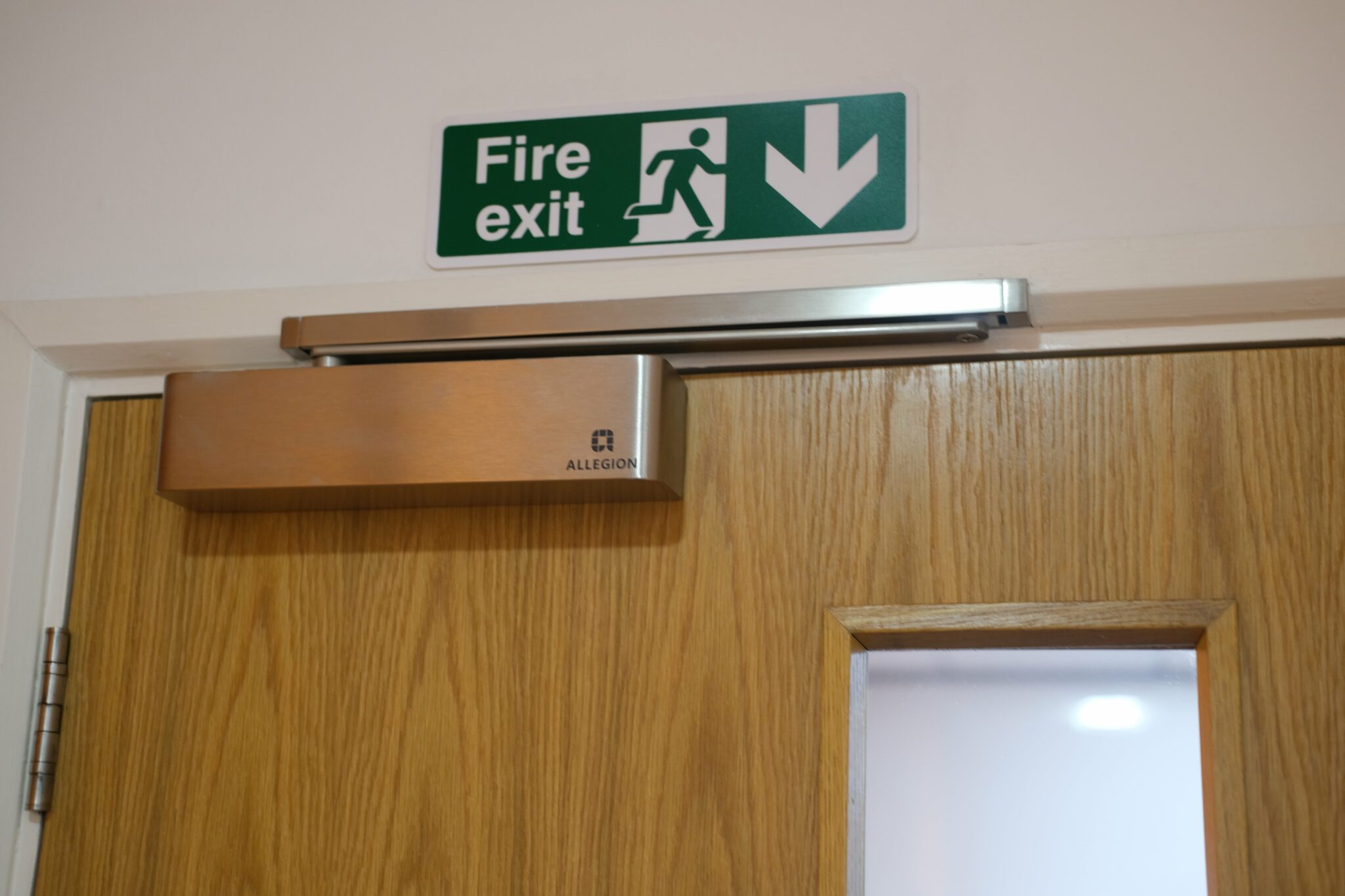
From this, London Fire Brigade’s eight-page document distilled the main information and includes a person-centred fire risk assessment checklist and a list of the main fire safety management procedures, such as testing fire doors and fire alarms, record-keeping and essential maintenance. Crucially, fire doors and their appropriate door hardware, such as mechanical and electromagnetic closers and panic emergency exit hardware, must be fitted correctly and regularly checked to ensure these heavily used products are fit for purpose.

However, key for specialised housing, it’s important to remember that there is no one-size-fits-all solution to fire safety products. Residents for example, must be comfortable using fire doors and their hardware, thus removing the risks associated with heavy or non-functional doors that residents in these settings may have additional problems operating. Decision makers are advised to consult a door hardware expert, who will provide further guidance as to the products that will best meet the needs of a speficic facility. These experts consider such issues as assessing the emergency access and egress systems, as well as establishing how best to accommodate the needs of all occupiers and staff.

Infection Contol

Infection control has long been front and centre of people’s minds – and never more so since the Covid-19 pandemic, which highlighted the endemic risks in all commercial, healthcare, domestic and care home settings.

In 2018, a report conducted by Allegion UK revealed that while 80% of infections are transmitted through the enivornment, only 71% of healthcare facilites used environmental cleaning to prevent the spread of infection. Furthermore, just 52% of healthcare respondents said they were satisfied that their existing infection control measures were robust and effective.

The potential for exposure to pathogens is significant within specialised home settings. While hand washing and disinfection protocols, as well as ventilation procedures, all form an important part of infection control, there are additional measures that can be taken, such as installing antibacterial door hardware, handles and levers in high-traffic areas.

These solutions contain added antibacterial protection to help eliminate potentially harmful bacteria and defend against the spread of microorganisms. In an environment where health risks are more probable, this provides extra peace of mind when it comes to maintaining the highest levels of hygiene and minimising the risk of contamination.

It’s also key to observe the building’s emergency exits. Emergency exit devices can also be coated with antibacterial properties, contributing to both fire safety standards and now infection control, by reducing the risk of cross-contamination, providing long-lasting protection and enabling people to escape a building quickly. Furthermore, touchless electromagnetic door controls can assist with ease of movement, fire safety and infection control by being linked to the building’s alarm system, closing shut in the event of a fire and eliminating the need for people to wedge the doors open.

Taking Responsibility

In what is now a critical time for many specialised housing facilities, decision makers must take responsibility in their choices to help meet both the fire safety and infection control requirements that have been set.

While it’s true that the varied nature of running sheltered, extra care and supported housing facilities can make decisions feel like complex challenges, today’s hardware solutions provide one helpful and easy solution, enabling higher levels of building safety and security – and that, in the current environment, is more important than ever.

Article was written by Karen Trigg of Allegion UK