Due to the pandemic, the RFA is offering the four-hour long Ethanol Emergency Response training in a webinar format. These webinars are instructed by a nationally accredited and professional instructor with an extensive background in emergency management/firefighting/hazardous materials response.
The goal of these seminars is for attendees to gain a full ethanol and ethanol-blended fuel emergency response training experience that can be put to use immediately in the field.
The training program covers the following: Ethanol and ethanol-blended fuels, chemical and physical characteristics of ethanol and hydrocarbon fuels, transportation and transfer, storage and dispensing locations, firefighting foam principles, general health and safety considerations, and storage and pre-planning considerations. Certificates of participation will be awarded to all registered attendees once the webinar has been completed.
Ethanol Emergency Response – Train the Trainer Webinar
RFA also offers Ethanol Emergency Response – Train the Trainer webinars, which is a pay-it-forward type of program. A single webinar can train a group of individuals who can then turn around and pass that information forward, equipping entire communities with the knowledge necessary to respond to any potential ethanol-related emergency.
The Train the Trainer courses are intended to develop instructors to lead operations level training. The instructors are responders who have an awareness level of hazardous material storage, handing, and emergency response.
The webinars are open to all professional individuals above the technical level of training who are interested in learning how to teach ethanol emergency response. Certificates of participation will be awarded to all registered attendees once the webinar has been completed.
In response to the continued demand for Advanced Targeted Fire Suppression Systems (ATFS) throughout 2020 and 2021, Helios Fire Systems has appointed Helen Sinton as Operations Manager, to further bolster the team’s success
Helen’s background in operations within both wood recycling and chipboard manufacturing industries means her existing knowledge of fire prevention and suppression alongside procedural expertise makes her the perfect fit for Helios.
Helen joins the team to continue operational excellence for Helios during this growth period and will oversee installations of systems on waste and recycling sites across the UK. She holds COTC level 4TMH, CPC National Road Haulage, IOSH Managing Safely, ISO 9001 internal Auditor and ILM management certification.
Helen adds: “I’ve worked in the wood industry for 20+ years, implementing and monitoring fire protection plans and seeing the number of fires the waste industry sadly faces. That’s partly down to inefficient outdated detection, which peaked my interested to work with Helios on the latest fire suppression technologies and their rollout to waste and recycling sites. I’ll be making sure things are always in the right place at the right time, that on-site procedures are 100% and making sure our customers experience the best possible install that then protects their business!”
Helen will oversee projects from initial consultation through to commissioning and staff training, alongside Adie Mason. Adie has been promoted to Head of Operations, after joining Helios from its inception six years’ ago. Before this, he gained a wealth of industry knowledge from a career in waste and recycling operations, including wood disposal and global waste management companies. His promotion will allow the team to expand its project capacity and continue to offer the best in fire suppression systems and products.
Adie adds: “I’m very pleased to welcome Helen to the Helios team, having known her for around 20 years with both of our backgrounds as members of the Wood Recycling Association. We’re working together managing Helios installs across the country and communicate with our on-site contractors to make sure there are no issues. I’m delighted to welcome her to the Helios team.”
Garry Adey, Managing Director at Helios adds: “This growth of our Operations Team means that we can ensure the smoothest installs of large complex site projects, and effectively communicate with our on-site engineers to make sure we’re providing top level service. Helen and Adie make the dream ops team!”
For over 70 years, Motorola Solutions has worked with counties across the state to provide them with mission-critical communication solutions to help keep communities safe.
“CirrusCentral Core offers an unprecedented level of resiliency,” said Stephen Kennedy, assistant county administrator, Sumter County Board of County Commissioners.
“During this test, we seamlessly switched to the secondary core in the cloud and used it for over two hours. We experienced firsthand how it ensures seamless communications for first responders in the event that one of our system hardware facilities is destroyed by a catastrophic disaster.”
Motorola Solutions’ ASTRO 25 radio networks are built to perform during natural disasters and in the worst imaginable conditions. They are critical to coordinate an emergency response and enable federal, state and local agencies to communicate with one another to help keep citizens safe.
The technology behind these trusted radio networks continues to evolve and now incorporates next-generation cloud based offerings for greater resiliency and secure network management from any location.
CirrusCentral Core is available as a subscription service with a low upfront investment, no upgrade costs, and pay-per-site pricing to fit an agency’s unique needs.
It eliminates the need to purchase and maintain hardware for a secondary on-premise P25 core. It is secure and monitored by Motorola Solutions’ team of technology and cybersecurity professionals to ensure it is always up to date and available in an emergency.
SVI Trucks is officially announcing the retirement of Bob Sorensen, the company’s Vice President of Sales. After 35 years with SVI Trucks, one of the nation’s leading custom fire apparatus manufacturers, Sorensen will retire on Jan. 27, 2021.
Joel Konecky, currently SVI’s Western Regional Sales Manager, will be promoted to VP of Sales, and in anticipation of his move, SVI Trucks has hired Jay Adams to fulfill western sales.
SORENSEN’S RETIREMENT
On Jan. 27, Sorensen will not only celebrate his retirement, but his 35th anniversary with the company. Sorensen began working at SVI Trucks drawing rescue trucks, which became instrumental in custom truck sales.
Eventually, Sorensen transitioned into a sales manager role, holding the VP Sales title for 25 years. In 2003, Sorensen became a joint owner of Super Vacuum Manufacturing, the parent company of SVI Trucks and the family owned and operated business. Sorensen will retain ownership duties in retirement.
“I will be forever grateful to Erv Weinmeister for providing me with the opportunity to work here,” Sorensen said. “My family and I have been blessed to watch SVI Trucks grow, both in business and our dealer network.
“When I transitioned into sales, we were producing roughly 10 trucks a year, and we probably only had 10 dealers then. Now, we build 40-50 trucks a year, and we have 35 dealers.
“This growth is truly a testament to not only our apparatus line but to the many great relationships built over the last several decades. In the end, I feel confident knowing I will pass the torch onto Joel, who not only brings leadership and experience but the exact same relationships to the table.
“And not only that, Ron Weinmeister will continue to oversee all truck sales and operations, so I fully believe the team is ready to take SVI to the next level.”
KONECKY’S PROMOTION
Joel Konecky joined SVI Trucks in April 2020, bringing 30 years of volunteer firefighting experience and 17 years of fire truck sales from Smeal Fire Apparatus and Spartan Motors to his original western regional role and now to the VP Sales role. Konecky also has a firm grasp on the internal workings of engineering, production, purchasing and overall, satisfied customers.
“When we hired Joel, we were excited because he brought a wealth of knowledge to SVI Trucksthat is hard to match. Not only has he helped countless departments navigate the truck building process, but his drive to develop internal processes also struck a chord with us,” Sorensen said.
Konecky will make the full transition to the VP Sales role on Jan. 27. Konecky can be reached via email at joelk@svitrucks.com or via cell phone at 402-443-9659.
ADAMS’ SALES ADDITION
In anticipation for Sorensen’s retirement and Konecky’s promotion, SVI Trucks hired Jay Adams, who brings 25 years of firefighting experience and 12 years of fire apparatus sales to his new western sales role. A former firefighter with the Charlotte Fire Department with a Bachelor’s in Fire Science, Adams retired from the department in July of 2019 as acting Battalion Chief / Captain with expertise in extrication, technical rescue and live burn training.
Meanwhile, in sales, Adams has represented multiple brands, including Ferrara and Seagrave, throughout the southeast. “I’m eager to work with Joel to expand the many great relationships he has in the western region,” Adams said. “But more than anything, I’m excited to represent the SVI Trucks brand. I’ve been a fan of this company for 20 years before I ever thought about working here. Not only is SVI the best truck manufacturer in the industry, but the company is family owned, and they care a lot about their employees and customers.”
Adams prides himself in his Lean Six Sigma Black Belt designation, championing for lean, high-quality manufacturing standards wherever he works. “Any process in a factory can be defined, measured, analyzed, implemented and controlled to create a standard that meets and exceeds the needs of the mission-critical industries we serve, and it’s also important to take the waste of material, time, engineering and effort to deliver on the timelines and budgets of our customers.”
Adams also sat on the Scott Safety advisory council, serving as the voice of the customer. “At SVI Trucks, I hope to continue to be the voice of my customers,” Adams said.
Adams can be reached at jaya@svitrucks.com or via cell phone at 970-617-0984.
This month marks the 35th anniversary of the founding of Telgian, a worldwide provider of fire protection, life safety and security solutions. Since 1985, Telgian has grown from a modest firm providing code development and consulting, fire testing and fire investigation, to an international company with locations around the globe, more than 350 employees and a comprehensive roster of fire protection, engineering and design, life safety and security services. Today, the firm counts many of the world’s most recognisable corporations as its clients.
“It is especially gratifying to celebrate this milestone in 2020. This year, more than ever before, we applaud the efforts of our dedicated associates as we continue to navigate the current, unprecedented global crisis,” says Telgian Executive Chairman Russell Leavitt. “As we look forward to the future, we know that our success will continue based on their outstanding character.”
Telgian founded by former firefighter
The company traces its roots back more than three decades to Tomes and Associates, founded by former firefighter and San Diego Fire Marshal Bill Tomes. The early success of the company was a result, not only of Tomes’ vast experience, but also his lifelong passion for the fire protection industry.
The company was founded on integrity, honesty and respect, along with attributes such as innovation, creativity and pride in one’s work as well as an unwavering dedication to customer service. This quickly attracted industry-leading experts from around the world, resulting in rapid growth and expansion.
“We are proud to mark our 35th anniversary this year. This milestone is a testament to the fact that our associates, vendors, and stakeholders renew their commitment to industry excellence and 100% customer satisfaction each and every day,” says Telgian CEO James Tomes.
A wide-ranging roster of services also grew to include fire and life safety consulting for business and government agencies, fire and building code interpretation, risk analysis and hazard evaluation, fire and building plan review, fire sprinkler system design, and industry training.
In 2007, principals formed the Telgian brand to more accurately reflect the diversity of the company’s many and varied fire, life safety, and security services. The word Telgian is, in fact, derived from Old English and means “to branch out and grow.”
Today, Telgian has dramatically increased the range of industries that it serves and includes two business units, each with a unique focus. Telgian Fire Safety, serves approximately 50,000 locations annually for the inspection, testing and repair of fire and life safety systems such as Fire Sprinkler Systems, Fire Alarm Systems, Fire Extinguishers, Kitchen Hood Suppression Systems, Backflow Systems, Emergency/Exit Lights, Special Hazards, and Clean Agent Systems, as well as Fire Alarm Monitoring.
Telgian Engineering & Consulting is a full-service engineering and risk mitigation consultancy specialising in complex, multi-discipline projects. Telgian Engineering & Consulting provides services related to the protection of people, property, information, and organisational mission against preventable losses, delivering effective protection solutions that meet today’s challenges.
Telgian’s history, reputation and an outstanding record of accomplishment have been built on the trust and confidence earned from numerous long-term clients. This sterling reputation is the result of a deep commitment to core values such as the Telgian Customer Advocacy Model, which ensures that customers, and their specific needs, are always the top priority.
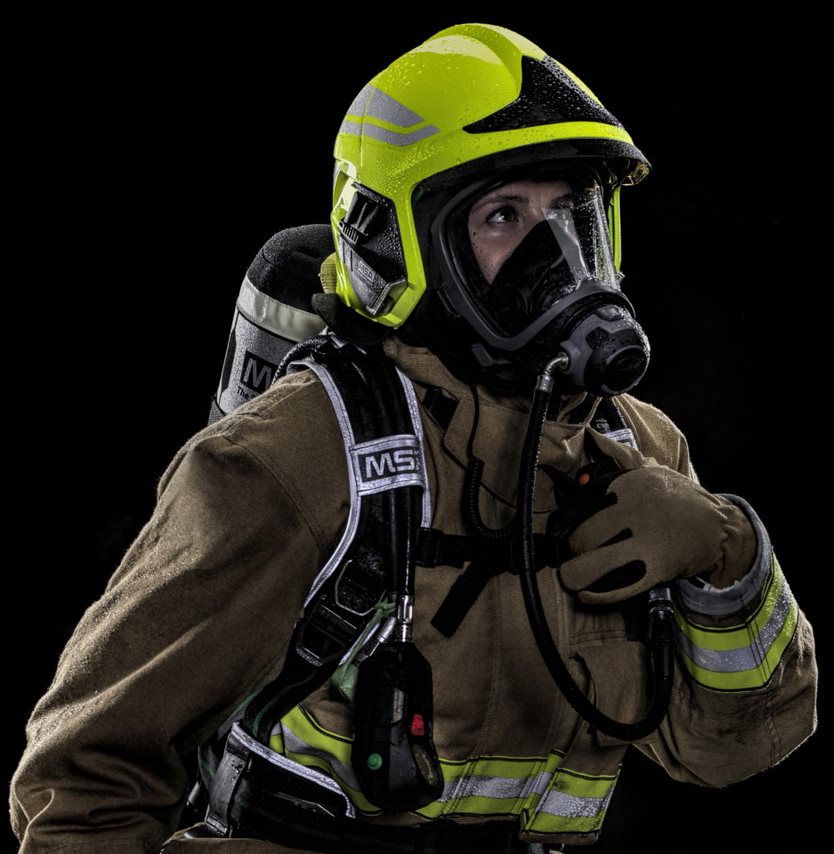
The company philosophy of MSA can be traced right back to its roots. A little over 105 years ago, as a result of a devastating mine explosion, two mine engineers started to build innovations to make the mining industry safer.
This ethos has developed over the years, and the company have expanded services to other sectors such as construction and gas, but one thing remains the same; the products are being built to make the end users experience better, whether that is in terms of protection or comfort.
A mission – to protect life – that’s remained unchanged for more than 100 years and it’s something MSA are extremely proud of. They don’t build innovative products for the sake of it, they do it to improve safety in each sector and provide technological leadership.
MSA have strong presence worldwide
As a result of this, they offer a range of products that help keep workers across the world safe. From a fire fighter perspective, they have established a strong North American base, unsurprisingly.
However, they now have a strong presence within the European and International markets, helped by the acquisitions of Cairns and Gallet, both market leading companies in their respective fields.
Jason Traynor, General Manager, Global Respiratory Protection and Fire Helmets for MSA Safety has been one of the many members of the MSA team who had an important part to play in the expansion of the company.
In his role, Jason is responsible for establishing the global vision, strategy and growth initiatives for his product groups. Upon joining MSA in 2012, Jason revolutionised MSA’s approach to Fire Service Marketing and was critical to the successful launch of the G1 and M1 SCBA platforms.
Tell us about what MSA do within the fire industry?
We have been in the industry a long time, since 1914 in fact. Some of the early products we produced back then still feel relevant to what we do today.
One of our early conceptions was the breathing apparatus, and while this has then developed over the years to modern day updated versions, the reasons for producing them remain the same.
For us, the fire industry is something we believe to be a critically important market, and we are continuing to invest in innovation. It is really about understanding the needs of the individual that has to wear the gear.
We’re not just driving innovation for the sake of change, it is all about making the end users experience better, whether that is in terms of protection or comfort, those things always go into our product development pipeline, and in terms of our core fire products right now, I would say they are the fire helmets and SCBA. However, in the US I would say we have a head to toe solution. We sell boots, breathing apparatus, helmets and a lot more.
You have described the M1 as MSA’s most advanced, ergonomic and modular and SCBA system, what were the ideas behind the system?
In 2014 we released a product called MSA G1, and that was the culmination of about five or six years of product development work. We spent roughly $50m on the platform, but the approach that we took was about understanding the requirements of the NFPA standard and working with end users fire fighters to understand the limitations of our products.
It was very successful and formed the basis of the M1 that we released 2 years ago in Europe. When coming up with the thesis, field of view was really important, but it also had to be lightweight and offer some comfort.
The other pieces of the system that are important are the modularity of the product. Because Europe is such a heterogeneous market every country will want something different from the system, so we wanted to make the product customisable. With regards to the ergonomics, the weight is low and close to the back so there is no added strain for the user.
I also think it was important that we made it accessible in terms of functionality and budget, and we have made sure its upgradable over time. We understand that these products are going to be used to 12-15 years, so if you’re buying it now it needs to still be relevant in 2030.
That’s why we’ve put things in like Bluetooth and IoT that may not be heavily used today, but we anticipate that the technology of the future will make it very relevant. When making the product, we were looking at it as a platform for the future.
To what extent have end users been involved in the M1 features?
From the beginning of the project we were talking with people who were using competitor SCBA. In fact, 75% of people we interviewed and worked with aren’t even MSA users! We spoke to people all over Europe and asked them about their experience with the SCBA they use. One concern that came up was cleanability.
The design took in to account how they clean it and ensured that it was easier to clean. I would say the feedback on the product has been really positive. In general, there was a lot that we were able to demonstrate that we took action and listened.
For example, we are going to England, Scotland and Ireland just to find out what the needs are, and I’ve probably been there personally 12 times since 2017! Throughout those trips we have been able to develop bespoke features that are only available within the UK market.
How will the safety aspects change the way end users work?
One of the most important aspects is understanding the air that is in your system and having the ability to transmit data from the SCBA. We’ve been able to do this for a while but the M1 takes this to another level. We also have a feature that is specific to the UK market.
The Entry Control Board (ECB) that helps us to understand the air situation of the fire fighter. They can also send evacuation notices and communicate two way through the control module and have the peace of mind that the evacuation was received and acknowledged.
A lot of technology has gone into that as we saw that was a specific need within the UK. A good example of that would be the Grenfell Tower tragedy, that was extremely complex. We have had conversations with people that were sorting through that data, and it was a complicated process. We can simplify that and help people understand how we could do this differently.
So, will all the data collected be centralised to the MSA Hub?
Typically, the HUB will be installed on a fire truck, but we do have a portable version. In scenarios where you can’t get the truck near to the scene of the fire the portable HUB can take over.
The SCBA has a long radio transmitter that sends the data to the hub via a data radio signal. The HUB then processes it and sends it to the cloud where it is available from anywhere in the world. The HUB is important because it takes the local data and makes it remotely accessible.
Tell us a bit more about the modularity features?
A basic system would be one that would just deliver and measure the air. By that I mean it would have a needle that would show you how much air you have left. What we have done is given the option of swapping out the analogue gauge.
So if you decide that three years down the line you want to have an electronic system that would have an LED screen that would calculate the air left in your system and the time remaining based on your breathing rate. When we talk about modularity it is really about how configurable the product is and being able to assess what is important to you at the time, and offering upgradability in the future.
Have you found a need in the UK market for the product?
When we look at the UK market it is very much driven by technology. This sense of data has been around for a while but when we speak to the UK fire departments we get the feeling that they only have one choice, and they were encouraged that we could provide them with another option. If we had found that they were telling us that they loved the competitors and they weren’t going to look at an alternative then we may have taken another path, but that’s not what we got at all. Our system is extremely competitive with other systems that have been in the UK for a while.
How important are the changes you have made to communications?
The headset has been well received. When we were doing market research, communications was the one area that fire fighters say can be improved so we are making investments in that area. We have another project that I can’t go in to too much detail about, but it is focusing on communications. Not only in terms of talking, also in terms of transmitting data across to others.
What would you say was the driving force behind M1?
I think that our approach to developing new products and driving innovation starts with and is designed for the end users. We drive technology leadership and excellence, but it starts with the question, how does this make a fire fighters life easier? We are dealing with people who are passionate about what they do and producing the vital technology they need is really rewarding.
As we move toward a more digitally connected generation, it is hardly a surprise that MSA are at the forefront of the industry. Especially with a concept that allows fire fighters to remain connected, share data and above all, stay safe. And with AI, IoT and machine learning ushering in a new way of working, future updates to the MSA systems could well bring further benefits for the industry
The Fire Protection Association have released a guide in best procedures to mainatain safety standards in resedintial care homes,
The guide provides basic steps that advises users on how to maintain safety procedures, and is published with the expectation to work alongside the fire risk assesment and fire warden on site.
Included in this guide is:
The fire triangle
General housekeeping
Typical sources of fuel
Typical sources of ignition
Action in the event of fire
Evacuation strategies
First aid firefighting
For full access to the guide visit the Fire Protection Association website
The National Fire Protection Association (NFPA) is calling for nominations for the 2021 James M. Shannon Advocacy Medal, which recognises fire and life safety advocates who have made significant contributions in lessening losses from fire, electrical, and other hazards.
Named for former NFPA President James Shannon, the award honors individuals or groups that champion cost-effective efforts and collaboration, while furthering NFPA’s mission.
As part of his long list of advocacy achievements in fire loss reduction, Shannon led the Coalition for Fire-Safe Cigarettes, paving the way for legislation on minimum fire safety standards for cigarettes in each state.
“The dedication these recipients exhibit towards creating safer communities is invaluable,” says Lorraine Carli, vice president of Outreach and Advocacy. “This award is our way of thanking them for lending their voices and taking actions towards improving life safety.”
NFPA considers nominees who are members of the fire service or any individual or group whose advocacy efforts meet the award’s criteria. The medal recipient will be announced later in 2021. Previous recipients have worked to increase use of sprinklers, advocated for the use of updated codes, and other activities.
Engage Services, a Marston Holdings company and a leading provider of field services to the public sector, energy and water sectors, is working with the Health and Safety Executive (HSE) to carry out COVID-secure spot check visits.
As an approved and appropriately trained supplier, Engage Services’ agents will undertake spot check visits on business premises on behalf of the HSE and Local Authorities across England, Wales and Scotland. These checks will help to establish that businesses have taken the necessary steps to make their premises COVID-secure and implemented measures to reduce the transmission of coronavirus to protect workers, visitors and customers.
Engage Services spot check support officers will assist the HSE by speaking with the responsible person in each business to check the COVID-secure measures they have in place. Using HSE’s comprehensive guidelines they will also provide businesses with basic guidance and advice.
Michael Wolfenden, Managing Director of Engage Services commented: “Engage Services is very pleased to be working with the HSE and is proud to help the Government’s response to the coronavirus pandemic.”
The range of wireless critical alerts manufactured by Luminite Electronics under the Nexus name has now been rebranded as ALERTEX.
The name change is part of Luminite’s strategy to simplify its brand names particularly for export markets. It was felt that the name ALERTEX better encompasses what the range does – a wireless critical alert system designed to provide a clear warning to an event requiring action.
ALERTEX comprises a range of wireless internal and external call points with sounders and beacons which can be rapidly deployed to provide a robust alarm system.
Units are battery powered and have a long and robust transmission range of 1km between units. The systems are portable and quick and easy to install with no civil works or cabling required. Internal and external units are available in a choice of colours.
ALERTEX units can be used in schools and places of worship as a lockdown system or on construction sites as a fire alert system.
LOCKDOWN SYSTEM – this is aimed primarily at schools and universities. Visually and audibly different to a fire alert, ALERTEX units comply with current OFSTED guidelines on lockdown. When one ALERTEX unit is activated it will trigger all units in range to sound an audible lockdown alert or message with a flashing blue beacon, distinct in sound and appearance from a fire alarm.
FIRE ALERT SYSTEM – this is aimed at construction sites or buildings undergoing refurbishment and acts as a rapid portable warning system to fire, suspected terrorist attack or any other alert event requiring evacuation.
Graham Creek, Managing Director of Luminite Electronics commented ‘The name change to ALERTEX gets across the intention of this range – to provide a clear alert to an event requiring action, whether that be lockdown or evacuation.’