Rosenbauer International AG has brokered its first syndicated loan. The debut transaction is for €170 million, with the option of increasing the amount.
The term is three years, with the option of twice extending the agreement by a further year each time. In taking this step, the Rosenbauer Group is optimising the maturity profile of its existing bank facilities and securing the refinancing of its existing liabilities.
“The impact of the COVID-19 pandemic is also being felt on the debt capital market. So I’m all the more pleased that we were able to successfully implement this syndicated loan,” says Sebastian Wolf, Chief Financial Officer of Rosenbauer International AG.
“This, combined with the equally successful placement of a promissory note loan last year, has allowed us to strengthen the financial foundations for the further development of our Group. This gives us planning reliability in the medium to long term.”
The transaction was arranged by UniCredit Bank Austria AG and Raiffeisen Bank International AG, who acted as joint coordinators, mandated lead arrangers and bookrunners. The banking syndicate also includes Commerzbank AG, Erste Bank AG, RLB Oberösterreich AG and Sparkasse Oberösterreich AG.
FIA has just published Fact File 14. It addresses the topic of Ionisation Chamber Smoke Detectors & The Carriage of Dangerous Goods & Use of Transportable Pressure Equipment Regulations 2009.
Statutory Instrument 2009 No. 1348, The Carriage of Dangerous Goods and Use of Transportable Pressure Equipment Regulations 2009 (CDG09) came into force on 1st July 2009.
The introduction of the 2009 Regulations revokes the 2007 Regulations which revoked the 2004 Regulations and The Radioactive Material (Road Transport) Regulations 2002.
The regulations covered by CDG09 affect many FIA members who either manufacture or use ionisation chamber smoke detectors (ICSDs).
In order to raise awareness of the changes and the implications that the new regulations have on the way that companies operate their businesses, this document summarises the key requirements that apply to the Fire Detection and Alarm Industry and what companies have to do to comply with the requirements for packaging ICSDs and transporting them.
For full access to the report, visit the FIA website.
A fire that broke out at a block of flats in Vauxhall required 60 firefighters in attendance to tackle the blaze.
A spokesperson for LFB said: “Around 60 firefighters and eight fire engines were called to a fire within a block of flats on Hebden Place in Lambeth.
“Firefighters tackled a fire within an electrical intake room in a communal area on the fourth floor of a ten-storey block of flats. The fire caused heavy smoke to spread into the floors above.
“Two people were assisted out of the building by firefighters, one suffered a panic attack while the second was suffering from smoke inhalation, both were treated at the scene by firefighters.
“The brigade was called at 7.36pm and the fire was under control at 9.42pm. Fire crews from Brixton, Battersea, Peckham, Soho, Clapham and Lambeth fire stations attended the scene. The cause of the fire is under investigation.”
Sentry Doors have announced their membership to the prestigious Made in Britain membership scheme. As a proud UK manufacturer of fully certified safety and security fire doors, quality and service are the cornerstones of the brand’s philosophy and the Made in Britain collective mark is a celebration of this.
Originally dreamt up by Denver Hewlett, CEO of Stoves to help consumers and specifiers identify products made in this country, the Made in Britain the marque supports and promotes British manufacturing and is viewed as a mark of quality.
Covering every branch of manufacturing from clothing to transport, the ‘Made in Britain’ marque offers the coveted confirmation that goods being sold by a business have actually been produced here.
Made in Britain (MiB) adheres to advice on country-of-origin labelling included in the Trade Descriptions Act 1968, while going further to explain this means: “the country of origin is therefore the country in which a product last underwent a final treatment or process resulting in a substantial change.” It is, presently, the only official mark for British manufacturers and is registered with UKIPO across 30 product classes.
Trading since 1989, Sentry doors are extremely passionate about manufacturing high performance timber fire door sets and proud that this skilled process happens right here in the heart of South Yorkshire. Manufacturing products in the UK offers complete control and greater flexibility.
Centralising the manufacturing process ensures that designers and manufacturers can work closely together which allows for continuous development and improvement of the already extensive range of fire door set, allowing the creation of bespoke designs to a consistent quality.
To be part of this fast-growing community of like-minded manufacturers, provides many benefits. Aside from helping customers identify British-made products, the platform brings together a whole host of UK manufacturers and encourages members to share ideas and insight.
“Customer confidence is absolutely essential when procuring fire doors and that’s why we see investment in accolades such as Made in Britain as imperative in order to provide buyer peace of mind that the products they are purchasing are made to the highest standards of quality and performance. We will continue to expand our already extensive certification and accreditation portfolio in order to offer ensure complete buyer confidence.” Ty Aziz
The fire equipment manufacturer LEADER has launched a new version of autonomous proportioning system: LEADER . With its patented mechanical and automatic mixing system, the new LEADER MIX 2000 fits for different firefighting scenarios, ensure reliable and optimum operation with low operational cost.
A new version which completes the range of autonomous proportioner until then limited to 1000 l/min.!
Designed and patented by the R&D team of the LEADER company, its unique system based on a venturi system achieve an automatic accurate aspiration of foam concentrate required to mix with water. Several fixed mixing ratios from 0.1% to 6% are available.
Simple and easy to use, the firefighter just has to turn a manual selector to immediately set up and adjust the mixing ratio. Ideal equipment for various fire interventions, the LEADER MIX 2000 is suitable for a wide flow range from 300 to 2000 l/min.
It realises real-time adjustment, without human intervention, of current water flow and in case of flow variations. On large scale fire requiring high flow, it is possible to combine several LEADER MIX 2000 to go up to even larger flows.
By coupling two LEADER MIX 2000, you achieve flow ranges of 600 to 4000l/min. The LEADER MIX 2000 handle all foam concentrate types, including AR-types (wetting-foaming agents, fluorine-free foam concentrate, AFFF, AFFF-AR, proteinic foam, etc.), whether their viscosity: liquids foams (Newtonian fluids) or highly viscous foams (pseudoplastic).
The equipment has been tested and calibrated for an accurate dosing, particularly for highly viscous pseudoplastic foam concentrates proportioned at 1% and 3%. The quality and performance of the produced foam are greatly related to the equipment used.
With the LEADER MIX 2000, get an accurate foam and water mix for successful firefighting and avoiding to waste water and precious stock of foam concentrate. The control panel allows to select the intervention position: water, foam or flush.
The “water” position (by-pass) reduces pressure loss in the water supply when foam injection is not necessary. The “flush” position allows the dosing system to be rinsed and clean up for the next operation. The simple interface is easily understandable for fast and flawless action.
As key part of the foam fire extinguishing system, the LEADER MIX 2000 foam proportioner is a 100% mechanical system, reliable and autonomous. It stand-alone and is ready to produce foam immediately.
It operates without electronics and without external power supply, unlike electronic foam proportioning technologies. No periodic maintenance is required. The absence of a metering pump increases the reliability of the system and allows dry operation if the end of the tank is reached.
This equipment has very low operational cost. All parts and components are corrosion resistant. This foam proportioning system is suitable for municipal fire departments, as well as for petrochemicals plants, industrial plants, logistics warehouses, waste treatment plants applications. Matching project specific requirements, the LEADER MIX 2000 mixing system can be easily installed in a centralized foam extinguishing system (foam pourer, deluge system, high expansion foam generator…) or on a fire fighting vehicle in its “fixed” version.
In its “portable” version, it can be placed on the ground close to the foam concentrate storage or on remote locations. Its “plug & play” robust construction as well as its extremely compact and light format (less than 35kg) give him maximum flexibility
The Fire Industry Association (FIA) has published its 12th Market Conditions Review. The report serves as an annual ‘snapshot’ to review how the fire industry market is performing.
It is based on a survey conducted by the FIA of both FIA member and non-member companies across the UK. In the current year, they pay particular attention to the influence of COVID-19 on the industry and compare the results with our survey in Spring that focussed on the impact of COVID-19.
This year’s market conditions survey reflects how Brexit has impacted the industry in the short, medium and long term. It also delves in to recruitment, training and invitations to tender.
To gain access to the full report go to the Fire Industry Association website.
National Foam have announced that it will discontinue the sale of all PFAS based foam concentrates into the State of California effective January 1, 2021.
National Foam UniversalF3 Green® 3% X 3% synthetic fluorine free foam concentrate has proven to be the replacement of choice for end-users in the Industrial, Chemical and Oil & Gas sectors. UniversalF3 Green® offers UL/ULC and LASTfire listings on both hydrocarbon and polar solvent in fresh and saltwater.
The only fluorine free foam currently available with this breadth of third party listings. UniversalF3 Green® foam concentrate has proven to be effective in both legacy and new fixed systems with numerous hardware cross listings, including bladder tanks, proportioners, foam making sprinklers and various discharge devises.
UniversalF3 Green® is one of the first fluorine free foam concentrates to be third party GreenScreen™ certified providing independent assurance to end-users that the product is PFAS free and avoids other known chemicals of concern.
National Foam MuniF3 Green Plus® 3% synthetic fluorine free foam concentrate has been designed specifically for the Municipal firefighting sector.
MuniF3 Green Plus® offers UL/ULC listings on hydrocarbon fires and covers various blends of gasoline, from unblended (i.e. sport racing) through E5, E10 and up to E15 (i.e. 15% ethanol/gasoline blend) and can be used with fresh and brackish water.
MuniF3 Green Plus® can also be used as a wetting agent on class A (Wildlands) fires, cross listed with the JS-10 handline nozzle and is GreenScreen™ certified.
National Foam “RED ALERT®” service, with warehousing facility located in California, has removed all PFAS based foam concentrates and will support the Industrial, Chemical and Oil & Gas sectors with its UL/ULC and LASTfire listed UniversalF3 Green® foam concentrate.
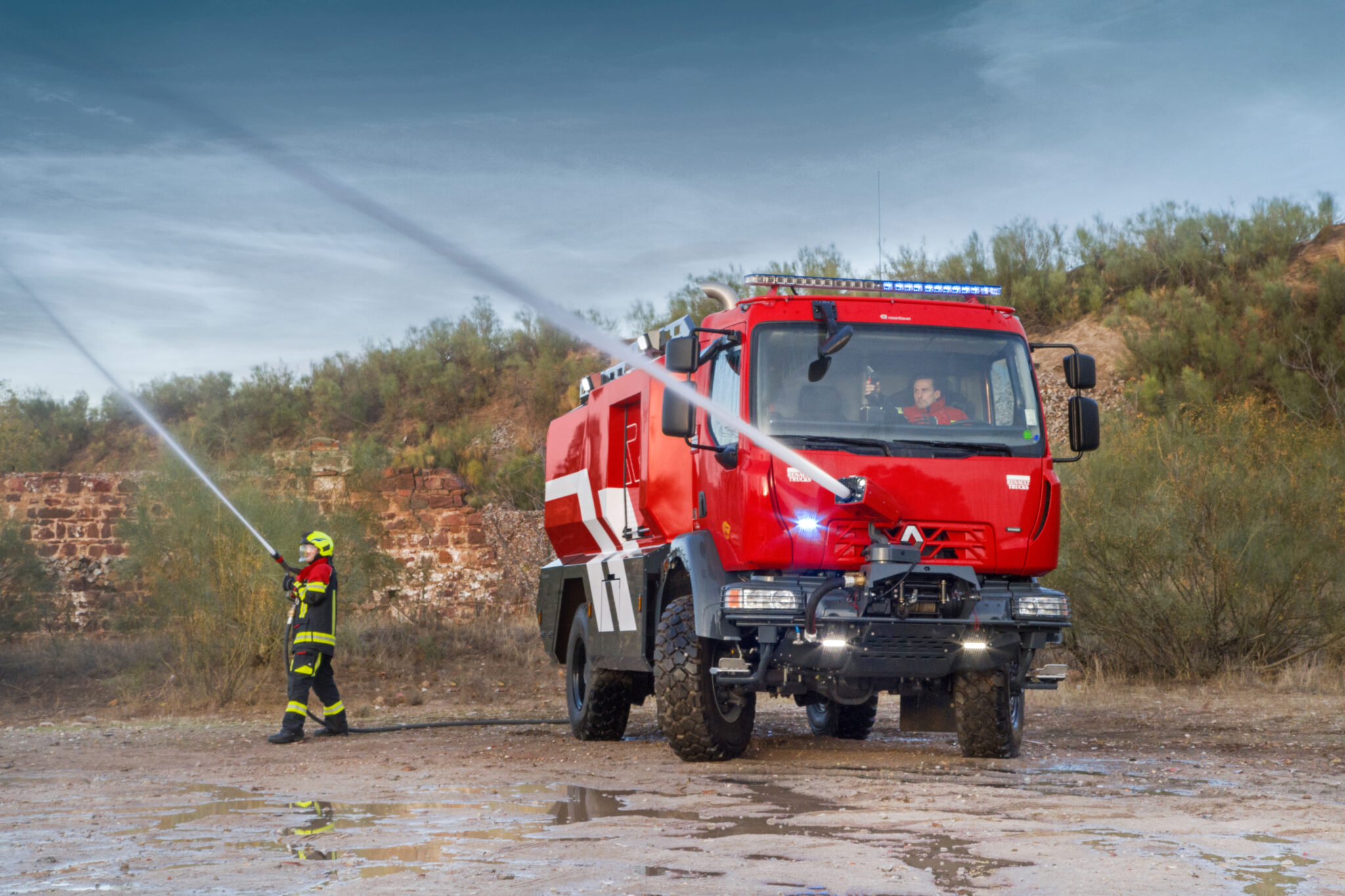
Rosenbauer has presented a new forest firefighting vehicle to the global market. It meets both category 3 of EN 1846-2 for all-terrain firefighting vehicles and specific requirements for the protection of the vehicle crew, as defined for example in the French standard NFS 61-517 or NFS 61-518.
This includes a thermal self-protection system and driver’s cab equipped with a rollover cell. With its compact dimensions, low center of gravity and single tires, the all-wheel drive vehicle is ideally suited for use in rough terrain.
The special firefighting equipment on board makes the extinguishing agents extremely cost-effective and efficient. Plus, the crew can fight the fire using a turret mounted on the bumper and controlled from the cab without having to exit the vehicle.
Robust lightweight superstructure The new forest firefighting vehicle is built on a 2-axle chassis from Renault with a total permissible weight of 14 tons. The all-wheel drive can be switched and the 6-cylinder diesel engine (Euro-6) has an output of 206 kW (280 hp). With a length of 6,900 mm and a wheelbase of 3,350 mm, the vehicle is extremely compact and maneuverable. The large underaxle clearance and a tipping angle of 25° increase off-road capability.
The firefighting body consists of two parts, a tank module made of polypropylene and a pump room module behind it made of a self-supporting aluminum sheet/profile construction.
The flexible and also high-strength body provides optimum load distribution and lateral stability for operation under off-road conditions – the consistent use of lightweight materials ensures a high loading capacity.
The vehicle water tank has a capacity of 3,500 l (500 l of which is for the self-protection systems); the separate foam tank holds 100 l. The additional equipment required for forest firefighting operations (fire swatters, firefighting backpacks, backpack sprayers, etc.) is housed in three spacious equipment compartments with dust-tight roller shutter closures.
Two are located on the sides of the vehicle; another is installed across the entire width in the rear. The built-in pump, foam proportioning system and rapid intervention hose reel are also accessible through this compartment.
Firefighting equipment for forest firefighting The firefighting equipment of the new forest firefighting vehicle consists of the combined NH25 normal/high pressure pump and the direct injection foam proportioning system RFC Admix Variomatic.
The pump has a capacity of up to 2,500 l/min at 10 bar (FPN 10-2000) and up to 400 l/min at 40 bar (FPH 40-250). In high-pressure operation, the supply of extinguishing water on board can be used very sparingly because the fine atomization causes more water to evaporate than under normal pressure, thus achieving a high extinguishing effect.
In addition, the kinetic energy of the firefighting water allows it to be driven deep into the forest floor, which means that even hot spots can be extinguished efficiently.
The RFC Admix Variomatic also produces wetting agents, light, medium and heavy foam, and the proportioning ratio is infinitely variable between 0.1% and 6%.
With the smallest proportioning quantity, the surface tension of the firefighting water is reduced to such an extent that it can penetrate deep into the flammable material and an excellent extinguishing effect can be achieved with minimal water consumption.
The suffocating effect of firefighting foam is used at higher proportioning ratios. The foam compound is injected directly into the pressure outlets and thus the water pump remains free of foam compound and does not have to be flushed after each use. In addition, water and another mains water or foam can be discharged simultaneously at one outlet or several injection points can be operated with different proportioning ratios.
Crew safety A system of spray nozzles protects both the crew cab and the substructure of the vehicle. The water for this comes from a secured tank segment and is pumped by a separate, electrically driven pump.
If the vehicle is trapped by fire during a forest fire, this system allows the crew to drive over a burning fire border and reach safety.
The Rosenbauer DWD Driver Warning System enhances off-road driving safety. This measures the vehicle inclination as well as the axial lateral and longitudinal forces and alerts the driver with visual and auditory signals if the vehicle is at risk of tipping over.
A rollover cell made of high-strength steel is also integrated into the cab structure to protect the crew in all situations.
The vehicle is also equipped with a light package consisting of high-performance LEDs and a front cable winch with a tractive force of 5,400 kg. An optional fresh air system which creates an overpressure in the cabin to prevent the penetration of fire gases can also be installed. We also have our own protective devices for the battery and electrical equipment.
The vehicle is being built at Rosenbauer’s Linares Forest Fire Competence Center in Spain. It is built to meet, in particular, the technical and tactical requirements of French, Spanish and Portuguese fire departments. It combines everything that is necessary for efficient and safe forest firefighting.
Following the Government Spending Review, the National Fire Chiefs Council (NFCC) will be studying the announcements as more detail emerges – and considering how it will impact on the Fire and Rescue Service (FRS).
The Chancellor’s announcement included a one-year settlement for the FRS – rather than three years – and a pause on public sector pay.
NFCC will be discussing the spending review with FRS and partners – including the National Employers who are responsible for setting pay in the fire and rescue service. However, and accepting the very difficult economic outlook, NFCC Chair Roy Wilsher made it clear that the NFCC believes public sector staff, including those who work in the FRS, deserve decent pay.
In their recent Spending Review submission to the government, NFCC highlighted a number of important areas which must be considered and properly resourced in the future.
These included: Resourcing the FRS to meet local and national risks; maintaining the right number of firefighters and staff; maintaining and improving the resilience of FRS; investing in people, and vital protection and building safety work which emerged from the Grenfell fire.
Research by NFCC shows since 2010, spending power in FRS has seen a real term cut of 28.55%, based on figures from standalone Fire and Rescue Authorities. In 2010 it was estimated at £1,523m, which fell to £1,373m in 2020/21.
NFCC Chair Roy Wilsher, commented: “The one-year settlement, which although less severe than the years of austerity, will still put FRSs under additional pressure and will impact on their ability to plan over a more sustained period of time, particularly when coupled with an expected reduction in council tax receipt. It is disappointing that the sector has not been afforded the flexibility to raise additional council tax.
“The announcement of a pay pause across much of the public sector is disappointing. This is particularly so given the exceptional work the FRS is undertaking across the country through the pandemic. Firefighters and staff have maintained the operational effectiveness of fire services whilst at the same time carrying out a wide range of additional activities from driving ambulances to supporting staff in care settings – all this as part of the collective public sector response to the crisis.
John Buckley, NFCC’s Finance Committee Chair said: “The emergency services must be prepared for any eventuality and this can only be achieved through planning, data and the right funding, both in this settlement and future spending reviews.
“Our submission to this year’s spending review set out a very clear and compelling case for the resources required to provide for Protection, Prevention and 999 Emergency response services. Our emergency response capability must be resilient enough to deal with large scale national emergencies and a range of smaller incidents occurring simultaneously, and potentially for a protracted period of time.”
“The NFCC will continue to work with individual services and Government to fully understand both the short and long-term implications of this settlement to ensure that the sector can continue to provide the best level of service possible to communities.”
The 2020 Security & Fire Excellence Awards looked a little different this year, taking place virtually for the first time due to the ongoing pandemic.
The awards continue to be supported by IFSEC International and FIREX International as well as headline sponsors First Response Group and Aico. Other VIP event sponsors included Amulet, CircleFM, HID Global and VPS and platinum sponsors Ajax Systems, CornerStone Cyber & Risk Consultancy, ICTS UK & Ireland, Security & Safety Things, SSGC and The Security Commonwealth.
The virtual awards kicked off with the industry’s karaoke rendition of Wonderwall by Oasis before host, Stephen Mulhern, announced the 2020 winners, ably supported by winning stings from Rockaoke.
Security & Fire Award winners
Split into Company, People, Vendors and Fire category groups, the 2020 winners included:
Adept Corporate Services; Axis Communications; Axis Security Services; BSIA with CySPAG; CornerStone; CriticalArc SafeZone Customer Success Programme; FGH Security and Delivery to the HMS Prince of Wales and Glastonbury; Gallagher; HawkSight SRM with HawkSight Software Virtual Global Security Operations Centre; Hikvision with MinMoe Touch-Free Face Recognition Terminals; Hörmann with OktaBlock Mobile Vehicle Blocker; SecuriGroup; Southampton City Council with Safer Living in Southampton; SSGC, Serco & The Yorkshire Regiment Association. STM Group (UK) with Making a Difference and Teesside University Security Team.
A highly competitive Security Manger of the Year category was deservedly won by Tracey Edwards, Southern Health NHS Foundation Trust.
And, introduced for the first time in recognition of companies going above and beyond during the pandemic, standing out from the crowd of brilliant submissions, Lockdown Hero of the Year was Mitie Security.