North, South and Central American fire associations unite in historic agreement

The Metropolitan Fire Chiefs Association (Metro Chiefs), a section of the National Fire Protection Association (NFPA) and International Association of Fire Chiefs (IAFC), have signed a five-year cooperation agreement with the Organization of American Firefighters (OBA), the largest international firefighting organisation in Central and South America.

The signing, which happened at the Asociación Mexicana de Jefes de Bomberos Conference in Durango, Mexico, marks the first time in history that the leading fire service organizations of North, South, and Central America have formally united to promote best practices in fire prevention, high-risk response, community risk reduction, and other emerging issues that threaten global community safety.

The official signing, presided over by the President of the Asociación Mexicana de Jefes de Bomberos, President Commander Sergio Ramirez, was witnessed by Commander Gustavo Paredes Moreno, Durango Fire Chief.

Signatories included Captain Roberto Duque Mora, president of the Organization of American Firefighters and Chief Robert Rocha, president of the Metropolitan Association of Fire Chiefs.

The agreement is part of a coordinated effort to expand the Metro Chiefs’ outreach to all Latin America countries beginning in 2019 and culminated this year with the signing of the agreement with the OBA.

To advance their cooperative goals and objectives, each association will be required to participate in joint conferences and meetings that focus on the established programs and projects laid out by the agreement.

“This cooperation agreement underscores the power of collaboration and evolution of emergency response around the world,” said Metro Chiefs president Robert Rocha of the Corpus Christi Fire Department.

“And we are pleased that the OBA and Metro Chiefs will be able to work alongside our Latin American counterparts as we confront some of today’s most pressing fire service issues such as the wildland/urban interface, emerging energy technologies, and the impacts of climate change in emergency response.”

NFPA President and CEO Jim Pauley commented: “Today’s fire service is continuing to adapt to the rapidly changing response landscape that includes fire prevention and protection, firefighter training, disaster relief, and rescue.

“This historic agreement provides an important and unique opportunity for international fire organizations to come together to share learnings and best practices that will result in more lives saved and more property protected worldwide.”
Fairview fire spreads to 4,500 acres

A wildfire on Fairview avenue, in the county of Hemet, California, has spread to 4,500 acres killing two people and injuring another according to the most recent update from Cal Fire.

The wildfire began shortly after 2 p.m. (2100 GMT) on Monday, spreading rapidly, and an evacuation order is in place, the Riverside County Fire Department said.

Around 5,000 homes were placed under evacuation orders on Monday evening. These orders and warnings were expanded eastward as the fire progressed on Tuesday.

Schools were closed Tuesday in Hemet due to the fire and will remain shut from Wednesday until further notice, the district said.

The blaze “was spreading very quickly, before firefighters even got on scene,” according to Cal Fire Captain Richard Cordova on Monday.

Cordova explained that the victims of the fire were in what he called a “one way in, one way out” area of a dangerous canyon with a lot of overgrown vegetation that has not burned in decades.

Emergency Aircraft Act introduced to improve response to wildfires

US Senators Kevin Cramer (R-ND) and Alex Padilla (D-CA) have introduced legislation to make states eligible to receive excess planes from the Department of Defense (DoD) to increase their wildfire suppression and emergency response capabilities.

The Emergency Aircraft Act would also remove the current cap on how many excess planes DoD can transfer to other federal agencies for wildfire suppression purposes.

Currently, the DoD has a program to transfer excess aircraft to federal agencies for wildfire suppression, but this is capped at transferring only seven aircraft total to each agency. As wildfire fire activity has increased in recent years, states have stepped up and greatly increased their own wildfire suppression capacity.

States should now be allowed to utilise excess DoD aircraft to increase suppression capabilities, put fires out faster, and increase search and rescue capabilities.

The bipartisan Emergency Aircraft Act of 2022 would:

  • Remove the arbitrary cap (currently 7) on how many excess aircraft DOD can transfer to federal agencies for wildfire suppression efforts;
  • Allow states to receive excess DoD aircraft;
  • Expand the uses for these transferred aircraft from just “wildfire suppression purposes” to include purposes of “wildfire suppression, search and rescue, or emergency operations pertaining to wildfires;” and
  • Mandate an annual report from DoD to the House and Senate Armed Services Committees on aircraft transferred during the previous fiscal year.

Senator Cramer said: “The Emergency Aircraft Act of 2022 removes arbitrary caps on the transfer of excess military aircraft to the Forest Service, states, and those on the frontline fighting fires. This bill is a no-brainer to aid our wildfire fighting capabilities.”

Senator Padilla said: “After years of increasingly catastrophic wildfires in California, it has become clear that the federal government must do more to support suppression efforts to get fires under control quickly, as well as support search and rescue efforts to keep our communities safe.

Padilla added: “This common sense bill will increase the tools at our disposal, including by allowing states – like California – to secure excess military aircraft to augment our aerial firefighting fleet.”

Largest wildfire in California this year remains uncontained

In what has become the largest fire in California this year, the McKinney wildfire has now burned 55,493 acres (22,457 hectares) of drought-stressed timber and remains at 0% containment, the California Department of Forestry and Fire Protection reported.

The fast-moving fire went which began on Friday (29 July) has already become the largest fire in the state in the year to date. The blaze has forced around 2,000 residents to flee as it destroyed homes and critical infrastructure, mostly in Siskiyou County, home to the Klamath National Forest, according to a statement from Governor Gavin Newsom on Sunday, a day after the fire was declared a state of emergency.

Two bodies were found inside a burned-out car near the Oregon border, authorities said on Monday, as crews battled the blaze for a fourth day and took advantage of rainfall in the area.

Authorities have yet to confirm the extent of property losses, but the Cal Fire said in an update posted on Monday that more than 4,900 homes were threatened by flames.

With lightning forecasted over the next few days, extra resources from elsewhere in the state are being brought in to help fight the region’s fires, according to the US Forest Service.

Nevada Division of Forestry invests in air support for wildland firefighting

The Nevada Division of Forestry (NDF) has announced a partnership with Rutledge Airborne Applications to provide critical air support for wildland firefighting throughout Nevada. The three-year partnership contract increases fire response capabilities by utilising state-of-the-art single engine air tankers (SEATs).  

SEATs are compact, versatile aircraft that can launch from smaller regional and local airports, such as those in Minden and Elko. They are capable of flying multiple missions within an hour, depending on proximity to a refill base. The aircrafts can also cover a greater range and fly at higher speeds than NDF’s current helicopter fleet.

Because of their smaller size, SEATs can safely manoeuvre in areas that are difficult to access. “We can go virtually anywhere, and we’ll work out from whatever base is closest to the fire to keep us efficient.” – said Cade Boeger, a pilot for Rutledge.

With fire seasons growing longer and more extreme each year, with the new partnership Nevada is reimagining their approach to fire preparedness to meet today’s challenges, including climate change impacts.

“This new partnership with Rutledge gives us more flexibility and efficiency in our response to wildfires. Our priority is to protect firefighters and first responders, Nevada families, communities, and natural ecosystems,” said Nevada’s State Forester Firewarden Kacey KC.

The first two SEATs arrived in Reno on Sunday night and are ready to assist firefighters on the ground anywhere in the state.

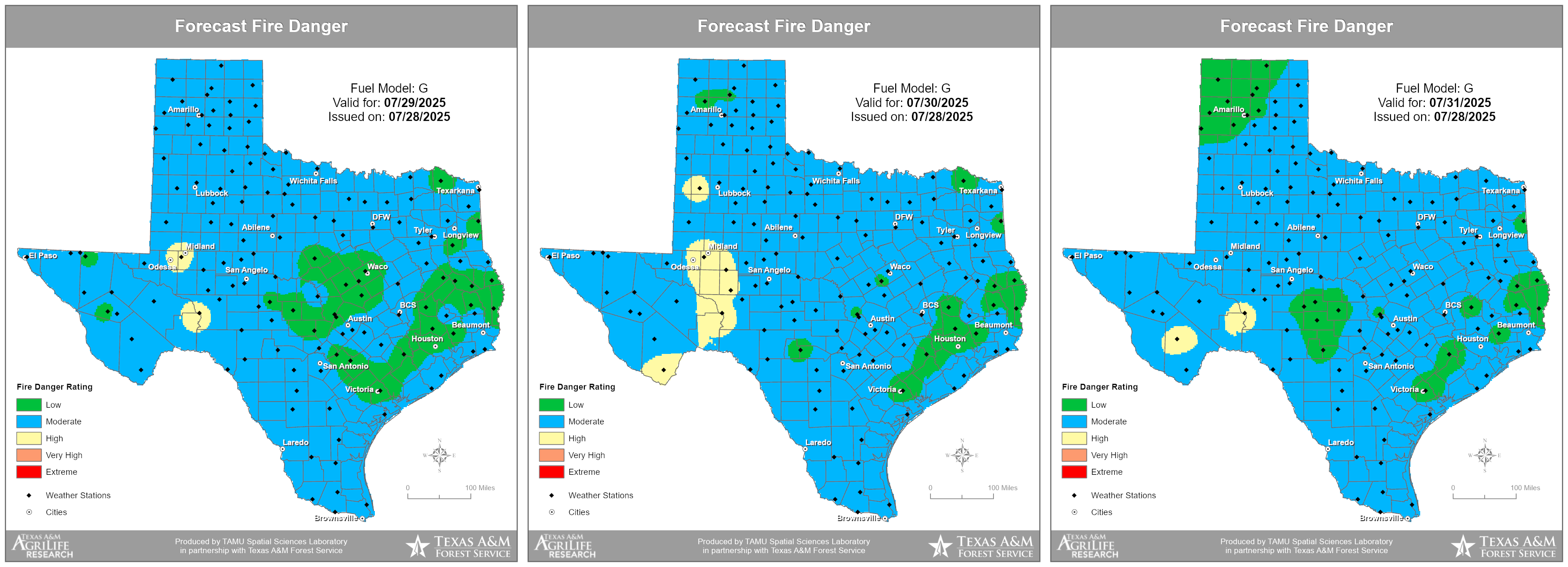
Texas on high alert as temperatures soar

Wildfires have been seen across in the weeks following Texas Govenor Abbott declaring a drought disaster for 164 counties across the state.

As of 20 July, 254 of Texas counties were put under a burn ban as drought and rising temperatures, fuels, or grasses, have become drought stressed and vulnerable to sparking wildfires.

About 99% of Texas had some level of drought conditions as of 20 July. The lower the fuel moisture, the more likely it is for a wildfire to start and spread, according to the National Centers for Environmental Information.

Heather Gonzales, a program specialist who focuses on wildfire prevention for the Texas A&M Forest Service, warned Texans against  doing any activities that may cause sparks such as welding, cutting and grinding materials outdoors.

This year has been a “much drier year than average,” Gonzales said, and the state has not had this many active burn bans since 2011.

By Saturday, fire danger is expected to increase across the state, according to the TFS’ forecasting tool.

Active fires

As of 7 am 21 July 21, there were 10 active wildfires over an estimated 16,426 acres of land.

Two two-day-old North Texas wildfires continued to resist containment Wednesday after destroying 21 homes, officials said.

The Chalk Mountain Fire near Glen Rose, Texas, destroyed 16 homes and damaged five others as it remained on the move Wednesday after scorching almost 10 square miles (26 square kilometers) of mostly short grass, brush and juniper as of midday Wednesday, said Alexandra Schwier, a Texas A&M Forest Service spokeswoman.

A fire at Possum Kingdom Lake destroyed five homes as it spread along its western shore, charring 500 (200 hectares) acres about 70 miles (113 kilometers) west of Fort Worth. That fire was 15% contained Wednesday, the Forest Service said.

California Water Service opens Firefighter Grant Program

California Water Service (Cal Water) has opened its fourth annual Firefighter Grant Program. Professional or volunteer uniformed fire departments serving any portion of Cal Water’s service areas are now able to apply for funding to offset costs associated with fire protection efforts, equipment, training, and education.

The program was launched in 2019 and provided $60,000 in grants. Since then, the program has nearly tripled, with $175,000 distributed among eight fire departments in 2021.

Cal Water awarded grants ranging from $7,500 to $38,000 last year for equipment such as new hoses, nozzles, and personal protective equipment to a rapid inflatable rescue raft, battery-powered hydraulic vehicle extrication tools, and a HeloPod.

Martin A. Kropelnicki, Cal Water President and CEO, said: “For the past three years, we have seen first-hand the meaningful differences our grants have made in protecting our communities and firefighters. We are pleased to reaffirm our commitment to partner in this way with the brave firefighters in our service areas, not only to supply the water they need in emergencies, but also to support the work they do every day to keep our customers and communities safe.”

Of the grant received in 2020 by the Northshore Fire Protection District in Lucerne, California, Fire Chief Mike Ciancio said: “A big thank you to Cal Water for accepting the Northshore Fire Protection District as a recipient of its community grant program. Cal Water donated funds to the department so that we could purchase a new set of extrication tools; these tools replaced a set of extrication tools that were over 20 years old and we could no longer get parts for.”

The application period for this year’s cycle will close at 5pm PT on Friday, 2 September. Grant recipients will be notified later in September 2022, when Firefighter Appreciation Month is observed.

For more information about the Firefighter Grant Program or to submit an application, applicants can visit www.calwater.com/firefightergrant or email firefightergrant@calwater.com.

Western Fire Chiefs Association introduces real-time Wildland Fire Map

The Western Fire Chiefs Association (WFCA) has introduced its new Fire Map, to provide near real-time information about active wildfires.

The WFCA Fire Map pulls data from the US Forest Service via National Interagency Fire Center IRWIN feed, and 911 Dispatch data via PulsePoint to track the location of the wildfire as they start and while they’re burning. It is the first map of its kind to pull such data from 911 Dispatch in relevant areas.

The map shows the name and location of the fire, alongside its size and what percentage it has been contained. It also shows how many responders have been assigned to the fire and how long the fire has been active.

“The current climate situation is incredibly scary,” said Chief Mark Niemeyer, Vice President of the WFCA and Fire Chief of the Boise Fire Department. “The WFCA is providing public access to definitive information around the paths of wildfires so that communities can quickly take action,” said Niemeyer.

“The WFCA is committed to provide an even deeper level of intelligence around wildfires as they happen”

As the WFCA looks to the future, it is creating a development path in the next year which will include 3D and predictive mapping models, air quality and weather data, as well as text message notifications.

Richard Price, President of the California-based 501(c)(3) nonprofit PulsePoint Foundation, commented on the launch: “We are excited to offer the opportunity for PulsePoint-connected agencies to seamlessly display fire incidents within the WFCA Fire Map. By leveraging widely-deployed PulsePoint 911 interfaces, the fire service is able to scale this critical public resource very quickly.

He added: “The addition of text notifications will be a game changer.”

Pye-Barker acquires Bender & Modlin Fire Sprinkler Inc.

 Pye-Barker Fire & Safety, headquartered in Atlanta, Georgia, has announced the acquisition of Bender & Modlin Fire Sprinkler, Inc.

The acquisition will strengthen Pye-Barker’s presence in Jacksonville, Florida and the surrounding markets of northeast Florida and southeast Georgia.

Bender & Modlin Fire Sprinkler is a full-service fire sprinkler company specializing in commercial and industrial fire sprinkler and protection systems. Allen Bender and Terry Modlin founded Bender & Modlin together in 1999 after a combined 50-year career as sprinkler contracting managers.

Bender & Modlin is an active member of the National Fire Protection Association, and supporter of the F.A.S.T. Apprenticeship Program and the National Institute for Certification in Engineering Technologies.

Allen Bender, President of Bender & Modlin, said: “Terry Modlin and I are thrilled to now be a part of the Pye-Barker family and to be moving to a new season in the evolution of our company. From the first meeting with Pye-Barker, it’s been evident that this is the right move. The process has been seamless, and we’re excited about the future for our customers and employees.

“We have a great personal relationship with the Pye-Barker management team, and all of us at Bender & Modlin Fire Sprinkler feel that we now have a genuine partner who has our best interest at heart.”

Bart Proctor, CEO of Pye-Barker, commented: “Bender & Modlin has a well-deserved reputation for consistently putting their customer first by recommending and building the most efficient and effective fire sprinkler systems in the industry.

“Their focus on the customer is unmatched and they’re a great group of people to work with. I couldn’t be happier that we are joining forces.”

Bender & Modlin will retain its name, leadership, and knowledgeable employees.

Forest fire threatens ancient sequoia trees in Yosemite National Park

A grove of ancient sequoia trees in Yosemite National Park are in danger as the Washburn Fire grew to more than 2,300 acres the US Forest Service has said. Firefighters are working in difficult terrain to protect some of the largest and oldest redwood trees in the world.

Firefighters on scene have been using a 4-foot tall sprinkler system to tackle the fire and maintain air-moisture to prevent extensive damage to the area.

The fire, which started on 7 July, is threatening around 500 giant sequoias in the Mariposa Grove, including a famed ‘Grizzly Giant’ which is thought to be around 3,000 years old.

The Washburn Fire has already caused nearly 1,600 people to evacuate the area, including the Wawona community located inside the national park and hundreds of campers staying close to Wawona.

The cause of the fire is still being investigated. Fire officials have said that warm and dry weather conditions are making it difficult to control the flames.

Mariposa Grove and Yosemite Valley have been protected since President Abraham Lincoln signed legislation in 1864. It has a long history of prescribed burning to reduce the negative impacts of high-severity fires, the National Park Service said in a statement.

The fire was downgraded from 25% contained to 22% containted on Monday night. Stanley Bercovitz, a spokesman with the US Forest Service, said: “We don’t want to say everything’s fine and we’re getting a good handle on this fire and it’s downhill from here on out, because all it’s going to take is one hour of wind.”