IFSJ Exclusive: Europe’s biggest fire suppression system

Ferran Dalmu-Rovira, CEO at Medi XXI GSA, talks to IFSJ about one of the biggest forest fire suppression systems ever developed

Can you give me some background on the GUARDIAN project?

Medi XXI GSA is an environmental engineering company founded 21 years ago. Under our combined operative, technical, and preventive experience, the recurrence of wildfires in the Mediterranean area, added to rural abandonment, climate change, residential areas proliferation in risk areas and changes in social sensitivity about environmental matters and forest management necessarily required a revision of the precepts of traditional preventive forestry.

In 2005 we began exploring new methods of working in the Wildland-Urban Interface (WUI) areas and the need to manage vegetation to adapt it to drier environments and understood that it must include, if sustainable, integrated and comprehensive solutions are desired, the integrated water cycle and a forest-hydrological approach to the problem.

Our GUARDIAN project was one of the 22 selected from the 184 projects presented from 21 European countries. In the Adapting to Climate Change category, 43 candidates took part and 6 were selected: GUARDIAN, along with projects from big cities like Amsterdam, Paris, Barcelona, Manchester and Seville.

Tell me about the development of the project over its lifetime? Who and what was involved?

At the beginning in (2005-2006) only our team was involved. Our first project was with one community (Santa Marina’s people), one local government (Carcaixent city council), and a small grant from our regional government (Valencian regional government). Following its success, in 2008 another local government from our region (Torrent city council, València) decided to develop an installation in the neighbourhood of El Vedat. In this project we met our partners from Hidraqua which is a company specialized in water networks management. This installation has 24 fixed sprinkler towers, a Total Mobilizable Water Volume of 1,600 m3 – 423,000 gal and a Water Power of 18,000 liters/minute – 4,800 gallons/minute during 85 minutes.

In 2018 they offered us to enter into a consortium with two Valencian city councils (Riba-roja del Túria, who would lead the project, and Paterna, as a beneficiary) because they are municipalities that share a forest border, and a wildfire problem in the Turia’s river natural park. During the project we also worked Universitat Politècnica de València – UPV, Universitat de València – UV, and CETAQUA, which is a water technology center based in Barcelona.

What were the main design considerations being made in designing the sprinkler system?

Our methodology is based on the four pillars: planning, fuel management, infrastructure and training. We include all these approaches in the design process. Specifically, about engineering, we use several methodologies of our own, because there is no specific standard in Europe that regulates sprinkler installations in WUI areas. We use comparative simulation, we use US Forest Service simulators, we use the standard for hydrant – based fire networks, and we add the towers and the sprinklers at the end of the line.

We use UNO methodologies, and NFPA to work with the communities, according with them the fuels management, and finally, we use a model of “type of wildfires” or “design wildfires” that was designed by the Fire Paradox project team (also European Commission financed) between 2006 and 2010. If the most severe wildfire in a region can be characterised, the expected impact against a WUI area can be characterised too. We have designed a defensive model for a general classification of WUI zones.

Were there any significant issues that arose during the project that you had to overcome?

The GUARDIAN project had a 3-year implementation period. Two years to resolve paperwork (and problems) and less than one year to execute the work. No one said it would be easy to design, but I always say that if it were easy, there would be no need for engineers. Main problems were making people understand the need for forest management, overcoming the fact of using water from a sewage treatment plant for use in a fire fighting system in a populated area, an area near an airport, but we have overcome all the problems thanks to an exceptional engineering team composed of people with different profiles, and a lot of personal commitment to the project.

How and when is the sprinkler system deployed?

There are two phases of operation. When there is no fire, preventive water is provided. These are the prescribed irrigations. In order to make this decision, an algorithm has been designed that is fed by the sensory network. It can also be activated on demand if the risk is considered to be high, or if there is a fire nearby, but not in the operational area. We calculate the Fire Weather Index, adapted, continuously, and when the plants exceed certain thresholds, we activate the system. The tricky part is to know when it is enough, because exceeding the recommended irrigation doses can cause excessive growth of the forest biomass, and this is not desirable.

The other scenario is activated when there is a fire within the system’s area of influence. We have three isochrones that are calculated from the simulation module of the platform. When the fire warning is received, the operator puts the point in the simulator and within one minute receives the data. Depending on the area of the starting point and the weather conditions, it is determined when the system should be activated.

Part of the water is supplied before the arrival of the fire, and the other part is reserved for the moment of impact. The system can be operated from a computer or from the smartphone app, so responsiveness is immediate. It takes less than 5 minutes from the time the warning is received until the system is activated. This gives us time for the emergency services to arrive. It is important to emphasize that it is not an extinguishing system, but a defense system. Our objective is to support ground operations, so that fewer units are needed to protect homes.

Are there any future development plans for the system?

We currently installing another system in Albufera’s Natural Park, and we have 11 more facilities under negotiation. The support from the European Commission has given us significant visibility, although the economic effort has been very important in our case. We have invested 400,000 euros in this project, in addition to the previous effort since 2005. We are working with the data sets we are obtaining to implement improvements based on artificial intelligence, and we are waiting for the burning season to begin to conduct trials for yield improvement. These projects require years to acquire specific knowledge.

Our plan for the next few years is to recoup the investment, and share the knowledge gained with other teams who share our values. We have learned a lot from NFPA in the United States, from CSIRO in Australia, from CONAF in Chile, from the Valparaiso Fire Department in Argentina, from our French and Italian friends. It is only fair to share what we have learned with other countries. We are working (and improving) with VR and AR too. We train the people (professionals and civilians) with this technology.

What lessons have you learned and what knowledge have you gained over the course of the project?

This year our country [Spain] has lost more than 300,000 hectares during the wildfire season. We do not know yet if this is the ‘new normal’. If this is the new normal and drought becomes more frequent, more intense and longer lasting we must be prepared. This project has confirmed what we already sensed: protecting communities from wildfires is not a technical problem. We have the knowledge and tools to protect communities even in extreme conditions. And I would like to state for the record that I speak from humility. Forest fires teach you to be humble. But what I have just said is a statement of fact. Protecting communities today is more of an economic, social and political problem than a technical one.

Many people do not understand that they live in risk areas. And that home ownership implies ownership of the risk to which that home is exposed. The public authorities must understand that no more buildings can be authorised in risk areas in order to, at least, not aggravate the problem. Nor is it helped by people who continue to deny, despite the evidence, the influence of Climate Change on extreme wildfires. And this, again, is not a technical problem.

With this project we have learned that by explaining the problem to the community properly, door to door, and explaining the actions to be carried out, the results are favorable. We have incorporated the local environmental groups to the supervision staff and they have participated in the project process. And finally, we have been able to demonstrate, thanks to the people who specialise in economics, how much savings we can bring to society through this tool.

Another thing we have learned, and it is very important, is that a combination of different tools works better than one tool alone. Sprinklers without forest management are useless. Forest management without prescribed burning does not work. Prescribed burning without herbivores is no good. Tools must be combined to obtain sustainable results in the long term. We use the complete toolbox.

GUARDIAN’s proposal is sustainable forest management adapted to the needs of the 21st century, incorporating Climate Change into the equation. This is perhaps the most important lesson learned. We have adapted and improved knowledge that has been useful for centuries. Without proper land management, no effective response to new fires is possible.

Project GUARDIAN in numbers

  • Total project budget: €5,494,755
  • EU Financing: 80%. €4,395,804
  • Execution time: 3 years
  • Towns involved: Riba-Roja de Túria and Paterna. Túria’s River Natural Park
  • Forest area managed: 35 hectares / 86,49 acres
  • Annual volume of regenerated water: 80,000 m3 / 21,133,764 gal
  • Water reservoirs: 5 (500 m3 / 132,000 gal each)
  • Total Mobilizable Water Volume: 2,500m3 / 660,500 gal
  • Water Power: 22,950 liters/minute – 6,100 gallon/minute during 100 – 105 min.
  • Water recovery total time: 3 days
  • Population potentially affected: 15,000 inhabitants
  • Fixed sprinkler towers: 40
  • Portable sprinkler towers: 12
  • Pipeline’s length: 6.5 km / 4 miles
  • Number of sensors: 164 (including weather stations, soil, atmospheric and tree sensors) managed with WUIProtect NETSense platform
  • Green firebreaks plants planted: 2,000 units of less combustible species

This article was originally published in the January edition of IFSJ. To read your FREE digital copy, click here.
Registration opens for FIREX 2023

Registration is now open for the only fire safety event in the UK to make third-party product approvals a condition of exhibiting. FIREX, exclusively supported by the Fire Industry Association, is back at the ExCeL in London on 16-18 May 2023. Free tickets are available here.

Where: ExCeL London, One Western Gateway, Royal Victoria Dock, London, E16 1XL

When: Tuesday 16, Wednesday 17, Thursday 18 May 2023, 10:00 – 17:00

Visitors have the opportunity to experience the latest third-party approved technology and solutions, network with thousands of global fire safety professionals and learn about the latest legislation and best-practice.

Many leading brands are already signed up to showcase the latest and most exciting fire safety innovations, including the likes of  C-Tec, Apollo Fire Detectors, Kentec, Advanced, Rockwool, Detector Testers, Warrington Testing & Certification, Aico, PlanRadaradar, Baldwin Boxall, Quelfire, Uptick, and many more.

At such a pivotal time for the sector, discover the latest fire safety best practices and regulations from leading industry experts. Have your say and join in on discussions ranging from concerns over single staircases in high-rise buildings to the role of IOT within fire safety.

Plus, for the first time, IFSEC & FIREX will be introducing the brand-new Distributor Network in recognition of the pivotal role distributors play in the professional fire and security sectors. Visiting customers can meet leading distributors such as ADI Global, DVS, CIE-Group, COP, Dynamic CCTV and Oprema to discuss product solutions from market leading suppliers.

A game changer or our show”

Event director, Gerry Dunphy, said: “I am incredibly proud to represent the only event in the UK which makes accreditation a condition of exhibiting. Neither you nor your customers take chances – so why should we?

“FIREX remains the biggest and best annual opportunity to stay up to date on the latest trends, developments, and opportunities. Every visitor will come away with knowledge and inspiration to help make your buildings comply and approach your projects more efficiently.

“This year, I am also especially excited about our sustainability initiatives, driving real change within both the events and the fire safety industry, as well as the new Elizabeth Line which will make it easier, faster and more convenient than ever to get there. A game-changer for our show.”

4 shows, 1 ticket

Enhance your fire safety strategies with solutions from health and safety, facilities management, security & smart buildings. FIREX also grants you free access to the co-located IFSEC, Facilities Show and Safety & Health Expo.

Registration is now open! Get your free ticket today.

Wireless technology: changing the fire safety game

Sandy Damm, the newly appointed CEO of Bull Cygnus Group sits down with IFSJ to talk about his plans for the company

Can you tell me about your professional background?

I spent 25 years in international business development, 15 years of that have been in profit centres, improving productivity and sales, developing people, creating value and growing the share price. I’ve carried out a few business turnarounds in that time too.

Most of those years were spent in building automation and building management systems – an industry which has many parallels to the fire safety sector. For the last 10 years, I was more involved with IoT and smart buildings.

What are your main aims as CEO? 

It’s a little early to say. At the moment, I’m focused on understanding the sector, the players and the products, developing existing teams, bringing good people on board and getting the right foundations in place. I have one to ones with every single employee gathering their ideas and getting my head around how everything works. The main priority is the launch of our new Cygnus technology under the SiteNet and SmartNet brands. We must clarify our positioning as a fire safety equipment manufacturer and become more visible to the market: Bull products provides ‘temporary’ solutions (products and services) whilst Cygnus Systems provides ‘permanent’ solutions (products only).

Did you learn a lot during your 1-to-1 conversations with employees?

I always find that this is where the best ideas in a business come from. My task is to take these ideas on board, put them together and build a coherent vision for the next five years. We’re still building this strategy to make sure we are in good shape for future growth. I can’t reveal too much at the moment, but we will certainly focus on international development, delivering a first-class customer experience and becoming more sustainable. There is room for plenty of improvement in the building and construction sector.

Another important area is training. Our industry is not the most interesting when it comes to attracting the younger generation. Attracting and retaining talent in a sector which isn’t that exciting is a challenge and an area where we can lead the way. I believe we can do more to attract people from outside the industry rather than always look to competitors. The first question when someone is hired is ‘which competitor are you coming from?’. Instead, it should be more about finding someone from outside the industry with other ideas and a different way of thinking, different culture, different language – I believe in diversity. Diverse teams make better decisions.

How do you overcome the issue of attracting talent?

Our focus on sustainability will attract the younger generation. We are committed to sustainable safety and on a journey to reduce our carbon emissions. We are working hard to reduce the energy we consume and secure energy supply from sustainable sources. We are changing the ways we work and focusing our business development on greener and more sustainable products and services. Eventually, we help our clients to reduce their carbon footprint and altogether we contribute to make the world a safer, cleaner and better place.

Can you tell me more about the Cygnus Academy?

The new Cygnus Academy is an in-person, high specification training hub for installers seeking to learn about our new Cygnus wireless fire detection and alarm system. 

It’s located at our HQ in Hereford, and provides a modern, fully equipped, and comfortable environment where installers can complete their training course to become a Cygnus Certified Partner. The course itself combines both theoretical and practical training to give detailed insights into our ground-breaking technology and the skills required to carry out a successful installation.

Upcoming dates include 10th and 24th January and 6th, 14th and 21st February and training can be booked here: help@cygnus-academy.com.

What about the new Cygnus fire alarm system?

Wireless technology has been evolving dramatically in recent years and our new system will be a real game-changer for permanent installations, bringing a reliable and safe solution to the market built on wireless mesh network technology.

This system will change the way they can design, install and commission systems for buildings, making the whole process much quicker, easier and much more cost-effective – especially in larger scale installations. Watch this space for more news when the system is launched in Q1 2023.

What are your plans for the Middle East and European markets?

We already have a few established partners in Europe and the Middle East. We are working with them to better understand the requirements of their local markets, identifying where there are opportunities and then supporting them to grow our international business significantly in the years ahead.

What is the main focus for Bull Products right now?

Our Bull Products business is focused on providing reliable, high quality temporary fire safety solutions for construction sites with a separate team and product range dedicated to this market. We have an in-depth understanding of the complex legislation that covers this environment and provide excellent customer service and support to ensure successful installations.

We are looking to grow our business in this sector too, adding new products and services and highlighting the cost-saving and sustainability benefits that customers receive when dealing with us. It’s a really exciting period for both Bull Products and Cygnus – I definitely joined at the right time! 

This article was originally published in the January edition of IFSJ. To read your FREE digital copy, click here.
IFSJ Exclusive: Evacuation Plan B with Triple A Solutions

Elspeth Grant, CEO and Expert PEEPs trainer at Triple A Solutions weighs in on the latest developments in the EEIS consultation

The Grenfell Tower Inquiry has now finished with the panel now considering their findings before producing the final report. In the meantime, the Government is trying to do everything they can for someone reason not to implement Phase 1 recommendations for PEEPs (Personal Emergency Evacuation Plans). My view, along with all the lawyers I speak to, is that there is already legislation that states disabled people must be able to evacuate a building.

In fact, the danger is with the latest load of consultations is that the Government are muddying the water, which is what the Local Government Association (LGA) and London Fire Brigade (LFB) responses have stated.

The Fire Safety Order in 2005 ring-fenced the responsibility for evacuation away from firefighters on to Responsible Persons managing the building. I was the Director of a Resident Management Organisation in 2006, and we immediately took legal advice on our responsibilities.  This has not changed over the past 15 years.

The Order is criminal law and puts the entire responsibility onto the individual(s) managing or controlling the building who can get a criminal record and go to jail for two years for non-compliance. There are still many influential fire professionals who are still advising responsible people and their clients that this is not the case. I feel very strongly about this as all the legal advice I received says their approach is incorrect.

The Government is now on their third consultation about PEEPs and the latest one is probably the most ridiculous. In one of the proposal questions it states that disabled people could be asked to pay for the reasonable adjustments, which is clearly illegal under the existing Equality Act.

We are just in an eternal loop of consultations. The Government did not like the responses they got last time, they will like them even less this time because the National Fire Chiefs Council (NFCC), LGA and LFB along with every other Fire Brigade have torn Emergency Evacuation Information Sharing (EEIS) apart.

Government action?

The Government does not actually have to do anything. Fire and Rescue Services just have to enforce the current legislation. Last year, I did Freedom of Information Requests of the English and Welsh FRS asking: ‘How many enforcement notices have you done for means of escape since the Grenfell Tower fire in multi-storey buildings; and then how many of these were for means of escape for disabled people’.

There had been around 1,294 enforcement means of escape notices – it will not be a surprise that there were none relating to disabled people, apart from one which could vaguely be associated. This left me with the impression that either every multi-storey building has PEEPs in place enabling every disabled person to leave at the same time as non-disabled people, or the Fire and Rescue Service are not enforcing the law equally in relation to disabled people and are therefore failing to perform their Public Sector Equality Duty.

Industry response

One criticism was that the EEIS proposals meet the requirement of neither the FSA, the FSO or the Equality Act. They all pointed out the Stay Put policy, but people are just not staying put in buildings that are on fire anymore; they get out if they are able to do so.

LFB said that Stay Put is the right Plan A and Plan C is rescue, which is the worst-case scenario. LFB rightly points out that they are a Fire and Rescue Service, not a Fire and Evacuation Service. There has to be a Plan B where everyone can move away from immediate danger. For me, that is the most important thing: to ensure that if the fire is in your flat, next door, or on your floor, you can move away; you can move down one or two flights.

Realistically if you can do that you can probably leave the building altogether. The Research by the University of Leeds and Phil Murphy on historical Incident Reporting Data going back to 2010 highlights why this is so important as it identifies that if a person is in the vicinity of a fire for over 20 minutes they are more likely to die than to be rescued.

The NFCC response stared that the EEIS proposals are contrary to all published guidance – the Means of Escape for Disabled People supplementary guidance published by the Home Office.  Section 1.1 Legal Overview very specifically states that there must be an evacuation plan to get everyone, including disabled people, out of the building without the assistance of the Fire and Rescue Service, an approach mirrored by British Standards. Is the Government now stating that the Home Office has published incorrect legal advice for the past fifteen years?

All guidance would have to be changed if the EEIS proposals were implemented and the FSO re-written – can you imagine writing a law in 2023 that states ‘all relevant persons must be able to move away from immediate danger and leave the building apart from disabled people’? It would just be open to immediate legal action.

The FPA reported in August this year that over 1000 legal actions have been launched related to the Grenfell Tower fire. These will not all be about PEEPs, but a fair few undoubtedly will be as fifteen disabled people died because they had no PEEPs and were unable to evacuate.

The LGA response to the EEIS Consultation is interesting as they have obtained legal advice stating that the EEIS proposal breaches the Equality Act. This is a huge turnaround because in 2011 the LGA  published the Fire Safety in Purpose Built Flats Guidance, authored by C S Todd & Associates, stating that  PEEPs were unreasonable, a statement that the LGA formally redacted last year.

What is your current view on the situation

We have the Fire Safety Order that states that everyone must be able to move away from immediate danger and leave the building as quickly and as safely as possible. My view is that existing legislation just has to be implemented and enforced equally for both non-disabled and disabled people. The responses from the professionals very specifically state that the law is already there, however the Government are not listening.  This is situation is dangerous for disabled people as well as Responsible Persons as it is going to muddy the water leaving Responsible Persons unclear about their legal responsibilities.

This article was originally published in the January edition of IFSJ. To read your FREE digital copy, click here.

IFSJ Exclusive: Small and sturdy with Survitec

Scott Tonks, Maritime Defence Category Manager at Survitec, tells all about one of the most advanced FRBs (Fast Rescue Boats) available for emergency services

Earlier this year, Global Survival Technology solutions provider Survitec introduced the new 420 GP/GPM FR, a new lightweight design inflatable rescue boat capable of rapid single-point inflation to meet the unique demands of waterborne search and rescue operations by the emergency services. IFSJ spoke to Scott Tonks, Maritime Defence Category Manager at Survitec, to learn more about how a greater understanding of how fire and rescue teams handle rescue boats led to the design of the new boat.

Research

Based on military-grade technology, the seven-person boat is unique in that it is the emergency services sector’s first 4.2m long fast rescue boat that can be rapidly inflated using just one nine-litre self-contained carbon air cylinder.

The Survival Technology solution was developed after consultation with the emergency services. To gain a deeper understanding of how rescue boats perform in real operations and to develop an advanced solution capable of meeting market demand, Tonks and his team undertook water rescue modules 3 and 4 to gain much greater knowledge.

‘Module 3, Water Rescue Technician’, helped better understand rescue techniques and equipment first responders use in a swift-water and flood environment. While Module 4, Swift Water and Flood Rescue Operator course, was carried out over the period of a week with a major fire brigade.

“We were able to experience first-hand the situations first responders encounter and better understand the kit they need to do the job. It provided a fantastic opportunity to see what was required of an FRB in a real operational setting, allowing us to develop and design a solution capable of meeting all their needs,” says Tonks.

Development

Using the information from the modules and the on-water experience gained from the emergency services, Survitec began working on the new 420 design to address some of the emergency services’ main challenges, such as getting a boat into remote locations and rapid inflation.

One key consideration in the development was the inflation system. By adopting a system designed for military boat application, Survitec could inflate the 420 GP/GPM FR boat from a single cylinder – the same cylinder firefighters wear on their backs – in just 40 seconds.

“We were able to significantly increase the speed of deployment using a single cylinder resulting in faster emergency response times, potentially saving more lives,” Tonks says.

Survitec, in partnership with Leafield Marine Ltd, redesigned the manifolds to ensure the optimal amount of air goes to each compartment of the boat, minimising the amount of air expelled through pressure relief valves. This also addressed air-loss issues due to fluctuating pressures operating in variable ambient temperatures.

“Changing temperatures is a real issue,” says Tonks. “Pressure varies in colder and warmer temperatures. Our single-cylinder solution is designed to bring the boat up to full pressure in all eventualities.”

As temperatures fluctuate throughout the day, pressure relief valves will let some of that air off to compensate for how we best use valves in varying temperatures, as Tonks attests.

“If a boat is over or under pressure, it’s going to cause issues,” he explains. “The keel is closer to the water, gets saturated, and therefore it will be colder. As a result, it will lose pressure, so we changed the pressure relief valve to be slightly higher than it needs so it will never be under-pressured to cause an issue.”

Durability

Another crucial element of FRB operation was understanding how firefighters handle rescue boats. This was achieved through a partnership with Technical Rescue International. “We noted valves, lifelines and other elements needed to be in a certain position because of where equipment is placed on board; this knowledge was invaluable in designing the boat to facilitate more unique requirements.”

Designed for rescues in fast-flowing waters and areas prone to flash flooding, the 420 GP/GPM FR boat is 4200m long and 1800m wide boat capable of a maximum payload of 903kg.

Manufactured from a durable Hypalon 1670dtex fabric and benchmarked against SOLAS and DEFRA rescue boat standards, the new boat incorporates reinforced grip patches and military-grade C7 interchangeable inflation valves strategically positioned to minimise any air loss during inflation. Any damage to valves can be easily replaced using a simple hand tool.

With multiple flooring options, the 420 GP/GPM FR can be packed and deployed so those first responders can be deployed into the water from vessels, piers and paths and with the FRB inflated in situ.

To emphasise the options available, Tonks refers to a project with a German emergency services unit that required a deck capable of supporting a set of ladders.

“We worked with them to understand how to get a ladder to work on an inflatable floor and hold its position safely,” he explains. “We can design new fittings to ensure they can secure ropes and guidelines.”

Looking ahead, Tonks says that with flash flooding increasing, emergency services will need this FRB to help save lives in areas that are often difficult to access. “Before now, first responders had to tow trailers and launch boats from slipways potentially some distance away from the location of the emergency, which places limitations on water rescue capability,” said Tonks. “With this solution, responders can access the immediate emergency area, get the boat in the water safely and quickly, and get on with the job of saving lives. We’ve been working with several fire brigades during testing stages who are very interested in the product.”

This article was originally published in the January edition of IFSJ. To read your FREE digital copy, click here.

Finalists Announced For 2023 Intersec Awards

Messe Frankfurt Middle East, organiser of the awards programme associated with Intersec – the world’s leading trade fair for safety, security and fire protection which runs at the Dubai World Trade Centre from 17th – 19th January – has unveiled the 54 finalists for this year’s honours.

The shortlist can be found in full here.

Spread across ten categories which recognise the best in security, fire and safety and personal industry contributions, this year’s finalists hail from across North America, the Middle East, including Israel, the UK, Far East and Europe.

“This year’s entries demonstrate the highest ever level of innovation impacting all sectors of the security eco-system,” commented Alex Nicholl, Show Director of Intersec. “The awards also highlight great advancements within the UAE security sector with numerous organisations presenting technology-led products and services.”

Fire awards

The UAE’s NAFFCO is hoping to secure the ‘Fire Product/Service of The Year’ award for its new smoke management system which integrates many systems into a single unit of responsibility for greater building safety. “The smoke management system that we have developed has a full unit responsibility that can be integrated with other life safety systems and building management system that allows smooth and unified operation”, said Mr. Abdulkareem Daraghmeh, General Manager, NAFFCO smoke management & security solutions.

Security awards

The UAE’s Axis Communications Inc. is bidding for the ‘Cybersecurity Product/Service of the Year’ accolade with its Axis Device Manager Extend aggregated dashboard, which enables users to manage their Axis device and sites from anywhere.

The dashboard gathers information about all customers’ devices and sites in one, easy-to-use application. They are then informed when recommended firmware upgrades are available and receive recommendations for replacement products. They can see which analytics are running on devices and apply new. It enables users to manage thousands of Axis devices and perform tasks at scale and roll back pushed out firmware in case of potential compliance issues. Jobs are fully traceable, and it’s possible to export all system device information for reporting or auditing purposes.

Dubai Police is vying for the ‘Safety Product/Service of the Year’ award with its ‘Lost and Found’ product which helps customers report their loss and match them within five minutes using AI and digital technologies. The system aims to communicate with government and semi-governmental sectors, institutions, public and private sectors and all segments of society in a smart and innovative way according to international standards.

The UAE’s Ministry of Health and Prevention has been shortlisted in the ‘Security Sustainability Product/Service of the Year’ for its Internet-of-Things Smart Building Project. The project includes many systems like visitor management, parking management, CCTV, smart facilities management, smart meeting rooms, wayfinding, smart speed gates and access control. It is also integrated with one of the world’s most sustainable model – BEEAH – which will help MOHAP improve performance, increase efficiency, become smarter, more responsive, and capable of making better informed decisions.

People awards

This year’s awards programme will also honour outstanding people within the fire and security industries. It features a ‘Young Emirati Achiever of The Year’ to recognise someone under 35 years of age who has demonstrated a great understanding of their sector, innovated an initiative, and is deemed to be the sector’s ‘One to Watch.’ Making the cut for the Emirati Achiever award are Hamda Al Maazmi of the UAE’s Ministry of Health and Prevention, Ahmad Al Awar of Dubai Police and Essa Ahmed Al-Mutawa of Dubai’s General Directorate of Civil Defense.

Candidates for the’ International Leader of the Year,’ award include high rise firefighter Brent Brooks, Les Allan of Heriot-Watt University, Khalid Al Khatib of NAFFCO, Sawsan Dahham of Dar Al Handasah and Mohammad Alqassim of Dubai Police.

Shortlisted for the ‘Long Service Award’, which recognises exceptional commitment to the sector, are Adil Abdel-Hadi of Aman Security Training, Abdulla Al Sayari of Abu Dhabi’s Department of Health, Ali Baghdadi of Ingram Micro, Mansoor Mabyooa of Civil Defense Ras al Khaimah and Woosuk Byun of Commax Co. Ltd.

The 2023 Intersec Awards will be presented in a glittering gala dinner ceremony at the Ritz Carlton DIFC on Wednesday, 18th January, and tickets for what is one of the industry’s most highly anticipated events are now on sale via https://intersec.ae.messefrankfurt.com.

IFSJ Exclusive: Gender diversity in the fire sector

Sarah Dixon, at Johnson Controls, speaks to IFSJ Editor Iain Hoey about the gender balance in a male-dominated field

What is your professional background and your position at Johnson Controls? What was your career progression to this point?

I have been with Johnson Controls now for 2 years where I’ve moved from UK&I GM Fire Suppression to Enterprise Sales Director. Prior to this, I spent 20 years in senior director roles across facilities management, lift maintenance, service delivery and manufacturing, and have a range of experience developing and managing businesses and supporting business infrastructure and delivering profitability and growth.

The fire industry is a traditionally male dominated field – what are your views on and experiences of gender bias in the sector?

It’s no surprise that the fire industry has traditionally been a male dominated one. In fact, when I first joined the industry, I was one of the only women in the Suppression leadership team. But now that is changing and we’re making great progress at encouraging more women to join our industry. In recent years, we’ve talked a lot about bringing a shift to culture in the fire industry but while gender diversity is a key part of the puzzle, improving it can’t be a standalone measure. We need so much more than that. The Hackitt report made the need for change across the buildings industry crystal clear. It described a resistance to change and the need to drive ‘real culture change’ and the right behaviours.

For me, if we’re all working towards a new standard, we need more than gender diversity, we need to be bringing in diversity of thought to challenge our practice and allow innovation to cut through. Anyway, why wouldn’t you want to champion diversity of thought? It unlocks values we should all be aiming for – like synergy and collaboration – and opens the door to new connected ways of working. And it makes good commercial sense.

At the end of the day, we aren’t here because we are women. We’re here because we want to create safer spaces for people to live comfortably. Our industry needs to go beyond gender diversity to a fuller understanding that brings business wide benefits at every level.

What are your views on diversity in the fire industry?

The fire industry is no different to other industries within the construction environment. In all of these industries, we see a lack of diversity. We don’t have a large portion of women in the construction environment, therefore we’re underrepresented across the board. It’s not always an appealing environment for women to go into, particularly with the digital era appealing to the younger generations – and it is generally seen as a more masculine industry.

But it’s not simply a diversity problem, it’s largely a cultural problem. We see this across the board, there’s a reluctance for managers to hire someone different from themselves. As a leader, if you open up those conversations with the team, you can see a fundamental shift. We still see that alpha culture in the industry, but we need to change that culture in order to have open communication. This starts from leadership.

What you want in a business is a lot of different people offering different insights and opinions- you don’t want carbon copies of yourself, as it doesn’t generate a mix of ideas. It’s not specifically a gender diversity conversation, it’s diversity of thinking as a whole.

What can the industry do to be more welcoming/to encourage more women to choose a career in fire engineering?

Despite modest progress, women are still drastically underrepresented in leadership roles. For every 100 men who are promoted from entry-level roles to manager positions, only 87 women are promoted. The industry needs to educate and empower women to think differently about their career paths. Fire engineering is not just a physical engineering job on site – there’s a range of roles. We need to educate those within the industry on supporting younger talent through their careers. In doing so, we create the right environments to retain diversity within the business. It’s a real cultural shift, and you do need organisations to change that dynamic. At certain levels you get a lot of female drop out, as life takes over and we have to prioritise things like hybrid work and flexibility.

We all have one goal – to make fire safety a priority in buildings, it’s not a tick box exercise and we need diverse thoughts and opinions to make this happen. We know there is still more to do to achieve gender equality, but I think we should aim even higher with company cultures that leave space for diverse perspectives and ideas from everyone.

As fire industry professionals, we have a part to play in a better buildings industry, one which has improved collaboration with all parties coming together as a whole. In our business our people are the hidden heroes of the buildings industry, but change has to be seen to be believed and it has to involve everyone. This sort of culture change is underpinned by diversity of thought all the way. That’s why we need to take strides across everything from HR to policies and processes to communication.

Why is cultural change at a people-level important for the fire industry?

In our business the ultimate goal is for contractors and developers to want an industry partner who can deliver all aspects of fire safety, not just one.  At its heart, it’s an exercise in coming together with our partners to make everything gel in sync as it should. It’s about scrapping the tick box approach to safety and believing in the value of what we bring to every stage of a building’s lifecycle.  But scrapping the tick-box approach and changing how we work can’t be just all about regulations, it has to be about a shift in culture that brings shared motivation.

To achieve this, we need a broad field of view that recognises the value a diverse workforce. Businesses must also take leadership in setting the direction and knowing what skills in your workforce will get you there. This informs everything from the way teams work together, to recruitment processes and even how you implement a framework for success. It’s a top-down mindset that involves teams across your whole operation. This has numerous benefits in terms of sharing knowledge and experience, but it also enables all teams to play their part.

What values should companies in the fire industry strive to build into their employee culture?

Simply, a positive, collaborative culture. If you create the right environment in your workforce, you reap the benefits. It’s not about handholding, it’s about creating that positive company culture, where good behaviours can grow.

Education, learning resources and opportunities for teachable moments that can engage everyone at any level is invaluable too. An organisation should encourage teams to have open and frank conversations where they can freely share their thoughts and feelings. Success relies on the engagement and emotional connection employees have the values your business is building into its culture. If you haven’t got that buy-in, you’ll never be able to create a more diverse, well-rounded approach to fire safety.

This article was originally published in the January edition of IFSJ. To read your FREE digital copy, click here.

What’s on the agenda at Intersec 2023?

The global fire and safety industry will gather for Intersec at Dubai World Trade Centre from January 17-19 2023

Fire and safety professionals from around the world are expected in Dubai in January to explore the strategies and advanced technologies that will future-proof global safety. More than 1,000 exhibitors from 120+ countries will unite at the 24th edition of Intersec, the world’s leading trade fair for safety, security, and fire protection at the Dubai World Trade Centre from January 17-19, 2023.

Advanced technological innovation will be a central focus for the exhibition’s five key segments. Fire and rescue will showcase the latest firefighting technologies, the best international standards, and practices, and is supported by the Dubai Civil Defence. Safety and Health will be divided into environmental, industrial, and public health and safety, whilst Cyber Security will host cyber solutions, experts, from national leaders to public and private sector professionals, from cyber connoisseurs to advisors, hackers to responders, and cyber economists to corporate buyers.

Alex Nicholl, Show Director, Messe Frankfurt Middle East, said: “We anticipate up to 30,000 security, emergency response, safety and cybersecurity professionals attending Intersec 2023, where technological breakthroughs will take centre stage and attract an influential participant profile.

“Industry experts, influencers, decision and policymakers, and distributors are uniting to explore the strategies and technologies that will govern the safety and wellbeing of future generations.”

Fire and rescue seminars

The global fire protection systems market is expected to grow to USD 84.6 billion by 2026, at a compound annual growth rate (CAGR) of 6.4%. Due to the rising number of construction projects in the Middle East and North Africa region and increased preference for technologically advanced tools and equipment, the demand for fire prevention and safety implementation systems is forecast to continue rising. With the launch of Giga projects, KSA particularly will register a 5.5% CAGR by 2025, reaching a cumulative value of USD $402 million.

Against this backdrop, the Intersec fire and rescue seminars will gather the most prominent fire and emergency service leaders from across the region to talk about the key challenges, opportunities, standards and policies and technology. These CPD-certified seminars will help attendees learn, network and collaborate with industry peers.

Source products

For fire and rescue, Intersec 2023 is one of the world’s largest gathering of fire and emergency professionals showcasing the latest firefighting technologies, the best international standards and practices, supported by the Dubai Civil Defence. Products presented at Intersec will include: Fire Prevention and protection, firefighting equipment, emergency alarm and warning systems, rescue equipment, evacuation equipment, and safety design in buildings.

Safety and well-being at work and in the wider environment has never been so critical. This is now being reflected with the changing and dynamic supply chains and rapid evolution of solutions in protective clothing, PPE, air quality, ergonomics, occupational hygiene, occupational health, sanitisers, environmental and waste management, workplace safety, cleaning and general sanitisation, safety signage and equipment, staff wellbeing and regulations.

Intersec will bring together the safety professionals keeping us and our environment safe whether at work or at leisure. Attendees to the show will be able to source the very latest products solutions and services from building safety and facility managers to those responsible for cities, malls, and the workplace.

Safety solutions

The safety section divided into three sub sections: environmental health safety, industrial and occupational health and safety, and  public health and safety.

Environmental health and safety (EHS or HSE) is the department in a company or an organisation tasked with ensuring that the work undertaken by the company does not cause undue environmental damage, put the workers’ health and safety at high risk, complies with applicable legislation, and follows best practices. EHS aims to prevent and reduce accidents, emergencies, and health issues at work, along with any environmental damage that could result from work practices.

Products presented at Intersec will include: biological, chemical, and physical hazards; environmental hazards; air emissions and ambient air quality; energy conservation; wastewater and ambient water quality; water conservation; hazardous materials management; waste management; noise; and contaminated land.

Industrial safety refers to the safety management practices that apply to the industrial sector. Those processes aim to protect industrial workers, machinery, facilities, structures, and the environment. Products presented at Intersec will include:  communication and training and monitoring; physical hazards; chemical hazards; biological hazards; radiological hazards BG; personal protective equipment (PPE); special hazard environments.

Community health and safety refers to protecting local communities from hazards caused or exacerbated by project activities (including flooding, landslides, contamination or other natural or human-made hazards), disease, and the accidental collapse or failure of project structural. Products presented at Intersec will include: water quality and availability; structural safety of project infrastructure; life and fire safety (LFS); traffic safety; transport of hazardous materials; disease prevention; and emergency preparedness and response.

Networking opportunities

Intersec provides the perfect platform to reconnect with existing clients, draw new connections and network to drive new business growth and opportunities by connecting with the likes of: installers and integrators, procurement and purchasing professionals, consultants and specifiers, and manufacturers and distributors. Representatives from government, oil and gas, aviation and transportation, construction, maritime and ports, retail, hospitality, travel, healthcare, property, banking, finance, IT, telecommunications, logistics, transportation, education, major events, public spaces, manufacturing, and industry will all be present at the show.

Fire and Rescue personnel in attendance will include: fire engineers, fire chiefs, fire safety officers, project managers, fire risk consultants, emergency response managers, directors of operations, purchasing managers, safety inspectors, construction engineers, HSE managers, chief executive officers, managing directors, specifiers an architects, building service engineers, team leaders, fire services, smoke management division managers, fire testing engineers, firefighting engineers, section heads and system installer.

Key speakers and seminars

The Fire and Rescue conference at Intersec is hosted by Dubai Civil Defence and has been specifically designed to address the challenges and opportunities that are unique to the GCC region, as well as introduce the latest innovative technological advancements.

Alex Nicholl, Show Director says the agenda for the conference focuses on several key themes: standards and policies, new energy sources, innovation and technology, education, and collaborations.

Standards and policies will feature an update on the regional standards and policies and what we can learn from other countries outside the region. New energy sources will see an assessment of the risks associated with new and sustainable energy resources and taking measures to prevent fire breakouts. Innovation and technology deals with changes in the fire environment due to innovative technologies and finding new solutions to existing and emerging challenges before an emergency response is required.

Education will identify the greatest hazards facing the communities and using that information to create education and prevention programs to reduce the effect of those hazards, whilst collaboration will examine how to adopt a collaborative plan for disaster management, working together with other nations.

“As this conference is dedicated to Fire and Rescue, I do think that all of the sessions will be invaluable for attendees from the fire industry,” said Nicholls. “If I had to select a few in particular, some of the key sessions I would advise to look out for include ‘High Rise Firefighting – Practical to tactical’, during which Captain Brent Brooks of Toronto Fire, Canada will examine the unique firefighting challenges posed by tall buildings and review tactical response options to address challenges in operational deployment; as well as ‘100 Years – 100 Cities – The Evaluation of Urban Fire Risks’ by Dr Peter Wagner, Head of Leadership Department, Berlin Fire and Rescue Academy, Member of CTIF, who will discuss the specifics of urban fire risks and distinct types of fire risks in cities.

Nicholls said he was which looking forward to also a panel discussion featuring Vinay Deshpande, Technical Director – Fire and Life Safety, WSP; Steven Reilly, Principal Engineer – Fire and Life Safety Lead MENA, Cundall and Susan Lamont, Director of Fire Safety, Arup who will take part in discussion focused on ‘Fire safety and sustainability – approaching the net zero challenge’.

He added: “It is also worth attendees making the effort to discover the Tech Zone activation, which allows exhibitors at Intersec, including those in the fire and safety sector, to showcase their products and solutions in 20-minute bitesize sessions. The schedule for these presentations will be announced closer to the time, so attendees should keep an eye out to make sure that they don’t miss any exciting announcements.”

Finally, on the over 400 fire sector exhibitors taking part at in the show, Nicholl added: “Intersec really brings the global fire industry to Dubai, exhibitors come from around the world, such as Reliable and Potter from the USA, HD Fire and KV Fire from India, Detnov from Spain, Luke Alexander from Singapore and Coopers Fire and Reaction Fire from the UK. Of course, this is in addition to the many UAE based companies represented, including NAFFCO, Bristol Fire Engineering and Waterfall Pumps. In fact, around 70% of the industry’s global market leaders will be at Intersec 2023 – it really is the place to be to interact with the worldwide fire industry.”

This article was originally published in the January edition of IFSJ. To read your FREE digital copy, click here.

IFSJ Exclusive: Beyond the foam with Fomtec

John Olav-Ottesen, Managing Director and Founder at Dafo Fomtec AB, explains why the transition to synthetic fluorine free foam is about more than just the foam

Legislation continues at a pace such that our industry talks everyday about the transition away from PFAS containing foam. For end users and specifiers, the obvious question is: “What foam should I choose”. Ignoring price and focussing on performance this is still difficult because SFFF (Synthetic Fluorine Free Foam) is still an emerging technology. Internationally recognised approvals are a good place to start but there are other variables to be considered and some are not down to the chemical formulation of the foam concentrate alone.

Whether looking at a new project or considering making the transition away from a PFAS containing foam it is necessary to consider several factors and variables into the decision on the most appropriate firefighting foam to use. Some of these factors are dependent on the location of the hazard, the type of hazard, the fuels involved, and the standards and international approvals requested on the foam.

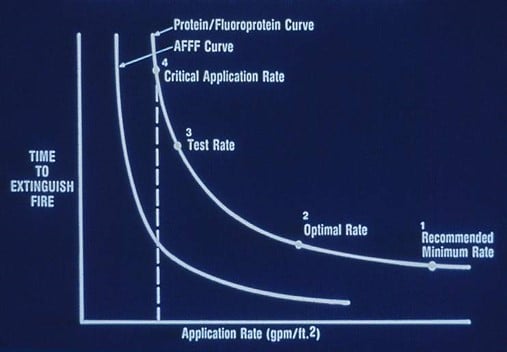
Figure 1 dates back 30 years to when I started in the foam business and illustrates one of the fundamental basics relating to the use of foam, which is there is an amount of foam that must be applied to a Class B fuel fire before it will extinguish. If we then increase the application density the extinguishing time decreases.

Test data over 50 years with PFAS containing foams allowed organisations such as UL, FM and EN to establish test rates and then advise on recommended minimum application rates. It is worth noting that the figure also shows that even 30 years ago we recognised that non film forming foams performed differently to our AFFF’s, FFFP’s and their AR versions.

The figure however still does not address the variables we see in real world missions, but as SFFF is non-film forming it is a reasonable assumption that the curve for an SFFF would be similar to that of the protein/fluoroprotein curve.

Considering the variables that could impact the curves we must start with the foams from different manufacturers and here it could be argued that a test protocol such as EN 1568-3 and EN 1568-4 is a suitable test protocol for this comparison as the only variables involved are the foam concentrate used and the foam qualities achieved with the foam solution through the UNI 86 nozzle.

This is conversely one of the weaknesses with this particular test protocol as the UNI 86 nozzle is a test nozzle and foam qualities achieved with discharge devices used in the field maybe very different, leading to different extinguishing times and reflash protection.

There is a strong argument therefore that different expansion ratios should be considered as part of the EN 1568-3 and EN 1568-4 test protocols, but this variable alone ignores the 25% drain time. Both UL 162 and FM 5130 consider a range of expansion ratio and 25% drain time when testing top side fire performance of a foam, and these must be matches to achieving those foam qualities based the operating parameters of a defined discharge device.

Discharge devices

The link between the foam concentrate and the discharge devices is even stronger when considering standard sprinklers as the discharge device. Here the EN approach is currently to ask the manufacturer for recommendations without giving any additional guidance on what data an end user or specifier should request. UL and FM, and now VdS now have test protocols using the heads that will upon successful testing be approved with the tested foam concentrate.

The impact of different fuels with SFFF’s has been discussed for some time and testing has been carried out by a number of organisations such as NRL, NFPA Research Group, and LASTFIRE. As a result of some of these tests we have already seen from the May 2021 edition of NFPA 5130 that under section 4.2 – Low Expansion Foam Concentrate Extinguishing Performance, within section 4.2.2.3 it states:

“When testing SFFF concentrates, Heptane is considered representative of hydrocarbon liquids with the following characteristics:

  • Flash point equal to, or greater than, Heptane.
  • Vapour pressure equal to, or less than, Heptance
  • Pure liquids (i.e. not blended such as gasoline / alcohol combinations”

Wording in FM approvals has been changed such that approvals now state “heptane” rather than “hydrocarbons”. At Fomtec we see on a weekly basis lists of chemicals being submitted with the questions asked about what application densities should be used for these chemicals. In many cases we just don’t have the test data with those chemicals so are having to advise our clients when what we are responding is “an opinion”.

For emergency response and the fire and rescue services the situation with some many different fuels and different discharge devices does see a tendency to favour use of following an EN 1568-3 and EN 1568-4 based analysis. As stated previously, hand lines are not equipped with UNI 86 test nozzles and typically a foam/water hand line nozzle will generate lower expansion and 25% drain times than that achieved with the test nozzle suggesting that greater application densities (and hence greater flow rates) will be required than should be indicated in the test.

Testing protocols

Operator techniques will also impact firefighting performance. Now test protocol exists to prove this in a quantitative way but the reports from the NFPA Research Group, and the FAA following their evaluation testing of SFFF’s both reported that their test engineers developed different operation techniques and improved extinguishing times.

It is clear from the more than 1500 fire tests that Fomtec has carried out, and supported by test data from third party organisations mentioned that the variables of fuel, foam qualities, application density and operator experience/techniques all contribute to the performance of the foam. Whilst finished foam qualities are partly due to the foam concentrate they are also due to the discharge devices and small changes with the discharge device can have a significant impact on the fire performance of the finished foam.

Extrapolation of data to predict the performance of foam if a variable is changed means giving an opinion and of course as soon as a different product, whether manufactured by Fomtec, or by another manufacturer, is introduced into the evaluation then the potential for a larger error with the opinion is greater.

Returning to our figure of extinguishing time versus application density it is clear that if operational application densities are required we must also take into account how these curves vary when the variables change. Here at Fomtec we are committed to our test programme called “The Enviro Programme” to establish the limits of performance for our SFFF products as the variables are changed, as decisions need to be based on Data, rather than opinions.

Boxout—

The list provided below is NOT exhaustive but the variables more directly relating to the fire performance of the SFFF concentrate are covered:

SFFF Foam Concentrate 
What type of foamSuitable for hydrocarbon fuels or hydrocarbon + water miscible fuels.
Proportioning ratioTypically 1%, 3% or 6% but can be different ratios of foam concentrate to water to generate the foam solution.
Expansion ratio of finished foamSuitable for LOW, MEDIUM or HIGH Expansion finished foam?
International Listings / ApprovalsWhat listings/approvals does the foam hold and are these appropriate for the application/mission.
Testing / Approvals with discharge devicesProvides confirmation that fire performance has been achieved with finished foam produced with the discharge device.
Testing / Approvals with fuels in hazardDifferent fuels even within group types can require different application densities.
Testing / Approvals with type II and type III applicationEmergency response with handlines or monitor response should use foam concentrates with type III listing / approval on hydrocarbon fuels.
Compatibility with dry chemicalLimited data available in impact of dry chemicals onto SFFF foam blankets.
Hardware 
Material compatibilityConsult manufacturers technical data to confirm that storage tanks and transfer pipework etc is suitable for the foam concentrate and solution.
Proportioning equipment compatibilityHas the proportioning equipment been tested / approved with the foam concentrate.
Discharge devicesWhat testing / approvals are available with the foam. Are there constraints on pressures and flow rates?
Operator Related 
Training in use of discharge devices – handline + nozzles, monitorsBest mission performance will require training in the use of equipment with SFFF’s
Knowledge of tested and approved foam qualitiesOptimum performance in manual firefighting will require knowledge of the foam qualities from the discharge devices.

This article was originally published in the January edition of IFSJ. To read your FREE digital copy, click here.

IFSJ Exclusive: Know your viscosity with FIREMIKS

Per Aredal International Sales Director at FIREMIKS AB, sheds light on the proportioning systems suitable for the transition to synthetic fluorine-free foam

During the market transition from AFFF (Aqueous Film Forming Foam) to SFFF (Synthetic Fluorine Free Foam) concentrates it is important to know the viscosity of the SFFF concentrate to choose the right type of proportioner.

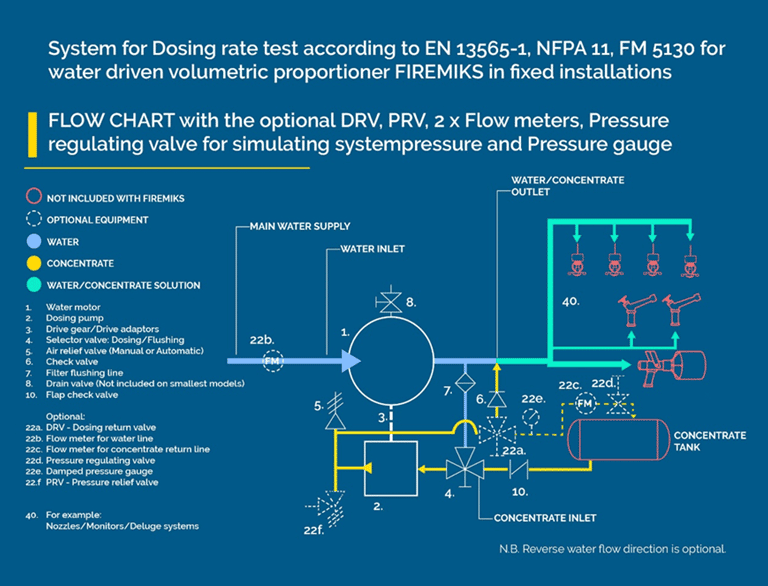
FIREMIKS is a water driven volumetric pump proportioner for firefighting – for fixed installations connected to a concentrate tank with gravity feed to the dosing pump. Extinguishing water drives the volumetric water motor, which in its turn drives the positive displacement pump that doses the correct amount of concentrate in the extinguishing water exiting the water motor.

As the regulatory authorities now are pushing for soonest possible transformation from PFAS-containing concentrates, towards SFFF concentrates, many proportioning systems are re-evaluated to ensure compatibility with the new concentrates. Different concentrate manufacturers offer a variety of foams which comes in a wide range of viscosities, including very high viscous concentrates. To be able to select an appropriate proportioner one needs to know the properties of the concentrate.

FIREMIKS is uniquely positioned to offer two types of dosing pumps, Gear and Piston (plunger), combined with our sturdy multi-vane motor that offers optimal reliability based on +30 years of experience in the market. Among several important factors, besides flows and pressures, we always gather info from the customer regarding the concentrate type and viscosity before we propose which type of pump that will match the customers need.

Proportioners with Gear Pump

Water motor driven pump proportioner equipped with a Gear pump are particularly suited for operating in the higher range of a systems maximum flow rate, such as deluge and large fire monitor systems. They are also most suited for high and very-high viscosity concentrates.

For example, we have with excellent result tested one of our Gear pumps models with a Fluorine-free foam with 8,040 cP (Brookfield Viscometer Spindle #4 at 30 rpm). The reason Gear pumps works well with these very-high viscous concentrates is that they are equipped with counter rotating gears which seals better with high viscosity fluids and creates an even flow that does not agitate the concentrate.

Proportioners with Piston Pump

Water motor driven pump proportioners equipped with Piston (plunger) pumps are on the other hand particularly suited for use in systems with low start-up flows in relation to the systems maximum flow rate, for example sprinkler systems. They are also very suited for low and medium viscosity concentrates.

Important to know is that Piston pumps have a limit upwards to high viscosity concentrates, normally around 4,000-4,500 cP (Brookfield Viscometer Spindle #4 at 30 rpm) due to the Piston pump reciprocating principle; for each revolution, the plunger sucks concentrate and then presses it out and the concentrate goes from zero to full speed twice per revolution in a very tight pump design. If the static viscosity is too high with non-Newtonian concentrates, the concentrate will not flow smoothly and therefor the correct dosing rate might not be achieved.

Important for all systems is that one should ensure that diameter on the foam supply piping is large enough for the concentrate delivery and to avoid longer concentrate lines. Recommendations are specified in our data sheet for each model. We are always available to guide you with more specific recommendations if needed for your specific project.

Verifying dosing rate according to EN 13565-1, NFPA 11 and FM 5130 on water driven volumetric pump proportioners.

To measure and verify the dosing rate on a proportioning system according to regulations and standards, at the commissioning and yearly maintenance, is an important task.  The aim is to ensure that the installed firefighting system proportion the correct amount of the concentrate into the firefighting water flow, as intended and designed.

To be able to easily test and verify the correct proportioning the FIREMIKS unit needs to be equipped with an optional Dosing return valve (DRV) (no 22a.) that directs the concentrate back to tank instead of being induced into the water flow. This allows for testing the system without mixing the concentrate. A Pressure relief valve (PRV), (no 22f.) is included with the DRV to eliminate the risk for over-pressure if return line to tank is closed/blocked by mistake.

Furthermore, one needs to install two calibrated Flow meters; one for main water line (22b.) and one electromagneticflow meter for concentrate return line (22c.), combined with a Pressure regulating valve (or a regular valve which can be partly closed to regulate the backpressure, e.g. globe valve) (22d.) to simulate system pressure, displayed by a Pressure gauge (22e.).

Environmentally and economically beneficial testing system

This described dosing test system ensures that it is possible to practise and test dosing rate without consuming the concentrate. It gives also substantial savings over the years with no cost for cleaning or destruction of dispersed solution after the test. With the growing strict environmental regulations, this advantage has become even more important today.

The accurate way of verifying dosing rate

Verifying dosing rate equals to verifying the correct volumetric function of both the water motor and dosing pump with two independent calibrated flow meters and calculate to this formula, in accordance with EN 13565-1, NFPA 11, FM 5130:

(Concentrate flow) / (Water flow + Concentrate flow ) x 100 = Dosing rate %

Revolution counter method – the limits

The revolution counter method which is also presented on the market assumes the correct working of the water motor, this means it gives only an estimateof water flow.

The is not an approved method to verify dosing rate as described by
EN 13565-1, NFPA 11 and FM 5130, who each require the use of a separate flow meter to measure water flow. Quote from FM Approval guide ref. rpm method: “May be used to provide a general estimate of the extinguish water flow”.

Revolution counting with handheld tachometer

The estimated water flow can also be measured with handheld tachometer (contact or non-contact) to ensure that the unit is not over-speeding, i.e. working within the upper rpm = flow limit specified in the Data sheets of each FIREMIKS model.

Measuring concentrate flow

An alternative method to measure the pumped concentrate is to pass it into a separate container after the pressure regulating valve (22d) and weigh the amount used from the tank during a defined time and then converting it to the corresponding flow rate.

In our experience, magnetic flow meters work well for measuring concentrate flows. Even so, it is even better to be able to establish a known weight or volume of concentrate used in a known time interval, because even approved magnetic flow meters are not tested on all concentrates available.

Handling and monitoring on site or remote

The flow meters, valves and pressure gauge described above can either be handled, monitored and read on site, or connected to remote handling, monitoring and readings. Independently of this – the most important factor is to ensure that data is measured accurately and according to standards to ensure that the installed firefighting system proportions the correct amount of the concentrate into the firefighting water flow.

This article was originally published in the January edition of IFSJ. To read your FREE digital copy, click here.