Patol: origins of the business and plans going forward

The company was founded in 1968 with an original focus on alarm annunciation. Back then Patol was heavily involved in supplying alarm solutions for the shipping industry but building on this experience in alarms and employing engineers with specific knowledge of the fire sector enabled the business to move swiftly into wider applications.

Less than a decade later, in association with Sterling Cables, Patol developed and started the manufacture of linear heat detection cables (LHDC) to offer the opportunity for early detection of fire and overheating in applications where other forms of detection were not viable due to the environmental challenges of a given site or the costs being prohibitive.

In fact, the technology is still used today. And its success is illustrated by the fact that LHDC is still manufactured and sold globally by Patol. In the early days it was quickly adopted as a preferred detection method in the new nuclear power stations that were being built. A notable project was its use in protecting the Thames Barrier when it was constructed in 1985 and it has also been used extensively on the London Underground network, particularly on escalators following the Kings Cross fire in 1987.

The technology involved in developing the original cable was sound and while there have inevitably been innovations over the years, we have always looked to build on this solid foundation. We now offer a range of options: analogue, digital and fibre optic. Recognising the different requirements of applications and the temperatures at which detection is required, we have extended the range to offer temperature ratings from 70°C to 240°C.”

Innovations

We recently introduced FibreSense, a Fibre Optic distributed temperature sensing solution.  The Fibre Optic sensing cable is available in two primary forms, Thermoplastic Tube (TT) and Armoured Tube (AT), with both versions providing cost effective fire detection for a wide range of different applications.  The Thermoplastic Tube cable is suited to many environments including those characterised by high levels of electro-magnetic (EMC) activity. The cable is Flame-Retardant Non-Corrosive (FRNC) and Low Smoke Zero Halogen (LSOH), with a Kevlar strength layer protecting a central structure comprising a gel-filled thermoplastic loose tube.  It measures temperature profiles at thousands of points simultaneously along the length of the cable and, given that it is immune to electro-magnetic interference (EMI), signal quality is unaffected in hostile environments.

Other fire safety solutions

Over the years Patol has also moved into different areas of specialised detection, adding IR Infrared Transit Heat and Flame Sensors, Securiton Aspirating Smoke Detection (ASD), and Vision TIR Thermal Imaging Fire Detection to its portfolio. The company has also expanded its role in international markets, including setting up a dedicated sales operation in India which is actively involved in many markets, including the country’s expanding power generation and industrial applications.

In addition to the power generation sector, Patol solutions are being widely adopted in many diverse projects, from waste recycling and petrochemical sites to car parks, tunnels and the food industry.

This article was originally published in the May edition of IFSJ. To read your FREE digital copy, click here

Certags: Cloud-based assets and equipment management for the fire safety industry

Certags is a leading worldwide supplier of heavy-duty identification, inspection, and certification industrial tags, stickers, and labels. This allows businesses offering fire safety services, in door fire inspections, and fire protection equipment to track their assets while maintaining visibility, compliance, and safety.

Certags clientele is rapidly growing across the UK, Europe, USA, and Australia. The company has been helping industries in various sectors since 2001. The firm has been making serious in roads in oil and gas, fire safety and security, lifting and riggings, construction, scaffolding, height safety, manufacturing, warehousing, shipping, engineering, and the entertainment industry.

Despite its successes both recent and past, Certags is aware of the demands of the modern era with a remote working business model taking more prominence following the pandemic. The company has decided to go digital and has recently launched a cloud-based app called ‘Frame’.

Cloud-based Asset Management

We live in a world of mobile and smart working which prompted Certags take the next step in the evolution of asset management through inspection labels, tags, and stickers by launching Frame, a cloud-based smartphone app that allows businesses to manage assets and equipment remotely with accuracy and efficiency.

Certags’ Frame is a multi-feature software solution that is customizable for your fire safety business needs. Promisingly, you can sync this paperless on-the-go asset management app across multiple devices. This will give you complete control over asset management, registration, and maintenance.

The idea behind Frame is to offer a 360-degree view of all water fire system, fire alarms, foam systems, smoke detectors, fire extinguishers, water sprinklers etc to ensure their safety and optimal performance. This can prevent many fire hazards resulting from equipment malfunction or lack of service.

Allowing users the ability to track the inspection and servicing of all water and fire systems, fire extinguishers, fire alarms and smoke detectors in your facility to ensure that your vital operations stay on track.

The workings

Setting up your cloud-based asset management via Frame involves five-steps: Attach Certags RFID/QR code to your assets and equipment; Scan the tag or QR code using Frame; Identify or create your zones; Identify assets type; and complete the schedules checklist for each equipment or asset.

Once Frame has been set up, the app will automatically update the user with real-time inspection data from any location or area. This data can be accessed from a desktop computer or a smartphone. Frame records the data in an easy-to-understand format with details such as what, where, by whom, and when.

This digital solution can also send schedule reminders so your steam will never miss inspection dates and stay on top of compliance.

Framing the benefits

Apart from the safety, visibility, and compliance, Certags industrial tags, labels, stickers, and cloud-based Frame offers several other perks.

Instant Access to Information: The system replaces the need for a field worker to submit an inspection report manually. Enabling employees promptly record all important data into the Frame app according to your scheduled pre-requisites and checklists.

Reporting: Tagging your smoke alarms, fire safety doors, fire extinguishers, water sprinkler systems along with remote access to their performance and condition allows you a holistic overview of your business’s asset portfolio. From general site reporting to individual KPI management, you will be able to view tailored verified reports of each asset, including forklifts, safety doors, fire extinguishers, etc.

Workflow Enhancements: Lack of visibility can lead to missing inspection dates and your sprinklers, carbon monoxide alarms, fire extinguishers, and smoke alarms breaking down due to inadequate maintenance. This type of failure can cause extended downtime. Certags digital tagging and live monitoring and reporting with Frame app allow you to prevent such incidents and escalate any triggered issues right away.

On-Boarding in the Field: You do not need to wait to register an asset onto your system manually. For example, with Frame, you can get a fire extinguisher onboard on the go. All you need to do is simply onboard a fire extinguisher during a routine inspection. Tag or label the new fire extinguisher and other similar equipment during the inspection, scan the tag with Frame, and your onboarding is complete.

Customisation: Certags can offer a customisable solution to ensure assets safety and management. You can create your own checklists, set schedules as per your needs and pull reports with information that you need.

The best part is that all authorised personnel will simultaneously access real-time data and reports. This avoids any incidents caused due to misunderstanding, lack of communication or transparency in sharing information.

Existing software solutions claiming to offer labels and tags for asset management lack efficiency, accuracy, and real-time reporting. That is why Certags decided to take the lead and bridge the gap with a cloud-based solution. Frame app does not require you to be a tech-savvy person. Anyone can operate Certags’ Frame app without the need to hire an IT specialist or Team.

Certags provide end-to-end support throughout the installation and integration process of Frame into your existing infrastructure. The company can also provide staff training in as little as 2 weeks’ time. This will allow your engineers and technical staff to get back to work right away.

The verdict

Fire safety is one of the largest areas of concern for most businesses, especially if operating in fire safety, building security, housing association and facility management sector.

The last couple of years have forced various sectors to adopt modern technology to gain a competitive edge. Therefore, Certags also took a leap and became a cloud-based solution provider for fire safety solutions for asset management.

Due to its impeccable reputation in the industry, businesses are already signing up to utilise Frame for all the benefits it has to offer and more.  If you are interested, please feel free to contact Certags on www.certags.co.uk/contact-us/ and speak to one of our team members.

This article was originally published in the May edition of IFSJ. To read your FREE digital copy, click here

Expert Insight: Fire protection DNA

Erik Boyter, CEO, WindowMaster and Ian King COO Zeroignition explore importance of a robust fire protection built into the DNA of every building

Smoke control systems should be built, certified and delivered in a way that building owners and occupiers can depend on.

It’s vitally important to recognise that only certified components of the system should be used. For example, smoke panels proven, factory built and certified to the relevant parts of EN12101 and other relevant standards like ISO21927-9.

A factory-based quality system or factory production control, audited by a notified body, should be used to certify components of factory-built products.

Consistency is key. Systematic checks of components, arrangement, fabrication and build in a controlled environment is the only appropriate route to prevent any variations in build from what has been tested and allowed to be certified. This helps ensure dependability as designed, and will enable the supplier to produce a product specific declaration of performance at point of manufacture.

System install and commissioning should be conducted and completed by an appropriate party qualified and competent to do so. This might be demonstrated through voluntary certification such as the SDI 19 scheme.

Finally, the building owner or manager is responsible for ensuring that the system remains compliant through a systematic approach to testing and maintenance.

It cannot be emphasised enough for life safety systems: compliant systems must exist and be documented throughout the design, manufacture and delivery process, as well as through the life of the building.

We’ve looked at smoke control systems, but of course fire safety also encompasses general building materials. While it is important to understand and use FR products in all building specification, it is also crucial we consider the wider system. Ian King, COO, Zeroignition, takes us through the importance of a systematic approach to fire safety.

The Grenfell tragedy was a catalyst for change in the construction industry. It marked the realisation that much more needs to be done to ensure the buildings we live in are properly equipped to protect occupants from the risk of fire and that safety must be put first, above all else.

As the Building Safety Bill continues to make its way through Parliament, albeit slowly, discussions around cladding continue to dominate headlines pushing fire safety even higher on the priorities list. Yet as we’ve seen, the pace of the bill has re-affirmed how notoriously complex fire safety compliance is in the UK.

In reality, we must remember the Bill will be unlikely to eradicate some of the wider issues that the industry struggles with, namely, cost and more recently the availability of materials. Add to this the lack of construction product testing facilities, which are key to the ‘levelling up’ of standards and quality. The Local Government Association (LGA) is one example, encouraging more reliable testing systems that are also more user friendly. It also wants to see businesses caught selling products that aren’t fit for market, held accountable. “The new regulator must have real powers and sanctions and the regulatory system must be properly funded,” says the organisation. “Trading Standards authorities have found themselves caught between costly and complex arguments between test labs about the correct approach to testing, with no way to resolve them.”

At Zeroignition, we agree with this sentiment. Since our founding, Zeroignition has been keen to see a vast improvement in accurate labelling by product manufacturers, ensuring that any information provided is easy to understand and identify, so that materials specified to construct buildings are what they say they are. Without this clear guidance, change will never materialise and people and properties will remain inadequately protected from fire.

Disrupting traditions

There’s no denying, construction projects are incredibly complex and involve a myriad of decisions. Every specification choice has a knock-on effect to the wider build, and unforeseen results can easily arise when a systematic approach to fire protection isn’t maintained.

Although it’s widely agreed by industry professionals that a methodical approach is the key to quality, there’s clearly some scepticism as to how to achieve this. Manufacturers, specifiers and architectural bodies must do more to ensure best practice is fully established and abided by, on every single project, without fail.

Beyond this, the construction industry should look to other industries for guidance, such as automotive and aviation, where a checklist approach reduces the risk of harm to passengers. It’s no longer good enough to work from memory or from a notepad and pen. Digital record keeping is now necessary to ensure certain fire planning elements aren’t being missed.

Beyond this, we need to look to the latest in communications theory and decision making to ensure that fire communications are presented in a way that sticks, and use ‘nudge theory’ to ensure that it’s easier to do the right thing.

Investing in robust knowledge

We know that in-depth knowledge surrounding product safety standards is essential for architecture, specification and construction professionals. Those working in the industry must be sure they have the knowledge and understanding of fire safety when specifying building projects.

It’s an area we investigated for ourselves, post-Grenfell, and the results reveal just how serious knowledge gaps around fire safety remain in the industry. The survey was conducted across the UK, Germany and France and of those questioned, just 3% of architects were able to correctly define the four basic fire protection terms: active fire protection, passive fire protection, fire resistance and reaction to fire.

A mere 2% of the architects interviewed said they’d received comprehensive fire protection training. While most agreed they had had some sort of training, less than one in ten (8%) said they’ve never had fire protection training. These findings reveal an urgent need for serious upskilling to ensure those building liveable structures are well informed and up to speed on the essential fire safety requirements and protocols.

A third of architects who participated in the study also revealed that their current employer doesn’t spend enough on fire protection training, and it seems since the outbreak of COVID-19 particularly, many have taken matters into their own hands. NBS (formerly National Building Specification) says it saw a marked increase in webinar attendance, as more people were working remotely and had the time to attend digital webinars and seminars without having to build time into their day to travel to and from the training venue. Online webinars covered a variety of different topics including fire safety, and were attended by product manufacturers, as well as architects and specifiers.

Positive change

The digital ‘revolution’ of the construction industry is also enforcing positive change. ‘Digital footprints’ which explicitly show that work has been carried out to the appropriate standard are now essential. A further take up of this approach will no doubt help to implement watertight fire safety checks before a building is handed over to the occupant or end user.

Discussions had with manufacturers we work with, have also shown first-hand how an increased focus on R&D projects is now taking place. Advancements in innovative materials that help boost fire safety are now coming to market for added protection on new and existing building projects.

Given what we’ve seen, fire protection now needs to be given the attention it deserves and a uniformed, robust framework needs to be set in place to make sure consistency is achieved across the sector. Increased levels of third-party testing is another area that needs to improve and a greater understand of how components work in tandem will be a key element in improving fire safety within construction.

Manufacturers also have a role to play. Specifiers need to have complete confidence in the products they are recommending which means product information must be up to date and accurate. Until we address the focus on quality vs cost, we’ll never achieve construction’s primary role: ensuring its occupants remain safe. 

This article was originally published in the May edition of IFSJ. To read your FREE digital copy, click here

Detection: Evolving to meet the UL 7th edition standard

Underwriters Laboratories (UL) have introduced challenging new requirements for smoke detectors. Apollo have responded by building the most solid, stable, and dependable fire detector yet based on our decades of experience and innovation in fire detection.

The Challenge

We know that one of the biggest challenges our customers face is false alarms. UL know this too, and through research conducted by National Institute of Standards and Technology (NIST) have introduced new requirements on smoke detector manufacturers, like us, to reduce the risk of false alarms. At the same time, UL have responded to the evolution of construction methods and materials that can change how fire behaves in a building. This has led to the introduction of a new fire test that requires faster and earlier detection of flaming fires than ever before.

Solution

We like to get the basics right. To Apollo this starts with the performance characteristics of the smoke sensors.

An optical smoke sensor must be protected from stray light, dust, and insects. These roles are all fulfilled by the enclosure, which we call the optical chamber. Whilst blocking these potential nuisances, the chamber must freely admit smoke allowing it to be measured by the optical sensor. A surprising amount of fluid-dynamics know-how is required to achieve this; since smoke from a fire tends to move relatively slowly with little energy to push it along. This has led to the unique chamber design of Soteria UL that collects smoke form the outer edges of the detector, removing any impediment to airflow, and achieving a particularly fast detection of fires without airflow delays.

Smouldering fires, in particular, tend to generate vast amounts of smoke, but due to the lack of heat in the fire, that smoke doesn’t have the energy to reach the optical chamber; and this problem worsens when the stack effect is introduced. Stack effect is when tiny pressure differentials, between ceiling cavity and a room, cause clean air from the ceiling to be forced through a detector and out of the smoke inlet, preventing smoke from a room fire entering the detector.

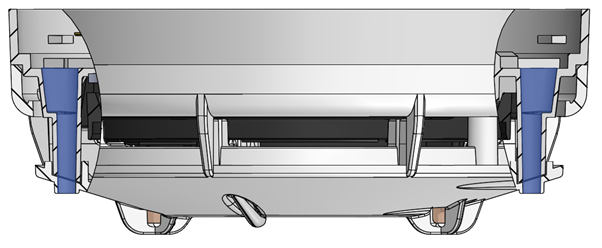
Soteria UL overcomes this issue through its patented vent design. These vents allow pressure differentials to be exhausted through a carefully positioned hole in the lid, so that is does not impede the flow of smoke into the smoke inlet or deeper into the optical chamber. Further, the vents allow any condensation that may occur in the cavity behind the detector, or in cable conduits, to escape without harm.

The drains, highlighted in blue, allow water and air to pass from the rear of the detector without affecting the smoke entry paths.

An often-overlooked characteristic of smoke sensors is their ability to operate uniformly no matter which direction the smoke is coming from. UL test detectors for this parameter in four different orientations and allows a variation of +/-50%. To ensure the most stable operation, we exceed this requirement and measure our detector at 360 orientations and achieve a variation of less than 10%/ft.

Why should a user care that Soteria UL’s directionality is so good? Well, if we had just one angle that was less receptive than others, then we would be forced to increase the overall sensitivity of the detector to ensure it can detect fire when tested in the poor orientation. By avoiding this pitfall, we can offer a detector with a perfectly balanced sensitivity.

Once smoke gets into the chamber, then it’s the job of the optical sensor to measure it, whilst discounting false readings from any foreign materials. The optical sensor consists of an industrially rated InfraRed (IR) light source. When smoke is present, light is scattered onto the light sensor. This sensor is a highly integrated Application Specific Integrated Circuit (ASIC), custom to Apollo, that combines the light sensitive element and electronic amplification.

Smoke is an aerosol – a mixture of air and tiny smoke particles. Because these tiny particles are similar in size to the wavelength of IR light, then they send that light scattering off in many directions via a quantum mechanical process that is described by Mie theory. Smoke from fires have precise characteristics; for example, it tends to scatter most light in the forward direction, rather than ‘reflecting’ it backwards.

We use this knowledge in the design of our optics, positioning the smoke sensor so it is more sensitive to the angles of scattering smoke, than the pattern of aerosols produced by cooking, for example. This is achieved with our unique patented optical sensor design.

The next nuisance that might trick our sensor is dust and insects. Traditional detectors suffer from the IR light source illuminating parts of the optical chamber, rather than just the scattering region in front of the light sensor. Because the light sensor is looking for only a tiny quantity of light to be scattered by smoke, then it can easily be fooled by light reflecting off chamber walls when dust or insects are present in the chamber.

Our first line of defence is stopping such things getting into the chamber. The Soteria UL uses a unique serpentine air inlet to prevent the ingress of dust. A fine nylon mesh prevents insects over a certain size from entering the chamber, but not all can be stopped is we still wish smoke to enter the chamber. Instead, we design the chamber to be robust to these smaller insects and accumulation of dust.

Firstly, a unique patented light absorbing surface of the chamber prevents the IR light being reflected around the chamber. This means that dust and insects on other surfaces of the chamber are less illuminated. Secondly, and this step takes some effort, all possible surfaces where an insect could stand and spread its wings, whilst being in the view of the light sensor, are eliminated. That means that even when an insect smaller than the screen finds its way into the chamber, it is very unlikely to be able to cause a false alarm. The same advantage is experienced when dust accumulates inside the chamber – there are no surfaces where dust can gather to cause stray light and trigger a false alarm.

And it’s not just our lab that this high performance is achieved. Every Soteria UL detector is produced and certified to conform to the same narrow range of sensitivity. This means that every product you install will behave the same as the last, it will not be more sensitive to common nuisances, or less sensitive to the attributes of fire. This is achieved in our factory with a blend of skilled hand assembly and highly automated modern manufacturing processes. Every single product is measured and calibrated for smoke sensitivity.

Once we have crafted the best smoke sensor, our next focus is the intelligent signal processing that determines when there is a real fire. Because the basics are right, we don’t need a highly complex, unpredictable, and opaque artificial intelligence algorithm. We simply add the right amount of smoothing, the right amount of delay, and a little enhanced detection of fast flaming fires. False alarms are avoided, not only by getting the basic smoke sensor right, but by reducing the response to slowly developing nuisance signals like cooking. The detector is constantly processing information, and if it decides there’s a fire, this is signalled to the panel via Core-Protocol with exceptional speed.

Keeping you safe from fire, every second of every day.

For more information on Soteria UL, Apollo’s 268 7th edition solution, contact enquries@apollo-fire.com or visit www.apollo-fire.co.uk/

This article was originally published in the May edition of IFSJ. To read your FREE digital copy, click here

PBI: Pushing the boundaries of fire protective clothing

Exclusive: Fabrics and materials manufacturer PBI has been pushing the boundary with its latest trademark innovation PBI LP, Ian Callaghan, Senior Director, International Marketing and Sales, PBI International tells us more

PBI is at the forefront of incredible innovation in the development of fabrics that protect firefighters against heat and flame, but are also lightweight and breathable, reducing the risk of heat stress.

The company’s range of fabrics have become the preferred choice of fire services all over the world. From USA and Europe, the Middle East to the Far East and Australasia, firefighters go to work every day protected by PBI outer fabrics.

Choosing to work with only the best fabric manufacturers in the supply chain ensures that every PBI product performs to the highest levels required in modern firefighting and rescue. The company’s close working relationship with its supply chains is a key factor in the continued investment in research and innovation which results in products that set new standards in comfort and performance. It has driven the development of an extensive range of structural firefighting outer shells designed specifically for the different needs of fire services.

The company’s product portfolio was recently expanded with the addition of, PBI LP, a trademark lightweight fibre that further enhances comfort, breathability and freedom of movement for future structural firefighting gear. 

Fabric made with PBI LP, which stands for ‘lightweight performance’, is 10% lighter than other outer fabrics for structural fire gear, helping to reduce the risk of heat stress.  Even though the unique PBI LP™ is lighter, it still enhances heat and flame protection and resistance to break open, without compromise.

The new lighter fibre performs incredibly well when used in outer shell fabrics, even when tested against other heavier para-aramid and meta-aramid outer shells. In independent test undertaken by BTTG in the same conditions the 180 gsm PBI LP garment outperformed an identical garment made with 220 gsm meta-aramid outer fabric. An eight second burn test was undertaken on the 2006 version of the male heat sensing manikin known as RALPH, which was developed by BTTG and conforms to ISO 13506.  For the test the hands and head were not used, leaving 123 sensors on torso, arms, legs that monitor the temperature on the surface of the manikin during the test.

The BTTG tests showed 2nd and 3rd degree burn injury prediction of only 1.8% for the garment with lighter PBI LP™, compared to a much higher figure of 19.3% burn injury for the meta-aramid, despite the meta-aramid also being 40gsm heavier.

Like all PBI fabrics, PBI LP delivers excellent tensile strength and will not become brittle, shrink, or break open when exposed to flame and high temperatures. This means that the integrity of the internal layers of the garment is protected, and the transfer of any radiant heat is slower, allowing more time for firefighters to escape to safety in a situation such as a flashover. PBI’s protection from exposure to heat and flame has been proven over many years of independent testing and performance in the field.

In a Dynamic Flame Test, which is used to demonstrate the time it takes for an outer fabric to breaks down under tension, PBI LP of 180g/m2 lasted 48 seconds, while a much heavier 220/ g/m2 Para-aramid/Meta-aramid fabric lasted just 3 seconds. 

PBI LP fabric is a result of PBI’s continued investment in research and development that creates new standards of firefighter protection.  That development process must always take account of the balance between comfort and protection.  That is why outer shells made with PBI LP join a wide range of PBI fabrics that meet the need of every situation and work effectively as an integral part of all garment design. Each product has different properties and applications, but every PBI fabric exceeds the required protection standards from heat and flame for outer fabrics.

PBI’s continued commitment to innovation and new product development is not restricted to structural firefighting solutions. Working closely with the supply chain, PBI has also developed a range of lightweight protective fabrics with increased tensile strength that is designed specifically for technical rescue, wildland and industrial firefighting. 

One of the biggest challenges to firefighter safety is the risk posed by heat stress.  It can cause many problems, from muscle fatigue and reduced cognitive function to cardiovascular strain and cardiac arrest.  Research has shown that more firefighters dies in the line of duty from cardiac arrest than any other cause. One of the paradoxes of firefighter protection is that structural firefighting garments designed to protect the wearer from heat and flame can potentially contribute to the rise in core body temperature that triggers heat stress. That’s why it is so important that the outer shell, which has a primary role of protecting from heat and flame, is designed to mitigate the risk of heat stress.

All PBI fabrics are designed to offer maximum thermal protection from the outside, while at the same time delivering high levels of breathability and comfort to reduce the risk of heat stress. They will not become brittle, shrink or break open when exposed to flame and high temperatures, which is among the characteristics of other fabrics. This means that the integrity of the internal layers of the garment is protected and the transfer of any radiant heat is slower, allowing more time for firefighters to escape to safety in a situation such as a flashover.

In the 40 years since opening for business in Charlotte, North Carolina, PBI Performance Products has created a reputation for protection without compromise that is recognised all over the world.

This article was originally published in the May edition of IFSJ. To read your FREE digital copy, click here

UK Government introduces ‘majority’ of Grenfell inquiry recommendations

The UK government has announced that The Fire Safety (England) Regulations 2022 will implement the majority of the recommendations made by the Grenfell Tower Inquiry in its Phase 1 report, which required a change in the law.

The regulations seek to improve the fire safety of blocks of flats in ways which are practical, cost effective for individual leaseholders and proportionate to the risk of fire and will come into force on 23 January 2023 following the publication of supporting guidance which is due later in 2022.

The regulations will make it a legal requirement for responsible persons – that is a building owner, or in residential properties, any other person in control of the premises – of high-rise blocks of flats to provide information to Fire and Rescue Services to assist them to plan and, if needed, provide an effective operational response. These regulations will apply to existing buildings. Requirements for new buildings may be different.

In high-rise residential buildings, responsible persons will be required to

  • Provide building plans to their local Fire and Rescue service with up-to-date electronic building floor plans and to place a hard copy of these plans.
  • Provide to their local Fire and Rescue Service information about the design and materials of a high-rise building’s external wall system and to inform the Fire and Rescue Service of any material changes to these walls.
  • Undertake monthly checks on the operation of lifts intended for use by firefighters, and evacuation lifts in their building and check the functionality of other key pieces of firefighting equipment.
  • Install and maintain a secure information box in their building containing the name and contact details of the Responsible Person and hard copies of the building floor plans.
  • Install signage visible in low light or smoky conditions that identifies flat and floor numbers in the stairwells of relevant buildings.

In residential buildings with storeys over 11 metres in height, responsible persons will be required to undertake annual checks of flat entrance doors and quarterly checks of all fire doors in the common parts.

In all multi-occupied residential buildings with two or more sets of domestic premises, responsible persons will be required to provide relevant fire safety instructions to their residents, which will include instructions on how to report a fire and any other instruction which sets out what a resident must do once a fire has occurred, and provide residents with information relating to the importance of fire doors in fire safety.

On whether these regulations are a proportionate response, the government guidance stated: “These regulations, where they legislate to require responsible persons to provide information to fire and rescue services focus only on high-rise residential buildings. This approach is a proportionate one which implements the majority of the Phase 1 recommendations, which require a change in the law, in a practical way.”

Commenting on the government’s plans, Grenfell United said: “We are enraged at the government, whose sole focus continues to be profit and not public safety. We’ve fought for years to create a legacy for our 72 loved ones, and to prevent another Grenfell. But five years on, the government has reverted back to the same policy in place before Grenfell.

“This policy resulted in 41% of those living with disabilities dying at Grenfell. It left them with no personal evacuation plan and no means of escape. They didn’t stand a chance. This report is a disgrace.

“Disabled people have the right to leave their homes safely. The government must implement the recommendation from the Phase 1 report of the Grenfell Inquiry and ensure personal evacuation plans for disabled residents.”

NFCC launches tools to support fire and rescue services

National Fire Chiefs Council’s (NFCC) People Programme has launched four new tools to support fire and rescue services in the selection, recruitment, nurturing and growth of diverse talent. 

The Equality, Diversity and Inclusion Hub, Recruitment Hub, Talent Management Toolkit and Coaching and Mentoring Portal have been put together as the culmination of months work by the NFCC project teams and colleagues from across the fire and rescue sector. 

Each tool champions best practice processes, showcasing sector-endorsed guidance to provide a consistent approach at a national level.  

The Equality, Diversity and Inclusion (EDI) Hub contains a of resources to help services ensure that equality, diversity and inclusion are part of everything they do.  

The Recruitment Hub is a centralised resource for colleagues finding and bringing in diverse talent.  

The Talent Management Toolkit has been developed to provide support to fire and rescue services around the key talent management areas: attract, identify, develop, engage, retain, deploy, and evaluate.

And the Coaching and Mentoring Portal allows a continuation of learning and connects individuals with coaches and mentors from within the sector.   

Ann Millington, People Programme Executive said: “I am immensely proud of the work by members of the People Programme in conjunction with fire and rescue services, and the resulting four products.  

“These products signify another significant leap forward by the NFCC in supporting the people already working in, and those yet to join, this exciting and dynamic sector.” 

The toolkits can be found on the UKFRS website.

North American Firefighters prepare for worsening fire forecast

Nearly 3,000 firefighters in North America are preparing for a worsening fire forecast in the days ahead as the country’s largest wildfire reached a temporary standstill in northern Mexico on Tuesday night due to light rain and snow in the mountains

The ongoing wildfire burning for in New Mexico has become the largest in the Southwestern state’s recorded history and it forced the evacuation of a small ski resort and villages in drought-hit mountains east of Santa Fe.

Fire officials in New Mexico said they planned to continue to clear flammable vegetation and deploy aircraft to douse smoldering forests before windier, hotter, drier conditions return this weekend.

Forest Service fire behavior analyst Stewart Turner predicted that by Friday: “Fire weather starts to enter the critical stage where we’ll probably see more growth and fire moving.”

Controlled burns put on hold

The U.S. Forest Service (USFS) on Friday called a temporary nationwide halt to controlled burns meant to reduce fire risk after the agency accidentally started part of New Mexico’s largest ever wildfire, having burned over 300,000 acres (123,000 hectares), destroyed up to 1,500 properties and displaced tens of thousands of people.

Forest Service Chief Randy Moore said fire danger levels were too high to use prescribed fire and ordered a 90-day review of policies before operations planned for this fall.

“Lessons learned and any resulting program improvements will be in place prior to resuming prescribed burning,” Moore said in a statement.

So far this year, wildland fires have burned across roughly 2,650 square miles (6,860 square kilometers) of the U – roughly twice the average burn for this time of year, according to a national center for coordinating wildfire suppression.

UK parliament could burn down ‘any day’ says former minister

Andrea Leadsome, former minister and current Member of Parliament for South Northamptonshire, has urged her fellow MPs to ‘get on’ with the renovation of the Parliament building to prevent at fire similar to that seen by the Notre-Dame cathedral in Paris in 2019.

In 2019, MPs voted to set up a sponsor body with responsibility for the restoration of the building. A review produced by the body put the basic costs of essential repairs between £7 billion and £13 billion and estimated they would take between 19 and 28 years to complete – or 12 to 20 years if the building was fully vacated.

Some politicians have expressed concern about moving out amid plans to relocate to Richmond House in central London were vetoed, despite the body claiming that costs would increase by 40% if politicians stayed put.

Speaking to Radio 4’s Week in Westminster programme, Leadsom said a fire of the scale seen by Notre-Dame could happen in Parliament, adding that a fire in 2017 was only averted because of the presence of the 24/7 fire patrol.

“That is so ‘there but for the grace of God’,” she said. “It could burn down today, tomorrow, any day and we’ve got to make that decision and get on with it.”

NFPA issues guidance on Sprinkler usage

The National Fire Protection Association (NFPA) has issued guidance on best practice for sprinkler systems following National Sprinkler Week which took place from 16-22nd of May.

Today NFPA 13E – the ‘Standard for the Installation of Sprinkler Systems – provides the information necessary to ensure fire departments are trained on and operate effectively with automatic fire sprinkler systems.

The guidance document explains that although some fire sprinkler systems are designed to suppress a fire, most are designed to control a fire. The main difference between fire control and fire suppression is related to the fire sprinkler systems impact on the fires heat release rate. 

The three principal causes of fire sprinkler system failures identified in NFPA 13E are a closed control valve, inadequate water supply for the system and occupancy changes that render the installed system unsuitable.

Beyond the primary causes found in the recommended practice, NFPA has conducted research on the U.S. Experience with Fire Sprinklers to help understand fire sprinkler effectiveness. 

The NFPA said that familiarisation with the types of control valves and their layout in a system will allow firefighters to both understand what valves will disrupt water flow and what position have they should be in for effective operation. 

If firefighters encounter a valve which is not in the correct position during a fire, placing that valve in the correct position may restore the system effectiveness.

Additionally, fire departments should never turn off a sprinkler system that has activated until they have confirmed the fire is fully extinguished and overhaul has taken place, and noted that simply turning the system back on may not reestablish fire control.

On water supply, it said it may be inadequate due to a lack of available water flow, lack of available pressure or both, and since fire department pumpers often have the capacity to supply water at higher flow rates and pressures than the normal water supply, utilising a fire department pumper to supply water to the fire department connection (FDC) can address most inadequate supply concerns. 

On occupancy changes, it said that although the fire department does not have an ability to impact occupancy changes during a fire incident, an effective pre-plan and inspection program has the potential to identify occupancy changes which can adversely impact fire sprinkler system effectiveness before fires occur.

It advised training those conducting these inspections to understand what types of commodities would represent a high heat release rate fire and how to identify if a sprinkler system could be designed to deliver the necessary water density can reduce this potential cause of failure.

It concluded by saying: “As with all NFPA recommended practices, the language is less rigid than a standard or code, utilising “should” instead of “shall” as to not limit the individual fire departments, allowing them to adopt more effective procedures.

“Familiarisation with NFPA 13E provides anyone who may be utilising a fire sprinkler system the knowledge necessary to positively impact the systems effectiveness.