JOIFF to host webinar on large-scale NFF fire testing

JOIFF is to host a webinar on Non-Fluorinated Firefighting (NFF) Foam Large Scale Testing For Tank Fire Applications on 19 April 2023 at 3pm.

Attendess will learn about: Large-scale Non-Fluorinated Foam (NFF) fire testing procedures and data and correlation of fire testing results to industrial tank firefighting based on historical data and firefighting expertise.

The webinar will also review the 3 stages for tank fire extinguishment success with NFF: achieve 90% control, specific NFF tactics to achieve full extinguishment, and post suppression actions.

Speaking at the webinar are Eric Lavergne. Petroleum, Oil & Gas Vertical Manager for Foam Products at Johnson Controls, Inc, and Dewey Morrison, Business Development Manager for Foam Products at Johnson Controls, Inc.

To register for the online event visit the event page.

IFSJ Exclusive: Data over opinion with Fomtec

John Ottesen, CEO and Founder of Dafo Fomtec AB, sits down with IFSJ Editor Iain Hoey to talk about his life, his company and why the fluorine-free foam pioneer is focused on a data-driven approach

Fomtec has been around for 22 years – can you tell me about your background in the firefighting foam industry and what led to the founding of the company?

I’ve been in the industry for 30 years now. I started my career in the fire industry at Tyco back in Norway in the early 1990s. I spent almost 10 years at the company in various positions, but everything I did related to foam – that is how I became connected to the foam industry.

I found that there is a lot of good things about working in a corporate environment, but I thought there might be an opening for more agile customer-focused company, where decisions could be made more dynamically and quickly and with strong customer focus – that is how the idea for Fomtec came to life.

Going back to 2000 something big happened in the industry – 3M exited the foam market, leaving a significant gap. This was a natural opening for how we came to enter the market, and I have now spent 22 years at the helm of Fomtec.

What were your initial plans and goals for Fomtec back in 2001? Has this changed in the intervening years?

I wanted Fomtec to be an agile, customer-focused, and innovative company. It was about creating the marriage of the product focus and the customer focus: putting the product in perspective as to how it is being used in the system.

We are a fire protection company that makes foam concentrates and hardware, not a chemical company blending a product. The idea I had was to be strongly customer and product-focused and offer in-depth insights into how our products are being deployed in a holistic approach.

My overarching goal was to have the company playing in the ‘Premier League’. You never know when you start something where it will end, but my ambition was always to be coming to a point where we have that kind of position in the market.

The industry has in many ways stayed the same, but there have been many changes over the past couple of decades. When I started back in 2001 and you looked at the UL listings – which is very important in our industry – there were only a small handful of companies with UL-approved products. Today there are many, so in that way, it has become very competitive on the approved-products side of things

After the PFAS story started when 3M exited the sector, the forever chemicals narrative has been impacting our industry ever since and has been strengthening our ambitions year on year to the point where in 2023 we are standing in front of a major phase-out of PFAS products.

How has the industry changed over the course of Fomtec’s lifespan?

Even though we had the internet and emails back in 2001, the internet is today very different from what it was, whether that’s marketing, finding customers, or even down how you deal with people online – it has changed the way we conduct our business. The mediums that we use to communicate and the role the internet plays in how we are visible to the market is a huge transition.

On the chemistry side, obviously, the impact of PFAS restrictions is big. This forces the industry into product development and innovation, it brings in new players into the market, and it challenges us in all aspects of what we do.

Product-wise there have not been any huge changes to the systems. The only thing that has really grown over the years, apart from the chemistry, is CAFS [Compressed Air Foam Systems] has become more of a product than it was back in the day. It was not a big thing back in the early 2000s, but now it has become something more significant. Other than that, it is pretty much the same except for the conditions which are around us. It can be a very volatile market from time to time, just as we are experiencing right now.

What are the biggest milestones/achievements for you and the company to date?

When we set out to do this, I wanted to play ‘Premier League’ when it comes to being one of the top companies in the world when it comes to product offerings and approvals and our overall position. I must say that when we got our first FM approval in 2007 it was a huge thing for me because FM does not approve products, it approves systems. Fomtec is not just a product offering, it is a system – that was a big thing that really lifted the position of the company.

The next big milestone for me was when we got our Military Specification (MIL-SPEC) in 2014 –  there are very few companies on the Qualified Products List (QPL) for the American military, and that was a hugely significant step for Fomtec. At the same time, we made a very smooth transition to C6 – we finished with the transition to C6 in 2014, which I’m proud of.

C6 is short for Short-chain fluorochemistry, and the move from long-chain (C8) chemistry to short-chain (C6) fluorochemistry was a big push by our industry to take steps to introduce more environmentally responsible chemistry. The industry had a voluntary deadline of January 2015 to make this transition from C8 to C6. These days C6 is being regulated as well, and that leads to the transition away from fluorochemistry (PFAS) altogether.

The thing that I’m most proud of is that we were the first company to bring an FM-approved fluorine-free sprinkler foam suitable for both hydrocarbon and polar solvent fires to the market. Being the first to introduce something to the market, to me, stands out as a fantastic achievement.

Those are my three – if you look at it, it’s 2007, 2014, and 2021 – it’s a seven-year cycle between these things.

We’ll have to check back in 2028 to see what you’ve done next!

That was my thinking too.

What is the current focus for Fomtec for the years ahead? What do you foresee being the main focus for yourself and the company?

It’s all about innovation now. It’s really important to be innovative and to continue to drive innovation at this time. We want to bring first-class products to the market. In the way we conduct our business and our innovation, what we talk about is to inspire the industry to focus on data, not opinion.

This transition [to fluorine free foam] is a major technological change and it affects not only the concentrate, but the whole system and the way the products are being used. We who take part in this early transition carry quite a heavy burden because we are setting the stage for what this is going to be. Is the future of foam going to be based on data and facts or are we going to take a short cut by making assumptions based on old truths?

In future generations, when people 10-20 years from now base their system designs and approach to fire protection, they’re going to look back at what was done in the early transition, just as we did. We have relied on the PFAS and testing that was carried out in the 70s and 80s – these we know now are old truths. We are making the new truths, and it is really important for us to do that in the correct way. That is the main focus for us now: to base everything on data, not opinion, to be innovative, and to continue being customer focused, which is key.

This is what I do. I have been doing it for my whole career, and for me, it is about carrying on what I have done and trying to keep that spirit we have had from the very beginning – to be customer focused, innovative, and never lose sight of where we started.

Has the response to your approach been positive?

I think so – I cannot speak for others in the industry, only for us, but it is a commitment to say data not opinion, because it puts a lot of responsibility on our shoulders. We have to really generate data and stick to data, and sometimes that is a heavy burden – you can do something wrong out of ignorance because you really do not have data, but if you do know and you still take the shortcut then that is a heavy responsibility. Our approach has been well received, and customers and users appreciate that, but it comes at a cost – it is not for free.

You have been in foam for most of your career – if you were not doing this, what do you think you would be doing instead?

That is a difficult question because you never know where you’ll wind up! Often it is a pure coincidence, and I think in my case it was a coincidence winding up in the fire industry altogether. But I have always said that if I was not making foam, I would be brewing beer.

Do you have any word of advice/wisdom for the readers of IFSJ?

I just want to reiterate that what Fomtec is all about these days which is: data not opinion. That is really key for the audience and everyone involved in foam and fire systems – that their design and approach to fire protection is data not opinion. It is really important. Fire systems, for most users, are an overhead – it does not contribute to the bottom line of the company who buys the system – but the day it needs to work, it definitively needs to work, which is why the data is absolutely critical. That is my wisdom to share: base your decisions on data not opinions.

This article was originally published in the March edition of IFSJ. To read your FREE digital copy, click here.

SFPE publishes report on environmental health impacts of fire suppression

The SFPE Foundation has announced the conclusion of its research project and the publication of a report on the environmental and health impacts of fire and fire-suppression activities during large-scale fire events.

Led by Jamie L. McAllister, P.E., Ph.D., Brendan McCarrick, P.E., Zelda Q. Zhao, and Curtis Fagan, the primary objective of this research project was to characterise the environmental and health impacts of wildland and structural, large-scale fire events.

The work included a literature review of large-scale fire incidents, identification of current large-scale incident impact monitoring capabilities, identification of standards and industry best practices for quantification of large-scale incident impacts, and a gap analysis.

The findings have been published in the free report titled “Environmental and Health Impacts of Fire and Fire-Suppression Activities During Large-Scale Fire Events“,

On March 16, 2023, the SFPE Foundation is hosting a webinar to review findings of the research, the gap analysis, and future work recommendations. Learn more and sign up at sfpe.org.

Leslie Marshall, Ph.D., Director, SFPE Foundation said: “This research provides foundational insight while highlighting the need for the fire engineering community to align research efforts and collaborate with a diverse array of stakeholders to advance our understanding of the impacts of fire and fire suppression activities during large-scale events.

“The SFPE Foundation remains committed to advancing the science of resilience, sustainability, and fires in the wildland-urban interface, as prioritized in the SFPE Research Roadmap.”

Early detection is key to prevent EV fires on ships says Survitec

Following several high-profile ship fires involving electric vehicles (EVs), leading Survival Technology solutions provider Survitec has advised operators of vessels transporting hybrid and EVs – such as ferries, ropaxes, roros, PCCs and PCTCs – on how best to prevent and control fire onboard ship involving lithium-ion batteries.

As part of ongoing initiatives within the industry to improve safety, there is a drive to develop early fire detection systems to better monitor and protect car decks and lithium-ion batteries installed in vehicles onboard. Any slight deviation in their properties can provide an early indication that conditions are right for a fire and afford time to take preventative measures to protect or quarantine hybrid and EVs.

Pre-ignition signs

Pre-ignition signs of a battery fire include heat and smoke from parts of the vehicle where the battery is usually placed, popping sounds from battery cells, and toxic gas emissions.

While early detection solutions are readily available, Rafal Kolodziejski, Survitec’s Head of Product Support & Development – Fire Systems, said that these systems are not yet adapted to allow for pre-fire conditions specific to lithium-ion batteries. That is, not only smoke and heat but also gas emissions, including, potentially, sound frequencies related to gas release.

Kolodziejski said: “Monitoring car decks for early-stage fire conditions – typically any fluctuation in temperature or atmospheric condition – is critical to preventing fire propagation. The type and location of sensors are vitally important.”

Kolodziejski said that Survitec is investing “heavily in the development of new solutions capable of pre-ignition monitoring” and is working with a major ship operator to design a comprehensive fire detection and extinguishing system for the EV cargo deck of a new build PCC (Pure Car Carrier).

New solutions

Currently in development, the company’s integrated graphical monitoring system can provide real-time status of all the fire-protected zones onboard. The monitoring system will link all the detection systems and sensors onboard to allow for the remote or local activation of a compartment’s fire suppression system.

“An EV battery fire is different to any other type of fire in that the battery generates explosive and toxic gases, increasing the size and propagation of the fire,” explained Kolodziejski.

“The heat is, therefore, more intense, and an extinguished fire can potentially reignite at any time until the battery is completely burnt down. This presents a real challenge regarding gas-based fixed fire systems, such as CO2. Traditionally, a system pack has sufficient gas for just one discharge in the event of a fire. Currently, classification societies propose that double the gas volume is provided, but this may not be enough to control fire or prevent reignition,” he continued.

Prevention is certainly better than the cure

Water-based solutions provide the best cooling effect, which is crucial in the case of this type of fire. However, the volume of water required to control an EV deck fire could impact ship stability, so a suitable drainage system must also be considered.

Research shows that a water mist system has the highest efficiency for this type of fire. However, because battery modules are installed under the floor in most EVs, the most significant heat will be generated at deck level. There are various R&D initiatives investigating the best water spraying method for this. One of these solutions is a pop-up nozzle that sprays water mist upwards and fixed, and mobile solutions are now at the testing stage.

Fire onboard ships where EVs may be involved is now a genuine industry concern, and, referring to guidelines the European Maritime Safety Agency (EMSA) published in May last year, Kolodziejski highlights some of the recommendations currently being proposed to limit fire propagation and allow for effective monitoring of the environment around EV cargoes and also easy access in the event of a fire.

For example, EV car-carrying ship owners are urged to consider increasing the space between each vehicle or reducing the number of units transported. Some ship operators are already requesting that batteries in used or second-hand EVs are disconnected prior to shipment, especially if EVs or their batteries show signs of damage.

“Prevention is certainly better than the cure at the moment,” said Kolodziejski. “Early monitoring and detection are becoming increasingly important safety factors for ship operators and crew. With an EV cargo, the earlier the crew can detect pre-fire conditions, the better.”

Firefighting foam and dry powder suppliers reminded to register on Gibraltar supplier network

H.M. Government of Gibraltar has invited tenders for the supply of firefighting foam and dry powder products to register on the Supplier Network at their earliest convenience to view and respond to this and future HM Government of Gibraltar electronic Tender and Quotation opportunities.

Completed Tenders are to be be submitted electronically via the Procurement eService Portal no later than midday on 17 February 2023. A detailed User Guide for Suppliers on how to respond to this electronic Tender opportunity is included with the tender document.

The government said that queries arising from the tender documents should not be submitted later than 5 working days before the closing date and should be limited to one query per tenderer with any number of points raised within each query. It said that the Procurement Office will only correspond with Suppliers who register an interest in this Contract Opportunity via the Supplier Portal.

IFSJ Exclusive: Europe’s biggest fire suppression system

Ferran Dalmu-Rovira, CEO at Medi XXI GSA, talks to IFSJ about one of the biggest forest fire suppression systems ever developed

Can you give me some background on the GUARDIAN project?

Medi XXI GSA is an environmental engineering company founded 21 years ago. Under our combined operative, technical, and preventive experience, the recurrence of wildfires in the Mediterranean area, added to rural abandonment, climate change, residential areas proliferation in risk areas and changes in social sensitivity about environmental matters and forest management necessarily required a revision of the precepts of traditional preventive forestry.

In 2005 we began exploring new methods of working in the Wildland-Urban Interface (WUI) areas and the need to manage vegetation to adapt it to drier environments and understood that it must include, if sustainable, integrated and comprehensive solutions are desired, the integrated water cycle and a forest-hydrological approach to the problem.

Our GUARDIAN project was one of the 22 selected from the 184 projects presented from 21 European countries. In the Adapting to Climate Change category, 43 candidates took part and 6 were selected: GUARDIAN, along with projects from big cities like Amsterdam, Paris, Barcelona, Manchester and Seville.

Tell me about the development of the project over its lifetime? Who and what was involved?

At the beginning in (2005-2006) only our team was involved. Our first project was with one community (Santa Marina’s people), one local government (Carcaixent city council), and a small grant from our regional government (Valencian regional government). Following its success, in 2008 another local government from our region (Torrent city council, València) decided to develop an installation in the neighbourhood of El Vedat. In this project we met our partners from Hidraqua which is a company specialized in water networks management. This installation has 24 fixed sprinkler towers, a Total Mobilizable Water Volume of 1,600 m3 – 423,000 gal and a Water Power of 18,000 liters/minute – 4,800 gallons/minute during 85 minutes.

In 2018 they offered us to enter into a consortium with two Valencian city councils (Riba-roja del Túria, who would lead the project, and Paterna, as a beneficiary) because they are municipalities that share a forest border, and a wildfire problem in the Turia’s river natural park. During the project we also worked Universitat Politècnica de València – UPV, Universitat de València – UV, and CETAQUA, which is a water technology center based in Barcelona.

What were the main design considerations being made in designing the sprinkler system?

Our methodology is based on the four pillars: planning, fuel management, infrastructure and training. We include all these approaches in the design process. Specifically, about engineering, we use several methodologies of our own, because there is no specific standard in Europe that regulates sprinkler installations in WUI areas. We use comparative simulation, we use US Forest Service simulators, we use the standard for hydrant – based fire networks, and we add the towers and the sprinklers at the end of the line.

We use UNO methodologies, and NFPA to work with the communities, according with them the fuels management, and finally, we use a model of “type of wildfires” or “design wildfires” that was designed by the Fire Paradox project team (also European Commission financed) between 2006 and 2010. If the most severe wildfire in a region can be characterised, the expected impact against a WUI area can be characterised too. We have designed a defensive model for a general classification of WUI zones.

Were there any significant issues that arose during the project that you had to overcome?

The GUARDIAN project had a 3-year implementation period. Two years to resolve paperwork (and problems) and less than one year to execute the work. No one said it would be easy to design, but I always say that if it were easy, there would be no need for engineers. Main problems were making people understand the need for forest management, overcoming the fact of using water from a sewage treatment plant for use in a fire fighting system in a populated area, an area near an airport, but we have overcome all the problems thanks to an exceptional engineering team composed of people with different profiles, and a lot of personal commitment to the project.

How and when is the sprinkler system deployed?

There are two phases of operation. When there is no fire, preventive water is provided. These are the prescribed irrigations. In order to make this decision, an algorithm has been designed that is fed by the sensory network. It can also be activated on demand if the risk is considered to be high, or if there is a fire nearby, but not in the operational area. We calculate the Fire Weather Index, adapted, continuously, and when the plants exceed certain thresholds, we activate the system. The tricky part is to know when it is enough, because exceeding the recommended irrigation doses can cause excessive growth of the forest biomass, and this is not desirable.

The other scenario is activated when there is a fire within the system’s area of influence. We have three isochrones that are calculated from the simulation module of the platform. When the fire warning is received, the operator puts the point in the simulator and within one minute receives the data. Depending on the area of the starting point and the weather conditions, it is determined when the system should be activated.

Part of the water is supplied before the arrival of the fire, and the other part is reserved for the moment of impact. The system can be operated from a computer or from the smartphone app, so responsiveness is immediate. It takes less than 5 minutes from the time the warning is received until the system is activated. This gives us time for the emergency services to arrive. It is important to emphasize that it is not an extinguishing system, but a defense system. Our objective is to support ground operations, so that fewer units are needed to protect homes.

Are there any future development plans for the system?

We currently installing another system in Albufera’s Natural Park, and we have 11 more facilities under negotiation. The support from the European Commission has given us significant visibility, although the economic effort has been very important in our case. We have invested 400,000 euros in this project, in addition to the previous effort since 2005. We are working with the data sets we are obtaining to implement improvements based on artificial intelligence, and we are waiting for the burning season to begin to conduct trials for yield improvement. These projects require years to acquire specific knowledge.

Our plan for the next few years is to recoup the investment, and share the knowledge gained with other teams who share our values. We have learned a lot from NFPA in the United States, from CSIRO in Australia, from CONAF in Chile, from the Valparaiso Fire Department in Argentina, from our French and Italian friends. It is only fair to share what we have learned with other countries. We are working (and improving) with VR and AR too. We train the people (professionals and civilians) with this technology.

What lessons have you learned and what knowledge have you gained over the course of the project?

This year our country [Spain] has lost more than 300,000 hectares during the wildfire season. We do not know yet if this is the ‘new normal’. If this is the new normal and drought becomes more frequent, more intense and longer lasting we must be prepared. This project has confirmed what we already sensed: protecting communities from wildfires is not a technical problem. We have the knowledge and tools to protect communities even in extreme conditions. And I would like to state for the record that I speak from humility. Forest fires teach you to be humble. But what I have just said is a statement of fact. Protecting communities today is more of an economic, social and political problem than a technical one.

Many people do not understand that they live in risk areas. And that home ownership implies ownership of the risk to which that home is exposed. The public authorities must understand that no more buildings can be authorised in risk areas in order to, at least, not aggravate the problem. Nor is it helped by people who continue to deny, despite the evidence, the influence of Climate Change on extreme wildfires. And this, again, is not a technical problem.

With this project we have learned that by explaining the problem to the community properly, door to door, and explaining the actions to be carried out, the results are favorable. We have incorporated the local environmental groups to the supervision staff and they have participated in the project process. And finally, we have been able to demonstrate, thanks to the people who specialise in economics, how much savings we can bring to society through this tool.

Another thing we have learned, and it is very important, is that a combination of different tools works better than one tool alone. Sprinklers without forest management are useless. Forest management without prescribed burning does not work. Prescribed burning without herbivores is no good. Tools must be combined to obtain sustainable results in the long term. We use the complete toolbox.

GUARDIAN’s proposal is sustainable forest management adapted to the needs of the 21st century, incorporating Climate Change into the equation. This is perhaps the most important lesson learned. We have adapted and improved knowledge that has been useful for centuries. Without proper land management, no effective response to new fires is possible.

Project GUARDIAN in numbers

  • Total project budget: €5,494,755
  • EU Financing: 80%. €4,395,804
  • Execution time: 3 years
  • Towns involved: Riba-Roja de Túria and Paterna. Túria’s River Natural Park
  • Forest area managed: 35 hectares / 86,49 acres
  • Annual volume of regenerated water: 80,000 m3 / 21,133,764 gal
  • Water reservoirs: 5 (500 m3 / 132,000 gal each)
  • Total Mobilizable Water Volume: 2,500m3 / 660,500 gal
  • Water Power: 22,950 liters/minute – 6,100 gallon/minute during 100 – 105 min.
  • Water recovery total time: 3 days
  • Population potentially affected: 15,000 inhabitants
  • Fixed sprinkler towers: 40
  • Portable sprinkler towers: 12
  • Pipeline’s length: 6.5 km / 4 miles
  • Number of sensors: 164 (including weather stations, soil, atmospheric and tree sensors) managed with WUIProtect NETSense platform
  • Green firebreaks plants planted: 2,000 units of less combustible species

This article was originally published in the January edition of IFSJ. To read your FREE digital copy, click here.
IFSJ Exclusive: Protecting wildlife from wildfire

IFSJ speaks to the team behind FireOut, the James Dyson Award Winning wildfire control solution

FireOut is a system designed with an aim to control wildfires in regions suffering from recurring outbreaks to protect life and land by adopting environment-friendly techniques. Earlier this year, the solution, developed by a team of five engineering students from different backgrounds at Heriot-Watt University Dubai, won a national 2022 James Dyson Award.

The team won the equivalent of £5,000 in their local currency as winners of the UAE National prize in the 2022 James Dyson Award, money which will go towards the next development phase of the team’s invention. The competition is an annual student design competition run in different countries around the world by the charity of billionaire British inventor and industrial designer, James Dyson.

IFSJ spoke to the engineering team, comprised of Tasneem Nawar – BEng (Hons) Chemical Engineering, Zahrah Tungekar – BEng (Hons) Mechanical Engineering, Eman Rashid – BEng (Hons) Mechanical and Energy Engineering, Zahid Rehman – BEng (Hons) Automotive Engineering, and Deenah Sabaahat – BEng (Hons) Electrical and Electronic Engineering, to find out more about the system designed to tackle bush fires.

What is FireOut?

FireOut is a system designed with an aim to control wildfires in regions suffering from recurring outbreaks to protect life and land by adopting sustainable techniques.

Why was it developed?

Hearing about the Australian bushfires that broke out in 2019-2020 and the immense damage caused to wildlife and property touched team deeply and served as the main driving factor for the beginnings of FireOut. Its main purpose was to combat the wildfires that cause heavy losses and damage to wildlife and property and add to the environmental degradation.

How does it work?

Upon fire detection by the sensor camera at the main station, the data is transmitted to the control room and the substation at the location of the wildfire over radio modules aided by antennas. At the substation, upon receiving signals, the controllers automatically operate the pump, pumping the collected rainwater from the tower to the sprinklers that use it to bring the fires under control till the first responders arrive.

 After the fire, the pumps can be closed manually or automatically from the control room. These towers that collect rainwater are also equipped with retractable roofs that shut when the towers are at their maximum capacity indicated by the water level sensors that are placed in them.

What was the development process like?

The design was developed after conducting extensive research and backing it up with calculations to ensure smooth function. Various other designs were also discussed and were critically assessed for the issue at hand before completely ruling them out. The design was finalised only after it was deemed feasible for the environment it was to be placed in.

CAD models were made to visualise the layout of the design and stress analysis was carried out on the tower to make sure that it can withstand the pressure of water stored in it for the safety of the surroundings. A scaled down prototype was also made using materials and techniques readily available to test out the idea allowing to see if the design required any further reconsiderations for better functioning.

Do you have any further plans for FireOut?

The team hopes for FireOut to be further researched, developed, and tested in upcoming years in its target locations to make it a reality and serve the better cause of preventing large scale damages and saving life and property.

At the moment, FireOut can only be adopted in regions with wildfire outbreaks that receive high precipitation, but it has the potential to also be adapted in regions with the same challenges but inadequate rainfall by developing alternate design techniques that accommodate to such environments thanks to its flexibility and modularity.

How does it differ from the other solutions on the market?

Most systems devised usually only detect wildfires and wait for first responders to arrive to the scene which causes the fire to spread causing more loss to land and lives. Added to this the first responders often have limited water supply which adds to the time taken to extinguish the fire.

Therefore, with the design having a rainwater storage system along with the sensor camera and a good communication system, large quantities of rainwater can be stored and can be pumped to sprinklers when needed so the extinguishing process can start well before the first responders arrive saving time, life, and land.

Moreover, it can be tricky to reach certain regions of the forest to put off these wildfires which can pose as a threat to the life of first responders. So, building the system can also help control the intensity and spreading of the fire preventing complete obstruction of those regions.

How did the James Dyson Award come about?

The team developed the idea for an academic requirement at Heriot-Watt University which is affiliated to Engineers Without Borders (EWB) UK and Ireland. The team was shortlisted to represent Heriot-Watt University Dubai for the Engineering for People Design Challenge held annually by EWB.  The team then decided to carry on with the journey and participate in the James Dyson Award (JDA) and were crowned to be the National Winners in the UAE.

What did you learn over the course of developing FireOut?

FireOut has helped the team grow as young engineers, learning to collaborate and work seamlessly with various disciplines. The project has enabled and strengthened the mindset of engineering for people, especially keeping a sustainable forefront within decisions. It grew the team’s research, development, and communication skills which all lead to success.

PHOS-CHEK marks 60 years of saving lives and protecting property

Global manufacturer of high-quality firefighting products and lubricant additives, Perimeter Solutions, has announced that PHOS-CHEK® long-term fire retardant is celebrating its 60th anniversary.

The brand manufactured by Perimeter Solutions was first approved for use in aerial wildfire attack by the United States Forest Service in 1963, and it became the go-to fire retardant for wildland firefighters around the world.

When it was introduced, PHOS-CHEK improved wildland firefighting. It was the first commercialized gum-thickened fire retardant that came with a range of viscosities. Before that, the only options available to fire managers were retardants with no-viscosity (un-thickened) or high-viscosity retardants.

The innovation allowed federal agencies to optimize retardant characteristics based on delivery system, topographical situation, fuel type, and specific fire characteristics.

Since 1963, the PHOS-CHEK brand has expanded beyond fire retardant to include industry-standard firefighting foams and foam dispensing systems, equipment to deploy PHOS-CHEK chemistry in remote wooded locations, as well as ground-based fire retardants that provide extended periods of protection from wildfire in at-risk areas and around people’s homes.

PHOS-CHEK technology is backed by a global team of people who support firefighting operations with bases, logistics, consulting, applications and technology development and more.

PHOS-CHEK is now synonymous with the development of the modern firefighting industry and has continued to evolve alongside wildland firefighting to help firefighters meet the challenges of longer, more intense wildfire seasons.

To celebrate this important milestone, Perimeter Solutions is launching the PHOS-CHEK 60th Anniversary Virtual Museum. An interactive gallery, visitors to the Museum can: Read about industry pioneers, like Larry Vandersall, who are responsible for the development and evolution of PHOS-CHEK technology; Learn about famous wildfires that changed fire safety and the lives of those who were affected by them; and see the impact wildfires have on human health and the world around us.

New features will be added to the PHOS-CHEK 60th Anniversary Museum every month to provide fresh content for visitors throughout all of 2023.

Edward Goldberg, CEO of Perimeter Solutions commented: “The story of PHOS-CHEK is more than a story about products and a company. It’s a story about vision, innovation, about courage, and commitment. It’s a story about the history of firefighting successes in the USA and beyond. We hope people will share this Museum with family, friends and business associates to let them know how committed we all are to providing solutions that save lives. We are thrilled to introduce the PHOS-CHEK 60th Anniversary Museum.”

To tour the PHOS-CHEK 60th Anniversary Virtual Museum, visit https://www.perimeter-solutions.com/en/phos-chek-60-years.

IFSJ Exclusive: Beyond the foam with Fomtec

John Olav-Ottesen, Managing Director and Founder at Dafo Fomtec AB, explains why the transition to synthetic fluorine free foam is about more than just the foam

Legislation continues at a pace such that our industry talks everyday about the transition away from PFAS containing foam. For end users and specifiers, the obvious question is: “What foam should I choose”. Ignoring price and focussing on performance this is still difficult because SFFF (Synthetic Fluorine Free Foam) is still an emerging technology. Internationally recognised approvals are a good place to start but there are other variables to be considered and some are not down to the chemical formulation of the foam concentrate alone.

Whether looking at a new project or considering making the transition away from a PFAS containing foam it is necessary to consider several factors and variables into the decision on the most appropriate firefighting foam to use. Some of these factors are dependent on the location of the hazard, the type of hazard, the fuels involved, and the standards and international approvals requested on the foam.

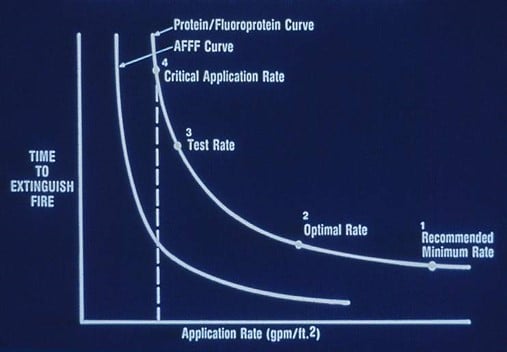
Figure 1 dates back 30 years to when I started in the foam business and illustrates one of the fundamental basics relating to the use of foam, which is there is an amount of foam that must be applied to a Class B fuel fire before it will extinguish. If we then increase the application density the extinguishing time decreases.

Test data over 50 years with PFAS containing foams allowed organisations such as UL, FM and EN to establish test rates and then advise on recommended minimum application rates. It is worth noting that the figure also shows that even 30 years ago we recognised that non film forming foams performed differently to our AFFF’s, FFFP’s and their AR versions.

The figure however still does not address the variables we see in real world missions, but as SFFF is non-film forming it is a reasonable assumption that the curve for an SFFF would be similar to that of the protein/fluoroprotein curve.

Considering the variables that could impact the curves we must start with the foams from different manufacturers and here it could be argued that a test protocol such as EN 1568-3 and EN 1568-4 is a suitable test protocol for this comparison as the only variables involved are the foam concentrate used and the foam qualities achieved with the foam solution through the UNI 86 nozzle.

This is conversely one of the weaknesses with this particular test protocol as the UNI 86 nozzle is a test nozzle and foam qualities achieved with discharge devices used in the field maybe very different, leading to different extinguishing times and reflash protection.

There is a strong argument therefore that different expansion ratios should be considered as part of the EN 1568-3 and EN 1568-4 test protocols, but this variable alone ignores the 25% drain time. Both UL 162 and FM 5130 consider a range of expansion ratio and 25% drain time when testing top side fire performance of a foam, and these must be matches to achieving those foam qualities based the operating parameters of a defined discharge device.

Discharge devices

The link between the foam concentrate and the discharge devices is even stronger when considering standard sprinklers as the discharge device. Here the EN approach is currently to ask the manufacturer for recommendations without giving any additional guidance on what data an end user or specifier should request. UL and FM, and now VdS now have test protocols using the heads that will upon successful testing be approved with the tested foam concentrate.

The impact of different fuels with SFFF’s has been discussed for some time and testing has been carried out by a number of organisations such as NRL, NFPA Research Group, and LASTFIRE. As a result of some of these tests we have already seen from the May 2021 edition of NFPA 5130 that under section 4.2 – Low Expansion Foam Concentrate Extinguishing Performance, within section 4.2.2.3 it states:

“When testing SFFF concentrates, Heptane is considered representative of hydrocarbon liquids with the following characteristics:

  • Flash point equal to, or greater than, Heptane.
  • Vapour pressure equal to, or less than, Heptance
  • Pure liquids (i.e. not blended such as gasoline / alcohol combinations”

Wording in FM approvals has been changed such that approvals now state “heptane” rather than “hydrocarbons”. At Fomtec we see on a weekly basis lists of chemicals being submitted with the questions asked about what application densities should be used for these chemicals. In many cases we just don’t have the test data with those chemicals so are having to advise our clients when what we are responding is “an opinion”.

For emergency response and the fire and rescue services the situation with some many different fuels and different discharge devices does see a tendency to favour use of following an EN 1568-3 and EN 1568-4 based analysis. As stated previously, hand lines are not equipped with UNI 86 test nozzles and typically a foam/water hand line nozzle will generate lower expansion and 25% drain times than that achieved with the test nozzle suggesting that greater application densities (and hence greater flow rates) will be required than should be indicated in the test.

Testing protocols

Operator techniques will also impact firefighting performance. Now test protocol exists to prove this in a quantitative way but the reports from the NFPA Research Group, and the FAA following their evaluation testing of SFFF’s both reported that their test engineers developed different operation techniques and improved extinguishing times.

It is clear from the more than 1500 fire tests that Fomtec has carried out, and supported by test data from third party organisations mentioned that the variables of fuel, foam qualities, application density and operator experience/techniques all contribute to the performance of the foam. Whilst finished foam qualities are partly due to the foam concentrate they are also due to the discharge devices and small changes with the discharge device can have a significant impact on the fire performance of the finished foam.

Extrapolation of data to predict the performance of foam if a variable is changed means giving an opinion and of course as soon as a different product, whether manufactured by Fomtec, or by another manufacturer, is introduced into the evaluation then the potential for a larger error with the opinion is greater.

Returning to our figure of extinguishing time versus application density it is clear that if operational application densities are required we must also take into account how these curves vary when the variables change. Here at Fomtec we are committed to our test programme called “The Enviro Programme” to establish the limits of performance for our SFFF products as the variables are changed, as decisions need to be based on Data, rather than opinions.

Boxout—

The list provided below is NOT exhaustive but the variables more directly relating to the fire performance of the SFFF concentrate are covered:

SFFF Foam Concentrate 
What type of foamSuitable for hydrocarbon fuels or hydrocarbon + water miscible fuels.
Proportioning ratioTypically 1%, 3% or 6% but can be different ratios of foam concentrate to water to generate the foam solution.
Expansion ratio of finished foamSuitable for LOW, MEDIUM or HIGH Expansion finished foam?
International Listings / ApprovalsWhat listings/approvals does the foam hold and are these appropriate for the application/mission.
Testing / Approvals with discharge devicesProvides confirmation that fire performance has been achieved with finished foam produced with the discharge device.
Testing / Approvals with fuels in hazardDifferent fuels even within group types can require different application densities.
Testing / Approvals with type II and type III applicationEmergency response with handlines or monitor response should use foam concentrates with type III listing / approval on hydrocarbon fuels.
Compatibility with dry chemicalLimited data available in impact of dry chemicals onto SFFF foam blankets.
Hardware 
Material compatibilityConsult manufacturers technical data to confirm that storage tanks and transfer pipework etc is suitable for the foam concentrate and solution.
Proportioning equipment compatibilityHas the proportioning equipment been tested / approved with the foam concentrate.
Discharge devicesWhat testing / approvals are available with the foam. Are there constraints on pressures and flow rates?
Operator Related 
Training in use of discharge devices – handline + nozzles, monitorsBest mission performance will require training in the use of equipment with SFFF’s
Knowledge of tested and approved foam qualitiesOptimum performance in manual firefighting will require knowledge of the foam qualities from the discharge devices.

This article was originally published in the January edition of IFSJ. To read your FREE digital copy, click here.
IFSJ Exclusive: Know your viscosity with FIREMIKS

Per Aredal International Sales Director at FIREMIKS AB, sheds light on the proportioning systems suitable for the transition to synthetic fluorine-free foam

During the market transition from AFFF (Aqueous Film Forming Foam) to SFFF (Synthetic Fluorine Free Foam) concentrates it is important to know the viscosity of the SFFF concentrate to choose the right type of proportioner.

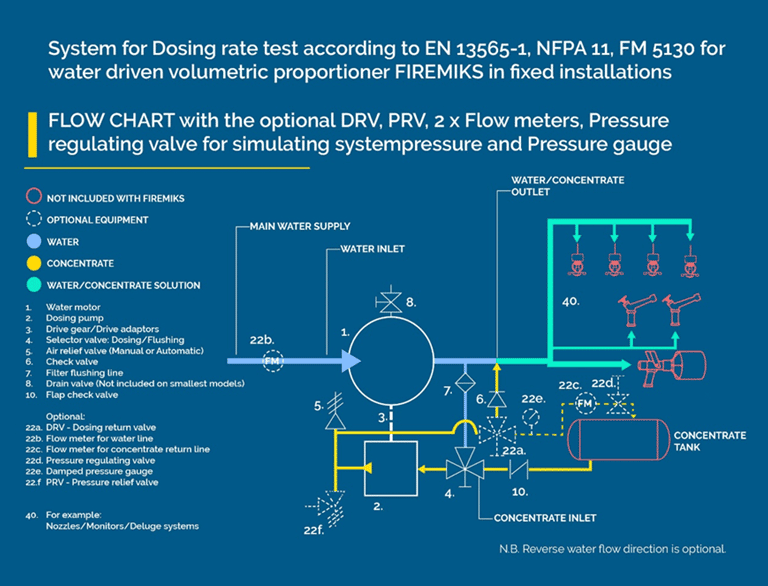
FIREMIKS is a water driven volumetric pump proportioner for firefighting – for fixed installations connected to a concentrate tank with gravity feed to the dosing pump. Extinguishing water drives the volumetric water motor, which in its turn drives the positive displacement pump that doses the correct amount of concentrate in the extinguishing water exiting the water motor.

As the regulatory authorities now are pushing for soonest possible transformation from PFAS-containing concentrates, towards SFFF concentrates, many proportioning systems are re-evaluated to ensure compatibility with the new concentrates. Different concentrate manufacturers offer a variety of foams which comes in a wide range of viscosities, including very high viscous concentrates. To be able to select an appropriate proportioner one needs to know the properties of the concentrate.

FIREMIKS is uniquely positioned to offer two types of dosing pumps, Gear and Piston (plunger), combined with our sturdy multi-vane motor that offers optimal reliability based on +30 years of experience in the market. Among several important factors, besides flows and pressures, we always gather info from the customer regarding the concentrate type and viscosity before we propose which type of pump that will match the customers need.

Proportioners with Gear Pump

Water motor driven pump proportioner equipped with a Gear pump are particularly suited for operating in the higher range of a systems maximum flow rate, such as deluge and large fire monitor systems. They are also most suited for high and very-high viscosity concentrates.

For example, we have with excellent result tested one of our Gear pumps models with a Fluorine-free foam with 8,040 cP (Brookfield Viscometer Spindle #4 at 30 rpm). The reason Gear pumps works well with these very-high viscous concentrates is that they are equipped with counter rotating gears which seals better with high viscosity fluids and creates an even flow that does not agitate the concentrate.

Proportioners with Piston Pump

Water motor driven pump proportioners equipped with Piston (plunger) pumps are on the other hand particularly suited for use in systems with low start-up flows in relation to the systems maximum flow rate, for example sprinkler systems. They are also very suited for low and medium viscosity concentrates.

Important to know is that Piston pumps have a limit upwards to high viscosity concentrates, normally around 4,000-4,500 cP (Brookfield Viscometer Spindle #4 at 30 rpm) due to the Piston pump reciprocating principle; for each revolution, the plunger sucks concentrate and then presses it out and the concentrate goes from zero to full speed twice per revolution in a very tight pump design. If the static viscosity is too high with non-Newtonian concentrates, the concentrate will not flow smoothly and therefor the correct dosing rate might not be achieved.

Important for all systems is that one should ensure that diameter on the foam supply piping is large enough for the concentrate delivery and to avoid longer concentrate lines. Recommendations are specified in our data sheet for each model. We are always available to guide you with more specific recommendations if needed for your specific project.

Verifying dosing rate according to EN 13565-1, NFPA 11 and FM 5130 on water driven volumetric pump proportioners.

To measure and verify the dosing rate on a proportioning system according to regulations and standards, at the commissioning and yearly maintenance, is an important task.  The aim is to ensure that the installed firefighting system proportion the correct amount of the concentrate into the firefighting water flow, as intended and designed.

To be able to easily test and verify the correct proportioning the FIREMIKS unit needs to be equipped with an optional Dosing return valve (DRV) (no 22a.) that directs the concentrate back to tank instead of being induced into the water flow. This allows for testing the system without mixing the concentrate. A Pressure relief valve (PRV), (no 22f.) is included with the DRV to eliminate the risk for over-pressure if return line to tank is closed/blocked by mistake.

Furthermore, one needs to install two calibrated Flow meters; one for main water line (22b.) and one electromagneticflow meter for concentrate return line (22c.), combined with a Pressure regulating valve (or a regular valve which can be partly closed to regulate the backpressure, e.g. globe valve) (22d.) to simulate system pressure, displayed by a Pressure gauge (22e.).

Environmentally and economically beneficial testing system

This described dosing test system ensures that it is possible to practise and test dosing rate without consuming the concentrate. It gives also substantial savings over the years with no cost for cleaning or destruction of dispersed solution after the test. With the growing strict environmental regulations, this advantage has become even more important today.

The accurate way of verifying dosing rate

Verifying dosing rate equals to verifying the correct volumetric function of both the water motor and dosing pump with two independent calibrated flow meters and calculate to this formula, in accordance with EN 13565-1, NFPA 11, FM 5130:

(Concentrate flow) / (Water flow + Concentrate flow ) x 100 = Dosing rate %

Revolution counter method – the limits

The revolution counter method which is also presented on the market assumes the correct working of the water motor, this means it gives only an estimateof water flow.

The is not an approved method to verify dosing rate as described by
EN 13565-1, NFPA 11 and FM 5130, who each require the use of a separate flow meter to measure water flow. Quote from FM Approval guide ref. rpm method: “May be used to provide a general estimate of the extinguish water flow”.

Revolution counting with handheld tachometer

The estimated water flow can also be measured with handheld tachometer (contact or non-contact) to ensure that the unit is not over-speeding, i.e. working within the upper rpm = flow limit specified in the Data sheets of each FIREMIKS model.

Measuring concentrate flow

An alternative method to measure the pumped concentrate is to pass it into a separate container after the pressure regulating valve (22d) and weigh the amount used from the tank during a defined time and then converting it to the corresponding flow rate.

In our experience, magnetic flow meters work well for measuring concentrate flows. Even so, it is even better to be able to establish a known weight or volume of concentrate used in a known time interval, because even approved magnetic flow meters are not tested on all concentrates available.

Handling and monitoring on site or remote

The flow meters, valves and pressure gauge described above can either be handled, monitored and read on site, or connected to remote handling, monitoring and readings. Independently of this – the most important factor is to ensure that data is measured accurately and according to standards to ensure that the installed firefighting system proportions the correct amount of the concentrate into the firefighting water flow.

This article was originally published in the January edition of IFSJ. To read your FREE digital copy, click here.