IFSJ Exclusive: Advanced Technology Delivered Simply

Ed Chivers, Global Product and Certification Director at Reacton, talks about competency, common component concept and plans for Intersec and beyond

Even though Reacton were incorporated in June of 1996, Reacton has roots going back 50 years and is one of the pioneering companies for the burst tube technology, specialising in the manufacture of automatic fire suppression systems. The organisation has a great foundation and supporting businesses that position it to develop and understand the market in detail, with connections in the waste and recycling sector and its sister company that installs these systems.

These connections have enabled Reacton to quickly understand the demands of the market from both design and durability, to fast response times and a close feedback cycle that allows it to bring brilliant products to the market in exceptionally quick timescales.

Fast forward to today and Reacton is a true leader and global manufacturer of critical asset fire protection through highly innovative suppression systems. At the heart of Reacton is its word class talent that provides its leading service on show today.

Ed Chivers, Global Product and Certification Director, is responsible for implementing and delivering Reacton’s global certification initiative that has his sights on becoming the most approved pre-engineered pneumatic tube-based manufacturer in the world. IFSJ sat down with Ed to find out about his background in the industry, Reacton’s common component concept and its plans for Intersec and beyond.

Can you tell me about yourself, your professional background?

I’ve been in the fire industry for over 20 years and worked with some of the biggest fire suppression OEM’s in the market. I’ve held roles from design engineer and technical manager through to sales manager and general manager which has allowed me to gain invaluable experience in all aspects of fire protection. During my career I’ve contributed to the ongoing development of fire suppression products, industry-related documents and articles, innovative web-based systems and sales tools, whilst having trained many companies worldwide.

Today’s role is extremely varied and demanding but very rewarding, working closely with the leading laboratories from across world, putting products through their paces and seeing them perform. Having great performing and approved products is only one part of the process, I have always had the vison of allowing these products to be understood and supported easily, this is what we see in the technical and supporting documentation from Reacton. Advanced technology delivered simply.

I also sit on certain trade association working groups that assist the industry, I am honoured to work with some of the best minds in the industry who all share the same passion which is to strive for a safer industry. We do this by creating guidance, key stakeholders and assisting on current and future standards/legislation.

Are there any trends in the industry that have been impacting your business and your product development?

Competency: as we introduce more approved products to the markets, ensuring that they’re delivered and installed to our strict requirements becomes essential. We have great innovative online tools to make sure that people can remain compliant, especially when the world has changed through Covid and face-to-face training was not an option. This goes back to our focus of clear and concise supporting information, we need our customers and partners to demonstrate a high level of knowledge and qualification of their expertise is essential, these are life safety products and command the correct approach.

Another important one is supply. As Reacton are a global leader of the manufacturing of automatic fire suppression systems, maintaining uninterrupted supply is vital. We’ve invested a significant amount in becoming self-sufficient through multiple means wherever possible. This includes specialised machines to make our components, state-of-the-art test equipment, larger stocks, and having multiple high-quality suppliers to ensure continuous supply through full redundancy. All of the time ensuring we can meet or exceed Reacton’s exceptionally high standards as this is something we would never compromise on.

Are there any solutions you have created that you think will become more prominent in the years ahead?

My general feeling is that there is a global shift in our market. Our market is the direct and indirect technology utilising pneumatic detection tube. That’s a global shift from only utilising the more traditional total flooding systems. This is mainly due to people becoming much more aware of the risks that are on their premises, education via manufacturers along with more insurance lead requirements. People are moving towards protecting the risk itself, not just configuring a system that protects the entire room which holds the risk. We’re looking at targeting the risk and protecting it at its earlier stages when the fire is as small as possible, extinguishing it before it has an opportunity to spread.

People understand that this delivers protection that is much more cost-effective, as the total cost of ownership of that system is reduced because we’re using a much smaller system which can be put back up and online again much faster. There is still a place for those total flood systems and a lot of the time people actually use them in conjunction, which means if there’s a fire then you’re not having to deliver hundreds of kilos of extinguishing agent which has a cost associated with it, you’re only delivering a few kilos right where the problem exists.

We’re seeing people becoming much more exposed and clearer on that product line whereas before it wasn’t as well adopted. That’s where we see this is going to be increasing as the years go on and Reacton are positioned extremely well for that. We want to set the standard for the industry that approved systems are the way forward, we must all be adopting this stance which provides official, independent scrutiny of the products and systems. Therefore, superior quality, reliability and performance is a natural by-product of this process.

What has Reacton been working on recently?

We’ve been working on our suite of internationally approved products through testing laboratories across the world, such as Underwriters Laboratories (UL), Research Institutes of Sweden (RISE), the Building Research Establishment (BRE) and The Commonwealth Scientific and Industrial Research Organisation (CSIRO) to name a few. Developing our systems to become one of the most approved and versatile, whilst keeping the product range easy and simple to install.

We’ve been working on the approvals for ours clean agent systems, but just as important as all the testing that goes on behind the scenes is the documentation and training that allows people to understand the product. We’ve created a product that we believe is extremely effective but is delivered with simplicity. Our technical manuals, training, any sales collateral will be extremely easy to use.

One of the main concepts of our product is that we use the same valve throughout the product range, but we also have just one nozzle that is used across the range of systems which range from one kilo all the way up to an 18 kilo system when used on our clean agent system. Customers don’t have to worry about whether they are installing the right nozzle or having to stock different types of nozzles, there is only one nozzle that they will use.

Are there any regions you’re currently focused on working in/increasing your presence in?

With our latest suite of approvals coming online we’re going to be opening up the American market in a much bigger way. We have an office there, but we’ve got some key partners who will now have an approved product that’s going to expand with huge traction.

The Middle East is a significant focus for us, our CEO of the business moved out there due to the demand and potential we have with our product, and we won one of the biggest bus tenders ever given to protect buses across the UAE. We’re also expanding in Australia with our latest testing and approvals which open up the large mining sector. We’re focusing on trying to increase our awareness globally.

One thing Reacton is very good at is trying to make sure we’re very transparent with what goes into developing a system. We’re not one of those companies that will sit back and say ‘here’s our certificate, that’s all you need to know’. We’re very open and show people how we arrive at that product, what’s actually involved with the testing – we’ll share videos of the vibration testing, climatic chambers, corrosion testing results, the fire tests we record – we’ll show all the information of what those fires look like, what you’ll have to put out, and the capabilities of the system.

What is your focus for Intersec? Is there anything specific you’re showcasing or hoping to achieve?

 The Middle East is extremely driven by approved systems. We’re going to be launching some clean agent systems at the show. We’ll be showcasing that new product line and also discussing certain parts of our lithium-ion battery suppression technology. We’re showcasing our approved clean agent systems which we’ve developed using 3M™ Novec™ 1230 fire protection fluid and FM-200™ Waterless Fire Suppression from Chemours.

We’re hoping to achieve awareness of the product and the fact that you can have an approved system that can be accessible to all markets. We’ve always prided ourselves on being able to have a product line which has an extremely high level of quality and high precision parts, and we try to deliver that at a price point that’s accessible to everyone. We don’t feel that anyone should be excluded from having fire suppression just because of price.

Looking ahead, what is next for Reacton? What are your aims for the years ahead?

One of the key parts that differentiates Reacton from other companies is that we have a common component concept. Instrumental to the current and ongoing success of the entire Reacton brand is our intentional common component concept. This approach allows us to rapidly upscale our business. We have a product line which covers electrical panels, wind turbines, CNC machines, heavy plant vehicles, bus market, kitchens – the product range is large, but we use common components throughout, which allows us to deliver approvals in a much faster fashion.

The great thing about the years ahead is that we’ve gone through a lot of the tough testing on those components now. We will be rapidly delivering more approvals in a much faster timescale than we have been because the components that are used throughout have already gone through the harsh environmental tests. It allows customers to hold fewer parts, there are fewer parts to control and support and the documentation they need. We can provide literature much faster and it is more economical to create because it’s got the common component. We can bring new approvals online much, much faster.

That’s what the future looks like for us – more approvals, coming much faster than we have done before. We are not stopping – we’re going to be delivering more and more approvals until we are the most approved pre-engineered direct and indirect system manufacturer in the market. We’re looking to forge partnerships with key partners across the world now that we have all the approvals that have come online.

This article was originally published in the January edition of IFSJ. To read your FREE digital copy, click here.
IFSJ Exclusive: A safer approach to wind-driven fires with Cold Cut Systems

Bernie Higgins, Head of Strategic Business Development at Cold Cut Systems UK, discusses a safer approach to wind-driven fires

Many of you will have seen, either in person or online, a demonstration of Cobra Ultra High Pressure Lance (UHPL) firefighting equipment. These demonstrations were usually undertaken using fire behaviour containers with a time and temperature indicator clearly visible, this enabled observers to see how quickly the temperature within the container dropped. This type of demonstration emphasised the value of using the Cobra Method also known as SAVE Scan Attack Ventilate Enter involving use of a Thermal Imaging Camera to scan, use of Cobra to cool and use of a Positive Pressure Ventilation – PPV – fan to clear away the residual steam and fire gases. This enables firefighting crews to gain safe access to a compartment fire.

It is also a very useful method for showing how Cobra works and the effect gained by the water droplets turning to steam within the fire gas plume.

However, Cold Cut Systems have been looking at more cost effective ways of both demonstrating Cobra and evaluating it against the types of firefighting risks that our customers (predominantly Fire and Rescue Services) want to protect Firefighters from.

To that end, we have been working closely with West Midlands Fire and Rescue Service (WMFRS), firstly to understand their risks, their response model and their success criteria and then to offer them the opportunity to evaluate Cobra UHPL as a risk mitigation tool. In undertaking this, we make it clear that Cobra is a tool in the modern-day Firefighters’ toolbox and it can be used to great effect in conjunction with other tools to enhance Firefighter safety as well as reduce water consumption and water damage.  However it will not do everything and its effectiveness is, in many ways, down to the knowledge skills and attitudes of the operators/crews.

The Evaluation

We undertook these evaluations at WMFRS’ Oldbury Training Centre – an excellent training facility where a significant range of fire conditions can be created in firehouses rather than in fire behaviour containers. Oldbury has very accurate and reliable temperature monitoring facilities for the safety of site users, and these were used during the evaluations as a means of measuring the effect of firefighting using the Cobra Method.

Initially, we ran some initial evaluations on ventilated and under ventilated compartment fires as well as a high rise fire scenario where Cobra was used from an aerial appliance cage to very good effect.

We wanted to give Cobra a bit more of a test and broaden our own understanding of what it can do so we decided to evaluate Cobra on a simulated wind driven fire. A wind driven fire is described in UK National Operational Guidance (NOG) as:

 ”….one where external wind or ventilation-forced pressure causes strong air movements, affecting the severity of firespread.”

Whilst wind driven fires can occur anywhere where there is a strong prevailing wind, they are particularly hazardous when they occur in high rise buildings. Many firefighters will have experienced the fierce fire spread at a high rise fire where an external window or opening has failed allowing the wind to blow into the fire compartment. These conditions are very hazardous for firefighters and the advice from the National Institute for Science and Technology (NIST) in the USA is:

”…. in a wind-driven fire, it is most important to use the wind to your advantage and attack the fire from the upwind side of the structure, especially if the upwind side is the burned side. Interior operations need to be aware of potentially rapidly changing conditions.”

We felt that Cobra could be used to good effect on a wind driven fire as a means for facilitating a window of opportunity for Firefighters to enter the fire compartment under safer conditions.

We planned the event with WMFRS carefully, undertaking site visits as well as individual and joint risk assessments and ensuring that we had plans in place to deal with any emergency situations that might arise for real on the day. Safety crews and radio communications were all in place and tested before the evaluation commenced.

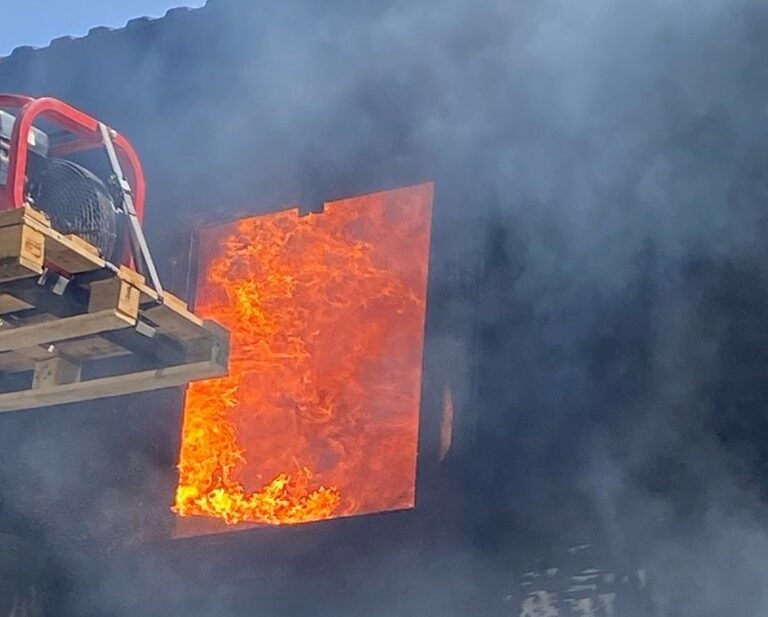
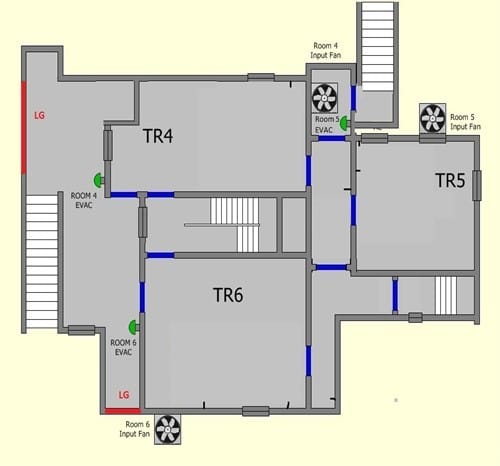
As can be seen from the picture below (figure 1), the wind driven fire was created using a PPV fan through a window into a fire compartment. Figure 2 shows the floor plan for the top floor of the firehouse. The window in TR6 was open to allow an outlet (exhaust) for the fire gases, (as shown by the red arrows). The firefighting crew, supplied by Cold Cut Systems, consisted of one Cobra Operator and one Cobra Senior Instructor with a further Cobra Operator acting as Cobra pump operator.

Figure 1

The fire compartment was room TR5 on the floor plan below (figure 2) with the fan going in through the window to the right of the compartment as you look at it on the plan. (Pale blue arrow)

Figure 1

The crew undertook a scan using a thermal imaging camera (TIC) before entering the building and decided to attack the fire using Cobra from the staircase adjacent to room TR5 (see the yellow arrow which is the Cobra access point on the plan at Figure 2). This gave the crew a high level of protection from the severe heat from the fire which was measured at 581 degrees centigrade before Cobra was used. It also gave protection against contamination from the fire gases and products of combustion. As can be seen from the temperature graph below, the temperature drop was quite dramatic going down to around 280 degrees quite quickly before briefly increasing and then dropping down to roughly around 160 degrees – a much better temperature to enter in order to fully extinguish the fire. It was interesting to note also, the change in temperature in the adjacent room (TR4) which showed a very similar temperature pattern to the fire compartment. The layout of the building offered few opportunities for a safe internal attack on this fire away from the flow path of the super-heated gases. Cobra was used for around eight minutes in total (including piercing) giving total water used at around 480 litres.

There were two key reasons for the success of Cobra in this scenario – firstly the skill and knowledge of the Cobra Senior Instructor and Cobra Operator which was used to good effect in deciding where to make the attack. Secondly, the over-pressurisation of the compartment as the water mist turned to steam – this worked well against the wind to allow the water mist to stay in the compartment for longer and so effectively cool the fire gases rather than being forced out along the flow path.

Please see the temperature readouts from the first floor rooms – Figures 3, 4 & 5 for details. Please note that there is an acknowledged discrepancy in the timings for the temperature readings, however the actual temperatures within the rooms were accurately measured.

The Cobra crew came out of the building and closed down their BA sets, they were able to report that they had not had to work in any high temperatures or in the presence of smoke/fire gases.

If you would like to discuss this article further or if you require further information on Cobra Ultra High Pressure Lance firefighting equipment, please contact Bernie Higgins on bernie.higgins@coldcutsystems.com

This article was originally published in the November edition of IFSJ. To read your FREE digital copy, click here.
Industry Expert: The reinvention of firefighting foam

John-Olav Ottesen, Managing Director and Founder of Dafo Fomtec AB, spoke to IFSJ about the ban on forever chemicals, data vs opinion, and the future of firefighting foam

There is currently a proposal to ban ‘forever chemical’ (PFAS) in firefighting foam across the EU. Why has this happened and what impact will it have?

This is the culmination of a long process in EU and legislators want to eliminate the use of PFAS, plain and simple. You use the term forever chemicals and PFAS molecules does not biodegrade in the environment and that is the main concern.

The transition to SFFF requires a holistic approach by end users – they must understand that this transition is not just about changing the concentrate. There is a wish for drop-in replacements among end users, but this is seldom achievable as the transition will often require, new storage tanks, new or recalibrated proportioning systems and the discharge device must be able to generate foam within the performance criteria of the individual foam concentrates. In many cases the application density as well as the operational tactics must be changed.

The finished foam fighting the fire is a product of foam concentrate as a part of a system, with tested and approved proportioning, and a foam quality generated by the discharge device that matches foam qualities proven by testing.

Why, when it comes to foam, is data more important than opinion?

It has always been the case that data is vital to enable correct design. With fluorinated foam, there was a higher degree of safety margin, they were simply more forgiving when it comes to issues like varying fuels and equipment. This is not the case with SFFF just now. We are still in the infancy with these products, so to base your fire protection on opinions can be disastrous, even fatal. We need to keep on gathering data and define the limitations of these products and base our fire protection on data collected through rigorous testing.

There has been a huge evolvement in performance of SFFF over the past 10 years, but as we reinvent foam, we understand that many old truths must be reconfirmed. We see that SFFF products are more fuel sensitive, and they must be used within the limitations that is defined by real test data and approvals. To use the words of the NFPA report on SFFF, the products must be deployed strictly within the listed parameter.

How have foam and fire suppression systems and solutions changed and evolved in recent years?

 Foam systems have been more or less the same during my 30 years in the industry. Compressed air foam systems have been introduced during this period and concentrates and equipment have evolved, but fundamentally they have not changed. With the move to SFFF, we see perhaps a need for more application specific approach. In some cases we will need higher application densities and change of discharge devices to accommodate for the use of SFFF foam, where a foam blanket plays a more vital role than with fluorinated foam.

With the inevitable move away from PFAS, and towards fluorine free foam, what are the main challenges that are a result of this transition and how can these be overcome?

First of all, the need for test data when designing systems. This puts a lot of responsibility on foam manufacturers but also on standards developers, designers, and end users. There is no way around it, we just need to keep on gathering data. The standards must adopt new insight and implement this going forwards. Designers and users must embrace the holistic approach and require real data.

Secondly, I would say that the cleaning of systems and handling of old concentrate is a real challenge, as we still do not know enough about the best way of doing this. The test methods for PFAS content are still being developed and refined, and the industry and laboratories are taking big steps to enable better methods. Methods for cleaning are available but the efficacy not yet 100% clear. The handling of old PFAS foam is also a challenge as questions are raised if high temperature incineration is effective enough. This is being discussed among regulators and industry right now.

What does the future hold for firefighting foam?

 For as long as there are flammable liquids in use, foam will play a central role in fire protection. We see a constant development towards ever more effective PFAS free foams, and this will carry on going forwards. I see this as a very exciting and innovative part of the industry and the next decade is going to be both challenging and interesting.

What are Fomtec’s core values and how do these impact its products and its customers?

Our core values are: Performance, Trust and Sustainability. In fire protection, Performance is driving us to keep on innovating and testing. Trust is essential for Fomtec and our products, and you build trust through all your interactions with partners and clients, and most of all trust in our products based on the data that we provide.

Sustainability for Fomtec starts with the way we conduct our own business and strive to reduce our environmental footprint. We have no emissions of process water, we recycle our waste and we develop our products based on environmentally responsible chemistry. This will at the end bring high performance and future proof products to our clients.

IFSJ Exclusive: Quelfire talks firestopping compliance

IFSJ spoke to Craig Wells, Sales Director at Quelfire, to discuss firestopping compliance

Tell me a little about Quelfire?

Quelfire is a manufacturer and supplier of passive fire protection with a primary focus on service penetration seals. We were established in 1977 as a family business and are still family[1]managed today. Since then, we have grown into one of the key providers of passive fire protection solutions and influencers of the market. Along with the products we manufacture and distribute, we put a huge emphasis on both technical support and education.

The culture within the organisation is very much: If we’ve got a tested solution we can sell it, if we don’t then we have to walk away. A large proportion of our annual investment goes into testing our products to achieve a larger scope of application based on feedback from our customers and the industry at large.

We supply specialist fire stop contractors, main contractors, builders, and all the trades in between – from dry-lining contractors to mechanical electrical contractors, anyone with an interest in passive fire protection we’re willing to engage with.

What exactly is firestopping compliance and why is it important?

Building regulations Approved Document B essentially states that all gaps and all penetrations must be suitably sealed. Compliance as a minimum is meeting the requirements of Approved Document B: to install and maintain products which have been tested to the correct standard for the particular application.

 It is important because it quite literally saves lives. A lot of people will be familiar with the Stay Put policy. There has been some criticism around that because of the events at Grenfell, but the policy is effective if the compartmentation is maintained using the correct products, installed in the correct way.

What recent developments have you seen around compliance?

The Grenfell Tower fire first raised the issue of compliance and consequently, this has raised the standards the industry must work to. The Building Safety Act, which received Royal Assent in April, has changed things certainly from the main contractor perspective. We hope this will continue. Fire stopping has historically been regarded as one of the smaller value packages that is implemented on a project towards the end. They will build walls and floors, run all the services through and then ask the fire stopper to come and firestop using the products.

What we’re seeing now is a change in the right direction. People are asking: what do we want to build, how do we want to build it, and is there a tested solution available. They’re now identifying the tested solution, working out what the parameters of that test evidence are and designing around it. The key thing then is sticking to the plan as we move through the installation stage.

There are some very positive changes which are being spring boarded by the introduction of the Building Safety Act, but also just a strong desire within organisations to do the right thing and we are glad to support this.

What should be done to improve compliance throughout the design and installation process?

The buzzwords, and rightly so, are early engagement and cross-party communication. These have got to be encouraged. The fire stop itself is only ever as good as the installation, as the substrate that it’s installed into, and as the actual services that are installed. You’ve got dry liners, mechanical contractors, electricians – maybe other specialist installation trades as well as the wall manufacturers and installers. All these things directly impact the effectiveness of the whole system, so it is important that we’re bringing everyone together at an early stage and designing the building using the tested solutions that are available.

How can parties work together to ensure compliance?

An early engagement meeting is critical. We get everyone together on the same page right from the start, making sure that everyone is involved from the early stages so there are no hiccups along the way. It requires regular meetings with all parties as the slightest change from one party could have quite a massive impact on another. There are also practical steps that we can take, such as Toolbox Talk training sessions. These are on-the-job training sessions conducted by manufacturers like ourselves.

The construction industry can be fairly complacent in terms of thinking that everyone is competent. If we take simple things like installing putty pads into electric socket boxes – you’ve got a qualified electrician that’s used to wiring up socket boxes and is then being asked to put a fire stopping device into the socket. It’s not hard to install a putty pad, but does that individual know why they are installing it? Do they just think it’s a gasket and regard it as a nuisance getting in the way of their wiring? Or do they understand that this is a life[1]safety critical element?

The other suggestion is to install physical sample walls. What you establish at that stage is exactly what is expected in terms of the installation; the writing can be on the wall in terms of expectations. From then on it becomes the benchmark. Anyone onsite can see what’s expected and can measure their work against this benchmark. There can also be that cross-party scrutiny, where one party can say ‘shouldn’t X be doing this because that’s what the demo wall shows?’

How do you make sure that the correct products are being installed?

 By promoting the message that help is available. Competency is knowing what you don’t know and it is really important for people to understand that there are manufacturers and system suppliers like ourselves who are willing to help and provide support. People should not think that they have to go it alone.

Technical support services in the construction industry have tended to be an email address that is monitored once every couple of weeks. We aim to respond to emails within one working day. People should understand that help is available and it’s not wrong to not know the answer to your solution.

There are people out there that can support you and provide you with an evidence-based solution. This has been a challenge in the industry – people have been afraid to go into the level of detail that’s required at an early stage because they think it is going to be hard work to get it out of the manufacturer. But, as I say, things are changing and for us that is one of the main reasons why persons choose to work with us along with our huge, tested scope of application of products.

Quelfire is hosting a panel discussion at London Build this month*, what is its focus and why should people attend?

The discussion is called ‘The Journey to Achieving Fire Stopping Compliance’. There are two strands to the journey aspect of it. One is understanding that it is a journey – from the early stages working out what is needed to achieve compliance and then the various stops along the way which need to be introduced to ultimately achieve compliance at the end of the project.

The other side is that for a lot of people, this is a massive cultural change, and cultural change does not happen overnight. There has been a historic attitude of ‘leave it to the end, leave it to the installers’ but really to achieve compliance it is a case of ‘take control and work out what’s needed, and dictate to the relevant people that this is what we need along the way.’

The discussion will focus on the importance of early engagement, designing the building using tested solutions and all the steps and tools that can be used along the way to make sure that all the parties are aligned and, ultimately, the building is constructed compliant and safe. We’ll also touch on the things that can be done to meet the requirements of the changing legislation and the emphasis on the Golden Thread.

*The Journey to Achieving Firestopping Compliance, led by Quelfire, took place at London Build on 16th November at 2.30pm on the Fire Safety Stage.

This article was originally published in the November edition of IFSJ. To read your FREE digital copy, click here.

Market Analysis: Rising demand for firefighting foam

International Fire and Safety Journal analyses the state of the suppression market

According to Grand View Research, the global fire suppression system market size was valued at USD 16.8 billion in 2021 and is expected to witness a compound annual growth rate of 4.8% from 2022 to 2030. Suppression is an umbrella term that for this statistic refers to the critical systems installed in buildings or establishments, playing a vital role in safeguarding properties and infrastructure in the event of a fire accident.

Suppression also encompasses the firefighting foam, for which the global market size was valued at USD 4.95 billion in 2021 by Grand View Research and is anticipated to witness a CAGR of 3.6% from 2022 to 2030.

The rise for firefighting foam across the forecast period is to be driven by increasing fire incidents such as wildfire, fuel-based fires and fires due to electrical failure among other causes. Firefighting foam has experienced a rise in demand from industries such as oil and gas, automotive, chemical, aviation, marine, and mining among others.

The report attributes the rising popularity of firefighting foam to innovation around its properties, such as higher expansion ratios, foam stability, resistance to higher temperatures, and efficiently disrupting the oxygen supply to suppress the fire.

The PFAS problem

Both the US Environmental Protection Agency and the European Commission have put forward plans to ban a key component of foam solutions: PFAS.

Foam manufacturer Fomtec said that the firefighting foam and foam system market for the next ten years will be totally driven by the transition away from PFAS containing foam to synthetic fluorine free foam thanks to legislation strengthening globally. Whilst some sectors will be given a longer period to make the transition, unlike Halon, it is unlikely that any sectors will be given an exemption.

Fomtec said: “Similar to the Halon 1301 alternatives the new SFFF’s are NOT drop-in replacements and the transition may involve adopting new operational tactics, changing discharge devices or at the other end of the scale having to change the design of a system to address an increase in the flow rate required. In many cases a holistic approach to the transition will be required based on how the hardware and foam agent work in combination. Having verifiable data on performance of the hardware and agent will be more important than ever as the SFFF technology evolves.

“Around the transition new opportunities exist for the cleaning of existing systems and the safe removal and disposal of old hardware and foam. At present how clean is clean is a little bit of a grey area and the whole industry would welcome more guidance on this area of the transition.” Industrial suppression

According to Grand View Research, the oil and gas segment dominated the global industry in 2021 with a maximum share of more than 20.85% of the overall revenue likely because highly flammable liquids and gases can lead to intense fire incidents, causing heavy property damage, pollution, and risk to human life. Oil[1]well fires result in the loss of millions of barrels of crude oil per day and can cause huge economic losses.

Combined with the ecological difficulties caused by the large amounts of smoke and unburnt petroleum along with the enormous fuel supply, oil-well fires are highly difficult to extinguish than regular fires. Hence the product demand has increased in recent years from the oil and gas industry. We are expected to see a similar trend during the forecast period. Fire accidents involving chemicals are the second-largest segment after oil and gas.

Regional breakdown

The Asia Pacific saw the biggest market share of the global firefighting foam industry in 2021, accounting for more than 33.50% of the overall revenue. Grand View Research attributed this to the rapid growth of industries, such as chemical, marine, automotive, aviation, and others, across economically emerging countries, such as China and India.

The Asia Pacific accounts for a major share of the global chemical production and fire accidents are common in the region due to a of lack of proper industrial safety. Dry weather conditions across various countries in the region also raise the risk of fire accidents, resulting in wildfires.

North America is the second[1]largest region, in terms of global consumption of the product, with demand from countries including the US and Mexico. Increasing fire-related accidents and wildfires in the US and Mexico due to climatic changes and human negligence are predicted to drive the regional market over the forecast period.

This article was originally published in the November edition of IFSJ. To read your FREE digital copy, click here.

IFSJ Exclusive: Building trust in three dimensions with UL Solutions

Ghaith Bakir, Lead Regulatory Engineer-MEA, Codes and Regulatory Services, UL Solutions looks benefits and safety considerations of 3D printing in construction

First developed in the 1980s and rising to prominence in the 2000s, 3D printing has become an increasingly valuable tool for design and subsequently for the construction industry. It works by creating a digital model of almost any shape or design that is required which can then be printed to the necessary scale. In the construction industry, it can be used from as little as printing specific components to printing entire buildings, paving the way for reduced waste and lowering labour costs.

Ghaith Bakir, Lead Regulatory Engineer MEA, Codes and Regulatory Services at UL Solutions explains that in construction, 3D printing is an automated process of joining materials to make building elements and systems components from 3D model data, layer upon layer.

“This innovative construction technique is rapidly moving from a conceptual and experimental stage to a viable building construction method,” he tells, suggesting to anyone who has not seen how buildings can be constructed using 3D printing to search the internet for ‘3D Printed Building Videos’ as the results may be eye-opening.

Bakir says there are many benefits of 3D printing for the construction industry: “In construction it offers a significant potential to increase efficiency in the building sector, including time reduction, waste reduction, cost-effective innovative solutions, safety, and sustainability.”

Code compliant

As with any new method of construction so come the safety need for safety and compliance checks. The main challenges for 3D printing in construction, says Bakir, is that building code authorities want assurance that the new construction technique complies with applicable building construction code requirements, many of which are prescriptive in nature.

“Builders need to demonstrate that the 3D-printed structures comply with applicable building or residential codes to gain building code authority approval for 3D-printed construction in jurisdictions,” he explains. “Code compliance presents a challenge for both a builder and code authority because building and residential codes currently lack prescriptive requirements for 3D-printed construction.

“Even code requirements for concrete construction are not directly applicable for cementitious-based 3D-printed construction since the mortar and cement-based fabrication, printed in a layer-upon-layer fashion without forming members, are not specifically covered by the concrete standards referenced in the model codes.”

As it stands, there are no prescriptive code requirements for 3D-printed construction, and so Bakir says that building code authorities must consider each project under the alternate materials and methods provisions in the code for their evaluation and approval.

“This approach allows them to approve 3D-printed building constructions, provided they are shown to comply with the intent of the code provisions and provide the code-prescribed quality, strength, effectiveness, fire resistance, durability, and level of safety,” he says.

Tried and tested

He suggests using testing and evaluation data from standards such as UL 3401, Outline of Investigation for 3D-Printed Building Construction, which can be used to evaluate the printer, fabrication process, and materials used to verify that they consistently produce building elements with the same properties.

Bakir says: “Builders can use the document to create a report of findings, showing AHJs that their building assemblies comply with relevant codes and standards like UL 263, Standard for Fire tests of Building Construction and Materials, and NFPA 275, Standard Method of Fire Tests for the Evaluation of Thermal Barriers.

“This report provides AHJs with the technical information they need to inspect and approve 3D-printed buildings under the alternative materials and methods code provisions and will speed up the approval process.”

The future of construction

One place which has recognised the 3D-printed construction market opportunity, says Bakir, is Dubai: “The United Arab Emirates continues to incorporate innovative solutions and cutting-edge technologies, such as 3D printing, into nearly all aspects of its economy. In 2016, the Dubai government launched the “Dubai 3D Printing Strategy” to transform Dubai into a leading user, producer and exporter of global 3D printing processes, technologies, and associated services.”

Many Dubai organisations have implemented the 3D Printing Strategy, including the Dubai Municipality and Dubai Health Authority . In 2021, the Vice President and Prime Minister of the United Arab Emirates, Sheikh Mohammed bin Rashid Al Maktoum, has issued a decree to regulate the use of 3D printing in Dubai’s construction sector and support the region’s target of ensuring 25 percent of its buildings are constructed using 3D printing technology by 2030.

“The legislation will seek to enhance efficiencies in construction projects and improve the competitiveness of Dubai’s local industry while also reducing waste in the sector and attracting leading companies to Dubai’s construction industry,” Bakir adds.

This article was originally published in the November edition of IFSJ. To read your FREE digital copy, click here.

IFSJ Exclusive: Pacific Helmets talks safety without compromise

Pacific Helmets’ Sales and Development Manager, Lee-Anne Glanville-Rothman, talks about Haloflex technology, helmet maintenance and the company’s international ambition

Pacific Helmets was established back in 1982 by David and Marion Bennett with the ambition of getting New Zealand Governments to mandate a safety standard for riding bicycles. David’s passion for safety drove the business forward moving from non-emergency services’ head protection into the realm of emergency services and technical rescue.

The first large scale tender which Pacific Helmets won for structure firefighting helmets was for the London Fire Brigade. This tender was the pivotal point in the company’s manufacturing evolution and the reason it continues to deliver quality products without compromising the end users’ safety.

We spoke to Lee-Anne Glanville-Rothman, Sales Development Manager, at Pacific Helmets to find out about the company’s new products and why “Safety without compromise” is the manufacturer’s mantra that it lives and breathes.

Tell me about your role at Pacific Helmets?

I was born and raised in South Africa and moved to New Zealand in 2017. I’ve always had a knack for technical applications and had developed a good understanding of the technical world when I moved. I joined Pacific Helmets in October 2021 which has served as my introduction into the fire and safety world. It’s been a great challenge and one that I’ve really enjoyed.

My role at the company is Head of Sales, Marketing and R&D. I work with a group that I’m lucky to have in my charge because we go head-to-head with some of the biggest competitors around the globe.

What is Pacific Helmets’ current focus?

We have a new product launching in the first quarter of 2023: the F20, with Haloflex™ technology. Everything in this helmet moves away from your traditional approach of the internal padding and soft components and suspension points. Our focus was full decontamination, ease of use and weight reduction. We’ve spent countless hours reading and listening to the studies which are available and ensured that our pursuit and design addressed as many of the concerns and requirements as possible.

The F20 has a ‘quick clip-in clip-out’ comfort padding system. You can disassemble and reassemble the soft components within 60 seconds. The design focused on ‘tool-free maintenance’ with the components that need to be changed out often. This approach aimed at reducing the necessity of a repair agent servicing the helmet, and the user being without their helmet for a period.

The repair works can be brought inhouse with training provided to guarantee the helmet’s integrity is not compromised. We’ve also reduced the weight of the helmet by 100-150 grams (depending on the standard) and we look forward to hopefully reducing that more in future developments. Haloflex marks the new innovative way forward for our company. We’re wanting to make waves in the industry and we’re going to be incorporating it into more of our product range.

What other new products have you been working on?

In our structural fire range, we have the one touch eye protector (OTEP™). You don’t have to pull it down manually. You push it up and it deploys. There is a small grub screw which allows for height adjustment to suit the individual wearer. The new rescue eye protector (Rescue EP) designed for our R6 rescue range will be available in the first quarter of 2023. The methodology of modular connection provides flexibility to end users to add and replace accessories if and when required. The Rescue EP moves away from the current attachment method towards a ‘retrofit’ which end users can complete themselves or our distributors before shipping the products out. A key focus of the design was adjustability – it’s not just a stationary eye protector. You can shift it forward and back to the wearer’s face, easily accommodating many face shapes and spectacles.

What advice do you have for firefighters with regards to longevity?

It is important to make sure that the chemicals or materials you’re using to clean the helmets comply with the manufacturer’s suggestions. This is normally within a specific pH range and we have that in our user information guides (UIG). We also, depending on the material you have internally for lining, suggest you clean and disinfect your internal soft components in accordance with the UIG or manufacturers guidelines.

You recently appointed Venari Group as your UK distributor – how did that come about?

Venari’s Oliver North and John Purdy approached us to open a conversation around the potential to supply Pacific Helmets products into the UK market. John, an ex-fireman, knew of the Pacific Helmets brand and thought the partnership would be a great match. I am excited to see what we will achieve together in the Fire and technical rescue market. The aim is to be accessible and visible while rebuilding our brand recognition with Venari.

What are Pacific Helmets’ plans for the future?

Our goal is to improve our market share and presence within the US. Our brand is well recognised and asked for by name, which is a great position to be in, specifically when your aim is to gain a larger share of the market.

The digital strategy project will provide an improved presence, not only through the US but globally to our current and future end users. The aim is to improve product data availability, easy access to technical documents, increase our distributors presence and locations, and build a space that improves the positive word of mouth advertising from impressions.

Our business has grown to this point from word of mouth. We have an opportunity to reach across multiple platforms, globally, to showcase what we offer and who we are. That’s what I am aiming at: building and becoming a ‘First responders’ brand of choice’.

Finally, what sets Pacific Helmets apart from other manufacturers?

We are head protection experts. Our focus and drive are bringing the best products and innovative designs to life. This platform provides ample room to think outside the box and in a few instances, we have been first to market with our products designs.

What we deliver to the end user brings them home safely. We do not skimp on quality or cut corners when it comes to making sure that out helmets pass and exceed standards. That’s been the driving heartbeat at Pacific Helmets, and it will forever beat strongly.

This article was originally published in the November edition of IFSJ. To read your FREE digital copy, click here.

IFSJ Exclusive: Machine vs manual BA mask cleaning with MEIKO

TopClean M from MEIKO is designed to make the BA mask cleaning process fast, cheap and hygienic

Working by hand is not to be underestimated – but it is not the best option for cleaning BA masks or regulators. In response to the length of time it takes to effectively clean this vital piece of firefighter personal protective equipment (PPE), MEIKO has developed TopClean M: a cleaning solution that is designed to be fast, hygienic and cost effective.

The problem

When on duty, firefighters must rely completely on their colleagues and their equipment. In Germany they refer to this as the “safety chain”. The safety chain combines all actions, methods, tactics, equipment and appliances associated with the safe use of respiratory protection and, in extreme cases, makes it possible to safely rescue the wearer of respiratory protection equipment by means of respiratory protection emergency rescue.

The safety chain includes all safety philosophy associated with respiratory protection during preparation for deployment, deployment itself and post-processing. Breaking the safety chain can put the life of the person wearing respiratory protection equipment at risk.

The post-processing referred to includes the cleaning of respiratory protective equipment. In the same way that certain hazardous situations can only be combatted by following certain processes. These valid processes are a great help when cleaning PPE.

Valid processes are not guaranteed in manual cleaning. Like many processes that are carried out by hand, manual cleaning is prone to error: incorrect dosing of the chemicals used, insufficient wetting of products, not enough application time – or too much application time, if you get distracted by another task in the middle of manual cleaning.

This is exactly what happened at one fire service. The results: the BA masks were left in the cleaning bath much longer than they should have been. The softener in the rubber parts of the mask dissolved, causing black marks on the firefighters’ faces the next time they used them.

The solution

To ensure that firefighter masks remain robust and are not damaged during the cleaning process, MEIKO developed the TopClean M: a modular system for cleaning of respirators, full-face masks, regulators and SCBA frames.

Unlike with manual cleaning, damage to BA masks like this will not happen with the TopClean M as all the parameters associated with the cleaning process (time, chemicals, mechanics, temperature) are predefined and run reliably.

The integrated door locking ensures that the processes cannot be interrupted once the start button has been pressed.

And a built-in empty indicator ensures that cleaning cannot commence without sufficient chemicals. According to the expert opinion of Professor Walter Popp, Head of Hospital Hygiene at Essen University Hospital, following intensive testing, he said that: “TopClean M delivers good cleaning and disinfection performance. (…) As a general rule it is preferable to use a machine rather than manual methods to clean BA masks.”

User safety

If manual cleaning is not carried out under the correct conditions, users can be put at an even greater disadvantage: cleaning vapours can be inhaled, chemicals can damage the skin and contaminated PPE can even harm those it is designed to protect. By contrast, machine cleaning is completed in a closed system, i.e. inside the TopClean M. What this means above all, is more safety and security for users, as they do not come into direct contact with the cleaning chemicals.

Saving time

Another disadvantage of manual disinfection is that it takes up the valuable capacities of respiratory protective equipment technicians – in particular when they are charged with removing all traces of chemicals from the equipment they are tasked with cleaning.

If it takes an average of 4.5 hours to complete the cleaning and disinfection process manually for 4 BA masks, using TopClean can reduce this time by 60%. All the technician has to do, is to take the BA masks apart, place them into the baskets and subsequently put them back together and carry out standard checks. TopClean M does the rest, with programme cycle times of between 6 and 10 minutes.

Using the TopClean M, up to four BA masks can be cleaned and disinfected simultaneously in next to no time, or eight regulators, or four BA masks and four regulators simultaneously.

Thomas Happersberger, Commander of Lahr City Fire Service, said that the MEIKO solution was an improvement on their previous methods: “Our previous manual process was reliable, of course. But the TopClean M and machine cleaning takes things to a whole new level, by giving us a much more consistent and reliable process.”

Olaf Fernys, who together with a colleague, is responsible for cleaning 892 BA masks and 661 regulators at Leipzig’s fire rescue headquarters, summarises all of these arguments quite simply: “It is not just about saving time; the improvement in safety and hygiene delivered by the TopClean M from MEIKO is more important.”

Machine cleaning in the TopClean M also means more safety and security for respiratory protective equipment technicians, because the cleaning and disinfection process delivered by the machine is approved by leading BA mask manufacturers.

Find out more about Meiko’s TopClean M at www.meiko-uk.co.uk

This article was originally published in the November edition of IFSJ. To read your FREE digital copy, click here.

IFSJ Exclusive: Setting suppression standards with Fomtec

As the industry transitions towards Fluorine Free Foams, John Olav Ottesen, Managing Director and founder of Dafo Fomtec AB, examines the deficiencies in recognised design and testing standards

When the serious discussions started around 2010 about high performance Fluorine Free Foams, one of the common lines we heard from the industry was that foams without fluorochemicals were ‘nothing new’.

Since the 1960s, firefighting foams have been manufactured based on PFAS containing fluorochemicals. By 2000 these PFAS containing foams would make up more than 90% of foam sales globally. Two characteristics of the fluorochemicals made them particularly attractive to the foam manufacturers.

Firstly these chemicals were Oleophobic which basically meant that they did not want to “mix” with the hydrocarbon chemicals in the fuels, and tended to resist or repel the fuel from the outer wall of the bubbles. In firefighting terms this meant that the bubbles did not pick up the fuel when the foam was directed onto a burning fuel surface.

Secondly, the fluorosurfactants in the foams impacted what is known as the interfacial tension at the fuel/foam interface and this lead to the creation of an aqueous layer being created between the fuel and the foam bubbles. Foams that were able to create this layer became known as “Film Forming Foams”, or FFF.

With many years of development and a limited number of foam manufacturers and manufacturing foam products following a similar formulation, it is understandable that the fire performance standards and associated design standards were based on the PFAS containing foams.

Different standards

When you consider what could be called geographically based standards from UL and FM, over EN, then EN 1568 adopted a rating system and EN 13565-2 (the foam system design standard) applied correction factors on the minimum application rates depending on the fire performance rating achieved in the EN 1568 fire test.

UL and FM adopted a pass/fail approach but tied the fire performance test into foam qualities (expansion ratio and 25% drain time) achieved with real world discharge devices. UL and FM also had specific test criteria for foam sprinklers whereas EN just stated that foam agents needed IA, IB or IC rating to be used in non-aspirated sprinklers.

Foam manufacturers, end users and the standards bodies had 50 years of experience and the knowledge that manufacturers were basically following the same basic recipe when formulating their foams. PFAS containing foams were regarded as forgiving and with good tolerances for different fuels and different discharge devices.

Where strict adherence to a UL or FM system was not required it was commonplace to see suppliers and consultants accepting hardware and foam that was not necessarily tested and approved together. Under EN 13565-2 this was not a necessary requirement as the standard was based on the assumption that one foam with a top side performance rating would perform the same as another foam with the same top side performance rating.

The transition to fluorine free

Unlike PFAS containing foams, manufacturers are not currently following the same basic recipe. Current commercialised synthetic fluorine free foams (SFFFs) are based on each manufacturers’ formulations of chemicals, have different physiochemical properties, and exhibit very different performance across different fuels and with different application techniques. As SFFFs started to be marketed there was a lot negative marketing that went beyond questioning the difference in performance to actually questioning whether or not SFFF’s ‘actually worked’. 

This has led to end users, specifiers and consultants questioning the ability of the foam for their application. At Fomtec we welcome these questions as this allows us to discuss the holistic approach to the transition away from PFA containing foams, whereby the foam concentrate is part of the solution and needs to have been tested and approved with the foam proportioning and discharge devices.

Pass the test

Whether a new requirement or planning the transition away from PFAS containing foams the end user is looking for answers on what foam to purchase/specify based on specification, suitability for their mission and of course price and availability.

Test standards are mostly written around the knowledge of the performance of PFAS containing foams. Although in their infancy, we see that SFFF’s currently exhibit more sensitivity to different fuels, to the type of water used to create the foam solution, to the foam qualities generated by the discharge devices, and to the type of discharge device.

We see that end users and consultants are now asking whether the approvals on the foam they are now being offered are relevant for their real-world applications. For Fomtec we believe that the tolerances with SFFF’s are currently smaller than we saw with PFAS containing foams and this is part of the reason that the Enviro Programme includes more than 1500 fire performance tests (so far).

Applying the right standards

Sometimes when deciding which standard to apply when choosing an SFFF, the end user is not going to be given a choice because of the legal or insurance requirements of the location or the mission/application.

In general the ideal situation is to apply and request the test standard that most closely mimics the real world application of the end user. It is completely impractical to expect all applications to be covered but we can look at some areas that are covered in some of the common test standards.

Fuel type

Most standards currently work on a grouping system or have a set fuel that is used in the fire testing. When we look at hydrocarbons this is most commonly heptane, although under ICAO it is Jet A-1 or Kerosene, and currently for Mil Spec it is Gasoline (Under the proposals for a new fluorine free Mil Spec for land based facilities two fire tests will be carried out on Gasoline and Jet A-1).

When water miscible fuels are considered the usual fuels used to represent the fuel groups are IPA (for alcohols) and Acetone (for ketones), although under UL and FM it is quite common to see additional fuels being added by different manufacturers.

Application type

For a topside device such as hoselines, monitors and foam makers, water immiscible (hydrocarbons) always start their test programmes with a direct (forceful) Type III application, whereas for water miscible (polar solvents) the programmes use an indirect (gentle) Type II application.

For EN 1568-3, ICAO and IMO the nozzle is fixed for the duration of the application, whereas for UL and FM once 90% control is achieved an operator is allowed to pick up the nozzle and to move around 2 sides of the test pan. For the DOD Mil Spec the operator manual fights the fire immediately and is allowed to move all the way around the circular test pan. For the water miscible fuel fires under all the fire performance test standards the application uses a fixed nozzle and the foam is directed at a backboard on the test pan and allowed to slide down the board onto the fuel surface.

Standard (non-aspirated) and foam/water sprinklers (aspirated) test protocols such as UL 162, FM 5130 and VdS require that a grid is arranged over the test pan and the test protocols define nozzle spacing, elevations and flow rates per nozzle.

Test standard deficiencies

Performance on different fuels with SFFF’s is a major issue as even on hydrocarbons the question of just allowing heptane as a representative fuel is being asked by the standard bodies. The latest FM 5130 standard (May 2021) already states under 4.2.2.3: “When testing SFFF concentrate, Heptane is considered representative of hydrocarbon liquids with the following characteristics: Flash point equal to, or greater than, heptane, Vapor pressure equal to, or less than, heptane, Pure liquids (i.e. not blended such as gasoline/alcohol combinations)”.

Data from the testing at Fomtec would indicate that grouping of the polar solvents and working with the reference fuels of IPA, for alcohols, and Acetone, for ketones is just as problematic.

Finished foam qualities of expansion ratio and 25% drain time are important with SFFF’s but many of the test protocols use a set nozzle and pressure as part of their approval that variations in foam qualities are not taken into consideration. UL and FM for their top side approval testing do require that foam qualities used in successful fire performance testing are matched to foam discharge devices.

At the other end of the scale the current EN design standard for foam systems EN 13565-2 has the statement when considering non aspirated discharge devices: ‘Consult manufacturer’. It is certainly arguable that the foam manufacturer should be able to provide good advice, but there are no standards or test protocols mentioned.

The future of foam

Anything we say here is an opinion, but we would like to say it as a ‘considered opinion’. Expect standards and testing that expands the hydrocarbon fuel testing required, and potentially some more fuels as test fuels in the water miscible.

The EN 1568-3 committee is looking at adding some variation in expansion ratio into the test protocol. We hope they will also consider the importance of 25% drain time and replace the ‘consult manufacturer’ guidance is with an internationally recognised test.

Here at Fomtec the development programme we named the ‘Enviro Programme’ continues and we are well over 1500 fire tests now as we add data for different fuels, different foam qualities, different discharge devices and operational techniques. When a client asks questions about SFFF our responses will be based on data not opinion.

This article was originally published in the November edition of IFSJ. To read your FREE digital copy, click here.

Fire, Camera, Action: Inside Ciqurix’s video flame detection technology

Paul Seligman, Chief Executive Officer at Ciqurix discusses new video flame detection technology that can spot fires quickly and reliably

Detecting fire has been a human preoccupation since the day it was first discovered. This constant threat has led to ever more sophisticated and imaginative methods of detection. The human eye was replaced as the most efficient way to detect fire with the widespread adoption of smoke alarms in the second half of the twentieth century.

Beam detectors, aspirating detectors and CO detectors followed, but all were blighted by the same problem: they were designed to detect the by-products of fire, not the fire itself. Ultimately the goal had to be a device that could reliably detect flame, not smoke or heat. Many things get hot, many things produce smoke, but only the presence of flame is undeniable evidence of a fire.

Flame, however, is an uncooperative medium. Its behaviour is unpredictable, and its range of potential shapes, colours and patterns of movement varied. To produce a flame detector that will reliably distinguish a flame from other sources of radiation was an endeavour that saw only limited progress for decades.

Rack mounted units proved too clunky, thermal imagers and UV/IR detectors too prone to false alarms and the vaunted IR3 detectors were unable to pinpoint the source of a fire or reject false alarms. Those devices that did hit the market required huge flames at short range, rendering them counterproductive, and prices were often too high for widespread adoption. The advance in video technology, however, has provided new opportunities to record and study flame, and so Video Flame Detection was born around the start of the nineties.

Detection today

The year is now 2022 and Video Flame Detection is here and quickly establishing itself in the market. There are several ways in which video technology can be deployed in the pursuit of reliable fire detection. Visual feeds can be run through algorithms to detect the specific shape pattern of a flame; sensitive thermal imagers can attempt to detect the fluctuations in temperature typical of fire; even the colour of a flame can be used to trigger a detector. The greatest success, however, has been found by selecting some elements from each column.

The result is a video flame detection system that can spot fires quickly and reliably without having to wait for particles to build up in detection chambers. There is no confusion between a vehicle exhaust and a fire and no need to wait until the temperature hits a certain point.

Video Flame Detection systems have made ground in the market despite a lack of regulatory requirement for them. The regulatory frameworks have simply not kept up with the pace of progress. The days of ticking boxes have emphatically passed, however, and businesses in particularly fire prone industries now need serious fire protection systems that do the job in a reliable manner.

The opportunities presented by Video Flame Detection led to the birth of our company, Ciqurix. We had been experimenting with new ways of detecting fire since 2012 but it was in the second half of the last decade that it became apparent that there was a gaping hole in fire safety and that we had the technology to fill it.

We created the FCam: a superpowered video flame detection system that is fully compliant with regulations. Our dual sensor technology combines video and near-infrared analytics to provide reliable, versatile, long range detection in any environment, able to accurately pinpoint a flame and mark it like a sniper’s scope.

The potential footprint of Video Flame Detection is amply demonstrated by the geographic and market spread of the users of Ciqurix’s systems. FCams are now protecting timber yards in Scotland, power stations in Australia, palm oil facilities in Malaysia and hotels in the Mediterranean. Industrial freezers, methane processing plants and a UNESCO World Heritage Site are all availing themselves of various versions of our products.

Solutions for all situations

Our user-led design model has given us a very wide product list, with an FCam system to suit all tastes. Although video detection is currently outside the scope of EN54, our CORE system has been designed specifically to take account of BS5839-1 and EN54 parts 2, 4 and 10, while the FLEX system acts as an add on to an existing fire detection or warning system. The reaction to an alarm from the FCam can be tailored to the needs of the user, but precision-guided suppression systems have proven increasingly popular.

A set of crosshairs and coordinates are produced and used to target suppression cannons and sprinklers to ensure that the fire is immediately controlled with minimal waste and Many things get hot, many things produce smoke, but only the presence of flame is undeniable evidence of a fire. minimal downtime. Systems with highly accurate zoned suppression have been designed for offices that cannot afford a moment of unnecessary loss of service, and for waste disposal sites dealing in flammable material, for whom even a momentary fire could be disastrous.

There is a camera variant for every situation: The FCamX, our workhorse, can be fitted with an anti-dust air nozzle and a heater for use in low temperatures; the FCamSolo, a slick-looking dome camera, is for the indoor use and is protecting hotels and banks around the world; the FCamEX is fully ATEX compliant, while the FCamXCR is suitable for use in corrosive environments.

Our technology is still evolving and we see many user-led developments for the FCam in the coming years. The pace of development is such that it is hard to see where the road might end for Video Fire Detection, but fire remains high in the public consciousness and the time is ripe for a tech revolution to make us all safer.

This article was originally published in the November edition of IFSJ. To read your FREE digital copy, click here.