Exclusive: Why is fire safety training essential?

LION looks at the many reasons that fire and safety training should not be overlooked, set aside, or reduced to a minimum when planned and organised

We usually think of fire safety training as a meticulous and complicated process. Companies are looking at the impact it will have on their team member’s working day and its impact on their output on the day planned. It is believed that this can be a waste of time when trainees take it as a day or half a day off.

Fire safety officers and trainers can struggle and meet resistance when organising such training drills. They need to be mindful of not losing time trying to get the attention and focus of their audience, trying to get them from point A to B as fast as possible, wasting as little time as possible in a day that will already be too short to cover it all. Having the time necessary to set up a realistic scenario that everyone could encounter in their daily life is also a challenge.

But did you know that you have three minutes to get yourself to safety when a fire happens and, after that, the fire is already out of control? Or that most uncontrolled fires are caused by small objects such as cigarettes and candles? Or that Christmas time is one of the worst times for fires? Christmas lights, candles, and light decorations are hazardous. Fire safety is absolutely critical during the holidays. The bottom line is that a fire can happen anywhere and anytime. When not handled carefully, a fire outbreak can lead to loss of life and valuable assets.

We all know firefighters have one of the most challenging and risky jobs in the world; they risk their lives to save others. After reading all those facts, getting basic fire safety knowledge is the bare minimum we should expect from ourselves. Furthermore, the maximum number of deaths and injuries are often due to fire mishaps resulting from employees not knowing the appropriate fire safety and exit strategies to follow during a fire emergency.

To keep yourself and the people around you safe, you need to have the knowledge to prevent and fight the fire. Having fire safety training is an essential source of this knowledge. Fire safety training also helps you know how to use firefighting equipment such as smoke alarms or fire extinguishers to put out a fire.

Essential training

Fire safety training is crucial and should be provided to employees. It is one of the best investments that a company can make. Fire safety training in the office not only helps keep employees safe but also helps prevent fire disasters. Training like fire safety courses also give employees reassurance in identifying sources of fire within the office, as well as helping them to decide how to deal with fire situations.

The best way to prevent a fire in the workplace is by providing suitable training to all employees. Fire safety training sessions teach employees how to recognise fire hazards to feel safe working in a particular environment. Training should cover some critical points including such as that electrical wires should not be near a heat source or located under rugs and carpets; the emergency exits of the office buildings should not be blocked.

Fire safety risk assessment

A fire safety risk assessment comes under fire safety training that helps the employees recognise what areas of their office building or workplaces need improvement for fire prevention and safety. During the training exercise, they learn to assess their workplace fire safety risk based on certain aspects. This might be whether the office has planned emergency routes, emergency lighting, and sufficient exit. Also, for business that have employees with disabilities this should be taken into account when making any evacuation plans.

All businesses need to demonstrate to their employees the fire evacuation plan and double-check they know where the emergency exits are so that staff or workforce can safely evacuate the office premises in the event of a fire. A fire safety training program is beneficial for the employees to take proper action when detecting fire warning signs.

Training employees on how to use a portable fire extinguisher is essential. Staff should know where the fire safety alarms and all the emergency exits are located in the office building so they can activate them if necessary.

The skills obtained from this training are helpful for quick and efficient response when a fire outbreak. It can also help in removing fire hazards. A lack of proper fire safety training can make even the slightest incident much more devastating.

Training tips

Maintain fire-safe practices regularly. Perform a fire risk assessment and keep it up to date. These are the two most essential thing that everyone should know in addition to how to protect themself from fire and not intentionally causing fires unless in a controlled environment. Fire safety is a major topic that must not be neglected. Choosing the right fire safety training equipment partner is crucial.

At LION, we understand the influence of training and the consequences of lack of training. We are committed to properly preparing anyone who may have one day to prepare for the real thing. We realise that a reliable training partner should be able to propose the right training solution by removing potential risks without sacrificing the realism of the training simulation.

Since developing our first industrial-grade smoke generator, we have committed to utilising innovative technology and high-quality, durable construction in product design and implementation. This passion has led us to develop advanced fire safety and emergency training products.

LION Fire and Technical Training Products and Solutions simulate every fire or emergency response situation facet. The training products, units, structures, and props are constructed accurately to scale. They are built into objects and appliances that would be found in real life. LION focuses on creating the most realistic training scenarios possible, allowing trainees to experience the full impact of an emergency.

Escalating training

LION is more than just a “run-of-the-mill” training equipment manufacturer. We believe there are safer, more cost-effective methods to prepare employees to face dangerous situations. We are committed to helping global fire safety officers in teaching their colleagues fire safety in unique ways. We propose training as an escalating program that supports your team wherever they are on their training journey.

With our vast range of digital, live-fire products, your trainees can become proficient with the basics before building up to live-fire training. We will suggest the best proper hands[1]on training – that most aligns with your training objectives – to build the skills to move them further along this spectrum.

as an escalating program that supports your team wherever they are on their training journey. With our vast range of digital, live-fire products, your trainees can become proficient with the basics before building up to live-fire training. We will suggest the best proper hands[1]on training – that most aligns with your training objectives – to build the skills to move them further along this spectrum.

How does LION work?

We aim to learn from everyone and value curiosity and personal initiative to understand and exceed our customers’ needs. We use teamwork and feel responsible for doing whatever it takes to deliver solutions. Long-term partnerships based on trust, transparency, and collaboration are at the heart of LION’s success and values.

To make sure that we can propose the proper training solutions, we build our own fire and training experience to be able to walk in our customers’ shoes. The unique portfolio we sell pushes us constantly to care that every emergency responder and firefighter that uses our training equipment get the experience they need to be safe and successful on every call.

We are ready for the next generation’s training!

This article was originally published in the October edition of IFSJ. To read your FREE digital copy, click here.
Exclusive: Mark Fusco, President at Rosenbauer America, talks supporting the mission of saving lives and protecting property

IFSJ caught up with Mark Fusco, the newly appointed President at Rosenbauer America, to discuss supply chain issues, electric vehicles and plans for the future of the business

First of all, congratulations on the appointment – how does it feel?

It is an honour. Rosenbauer is in a strong position in the market and as a company. We’re positioned for a lot of growth, we’ve made a lot of investments over the last several years. For me personally, this is a great opportunity to contribute on the long tradition and heritage of the company and be a part of its future is an extremely exciting. I’m very humbled and thankful for it.

Can you tell me a little about yourself, your background, and your career leading up to your appointment as President?

I’ve been with Rosenbauer for nearly two years. I was brought on as its Vice President of Sales and Marketing. The privilege I’ve had in the last few years is being a part of the leadership team to develop and craft the forward direction of the business. Learning the company and getting involved in its products, the market that we serve, and the customers was something that I was focused on for the last few years leading up to this role.

Prior to joining Rosenbauer, my background is in agriculture specifically in heavy equipment manufacturing. When you look at the products, there are a lot of similarities between large agricultural equipment and fire trucks. They are customised, complex and built in a way that is designed to serve communities.

In 20 years, I spent 13 of them with John Deere and had an opportunity to work in a variety of different capacities including from a product development standpoint, dealer development aspect, field sales and factory operations. My last three leadership roles at Deere included sitting over its Asia and Africa business, I repatriated to the US and was responsible for its tactical marketing organisation, and last finished leading its eastern US business division where I was responsible for its dealer channel, complete goods sales, service and parts organisations.

What have you been working on since taking over as President?

My initial focus, which is really an industry situation, is the supply chain dynamic that any heavy manufacturer is currently faced with. Fire trucks, on road trucks, tractors – no matter what it might be, there is a necessity to manage the supply chain on a day-to-day, minute-to-minute basis. Our factory operations are an immediate focus for me so we can continue to build on the strong position the company has found over the last two years.

Fire departments are counting on us. Something we like to share with our team members is that we have the strongest order backlog in company history. There is a severe need for replacement apparatus in communities, with many making emergency purchases. It is an extreme focus for us to deliver trucks to the communities that desperately need them.

What are your thoughts on the firefighting vehicle market and the rise of electric vehicles?

From a new product development standpoint, the EV (electric vehicle) space has been something Rosenbauer worldwide has focused on for more than a decade. We have been involved with research and development, thought partnerships, working with leading universities, fire departments and outside industries such as automotive to really start to understand the EV trend.

Rosenbauer has developed the first fully electric fire truck in the world for full scale application. All the supporting elements that are needed to support customers in this new vehicle category is an area that has been a key focus for us. It is something that the entire company has enjoyed and is something I have taken hold of as we get closer to bringing the RTX electric fire truck to market.

Does Rosenbauer America have any plans in the pipeline for the years ahead that you would like to share?

A great product that we significantly invested in and did research on for about six years globally is the battery extinguishing system technology (BEST) to assist fire departments in combatting EV fires in a more sustainable and safe way than the previous practices. BEST is placed to solve the problem that is EV fires occurring on a radically increasing basis as the number of EVs continues to exponentially increase across the world. That has been a key focus, and we’ll continue to build upon that platform with enhancements and additional technology down the line.

We’ve also got a whole host of digital solutions that we recently brought to market globally which were launched within the last month. They are designed to help fire departments become more predictive and efficient with their firefighting capabilities. For example, with some of the different topography you can pinpoint a wildfire before it has started and develop a tactical strike team. We’ve got many technology products in pipeline in several different stages to assist fire departments in that regard.

We have a host of remote diagnostics in different machine type analytics and connected services that can proactively predict whether a fire apparatus has not been properly serviced for example, whether that means it has passed its service interval or needs an update that the department has been unable to attend to for whatever reason.

We are committed to looking at all the market segments and developing new products and new technology to bring to market whilst still supporting the current apparatus requirements of our customers.

There has been radical growth within our aerials business, with our smart aerials which have automated features, taking a lot of risk out of the operation of a complex vehicle. Some of the automated features and technology of our smart aerial has been widely accepted into the market and bringing safer operations, assisting many of the pain points of a fire department.

We recently brought out a new custom general chassis. We are now able to bring a custom truck to some markets that maybe didn’t have the funding or budgets historically, presenting a suitable price point without sacrificing the safety and benefits and features that a custom chassis offers.

Finally, do you have any predictions for the future of Rosenbauer America.

Some folks have asked me as I’ve come into the new role what we can expect over the next few years. The message I’ve been driving is to continue what we’re doing well to get us to this point, which is due in part to the hard work and commitment of team members throughout the company.

I fully expect us to become more integrated as an organisation. The Rosenbauer group is built from a variety of joint ventures or different business units. As we look to bring the company to the next level and set it up for the next 150 years, the increased collaboration amongst out campuses, leveraging what we do best in each of the areas is a big focus of mine. We’ve got a very hard working and committed culture that we want to continue to foster, leverage and build upon. We have new team members that are joining and ensuring we continue to do what we do well.

Also, with all the different dynamics externally, we put ourselves in a position of agility in what is probably going to be a continuing supply challenge environment. We are challenging ourselves to do things a little faster than we have before and counting on team members to raise ideas and promote a culture that is inclusive, forward driven, and committed to the fire service, which is really what Rosenbauer is all about.

Rosenbauer’s purpose is the mission of saving lives and protecting property. We’re here for communities, we’re here to serve. It’s truly in Rosenbauer’s DNA and that’s why we do what we do every day.

This article was originally published in the October edition of IFSJ. To read your FREE digital copy, click here

Exclusive Interview: Chris Ferrara, President and CEO of US Fire Pump

Chris Ferrara, President and CEO of US Fire Pump, speaks exclusively with IFSJ about his long career in the industry, his achievements to date and what he plans to do next

In the fire industry, Chris Ferrara is a name that many will be familiar with. With a career spanning over 40 years dating back to his days as a volunteer firefighter in Baton Rouge, Louisiana, Ferrara made a name for himself in the industry as a fire truck manufacturer and is responsible for building over 6,000 fire trucks that have been deployed at major locations across the globe.

Five years ago, after finding himself in the position to sell his fire truck manufacturing business, Ferrara Fire Apparatus, to REV Group in 2017, Ferrara decided to turn his focus to US Fire Pump, a business he started in 2014. IFSJ had the immense pleasure of sitting down with Chris to hear more about his impressive career in the industry, learn about some of the lesser known aspects of US Fire Pump’s offering, and his plans to re-enter the fire truck game.

Chris – you’re career in the fire industry is very impressive, where did it all start?

I started my career straight out of high school when I joined the local union apprenticeship programme to learn how to weld and pipe fit, following my dad’s footsteps. My wife and I got married and moved out to a small community north of Baton Rouge where I joined the local volunteer fire department.

Back then the volunteer fire department was strictly donation funded. At that time, we needed a new fire truck but we didn’t have the funds. With my background of fabrication and welding, me and a couple of guys got together and started building a fire truck in a barn.

Since there, my career leapt after working at different industrial facilities around Louisiana as a pipe fitter and welder, but I always wanted to go into business for myself. I started selling miscellaneous fire equipment – hoses and nozzles and rescue tools – in the early days around 1981. During this time, I had the opportunity to tour fire truck manufacturing facilities across the country and said to myself ‘I can do anything those guys are doing’ so I and hired some personnel and we began building first class fire trucks.

We started that on a full-scale basis in 1985 and that business substantially took off. As the story goes on, that business substantially grew with customers all around the world. I had customers in Dubai, China, Turkey, Mexico, Canada – all around the world, and in just about every major city domestically in the US.

What made you decide to leave the fire truck market?

I had an opportunity to exit that business around five years ago. A publicly traded company wanted to expand their business and so I decided to sell up and focus on US Fire Pump. But I couldn’t stay home and do nothing. I consider myself to be one of the biggest innovators in the fire industry and hopefully that’s what people will remember me for.

My main goal with US Fire Pump was to manufacture the largest fire pump ever produced on a fire truck. We accomplished that in around 2014 when we won the Guinness Book of World Record for the highest capacity fire pump ever installed on a fire truck anywhere in the world. This pump produces more than 6,000 gallons per minute from draft, and from a pressurised source it could get in excess of 10,000 gallons.

US Fire Pump is more than just a pump manufacturer – what else is the company involved in?

As the evolution went on, we also started a firefighting team that are now considered the largest industrial firefighting team in the world. We have, in the last six years, put out every major industrial fire domestically in the United States from an aircraft carrier for the Navy to one of the largest fires in Texas history at a terminal in Deer Park.

Not only are we building great pumps and rental pumps, we also have really brought a lot of new technology in the firefighting effort in industrial firefighting, developing new foam products, new foam supply equipment products.

We’re constantly looking for new ways and new ideas to stretch the boundaries of technology of how to attack fire. We always say in large scale fires that distance is always your friend. If we can throw a water foam solution in from 600 feet away from a fire that puts a firefighter in a safer position and still accomplishes the goal.

One of the biggest changes in firefighting in recent times has been the move towards fluorine free foam – how have you worked to incorporate this?

Fluorine free one of our biggest focus areas. It is a worldwide issue. We’re having to find ways to attack fires with a completely different tactic that no one else has seen before. Not only do you need to have more foam solution when using fluorine free, it’s a tactic that a lot of people are not used to. It has been about retraining the industrial firefighting groups over what action to take when using fluorine free products.

To my knowledge, there hasn’t been a major tank extinguishment with flouring free products so we’re always going to be challenged when that day comes in making sure that this product works, which is why we’re constantly running tests and research. In addition to that, we’ve had to develop other appliances and equipment that coincide with the new fluorine free products.

What else is US Fire Pump working on at the moment?

Our other focus has been what we call ‘big water flow’. Extinguishing fires takes a tremendous amount of water and foam solution to put out. People commonly think ‘I’ll hook up to a fire hydrant’ or something that’s close to where the fire is. With all the fires we attend we are always looking for alternative water sources. We have designed big submersible hydraulic pumps to get water from alternative water sources such as rivers, ponds and lakes.

We also use our hydraulic submersible pumps to de-water facilities. Following a hurricane last year, a large industrial facility was completely flooded – 20 acres of facility that was completely underwater. We were pumping over 10 million gallons of water a day and by the time the job was through we had pumped almost a billion gallons of water out of this facility.

I know that you’re now making a move back into the fire truck industry – what spurned that? And what are your thoughts on the move towards electric fire trucks?

It wasn’t something that we were necessarily looking for in the business – we were very focused on US Fire Pump and the emergency response team – but the customer drove us back into the business because of the reputation I built over the last 40 years.

We’ve had customers coming to us saying ‘we want you to build a great product like you’ve done before that we know is reliable and know that you can build’. We’re into that hot and heavy now. We’ve got quite a few trucks sold already and we’re going to go after business with customers that want a reliable, heavy-duty built product.

The technology has surely changed with electronic controls and different features – but I’m old school. I like to be a failsafe person. When I pull up on the scene people’s lives are at stake. When you engage the pump and the foam system, we want to make sure that system is going to work every time.

Finally, supply chain issues have been impacting industry across the world – has this had an impact on US Fire Pump?

With our fire truck division, we see that with the reputation and the relationships that I have with a lot of different manufacturers we can get geared up quite fast. Going forward, there may be some issues with some supply chains, but we’ve overcome that by having the inventory and manufacturing the products ourselves to overcome a lot of those issues.

I understood what was going on globally with the supply chain. It goes against the manufacturing principal of ‘just in time’, but we instead invested in over 15-20$ million of inventory of items built and ready to be built immediately so that we could have items for our customers. The industry standards for today in fire trucks and pumps may be two years for delivery of these critical items that these municipalities and industrial facilities need.

This article was originally published in the October edition of IFSJ. To read your FREE digital copy, click here.

Suppression: Alternative fuel for the fire

Paul Trew, the newly appointed Alternative Fuels Co-ordinator at the Institution of Fire Engineers and former head of safety at London Fire Brigade, discusses his new role and explains the implications and potential risks alternative fuels pose for the fire industry

Whilst I joined Institution of Fire Engineers (IFE) as the technical support manager at the start of this year, I more recently took on the additional responsibility as the new dedicated alternative fuels coordinator. This comes at a crucial time with the world changing at a faster pace than ever before driven by the challenges raised by climate change and sustainability.

The adoption of alternative fuels has wide ranging implications for the fire industry including new and existing buildings, engineering and firefighting to name a few.  As the international professional body for those in the fire sector, I will work to help assess these changes, identify their impacts and educate our members.

Working with IFE members, volunteers and branches from around the world as well as external partners, my focus is on creating a valuable pool of knowledge to help members and the sector better understand the impact of alternative fuels and energy storage systems including hydrogen, electric vehicles, and lithium-ion batteries on fire safety and engineering.

The new resource will give members rapid access to the latest guidance and advice via technical updates and ensure IFE is at the forefront of consultations for the new standards and regulations needed to keep pace with change.

The IFE is committed to working with its members and other partners to help raise standards and ensure continued safety. With a dedicated resource in place to focus on alternative fuels, the IFE will provide a flow of knowledge which is critical to our sector and in turn will enable members to advance their knowledge, improve their competence and raise standards across the industry.

Alternative fuels

Our world is changing and innovations are constantly being introduced as we strive for a more sustainable future. With new investments in hydrogen infrastructure, renewable energy and other green technologies, come new risks. The rapid adoption of EVs around the world means it is critical for us to understand how to mitigate, manage and deal with lithium-ion battery fires.

Lithium-ion batteries are a popular technology for electric vehicles because they store a huge amount of energy in a very small space. However, if the battery is exposed to excessive heat, or there is a penetration in the battery case, then an internal short circuit causes heat that triggers a chemical reaction and a process called thermal runway which can lead to ignition, or in some cases even explosion. This impacts on where energy storage batteries are located in buildings, where EVs should be parked at home as well as multi story car parks and how first responders should deal with the additional risks.

For heavy vehicles and high heat demand in industry, hydrogen is becoming a major part of the decarbonisation roadmap for many countries. In Sweden they have already introduced hydrogen powered refuse trucks, Mercedes Benz has demonstrated how hydrogen can be used as an alternative to diesel to power HGVs and Japan and Australia are already collaborating on liquid hydrogen supply chain projects.

In the UK, JCB has announced plans to fuel heavy plant and equipment that is poorly suited to battery power, by hydrogen.  Mining giant Anglo American is also looking at powering its giant 220 tonne trucks with hydrogen.

Indeed, hydrogen is primarily being trialled as an alternative to diesel for buses and heavyweight trucks and this includes fire trucks.  This means changes to operational considerations when they become involved in fire.

Under the Transition to Zero Emission programme, Innovate UK  is funding HySPERT (HYdrogen Special Purpose Electric vehicle platform for Refuse collection and fire Trucks), which sees Liverpool-based ULEMCo, a specialist in the conversion of commercial vehicles to hydrogen power, working in partnership with Oxfordshire County Council (OCC) and its fire and rescue service (FRS) to develop a design for a zero-emissions fire truck that can operate continuously for up to 40 hours.

On the domestic front, hydrogen is also being lined up as part of the future energy mix for household boilers. Boiler manufacturers are working on a new ‘hydrogen-ready’ standard which will mean the UK can switch as easily as possible to 100% hydrogen much further down the line. The important thing to realise is that ‘hydrogen-ready’ boilers are still in development, whereas ‘hydrogen-blend ready’ boilers are widely available.

In May last year, IOSH  provided an overview of the risk of hydrogen fuel cells in vehicles that concluded that the two main hazards from fuel cell and hydrogen-powered vehicles are electrical shock and fuel flammability. Some fuel cell vehicle motors run on voltages exceeding 350V. With such high currents, the danger of electric shock is great, with 50V being high enough to stop the human heart.

Fuel flammability

Flammability is also an issue. Hydrogen has a flammability range between 4% to 75% in air, which is very wide compared with other fuels (gasoline is to 7.6%). Under the optimal combustion condition (a 29% hydrogen-to-air volume ratio), the energy required to initiate hydrogen combustion is much lower than that required for other common fuels (for example, a small spark will ignite it). However, hydrogen is about 57 times lighter than gasoline vapour and 14 times lighter than air. This means that if it is released in an open environment, it will typically rise and disperse rapidly. This is a safety advantage in an outside environment. Hydrogen also burns with an almost invisible flame, making it less noticeable and harder to firefight.

So, leakage can be a concern, especially when vehicles are stored in enclosed spaces as hydrogen can build up in roof spaces. Due to its small molecular size, hydrogen disperses quickly at normal atmospheric pressure. Therefore, it needs to be maintained at higher pressures (up to 10,000 pounds of force per square inch). The rupture of a pressure tank can cause high concentrations of hydrogen to form in the vicinity of the vehicle, as the turbulent flow rate of hydrogen is extremely high. Even though hydrogen disperses quickly, this emission will cause a combustible mix to form for a short period in the open.

All vehicles must be manufactured to minimum safety requirements, either nationally or internationally. The United Nations World Forum for Harmonization of Vehicle Regulations sets safety standards for motor vehicles. Standards for electrical safety, such as IEC 60664-1:2020 Insulation coordination for equipment within low-voltage supply systems – Part 1: Principles, requirements and tests, and ISO 19881:2018 Gaseous hydrogen – Land vehicle fuel containers, give minimum requirements for design specifications of components for electrical and fire safety.

H2Tools.org produced a paper based on the safety of hydrogen fuel cell cars. Researchers tested the electrical safety measures and leakage of hydrogen, both in use and post-crash. The electrical isolation and electrical continuity met the requirements in use and post-crash and no leakages from the tank were identified.

One of our largest special interest groups has a working group specifically looking at hydrogen vehicle infrastructure and transport. Legislation and regulations are piecemeal around the world and the aim is to bring learnings together to help shape a consistent approach that not only informs fire engineering professionals but can also help Governments, regulators and legislators develop statutory guidance that can keep everyone safe in a fast-changing world.

We have also been looking at the fire risks of solar panels, especially in relation to the fact that they remain live for as long as light reaches the panels, even when disconnected. Ultimately, the decarbonisation journey has been a catalyst for innovation and as fire engineers, we need to keep pace with the rapid technological and material changes that are being adopted around the world in transport, business and domestic settings.

The IFE’s strategy is focused on professional competency and sustainability, and we bring regular updates and technical articles to members through our journal, newsletters and CPD events. Our branches around the world are contributing to our knowledge base which will be hosted on our website. Our priority is to give members the tools and professional standards they need to navigate a more sustainable future.

Climate change events and the geopolitical landscape are both accelerating demand for alternative fuels with adaption happening at a rapid pace, in some cases more quickly than regulation so fire engineers have to adapt by staying at the forefront of knowledge, initiating research and sharing best practice.

This article was originally published in the September edition of IFSJ. To read your FREE digital copy, click here.

Exclusive Interview: Russell Leavitt, NFPA Chair of the Board

IFSJ caught up with Russell Leavitt, Executive Chairman of Telgian Holdings, to find out about his new position as the National Fire Protection Association’s Chair of the Board

Congratulations on your appointment to Chair of the Board. How does it feel?

I am deeply humbled by my appointment to serve as the Chair of the NFPA Board of Directors. The list of previous chairs is distinguished and filled with some of the champions of our industry. I have had the honour and privilege of having been led and mentored by previous chairs including Dr Ernest Grant, Randy Tucker P.E., Keith Williams former CEO of Underwriters Laboratories, and Amy Acton President of the Phoenix Society for Burn Survivors. These individuals, along with all the board members with whom I have served, come from a variety of backgrounds but share a common passion for making the world a safer place to live. I am looking forward to doing all I can during my two-year term to assist NFPA in living its vision and fulfilling its mission.

Can you tell me a bit about yourself and your background in the fire industry?

I started my career in fire and life safety as a fire protection system design trainee in 1980 and worked in many roles including those of lead designer, project estimator, and general manager of a fire protection contracting firm. In 1990, a co-worker and I founded a fire protection system design company. We merged with a small fire and life safety consulting group in 1991. We eventually branded the company as Telgian Corporation which is now a part of Telgian Holdings, Inc. and I served as the CEO for six years. I became the Executive Chair of Telgian Holdings in 2009 and continue to serve in this capacity.

Throughout my career I have been heavily involved in the education and training of fire protection and life safety professionals including engineers, designers, contractors, and enforcers. I have conducted hundreds of training sessions throughout the world for organisations such as American Fire Sprinkler Association (AFSA), Society of Fire Protection Engineers (SFPE), and NFPA. I have also had the privilege of standing before audiences in diverse locations such as Lagos Nigeria, Cairo Egypt, Frankfurt Germany, Mexico City Mexico, Panama City Panama, Kuala Lumpur Malaysia, Buenos Aires Argentina, Istanbul Turkey, Jeddah Saudi Arabia, Paris France, and Rotterdam Netherlands, to name a few.

In addition, I authored training programs for AFSA, NFPA, and Fire Smarts LLC. In 2013, I was honoured with the Parmelee Award by the AFSA for my contributions to the fire sprinkler contractor industry and by my nomination to the NFPA board of directors, on which I continue to serve.

You’ve been active with the NFPA for a number of years, can you tell me about your work with the Association prior to your appointment as Chair?

I was appointed to my first NFPA technical committee in 1992. It was my first active participation in the association and began my long history of technical committee service. NFPA publishes over 300 codes and standards, each of which are overseen by a technical committee, or panel in the case of the National Electric Code. These groups work as volunteers and review proposed revisions to a code or standard and, through a very strict process, determine the final content.

The most active codes and standards are revised on 3-to-5-year cycles and often involve many hours of work, travel, and research on the part of each volunteer. I have worked on, including serving as chair, technical committees for over a dozen codes and standards over the years including the Standard for the Installation of Sprinkler Systems (NFPA 13), The Standard for the Inspection, Testing, and Maintenance of Water-based Suppression Systems (NFPA 25), and the Code for the Protection of Cultural Resource Properties (NFPA 909), to name a few.

As a result of my technical committee work, I was given the opportunity to become an instructor for the NFPA Professional Development Education Series, serve as a contributor to NFPA handbooks, and work as the subject matter expert for the development of live and on-line training programs.

What are your plans for the Association as Chair for the next two years?

This is an easy question to answer. I simply want to use my role as chair to continue to support the Association’s CEO Jim Pauley and his executive leadership team as they meet the challenges of an increasingly complex world. NFPA is made up of stakeholders from all facets of the fire and life safety world including standards enforcement, firefighting and prevention, manufacturing, and risk management. NFPA assists its stakeholders as they deal with issues such as the impact of climate change on fires in the wildland-unban interface, active shooter incidents, automatic retrieval storage facility fires, energy storage, and the introduction of codes and standards in the developing world. The mission is wide ranging and dynamic.

Although NFPA is a non-profit organisation, it self-funds its mission. NFPA does not support itself with charitable contributions, endowments, or government support. One of the most important functions of the board is to assist the organisation in maintaining the balance of generating revenue to achieve its altruistic objectives.

The board is actively involved in assisting the organisation as it moves into this challenging next phase of its existence. At the same time, the association is looking at other ways to fund its ever-growing mission and the experience and knowledge of the board members is an invaluable source of assistance in the transformation.

Do you have any initiatives or issues you’re looking to promote through your position?

I am a big supporter of the NFPA mission, and I have no qualms about promoting my belief that NFPA provides the best fire, life safety, and electrical standards in the world. The process is consensual, balanced, and most of all, transparent. The needs of all stakeholders are given their due in the development process and this is a rather unique approach and one in which I am very proud to participate.

I am also committed to the promotion and development of the NFPA Fire and Life Safety Ecosystem. This holistic approach to fire and life safety perfectly sums up the way in which we will finally create a world that is free of the negative impact from fire and other risks to living safely. For example, we can create standards, but if a community has no method for formally adopting the standards or lacks a means for enforcement, the standards are simply words on a page.

How has the fire industry changed during your career?

When I started designing sprinkler systems in 1980, we had one type of sprinkler (spray), several orifice sizes, temperature ratings, etc. Now we have many types such as residential, ESFR, CMSA – the list is almost endless. We have standard-response, fast response, many orifice sizes, etc. NFPA 13 has grown from a pocket-sized pamphlet to a standard sized book of over 600 pages. At times I feel as though the complexity of designing and installing a sprinkler system has become almost untenable for all except the most expert of users. We need to look at how we can simplify things a bit, particularly as we move into developing countries.

I realise I am dating myself, but I started my career working with graphite and vellum. We created our designs by hand, we hydraulically calculated systems manually, and we developed individual details and diagrams. I am concerned because many of our young engineers and designers do not understand the basics. For example, we utilized computer hydraulic software programs without understanding how the software works. As a result, we often miss efficiencies that could be had because we are one-dimensional in our knowledge.

That said, I would not trade where we are today for where I started. We are producing better fire protection products, methods, and processes than ever before and the reduction in fire and life safety risks bear this out. We just need to make sure that we keep the pace and we do not sacrifice the gains we have made for purely economic reasons. We must never lose sight of our mission for the elimination of injury and death due to fire and other risks to life safety.

Any opinions expressed by Leavitt in this interview are his alone and do not represent an official statement or position of the NFPA.

This article was originally published in the September edition of IFSJ. To read your FREE digital copy, click here.

Impossible standards: Experts weigh in on the European Commission’s Construction Products Regulation Proposal

Earlier this year, the European Commission adopted a proposal for a revised Construction Products Regulation (CPR) which was set to simplify rules for construction products on the EU market. The CPR was designed to lay down harmonised rules for the marketing of construction products in the EU, providing a common technical language to assess the performance of construction products.

It was created to ensure that reliable information is available to professionals, public authorities and consumers so they can compare the performance of products from different manufacturers in different countries.

Standards for individual fire safety products such as smoke detectors fall under the CPR and the performance characteristics of these products are to a large extent identical across all of Europe encouraging their free trade across the region. A system compatibility standard outlines which products belong to which system while the design, installation, commissioning, and maintenance of a fire safety system are largely achieved through national standards.

The produced standards focus on the overall function of the devices and ensure they are robust and have performance levels that are in alignment with national and/or regional regulations. This arrangement has been developed over many years and has met the needs of stakeholders across the continent. However, the application standards would be meaningless without robust product standards.

Association of European manufacturers, installers and service providers of the electronic Fire Safety and Security industry, Euralarm, said that the drafted CPR shows that it is not possible to solve the current issues easily as the legal boundaries remain unchanged. Harmonised standards remain legally controlled documents according to the Commission’s interpretation of the European Court of Justice ruling and the new CPR does not provide any means to resolve this.

The fire safety industry would have to re-write all product standards to align with what the European Commission is requesting and consequently the system standard and all the national application standards would have to be re-written, which Euralarm estimates would be an undertaking of at least 10 years. Euralarm has now issued an official position on the CPR proposal.

Euralarm’s position

Welcoming the proposal for the new CPR as the start of a journey towards a more sustainable and digital construction sector, Euralarm noted a number of positives. It welcomed the CE-marking remaining a part of the new CPR, calling it an important aspect of the harmonisation of the Single Market for construction products which has allowed companies to enjoy the free movement of these goods.

It also welcomed the increased focus on sustainability as most Europeans spend up to 90% of their time indoors and building are said to account for 40% of the energy consumption, Euralarm said it is easy to see why the construction products industry plays such an important role in the implementation of the circular economy package and environmental sustainability.

Other positives it noted were the use of digital tools for compliance procedures being extended, that the Commission is empowered to adopt delegated acts to avoid double assessment of products, and that, through the provision of delegated acts, particular product requirements will become mandatory under the new CPR.

While welcoming these aspects, Euralarm noted that it believes they need to be implemented in a practical and transparent way and, moreover, they highlighted a number of fundamental concerns with the proposal.

In particular, in the introduction and conclusion, Euralarm emphasised that the CPR proposal failed to address the core problem: “We note that the legal framework proposed is very flexible and, contrary to the consultation process, makes fundamental changes to the CPR. However, the times scale for the introduction of the new legislation, coupled with complexity of options and need for delegated acts to establish the details and consequences for our sector, fail to address the core issue which is that the EU standardization process has stagnated under the weight of the legal interpretations and obligations of the current CPR.”

Another key issue Euralarm highlighted was the complexity of the proposal: “We are not sure if we understand the big picture correctly – processes aren’t clear. The multiplication of using delegated act brings unnecessary complexity.”

It also raised concerns with combining the DoP (declaration of performance) with a DoC (Declaration of Conformity), noting that, contrary to the objectives of the proposal, does not result in the simplification that many stakeholders aspired to during the impact assessment.

Concluding its response, the position paper states that: “Euralarm welcome the publication of the Commission’s proposal for a new Regulation on construction products and believes that the suggestions and questions presented in this position paper would contribute to a clearer regulatory environment for the construction sector if the proposal goes ahead.

“However, Euralarm also observes that the core problem facing our sector is the stagnation of the standardisation process and have reservations that the processes and legislative complexities contained within Commission’s proposal for a new CPR will address this fundamental issue.”

The expert view: Peter Massingberd-Mundy

IFSJ asked Technology and Expert Practices Manager, Peter Massingberd-Mundy, to comment on the CPR and Euralarm’s position.

Why is the standardisation process stagnating?

To oversimplify the problem there are three key legal aspects to the challenges facing standard writers.

Firstly, we are repeatedly informed that the “James Elliott case” fundamentally changed the legislative standing of standards in Europe because the Judge concluded that any harmonised standard should be considered to be part of EU law.  One of the key reasons given was that “the Commission exercises significant control over the procedure for the drafting of harmonised technical standards by the CEN” (ref case C-613/14) . 

This court ruling (in January 2016) was in relation to whether it was necessary for a national court to refer to the European Court for an interpretation of a harmonised standard.  However, the ruling has had much wider implications such that it is becoming expected that any requirements in a harmonised standard must be agreed by all member states and recorded in a standardisation request BEFORE the standard can be written.  This calls to mind the common conundrum: Which comes first? – the hEN or the regg? … is it actually possible to agree “requirements” when the test methods have not been defined?

The second aspect is that the Construction Products Regulations are fundamentally different from other Directives under the New Legislative Framework in that hENs cited under the CPR become a mandatory requirement – the expectation being that they should express how the performance of (the “essential characteristics” of) a product is to be expressed – the logic being member states should establish any performance requirements unless those requirements have been defined in the Standardisation Request. 

Other legislation (such as EMC and LVD) take an opposite approach; they lightly define the essential requirements within the regulation/directive (e.g. the product must be “safe”) and the hENs are prepared to provide a standardised and more detailed way to demonstrate that the essential requirements have been met.  In fact, a product that is in line with the appropriate hEN is conferred with a “presumption of conformity” to the legislation. 

The third aspect is that the European Commission took the opportunity to update the original Construction Product Directive (CPD) and turn it into a Regulation – thus enacting it as law in all member states.  One fundamental change that was slipped in during this update (possibly in anticipation to the impending ruling of the James Eliot case) was Article 17 clause 5 which states that “The Commission shall assess the conformity of harmonised standards established by the European standardisation bodies with the relevant mandates.”  These mandates are essentially the original, light touch, standardisation requests prepared under the CPD. 

These legal aspects (and several others, some relating to exhaustiveness) have stagnated the preparation and citation of hENs under the CPR.  For TC72, 6 candidate hENs prepared in the early 2010s remain uncited despite them being technically sound and adopted by several countries.  Moreover, the existing cited standards (such as EN54-11 for fire alarm call points) cannot be updated because, if TC72 opts to do so. any new revision will not be cited by the European Commission, so the market ends up with TWO current versions – the latest one and the legally adopted one. 

What changes in the revised CPR is the European Commission proposing?

It took our team of experts several long meetings and many hours of reading to try and de-cypher the changes proposed by the Commission, but they amount to introducing more powers for the Commission; increasing the use of Delegated Acts to provide the details and legal control by which the standards for each sector within the Construction Industry are realised.  Instead of taking the opportunity to reduce the legal complexity and simplify the CPR, the proposal introduces more options – which, while welcome, requires detailed secondary legislation (in the form of a Delegated Act or Standardisation request) before a harmonised standard can be written.  The timescales for this are eyewatering – extending to 2045.  For example, Fire alarms are 11th priority under the CPR Acquis and work will not start on drafting new Standardisation requests for the EN 54 series before 2024.

This is in stark contrast to the request made in the EU parliament on 21st March 2021 that the Commission find a quick and viable solution to the backlog in standardisation.

However, this same parliamentary debate also called on the Commission; to explore the possibility of including additional obligations with respect to health, safety and environmental aspects, to harness the full power of digital technologies and to assess how the CPR could enhance circularity.  These aspects are addressed in the Proposal but exacerbate the main problem of stagnation.

Why is this unfeasible for the fire safety industry?

As outlined above TC72 has 6 candidate hENs stuck in the pipeline and several that need revising.  For example, many cited standards refer to an old revision of the EMC immunity standard EN 50130-4.  This leads to double testing as manufacturers are obliged to get their products tested by a notified body to the revision harmonised under the CPR but also have to arrange testing to the latest version to satisfy the EMC directive (and several significant “quality marks” which continue to be a prerequisite for successful sales in certain markets).

A more specific example is EN 54-3, for sounders, which was revised in 2014 to include a number of important updates.  Unfortunately, despite a formal amendment in 2019 (and proposals for a further amendment to address specific objections to its citation) the harmonised revision remains at the 2006 amendment. This situation is confusing and frustrating for the market and particularly for the Notified Bodies as they are unable to apply the clarifications and improvements of the 2014 revision.

In short – standards should not be set in legal concrete and need to remain reasonably dynamic – 10+ years between revisions is not appropriate.

What is Euralarm’s positions on the latest proposal?

As a trade association, Euralarm has many members and establishing a strong consensual position is challenging – particularly in complex matters.  Thus, while emphasising that the Proposal does not address the core problem of stagnated standardisation the position paper also looks to provide some practical observations on the proposal and how it might be improved – if the Parliament opts to pursue ever more complex EU regulation of standards.

What alternative approach does Euralarm suggest?

Unpicking the legal gordian knot that is being tied around standards is a huge challenge but, within a small group of experts, Euralarm has identified and is exploring three possible approaches. 

The first is to follow the path mapped out by the Commission and work towards adopting all the current expectation of our FD&A devices as legal requirements.  Several parties see this as the safest way of proceeding, but others fear it will stifle innovation and be a barrier to introducing safer products and systems. 

The second approach is to retain the current performance expectations of FD&A devices within the hENs and, while it would be a legal requirement to declare the performances of each characteristic the standards would facilitate an option not to meet normal performance expectations.  This idea has been pursued by CEN TC72 and is referred to as the “open descriptions” approach.  Several parties are concerned that this approach is not possible/permitted/supported by the Commission/legislation while others see it as an effective way to retain current performance expectations without establishing each and every one as a legal requirement.

The third idea is to take a systems approach and only set down legal requirements on the system performance, not on individual components.   As such the basic requirements for detection, manual initiation, response times, transmission path monitoring and the alarm output (sound/light) would be established in a new simplified hEN.  It is anticipated that the current EN 54 series would be retained as voluntary standards, for reference by installations codes and to support Quality marks.  Some parties fear that subsidiarity principles may be contrary to this approach, particularly for member states when the installation codes rely on the legal conformity bestowed by the EN 54 standards being harmonised.  Others are concerned that the non-harmonised status of the EN 54 series may not be possible but if is then the advantages of minimising the categoric legal restrictions on products makes this an attractive solution.

What, if any, are the next steps?

Euralarm continues to flesh out the details of these three approaches and though discussion with its members and with colleagues in CEN, the Commission, member states and national associations will pursue the most appropriate.

Exclusive: Critical certification for water mist systems

Vivek Vijay, Certification Specialist with Emirates Safety Laboratory, explains the importance of third-party certification for water mist systems

When we hear about a water mist system, multiple questions arise regarding its reliability, durability, effectiveness parameters on various classes of fires, system maintenance costs, how it can replace other suppression agents – the list goes on.  Some still perceive water mist to be an ineffective or antiquated fire suppression/protection system compared to other suppression agents like foam, clean agents, or dry and wet chemical systems.

In recent years, there has been solid progress in water mist system technologies with various new brands entering the market with their unique designs, better extinguishing abilities, improved reliability, and advanced durability.  It is time to reconsider and explore water mist systems, the benefits these types of systems can provide and explore insights into how these systems support sustainability, and water conservation, and contribute to impacting less on the environment.

NFPA defines water mist systems as fire suppression systems that use ‘very small’ water droplets to extinguish or control fires. These droplets are more efficient and effective in containing fires over standard sprinkler systems due to the increased cooling effects, oxygen displacement capability, and pre-wetting function that the droplet size and distribution provide.

Other benefits of water mist systems over standard sprinkler systems are they require less water and operate via reduced pipeline sizes.  Water mist fire protection systems can be either a single fluid (water) or twin fluid (water & atomising media) system.

A water mist system, sometimes referred to as fog or ultra-fog water mist system, utilises water as a medium, like conventional sprinkler systems, for containing and extinguishing the fire. So why consider a different system that uses the same medium for fighting and suppressing fires?

To answer this, we need to explore various considerations, including the difference between a water mist system and a traditional sprinkler system, whilst seeking to understand the reliability and effectiveness of water mist and, for selection, we need to consider specific hazards and occupancy needs.

It is the revolutionised design of a water mist system where the water droplet size is significantly reduced to an extent where it is discharged in the form of fine mist from a discharge device.  The mist droplet absorbs enough heat for it to convert from liquid state to steam, it expands, and when the water molecules expand as steam, it eliminates oxygen molecules from the burning particulate. 

Also, with respect to the consumption rate of water, a water mist system uses 50 to 90 per cent less water as compared to a traditional sprinkler system. Again, the merit of the water mist system is not only limited to controlling the room temperature and converting droplets to steam, thus suffocating the fire, but also in its ability to reduce water damage as compared to traditional sprinklers. With that, the water mist system proves to be more efficient on electrical fires as well as occupancies with valuable items that require as little water damage as possible.

Setting the standard

Now the question is, how can a water mist system be considered reliable for the protection of specific applications and specifically protected area volumes? If a manufacturer/distributor approaches you with a conformity certificate for their water mist system against NFPA 750 standard, can it be accepted or not?

The answer is no. Why? Because NFPA 750 standard provides a guideline for the minimum requirements for the design, installation, maintenance, and testing of water mist systems. As mentioned in the scope section of the NFPA 750 (2023 edition), ‘This standard does not provide definitive fire performance criteria, nor does it offer specific guidance on how to design a system to control, suppress, or extinguish a fire’.

Then what are the standards available in the market for getting water mist systems tested and certified? Is certification granted for the entire system or for individual components? Is there a unique comprehensive standard for water mist systems?

Third-party certification agency, such as Emirates Safety Laboratory (ESL), can support end users with customised evaluation program for the specific water mist system based on the individual requirements as per the FM 5560 standard.

A third-party conformity assessment body (CAB) will work case by case and provide customers with a tailored assessment program that will be acceptable local authorities. When it comes to fire test protocols, they are common and required for all water mist systems. Certification agents such as ESL will be able to specify the range of components and fire tests that need to be conducted for the proposed system.          

ESL’s certification assessment program is not limited to component evaluation and fire test protocols. It also includes a peer review of the manufacturer’s design, installation, operation, and maintenance manual, ensuring the proposed water mist system is designed for the specific application/hazard.

A detailed technical study about installations should also be carried out and evaluated to determine whether the proposed installation can achieve maximum effectiveness. When it comes to operation and maintenance, the third party should ensure that the proposed system is user-friendly and easy to maintain, and many such technical aspects ensure the proposed system is appropriate and suitable for the specific environment, hazard and applications.

Third-party certifier exists to support manufacturers or their representatives to obtain accreditation for either individual component component assemblies or the entire water mist system itself. For example, ESL will focus on the customer’s targeted market and our evaluation program includes the local regulations/requirements. We will also help to identify whether the individual component needs to be included in the certification program or not.

By holding a third-party certificate of conformity for your water mist system, the product is demonstrably capable of combatting almost all classes of fires. Certified water mist systems can now displace traditional sprinklers for Class A fires, foam concentrates and dry chemicals from Class B fires, clean agents and carbon dioxide from Class C fires and finally, wet chemicals from Class K/ Class L fires.

A new perspective

Over the past decade, various research shows that a water mist system is as effective as a foam system even though it does not create a complete cover of a blanket over the hazard. It can suppress fire by displacing oxygen with the steam production and needs to stay for a period of time to prevent re-ignition. The case is very similar when it comes to an alternative to dry chemical systems and clean agent systems.

Studies showed that due to the droplet size, a water mist system causes very little damage to equipment, reduced respiratory issues, relaxed evacuation of people, easier residue cleaning, etc., and when compared to the clean agent and dry chemical systems, associated costs can be significantly less for water mist system.

The most important component of a water mist system is its high-pressure pump system. Third-party certifiers such as ESL can provide individual certification for high-pressure pumps and their associated accessories. An evaluation program for water mist pump certification will be set out based mainly on the type of pump and its targeted market and the assessment will provide conformity on the product and verifies its performance, durability, reliability and its suitability.                                                 

Another major component of a water mist system is its discharge nozzles which contain two or more orifices designed to produce and deliver an atomized water spray. Nozzles can be designed to operate independently of other nozzles, as a group of nozzles or as a combination of two or more. 

Certification offers assurance that the proposed nozzle is suitable for the specific requirements. This can be achieved by undertaking a peer review and evaluation, executed by undertaking a detailed assessment of the various test results understood from the test reports that were conducted in accordance with the CAB’s test plan. 

The conformity certificate issued by ESL will better position the manufacturer to access more markets and geographies, and at the same time, end users can trust and rely on the proposed system design, assured performance and fire rating criteria.        

Emirates Safety Laboratory can provide a certificate of conformity to the water mist system or its individual component and component assembly through its tailored assessment plan as per the FM 5560 standard and other local regulations enabling more user-friendly and reliable water mist system products to be introduced into the market.

This article was originally published in the September edition of IFSJ. To read your FREE digital copy, click here.

Exclusive: Passive fire protection set in stone from ROCKWOOL

IFSJ spoke to Paul Barrett, Head of Production Management at ROCKWOOL to find out how its line of passive protection products are slowing the spread of fire

A s the UK’s leading manufacturer of non-combustible stone wool insulation, ROCKWOOL has always supported the construction industry in creating buildings that actively contribute to passive fire protection by integrating its insulation into a building’s fabric.

Over the past 43 years, ROCKWOOL has extended its fire protection solutions with the FIREPRO range – products which provide firestopping and fire resistance throughout an entire building, from service penetrations to compartmentation. IFSJ spoke to Head of Product Management, Paul Barrett, to learn more about the ROCKWOOL business, and the solutions the company has developed to improve fire safety in buildings.

What is ROCKWOOL and when was the company established in the UK?

 ROCKWOOL Limited was established in 1979 and is part of the ROCKWOOL Group. With one factory based in South Wales and over 500 employees across the UK, we offer a full range of high-performing and sustainable insulation products for the construction industry and are the world leader in stone wool solutions.

Stone wool is the unique material that lays the foundation of our business. All of our stone wool insulation products possess fire, acoustic and thermal insulation properties, as well as a lifelong durability, making it a sustainable and cost-effective choice.

What is stone wool and how does it offer fire protection?

Stone wool is manufactured from naturally occurring volcanic rock which is a vastly abundant material. Being made from volcanic rock means that stone wool is naturally non-combustible and is capable of withstanding temperatures in excess of 1000o C.

Over the years, the fire protection properties of stone wool have helped to protect many lives and its unique thermal properties have improved the indoor climate of many buildings and homes. Our products have been installed in domestic, commercial and industrial buildings of all types, from prestige projects including London’s O2 Arena and Hong Kong Airport to family homes, local hospitals and schools in many countries.

Why did ROCKWOOL develop the FIREPRO range?

We wanted to extend our passive fire protection range beyond core stone wool products to offer a complete solution. Our aim was to help architects, contractors and developers conform to current fire regulations, making buildings and their inhabitants safer in the event of fire.

The result was the ROCKWOOL FIREPRO range. The FIREPRO range provides access to a comprehensive suite of passive fire protection products and certified solutions offering firestopping and fire resistance performance.

What is the FIREPRO range designed for?

Our comprehensive range of FIREPRO solutions can provide fire protection within a wide range of building applications, including: structural protection, penetration seals, linear joint seals, cavity barriers and building services.

The FIREPRO suite of solutions includes over 25 product ranges designed for a variety of applications. For example, ROCKWOOL Fire Barrier and Fire Barrier Slab were developed to offer easy to install solutions that effectively help to prevent the spread of fire and smoke within unseen roof and ceiling voids.

The ROCKWOOL BEAMCLAD System provides a complete ‘tool-box’ of fire protection options for the diversity of modern steel construction. To effectively reinstate compartmentation within fire rated walls and floors, we developed the FIREPRO Ablative Coated Batt which offers a property critical fire stopping protection.

What is the latest FIREPRO innovation?

We recently launched a new, multi-application fire resistant sealant to the market – Silicone X – which enhances our existing range of fire rated sealants.

Silicone X is a new ‘Type X’ silicone sealant, which is suitable for linear joint seals in walls and floors and for external and internal applications across a range of substrates. As well as providing up to four hours fire integrity in accordance with BS EN 1366-4:2006, FIREPRO Silicone X has been categorised as Type X in accordance with the applicable European Assessment Document (EAD), meaning it is suitable for external applications including those exposed to weathering.

How do you support the fire industry?

For starters, we have a dedicated fire protection team which is on hand to support with solution specification and provide project guidance all the way through to installation. This team is backed up by ‘Technical Solutions’. The technical team provides telephone and email support to assist with technical queries, whether that’s access to relevant test reports and product certification, through to installation advice.

The product management team also has fire protection and HVAC specialists, who lead our testing and certification programme. In addition to bringing new and fully tested firestopping and fire protection solutions to market, this has helped us to create a comprehensive suite of standard details for firestopping.

Where standard details are not available for a specific project requirement, we are able to support with engineering judgments.

Where can people find the latest industry information?

We also have a suite of established passive fire protection resources available which are easily accessible through the FIREPRO Resource Hub. This Hub helps to make specification and compliance simpler by bringing all materials that might be needed into one place, with access to the latest information and guidance always available.

The latest edition of the ROCKWOOL FIREPRO Book can be accessed from the Resource Hub and is a comprehensive catalogue of tested and certified passive fire protection solutions. On the FIREPRO Resource Hub, users will also find the ROCKWOOL Firestopping Standard Details Pack. This guide provides in[1]depth guidance on the performance parameters of our passive fire stopping product solutions, according to certified installations and applications.

Users of the Resource Hub can also view the latest CPD modules as well as the FIREPRO Solutions Finder. Visit the ROCKWOOL FIREPRO Resource Hub now at rockwool.com/uk/firepro  

IFSJ Exclusive: Behind the scenes of PPE Managed Services

MSA Bristol has opened a third in-house Service Centre, located in Scotland, in response to growing demand for Managed Services in the UK.  Service Operations Director, Edward Shepherd, takes us behind the scenes in the new centre and explains why the provision of managed services has become integral to firefighter health and safety.

Over the last 20 years, the fire industry in the UK has experienced a profound step-change in attitudes towards the cleaning and maintenance of PPE.  When our first Service Centre opened in Bristol back in 2000, most fire and rescue services (FRSs) were cleaning their own kit at the station. The offer of professional managed services provided a convenient means of cleaning kit off-site so that firefighters could focus on the job in hand. 

Today, our in-house service operations have grown exponentially and account for a significant proportion of our business in the UK, with most FRSs now regarding professional managed services as an essential requirement.  So much so, that we have recently opened a brand-new Centre in Livingston, for servicing firefighter PPE in Scotland and the North of England.

This increase in take up of Managed Services packages in the UK has been fuelled partly by convenience and competitive pricing but is also in direct response to health concerns surrounding the effect of smoke particles on the body. 

Firefighter health concerns

Over the years, evidence has emerged that toxic smoke particles are not only harmful to health when inhaled, but can also be absorbed through the skin, and that the mishandling or continuous wear of soot-contaminated PPE can pose a threat to the long-term health of firefighters.

In response, the Fire Brigades Union (FBU) has taken steps to disseminate practical information and advice on how to reduce the threat of contaminants, such as using wet wipes to clean the face and neck immediately after an incident, showering and changing after removing PPE, and always ensuring PPE is properly cleaned and in good condition before use.

All UK Fire & Rescue Services now follow strict guidelines and procedures for removing garments after fire-related incidents, and the historical perception of soot-covered uniforms as a ‘badge of honour’ for firefighters has thankfully become a thing of the past.

Setting the standards of PPE decontamination

National and international standards have also been developed to provide guidance and to outline best practice on cleaning PPE. In 2019, The British Standards Institute (BSI) published a new Code of Conduct: BS8617: 2019 Personal protective equipment for firefighters – Cleaning, maintenance and repair. It has the status of a standard and provides clear guidance on the cleaning, maintenance and repair of firefighters’ PPE (garments, helmets, gloves, footwear and fire hoods), to reduce the potential health and safety risks associated with poorly maintained, contaminated, or damaged equipment.

In addition, in April this year the International Standards Organisation (ISO) published a new international standard for the cleaning and repair of PPE, with MSA Bristol’s Compliance Manager Richard Ballheimer appointed as Joint Project Leader. ISO 23616 Cleaning Inspection & Repair of Firefighters PPE covers garments, helmets, gloves, footwear, fire hoods and importantly, respiratory protection devices, which are particularly susceptible to contamination. 

MSA Bristol has been a leading designer and manufacturer of specialist firefighting PPE for more than 60 years, so we are well-placed to take care of the garments we produce, and have the expertise to professionally clean, decontaminate, inspect and repair each item to ensure it is fit for purpose.  

We supply more than two thirds of fire services in the UK with PPE via the Collaborative Framework alone, and the majority have chosen to access our Managed Services as part of their contract.  These are serviced by our specialist Service Centres in Bristol and London, and now also in Scotland.

Collect, clean, inspect, deliver

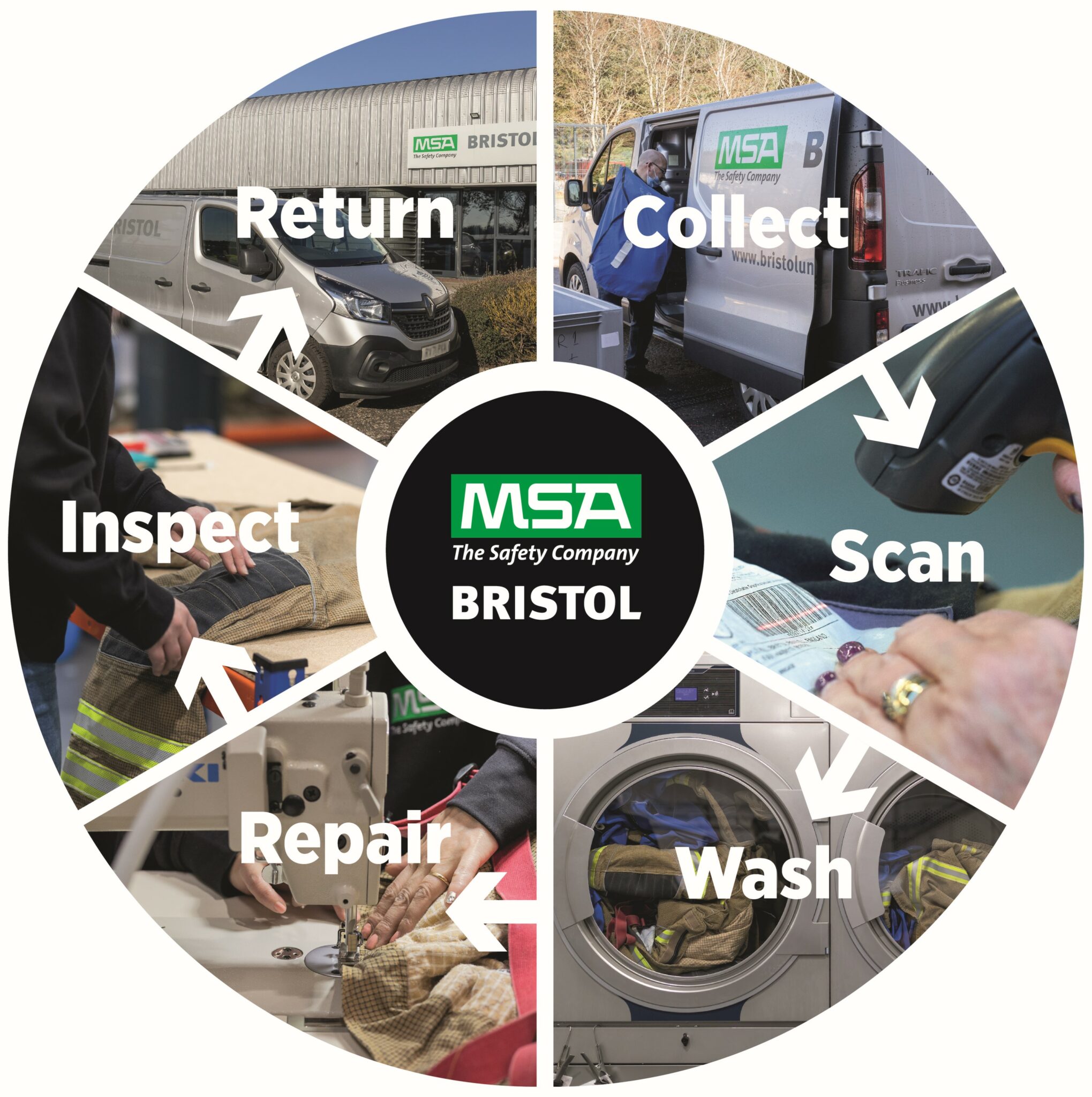
Scottish FRS is the UK’s largest Fire and Rescue Service with 6,660 firefighters operating out of 365 stations, and is the first to make use of our new Scottish Service Centre.  As part of our service we provide collection, cleaning, decontamination, inspection, maintenance, garment tracking, delivery, stock support and online ordering via a Wardrobe Management System, in a continuous cycle:

  • MSA Bristol delivery drivers collect soiled or damaged kit from key service hubs around Scotland in a fleet of liveried vans. 
  • The garments are transported to the Scottish Service Centre in Livingston where they are professionally washed and dried.
  • Contaminated PPE which has been exposed to toxic or hazardous materials is cleaned in a specially controlled environment.
  • Each garment is thoroughly inspected, and any imperfections or damage repaired by our team of skilled sewing machinists.
  • The garments are checked again, and if they pass the inspection, and are fully fit for purpose, they are returned to Scottish FRS.
  • A service history log is completed for each item of PPE, recording all cleaning, repairs, decontamination and inspections. Unique bar codes enable the tracking of each item’s life-journey including the date of manufacture, and the specific rolls of fabric that were used to create it.
  • Collection to delivery is undertaken within seven days.

The Service Centre features top-of-the-range commercial 33kg capacity Electrolux washers and driers, which are digitally-controlled and draw from a pre-heated water supply system to reduce cycle times and electricity usage. Thanks to this swift and efficient new technology, the Centre has the capacity to handle up to 900 garments per week, with the service history of each and every item tracked via a unique bar code.

Smooth operations

Our new team at the Service Centre, headed up by Manager, Anton De Klerk, has been working very closely with Scottish FRS to gradually implement all these systems and ensure the processes are running smoothly. Roddy Mackinnon, Equipment Manager at Scottish Fire and Rescue comments: “Regular cleaning, decontamination and repair of PPE is essential for providing firefighters with suitable protection.

“We have been using MSA Bristol’s managed services since March 2021 and are delighted that these services are now being delivered within Scotland.  The team have worked closely with us throughout the transition to ensure that the high levels of service and quick turnaround times are maintained.”

At MSA Bristol we firmly believe our fully managed services provide the gold standard of care and maintenance throughout the lifetime of a PPE garment.  As a company, our ultimate goal is to offer PPE that provides maximum protection against all potential hazards and risks to firefighters. Whilst we are proud to be a world leader in the design and manufacture of high-quality PPE, it is just as important that our kit is well-maintained and regularly cleaned, so that it gives the very best protection at each and every call out.

This article was originally published in the September edition of IFSJ. To read your FREE digital copy, click here.

Expert Insight: Weaving protection into the fabric of firefighting

IFSJ sat down with Amanda McLaren, Managing Director at Hainsworth Protective Fabrics to find out about the technical side of its flame-resistant fabrics

Let’s start at the beginning: can you tell me about the history of Hainsworth?

Hainsworth Protective Fabrics is a leading manufacturer of PPE fabrics, based at our Mill in West Yorkshire. Its parent company AW Hainsworth & Sons was established in 1783 as a manufacturer of protective woollen uniform cloth for the British army. Hainsworth cloth is synonymous with UK military history, and the iconic scarlet fabric is still worn by the Queen’s Guards outside Buckingham Palace today. Hainsworth now manufactures premium woollen textiles for a wide range of markets, including fashion, leisure and transport interiors, but it is through our Protective Fabrics brand that we continue to develop our expertise designing and developing world-class flame-retardant textiles for emergency services professionals.

At what point during its extensive history did Hainsworth become involved with the fire industry?

Hainsworth has been supplying fabric for firefighter uniforms since the earliest days of the fire service. In the 19th century, the most flame-retardant fabric on the market was Wool Melton, which was manufactured by Hainsworth for the British army. Naturally, when Eyre Massey Shaw established the London Fire Brigade in the late 1800s he selected Wool Melton to be used for the firefighters’ protective uniforms.

We continued to supply Wool Melton to UK fire brigades throughout the early 20th century up until the 1970s, when we introduced PPE textiles woven using man-made flame-resistant fibres to the market. From there we continued to develop fabrics that delivered greater and greater levels of flame protection, working closely with firefighters to make sure we understood the changing requirements of their role. Today Hainsworth Protective Fabrics are worn by firefighters around the World, and our amazing Product Development Team continue to push the boundaries of innovative fabric technology.

What are the main uses for Hainsworth fabrics in the fire market?

We have designed and developed fabrics for use across multiple firefighting scenarios, including: structural; wildland; electric arc; urban search and rescue; water rescue; and road traffic collisions.

Our hero product is our TITAN fabric system. TITAN is a fibre structure from which we have developed a range of outer shell fabrics for garments across the emergency services. TITAN fabrics range from TITAN 1241 – a lightweight textile for use in technical rescue and riot police coveralls, where flexibility is paramount – to TITAN 1220, a highly breathable yet strong fabric designed to reduce the risk of heat stress for structural firefighters. Our TITAN 1260 is a premium outer shell fabric woven using Aramids and PBI fibres, increasing thermal integrity while remaining flexible and wearable, and is worn by today’s London Fire Brigade – a far cry from the Wool Melton they started out with.

We also offer a pioneering fabric solution for wildland firefighting PPE – ECO-DRY Shield. The fabric was developed following the introduction of new wildland standards in Australia, and is designed to provide the high mobility and flexibility needed for prolonged call-outs in external environments. ECO-DRY Shield is now the fabric of choice for wildland firefighters in South Australia, which sees some of the harshest firefighting conditions in the World. We recently also started supplying the fabric to firefighters in the UK for the first time.

All of our fabrics are created with the specific needs of the end user in mind and we take the time to listen to firefighters when developing any new products. For example, our AGILE fabric structure was developed in response to firefighter concerns about chemical contamination and exposure to carcinogens. AGILE weaves together protective fibres in a tight structure that provides maximum resistance to liquid penetration and prevents harmful particles from being absorbed into the garment. It is also incredibly strong and durable, allowing for the firefighter to wash their kit over 100 times and still have it perform as well as if it were new.

Can you talk a little about the technical aspects of Hainsworth fabrics?

At Hainsworth we have an unrivalled knowledge of the unique qualities of different fibres and how they can be woven together to maximise their benefits, built up over 250 years of textile manufacturing.

An example of this would be the AGILE fabric structure I described above. We used our long history of fabric knowledge to weave together flame-retardant fibres in a structure inspired by the twill used in classic raincoats, resulting in a fabric that allows for maximum water runoff and protects from harmful liquid chemicals.

We call our approach to textile development Fibre Positioning Technology – the unique placement of fibres resulting in fabric greater than the sum of its parts.

This methodology applies to every product we develop. TITAN was designed as an open and breathable structure that allows for the flow of perspiration moisture, helping the wearer to stay cool and clear-headed. The insulating pockets of air created as a result of this process also increase the wearer’s protection from heat and flame.

In addition to knowing where to position fibres, we also have an innate understanding of how to combine different materials to meet the specific requirements of the wearer. ECO-DRY Shield, for example, is a unique mixture of synthetic flame-resistant fibres and premium merino wool. Nomex and Lenzing FR provide thermal stability, keeping the wearer protected, while wool wicks away moisture and allows for a consistent body temperature. The different fibres combine to create a flexible, comfortable, yet flame retardant textile perfect for the modern wildland firefighter.

Finally: tell me little about your own background and your future plans for Hainsworth?

Since 1989, I have been working within the Engineering Sector; focusing on my chosen career path – Operations and Supply Chain Management. During 1999, I took my first step into the Textile Sector, working as a Supply Chain Manager and subsequently as the Operations Director, for James Heal & Company – a Global Leader of Textile Testing Equipment.

In 2008, I left the Business in to explore Directorship positions within larger Manufacturing environments – covering both the Automotive and Leisure Sectors., each one of them a leading UK Brand. However, I missed Textiles and returned to James Heal in 2014, to support the Owner to complete a Business Sale – subsequently succeeding him as the new Managing Director of James Heal in 2014, under the ownership of Battery Ventures – a VC Company based in Boston, USA. During the following 6 years’, I was fortunate enough to travel to many Countries, visiting our Agents and end Customers’ – which of course, were often Textile Mills. The top and bottom line grew to plan and I learned a lot about running a successful Business.

In late 2020, I noted AW Hainsworth were looking for a new Managing Director for their Business – AWH was actually a Customer and Supplier to James Heal, so I was more than familiar with the Mill and the amazing Products produced. It was ‘hand in glove’ as a fit and as such, given the challenging post-pandemic and Brexit environment, I was thrilled to be appointed into this exciting role, in April 2021.

Since then, with the support of both the shareholders and a highly competent and experienced Team, I have been able to redefine our growth strategy and determine a number of new opportunities for the Business. We exceeded last year’s Business Plan and have set out a new 3-year plan, which demonstrates growth through an ongoing investment programme. We have already invested in a state-of-the-art R&D and Quality Control Laboratory and have placed orders for new Raising & Cropping Machinery, along with a new Loom for our Leisure Business. We have full commitment to a Sustainable Business Model; putting our people at the centre of investment strategy – this includes a newly defined Apprenticeship Model and investment in existing skills, to ensure a multi-skilled workforce for the future. All in all, it is a very exciting time for the company and I am thoroughly enjoying steering the ship.

This article was originally published in the September edition of IFSJ. To read your FREE digital copy, click here.