U.S. Forest Service has ended its prohibition on masks for Wildfire Fighters and will now provide N95 respirators during major incidents across the United States.
AkzoNobel launches Chartek ONE passive fire protection in Europe
International has introduced Chartek ONE, an epoxy-based passive fire protection system, to the European market
Turnout gear’s dirty secret: Gear Wash explains contamination risks
Brian Marenco, Director of Major Accounts at Gear Wash, explains how proper PPE decontamination can protect firefighters from harmful contaminants embedded deep within turnout gear
Equipmake develops electric fire engine charging system
Equipmake has announced the development of the ZEPA V2V project, a new auxiliary power system designed for electric fire engines.
Kidde Commercial adds new fire alarm devices
Kidde Commercial has announced new outdoor models and low frequency horn-strobes for its Genesis LED fire alarm series.
Illinois to ban PFAS in firefighter gear from 2027
Illinois will ban firefighter gear with intentionally added PFAS from 2027.
Ballyclare to showcase firefighter PPE at UK Emergency Services Show
Ballyclare has announced it will present its latest firefighter protective clothing at the Emergency Services Show (ESS) in Birmingham on 17–18 September 2025.
How to Test Smoke Alarms Properly
A smoke alarm is one of the most important safety devices in the home, yet they’re often overlooked until it’s too late.
If you have one installed, testing your smoke alarm regularly is a simple task that can save lives.
To test a smoke alarm, press and hold the test button on the front panel until you hear a loud, continuous sound.
If the alarm does not sound, replace the battery. If it’s a sealed unit, speak to a specialist to replace the alarm.
You can also use a smoke detector test spray or safe smoke source to check the sensor, following the manufacturer’s guidance.
Our article explains exactly how to test your smoke alarm properly, how often you should test it, what to look out for, and what to do if something’s not right.
Whether you’re a homeowner, renter, or responsible for a business premises, this guide will leave you better informed and safer.
What is a smoke alarm and do I need one?
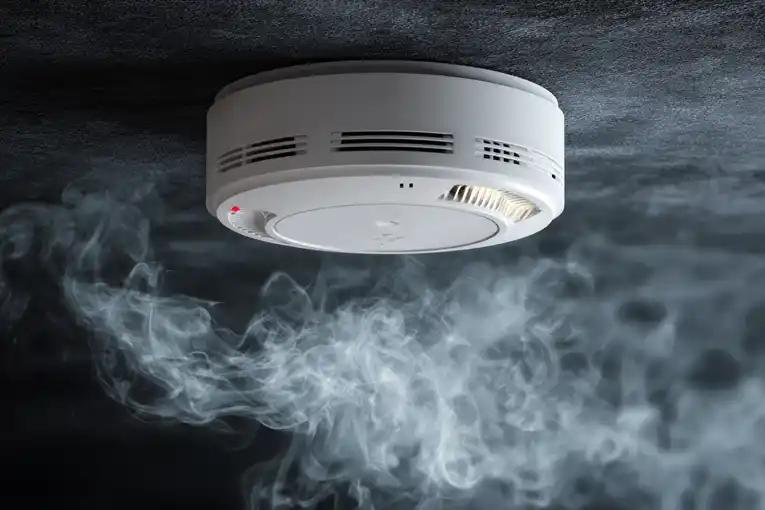
Smoke alarms are devices specifically designed to detect smoke (a primary indicator of fire), and sound an audible warning to alert people in the building.
Most smoke alarms operate using either ionization sensors, which respond to fast, spreading fires, or photoelectric sensors, which are better at detecting slow, smoldering fires.
Some units combine both technologies for a more comprehensive coverage.
Every single building, residential or commercial, needs a smoke alarm – bar none!
In most countries, having at least one working smoke alarm on every level of a home is a legal requirement.
In the United States for example, the National Fire Protection Association (NFPA) recommends smoke alarms are fitted inside each bedroom, outside each sleeping area, and on every level of the home, including the basement.
In the UK, Australia, and many other countries, similar laws and recommendations also exist.
Why Test Your Smoke Alarms?
Testing your smoke alarm is the only way to know its working properly.
Even if the unit appears in good working order, components inside can degrade over time.
Batteries can die. Dust or insects can clog the sensors. Wiring can loosen.
A malfunctioning smoke alarm is essentially useless in an emergency.
Fire statistics consistently show that the risk of dying in a home fire is cut in half when working smoke alarms are present.
Regular testing ensures you and your family are alerted in time to escape.
How Often Should I Test My Smoke Alarms?

Experts recommend testing your smoke alarms once a month.
This frequency ensures that any battery issues, sensor faults, or connectivity problems are identified before a real emergency happens.
Here’s some additional maintenance recommendations to remember:
- Battery-powered alarms: Replace batteries at least once a year, unless the alarm uses a 10-year sealed battery.
- Hardwired alarms: These are connected to your home’s electricity supply but typically still have a backup battery that needs yearly replacement.
- All smoke alarms: Replace the entire unit every 10 years, or sooner if the manufacturer recommends it or if the unit fails testing.
Marking these tests on your calendar or making them a part of your monthly routine is an easy way to stay safe.
How to Test a Smoke Alarm

Testing a smoke alarm is a very straightforward process, but it varies slightly depending on the type of smoke detection unit you have installed.
Battery Units
- Locate the test button: This is usually visible on the front face of the alarm.
- Press and hold the button: After a few seconds, the alarm should emit a loud, high-pitched sound.
- Listen for consistency: The sound should be continuous and strong. If it’s weak or erratic, replace the battery immediately.
- No sound? Replace the battery first, then test again. If there’s still no response, replace the entire unit.
Hardwired Units
- Locate the test button: Press and hold the test button exactly as you would on a battery-operated alarm.
- Interconnected alarms: If your home has interconnected alarms, pressing the test button on one unit should cause all the alarms to sound. This is normal and confirms they’re correctly linked.
- Backup battery: Even though these alarms are connected to mains power, always check the battery backup. If the alarm fails the test and replacing the battery doesn’t fix it, call an electrician to inspect the wiring or replace the unit.
Optional Sensor testing
If you want to test the smoke sensor itself (not just the loudspeaker or battery), you can use a smoke detector test spray.
This creates a safe, simulated smoke environment.
Unless advised by the manufacturer, avoid using real smoke such as candles or matches, as this can contaminate and damage the sensor.
Troubleshooting
If your alarm fails the test or behaves strangely, here’s what to do:
- Weak or chirping sound: This usually indicates a low battery. Replace it and retest.
- No sound at all: Try a brand new battery. If still silent, the unit may be faulty.
- Frequent false alarms: Dust, steam, cooking fumes, or insects can all cause false triggers. Clean the alarm with a vacuum cleaner or soft brush. Avoid using sprays or solvents.
- Random beeps: Some units beep to signal end-of-life, often every 30 to 60 seconds. Check the label on the back for the recommended replacement date.
Safety Tips
- Always test your alarms after a vacation or extended period away.
- If you’re hearing impaired, install smoke alarms with strobe lights or vibration alerts.
- Avoid painting over smoke alarms since this can block sensors.
- For rental properties, landlords are usually responsible for installing alarms, but tenants should still test them regularly.
- Don’t ignore chirps or unusual sounds, since they’re indicators telling you something’s wrong.
Key Takeaways
Testing your smoke alarms is one of the simplest ways to protect everyone in your home.
It takes less than a minute, but it could be the difference between life and death in the event of a fire.
Make it a habit, stay informed, and stay safe.
When testing, press and hold the test button monthly to check your smoke alarm’s function.
Replace all batteries at least annually, or sooner as needed.
Alarms should be fully replaced every 10 years, even if they seem to function properly.
Use some test spray for a more thorough check of the smoke sensor if desired.
And address any beeping, silence, or false alarms promptly. Don’t ignore them.
Still manually washing your PPE? Why fire services across Europe are switching
MEIKO examines the risks of poorly cleaned PPE, including equipment failure, cross-contamination and technician exposure
Could new firefighting foam replacements change the market?
Capstone withdrawal and HT&K’s response
HT&K’s Anti-Fire Group has announced the launch of HT1157, HT1157D, and HT1470 as replacements for Chemours’ discontinued Capstone fluorosurfactants, according to the company’s statement issued on 27 August 2025.
Chemours stopped supplying its Capstone fluorosurfactants to the firefighting market in early 2025, a move that disrupted foam concentrate formulation worldwide.
HT&K said its new fluorosurfactants are designed as drop-in replacements for Capstone 1157, 1157D, and 1470, allowing use without the need for recertification of existing foam concentrates.
The group confirmed that its products match the actives concentration and fluorine content of the Capstone range.
It added that opportunistic companies had marketed inferior substitutes under similar numbering, but the HT&K formulations are chemically and spectroscopically identical to the originals.
Technical specifications and comparisons
HT&K explained that comparative testing, including surface tension analysis, showed its new products behave in the same way as the discontinued Capstone materials.
It said the results demonstrate that HT1157, HT1157D, and HT1470 function as direct replacements.
Small observed differences were described as normal batch-to-batch variations typically seen within production runs from the same manufacturer.
The company noted that foam properties data are available on request and reinforce the similarity between its formulations and the Capstone products.
Market positioning and product line
According to HT&K, the new fluorosurfactants are part of a wider line of chemicals developed for firefighting foam formulators.
The company stated its aim is to provide equivalent alternatives to products from Chemguard, Chemours, and Dynax.
It said this allows formulators to continue production without requalification of concentrates.
HT&K added that its website contains further details on the replacement products and its wider portfolio.
Background on HT&K Anti-Fire Group
HT&K explained that it was established in 2010, with research and production facilities in Helon, Dongguan, and Qingyuan, China.
The company reported employing 70 staff, with its research and development team holding more than 40 international patents and over 100 years of combined experience in fluorochemicals and polymers.
It formed the Anti-Fire Group in 2019 with a dedicated focus on firefighting chemicals.
Since then, it said it has developed both fluorinated and fluorine-free foam concentrate technologies.
Future development and fluorine-free alternatives
HT&K noted that alongside fluorosurfactant replacements, it continues to develop fluorine-free firefighting foam technologies.
It said it has achieved what it described as “performance-leading” results in this field.
The company indicated that it remains active in research and development to meet changing regulatory and environmental expectations.
It stated that its goal is to establish itself as a technology leader in the firefighting chemical segment.
Relevance for fire and safety professionals
The discontinuation of Capstone fluorosurfactants has disrupted firefighting foam supply chains.
HT&K’s replacements offer formulators continuity by avoiding the need to recertify existing products.
The company’s development of fluorine-free alternatives aligns with wider industry moves towards reducing reliance on fluorochemicals.
This development is relevant to fire and safety professionals involved in foam specification, procurement, and compliance.
New HT&K firefighting chemicals replace discontinued Capstone products: Summary
HT&K’s Anti-Fire Group has launched HT1157, HT1157D, and HT1470 as replacements for Chemours’ discontinued Capstone fluorosurfactants.
Chemours ended supply of Capstone firefighting products in early 2025.
HT&K said its replacements match the concentration and fluorine content of the originals.
It confirmed they are drop-in substitutes that avoid the need for recertification of foam concentrates.
The company reported surface tension tests showing performance equivalence.
It stated that differences observed were consistent with normal manufacturing batch variations.
HT&K said foam property comparisons are available on request.
The replacements are part of a wider line of firefighting chemicals.
The group was formed in 2019 to focus on firefighting chemical development.
It operates from facilities in Dongguan, Helon, and Qingyuan, China.
The company said its staff hold more than 40 patents.
HT&K is also developing fluorine-free foam concentrate alternatives.
It reported that these have achieved leading performance in tests.
The replacements are available through the company’s website.
HT&K confirmed that product availability and pricing details can be requested directly.