Burghill Farms, a partnership trading as Dalhousie Estates, and Mr Piers Le Cheminant have been fined following an incident where one of the occupants of a holiday cottage was found collapsed in a bathroom heated by a portable cabinet propane gas heater.
Forfar Sheriff Court heard that on 28 October 2015, the victim, Thomas Oliver Hill, was staying with his girlfriend and her family at Glenmark Cottage, Tarfside, north-west of Edzel. They were renting the cottage from Mr Le Cheminant, who in turn rented the property from Burghill Farms who were paid 20 per cent of the rental income he received. Mr Hill had taken a bath in the bathroom, which was heated by the gas heater. His girlfriend and her family became concerned when he did not appear after an hour. They knocked on the bathroom door and forced entry when they didn’t receive a response. Mr Hill was found collapsed next to the bathroom door and later died. A post-mortem confirmed the cause of death was carbon monoxide poisoning.
An investigation by the Health and Safety Executive (HSE) found that Burghill Farms and Piers Le Cheminant did not have a suitable and sufficient system of maintenance in place for the cabinet heaters and the cabinet heaters were placed in rooms which were too small for the heaters to be used safely due to a lack of suitable ventilation. However, these failings could not be proven to be causally connected to the death of Mr Hill.
Burghill Farms of Brechin Castle, Brechin, Angus pleaded guilty to breaching Regulation 36(2)(a) of The Gas Safety (Installation and Use) Regulations 1998 and Section 33(1)(c) of the Health and Safety at Work etc. Act 1974. The company was fined £120,000.
Piers le Cheminant of Poundsgate, Newton Abbot, Devon, pleaded guilty to breaching Regulation 35 of The Gas Safety (Installation and Use) Regulations 1998, and Section 33(1)(c) the Health and Safety at Work etc. Act 1974. He was fined £2,000.
Speaking after the hearing, HSE principal inspector Niall Miller said: “Landlords have a duty to maintain gas heaters in a safe condition, which in the context of movable gas appliances includes maintaining an appropriate operating environment.”
A luxury motor yacht manufacturer has been fined after a worker suffered serious crushing injuries to his right hand during a lifting operation.
Leicester Magistrates’ Court heard how on 3 December 2018, an employee suffered serious crushing injuries to his right hand during the lifting of a storage cage at Fairline Yachts manufacturing facility at Nene Valley Business Park, Oundle. As there was no goods lift in the manufacturing unit an overhead crane was used. As the cage was lifted it began to tip and fall in the direction of the employee. The cage trapped his hand against a boat trolley causing serious crushing injuries to the employee’s dominant right hand.
An investigation by the Health and Safety Executive (HSE) into the incident found that the lifting operation was not properly planned by a competent person, appropriately supervised or carried out in a safe manner.
Fairline Yachts Limited of Nene Valley Business Park, Oundle pleaded guilty to breaching Section 2(1) of the Health and Safety at Work etc. Act 1974. The company was fined £230,000 and ordered to pay costs of £7,410.
Speaking after the hearing, HSE inspector Aaron Butel said: “When undertaking lifting operations involving lifting equipment companies should ensure that they are always properly planned by a competent person, appropriately supervised and carried out in a safe manner.
“Companies should be aware that HSE will not hesitate to take appropriate enforcement action against those that fall below the required standards”.
Firefighters are preparing for a busy post-lockdown Bonfire season after the number of fires almost doubled during the week between Halloween and Bonfire Night last year.
Firefighters saw around a 90 per cent rise in fires in the period between 30 October and 9 November 2020 in comparison to the week prior, with London Fire Brigade’s 999 Control Officers taking over 600 calls on Bonfire Night alone. Firefighters attended 542 fires in this period, making the season one of the busiest times of the year for the Brigade.
In lockdown, this was an increase of more than 10 per cent from the previous year, which the Brigade believes was due to more people using fireworks at home. But this year, the Brigade is expecting it to be even busier. This is because the pent-up demand for fireworks displays during the first post-lockdown Bonfire season is expected to result in far more displays and gatherings overall, as friends and family who missed out on celebrations last year come together to host home fireworks displays.
The Brigade’s Deputy Assistant Commissioner for Fire Safety, Charlie Pugsley, said: “This is always a very busy time of year for the Brigade and whilst we know that this season has been much anticipated by family and friends who weren’t able to be together at home last year, we’re asking people to consider alternative ways to celebrate rather than hosting fireworks displays at home.
“Find an organised fireworks display near you instead. They’re controlled and much safer, and it will also be more considerate for your neighbours and any pets. If you can’t attend an organised event, why not get creative with firework alternatives like glow sticks and garden lights.
“If you do choose to use fireworks, make sure you familiarise yourself with our advice, ensure you have enough space to use fireworks, carefully read the instructions and stay safe.
“Take care when buying fireworks, buy them from a reputable, licensed seller and always look for a CE mark to make sure they’re safe to use and only buy fireworks up to Category 3*. Never drink alcohol and set off fireworks and don’t throw fireworks or return to a firework once it has been lit. It’s important to also be careful with sparklers, particularly with children, as they can stay hot enough to cause serious burns even after they burn out.”
The Brigade is also urging people to avoid bonfires in gardens as they can quickly spread out of control. However, they ask that those who do choose to build a bonfire check their local authority’s advice on bonfires and always build bonfires clear of buildings, sheds and fences and never leave it unattended.
Eight fires caused by fireworks on Halloween last year
It’s not just Bonfire Night that the Brigade is concerned about, as firefighters attended eight separate incidents across London on Halloween caused by fireworks last year. A stray firework on Halloween night 2020, destroyed the balcony of a flat in Fulham.
The Brigade is also urging those planning on having candles out at Halloween or Bonfire Night, to swap to a flameless electric alternative. These battery powered lights are much safer than traditional candles and reduce the risk of setting costumes or decorations alight.
*Fireworks come in 4 categories:
Category 1 fireworks are low hazard fireworks. They pose the least danger, make very little noise and are for use in a limited space (including indoors). Examples include party poppers and Christmas crackers.
Categories 2 and 3 are ‘adult fireworks’ and are available in shops and supermarkets. These will have Category F2 or F3 on the box.
Category 4 fireworks are banned for sale to the public and are for professional displays only. These are available at specialist suppliers.
A handrail manufacturing company has been fined after an employee’s was injured after being drawn into a roller and crushed.
Manchester Magistrates’ Court heard how, on the 27 March 2019, an employee of Dealercast Ltd in Hardy Street, Eccles was being trained by company director Chris Ellor to use a rolling machine to bend pieces of steel tube. While the employee was feeding the tubing between the rollers of the machine, the heavy-duty gloves he was wearing caught between the tubing and one of the rollers. His hand was drawn into the machine injuring his little finger, which later had to be amputated from the second knuckle.
An investigation by the Health and Safety Executive (HSE) found that the company had not performed a machine specific risk assessment so the risk of entanglement in moving parts had not been highlighted. The employee had no previous experience of working on this type of machine and had not completed training. The company failed to recognise the dangers of using gloves when working with machinery, which was standard practice, as the company had not provided instruction on the correct procedures.
Dealercast Ltd of Barton Hall Industrial Estate, Hardy Street, Eccles, Manchester pleaded guilty to breaching Section 2 (1) of the Health and Safety at Work etc. Act 1974. The company was fined £20,000 and ordered to pay costs of £3,661.
Director Christopher Ellor of Arncliffe Road, Bury, Greater Manchester pleaded guilty to breaching Section 2 (1) of the Health and Safety at Work etc. Act 1974, by virtue of 37(1) of the Act. He was fined £1,280 and ordered to pay costs of £3,461.
Speaking after the hearing, HSE principal inspector Peter Lennon said: “Employers should ensure they carry out an assessment of the risks and put in place a safe system of work for the operation of all machinery. Companies should be aware of the responsibility upon company directors to recognise the way in which their employees are working. Employers should also be aware of the risk of entanglement when wearing gloves whilst operating machinery.
“Had the company put in place a clear system of work and prohibited the wearing of gloves when operating this machinery, the incident could have been avoided.”
Britain’s safety regulator has today, 25 October, issued a safety notice on the use of wheeled loading shovels, widely used in the waste and recycling sector.
The Health and Safety Executive (HSE) notice follows nine fatal vehicle-pedestrian collisions in the past four years. Six of these occurred in the waste and recycling sector, with the remainder involved moving wood chip.
HSE has identified issues of poor visibility caused by the bucket and load, the engine at the rear and the cab pillars, significantly reducing the drivers’ ability to see pedestrians and, to a lesser extent, other vehicles. The use of larger capacity buckets, which has become common practice where low-density material is being moved, makes forward visibility significantly worse.
Regulation 4 of The Provision and Use of Work Equipment Regulations 1998 (PUWER) requires machinery to be suitable for the purpose for which it is used. This also applies if the equipment is adapted, for example by fitting a larger bucket.
Manufacturers and other specialist suppliers have attempted to address the problem by adding ‘visibility slots’ or mesh at the top of buckets, but evidence from investigations suggests these are ineffective when the bucket is in the carry position or obscured by the load. Camera systems have been under development for some time, but their effectiveness remains unproven and are not widely available.
Head of HSE’s Waste and Recycling team, HM Principal Inspector of Health and Safety, Tim Small, commented:
“Poorly planned use of wheeled loading shovels can have fatal consequences. This safety notice reminds duty holders who use these machines of the need to fully assess and actively manage the risk of vehicle-pedestrian collisions. Currently, the only effective control measure is strict segregation of vehicles and pedestrians. If you cannot ensure that segregation, you should not use larger capacity buckets or wheeled loaders, but employ alternative work methods such as using different machinery and/or site management arrangements.
“Before using wheeled loaders – or making changes to them – you should review your workplace transport risk assessments to ensure they will be safe to use in your environment and in the way you intend to use them. By implementing appropriate risk controls, needless pedestrian deaths could be avoided.”
With more regulations being forced upon petrol and diesel vehicles, coupled with a public that are placing a greater emphasis on the environment, demand for public use in EV’s is increasing even with the dangers of electric vehicles being very real.
For that reason, it’s important that those using the EV’s are aware of the potential dangers.
One such danger is fire.
In this article, Tommy Carnebo, a firefighter with 21 years’ experience and specialist in fire in electric and gas cars looks to answer some of the most common questions regarding electric vehicle dangers and fires.
Carnebo currently works as a firefighter at Södertörn Fire Protection Association in Stockholm, Sweden but is starting a new position at Dafo Vehicle Fire Protection in Sweden in the upcoming month.
What Happens If You Crash an EV Compared to an ICE Vehicle?
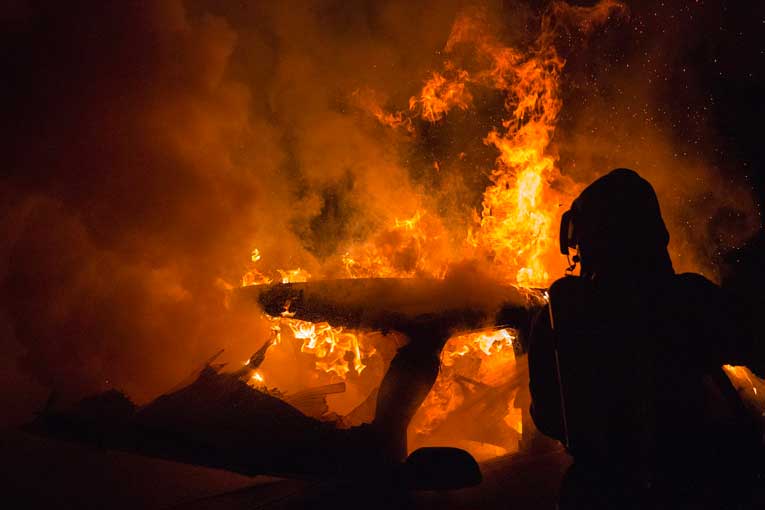
Electric Vehicle Engulfed in Flames. Image credit: Pixabay
The first thing you have to understand is that every department around the world are aware of the risks of conventional internal combustion engined vehicles and what can happen when they crash.
But the new challenge for us is electric vehicles.
When they crash, they don’t follow the pattern of ordinary cars that we are used to because they are propelled with batteries.
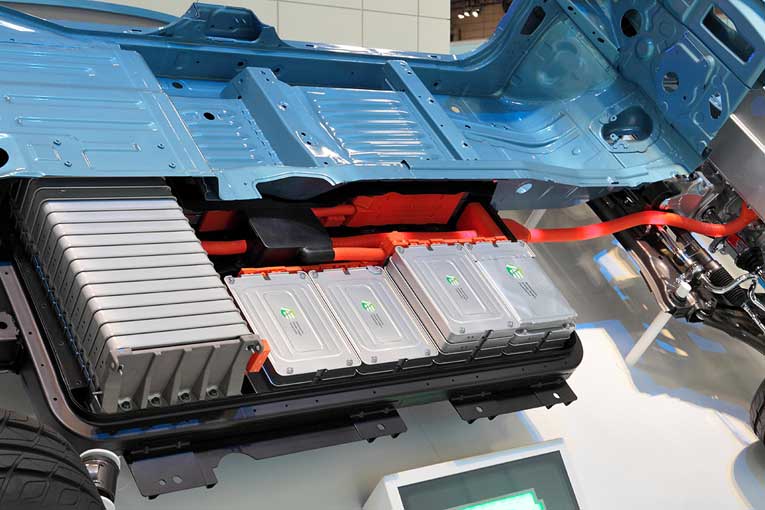
The problem with the electric vehicle is that when they are involved in a high-speed crash, there’s a chance that the battery will be damaged and catch fire.
This is the biggest difference between normal “ice” vehicles and electric vehicles.
With a normal vehicle, there may be some fuel that leaks but we can simply put foam on to the spill.
I have personally been to fire departments in Norway, Sweden and other European countries and I can say with experience that they are not prepared for this type of accident involving electric cars.
Can Electric Vehicles Catch Fire After a Crash?
We have seen a number of cases like this in Sweden.
In fact, as recently as this summer my fire department were on the scene of a crash involving a Tesla and a Volvo.
When the team arrived at the scene, the Tesla was engulfed by fire.
They tried to suppress the fire, but the problem with electric vehicles is that they are so hard to put out that the team left the Tesla and focused on the people who were involved in the crash.
They did put the fire out, but it reignited several times which is also another issue with these vehicles.
They can catch fire again, and again and again.
What’s the Different Between a Normal Car Fire & an EV Fire?
I am currently working at a department in Sweden and for the last couple of years we have had roughly 80 car fires each year.
I would say that 99% of them aren’t catching fire by themselves, because someone is helping them.
With these fires we arrive at the scene and put them out by using 1500 litres of water.
That sounds a lot, but it really isn’t!
With electric vehicles, if the car is running to the state of thermal runaway, we have a real challenge because there is no way we can get the water inside the battery.
We need to do that to extinguish the fire, but the battery pack is sealed which makes getting inside impossible.
When the thermal runaway occurs, there’s an opening that allows us to get some water inside.
But we still have to remain on the scene for a number of hours to make sure that the car doesn’t catch fire again.
When we calculated how much water this uses, we found that we were using between 10,000 to 15,000 litres of water compared to 1,500 on a normal car.
Thermal runaway occurs when a battery cell has reached the temperature at which the heat will continue to increase on its own and the electrolyte catches fire.
Through this it becomes self-sustaining as it creates oxygen which feeds the fire.
As the heat source and the fuel are both existing within the battery, these fires can develop quickly.
The release of flammable electrolyte makes fire extinguishing very difficult.
In addition, there’s a lot of toxic gases being emitted such as hydrogen fluoride, which can cause serious damage to both the skin and the respiratory tract.
Can You Extinguish a Thermal Runaway in an EV Battery?
So far in Sweden we are using water and there is are a lot of companies working to provide alternatives to water-based solutions.
But the problem is it’s not possible for us to get the water inside the battery.
If you’re going to use water or any other solutions, you need to first get it inside the battery.
Essentially, it’s possible to put the fire out, but you first have to get inside the battery and that’s the biggest problem for fire departments.
Both the fire department and the salvage company have to be educated on how to salvage burnt out electric vehicles.
Essentially, they have to do some background checks on the vehicle before salvaging it.
When those checks have been done, and there’s no smoke from the battery, you can salvage the car.
But it can’t be towed to an ordinary vehicle speed shop because it has to have a quarantine place.
What’s a Quarantine Place & How Long Does an EV Need to Stay There?
At my fire department we’ve produced a document together with three organisations in Sweden that outlines what a quarantine place should look like.
Firstly, it has to have a roof overhead because if the battery is exposed to rainwater, it can start to burn.
Secondly, if there are no concrete walls, there has to be nothing within 10 metres of the vehicle.
You can start to decrease the area if you have concrete walls and if there are some form of monitoring systems in pace in the quarantine place.
What Can Be Done to Make the Quarantine Place Safer?
We’re working with Dafo Vehicle Fire Protection to develop a sensor that can monitor the damaged electric vehicle.
We’re also looking at getting sensors next to and inside the car that can monitor if there is a ventilation or a thermal runaway that is starting so you can get an early warning if there is smoke.
If you have these types of systems in place, you can start to decrease the area of the quarantine place.
With these systems you will also get a warning that there may be a fire starting or something is wrong with the batteries.
The blueprints for this will be produced soon.
If There’s an EV Fire Underground, a Garage Ore on a Ferry, is the Fire Department Equipped to Handle It?
The quick answer to this is no.
The issue with electric cars is they produce a number of toxic gases such as hydrogen fluoride and scientists aren’t sure on how toxic they are.
When these gases enter our skin, there’s a risk that firefighters will be injured, even with breathing apparatus on.
In Sweden we have a time limit of 40 minutes of exposure per person then you have to leave the scene.
The problem with underground fires is that there is so much heat and there is nowhere that we can get rid of the smoke, and of course with electric vehicles they can keep on reigniting.
Cities are now looking to electrify buses, what are the risks?
We need to have some form of monitoring of the batteries because there are some batteries that are usually placed on the bus roof, and as they are fast charging there is always a risk.
Also, as these cities will have a high number of buildings, if there’s a fire the building will have to be evacuated due to the smoke.
Finally, in some cities these buses are going under low bridges.
If one of these buses hits a low bridge, there’s a risk of causing a big fire.
What are your thoughts on the mining industry using electric vehicles?
I have worked with a lot of mining companies and electrical mining can be a good thing, but the batteries are so big that you will have to have monitoring on the batteries and the charging because the mining and charging will be done underground.
You will also need something that will buy some time to allow people to get to the rescue chambers.
Early detection of potential battery failure together with rapid cooling is key to effectively stopping, or delaying a potentially hazardous situation without the fire developing further.
For this reason, Dafo Vehicle Fire Protection has developed a specific risk mitigation solution.
About the Author
Tommy Carnebo, is a Risk Management Specialist at Dafo Vehicle Fire Protection.
He’s written and published a wide range of editorial pieces and articles on some of the most common questions on electric vehicle dangers.
A self-employed gas fitter from Burnley has received a 15-month community order after carrying out gas work without being Gas Safe registered.
Preston Crown Court heard that Adam Kilbride carried out work at two properties in Burnley in December 2018 and January 2019, whilst falsely claiming to be Gas Safe registered.
Following notification of installation defects by the occupiers of the properties, Gas Safe inspectors visited one of the properties and found the work to be of a poor standard. It was classed as ‘At Risk’ and ‘Not to Current Standards’
An investigation by the Health and Safety Executive (HSE) found Adam Kilbride was not a registered with Gas Safe Register and was also found to have falsely pretended to be Gas Safe Registered.
Adam Kilbride of Burnley pleaded guilty to breaches of Regulations 3(3), 26(1) and 3(7) of the Gas Safety (Installation and Use) Regulations 1998. He was sentenced to a 15-month community order and 100 hours of unpaid work . He was also ordered to pay £400 compensation to the homeowner and ordered to pay costs of £6000.
Speaking after the hearing, HSE inspector Caroline Shorrock said: “Adam Kilbride undertook gas work which he knew he was not registered to do. All gas work must be done by registered Gas Safe engineers to ensure the highest standards are met in order to prevent injury and loss of life. Installers will be prosecuted if they carry out gas work without the proper qualifications. We would advise all householders to check that anyone they allow to work on the gas supply is gas safe registered. This can be done at the Gas Safe Register website”.
The Scottish Fire and Rescue Service is highlighting the risks to communities from deliberate fire setting and attacks on crews as it enters its busiest period of the year.
Firefighters attended more than 1350 deliberate fires during the four-week period leading to Bonfire Night 2020, placing unnecessary pressure on the Service and potentially impacting crews’ ability to respond to genuine emergencies.
The Service wants to highlight the issue and is asking the public to support its #BangOutOfOrder campaign to raise awareness of the impact these incidents cause.
Deputy Assistant Chief Officer (DACO) Alasdair Perry is the Scottish Fire and Rescue Service’s Head of Prevention and Protection. With just under three weeks to go until Bonfire Night he said: “We have a zero-tolerance approach to deliberate fire setting and anti-social behaviour involving the misuse of fireworks and other projectiles. To say these incidents are ‘bang out of order’ is an understatement.
“A deliberate fire can put property, resources and indeed lives at risk. We are working positively with young people and our partners to raise awareness of the very real dangers and consequences of such actions.”
DACO Perry explained what people can do to keep themselves safe. He said: “The build-up of rubbish and waste, particularly bulky items such as large amounts of cardboard or furniture, represents a real fire risk.
“By taking some simple measures you can help protect you, your family, your property and those around you from the potentially devastating consequences of a fire.
“If you can, store your waste in a safe, locked location such as a garage or shed. If you must store it outdoors – keep it away from the property if possible.
“If you are keeping anything inside, store it away from heat sources and open flames, or electrical outlets and equipment.”
Attacks on firefighters and other emergency services and public-sector staff have also been highlighted.
DACO Perry said: “Last year on Bonfire Night our crews experienced twelve attacks. On any night of the year an attack on crews responding to incidents is unacceptable, but to have twelve on our busiest night of the year puts everyone in danger.
“We know it’s a very small minority of people who engage in anti-social behaviour, but there’s no question it can also impact on our firefighters, Operations Control colleagues and our partners too.
“If an appliance is damaged it may not be available for other emergencies. Our emergency service partners are diverted from other emergencies to escort us to deal with incidents, if crews need treatment and to investigate the attacks.
“It’s time to bring an end to this type of anti-social behaviour and make sure firefighters – and our emergency service partners – can do their job and keep the communities they serve safe.”
The Service has been working with a range of partners including Police Scotland and schools to ensure young people understand the risks of taking part in anti-social behaviour.
Anyone with information about any deliberate fire setting or attacks on emergency services staff can call Police Scotland on 101, Crimestoppers on 0800 555 111 or report online to Fearless at www.fearless.org.
Ross Markham, Managing Director of Bull Products Limited discusses how fire safety on temporary sites can be improved
Fire safety in permanent structures and buildings, like homes and offices has been high in the news agenda over recent years, but fires are all too common when the site is temporary in nature. The most common type of temporary site is a construction site, whether that is a new build or a refurbishment project. The fire at the Notre-Dame cathedral renovation is a prime example of the potential risks within a construction site.
However, there are other temporary sites where fire presents a risk to assets and human life. These could include shipbuilding sites, civil engineering and infrastructure projects and even Covid test centres and festivals.
What are the risks?
There are numerous causes of fires on temporary installations. These include ignition risks, electrical faults, flammable materials and unauthorised site access. Below are the dangers that each bring to temporary sites.
Ignition Risk
Historically, smoking on sites has been a major cause of fire on building sites, normally when cigarettes are not properly extinguished. Most sites now prohibit smoking on site; however this has to be constantly and consistently enforced. Having good signage across the sites acts as a good continuous reminder. Designated smoking areas should also be established well away from the main work areas and offices.
Heat is used in many industrial applications, such as when welding and soldering metals. Naked flames are often used in the application of roofing materials. During these processes, sparks can also be a cause of fires.
It is important that site workers are well trained to know the potential site of hazards, so they can minimise the risk by following the correct procedures in the workplace, such as storing materials in the correct place and keeping the workplace clean and tidy.
Many larger sites will have a permit to work scheme (PTW) whereby employees are inducted and trained on health and safety issues, including fire prevention. If a fire breaks out, good training is paramount. Workers should also have access to the correct firefighting equipment and the site should be adequately alarmed, with clear and obvious alarm points and the correct type of detection (heat, smoke etc).
Electrical Faults
Old wiring systems are often the cause of fire in older buildings. For example, when refurbishment projects begin, old wiring circuits can be disturbed and create a heightened risk of fire. Tangled and damaged wires can also overheat and cause fires.
Old halogen and halide light can get very hot and should be avoided on construction sites. One way to overcome this is through the use LEDs, which operate at a low temperature, presenting a fraction of the risk. They also keep energy usage and cost down. All lighting and heating should be kept away from combustible materials – that is to say, it is paramount to ensure that sites are kept clean, tidy and organised.
To minimise the risk of fire caused by electrical appliances, machinery and equipment on temporary sites, PAT testing should be undertaken. All electrical installations must also comply with BS7671:2008. This standard includes a section specific to construction sites.
Flammable Materials
Many temporary sites contain flammable substances in the form of solids (explosives), liquids (i.e. petrol and diesel) and gases (propane, butane). Poorly stored or managed flammables can cause catastrophic fires and even explosions. Additionally, combustible materials like waste packaging and paper, stored incorrectly, can heighten the risk of fire. General waste should also be stored well away from ignition risks.
The management and control of building materials and waste on site is regulated by the Environment Agency through the Site Waste Management Plans Regulations, 2008.
Having adequate spill control facilities and training is useful if flammable accelerants like petroleum, diesel or paraffin are spilt on-site.
Unauthorised Site Access
Thankfully arson is rare on temporary sites, but when it happens it can be catastrophic. Controlling access through adequate physical perimeter security along with gated access points with full identification checks should be a high priority. CCTV systems and security guards may also be an option for larger sites. Again, keeping flammable substances and accelerants locked away will reduce the temptation and opportunity for intruders.
Access management software, like the SmartGate system, can also pre-register visitors, induct them on health and safety, issue permits to work and ensure contractors have adequate certifications and accreditations.
How can temporary site operators and contractors minimise risk?
At Bull, we have developed the Fire360 process which is a sequence of robust events to ensure a low-risk environment.
Some of the key features of the Fire360 process include:
Initial site survey to establish the fire safety requirements of the site, both to maximise protection but also to comply with fire safety regulation.
Carry out an initial formal Fire Risk Assessment (FRA) by a qualified fire risk assessor followed by subsequent FRA’s at regular intervals, normally every 3 or 6 months.
Installation of a fire protection systems, such as the Cygnus 1 system, by BAFE and CSCS certified engineers
Ensure your on-site team receives professional fire safety training, with specialist training for fire marshals and first-aiders.
When a site is completed, fire safety equipment should be professionally de-commissioned. Bull offers a service to collect and store equipment, so it can be tested, cleaned and delivered to the site where it is required next.
Even if all the preventive measures are undertaken, fire can still break out. If that happens, it is important to have a robust alarm system developed specifically for temporary sites, such as the Cygnus 1 system. This system is completely wireless, making installation simple and quick. Cygnus 1 has an extremely strong radio signal, which means it has a greater range and can reach shielded areas of the building that other detection systems cannot. Once installed, Cygnus 1 creates a wireless mesh, or network, with each detector and the control panel. Should a detector be damaged or be obstructed, the Cygnus 1 mesh will self-heal, ensuring coverage throughout the site.
To sum up, by being proactive, systematic and organised, the risk of damaging fires on temporary sites can be dramatically reduced. Whether a site is temporary or permanent, there is no need to compromise on fire safety.
CASE STUDY
PREMIER MODULAR – COVID-19 test sites across the UK protected with Bull Products
Earlier this year, Bull Products was selected to supply its Cygnus Wireless Alarm System to around 50 Covid-19 standalone test sites across the UK.
Premier Modular is the modular building specialist responsible for installing 50 self-contained Covid test sites across the UK, from Inverness to Portsmouth as part of the national effort to support the NHS in increasing testing capacity.
Within six hours of the initial order, Bull installed its Fire Call Point Alarms and Smoke Detectors to the first test site delivered by Premier which was located in Bolton.
Matthew Trigwell, Sales Director at Bull Products, says: “It’s a privilege to work alongside Premier Modular to provide fire safety equipment to these vital test sites. The Cygnus alarm system provides an ideal solution to projects that require a quick turnaround thanks to the speed of installation and ease of use of this temporary fire detection and alarm system.
“It’s another example of how the Cygnus wireless system is ideal for all temporary sites to protect both people and property.”
Elgan Roberts, Contracts Manager at Premier Modular, adds: “We have worked with Bull for many years, and so we were confident they were the perfect partner to supply the Cygnus alarm system. The wireless alarm system is reliable and flexible, and we have no doubt it will provide enhanced fire safety across all of the Covid-19 test sites that we are installing around the UK.”
Ross Markham, Managing Director of Bull Products Limited
A leading manufacturer of fire resistance cables believes building safety could remain a ‘ticking time bomb’ if product testing for fire cables is not strengthened.
For many years, Wrexham Mineral Cables has been calling for more stringent testing standards as it believes too many cables are classified as fire resistant yet are not fit for purpose in real-life fire scenarios.
Under current standards, only ‘fire-resistant’ cables greater than 20mm in diameter undergo testing for direct impacts to reflect falling debris and water jet testing on a single test sample. For ‘ENHANCED fire resistant’ cables under 20mm, no direct impact test takes place, and the water test is just a spray test, whilst different stages of each test are carried out on different samples of cable.
It comes at a time when London’s Fire Commissioner Andy Roe has called for urgent change in the building industry as the number of blocks of flats in London with fire safety failings is now more than 1,000. Whilst a majority of the issues are due to cladding, the remainder have other fire safety defects, and in all of these buildings, LFB has suspended its ‘stay put strategy’.
Wrexham Mineral Cables Commercial Manager Steve Williams says testing needs to be strengthened for all fire-resistant cables as part of the construction industry’s wider drive to improve building safety.
He commented: “ENHANCED fire-resistant’ cables play a fundamental role in ensuring that emergency and building critical systems are supported in the event of a fire. Not only do they provide early indication of a fire, they keep them safe whilst providing extended time for rescue services to evacuate occupants and ensure critical circuits remain functional for longer periods. This is particularly critical in high rise buildings where evacuation times can be extensive or hindered due to the sheer size of the building.
“The tests which construction products are subjected to need to be relevant and relied upon. It is extremely concerning that ‘ENHANCED fire-resistant’ cables most commonly being used in fire alarms, emergency lighting, extraction systems, monitoring systems or even backup generators may not survive fire, water, and direct impact. If this remains the case, building safety will remain a ticking time bomb.”
Mr Williams says Mineral Insulated Copper Cable (MICC) is the only fire performance cable that, in historical testing, has survived over 1000˚C, whilst being subjected to direct hammer blows and a full water pressure test using a fire hose. Samples tested have been measured at just 5.7mm in diameter and maintained circuit integrity for over 3 hours.
He added: “We remain committed to raising industry standards. And the only way to achieve this is by introducing a higher classification for such products. The Government’s review of current systems for testing construction products was a step in the right direction, but more needs to be done to ensure the safety of buildings.
Regardless of size or construction, if a cable is required to function in the event of a fire, each single cable sample must have to pass a true fire scenario test, helping identify those which can survive, rather than simply resist fire. Ensuring that the tests which construction products are subjected to are relevant and can be relied upon is the only way we can make buildings truly safe.”