The Northern Ireland branch of the Institute of Fire Engineers (IFE) is set to host an enlightening webinar titled “The Mindful Firefighter”.
This upcoming event, chaired by Hayley Burgess, IFE’s International President and Northern Ireland branch chair, aims to shed light on the critical topic of mindfulness in the firefighting profession.
Focus on mindfulness in firefighting
In a field known for its high-stress and demanding nature, the concept of mindfulness is increasingly becoming vital for firefighters.
This webinar is a timely initiative to explore this important aspect of mental health in the firefighting community.
Expert insights from Daniel Meeks
The event will feature a presentation by Daniel Meeks, a certified life coach with a deep understanding of mindfulness techniques.
Meeks’ presentation will delve into four key areas: cultivating a state of awareness, the benefits of mindfulness, his unique concept of past, present, and future, and how this approach can benefit the delegates in their professional and personal lives.
Interactive session with opportunity for questions
Following Daniel Meeks’ presentation, the webinar will provide a platform for attendees to engage in a question-and-answer session.
This interactive segment will allow for a deeper understanding and discussion of the topics covered.
Support from industry partners
The Mindful Firefighter webinar is supported by prominent industry partners, including MH Fire Safety Ltd, MSC Fire Ltd, and HB Safety Consultancy Ltd.
Their sponsorship is a testament to the industry’s commitment to the well-being of firefighting professionals.
Upcoming dates for the event
The webinar is scheduled for the following date and time:
The Mindful Firefighter webinar is a commendable initiative by the IFE’s Northern Ireland branch, highlighting the growing recognition of mental health in the firefighting profession.
The focus on mindfulness, especially in a high-pressure environment like firefighting, is not only progressive but essential.
Daniel Meeks’ insights into mindfulness and its application in both professional and personal realms offer valuable tools for firefighters.
This webinar is an important step towards fostering a more mentally resilient and aware firefighting community.
Abloy UK has recently unveiled an extensive lineup of training dates for 2024, highlighting its commitment to enhancing safety and security through education.
The announcement is particularly significant for the fire safety sector, as it emphasises the importance of compliance and understanding of industry standards in emergency and panic escape scenarios.
Focus on compliance and industry standards
The Academy’s offerings, including the Foundations and Foundations Plus courses, are tailored to equip various stakeholders such as installers, security managers, end users, and specifiers with vital skills and knowledge.
These courses aim to ensure safety and security while also emphasizing the significance of saving lives during emergencies.
The Foundations course specifically addresses the legal performance criteria for access control locking applications for fire and escape doors, conforming to standards like BS EN 179, BS EN 1125, and the newly included BS EN 13637.
This focus on compliance is critical for the fire sector, ensuring that only compliant solutions are specified.
Advanced training and expert leadership
The Foundation Plus course, designed as an advanced add-on, delves deeper into industry standards and compliance terminology.
This advanced training equips attendees with the expertise to specify products that are appropriate for both the application and door type, further underlining its relevance to fire safety and security.
Both courses are led by Pat Jefferies, Commercial Director at Abloy UK, a renowned expert in locks and door opening solutions.
Jefferies’ involvement, given his role as the UK’s electric locking technical expert retained by BSI and CEN, adds a layer of authority and expertise to the training.
Embracing digital solutions
The Digital Access Solutions Academy, another integral part of Abloy’s training program, showcases a focus on new digital solutions and ecosystems.
With courses on solutions like CLIQ, Incedo, SMARTair, Aperio, and the ePED Escape Door System, the academy addresses the evolving market demand for smarter security solutions.
These courses are essential for installers to stay abreast of the fast-paced changes in the security sector.
Accessibility and schedule
All courses take place at Abloy UK’s headquarters in Willenhall, West Midlands. Most courses are offered free of charge, making them accessible to a wide range of participants.
The schedule for 2024 includes multiple dates for both Foundations and Foundations Plus courses, as well as the digital solutions courses, providing ample opportunities for interested parties to partake.
IFSJ Comment
Abloy UK’s announcement of its 2024 training dates is a significant development for the fire safety and security sectors.
By offering comprehensive training that covers both traditional and digital security solutions, Abloy addresses the critical need for continuous learning and adaptation in an industry that is constantly evolving.
The emphasis on compliance with industry standards and legal criteria ensures that professionals in the field are well-equipped to make informed decisions that enhance safety and security.
The NEBOSH 2023 online conference, themed ‘For Professionals, For People’, has recently become available on-demand, providing a wealth of knowledge and expertise to a global audience.
This opportunity allows professionals in the health and safety industry to access and learn from a diverse range of topics and expert insights at their convenience.
Comprehensive range of topics for professional development from NEBOSH
The conference, originally held on 21 November 2023, featured a broad spectrum of sessions.
These included supervisors’ safety leadership, digitalisation for remote fieldworkers, and effective communication strategies to build organisational culture.
The agenda also covered the development of a mental health maturity model in the workplace, showcasing the conference’s commitment to addressing contemporary challenges in occupational health and safety.
Emphasising the social aspects of ESG
Another significant aspect of the NEBOSH conference was the focus on the social components of Environmental, Social, and Governance (ESG).
Held at the Edinburgh International Convention Centre on 16 November 2023, this segment of the conference put a spotlight on the importance of considering people’s health, safety, and wellbeing in the broader context of ESG.
Key discussions included managing psychosocial risks, the effective use of PPE, and understanding occupational road risks.
Digital access and global reach
One of the key features of this year’s conference is its digital availability.
This move not only widens the reach of the conference, allowing thousands from around the world to participate, but also underscores NEBOSH’s commitment to making professional development in health and safety accessible to all.
Most sessions are accompanied by a downloadable digital certificate, adding value to the learning experience for delegates.
IFSJ Comment
The NEBOSH 2023 online conference’s shift to on-demand availability marks a significant stride in making professional development in health and safety more accessible and inclusive.
The wide range of topics covered, from mental health to digitalisation, reflects the evolving landscape of occupational health and safety.
This approach caters to the current needs of professionals and sets a precedent for future conferences in terms of content diversity and accessibility.
The emphasis on ESG, particularly the social aspects, aligns with the growing recognition of the integral role of health and safety in sustainable business practices.
By offering these sessions on-demand, NEBOSH is ensuring that the valuable insights and learnings from the conference can continue to influence and educate professionals worldwide, fostering a safer and more informed workplace environment.
Euralarm, the representative body of the electronic fire and security industry in Europe, has announced a free live-webinar titled “How can Digitalization of Remote Services shape the Fire Industry?” scheduled for December 5th.
This event aims to shed light on the transformative role of digital technology in enhancing the safety, efficiency, and effectiveness of remote fire services.
Digitalisation in the fire industry: A transformative journey
The webinar, taking place on December 5th from 16.00 to 17.30 CET, is set to feature a panel of industry experts who will delve into the latest advancements in remote service technologies.
These include remote monitoring, predictive maintenance, and real-time data analytics.
The session is designed to cater to a wide audience, including fire industry professionals, facility managers, and those interested in the future of fire safety.
Advancements in remote services technology
Digital technology is increasingly becoming integral to various sectors, and the fire industry is no exception.
The webinar aims to provide valuable insights and practical strategies for leveraging digital solutions in the fire industry.
The discussion will focus on how these advancements can offer a competitive edge and help professionals stay ahead in a rapidly evolving field.
Practical strategies for leveraging digital solutions
The importance of embracing digitalisation in the fire industry cannot be overstated, especially in an interconnected world.
This webinar promises to offer practical strategies for harnessing digital technology to improve the overall safety and efficiency of fire services.
It’s an opportunity for participants to gain insights into the future trends and prepare for the changes in the industry.
IFSJ Comment
The webinar organised by Euralarm marks a significant step towards understanding and integrating digitalisation in the fire industry.
It highlights the urgent need for the industry to evolve and adapt to the digital era.
The focus on remote services, predictive maintenance, and real-time data analytics underlines a shift towards more proactive and efficient fire safety measures.
This digital transition is not just about technological advancement but also about enhancing safety and operational efficiency.
Such initiatives are crucial in guiding professionals and stakeholders in the fire industry towards a more connected and digitally adept future.
FLAIM Systems has announced its latest software release for customers, showcasing an array of new features, scenarios, and improvements.
This advancement, carefully tailored to user feedback and market demands, marks a significant step in the evolution of immersive firefighter training.
New features and improvements in the latest update
The latest software update, R1 2023, introduces the Learning Performance Analytics System, Capture, designed to provide precise and actionable intelligence for refining training strategies.
Enhancements in system updates now allow access to the latest software releases via a Wi-Fi connection, ensuring users can leverage new features and fire training scenarios with ease.
Moreover, the heat suit’s sensitivity has been enhanced, offering a more realistic experience in responding to fire direction and proximity.
A notable addition is the scenario classification system, closely aligned with normal fire incident classification systems, adding a new dimension to the training scenarios.
To enhance realism, new on-scene vehicles such as tanker and pumper vehicles have been introduced, along with a thermal camera in all scenarios for more accurate heat detection.
The audio experience has been sharpened, with spatial tracking of sounds from occupants, personnel, and suppressants for improved situational awareness.
Expanding the firefighter training experience
The software update brings significant enhancements in creating life-like scenarios.
For example, the introduction of physics-based properties allows objects to react realistically to suppressants used by trainees.
The concept of ‘Overhaul’ has been introduced, where scenarios do not end upon the trainee’s success or failure, adding an extra layer of training depth.
FLAIM Attack, a skill-based game, has been incorporated to build muscle memory under strenuous conditions, introducing electrical hazards and requiring trainees to crouch.
The update also features a fully functional push-to-talk radio, simulating fire ground communication, and an alert system indicating firefighter danger.
Additionally, users can now activate a torch via a button on the vest, usable in any scenario.
Comparison with previous updates
Comparatively, the previous R2 2022 software update introduced a large-scale, complex Aviation Rescue and Firefighting (ARFF) scenario, featuring a Boeing 777 crash and the resulting fire.
A new Brazilian refinery scenario with high-pressure gas jet fire and a naphtha fuel leak fire was also added, along with a new SUV Fire Incident scenario, showcasing the power of instructor ‘injects’.
The multi-user system, a highly requested feature, was introduced with two custom-made scenarios, enhancing collaborative training experiences.
Significant advances were made in the simulation system, fire dynamics, and visual enhancements, making the training experience more realistic and reflective of actual firefighting conditions.
FLAIM Attack, a VR rhythm game, was introduced to teach hose techniques in a fun and competitive manner.
IFSJ Comment
The latest software update from FLAIM Systems represents a monumental leap in firefighter training technology.
By incorporating cutting-edge features like enhanced heat suit sensitivity, scenario classification, and improved audio-visual experience, FLAIM has set a new standard in immersive training.
The introduction of Capture for performance analytics and the expansion of training scenarios, including FLAIM Attack, underline a commitment to continuous innovation and adaptability in firefighter training.
This update not only improves the effectiveness and realism of training but also demonstrates the potential of technology in shaping the future of firefighting, ensuring that firefighters are better prepared for the challenges they face in the field.
Read IFSJ’s exclusive article with James Mullins, Chief Technical Officer at FLAIM Systems who gives us a glimpse in the vitality of VR firefighter training.
Euralarm, alongside industry partners, will host a webinar focussing on the future of talent in the fire safety sector.
This event is part of the opening day of the European Fire Safety Week on November 13, beginning at 13:30 CET.
The session aims to explore avenues for attracting new talent into the fire safety sector, an industry pivotal to the construction and renovation of buildings across Europe.
Details of the webinar, including registration, can be found on the European Fire Safety Week website, with attendees able to register here.
Industry experts to discuss fire safety sector’s talent attraction
The session will feature speakers Krzysztof Biskup from the European Fire Safety Alliance, Andrew Bailey from Rathbone Results, George Zitko from Zitko Group, Miguel Coll from Siemens, and Franklyn Okwara from the Modern Building Alliance.
The full programme is available on the European Fire Safety Week’s website for those interested in the detailed agenda.
Securing the future of fire safety through talent development with Euralarm
The fire safety sector, essential for ensuring the safety of buildings, faces the challenge of attracting skilled professionals.
With technological advancements demanding new skills, and the European Renovation Wave and Digital Transition setting ambitious goals, the sector’s need for talent is growing.
This webinar aims to address these challenges and propose solutions for developing the future workforce that the fire safety sector requires to flourish.
IFSJ Comment
The landscape of fire safety is rapidly evolving, influenced by technological advancements and regulatory changes.
The need for skilled professionals in this sector is a reflection of the critical role fire safety plays in safeguarding our communities.
Today’s discussion about the recruitment and development of talent is more than a sector-specific concern; it’s about ensuring that as our buildings become smarter and our construction standards higher, we have the right people with the right skills to design, implement, and manage fire safety systems.
The insights from this webinar could influence how the industry approaches talent acquisition and development, potentially impacting fire safety standards and the wellbeing of citizens across Europe for years to come.
Fire and Emergency New Zealand has been proactive in promoting fire safety within educational institutions by implementing a novel approach in the Hutt Valley and Wainuiomata regions.
This program, over the past 18 months, has aimed to provide high-quality, consistent fire safety education in local schools.
Fire safety education takes a new turn in New Zealand schools
A team of dedicated ‘Ambassadors’, including Dan Sharpe who originally conceptualised the idea, alongside Robert Wilson, Paris Winiata, Jamie Gray, Zoe Sinclair, Jacqui Warnes, Hami Love, and Paul Carline, has been established.
These individuals have committed themselves to deliver fire safety education to children, or tamariki, by working closely with schools to develop custom education plans.
The Ambassadors are responsible for approximately seven schools each, and to date, the initiative has seen 52 schools join, with a long-term goal of incorporating 58 schools.
The programme is praised for its effective approach in providing each school with a dedicated contact for fire safety education, enabling the cultivation of sustainable relationships and improved outcomes for students and their families.
Strengthening community resilience through fire safety
The initiative is not only beneficial for the students but also for the Ambassadors, as it enhances their leadership skills and builds their confidence in delivering presentations.
Moreover, the programme is structured to provide mentorship and support for the Ambassadors as they develop their roles.
Jamie Gray, from Hutt City Station, reflected on the importance of the Ambassadors’ role: “With Ambassadors going in without a truck, I think that helped the schools realise we are prioritising them.
“Because when you go out on the truck, they are aware that you may have to go out because you’re going to get calls.
“They (schools) didn’t feel prioritised. So this helped build that relationship’.
Additional services and community support
Beyond the classroom, the Ambassadors also guide schools towards further activities and programmes, like Ahikura Whānau-Centred Education, enhancing the overall educational experience related to fire safety.
IFSJ Comment
The shift to a dedicated ambassadorial approach for fire safety education in New Zealand schools demonstrates a strategic effort to foster stronger community relationships and build resilience.
Such initiatives contribute significantly to the reduction of fire hazards through education and awareness, especially among young students.
The direct involvement of fire safety professionals without the distractions of operational demands underscores a commitment to prioritising safety education.
The positive reception by schools and the expansion of the programme suggests a successful model that could influence fire safety education strategies globally.
Contrary to certain assumptions, not every fire is the same.
Indeed, there are different types of fire, each with varying hazards.
As a result, it’s prudent to be aware of the different classes of fires to avoid using the wrong type of fire extinguisher if an incident were to occur.
There are six classes of fire, as we explore further hereunder.
Class A: Combustible Materials
Class A Fire combustible material. Image credit: Pixabay
Class A fires are those which involve solid combustibles.
It could be anything from furniture to fixtures and fittings, paper, cardboard, or even the structure of a building.
If any type of solid material is burning, it’s said to be a Class A fire.
It’s one of the most common types of fires, as well as one which is relatively hard to extinguish.
How to Extinguish Class A Fires
In order to put out a Class A fire, you should ideally use water and foam extinguishers.
Water is the most common type of fire extinguisher as it can handle most fires that involve solids.
However it’s critical to bear in mind that since water is a conductor, it should not be used near any electrical equipment.
One may also use power and wet chemical fire extinguishers for a Class A fire, however the former are more suited.
Class B: Flammable Liquids
Class B Fire combustible material. Image credit: Unsplash
Class B fires are those which involve liquid combustibles.
Unfortunately there’s all kinds of liquids as well as chemicals used in buildings, warehouses and workplaces, and a high number of them are flammable or explosive.
Some examples include paints, adhesives, inks, fuels and solvents.
As a result, many Class B fires tend to occur in workplaces and they can be extremely dangerous.
It’s imperative to be aware of the types of flammable liquids that are present or used, and ideally carry out a COSHH assessment.
Such assessments are legally required when there are hazardous substances.
Safe storage of such substances is critical, and they should be placed as far away as possible from any sources of ignition.
They should also be stored in suitable containers and be clearly labeled.
How to Extinguish Class B Fires
Class B fires should be put out by means of foam or powder extinguishers.
These are the best types of extinguishers in the case of such fires, but CO2 extinguishers can also be used even though they have limited suitability.
Class C: Flammable Gasses
Class C Fire combustible material. Image credit: Unsplash
Natural gas and LPG are examples of flammable gasses.
Fires involving such gasses are classified as Class C fires.
It’s crucial to keep gasses in sealed containers in a storage area which is safe.
How to Extinguish Class C Fires
In the case of a Class C fire, it’s first of paramount importance to shut off the gas supply.
Then, one should use a dry powder fire extinguisher to put out the fire.
Class D: Metals
Class D Fire combustible material. Image credit: Pexels
Some types of metal, like sodium for example, are combustible.
Metals help fires to spread as they are good conductors.
And since metals will soften up and start melting when exposed to high temperatures, metal joists and columns could lead to a building to collapse when there’s a fire.
How to Extinguish Class D Fires
First of all, it’s important to point out that water can act as an accelerant on fires involving metals.
Hence it’s crucial to avoid using a common water extinguisher if you’re dealing with a Class D fire.
It’s recommended to use dry powder extinguishers in such cases.
In the case of a small fire, one can also use sand or dry earth to smother it.
Class E: Electrical
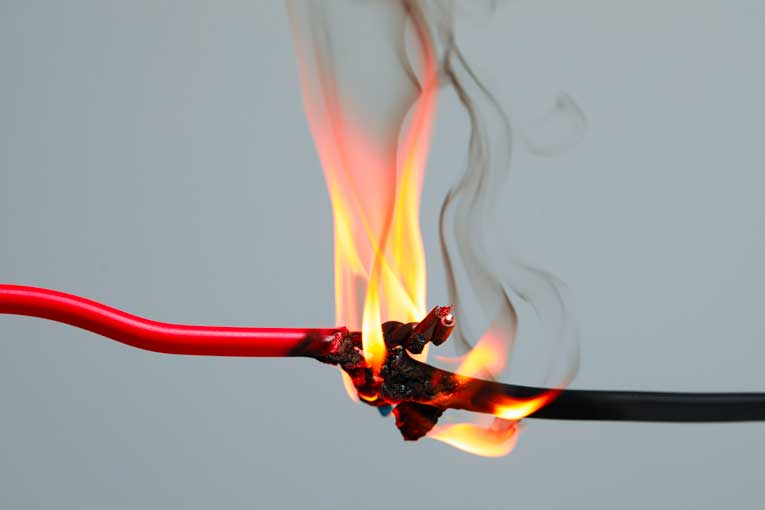
Class E Fires are started by electrical faults. Image source: Shutterstock
Electrical fires are not assigned a full class since they can fall into different classifications.
Hence Class E is not strictly a class as electricity is essentially a source of ignition.
How to Extinguish Class E Fires
In the case of electrical fires, it’s crucial not to use any water.
The best type of fire extinguisher to use on such a fire is the CO2 extinguisher.
One may also use dry powder extinguishers which may still be effective in the case of low voltage.
If possible, always turn off the power supply when tackling such a fire.
Class F: Cooking Oil & Fats
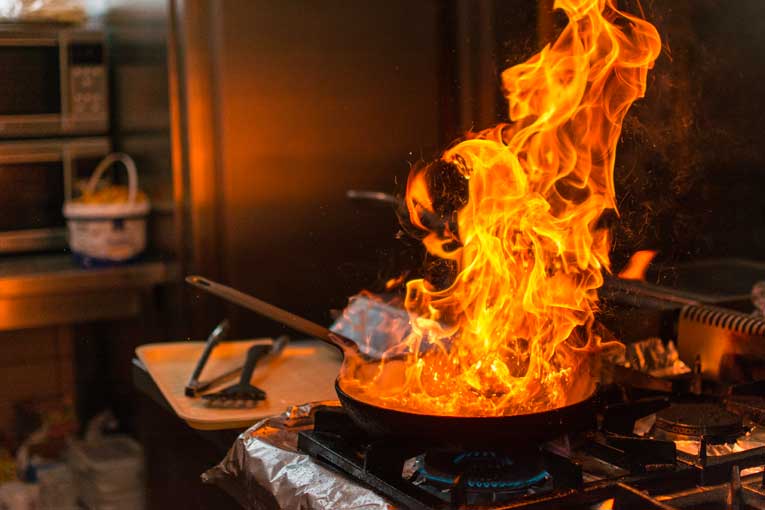
Class F Fire combustible material. Image source: Shutterstock
When cooking oil, deep fat frying and spills of flammable oils are close to heat sources a Class F fire can arise.
This is a fire which is common in commercial kitchens, but it can also occur in residential homes.
It’s important to avoid leaving any frying equipment unattended while it’s being used.
Class F fires are quite hard to extinguish due to the heat from the oil.
Also, should the wrong type of extinguisher be used, it can lead to the fire spreading easily.
How to Extinguish Class F Fires
Class F fires should be put out using wet chemical extinguishers.
This is the only type of extinguisher that is approved for use on cooking oils and fats.
A fire blanket can be effective if the fire is small.
Different Types of Fire Extinguishers
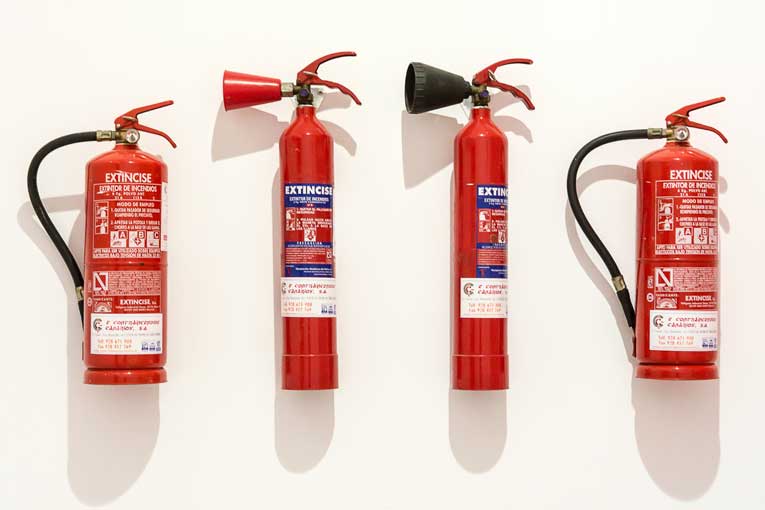
Wall Mounted Fire Extinguishers. Image credit: Pexels
By now you should have a better understanding of the different classes of fires that require certain fire extinguishers to be extinguished.
The following is a complete list of the various fire extinguishers that exist.
Water (Class A)
A water based fire extinguisher is used when there are Class A fires involving combustible materials.
Most premises are required to have this type of fire extinguisher and hence you will typically find it in offices, hospitals and schools.
Foam (Class A & B)
In the case of a Class A or B fire, a foam fire extinguisher is recommended.
This type of extinguisher will perform a cooling function, thereby smothering the burning materials.
The foam will then help to prevent the fire from reigniting.
This type of extinguisher should never be used when there is an electrical source or a kitchen fire.
Powder (Class A, B, C & E)
Dry powder fire extinguishers are very versatile and suitable for different classes of fires, including those involving combustible materials, flammable liquids and gasses.
In fact they are sometimes referred to as ABC extinguishers.
A powder extinguisher will smother the fire by producing a thick barrier which will stop the fuel from being exposed to oxygen.
Such an extinguisher should not be used in confined spaces since the powder can be inhaled.
It also leaves a residue which is quite difficult to clean up.
These types of extinguishers are often found in commercial workspaces, especially those where welding is involved, and boiler rooms.
CO2 (Class B & E)
A CO2 extinguisher contains carbon dioxide.
It suffocates the fire as it transfers the oxygen which would otherwise be used for burning.
This type of extinguisher is suitable for Class B and E fires, that is those involving flammable liquids or electrical fires.
L2 (Class D)
L2 Dry powder fire extinguishers are ideal for Class D fires, that is those involving metals.
Wet Chemical (Class A & F)
Wet chemical fire extinguishers are to be used in the case of Class F fires where cooking oils and fats are present.
They can also be used for Class A fires.
They are thus a must have in commercial kitchens and canteens.
This fire extinguisher will create a layer of foam on the oil or fat that is burning, and so no more oxygen can reach the fire, thereby extinguishing it.
MultiCHEM (Class A, B & F)
MultiCHEM fire extinguishers are ABF-rated.
They are ideal for fires involving flammable liquids, even in cases when there are large quantities of fuel, or a large surface area.
It’s also suitable for deep fat fryer fires
Water Mist (Class A & F)
Water mist extinguishers are suitable for Class A and F fires, and so they are commonly found in various settings.
They work by producing a mist, which cools down the fire and also cuts off the oxygen supply.
Conclusion
A basic understanding of different classes of fires and the most suitable fire suppression to be used is important for fire safety.
We hope that now you have a clearer understanding of the various classes of fires and which fire extinguisher/s to invest in to be well prepared in case a fire broke out.
Commencing on November 28, 2023, and spanning until April 2024, the course is strategically timed to assist candidates in their preparation for the Fire Protection Engineering PE Exam scheduled for April 16th, 2024.
Expert guidance for aspiring fire protection engineers
With ten instructors specialising in various aspects of fire protection engineering, the SFPE PE Exam Review Course taps into the vast expertise of SFPE’s member community.
The live online courses, available twice a week, also offer recorded sessions for on-demand access.
Attendees benefit from added review sessions, online discussions, practical problem-solving exercises, and dedicated office hours with the instructors.
This comprehensive approach ensures candidates are well-equipped to approach the exam.
Stephen Dale, Chair of the SFPE PE Exam Review Subcommittee, commented: “The SFPE PE Exam Review Course focuses on the fundamentals of each topic area of fire protection engineering while preparing attendees to think critically, adapt to the exam, and be successful Professional Engineers.”
Historical data indicates that engineers who opt for the 18-week SFPE PE Exam Review Course are notably better prepared for the PE exam compared to those who don’t.
Further insights about the SFPE Principles and Practice of Engineering (PE) Fire Protection Exam Review Course and the upcoming NCEES spring exam timetable can be found at sfpe.org/2024peexamreviewcourse.
IFSJ Comment
As the world moves towards more stringent safety standards and regulations, ensuring that engineers are proficiently trained becomes paramount.
The comprehensive preparation offered by SFPE, harnessing the expertise of its member community, underlines its commitment to elevating the standards of fire protection engineering.
For aspiring engineers, this course represents an invaluable opportunity to be adequately prepared, especially given the evolving challenges in fire safety and protection.
In a recent development, FireQual Awarding Organisation has obtained Ofqual approval, enabling them to offer both Ofqual and SQA Regulated Qualifications to professionals in the fire safety sector.
Recognition from Ofqual: A major milestone for FireQual
Lewis Ramsay, FireQual Chair, remarked: “This is a great milestone for FireQual, and we thank Ofqual for recognising the significance of making fire safety qualifications accessible to the industry.
“We strongly believe that the demands for competency are set to rise, with professionals in the sector increasingly needing to prove their relevant knowledge before undertaking any task.”
FireQual’s commitment to enhancing fire safety competency
Justin Maltby-Smith, BAFE and FireQual Managing Director, stated: “This is a huge achievement for FireQual, and we are delighted to have been awarded this recognition.
“FireQual already deliver nationally recognised Regulated Qualifications via SQA, however achieving Ofqual approval further supports the sector to develop additional avenues that provide access to regulated fire safety qualifications.”
Douglas Barnett, BAFE Chair, added to the sentiment: “It has been a lengthy process to achieve Ofqual, and we are extremely proud to gain this approval.
“FireQual will now be developing additional qualifications to build on the individual competence requirements that are being introduced into the fire sector.
“BAFE will continue to introduce the requirement of regulated qualifications for individuals working within an organisation looking to achieve or maintain their BAFE Scheme Registration.”
Ensuring a regulated qualification aligns with the needs of its users is paramount.
FireQual’s strategy, when introducing or reassessing qualifications, includes both theoretical and practical components in its Qualification Specification.
This dual approach instils confidence in the market, signifying that a FireQual qualification holder possesses not only the requisite knowledge but also the applicable skills.
FireQual is enthusiastic about collaborating with UK training providers who are keen to deliver Ofqual Regulated Qualifications.
Such partnerships will amplify the number of FireQual Approved Training Centres, facilitating individuals in showcasing their expertise, a crucial part of the broader demonstration of proficiency in the fire safety domain.
IFSJ Comment
The Ofqual approval for FireQual signifies a shift in the landscape of fire safety qualifications in the UK.
As the demand for heightened competency in the sector grows, the availability of robust, regulated qualifications becomes even more crucial.
FireQual’s move not only ensures the provision of such qualifications but also amplifies the emphasis on both theoretical and practical knowledge.
The prospective collaboration with additional training providers further cements the commitment to broadening access and enhancing the credibility of training in the fire safety industry.