Alerter Group to launch fire alarm devices for hearing loss at Birmingham event

Fire alarm devices to be shown at Birmingham event

Alerter Group will launch its next generation Deaf Alerter devices at The Fire Safety Event, which runs from 28 to 30 April at the NEC in Birmingham.

The company confirmed that the redeveloped devices, designed to provide fire alarm notifications for people who are deaf or hard of hearing, will be displayed on Stand J36 in Hall 4.

The new devices are rechargeable and include a larger LCD backlit screen for improved readability.

Notifications sent to the devices can also be delivered to Bluetooth-connected smart phones.

Fire alarm system compliance and product details

Alerter Group stated that the Deaf Alerter systems are compliant with BS 5839-1:2025 and use a National Roaming feature.

This allows the devices to receive notifications in any UK building displaying the Deaf Alerter sign.

BS 5839-1 Section 18 covers the special requirements for fire alarm warnings for people with impaired hearing.

Section 18 is described as the minimum acceptable standard by industry experts and is considered safe to use.

Company background and wider product range

Alerter Group has 25 years of experience in designing, manufacturing and installing radio-based emergency communication systems.

Its product range also includes Refuge Alerter, a wireless Emergency Voice Communication System enabling two-way communication between building management and refuge points.

What giga-projects mean for fire alarm components in the Middle East

A new market report sets a 2026 baseline for the Middle East fire alarm components sector and forecasts how it will evolve to 2035.

The IndexBox Platform analysis defines the market as covering equipment used to detect fires, raise alarms and control systems.

It includes smoke, heat and flame detectors, manual call points, alarm sounders, visual indicators, control panels and input output modules.

It splits the market between conventional systems and addressable intelligent systems, with the latter gaining traction in high-value developments.

It identifies the Gulf Cooperation Council countries Saudi Arabia, the United Arab Emirates, Qatar, Kuwait, Oman and Bahrain as the region’s largest market because of construction activity and tighter regulation.

It says the value chain runs from manufacturers to distributors, system integrators, consultants and contractors before reaching public and private end users.

Demand from codes and mega-projects

The report links demand to stronger national fire and life safety codes, citing the Saudi Building Code and the UAE Fire and Life Safety Code of Practice, and notes their alignment with NFPA and EN standards.

It points to Saudi Vision 2030 projects such as NEOM, the Red Sea Project and Qiddiya, alongside major UAE developments including Expo City Dubai, as major sources of demand.

It says commercial and residential buildings, oil and gas sites and public infrastructure such as airports, metro systems, hospitals and schools all drive consumption of fire alarm components.

It adds that higher insurance costs and business continuity concerns are pushing some organisations beyond minimum code requirements.

Supply, trade and pricing

The report says supply combines imported products with growing regional assembly and manufacturing, particularly in the UAE, Saudi Arabia and Turkey.

It notes that local production mainly covers control panels, standard detectors, manual call points, alarm sounders and backup batteries, while key electronic parts remain imported.

It identifies China, Germany, the United States and the United Kingdom as major sources of imports, with Jebel Ali in the UAE and King Abdullah Port in Saudi Arabia acting as key logistics hubs.

It says pricing is shaped by global costs for plastics, metals and semiconductors, and by whether products are conventional or addressable.

It adds that large projects typically involve bundled pricing that includes design support, software, commissioning and warranties, with maintenance and spare parts providing ongoing revenue.

The market is expected to shift towards connected fire alarm systems that feed data into wider building and city networks as regulations evolve around performance reporting, cybersecurity and false alarm control.

Skills for Security expands fire technician training through C-TEC partnership

New partnership targets competence in apprentice fire and security technicians

Skills for Security has partnered with C-TEC to strengthen training opportunities for apprentice fire and security technicians through access to current technologies and direct engagement with industry expertise.

C-TEC will support the programme by providing equipment for training, technical resources and access to its engineering and product development expertise.

The organisations said the aim is to give apprentices more direct exposure to the technologies they are expected to work with in the field.

Hands-on work with fire systems

Apprentices will work with fire alarm, evacuation alert and lockdown systems used across the UK.

Skills for Security said the training is intended to build understanding of how these systems are designed, installed and maintained in line with relevant British Standards and industry regulations.

The programme will also include demonstrations and discussions focused on how design choices affect performance, usability and long-term maintenance.

C-TEC outlines workforce expectations

Andy Green, Marketing Director at C-TEC, said: “C-TEC recognises the importance of ensuring new technicians are trained using equipment they will encounter throughout their careers.

“By supporting Skills for Security, we can help apprentices develop the confidence and technical understanding needed to work with life-safety systems responsibly and competently.

“Our aim is to contribute to a well-prepared workforce that can maintain the standards to ensure compliance.”

Skills for Security on competence focus

Skills for Security said the partnership aligns with an increasing focus on competence, as technology changes and regulations continue to develop.

The organisation added that collaboration between manufacturers and training providers can help apprentices meet expectations around understanding and accountability.

David Scott, Managing Director at Skills for Security, added: “Partnering with C-TEC gives our apprentices hands-on experience with current systems while combining technical expertise and training to develop knowledgeable, confident fire and security professionals.

“This collaboration highlights our shared commitment to practical learning, industry standards, and the continued commitment to a skilled, safety-focused workforce.”

What this means for training and compliance

Fire-protection contractors, system installers and training officers can use partnerships of this type to align apprentice learning with the equipment and system categories used in live projects.

Manufacturers contributing training equipment and technical input can help training providers show how design decisions affect installation practice, usability during commissioning and maintenance requirements over time.

For organisations responsible for competence management, the focus on working to relevant British Standards and industry regulations provides a direct link between practical training and compliance expectations.

For facility managers and building services engineers, a workforce trained on fire alarm, evacuation alert and lockdown systems supports clearer handover conversations and more consistent maintenance planning once systems are in service.

Cygnus returns to London Build 2025 with certified wireless fire detection range

Cygnus celebrates SmartNet anniversary at London Build 2025

Cygnus will exhibit at London Build 2025 from 19–20 November at Olympia, London.

The company said the event will mark the two-year anniversary of SmartNet, described as the world’s first fully EN 54 certified and 100% wireless fire detection and alarm system.

Cygnus explained that SmartNet is both EN 54 certified and BS 5839-1 compliant.

It is designed to be up to twenty times faster to install than wired systems, reducing disruption to buildings and operations.

The network operates through radio devices using a patented self-forming, self-healing wireless mesh design with multipath redundancy and channel hopping technology to ensure reliability.

Company outlines scalability and range options

Cygnus stated that SmartNet-Pro can connect up to 511 devices per panel and support 96 zones, with up to five panels networked for a combined total of more than 2,500 devices.

SmartNet-100 offers similar capabilities at a smaller scale, supporting up to 100 devices.

According to the company, SmartNet-100 is aimed at small to medium-sized projects where the scalability of SmartNet-Pro is not required.

Accessories and tools to enhance installation

Cygnus will also present its Accessories range at the show.

The Cygnus Configuration Software Tool and Mesh Analyser simplifies setup by providing visibility of radio communication paths, signal integrity and diagnostics.

The company said advanced cause and effect programming can be configured through the software, streamlining installation and commissioning.

The Portable Programming Unit enables installers to deliver firmware and configuration updates wirelessly on site, which Cygnus said helps in areas that are difficult to access.

The Site Survey Kit replicates the mesh network using three bespoke detectors to assess environmental suitability before full deployment.

Focus on engagement at the event

Denley Nunn, Head of Sales at Cygnus, said: “We’re delighted to be back at London Build.

“We had a great event last year and we were pleased with the feedback we received about the SmartNet fire detection and alarm system.

“We are looking forward to connecting with the industry again and delving deeper into our wireless system and our full range of accessories.

“We are excited to welcome visitors to stand M50.”

Visitors can find Cygnus on stand M50 to learn more about SmartNet and its supporting tools.

Further details are available at www.cygnus-systems.com.

Relevance for fire and safety professionals

The SmartNet system and accessories described by Cygnus are of interest to fire alarm system designers, installers and building managers involved in both new and retrofit projects.

The fully EN 54 certified wireless system provides options for fast installation with reduced disruption to occupied buildings, which may benefit public sector, healthcare and commercial facilities requiring continuous operation.

Its scalable structure, from SmartNet-100 to SmartNet-Pro, offers flexibility across project sizes, while tools such as the Mesh Analyser and Portable Programming Unit can assist installers in ensuring network stability and simplified commissioning.

For compliance officers and risk assessors, the dual EN 54 and BS 5839-1 certification provides assurance of conformity with recognised standards.

Fire Industry Association explains BS 5839-1:2025 fire detection and alarm changes

FIA highlights new BS 5839-1:2025 fire detection and alarm standard

The Fire Industry Association (FIA) has released detailed guidance on the updated BS 5839-1:2025 code of practice for non-domestic fire detection and alarm (FD&A) systems.

The revised standard, which came into effect on 30 April 2025, replaces the 2017 edition.

According to the FIA, the update reflects the evolving technological landscape and incorporates lessons learned from real-world applications.

The standard sets out how FD&A systems should be designed, installed, commissioned and maintained in non-domestic buildings.

It introduces structural, terminological and procedural changes to ensure consistency, accountability and clarity across the fire safety sector.

Key updates in BS 5839-1:2025

The FIA said the standard has been restructured for improved clarity, with a refreshed numbering system to align with other UK fire safety standards.

Terminology has been updated in line with BS 4422, including changes such as “handover” replacing “acceptance” and “fire and rescue service” replacing “fire service.”

The new edition defines the responsibilities of designers, installers, commissioners and maintainers more explicitly.

The FIA explained that the update requires key documentation – such as zone plans and cause-and-effect records – to be formally agreed and recorded.

New provisions tighten rules on variations and classify certain omissions, including missing zone plans and lack of required remote monitoring in care premises, as non-compliant.

False alarm management is also strengthened through the introduction of a standardised notice to be displayed at control equipment connected to the fire and rescue service.

Digital connectivity receives dedicated guidance, with sections addressing cyber security, remote access controls and the forthcoming Public Switched Telephone Network (PSTN) switch-off.

The FIA said these updates collectively reinforce competence and documentation throughout a system’s lifecycle.

Practical actions for duty holders

The FIA outlined that building owners, facilities managers and responsible persons must ensure system documentation and maintenance meet the new requirements.

It said duty holders should verify that logbooks, cause-and-effect descriptions and zone plans are complete and current.

False alarm incidents should be investigated and recorded, with corrective measures implemented to prevent recurrence.

Remote monitoring arrangements must meet new performance and timing criteria, particularly in residential care and supported housing settings.

Service intervals should follow the recommended six-month schedule, with inspections properly documented.

The FIA added that safe access to interfaces, such as smoke control and door release systems, must be maintained.

It said these steps align with both BS 5839-1:2025 and obligations under the Building Safety Act.

FIA roadshow promotes understanding and compliance

To support implementation, the FIA launched a BS 5839-1:2025 Standards Update Roadshow across the UK.

The organisation said the series combined in-person and online sessions attended by thousands of professionals.

FIA technical experts presented scenario-based discussions breaking down complex revisions into practical examples.

The Association reported that attendees valued the chance to clarify details and benchmark current practices against new expectations.

The FIA described the roadshow as part of its ongoing effort to bridge the gap between regulation and practical application across the fire sector.

Competence and training under the new standard

The FIA said competence underpins every section of BS 5839-1:2025 and remains central to its training framework.

Its FD&A training pathway offers qualifications at foundation, intermediate and advanced levels for system designers, installers, commissioners and maintainers.

Professionals who complete FIA training demonstrate the technical competence and continuing professional development (CPD) expected by the standard.

The FIA noted that for employers and clients, these qualifications provide measurable assurance of capability and compliance.

Shared responsibility for safer systems

The FIA said the 2025 revision of BS 5839-1 represents a collective effort to enhance accountability and system reliability.

It emphasised that designers, installers, commissioners, maintainers and building managers each hold defined responsibilities to ensure system performance.

The organisation added that aligning practice with the new standard, supported by accurate documentation and competence-based training, will improve safety outcomes across the built environment.

Relevance for fire and safety professionals

The BS 5839-1:2025 update carries direct implications for fire engineers, system designers, installers and maintainers who work on non-domestic fire detection and alarm systems.

Building owners, facilities managers and responsible persons are also affected, as the new standard specifies documentation, maintenance and variation procedures linked to legal duties under the Building Safety Act.

For training providers and CPD coordinators, the FIA’s revised courses and roadshow resources support compliance with the updated competence expectations.

By applying the 2025 standard, professionals can ensure alignment with the latest regulatory framework and maintain reliable detection and alarm performance across buildings.
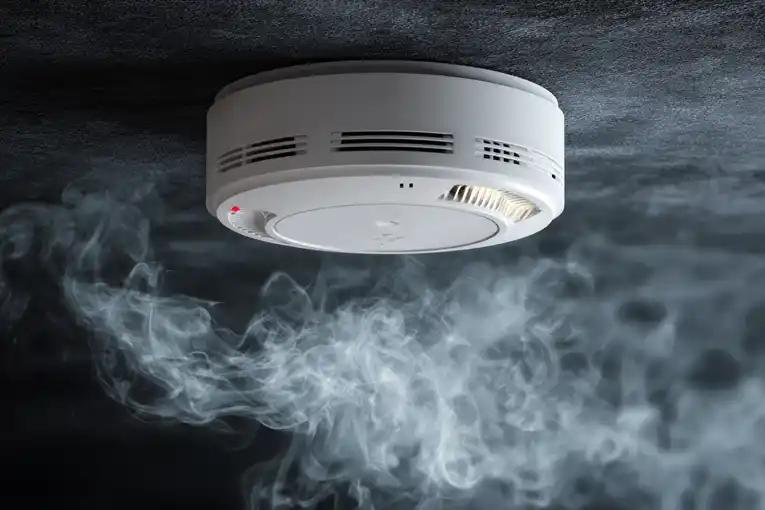
How to Test Smoke Alarms Properly

A smoke alarm is one of the most important safety devices in the home, yet they’re often overlooked until it’s too late.

If you have one installed, testing your smoke alarm regularly is a simple task that can save lives.

To test a smoke alarm, press and hold the test button on the front panel until you hear a loud, continuous sound.

If the alarm does not sound, replace the battery. If it’s a sealed unit, speak to a specialist to replace the alarm. 

You can also use a smoke detector test spray or safe smoke source to check the sensor, following the manufacturer’s guidance.

Our article explains exactly how to test your smoke alarm properly, how often you should test it, what to look out for, and what to do if something’s not right.

Whether you’re a homeowner, renter, or responsible for a business premises, this guide will leave you better informed and safer.

What is a smoke alarm and do I need one?

What is a Smoke Alarm

Smoke alarms are devices specifically designed to detect smoke (a primary indicator of fire), and sound an audible warning to alert people in the building.

Most smoke alarms operate using either ionization sensors, which respond to fast, spreading fires, or photoelectric sensors, which are better at detecting slow, smoldering fires. 

Some units combine both technologies for a more comprehensive coverage.

Every single building, residential or commercial, needs a smoke alarm – bar none!

In most countries, having at least one working smoke alarm on every level of a home is a legal requirement.

In the United States for example, the National Fire Protection Association (NFPA) recommends smoke alarms are fitted inside each bedroom, outside each sleeping area, and on every level of the home, including the basement.

In the UK, Australia, and many other countries, similar laws and recommendations also exist.

Why Test Your Smoke Alarms?

Testing your smoke alarm is the only way to know its working properly.

Even if the unit appears in good working order, components inside can degrade over time.

Batteries can die. Dust or insects can clog the sensors. Wiring can loosen.

A malfunctioning smoke alarm is essentially useless in an emergency.

Fire statistics consistently show that the risk of dying in a home fire is cut in half when working smoke alarms are present.

Regular testing ensures you and your family are alerted in time to escape.

How Often Should I Test My Smoke Alarms?

Woman Testing Smoke Alarm

Experts recommend testing your smoke alarms once a month.

This frequency ensures that any battery issues, sensor faults, or connectivity problems are identified before a real emergency happens.

Here’s some additional maintenance recommendations to remember:

  • Battery-powered alarms: Replace batteries at least once a year, unless the alarm uses a 10-year sealed battery.
  • Hardwired alarms: These are connected to your home’s electricity supply but typically still have a backup battery that needs yearly replacement.
  • All smoke alarms: Replace the entire unit every 10 years, or sooner if the manufacturer recommends it or if the unit fails testing.

Marking these tests on your calendar or making them a part of your monthly routine is an easy way to stay safe.

How to Test a Smoke Alarm

Smoke  Detector
Image credit: Pixabay

Testing a smoke alarm is a very straightforward process, but it varies slightly depending on the type of smoke detection unit you have installed.

Battery Units

  1. Locate the test button: This is usually visible on the front face of the alarm.
  2. Press and hold the button: After a few seconds, the alarm should emit a loud, high-pitched sound.
  3. Listen for consistency: The sound should be continuous and strong. If it’s weak or erratic, replace the battery immediately.
  4. No sound? Replace the battery first, then test again. If there’s still no response, replace the entire unit.

Hardwired Units

  1. Locate the test button: Press and hold the test button exactly as you would on a battery-operated alarm.
  2. Interconnected alarms: If your home has interconnected alarms, pressing the test button on one unit should cause all the alarms to sound. This is normal and confirms they’re correctly linked.
  3. Backup battery: Even though these alarms are connected to mains power, always check the battery backup. If the alarm fails the test and replacing the battery doesn’t fix it, call an electrician to inspect the wiring or replace the unit.

Optional Sensor testing

If you want to test the smoke sensor itself (not just the loudspeaker or battery), you can use a smoke detector test spray.

This creates a safe, simulated smoke environment.

Unless advised by the manufacturer, avoid using real smoke such as candles or matches, as this can contaminate and damage the sensor.

Troubleshooting

If your alarm fails the test or behaves strangely, here’s what to do:

  • Weak or chirping sound: This usually indicates a low battery. Replace it and retest.
  • No sound at all: Try a brand new battery. If still silent, the unit may be faulty.
  • Frequent false alarms: Dust, steam, cooking fumes, or insects can all cause false triggers. Clean the alarm with a vacuum cleaner or soft brush. Avoid using sprays or solvents.
  • Random beeps: Some units beep to signal end-of-life, often every 30 to 60 seconds. Check the label on the back for the recommended replacement date.

Safety Tips

  • Always test your alarms after a vacation or extended period away.
  • If you’re hearing impaired, install smoke alarms with strobe lights or vibration alerts.
  • Avoid painting over smoke alarms since this can block sensors.
  • For rental properties, landlords are usually responsible for installing alarms, but tenants should still test them regularly.
  • Don’t ignore chirps or unusual sounds, since they’re indicators telling you something’s wrong.

Key Takeaways

Testing your smoke alarms is one of the simplest ways to protect everyone in your home.

It takes less than a minute, but it could be the difference between life and death in the event of a fire.

Make it a habit, stay informed, and stay safe.

When testing, press and hold the test button monthly to check your smoke alarm’s function.

Replace all batteries at least annually, or sooner as needed.

Alarms should be fully replaced every 10 years, even if they seem to function properly.

Use some test spray for a more thorough check of the smoke sensor if desired.

And address any beeping, silence, or false alarms promptly. Don’t ignore them.

Telgian to present fire alarm system commissioning webinar

Webinar to explore fire alarm commissioning in the US

Telgian has announced that Jim Burian, Regional Practice Leader at Telgian Engineering & Consulting, will lead a Fire Smarts webinar on fire alarm system commissioning on 14 August 2025.

According to the company, the 90-minute session will outline how commissioning ensures fire alarm systems are installed and operate according to design specifications.

The firm said the event will cover the goals of fire alarm commissioning, testing of components, documentation procedures, and stakeholder communication.

The session will take place from 2:00 pm to 3:30 pm Eastern Time.

Registration for the session is open to fire protection professionals across the United States.

Commissioning process and testing procedures

According to Telgian, commissioning involves a verification and documentation process confirming that a fire alarm system functions according to its intended design.

The company said the session will examine how to test initiating devices for alarm conditions and tamper switches for supervisory alerts.

It added that the session will also review the verification of notification appliances during alarm scenarios.

Participants will be guided through each stage of the commissioning process.

Burian is expected to explain how commissioning impacts system performance and code compliance.

Documentation and stakeholder responsibilities

Telgian stated that the webinar will include a segment focused on documentation best practices.

The firm said this will include guidance on how commissioning information should be formatted and stored.

It added that guidance will also be given on how documents should be distributed to relevant parties.

The process is expected to include recommendations for improving traceability and accountability across stakeholders.

Telgian said documentation is a critical part of system handover.

Presenter background and qualifications

According to Telgian, Jim Burian brings extensive experience in fire protection design and compliance.

The company said he has led teams of engineers, designers and code consultants on projects across the Mid-West.

It added that he has managed product safety and compliance initiatives involving UL testing and approvals.

Burian holds a Mechanical Engineering degree from the Illinois Institute of Technology.

He is the current Chair of the Chicago Chapter of the Society of Fire Protection Engineers and an active member of AIA Chicago.

Course relevance for fire safety professionals

Telgian said the webinar is aimed at engineers, contractors, and code officials involved in fire alarm system design and installation.

It explained that the content will be relevant to both new system installations and upgrades.

The firm said the session will also provide insights for professionals involved in inspection and maintenance.

Burian will provide examples and case-based guidance during the session.

The company said continuing education credits may be available through Fire Smarts.

Telgian to present fire alarm system commissioning webinar: Summary

Telgian has announced a webinar on fire alarm system commissioning.

Jim Burian will lead the session on 14 August 2025 from 2:00 pm to 3:30 pm ET.

The session will cover commissioning goals, testing procedures, documentation, and stakeholder responsibilities.

Burian is Regional Practice Leader at Telgian Engineering & Consulting.

He holds a degree in Mechanical Engineering and chairs the SPFE Chicago Chapter.

He has led design and compliance teams across the Mid-West.

The webinar will be hosted by Fire Smarts.

It is open to professionals involved in fire alarm system design, installation, and compliance.

Fike releases Twinflex VAD Sounder Strobe in UK and Europe

Fike product launched for fire alarm compliance in UK and Europe

Fike has announced the release of its new Twinflex VAD (Visual Alarm Device) Sounder and Sounder Strobe across the UK and European markets.

The manufacturer said the product is designed to work with the existing Twinflex 2-wire range and aims to simplify fire alarm system installation.

According to Fike, the product provides both audible and visual alerts and supports BS 5839 Part 1 compliance.

It is powered from the same zone wiring as other Twinflex devices and does not require additional power supplies.

Fike stated that this product is suitable for use in commercial and industrial settings.

Product designed for compliance and reduced wiring complexity

Fike said the Twinflex VAD Sounder and Sounder Strobe meet EN54 Part 3 and EN54-23 requirements.

The sounder strobe combines a visual and audible alert function into a single device that can be installed on the same zone circuit as Twinflex ASD detector/sounders.

This configuration is intended to minimise the need for extra cabling, reducing labour time during installation.

The product is aimed at both new construction and retrofit applications.

Fike described the product as “zone-powered”, which the company said allows for efficient deployment within Twinflex systems.

Statement from Fike on innovation and user focus

Colin Smith, Fire Manager for UK and Europe at Fike, said: “The new Twinflex VAD Sounder Strobe which has a flash rate of between 35ms to 110ms and a very low operating current of 144 uA reflects our continued commitment to innovation, reliability, and installer-friendly solutions.”

He added: “It builds on our proven Twinflex platform, offering installers and end-users peace of mind through simplified wiring and high-performance audible alerts.”

The product is currently available via Fike distributors and authorised partners.

Fike releases Twinflex VAD Sounder Strobe in UK and Europe: Summary

Fike has released the Twinflex VAD Sounder and Sounder Strobe in the UK and Europe.

The product is designed for use with the company’s Twinflex 2-wire alarm system.

It integrates audible and visual alerts in a single zone-powered device.

The company said the design reduces installation time and cabling complexity.

Fike stated that the device is compliant with BS 5839 Part 1, EN54 Part 3 and EN54-23.

It has a flash rate of 35ms to 110ms and a low current draw of 144 uA.

The product is intended for both new and retrofit installations.

Colin Smith, Fike’s Fire Manager for UK and Europe, said the launch supports installer-friendly innovation.

The product is available through Fike distributors and partners.

Honeywell to upgrade fire alarm system at Phoenix Sky Harbor International Airport

Fire alarm upgrade announced for US airport

Honeywell has announced it will lead a fire alarm system upgrade at Phoenix Sky Harbor International Airport in the United States.

The company said the upgrade will take place in Terminal 4, the busiest terminal at the airport, with over 80 airline gates across eight concourses.

The existing Honeywell fire alarm system was originally installed in 2003.

Honeywell said the new upgrade will incorporate modern devices and modules that comply with the latest UL safety standards.

The company added that the upgraded system will include automated components designed to improve emergency response and performance.

Scope of the terminal project

According to Honeywell, the system upgrade will focus on both hardware and software changes.

The company confirmed that maps used by the Honeywell Enterprise Buildings Integrator (EBI) will be updated to improve alarm location accuracy.

Honeywell said EBI maps will assist emergency responders by providing clearer visualisation of incident sites within the terminal.

The upgrade is expected to be complete in 2026.

The EBI system will remain operational throughout the project to maintain full terminal protection during installation.

Supporting operational efficiency

Honeywell said the digital dashboard included in the system will improve operational insights and reduce costs.

The dashboard is intended to help decrease routine maintenance and cut down the manpower required to manage the system.

The company highlighted that the upgrade is being delivered at a time when labour shortages remain a challenge across the building safety sector.

The upgrade forms part of efforts to maintain system performance while addressing current workforce constraints.

Daily passenger numbers and risk management

Phoenix Sky Harbor International Airport handles an average of 94,000 passengers per day.

Terminal 4 is the main terminal used for both domestic and international flights.

Honeywell said the project aims to help ensure passenger safety is not compromised while work is carried out.

The company confirmed that no disruption to normal operations is expected during the upgrade period.

Comment from Honeywell leadership

Sudhakar Janakiraman, President of Honeywell Building Solutions, said:

“This award to enhance the Phoenix Sky Harbor International Airport’s fire alarm system reflects our commitment to delivering innovative and reliable automation solutions that protect this busy airport while also helping ensure uninterrupted operations for passengers and staff.”

“We are honoured to work on this vital safety initiative that builds on a long-standing and valued relationship.”

Honeywell to upgrade fire alarm system at Phoenix Sky Harbor International Airport: Summary

Honeywell has been selected to upgrade the fire alarm system at Phoenix Sky Harbor International Airport in the United States.

The upgrade applies to Terminal 4, which includes more than 80 airline gates.

The existing system was installed in 2003.

The new installation will include automated devices and modules that meet the latest UL safety standards.

Honeywell stated that the project will optimise emergency response and performance.

The Enterprise Buildings Integrator (EBI) dashboard will be updated to improve location mapping for alarm events.

The dashboard will help guide emergency responders with increased accuracy.

The system will remain active throughout the installation to protect the terminal.

The upgrade is expected to finish in 2026.

Phoenix Sky Harbor serves an average of 94,000 passengers each day.

Honeywell said the system aims to maintain safety and efficiency during the project.

The company noted current workforce constraints as a factor in automation strategy.

Honeywell confirmed the upgrade will reduce maintenance demands and operational costs.