The future of fire detection: greener and smarter

Over three days, from the 17th to the 19th May, FIREX International brought together the entire fire safety supply chain for a unique opportunity to explore innovative products and solutions available for the first time since the pandemic.

Greener life safety products and protecting the UK’s commitment to low carbon energy

For building owners looking to improve their energy consumption or installers looking to offer more environmentally friendly and cost-effective solutions, the Hochiki team will be providing live demonstrations of their power saving and environmentally friendly products they manufacture. Visitors to the Hochiki stand will also get a chance to hear about a recent customer life safety project at one of the UK’s largest offshore windfarms.

FIREscape+ combined fire detection and emergency lighting system, features LED downlighters consuming only 0.1W once fully charged. This low energy consumption directly correlates with lower CO2 emissions, providing building owners with a greener solution.

The system helps improve energy efficiency, as unlike traditional emergency lighting systems, each luminaire and exit sign is only ‘trickle charged’ until the integral batteries are at full capacity.  But the system also helps building owners to reduce costs in other ways.  Because both fire and lighting devices run on low voltage cables from the control panel, a qualified electrician is not required to wire each device, thus drastically reducing labour costs during install and during any ongoing maintenance visits.

Visitors also learned how Hochiki are helping to protect and keep operational one of the UK’s largest offshore windfarms at Margate, critical as thoughts turn to how the UK can start to produce more of its own energy and rely less on foreign sources. For a country once solely reliant on coal to power its homes and businesses, the UK is now the leader in offshore wind energy. Encouragingly, today 44% of the UK’s electricity comes from renewable sources – a figure expected to accelerate given the Government’s April 2022 announcement, committing to “supercharge” clean energy deployment, which would see 95% of Great Britain’s electricity set to be low carbon by 2030.

Operated by London Array and generating about £1million worth of electricity a day when all 175 turbines are in operation, Margate wind farm produces enough electricity to power half a million UK homes a year and reduces harmful CO2 emissions by around 925,000 tons per year.

Hochiki were thrilled to be appointed as the manufacturer of the life safety devices on board the offshore and onshore substations.

Dan Smith, Technical Services Manager for KM Security Solutions explains: “The constant change in weather combined with sea-salt spray makes offshore wind farms an incredibly hostile environment to work in, not only for people but also for the systems, cabling and devices that help to run it and keep it safe. Therefore, it is imperative we install life safety devices that won’t let the teams and premises down in an emergency. We have been using Hochiki products for well over a decade now. Not only do we trust them to work, but we also trust the devices to last.”

Visitors to FIREX will be able to find out more about this exciting and complex project when they visit the Hochiki stand.

Sophisticated design combined with powerful customer insight

Consumer insight can provide a business with the opportunity to better personalise and tailor products to the needs, wants, and demands of their customers. Organisations that leverage their customer behaviour to generate insights outperform their peers by 85% in sales growth, according to Microsoft.

Over the last two years the teams at Hochiki Europe have focused a lot of time and attention into customer insight which in turn has driven product development. The team are excited to be able to demo the new and improved L@titude system. With huge investments made in the research and development of this product, led by customer feedback, this latest model combines the very latest in hardware and software and is the company’s market leading control and indication system.

Sophisticated enough to operate anywhere in the world, in multiple languages, across all manner of applications – from schools and hospitals, city skyscrapers filled with thousands of office workers, apartment blocks and entertainment venues, cultural and commercial spaces as well as international travel ports, manufacturing warehouses and logistics hubs. The system has been designed to be simple to configure and easy to use, utilising touchscreen technology with a graphical user interface to help display vital information in a user-friendly manner. The L@titude system is EN approved and recently DBI certified for the Danish market following its EN54 Part 13 BRE approval.

Hochiki Customer, Jardine Motor Group, commented: “We were absolutely blown away with the professionalism and levels of support shown by Hochiki Europe; both of which were demonstrated from our tour of the manufacturing facility and their ongoing liaison. Having the chance to see the production and design process gave us reassurance in their ability to provide state-of-the-art life safety systems which would meet our needs as a business. This end-to-end support was a truly personalised experience, with Hochiki Europe even taking onboard our suggestions for improvements. Taking such an interest in our needs confirmed our decision in choosing them as our manufacturer and ultimately our trust in their products”.

Demonstrations of the system will be available on the Hochiki stand.

A new generation of Hybrid Wireless Fire Detection is the Waking Watch alternative.

Following the Grenfell Tower disaster, Waking Watch schemes have been used to monitor buildings identified as fire risks, until dangerous cladding is removed. However, these schemes come at a high operational cost, and sadly, human error. Building owners and local authorities are looking to life safety manufacturers, installers, and innovative technology to help with a more cost-effective and more importantly more reliable alternative to these schemes.

One such piece of technology is Hochiki’s next generation of hybrid wireless fire detection product, Ekho. At the core of the system is the wireless Translator module, hard-wired to the existing fire alarm control panel loop which communicates continuously with the wireless devices. Wireless Expander modules are then used to extend the self-healing radio mesh network, increasing the reach and capacity of the overall system. The Expander mesh network guarantees an “always on” connection between the wireless devices and the Translator/fire control panel.

The system can be installed as a temporary solution to continuously monitor individual apartments within a building, as it is easily removed without damage to the structure.  Alternatively, can be installed as a permanent extension of the house fire system. Customers are saying that this hybrid life safety technology helps residents feel safer and building owners reassured, due to the self-configuring mesh network which keeps the devices connected and communicating with the fire panel 24/7.

Commenting on a recent install in a London Borough one Hochiki customer said: “This was an incredibly complex and highly involved project across six buildings each with 16 floors. We worked closely with the team at Hochiki who recommended the Ekho range as it offered a hybrid wireless solution which allowed us to work around issues such as cabling inside private spaces. Ekho being wireless still allowed for early detection but most importantly, detection at windows to monitor for any incident outside of the building, within the problem cladding, for example.

Using the Hochiki technology gave the residents peace of mind that the new system was ‘always on.’  The Ekho range is ultra-dependable, and much more cost effective than the existing Waking Watch scheme.”

Hochiki’s Sales Director, Nathan Hudson said, “I am immensely proud of our teams and how they have continued to develop and bring to market leading products as well as serve our customers especially over the last two years. There is a reason we are the trusted as the leader in fire detection, it is our people and their passion to ensure our customers get the best.”

This article was originally published in the May edition of IFSJ. To read your FREE digital copy, click here

Detection: Evolving to meet the UL 7th edition standard

Underwriters Laboratories (UL) have introduced challenging new requirements for smoke detectors. Apollo have responded by building the most solid, stable, and dependable fire detector yet based on our decades of experience and innovation in fire detection.

The Challenge

We know that one of the biggest challenges our customers face is false alarms. UL know this too, and through research conducted by National Institute of Standards and Technology (NIST) have introduced new requirements on smoke detector manufacturers, like us, to reduce the risk of false alarms. At the same time, UL have responded to the evolution of construction methods and materials that can change how fire behaves in a building. This has led to the introduction of a new fire test that requires faster and earlier detection of flaming fires than ever before.

Solution

We like to get the basics right. To Apollo this starts with the performance characteristics of the smoke sensors.

An optical smoke sensor must be protected from stray light, dust, and insects. These roles are all fulfilled by the enclosure, which we call the optical chamber. Whilst blocking these potential nuisances, the chamber must freely admit smoke allowing it to be measured by the optical sensor. A surprising amount of fluid-dynamics know-how is required to achieve this; since smoke from a fire tends to move relatively slowly with little energy to push it along. This has led to the unique chamber design of Soteria UL that collects smoke form the outer edges of the detector, removing any impediment to airflow, and achieving a particularly fast detection of fires without airflow delays.

Smouldering fires, in particular, tend to generate vast amounts of smoke, but due to the lack of heat in the fire, that smoke doesn’t have the energy to reach the optical chamber; and this problem worsens when the stack effect is introduced. Stack effect is when tiny pressure differentials, between ceiling cavity and a room, cause clean air from the ceiling to be forced through a detector and out of the smoke inlet, preventing smoke from a room fire entering the detector.

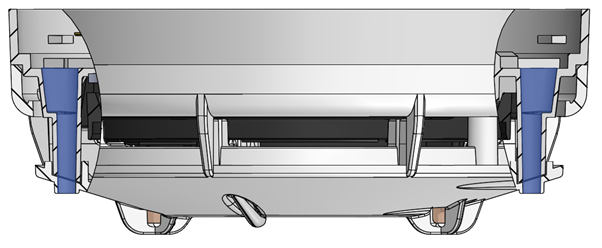
Soteria UL overcomes this issue through its patented vent design. These vents allow pressure differentials to be exhausted through a carefully positioned hole in the lid, so that is does not impede the flow of smoke into the smoke inlet or deeper into the optical chamber. Further, the vents allow any condensation that may occur in the cavity behind the detector, or in cable conduits, to escape without harm.

The drains, highlighted in blue, allow water and air to pass from the rear of the detector without affecting the smoke entry paths.

An often-overlooked characteristic of smoke sensors is their ability to operate uniformly no matter which direction the smoke is coming from. UL test detectors for this parameter in four different orientations and allows a variation of +/-50%. To ensure the most stable operation, we exceed this requirement and measure our detector at 360 orientations and achieve a variation of less than 10%/ft.

Why should a user care that Soteria UL’s directionality is so good? Well, if we had just one angle that was less receptive than others, then we would be forced to increase the overall sensitivity of the detector to ensure it can detect fire when tested in the poor orientation. By avoiding this pitfall, we can offer a detector with a perfectly balanced sensitivity.

Once smoke gets into the chamber, then it’s the job of the optical sensor to measure it, whilst discounting false readings from any foreign materials. The optical sensor consists of an industrially rated InfraRed (IR) light source. When smoke is present, light is scattered onto the light sensor. This sensor is a highly integrated Application Specific Integrated Circuit (ASIC), custom to Apollo, that combines the light sensitive element and electronic amplification.

Smoke is an aerosol – a mixture of air and tiny smoke particles. Because these tiny particles are similar in size to the wavelength of IR light, then they send that light scattering off in many directions via a quantum mechanical process that is described by Mie theory. Smoke from fires have precise characteristics; for example, it tends to scatter most light in the forward direction, rather than ‘reflecting’ it backwards.

We use this knowledge in the design of our optics, positioning the smoke sensor so it is more sensitive to the angles of scattering smoke, than the pattern of aerosols produced by cooking, for example. This is achieved with our unique patented optical sensor design.

The next nuisance that might trick our sensor is dust and insects. Traditional detectors suffer from the IR light source illuminating parts of the optical chamber, rather than just the scattering region in front of the light sensor. Because the light sensor is looking for only a tiny quantity of light to be scattered by smoke, then it can easily be fooled by light reflecting off chamber walls when dust or insects are present in the chamber.

Our first line of defence is stopping such things getting into the chamber. The Soteria UL uses a unique serpentine air inlet to prevent the ingress of dust. A fine nylon mesh prevents insects over a certain size from entering the chamber, but not all can be stopped is we still wish smoke to enter the chamber. Instead, we design the chamber to be robust to these smaller insects and accumulation of dust.

Firstly, a unique patented light absorbing surface of the chamber prevents the IR light being reflected around the chamber. This means that dust and insects on other surfaces of the chamber are less illuminated. Secondly, and this step takes some effort, all possible surfaces where an insect could stand and spread its wings, whilst being in the view of the light sensor, are eliminated. That means that even when an insect smaller than the screen finds its way into the chamber, it is very unlikely to be able to cause a false alarm. The same advantage is experienced when dust accumulates inside the chamber – there are no surfaces where dust can gather to cause stray light and trigger a false alarm.

And it’s not just our lab that this high performance is achieved. Every Soteria UL detector is produced and certified to conform to the same narrow range of sensitivity. This means that every product you install will behave the same as the last, it will not be more sensitive to common nuisances, or less sensitive to the attributes of fire. This is achieved in our factory with a blend of skilled hand assembly and highly automated modern manufacturing processes. Every single product is measured and calibrated for smoke sensitivity.

Once we have crafted the best smoke sensor, our next focus is the intelligent signal processing that determines when there is a real fire. Because the basics are right, we don’t need a highly complex, unpredictable, and opaque artificial intelligence algorithm. We simply add the right amount of smoothing, the right amount of delay, and a little enhanced detection of fast flaming fires. False alarms are avoided, not only by getting the basic smoke sensor right, but by reducing the response to slowly developing nuisance signals like cooking. The detector is constantly processing information, and if it decides there’s a fire, this is signalled to the panel via Core-Protocol with exceptional speed.

Keeping you safe from fire, every second of every day.

For more information on Soteria UL, Apollo’s 268 7th edition solution, contact enquries@apollo-fire.com or visit www.apollo-fire.co.uk/

This article was originally published in the May edition of IFSJ. To read your FREE digital copy, click here

Kentec Installation Programme hits three year mark

Life-critical control systems manufacturer, Kentec, has celebrated the third anniversary of its Kentec Installation Programme (KIP) at this year’s FIREX, now with more than 200 installers registered across 19 countries.

Since its launch at Firex three years ago, installers have been benefiting from the scheme which include training to ensure every installation is optimised to realise the technology’s full potential. The scheme also provides KIP-dedicated technical support (including on-site), and advanced access to the latest Kentec systems and software.

Kevin Swann, Managing Director of Kentec Electronics, said: “In addition to training and support, our KIPs tell us that their membership supports client tenders by demonstrating individual competency on the award-winning Taktis panel and ever-loved Syncro AS, which is fantastic to hear.

“Covid-19 hit while the scheme was still in its infancy, which forced us to look to ways to make virtual training as impactful as possible. That’s opened the doors to so many efficiencies and opportunities – and has helped build the scheme into one that we are very proud of,” he adds. “The team and I are looking forward to speaking to customers and taking them through the highlights of our stand, at what promises to be another fantastic industry event.”

Kentec’s latest wireless Mesh technology was a leading focus on its FIREX stand this year. The team demonstrated how it reduces installation costs and timescales and removes the installation and construction limitations associated with wired systems, including building work, fire stopping and containment systems.

Walker fire expands into detection market with double acquisition

Fire safety firm Walker Fire has made two acquisitions to drive its expansion in the fire detection and security sector.

The Preston-based firm has acquired Leicestershire-based Detector Alarms and Hampshire-based Southern Fire Protection, for an undisclosed sum.

Detector Alarms, which trades as Detector Fire and Security, operates across Leicestershire and the Midlands, specialising in the installation and servicing of security and fire safety systems.

Southern Fire Protection operates across Hampshire and specialises in fire safety equipment installation and servicing.

David Cosgrove, Walker Fire managing director, said: “Our goal is to become one of the UK’s foremost providers of fire safety and building security services.

“The two businesses we have acquired have operational capabilities and values that are very aligned with our own and further strengthen our service offering and national footprint.”

Walker Fire is part of Ireland’s Moyne Roberts Group. Based at Roman Way Industrial Estate in Preston, the business has 238 staff and offers services in the installation and servicing of fire alarms, fire suppression systems and other fire safety equipment, as well as fire risk assessment and fire safety training services.

Walker Fire was advised on the transactions by the corporate finance, property and employment teams at law firm Harrison Drury solicitors. Stuart Hinnigan, partner at Scott & Wilkinson accountants, advised on the financial aspects of the deal.

Jack Stephenson, associate solicitor in the corporate team at Harrison Drury, said: “We’re proud to have supported Walker Fire’s growth strategy by advising them on a significant number of transactions over the last few years.

“These latest strategic acquisitions help Walker Fire grow its capabilities and geographical coverage and we’re pleased to have played our role in making this possible.”

Sarah Astley, associate solicitor in the employment team, added: “We’re pleased to be working alongside the team at Walker Fire, supporting them with the employment aspects of these acquisitions and ensuring a smooth transition for all staff, clients and stakeholders.”

FIA releases fire alarm guidance for people with sensory sensitivities

The Fire Industry Association has developed a guidance document to cover situation situations where fire alarm warnings are intended for people with sensory sensitivities.

The FIA was contacted in last year about the issue of suitability of fire alarm warnings in special schools, a topic which has not previously been fully addressed in the Code of Practice for fire detection and fire alarm systems.

A group consisting of people with a personal interest and experience in the matter, and experts in the fields of disability and fire safety, came together to formulate the document, highlighting the need for more, and better conversation surrounding the needs of individuals with disabilities.

The new guidance said: “It is anticipated that this guidance document will encourage designers to collaborate with clients to gain a full understanding of building occupants, and thus provide for fire alarm systems that assist evacuation in preference to inappropriate application of the recommendations of a national code which are likely to cause distress and hamper the evacuation of those with sensory sensitivities.

“This guidance document will assist fire risk assessors in asking appropriate questions as part of their work, particularly when assessing special schools, mainstream schools with resource provisions or units, day centres or residential accommodation.”

The guidance from the document, which can be found here, will be presented by James Jones (Vimpex, and FIA Board member), and Sonny White, the 16-year old FD&A expert who instigated the document, at Firex on Wednesday 18 May.

Global fire protection systems market to reach $130bn by 2030

The global fire protection system market size is expected to reach $130.37bn by 2030, according to a study. It is expected to expand at a CAGR of 6.7% from 2022 to 2030. Increasing adoption of wireless technology in fire protection systems, growing human and property loss owing to fire breakouts, and stringent fire safety regulations are projected to fuel the market growth.

Increasing implementation of building safety codes and renovation projects is also anticipated to be a major factor influencing the market growth. The application and usage of fire protection systems are anticipated to increase continuously with the developments of commercial entities and corporations.

Reportlinker.com released a report titled ‘Fire Protection System Market Size, Share & Trends Analysis Report By Product, By Service, By Application, By Region And Segment Forecasts, 2022 – 2030’.

Technology enhancements such as extinguishing technology based on mist and products such as laser optical / infrared smoke detectors, alarms with embedded voice evacuation announcements, hypoxic air fire suppression systems, and wireless fire alarm systems are expected to gain traction in the market globally. In addition, in 2020, the market was hampered due to the Covid-19 pandemic, which has interrupted production, impacted demand, and caused supply chain disruption.

The growing trend of integrating fire alarm and detection systems with building automation systems offers vast growth opportunities to the market. Connectivity with building automation systems is increasingly becoming a major feature of fire protection systems in commercial, industrial, and residential applications.

This can be attributed to the fact that such integration allows for the development of systems that are capable of sharing and gathering data, which can help in alerting individuals about fire safety issues in the premises. A notable rise in investments in smart building automation technologies across several regions is expected to lead to new opportunities for building automation systems in the industrial and commercial sectors.

Consumers in developed regions such as Europe and North America have seen a steady rise in demand over the past few years, and the growth trend is also projected to continue over the next few years. However, a lack of stringent regulations and the high cost of advanced fire protection systems have kept the markets in emerging countries largely untapped.

Nevertheless, improving economic conditions in countries, including Brazil and India, are anticipated to boost the demand for fire protection systems over the forecast period.

Infrastructural development activities across the Asia Pacific region owing to the rising demand for new transport and utility infrastructure will drive the demand. The high rate of urbanization is placing increased pressure on under-invested, weak city infrastructure.

The consecutive rise in focus on new residential and infrastructural development projects is expected to propel the demand for fire protection systems across this region; thus, such factors are fuelling the market growth.

CSL and Noby announce distribution partnership for Norway

The Oslo-based company, Noby AS, is a specialist distributor for Intrusion Alarm, Camera Surveillance, Smoke Detectors, Fire Alarm, Transmission Systems, Access Control, and are now able to offer their customers the latest CSL products and solutions, including the CSL Router and CSL Managed 4G SIMs.

Ken Inge Hanski, Product Manager at Noby, commented: “CSL’s partnership will enable Noby to offer solutions including 4G SIMs for installers requesting complete solutions with network connection for their projects. It is important for us to help our customers in a market where technology is continuously updating. We do that with quality products from well-established suppliers such as CSL, to supply our customers with products they can trust. CSL are market leaders in providing secure connectivity solutions and we are happy to be able to present their products on the Norwegian market.”

Ingemar Spångberg, Business Development Director – Nordics, added: “We are delighted to announce this partnership with Noby to enable us to provide our connectivity solutions to the Norwegian market. Noby are a long-established and trusted brand and we look forward to working closely with them to support Installers.”

www.csl-group.com/

Active fire protection market set for growth post Covid-19

The active fire protection market is comprised of detection/alarms and suppression systems. Alarms and detection systems account for 63% of the overall active fire protection market, having gained slight share over the last two years, with the majority of installations of products and systems going into the non-domestic sectors. Domestic smoke alarms only account for a small portion of total market value.

Over the last decade or so, innovations in detection technology have significantly reduced the likelihood and number of false alarms, through such developments as improved capability of sensor technology in smoke detectors. However, the number of false alarms due to apparatus faults has stabilised in the last three years, suggesting that more recent product improvements are no longer having an impact on the number of false alarms.

AMA Research’s current forecast indicates a decline in 2020 due to the impact of Covid-19, this is down to the closing building sites, the furloughing of employees as well as restrictions on the supply of building materials throughout the world. The active fire protection market is expected to grow by 14% between 2020 and 2024.

Fire detectors, which serve to identify where a fire is occurring by locating heat, smoke or flames, before providing a warning of the blaze through an audible alarm and often through the alerting the fire service will outperform the market, increasing 17% between 2020 and 2024.

Higher levels of publicity and the greater awareness of fire safety measures, particularly within high rise buildings, should stimulate demand for active fire protection products. This should be seen in both new installations and particularly in the replacement sector.

Increasingly, businesses are adopting integrated fire and security systems, which is likely to remain a key feature of the industry. IT-based security systems, often including fire protection systems in combination with other security measures on a single network, such as video surveillance, access control and intruder alarms.

Laura Pardoe, Editor of the Active Fire Protection Market Report comments “the active fire protection sector is mature and has been primarily driven by the wider performance of the UK building and construction market. That said, changes to building regulations in the wake of the Hackitt Review will provide additional demand for the fire protection industry, particularly with regard to sprinkler systems in high buildings.”

The information was taken from the Active Fire Protection Market Report – UK 2020 -2024 by AMA Research, which is available to purchase now at www.amaresearch.co.uk

EN54 (Fire) certified variants added to the DualCom Pro range

CSL have announced that their DualCom Pro range has been extended to include two new EN54 (Fire) certified products. These variants are available to order now from your chosen ARC. EN54 certification is the most important aspect in terms of signalling for fire detection and alarm systems.

However, the cost of products has always been an issue, with most fire systems having no monitoring at all despite many fires occurring when the premises are empty. DigiAir Pro Fire offers a totally wireless single path solution, whilst GradeShift Pro Fire offers dual path signalling via 2 separate radio modules.

Both solutions come with multiple 4G WorldSIMs, providing the most reliable fire signalling systems ever. The wireless capabilities of DualCom Pro mean that no installation is limited by the infrastructure of the premises, making it easier than ever to provide professional Fire Monitoring.

CSL’s Sales Director, Rob Evans, commented: “Over the past few years CSL has seen an increased industry demand for EN54 (Fire) certified signalling products that offer flexibility of installation, increased reliability and cost-effectiveness. We are confident that all criteria have now been satisfied with the new DualCom Pro Fire products.”

www.csl-group.com/