Evacuation: a stitch in time saves lives

The fire safety order leaves no caveats for evacuation during an emergency, Triple A sheds light on the legislation

There are an estimated 1 billion disabled people worldwide. The purpose of the UN Convention on the Rights of Persons with Disabilities is to promote, protect and ensure the full and equal enjoyment all human rights and fundamental freedoms by all persons with disabilities, and to promote respects for their inherent dignity. In the UK, there are 14.1 million disabled people whose rights are protected through the Equality Act 2010. 

Disabled and Evacuation in an Emergency The use of technology and social care packages has resulted in many disabled people living fulfilled, independent lives within their communities. There is often a common belief that all disabled people are wheelchair users. 

Access and egress for disabled people

The Regulatory Reform (Fire Safety) Order 2005, covers almost all buildings in England and Wales. The onus for compliance is on the individual Responsible Person who is the owner, employer or person in control of the building. 

The Fire Safety Order specifically states that all relevant people must be able to leave the building as quickly and as safely as possible and processes must be in place for when any relevant person is in immediate danger. There are no caveats excluding either disabled people or residential accommodation from the requirement and non-compliance is a criminal offence.

Building Regulations ensure that multi-storey buildings are accessible to disabled people through the provision of lifts, but the majority of lifts are not fire protected and cannot be used during a fire. This presents a challenge for many Responsible Persons delivering compliance with the Fire Safety Order where it relates to evacuation from residential buildings.

PEEPs and ‘buddies’ in residential buildings

The Fire Safety Order covers the common areas of residential accommodation.  English Heritage state that 54% of housing association tenants are disabled and many of these will be residents in multi-storey buildings, which have no fire-protected lifts and no staff. 

It is important to recognize that the Fire Safety Order does not require evacuation assistance to be provided by an employee, just that the person is competent and trained. In reality, in the vast majority of cases family members, neighbours or friends are the ‘first responders’ in an emergency and are unlikely to abandon the disabled person to save themselves.  There are also considerable advantages in involving them as a buddy:

  • they know the disabled person’s capabilities;
  • the disabled person trusts them;
  • they are aware of any vulnerabilities;
  • they will be used to communicating with the disabled person.

Many Responsible Persons are concerned about potential liabilities resulting from training family members, friends or neighbours to assist a disabled person.

PEEPS in the workplace and public access environments

In secure workplaces, the Responsible Person is aware who is present within the building and able to develop a Personal Emergency Evacuation Plan (PEEP) for each individual disabled person. 

In public access environments, the Responsible Person is unlikely to know who will be present in the building and therefore will need to develop Generic Emergency Evacuation Plans (GEEPs).  It is important that any strategy does not place employees in danger if they are involved in the evacuation of a disabled person as this would breach the Health & Safety Act 1974.

Developing the PEEP

The Fire Safety Order requires that the Responsible Person ensures that employees are provided with training prior to their being required to undertake new activities which includes the development of PEEPs.  Triple A Solutions provides Institute of Fire Engineers accredited training to ensure that the Responsible Person can prove due diligence in meeting the requirements of the Fire Safety Order.

The elements that need to be considered during the development of a PEEP are: he physical environment, the disabled person, and the assistance required.

Conclusion

The Tenants Management Agents of Grenfell Tower failed to develop PEEPs for their disabled residents despite being fully aware that they were unable to evacuate. As a result, 41% of the disabled residents of Grenfell Tower died and there were additional fatalities and injuries occurred due to non-disabled residents refusing to attempt to evacuate without the disabled resident.

Those who manage buildings must comply with the requirements of the Fire Safety Order for both disabled and non-disabled people.  The alternative is to risk a criminal prosecution if injuries or deaths occur.

This article was originally published in the May edition of IFSJ. To read your FREE digital copy, click here
Survitec launches ‘Head Start’ programme for ship fire safety

Survival Technology specialist Survitec has introduced a new programme to ensure shipowners are fully equipped to protect crews and assets throughout the entire lifetime of their vessels.

The “Head Start” programme is a complete through-life supply and service initiative. Survitec has been working with shipowners, designers and ship builders from first designs to ensure that vessels are protected with the most advanced safety solutions possible and to ensure they can be operated and maintained efficiently throughout the vessel’s lifetime.

Finn Lende-Harung, Commercial Director – Fire Solutions, Survitec, said: “Being involved from the planning phase onwards, we can help to optimise safety system design, installation and commissioning as well as ensuring shipowners benefit from the most cost-effective means of managing their ongoing system training, servicing, and certification requirements.

“From the very beginning of a project, shipowners have immediate access to our global network of experts through a single point of contact. We’re providing a complete one-stop safety shop from the design phase through to ongoing vessel operations. We’re setting shipowners on course for a lifetime of safety at sea.”

Rafal Kolodziejski, Survitec’s Head of Product Support and Development – Fire Systems, cited the increasing number of newbuilds opting to run on alternative fuels as one of the main reasons why the initiative is becoming so appealing.

He said: “The industry is well advanced in fire extinguishing technologies and mediums for gas and methanol fuelled fires. However, li-ion batteries, ammonia, and hydrogen are relatively new marine fuel and powering options, presenting very different challenges for shipowners and operators.

“The risk of fire from these alternative fuels can be substantial, requiring a higher focus on prevention and the monitoring of gas leakage and temperatures. When we are involved in a newbuild project from the beginning, we can better mitigate any risk further down the line through quick-response fire system solutions.”

Lende-Harung added that as the shipping industry moves towards digital technologies and the possibilities of autonomous shipping – accelerated perhaps by current operational and financial challenges: “Remote monitoring, diagnostics and online maintenance will in the future become a major consideration at the design stage.”

Survitec’s fire system experts can monitor system conditions, support ship crew with trouble shooting and adjustment of equipment shoreside without having to physically attend the ship,” said Lende-Harung. “A remote VPN gateway connects to the fire safety system operator panel via an ethernet cable or Wi-Fi through a secure gateway.

“We can connect at short notice in case of issues threatening normal operation or to provide training to ship crews. For example, we can help a system operator tune-up their inert gas system to reduce fuel consumption, reduce maintenance and increase system stability. Remote diagnostics and the monitoring of fire safety equipment will become a major factor in the swing towards autonomous shipping.”

Rebecca Croton joins Quelfire marketing team

Quelfire has further expanded its team with the addition of Rebecca Croton as Content Marketing Executive.

Commenting on her new position, Cronton said: “I have always had a passion for writing and creating content, I studied English and Journalism at university, so I knew it was going to be something I would enjoy. It is great to see how passionate everyone is at Quelfire, it is a fun yet professional atmosphere.

“I have never worked in the passive fire protection industry before, but I feel like I have learnt so much already. Even when you think you are not learning, you are! There has been a lot to take on board, but it has been very interesting as it is relevant to every single one of us. Particularly, I have enjoyed spending time with each member of ‘Team Orange’ to learn about their roles, how they play a part in fire safety and how I can assist them with future content.

“During my first two days, I jumped into fire safety headfirst, at The Fire Safety Event. It was a great opportunity to learn from my colleagues and meet specialists in the industry, to hear about their typical challenges.”

Welcoming Rebecca, Quelfire’s Marketing Manager Timea Popovics said: “As a result of increased scrutiny over the accuracy of construction product information and requests from customers for more regular updates on new tested details, we were keen to focus more on content. We believe that it will be critical in building and maintaining connections and engagement with customers and other partners.

“Rebecca will play a key role in keeping information about our solutions up-to-date and ensure it reaches our customers and all parties involved in firestopping. We are delighted to welcome Rebecca to Quelfire’s ‘Team Orange’ and look forward to encouraging her in the development of this important new role.”

Detection: Evolving to meet the UL 7th edition standard

Underwriters Laboratories (UL) have introduced challenging new requirements for smoke detectors. Apollo have responded by building the most solid, stable, and dependable fire detector yet based on our decades of experience and innovation in fire detection.

The Challenge

We know that one of the biggest challenges our customers face is false alarms. UL know this too, and through research conducted by National Institute of Standards and Technology (NIST) have introduced new requirements on smoke detector manufacturers, like us, to reduce the risk of false alarms. At the same time, UL have responded to the evolution of construction methods and materials that can change how fire behaves in a building. This has led to the introduction of a new fire test that requires faster and earlier detection of flaming fires than ever before.

Solution

We like to get the basics right. To Apollo this starts with the performance characteristics of the smoke sensors.

An optical smoke sensor must be protected from stray light, dust, and insects. These roles are all fulfilled by the enclosure, which we call the optical chamber. Whilst blocking these potential nuisances, the chamber must freely admit smoke allowing it to be measured by the optical sensor. A surprising amount of fluid-dynamics know-how is required to achieve this; since smoke from a fire tends to move relatively slowly with little energy to push it along. This has led to the unique chamber design of Soteria UL that collects smoke form the outer edges of the detector, removing any impediment to airflow, and achieving a particularly fast detection of fires without airflow delays.

Smouldering fires, in particular, tend to generate vast amounts of smoke, but due to the lack of heat in the fire, that smoke doesn’t have the energy to reach the optical chamber; and this problem worsens when the stack effect is introduced. Stack effect is when tiny pressure differentials, between ceiling cavity and a room, cause clean air from the ceiling to be forced through a detector and out of the smoke inlet, preventing smoke from a room fire entering the detector.

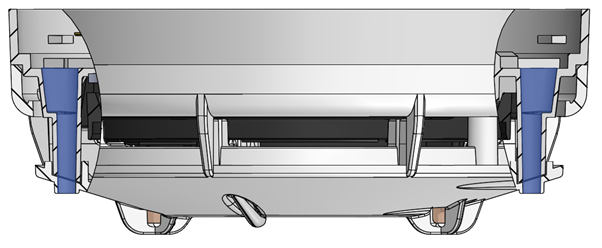
Soteria UL overcomes this issue through its patented vent design. These vents allow pressure differentials to be exhausted through a carefully positioned hole in the lid, so that is does not impede the flow of smoke into the smoke inlet or deeper into the optical chamber. Further, the vents allow any condensation that may occur in the cavity behind the detector, or in cable conduits, to escape without harm.

The drains, highlighted in blue, allow water and air to pass from the rear of the detector without affecting the smoke entry paths.

An often-overlooked characteristic of smoke sensors is their ability to operate uniformly no matter which direction the smoke is coming from. UL test detectors for this parameter in four different orientations and allows a variation of +/-50%. To ensure the most stable operation, we exceed this requirement and measure our detector at 360 orientations and achieve a variation of less than 10%/ft.

Why should a user care that Soteria UL’s directionality is so good? Well, if we had just one angle that was less receptive than others, then we would be forced to increase the overall sensitivity of the detector to ensure it can detect fire when tested in the poor orientation. By avoiding this pitfall, we can offer a detector with a perfectly balanced sensitivity.

Once smoke gets into the chamber, then it’s the job of the optical sensor to measure it, whilst discounting false readings from any foreign materials. The optical sensor consists of an industrially rated InfraRed (IR) light source. When smoke is present, light is scattered onto the light sensor. This sensor is a highly integrated Application Specific Integrated Circuit (ASIC), custom to Apollo, that combines the light sensitive element and electronic amplification.

Smoke is an aerosol – a mixture of air and tiny smoke particles. Because these tiny particles are similar in size to the wavelength of IR light, then they send that light scattering off in many directions via a quantum mechanical process that is described by Mie theory. Smoke from fires have precise characteristics; for example, it tends to scatter most light in the forward direction, rather than ‘reflecting’ it backwards.

We use this knowledge in the design of our optics, positioning the smoke sensor so it is more sensitive to the angles of scattering smoke, than the pattern of aerosols produced by cooking, for example. This is achieved with our unique patented optical sensor design.

The next nuisance that might trick our sensor is dust and insects. Traditional detectors suffer from the IR light source illuminating parts of the optical chamber, rather than just the scattering region in front of the light sensor. Because the light sensor is looking for only a tiny quantity of light to be scattered by smoke, then it can easily be fooled by light reflecting off chamber walls when dust or insects are present in the chamber.

Our first line of defence is stopping such things getting into the chamber. The Soteria UL uses a unique serpentine air inlet to prevent the ingress of dust. A fine nylon mesh prevents insects over a certain size from entering the chamber, but not all can be stopped is we still wish smoke to enter the chamber. Instead, we design the chamber to be robust to these smaller insects and accumulation of dust.

Firstly, a unique patented light absorbing surface of the chamber prevents the IR light being reflected around the chamber. This means that dust and insects on other surfaces of the chamber are less illuminated. Secondly, and this step takes some effort, all possible surfaces where an insect could stand and spread its wings, whilst being in the view of the light sensor, are eliminated. That means that even when an insect smaller than the screen finds its way into the chamber, it is very unlikely to be able to cause a false alarm. The same advantage is experienced when dust accumulates inside the chamber – there are no surfaces where dust can gather to cause stray light and trigger a false alarm.

And it’s not just our lab that this high performance is achieved. Every Soteria UL detector is produced and certified to conform to the same narrow range of sensitivity. This means that every product you install will behave the same as the last, it will not be more sensitive to common nuisances, or less sensitive to the attributes of fire. This is achieved in our factory with a blend of skilled hand assembly and highly automated modern manufacturing processes. Every single product is measured and calibrated for smoke sensitivity.

Once we have crafted the best smoke sensor, our next focus is the intelligent signal processing that determines when there is a real fire. Because the basics are right, we don’t need a highly complex, unpredictable, and opaque artificial intelligence algorithm. We simply add the right amount of smoothing, the right amount of delay, and a little enhanced detection of fast flaming fires. False alarms are avoided, not only by getting the basic smoke sensor right, but by reducing the response to slowly developing nuisance signals like cooking. The detector is constantly processing information, and if it decides there’s a fire, this is signalled to the panel via Core-Protocol with exceptional speed.

Keeping you safe from fire, every second of every day.

For more information on Soteria UL, Apollo’s 268 7th edition solution, contact enquries@apollo-fire.com or visit www.apollo-fire.co.uk/

This article was originally published in the May edition of IFSJ. To read your FREE digital copy, click here

At least 149 buildings in Chennai violate fire safety norms

At least 149 buildings in Chennai have been placed under the scanner of Special Task Force (STF) for fire safety norm violations. The State fire services department will soon make checks on these buildings to ensure corrective measures are taken by their owners, said CMDA member-secretary Anshul Mishra.

Tamil Nadu government issued an order on December 17, 2018, to constitute two special task forces to address issues pertaining to encroachments, unauthorised construction, and enforcement of provisions of Second Master Plan in Chennai Metropolitan Area (CMA) and other areas that come under the jurisdiction of Directorate of Town and Country Planning and Composite Local Planning Authority.

The latest drive comes after the fire safety STF conducted a meeting after a gap of 20 months in January this year. The STF also carried out a separate study on fire safety measures needed in congested areas with narrow roads such as George Town, Purasawalkam, Triplicane, and T Nagar.  

The task force was formed after the Centre in 2018, in accordance with a suggestion of the Supreme Court, asked all States to take necessary steps to ensure fire safety measures in buildings.  

Five of 16 buildings in Chennai, where major violations were detected during an enforcement drive carried out against 396 buildings that got approval after May 2021, could also be issued with lock and seal notices, Mishra said.

All five buildings were constructed beyond approved height. While a residential area has been converted into a hospital in one case, there is shortage of car parking space in another one, sources said.

 Enforcement drives will now be carried out regularly as CMDA staff strength has been enhanced through new recruitment drive, Mishra said.

Mishra added that the CMDA is also trying to reduce time taken to clear layout files: “We have come out with a document checklist. This will be helpful in complying with CMDA norms.! Previously, layout files were prepared by the layout division of the CMDA. Now, to reduce time and ensure transparency, applicants have been asked to submit layout drawings themselves.

Tokyo major earthquake death-toll prediction number revised down

The Metropolitan government has released a report which as revised down the estimated number of people who would die in the event of a major earthquake in Tokyo by 30% to 6,100.

The report by a panel of earthquake experts attributed the reduction of around 3,500 people as a result of advances in the quake-resistance of buildings and the greater use of non-combustible materials in their construction.

The pane concluded that the largest death toll of up to 6,148 would result if a quake with a magnitude of 7.3 originated in the southern part of central Tokyo, after it simulated significant earthquakes with different epicenters for the latest damage projection.

Of the estimated deaths, 3,209 would be caused by collapsed buildings and 2,482 by fires, the report said.

“Although the number of deaths has been reduced, losses of as many as 6,000 people must not be allowed to happen,” Naoshi Hirata, commented Head of the panel and professor emeritus at the University of Tokyo. “It is necessary to steadily advance measures.”

Exclusive: Evac+Chair discuss best evacuation products for all environment

Evac+Chair is the original and global leader in the design, development and manufacture of emergency evacuation chairs. With over 40 years’ experience in the manufacture of life saving solutions Evac+Chair is dedicated to providing the mobility impaired with a safe and quick means of evacuation.

The Evac+Chair was invented by US citizen David Egan following an emergency evacuation in which he and his wife were involved. David’s wife had suffered with polio as a child, which had caused her mobility to be impeded and when they were forced to evacuate from the 38th Floor of a Manhattan building, David had to carry her to safety.  Recognising the need for a product to assist in the quick and safe evacuation of the mobility impaired, David set about designing a solution that would do just that.

Today, the iconic blue and yellow Evac+Chair is recognised worldwide; exported to 70 countries, across 6 continents and has assisted in saving countless lives. The Chair has earned a well-deserved place in the 9/11 memorial museum for assisting in the evacuation of mobility impaired people, during the twin towers attack.

Whilst the fundamental aspects of the design of the Evac+Chair has been unaltered over the past 40 years, customer insight and investment in R&D has led to the product range being expanded and enhanced, providing greater safety and comfort to both the operator and passenger. Independent research carried out by the University of Greenwich concluded that an Evac+Chair provides the safest, quickest means of escape for the mobility impaired, compared with other types of evacuation products.

In 2020, Evac+Chair International moved into a new state-of-the-art headquarters in the West Midlands. The 38,000 square foot purpose-built facility has enabled Evac+Chair to implement enhancements to the productivity and manufacturing processes, however every chair remains hand made.  With ISO 9001 and ISO 13485 accreditations, Evac+Chair prides itself on its superior product quality and every chair undergoes rigorous quality checks, throughout manufacture and before dispatch.

Whilst many consider a mobility impairment to be a permanent disability, it can also be temporary, such as a sporting injury, pregnancy or even panic attack brought about by an emergency evacuation. Therefore, having an evacuation chair is vital for all commercial buildings, to ensure everyone can be safely evacuated in the event of a fire, or other emergency. Evac+Chair products not only provide a safe means of escape for the mobility impaired but protect everyone, as a mobility impaired person evacuating without assistance may impede the whole evacuation process, and as a result put others’ lives along with their own, at risk. 

The Regulatory Form Order for Fire Safety 2005 states, it is no longer the responsibility of the Fire Service to facilitate the evacuation of non-domestic premises.  It is the designated ‘responsible person’ (the person having control of the building, or a degree of control; i.e.  landlords, business owners, employers, facilities managers or risk assessors) who must ensure that everyone can be evacuated quickly and safely in an emergency.

Under the Management of Health and Safety at Work Regulations 1999, employers have a duty of care to assess any risks that affect the health and safety of employees and put in place appropriate procedures to be followed ‘in the event of serious and imminent danger’. The responsible person must carry out a regular review of the risk of fire on the premises and identify any issues, following which a plan must be developed to mitigate these risks, this should include the planning for the evacuation of those with disabilities.

Whilst Evac+Chair products are suitable for all environments including offices, hotels, schools, sports stadia, retail outlets, healthcare and factories, each chair has a unique set of features that make it more suitable for certain environments. To help ensure you select the correct product Evac+Chair offer a FREE evacuation assessment. Conducted by one of their nationwide consultants who will visit your site and make recommendations as to the most suitable evacuation chair for the building type and the most effective installation points. In addition, Evac+Chair offer training courses to ensure operators are confident in the deployment and operation of an evacuation chair, providing a safe and smooth emergency evacuation.

For more information or to book a FREE evacuation assessment, contact Evac+Chair: Telephone: +44 (0)121 706 6744 | Email: enquiries@evacchair.co.uk | Website: evacchair.co.uk

This article was originally published in the May edition of IFSJ. To read your FREE digital copy, click here

PBI: Pushing the boundaries of fire protective clothing

Exclusive: Fabrics and materials manufacturer PBI has been pushing the boundary with its latest trademark innovation PBI LP, Ian Callaghan, Senior Director, International Marketing and Sales, PBI International tells us more

PBI is at the forefront of incredible innovation in the development of fabrics that protect firefighters against heat and flame, but are also lightweight and breathable, reducing the risk of heat stress.

The company’s range of fabrics have become the preferred choice of fire services all over the world. From USA and Europe, the Middle East to the Far East and Australasia, firefighters go to work every day protected by PBI outer fabrics.

Choosing to work with only the best fabric manufacturers in the supply chain ensures that every PBI product performs to the highest levels required in modern firefighting and rescue. The company’s close working relationship with its supply chains is a key factor in the continued investment in research and innovation which results in products that set new standards in comfort and performance. It has driven the development of an extensive range of structural firefighting outer shells designed specifically for the different needs of fire services.

The company’s product portfolio was recently expanded with the addition of, PBI LP, a trademark lightweight fibre that further enhances comfort, breathability and freedom of movement for future structural firefighting gear. 

Fabric made with PBI LP, which stands for ‘lightweight performance’, is 10% lighter than other outer fabrics for structural fire gear, helping to reduce the risk of heat stress.  Even though the unique PBI LP™ is lighter, it still enhances heat and flame protection and resistance to break open, without compromise.

The new lighter fibre performs incredibly well when used in outer shell fabrics, even when tested against other heavier para-aramid and meta-aramid outer shells. In independent test undertaken by BTTG in the same conditions the 180 gsm PBI LP garment outperformed an identical garment made with 220 gsm meta-aramid outer fabric. An eight second burn test was undertaken on the 2006 version of the male heat sensing manikin known as RALPH, which was developed by BTTG and conforms to ISO 13506.  For the test the hands and head were not used, leaving 123 sensors on torso, arms, legs that monitor the temperature on the surface of the manikin during the test.

The BTTG tests showed 2nd and 3rd degree burn injury prediction of only 1.8% for the garment with lighter PBI LP™, compared to a much higher figure of 19.3% burn injury for the meta-aramid, despite the meta-aramid also being 40gsm heavier.

Like all PBI fabrics, PBI LP delivers excellent tensile strength and will not become brittle, shrink, or break open when exposed to flame and high temperatures. This means that the integrity of the internal layers of the garment is protected, and the transfer of any radiant heat is slower, allowing more time for firefighters to escape to safety in a situation such as a flashover. PBI’s protection from exposure to heat and flame has been proven over many years of independent testing and performance in the field.

In a Dynamic Flame Test, which is used to demonstrate the time it takes for an outer fabric to breaks down under tension, PBI LP of 180g/m2 lasted 48 seconds, while a much heavier 220/ g/m2 Para-aramid/Meta-aramid fabric lasted just 3 seconds. 

PBI LP fabric is a result of PBI’s continued investment in research and development that creates new standards of firefighter protection.  That development process must always take account of the balance between comfort and protection.  That is why outer shells made with PBI LP join a wide range of PBI fabrics that meet the need of every situation and work effectively as an integral part of all garment design. Each product has different properties and applications, but every PBI fabric exceeds the required protection standards from heat and flame for outer fabrics.

PBI’s continued commitment to innovation and new product development is not restricted to structural firefighting solutions. Working closely with the supply chain, PBI has also developed a range of lightweight protective fabrics with increased tensile strength that is designed specifically for technical rescue, wildland and industrial firefighting. 

One of the biggest challenges to firefighter safety is the risk posed by heat stress.  It can cause many problems, from muscle fatigue and reduced cognitive function to cardiovascular strain and cardiac arrest.  Research has shown that more firefighters dies in the line of duty from cardiac arrest than any other cause. One of the paradoxes of firefighter protection is that structural firefighting garments designed to protect the wearer from heat and flame can potentially contribute to the rise in core body temperature that triggers heat stress. That’s why it is so important that the outer shell, which has a primary role of protecting from heat and flame, is designed to mitigate the risk of heat stress.

All PBI fabrics are designed to offer maximum thermal protection from the outside, while at the same time delivering high levels of breathability and comfort to reduce the risk of heat stress. They will not become brittle, shrink or break open when exposed to flame and high temperatures, which is among the characteristics of other fabrics. This means that the integrity of the internal layers of the garment is protected and the transfer of any radiant heat is slower, allowing more time for firefighters to escape to safety in a situation such as a flashover.

In the 40 years since opening for business in Charlotte, North Carolina, PBI Performance Products has created a reputation for protection without compromise that is recognised all over the world.

This article was originally published in the May edition of IFSJ. To read your FREE digital copy, click here

Swiss Air Force teams up with Rosenbauer for aircraft firefighting training

The Swiss Air Force has teamed up with fire service vehicle and equipment manufacturer Rosenbauer to implement its PANTHER training system to enable training for the tactical handling of ARFF vehicles as well as handling the extinguishing and control panels.

The PANTHER training system will be installed in the fire training center of CFR Campus PHÈNIX at Payerne Airport.

The simulator landscape consists of two PANTHER tactical simulators – 8×8 and 6×6 S, as well as two simulators that can be configured bot as ARFF vehicles and command or logistics vehicles.

The two PANTHER simulators are equipped with identical PANTHER cockpits, while the other two have generic cockpits on which all functions can be operated the same way as in the respective original vehicle.

Everything that happens outside the vehicles is displayed on large LED screens in Ultra-HD (4 times HDTV) resolution. Each screen is controlled by its own computer; a total of 18 computers with powerful graphics cards are installed in the training system.

The system also includes a control panel on which the virtual training sessions are planned, programmed, and documented. There are five airport layouts and numerous aircraft types to choose from, the time of day or night, and the weather and runway conditions can be modified in order to make the operational action as realistic as possible.

All firefighting operations from leaking jet fuel to an undercarriage catching fire or burning jet engines can be trained on, whereby the control of the firefighting equipment is just as sensitive as in the real-life counterparts.

“The Swiss Air Force is building a competence center for aircraft firefighting here, where the members of the aircraft incident squads will receive their complete training in future and be able to complete regular drills under real conditions,” saod Hans Schmid, Head of Crash and Fire Rescue Swiss Air Force.

“In the future, each and every member will train on the simulators for at least two days a year. Their integration into an overall system allows us to systematically and efficiently structure the training. In addition, three liquid gas-fired fire simulators (dummy aircraft) are available for “hot” drills on the approximately 26,000 m2 site.”

Markus Zellinger, Managing Director of Rosenbauer Switzerland added: “The Swiss Air Force’s aircraft incident squads can train for every operational scenario imaginable in a resource-saving, safe, and controlled manner. That’s the great advantage of simulator training.”

Two join Society of Fire Protection Engineers board of directors

The Society of Fire Protection Engineers (SFPE), the professional society for fire protection and fire safety engineering, has announced that Robert McNamee, PhD [right], and Wojciech Węgrzyński, PhD [left], have joined the SFPE Europe Board of Directors.

McNamee and Węgrzyński were elected at the SFPE Europe General Assembly Meeting in London, UK, on 16 May 2022. They join David Grossmann, Chair; Kees Both, Immediate Past Chair; and Beth Tubbs, SFPE 2022 President, on the SFPE Europe Board of Directors.

Under the expanded leadership, SFPE Europe plans to increase its collaboration with SFPE chapters, to represent the voice of the fire safety engineer on European technical committees, to explore additional programs and partnerships, and to better meet the needs of engineers throughout Europe.

Headquartered in Brussels, Belgium, members of SFPE Europe include the Society’s 20 European chapters in Albania, Austria, Benelux, Cyprus, Denmark, Finland, France, Germany, Greece, Israel, Italy, Malta, Norway, Poland, Portugal, Serbia, Spain, Sweden, Switzerland, and United Kingdom, plus five student chapters at the Main School of Fire Service, Coimbra University, International Master of Science in Fire Safety Engineering, Imperial College/Greater London, and the University of Edinburgh.