Exclusive: TLX Technologies talk adding value to suppression systems

With an approach towards product development to add value to suppression systems, TLX Technologies highlights some key innovations from the firm

As the fire protection industry gathers this summer for Interschutz 2022 in Germany, it is interesting to look back on how much has changed since the last event was held seven years ago.

While there has been development and growth across all aspects of the industry, TLX Fire & Security, a division of TLX Technologies, has been focused on the changes in standards as well as the adoption of better security features on fire suppression systems worldwide.

In January 2016, shortly after the last Interschutz show, NFPA 2001: Sec. 4.3.4.1 (a standard for supervision on actuation devices for fixed gaseous fire suppression systems) went to effect. The goal behind the introduction of this standard was to provide a means for ensuring that the actuating device would be correctly installed on the system, at both initial installation and also after periodic maintenance, by providing a visible and audible signal at the fire panel when the actuator was either disconnected or not installed properly.   

TLX showcased its first product that met this new standard for supervision at Interschutz 2015. Since that time, system manufacturers across the globe have been adopting this standard for their actuating devices to ensure proper installation, especially for those systems that would be sold into areas where the NFPA guidelines are observed. Additionally, other regions have seen the benefit of updating their own standards in like manner. For example, later this year the European standard (EN 15004) will be changing to require supervision of actuating devices to better align with the NFPA standard that has been in effect for the last six years. While the initial NFPA standard was designated specifically for fixed gaseous fire suppression systems, NFPA recently expanded that standard to water systems with the update to standard NFPA 13: Sec. 8.3.1.2.1 that went into effect in January of last year.

Although TLX has been designing and producing actuation devices for fixed gaseous fire suppression systems for over 20 years, they have seen marked growth since developing their first product that met NFPA standards for supervision. They expect that growth to continue in the coming years as regulatory standards further align globally across the fire suppression industry.

Since their first product introduction, TLX has added several additional actuators to their portfolio to meet the requirements of suppression systems with higher operating pressures. They also added manual actuation and reset options for their actuators along with a pneumatic actuator that pairs with their electric actuators to provide customers with a full system solution. All their electric actuators are UL 864 Recognized and meet the NFPA requirements for supervision. 

New Products Showcased

TLX approaches product development with the goal of giving system manufacturers access to solutions that will add value to their suppression systems. This year TLX Fire & Security will be showcasing their new patented Explosion Proof Actuator with Supervision and their Liquid Level Sensor at both the NFPA and Interschutz shows in June. 

Fire suppression systems for hazardous environments typically rely on an actuation device and additional tubing between the actuation device and the storage tank to route discharge pressure through the system. This creates the potential for a number of leak points. Additionally, such systems require an enclosure so that if flammable gas were to make its way into the actuation device and ignite, any fire would be contained within the enclosure and would not cause combustion of any flammable substances in the atmosphere.

TLX had received numerous inquiries about possible solutions that would satisfy safety requirements for hazardous locations. Their team decided to develop a top-mounted linear actuator that acted as its own enclosure. The result was the Explosion Proof Actuator with Supervision, which is UL HazLoc, ATEX, and IECEx certified for use in hazardous locations and meets NFPA requirements for supervision.

The actuator’s top-mounted design means that it does not act as a pressure vessel on the discharge valve. This eliminates the extra connections that other solutions rely on to connect the actuator to the storage tank and route discharge pressure through the system. As a result, the only potential leak point at the tank is at the top of the discharge valve. Additionally, special design features and material grade selection allow the actuator to act as its own enclosure. All potential flame paths are specifically designed to prevent flame egress in the event a spark were to ignite any gas found in the actuator.

Because every system is unique, the actuator can be customized to fit any system. The internal components can be configured during production to match any operating pressure up to 300 bar. The interface can also be fully customized: mounting thread, connection type (male or female), firing pin stick out, and firing pin geometry can all be configured according to the customer’s specifications.

The Explosion Proof Actuator with Supervision provides an all-in-one solution for hazardous locations that simplifies installation and maintenance and helps improve system reliability.

While TLX has long specialized in producing the most innovative actuation devices, they have taken their technological expertise and applied it to integrated sensing to satisfy other needs in the fire suppression industry. Most recently, they developed a liquid level measuring device that offers a better alternative to current methods of determining the level of extinguishing agent in a system’s storage tanks.

Most solutions for measuring the level of extinguishing agent require a technician to take a manual reading and calculate the weight using a conversion table. Accurately calculating the weight of the extinguishing agent is crucial for keeping the system operating, and manually calculating conversion table data creates the potential for errors.

TLX Fire & Security developed a solution that would eliminate the potential for human error that is inherent in many of the methods currently being used. The Liquid Level Sensor automatically provides a thermally compensated weight reading of the extinguishing agent in the fire suppression system’s storage tanks. The sensor is comprised of a sealed tube with a magnetic float mounted on the outside of the tube. This tube is installed in each tank prior to being filled with the extinguishing agent. There is another magnetic float inside the tube that interlocks with the float outside the tube, providing an accurate measurement of the fluid level inside the tank. At the end of the tube at the top of the tank is a sensor that sends float position and temperature data to a microcontroller that is preprogrammed with a conversion table for that specific tank and extinguishing agent configuration. The microcontroller then automatically calculates the weight of the extinguishing agent inside the storage tank.

The weight of the extinguishing agent can be displayed directly at the tank on a digital display or transmitted to the fire control panel via hardwired or wireless connection. Data can also be accessed remotely or downloaded using a USB connection. Additionally, a simple GO/NO-GO status can be displayed with a green/red LED to indicate the status of the storage tank.

While the Liquid Level Sensor is an ideal solution for many fire suppression systems, some systems require the tanks to be weighed. For such systems, TLX is currently developing the Hanging Weight Sensor and Platform Weighing Sensor. These sensors will feature continuous monitoring, high accuracy (100 g resolution), and 500 kg maximum capacity. These weighing sensors are scheduled to be available to the market in the second half of 2022. 

The Future of the Industry

Data collection and the Internet of Things (IoT) has revolutionized the way businesses operate in nearly every industry. Everything from warehouses to manufacturing has used this technology to add value and improve efficiency. Warehouses have dramatically improved inventory accuracy and pick and ship times. Data can be collected and analyzed on manufacturing equipment for predictive and preventative maintenance, minimizing downtime.

However, the fire suppression industry has been slow to explore the ways that data collection and remote monitoring can improve safety and efficiency and bring value to their fire suppression systems. The changes brought to the world by the COVID-19 pandemic, often resulting in fewer people on-site and the explosion of remote work, has caused the industry to more seriously consider how IoT can be best used.

Data collection and IoT can make fire suppression systems safer and more efficient than they have ever been. Typically, fire suppression systems are only inspected biannually. If there is a fault in the system, it may not be detected until one of these inspections. But with remote monitoring, system faults can be detected almost immediately and addressed in the most efficient manner possible. This makes for a safer, more valuable system.

This technology promises to bring considerable value to all stakeholders. It is critical that the industry begins considering how data collection and IoT can be deployed. As customers begin to realize how this technology is benefitting other systems they rely on, they will look to the fire suppression industry for similar solutions for their fire suppression systems. If the industry fails to seize the opportunity to utilize this technology, another industry may step in and fill the void. The HVAC industry is already using this technology, and they may begin to include fire suppression data collection in their monitoring systems. By investing in this technology, the fire suppression industry can take an important step to ensure its growth and profitability.

This article was originally published in the May edition of IFSJ. To read your FREE digital copy, click here

Exclusive: The Value and Growth of Monitored Fire Alarm Signalling Systems

John Coleman, Head of Sales UK & Ireland at CSL, discusses the latest developments around professionally monitored fire alarm signalling systems.

Historically, Fire Systems have been designed to protect lives when the building is occupied. But increasingly, we have seen examples where fires have occurred in empty premises. 60 fires a day occur in or beside vacant or derelict properties in the UK (Home Office Statistics). When a fire occurs and the premises are empty, it will not be reported unless someone nearby sees it or hears the alarm.

The Benefits of Monitoring

Statistics suggest that only around 6% of fire systems have a monitored alarm, yet 67% of fires occur when premises are empty. A Fire System with Professional Signalling reports any faults or alarms to a Monitoring Centre, providing 24/7 365 peace of mind for premises owners. In addition, arson – just like criminal damage and theft – is much more common in empty buildings as opposed to those which are occupied. Monitored Fire Systems allow for faster reporting of incidents as well as acting as a deterrent.

Recent Examples

In February this year, 130 firefighters were called to tackle a blaze at the Armadillo Self Storage Unit in Cheadle, Greater Manchester. The fire, which started at 1 am, destroyed 40% of the building and many companies using the facility lost everything they had on-site. In these instances, every second counts. A professionally monitored fire alarm would immediately alert the Alarm Receiving Centre and the Fire Brigade, to ensure the fastest possible response to such incidents. In doing so, this would minimise the impact of the fire as best as possible.  

European Standards

EN54 certification is the most important aspect in terms of signalling for fire detection and alarm systems. However, the cost of products has always been an issue, with most fire systems having no monitoring at all despite many fires occurring when the premises are empty.

Over the past few years, we have seen an increased industry demand for EN54 (Fire) certified signalling products that offer the flexibility of installation, increased reliability, and cost-effectiveness. We are confident that all criteria have now been satisfied with the new DualCom Pro Fire products.

The DualCom Pro 2 Fire Range

We recently announced the arrival of the new DualCom Pro 2 Fire variants. These latest innovations, which include DigiAir Pro 2 and GradeShift Pro 2, are now available to order from your chosen ARC. DigiAir Pro 2 Fire offers a wireless single-path solution, whilst GradeShift Pro 2 Fire offers dual-path, dual-radio signalling via 2 separate radio modules. Both solutions come with multiple 4G WorldSIMs, providing the most reliable fire signalling systems ever, whilst the wireless signalling options mean the installation is not limited to the infrastructure of the premises.

Our Fire variants enable devices to signal alerts directly to a professional monitoring station 24/7 when the premises are left unattended. This is one of the reasons CSL’s Fire variants are now trusted in over 7,000 professional fire installations across Europe.

Wireless 4G Connectivity

All variants of the DualCom Pro 2 Fire Range are wireless 4G solutions. This means that the device can be placed in whatever position is best for the installer and radio coverage. The Range is supplied with High Gain Aerials and extension cables are available to ensure that the best signal can be accessed every time.

Value

In the past, fire monitoring has been cost-prohibitive as was not often pushed by insurers, and therefore installers didn’t see the benefits of doing this. Today, the options available via CSL are cost-effective and accessible for all. Many Installers are not include monitoring for fire systems as standard. It offers increased value for Installers in terms of insights on faults and performance. Take control of your professional fire installations and access this instant information using the My Base App.

All IP

The UK and Ireland’s Communications Providers are in the process of upgrading their customers from the existing analogue phone service to an enhanced IP service, with the plan to migrate to a fully digital phone service by the end of 2025. The change will affect anything that currently plugs into the existing analogue telephone wall sockets, including Fire signalling systems. The project is well underway, and the impact is already being seen at premises nationwide. For more information, please visit the CSL website!

Fire & Security Matters Awards 2022

We are delighted to announce that DualCom Pro Fire 2 has been announced as a finalist for the upcoming Fire & Security Matters Awards in the Fire Innovation of the Year category! Another reflection of how well this innovation has been received by the industry.

Case Study – Black Box

Black Box is a fully accredited BAFE (SP203) Fire Alarm System Service Provider with an extensive portfolio of installations. On every one of these systems, Black Box install the highest grade of professional fire monitoring with connections into an ARC. As part of this, they are installing GradeShift Pro 2 Fire as standard for all new and existing customers. GradeShift Pro Fire is a DP2 graded, radio/radio dual-path signalling solution, with a catastrophic failure reporting time of 31 minutes. With analogue telephone (PSTN) lines soon to be redundant, Black Box is using GradeShift Pro Fire to upgrade any legacy systems that rely on this older technology.

EN54 certified monitored signalling forms an essential part of a fully compliant system, that can report any faults or issues in a much shorter period, providing peace of mind for customers. The addition of the My Base App for remote configuration changes, allows Black Box to manage its entire DualCom Pro signalling base.

“GradeShift Pro Fire provides us with an ideal dual-radio, EN54 alarm signalling solution. It enables us to install to the latest and highest standards, whilst overcoming any on-site issues we may face such as no availability of IP or PSTN connections.”

David Barnes, Managing Director of Black Box

Case Study – Moray Fire

Moray Fire Protection provides personal and comprehensive fire detection and protection services to companies, government organisations and individuals throughout Scotland. The company is BAFE registered and operates under industry recognised standards. Located in Elgin, they are ideally situated to service clients throughout the whole of Scotland including Moray, the Highlands, Aberdeen, and Aberdeenshire.

Moray Fire Protection has recently taken over a contract to maintain eight care homes across Moray and the Highlands. Having inherited these sites from a previous contractor, Moray Fire Protection decided to upgrade and replace the installations with new equipment including the latest alarm signalling. With analogue telephone (PSTN) lines soon to be redundant, Moray Fire Protection reached out to CSL as they felt that the DigiAir Pro 2 Fire was the best-suited signalling product for these installations.

DigiAir Pro 2 Fire is an SP3 graded, radio only single-path signalling solution, utilising all mobile networks via our WorldSIM to signal an alarm. As a tailor-made fire signalling solution, DigiAir Pro 2 Fire also offers a faster catastrophic failure reporting time of 31 minutes.

With EN54 certified monitored signalling, Moray Fire Protection now have a fully compliant system, that can report any faults or issues in a much shorter period, providing peace of mind for their customers. The addition of the My Base App for remote configuration changes, allows Moray Fire Protection to manage their devices for their customers and ensure the service is always working correctly.

“DigiAir Pro Fire provides us with the perfect radio solution for upgrading all our legacy, monitored single-path sites. It is enabling us to future-proof our estate as part of the ongoing All IP transition and ahead of the ‘Big Switch Off’ in 2025.”

Neil Hughes, Alarm Engineer, Moray Fire Protection

In summary

Why wouldn’t you add professional alarm signalling to your fire systems? For more information, please visit our website:

www.csl-group.com/uk/sectors/fire

This article was originally published in the May edition of IFSJ. To read your FREE digital copy, click here

Quelfire: Building Safety Act brings ‘air of hope’

Fire Protection System supplier Quelfire looks at The Building Safety Act and what it means for the fire industry

It has been nearly five years since the devastating fire that destroyed Grenfell Tower, which saw the loss of 72 lives. Others lost their homes, possessions and loved ones, which changed the course of their lives forever. Since the tragic event, a public inquiry was conducted into the cause of the fire, leading the construction industry to come under heavy scrutiny.

In May 2018, Dame Judith Hackitt’s Independent Review of Building Regulations and Fire Safety found that “the regulatory system for high-rise and complex buildings was not fit for purpose.” 53 recommendations were put forward to change the way the industry works and create a safer living space for residents. But more importantly, Dame Judith Hackitt looks to drive a cultural change to make sure something this catastrophic never happens again.

After being introduced to parliament in July 2020, the Building Safety Bill was published a year later in July 2021 and was summarised by then-Housing Secretary Robert Jenrick as a “key step in an extensive overhaul to building safety legislation.”

On the 28th of April 2022, the Bill received Royal Assent meaning that now it has passed all the parliamentary stages in the House of Commons and the House of Lords, it will take a more prominent stance in the built industry as The Building Safety Act.

The Act will be directly responsible for buildings that are at least 18 metres tall or have seven storeys, with at least two residential units. It will also cover hospitals and care homes if they meet the specification.

The Building Safety Act (BSA) has named the Health and Safety Executive (HSE) as the Building Safety Regulator (BSR) to oversee the safety and performance of all buildings. With this, comes the duty to assist and encourage improvements in the built environment industry, holding powers of enforcement and sanctions.

Introduction of Gateways two and three will establish new requirements at key stages of design and construction. They are vital decision points within a project that must be passed before it can progress to the next stage, therefore, enabling a rigorous process where each stage of design and construction is monitored.

The Golden Thread, which is a live digital document that allows someone to understand a building and ensure that all information is up-to-date and accurate, will guarantee that any person responsible for any aspect of a project or building – dutyholders – work and findings are handed to the building’s owner upon completion. This will enable the right person to have the correct information regarding the safety of residents and building; ensuring risks are managed effectively. Failure to comply will see that those who are responsible for the safety of a building – the Accountable Person – are charged by criminal offence.

Finally, the introduction of The New Home Ombudsman, which will offer dispute resolution for buyers of new build homes against developers, enables the creation of a Construction Product Regulator (CPR), who will confront poor practice early on in a project and help guarantee that all construction products on the UK market are safe. They will work closely with the BSR to ensure the system of product testing and certification is being followed.

Both parties will assist in advising The Secretary of State on which products should be considered as safety-critical and consequently, remove products from the market that present any safety risks.

 So, what does this mean for the fire industry?

The government are working to ensure that the Fire Safety Order 2005 (FSO), which places duty on individuals in an organisation – the Responsible Person – to identify, control and reduce the risk of fire, and the new building safety regime work effectively together. The Fire Safety Clause in the BSA amends the FSO to further strengthen fire safety measures for non-domestic premises, which include common parts of high-rise residential buildings subject to the BSA. The FSO and BSA will overlap in some respects, but through the cross-work of the government, by aligning these essential regimes it will ultimately work to further protect residents in high-rise residential buildings.

In a typical safety case report, the Accountable Person will ensure that they have a preventative approach for managing building safety risks. An aspect of this report will cover major fire and structural hazards for example, compartmentation. This includes key areas of passive fire protection: linear gaps and cavity fire stops, service penetrations and fire doors. HSE is urging anyone involved in the design or construction of a building to act now, at the earliest stage, and become proactive in the process of ‘building a safer future.’ The work the fire industry does now can help comply with this by raising more awareness of what early engagement in firestopping is; conducting CPDS to educate the industry; providing more tested details and technical support and offering on-site support.

Despite the Building Safety Act being law, many of the requirements will not come into force until 12-18 months after the Royal Assent as the industry prepares for the new regime. The government’s transition plan can be found here.

The risk of fire has decreased considerably over the years. However, the tragedy of Grenfell has shown that there is too much scope for “poor practice, poor culture, poor accountability and poor management.” The Building Safety Act brings an air of hope to survivors and their family members but ultimately, pays respect to the 72 victims. Without the Act, there would be no push for government reform and the risk of Grenfell happening again would be inevitable.

Expert Insight: Fire protection DNA

Erik Boyter, CEO, WindowMaster and Ian King COO Zeroignition explore importance of a robust fire protection built into the DNA of every building

Smoke control systems should be built, certified and delivered in a way that building owners and occupiers can depend on.

It’s vitally important to recognise that only certified components of the system should be used. For example, smoke panels proven, factory built and certified to the relevant parts of EN12101 and other relevant standards like ISO21927-9.

A factory-based quality system or factory production control, audited by a notified body, should be used to certify components of factory-built products.

Consistency is key. Systematic checks of components, arrangement, fabrication and build in a controlled environment is the only appropriate route to prevent any variations in build from what has been tested and allowed to be certified. This helps ensure dependability as designed, and will enable the supplier to produce a product specific declaration of performance at point of manufacture.

System install and commissioning should be conducted and completed by an appropriate party qualified and competent to do so. This might be demonstrated through voluntary certification such as the SDI 19 scheme.

Finally, the building owner or manager is responsible for ensuring that the system remains compliant through a systematic approach to testing and maintenance.

It cannot be emphasised enough for life safety systems: compliant systems must exist and be documented throughout the design, manufacture and delivery process, as well as through the life of the building.

We’ve looked at smoke control systems, but of course fire safety also encompasses general building materials. While it is important to understand and use FR products in all building specification, it is also crucial we consider the wider system. Ian King, COO, Zeroignition, takes us through the importance of a systematic approach to fire safety.

The Grenfell tragedy was a catalyst for change in the construction industry. It marked the realisation that much more needs to be done to ensure the buildings we live in are properly equipped to protect occupants from the risk of fire and that safety must be put first, above all else.

As the Building Safety Bill continues to make its way through Parliament, albeit slowly, discussions around cladding continue to dominate headlines pushing fire safety even higher on the priorities list. Yet as we’ve seen, the pace of the bill has re-affirmed how notoriously complex fire safety compliance is in the UK.

In reality, we must remember the Bill will be unlikely to eradicate some of the wider issues that the industry struggles with, namely, cost and more recently the availability of materials. Add to this the lack of construction product testing facilities, which are key to the ‘levelling up’ of standards and quality. The Local Government Association (LGA) is one example, encouraging more reliable testing systems that are also more user friendly. It also wants to see businesses caught selling products that aren’t fit for market, held accountable. “The new regulator must have real powers and sanctions and the regulatory system must be properly funded,” says the organisation. “Trading Standards authorities have found themselves caught between costly and complex arguments between test labs about the correct approach to testing, with no way to resolve them.”

At Zeroignition, we agree with this sentiment. Since our founding, Zeroignition has been keen to see a vast improvement in accurate labelling by product manufacturers, ensuring that any information provided is easy to understand and identify, so that materials specified to construct buildings are what they say they are. Without this clear guidance, change will never materialise and people and properties will remain inadequately protected from fire.

Disrupting traditions

There’s no denying, construction projects are incredibly complex and involve a myriad of decisions. Every specification choice has a knock-on effect to the wider build, and unforeseen results can easily arise when a systematic approach to fire protection isn’t maintained.

Although it’s widely agreed by industry professionals that a methodical approach is the key to quality, there’s clearly some scepticism as to how to achieve this. Manufacturers, specifiers and architectural bodies must do more to ensure best practice is fully established and abided by, on every single project, without fail.

Beyond this, the construction industry should look to other industries for guidance, such as automotive and aviation, where a checklist approach reduces the risk of harm to passengers. It’s no longer good enough to work from memory or from a notepad and pen. Digital record keeping is now necessary to ensure certain fire planning elements aren’t being missed.

Beyond this, we need to look to the latest in communications theory and decision making to ensure that fire communications are presented in a way that sticks, and use ‘nudge theory’ to ensure that it’s easier to do the right thing.

Investing in robust knowledge

We know that in-depth knowledge surrounding product safety standards is essential for architecture, specification and construction professionals. Those working in the industry must be sure they have the knowledge and understanding of fire safety when specifying building projects.

It’s an area we investigated for ourselves, post-Grenfell, and the results reveal just how serious knowledge gaps around fire safety remain in the industry. The survey was conducted across the UK, Germany and France and of those questioned, just 3% of architects were able to correctly define the four basic fire protection terms: active fire protection, passive fire protection, fire resistance and reaction to fire.

A mere 2% of the architects interviewed said they’d received comprehensive fire protection training. While most agreed they had had some sort of training, less than one in ten (8%) said they’ve never had fire protection training. These findings reveal an urgent need for serious upskilling to ensure those building liveable structures are well informed and up to speed on the essential fire safety requirements and protocols.

A third of architects who participated in the study also revealed that their current employer doesn’t spend enough on fire protection training, and it seems since the outbreak of COVID-19 particularly, many have taken matters into their own hands. NBS (formerly National Building Specification) says it saw a marked increase in webinar attendance, as more people were working remotely and had the time to attend digital webinars and seminars without having to build time into their day to travel to and from the training venue. Online webinars covered a variety of different topics including fire safety, and were attended by product manufacturers, as well as architects and specifiers.

Positive change

The digital ‘revolution’ of the construction industry is also enforcing positive change. ‘Digital footprints’ which explicitly show that work has been carried out to the appropriate standard are now essential. A further take up of this approach will no doubt help to implement watertight fire safety checks before a building is handed over to the occupant or end user.

Discussions had with manufacturers we work with, have also shown first-hand how an increased focus on R&D projects is now taking place. Advancements in innovative materials that help boost fire safety are now coming to market for added protection on new and existing building projects.

Given what we’ve seen, fire protection now needs to be given the attention it deserves and a uniformed, robust framework needs to be set in place to make sure consistency is achieved across the sector. Increased levels of third-party testing is another area that needs to improve and a greater understand of how components work in tandem will be a key element in improving fire safety within construction.

Manufacturers also have a role to play. Specifiers need to have complete confidence in the products they are recommending which means product information must be up to date and accurate. Until we address the focus on quality vs cost, we’ll never achieve construction’s primary role: ensuring its occupants remain safe. 

This article was originally published in the May edition of IFSJ. To read your FREE digital copy, click here

Evacuation: a stitch in time saves lives

The fire safety order leaves no caveats for evacuation during an emergency, Triple A sheds light on the legislation

There are an estimated 1 billion disabled people worldwide. The purpose of the UN Convention on the Rights of Persons with Disabilities is to promote, protect and ensure the full and equal enjoyment all human rights and fundamental freedoms by all persons with disabilities, and to promote respects for their inherent dignity. In the UK, there are 14.1 million disabled people whose rights are protected through the Equality Act 2010. 

Disabled and Evacuation in an Emergency The use of technology and social care packages has resulted in many disabled people living fulfilled, independent lives within their communities. There is often a common belief that all disabled people are wheelchair users. 

Access and egress for disabled people

The Regulatory Reform (Fire Safety) Order 2005, covers almost all buildings in England and Wales. The onus for compliance is on the individual Responsible Person who is the owner, employer or person in control of the building. 

The Fire Safety Order specifically states that all relevant people must be able to leave the building as quickly and as safely as possible and processes must be in place for when any relevant person is in immediate danger. There are no caveats excluding either disabled people or residential accommodation from the requirement and non-compliance is a criminal offence.

Building Regulations ensure that multi-storey buildings are accessible to disabled people through the provision of lifts, but the majority of lifts are not fire protected and cannot be used during a fire. This presents a challenge for many Responsible Persons delivering compliance with the Fire Safety Order where it relates to evacuation from residential buildings.

PEEPs and ‘buddies’ in residential buildings

The Fire Safety Order covers the common areas of residential accommodation.  English Heritage state that 54% of housing association tenants are disabled and many of these will be residents in multi-storey buildings, which have no fire-protected lifts and no staff. 

It is important to recognize that the Fire Safety Order does not require evacuation assistance to be provided by an employee, just that the person is competent and trained. In reality, in the vast majority of cases family members, neighbours or friends are the ‘first responders’ in an emergency and are unlikely to abandon the disabled person to save themselves.  There are also considerable advantages in involving them as a buddy:

  • they know the disabled person’s capabilities;
  • the disabled person trusts them;
  • they are aware of any vulnerabilities;
  • they will be used to communicating with the disabled person.

Many Responsible Persons are concerned about potential liabilities resulting from training family members, friends or neighbours to assist a disabled person.

PEEPS in the workplace and public access environments

In secure workplaces, the Responsible Person is aware who is present within the building and able to develop a Personal Emergency Evacuation Plan (PEEP) for each individual disabled person. 

In public access environments, the Responsible Person is unlikely to know who will be present in the building and therefore will need to develop Generic Emergency Evacuation Plans (GEEPs).  It is important that any strategy does not place employees in danger if they are involved in the evacuation of a disabled person as this would breach the Health & Safety Act 1974.

Developing the PEEP

The Fire Safety Order requires that the Responsible Person ensures that employees are provided with training prior to their being required to undertake new activities which includes the development of PEEPs.  Triple A Solutions provides Institute of Fire Engineers accredited training to ensure that the Responsible Person can prove due diligence in meeting the requirements of the Fire Safety Order.

The elements that need to be considered during the development of a PEEP are: he physical environment, the disabled person, and the assistance required.

Conclusion

The Tenants Management Agents of Grenfell Tower failed to develop PEEPs for their disabled residents despite being fully aware that they were unable to evacuate. As a result, 41% of the disabled residents of Grenfell Tower died and there were additional fatalities and injuries occurred due to non-disabled residents refusing to attempt to evacuate without the disabled resident.

Those who manage buildings must comply with the requirements of the Fire Safety Order for both disabled and non-disabled people.  The alternative is to risk a criminal prosecution if injuries or deaths occur.

This article was originally published in the May edition of IFSJ. To read your FREE digital copy, click here

Survitec launches ‘Head Start’ programme for ship fire safety

Survival Technology specialist Survitec has introduced a new programme to ensure shipowners are fully equipped to protect crews and assets throughout the entire lifetime of their vessels.

The “Head Start” programme is a complete through-life supply and service initiative. Survitec has been working with shipowners, designers and ship builders from first designs to ensure that vessels are protected with the most advanced safety solutions possible and to ensure they can be operated and maintained efficiently throughout the vessel’s lifetime.

Finn Lende-Harung, Commercial Director – Fire Solutions, Survitec, said: “Being involved from the planning phase onwards, we can help to optimise safety system design, installation and commissioning as well as ensuring shipowners benefit from the most cost-effective means of managing their ongoing system training, servicing, and certification requirements.

“From the very beginning of a project, shipowners have immediate access to our global network of experts through a single point of contact. We’re providing a complete one-stop safety shop from the design phase through to ongoing vessel operations. We’re setting shipowners on course for a lifetime of safety at sea.”

Rafal Kolodziejski, Survitec’s Head of Product Support and Development – Fire Systems, cited the increasing number of newbuilds opting to run on alternative fuels as one of the main reasons why the initiative is becoming so appealing.

He said: “The industry is well advanced in fire extinguishing technologies and mediums for gas and methanol fuelled fires. However, li-ion batteries, ammonia, and hydrogen are relatively new marine fuel and powering options, presenting very different challenges for shipowners and operators.

“The risk of fire from these alternative fuels can be substantial, requiring a higher focus on prevention and the monitoring of gas leakage and temperatures. When we are involved in a newbuild project from the beginning, we can better mitigate any risk further down the line through quick-response fire system solutions.”

Lende-Harung added that as the shipping industry moves towards digital technologies and the possibilities of autonomous shipping – accelerated perhaps by current operational and financial challenges: “Remote monitoring, diagnostics and online maintenance will in the future become a major consideration at the design stage.”

Survitec’s fire system experts can monitor system conditions, support ship crew with trouble shooting and adjustment of equipment shoreside without having to physically attend the ship,” said Lende-Harung. “A remote VPN gateway connects to the fire safety system operator panel via an ethernet cable or Wi-Fi through a secure gateway.

“We can connect at short notice in case of issues threatening normal operation or to provide training to ship crews. For example, we can help a system operator tune-up their inert gas system to reduce fuel consumption, reduce maintenance and increase system stability. Remote diagnostics and the monitoring of fire safety equipment will become a major factor in the swing towards autonomous shipping.”

Rebecca Croton joins Quelfire marketing team

Quelfire has further expanded its team with the addition of Rebecca Croton as Content Marketing Executive.

Commenting on her new position, Cronton said: “I have always had a passion for writing and creating content, I studied English and Journalism at university, so I knew it was going to be something I would enjoy. It is great to see how passionate everyone is at Quelfire, it is a fun yet professional atmosphere.

“I have never worked in the passive fire protection industry before, but I feel like I have learnt so much already. Even when you think you are not learning, you are! There has been a lot to take on board, but it has been very interesting as it is relevant to every single one of us. Particularly, I have enjoyed spending time with each member of ‘Team Orange’ to learn about their roles, how they play a part in fire safety and how I can assist them with future content.

“During my first two days, I jumped into fire safety headfirst, at The Fire Safety Event. It was a great opportunity to learn from my colleagues and meet specialists in the industry, to hear about their typical challenges.”

Welcoming Rebecca, Quelfire’s Marketing Manager Timea Popovics said: “As a result of increased scrutiny over the accuracy of construction product information and requests from customers for more regular updates on new tested details, we were keen to focus more on content. We believe that it will be critical in building and maintaining connections and engagement with customers and other partners.

“Rebecca will play a key role in keeping information about our solutions up-to-date and ensure it reaches our customers and all parties involved in firestopping. We are delighted to welcome Rebecca to Quelfire’s ‘Team Orange’ and look forward to encouraging her in the development of this important new role.”

Detection: Evolving to meet the UL 7th edition standard

Underwriters Laboratories (UL) have introduced challenging new requirements for smoke detectors. Apollo have responded by building the most solid, stable, and dependable fire detector yet based on our decades of experience and innovation in fire detection.

The Challenge

We know that one of the biggest challenges our customers face is false alarms. UL know this too, and through research conducted by National Institute of Standards and Technology (NIST) have introduced new requirements on smoke detector manufacturers, like us, to reduce the risk of false alarms. At the same time, UL have responded to the evolution of construction methods and materials that can change how fire behaves in a building. This has led to the introduction of a new fire test that requires faster and earlier detection of flaming fires than ever before.

Solution

We like to get the basics right. To Apollo this starts with the performance characteristics of the smoke sensors.

An optical smoke sensor must be protected from stray light, dust, and insects. These roles are all fulfilled by the enclosure, which we call the optical chamber. Whilst blocking these potential nuisances, the chamber must freely admit smoke allowing it to be measured by the optical sensor. A surprising amount of fluid-dynamics know-how is required to achieve this; since smoke from a fire tends to move relatively slowly with little energy to push it along. This has led to the unique chamber design of Soteria UL that collects smoke form the outer edges of the detector, removing any impediment to airflow, and achieving a particularly fast detection of fires without airflow delays.

Smouldering fires, in particular, tend to generate vast amounts of smoke, but due to the lack of heat in the fire, that smoke doesn’t have the energy to reach the optical chamber; and this problem worsens when the stack effect is introduced. Stack effect is when tiny pressure differentials, between ceiling cavity and a room, cause clean air from the ceiling to be forced through a detector and out of the smoke inlet, preventing smoke from a room fire entering the detector.

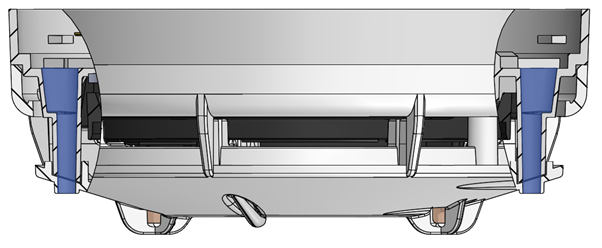
Soteria UL overcomes this issue through its patented vent design. These vents allow pressure differentials to be exhausted through a carefully positioned hole in the lid, so that is does not impede the flow of smoke into the smoke inlet or deeper into the optical chamber. Further, the vents allow any condensation that may occur in the cavity behind the detector, or in cable conduits, to escape without harm.

The drains, highlighted in blue, allow water and air to pass from the rear of the detector without affecting the smoke entry paths.

An often-overlooked characteristic of smoke sensors is their ability to operate uniformly no matter which direction the smoke is coming from. UL test detectors for this parameter in four different orientations and allows a variation of +/-50%. To ensure the most stable operation, we exceed this requirement and measure our detector at 360 orientations and achieve a variation of less than 10%/ft.

Why should a user care that Soteria UL’s directionality is so good? Well, if we had just one angle that was less receptive than others, then we would be forced to increase the overall sensitivity of the detector to ensure it can detect fire when tested in the poor orientation. By avoiding this pitfall, we can offer a detector with a perfectly balanced sensitivity.

Once smoke gets into the chamber, then it’s the job of the optical sensor to measure it, whilst discounting false readings from any foreign materials. The optical sensor consists of an industrially rated InfraRed (IR) light source. When smoke is present, light is scattered onto the light sensor. This sensor is a highly integrated Application Specific Integrated Circuit (ASIC), custom to Apollo, that combines the light sensitive element and electronic amplification.

Smoke is an aerosol – a mixture of air and tiny smoke particles. Because these tiny particles are similar in size to the wavelength of IR light, then they send that light scattering off in many directions via a quantum mechanical process that is described by Mie theory. Smoke from fires have precise characteristics; for example, it tends to scatter most light in the forward direction, rather than ‘reflecting’ it backwards.

We use this knowledge in the design of our optics, positioning the smoke sensor so it is more sensitive to the angles of scattering smoke, than the pattern of aerosols produced by cooking, for example. This is achieved with our unique patented optical sensor design.

The next nuisance that might trick our sensor is dust and insects. Traditional detectors suffer from the IR light source illuminating parts of the optical chamber, rather than just the scattering region in front of the light sensor. Because the light sensor is looking for only a tiny quantity of light to be scattered by smoke, then it can easily be fooled by light reflecting off chamber walls when dust or insects are present in the chamber.

Our first line of defence is stopping such things getting into the chamber. The Soteria UL uses a unique serpentine air inlet to prevent the ingress of dust. A fine nylon mesh prevents insects over a certain size from entering the chamber, but not all can be stopped is we still wish smoke to enter the chamber. Instead, we design the chamber to be robust to these smaller insects and accumulation of dust.

Firstly, a unique patented light absorbing surface of the chamber prevents the IR light being reflected around the chamber. This means that dust and insects on other surfaces of the chamber are less illuminated. Secondly, and this step takes some effort, all possible surfaces where an insect could stand and spread its wings, whilst being in the view of the light sensor, are eliminated. That means that even when an insect smaller than the screen finds its way into the chamber, it is very unlikely to be able to cause a false alarm. The same advantage is experienced when dust accumulates inside the chamber – there are no surfaces where dust can gather to cause stray light and trigger a false alarm.

And it’s not just our lab that this high performance is achieved. Every Soteria UL detector is produced and certified to conform to the same narrow range of sensitivity. This means that every product you install will behave the same as the last, it will not be more sensitive to common nuisances, or less sensitive to the attributes of fire. This is achieved in our factory with a blend of skilled hand assembly and highly automated modern manufacturing processes. Every single product is measured and calibrated for smoke sensitivity.

Once we have crafted the best smoke sensor, our next focus is the intelligent signal processing that determines when there is a real fire. Because the basics are right, we don’t need a highly complex, unpredictable, and opaque artificial intelligence algorithm. We simply add the right amount of smoothing, the right amount of delay, and a little enhanced detection of fast flaming fires. False alarms are avoided, not only by getting the basic smoke sensor right, but by reducing the response to slowly developing nuisance signals like cooking. The detector is constantly processing information, and if it decides there’s a fire, this is signalled to the panel via Core-Protocol with exceptional speed.

Keeping you safe from fire, every second of every day.

For more information on Soteria UL, Apollo’s 268 7th edition solution, contact enquries@apollo-fire.com or visit www.apollo-fire.co.uk/

This article was originally published in the May edition of IFSJ. To read your FREE digital copy, click here

At least 149 buildings in Chennai violate fire safety norms

At least 149 buildings in Chennai have been placed under the scanner of Special Task Force (STF) for fire safety norm violations. The State fire services department will soon make checks on these buildings to ensure corrective measures are taken by their owners, said CMDA member-secretary Anshul Mishra.

Tamil Nadu government issued an order on December 17, 2018, to constitute two special task forces to address issues pertaining to encroachments, unauthorised construction, and enforcement of provisions of Second Master Plan in Chennai Metropolitan Area (CMA) and other areas that come under the jurisdiction of Directorate of Town and Country Planning and Composite Local Planning Authority.

The latest drive comes after the fire safety STF conducted a meeting after a gap of 20 months in January this year. The STF also carried out a separate study on fire safety measures needed in congested areas with narrow roads such as George Town, Purasawalkam, Triplicane, and T Nagar.  

The task force was formed after the Centre in 2018, in accordance with a suggestion of the Supreme Court, asked all States to take necessary steps to ensure fire safety measures in buildings.  

Five of 16 buildings in Chennai, where major violations were detected during an enforcement drive carried out against 396 buildings that got approval after May 2021, could also be issued with lock and seal notices, Mishra said.

All five buildings were constructed beyond approved height. While a residential area has been converted into a hospital in one case, there is shortage of car parking space in another one, sources said.

 Enforcement drives will now be carried out regularly as CMDA staff strength has been enhanced through new recruitment drive, Mishra said.

Mishra added that the CMDA is also trying to reduce time taken to clear layout files: “We have come out with a document checklist. This will be helpful in complying with CMDA norms.! Previously, layout files were prepared by the layout division of the CMDA. Now, to reduce time and ensure transparency, applicants have been asked to submit layout drawings themselves.

Tokyo major earthquake death-toll prediction number revised down

The Metropolitan government has released a report which as revised down the estimated number of people who would die in the event of a major earthquake in Tokyo by 30% to 6,100.

The report by a panel of earthquake experts attributed the reduction of around 3,500 people as a result of advances in the quake-resistance of buildings and the greater use of non-combustible materials in their construction.

The pane concluded that the largest death toll of up to 6,148 would result if a quake with a magnitude of 7.3 originated in the southern part of central Tokyo, after it simulated significant earthquakes with different epicenters for the latest damage projection.

Of the estimated deaths, 3,209 would be caused by collapsed buildings and 2,482 by fires, the report said.

“Although the number of deaths has been reduced, losses of as many as 6,000 people must not be allowed to happen,” Naoshi Hirata, commented Head of the panel and professor emeritus at the University of Tokyo. “It is necessary to steadily advance measures.”