IFSJ Leaders in Fire & Safety Conference: Meet the Speakers

The IFSJ Leaders In Fire & Safety Conference promises to be a must-attend event for anyone in the Middle East fire and safety industry, and will bring together some of the most prominent figures in the industry as speakers and panellists to discuss the biggest issues facing leaders in the industry.

Among them are experts in business strategy, emerging trends, regulations, and innovation from the region. Attendees can expect to hear from an array of speakers, including industry leaders, top executives, and influencers, who will share their insights and perspectives on the latest developments and challenges in the field. The diverse range of speakers promises to make the conference an informative and engaging experience for all attendees.

IFSJ is proud to introduce the speakers and panellists who will be sharing their insights with attendees to the exclusive one-day event.

KEYNOTE ADDRESS

H.E. Excellency Brigadier Expert Ali Hassan Al Mutawa, Assistant Director General of DCD for Fire and Rescue Affairs

CONFERENCE CHAIR

Terry Johnson, Technical Service Manager at ENOC and President of The Institutions of Fire Engineers GCC Branch

Terry Johnson’s career began in the UKFRS and progressed to international development with the United Nations Development Program (UNIDO) as an ‘Technical Assistant Expert’ Fire Safety Training in the Oil & Gas sector. He spent some time at the Fire Service College UK looking at international development subsequently seconded to Dubai Civil Defence (DCD) UAE.

He represented DCD on various Emergency Crisis committees and working groups as a Senior Fire, Rescue & Emergency Services Professional, disciplined for All Operational requirements, including Major Emergency Incident planning and crisis liaison. Now, Johnson is currently engaged by Emirates National Oil Company ENOC, looking at sustainable and environmental solutions to match the resilience needed for asset and response team protection for ENOC assets. 

PRESENTERS

Jason Traynor, General Manager at MSA

Jason is the General Manager of Global Fire Service Products and Integration Leader of MSA Bristol for MSA Safety. In this role, he is responsible for establishing the global vision, strategy and growth initiatives for MSA Safety’s global portfolio of Fire Service Products and provides leadership for the integration of MSA Bristol. Upon joining MSA in 2012 as the Product Group Manager for Respiratory Protection, Jason revolutionized MSA’s approach to Fire Service Marketing and was critical to the successful launch of the G1 SCBA and M1 SCBA platforms.

Sinclair Duffie, Chief Fire Officer – Nawah Energy Company

Sinclair Duffie joined the Scottish Fire Service in 1983 with Central Region Fire Brigade. In 1993, he moved into Fire Prevention as Station Officer in and remained there and promoted to Station Manager in 2004. Duffie spent the remaining nine years of service between operations, training, and community safety before retiring in early 2012 with 29 years’ service. In 2012, Duffie joined ADNOC offshore operations on Das Island as Incident Command System Coordinator responsible for major incidents response planning and development. In 2017, he joined Nawah as a Team Leader. He was promoted to his current position which he has been held since 2018.  Duffie has been active on the Middle East conference circuit. He currently lives in Al Dhannah city in Abu Dhabi.

James Clarke, Fire Officer with Bedfordshire and Luton Fire and Rescue Service

James Clarke is Station Commander with 24 years operational experience. He has worked in research, development and procurement within the fire service. He has been instrumental in moving one the most influential services in the UK towards best practice with regards to post fire decontamination. Clarke has previously presented at the UKs first seminar on occupational cancer in the fire service on post fire decontamination and implementing policy and procedures.

Howard Leedham MBE, Managing Director, ESID DMCC

Howard is the Managing Director of ESID DMCC, a Special Situations and Global Consultancy company based in Dubai. He has lived and worked in the Middle East for much of the past 15-years and is a licensed “Security Expert” with the Security Industry Regulatory Authority. He is a member of the Security Professionals Association, and was most recently the Industry Ambassador to Intersec 2022.

Captain Essa Ahmed Al-Mutawa, Director of the Control and Monitoring Department at DCD

PANELLISTS

David Campbell, General Manager – Dubai Civil Defence Emirates Safety Laboratory

David Campbell is General Manager for Dubai Civil Defence’s Emirates Safety Laboratory, educated in Applied Sciences – Fire Technology, Fire Engineering and Environmental Sciences – Natural Resource Management and Digital Transformations with 33 years working in the sector of which the past 13 years supporting the Middle East region.

Alexander Castellanos, Head of Fire & Life Safety – Middle East at WSP

Castellanos has close to two decades of experience in the Fire and Life Safety Engineering field. He graduated from the prestigious University of Maryland Fire Protection Engineering program from where he went on to practice in New York City, China, and London. He relocated to the UAE in early 2012 and is currently the regional Head of Fire and Life Safety for WSP in the Middle East where his focus is on client care and technical excellence of the team. Alexanders experience ranges from working with fire and egress modelling early in his career to site supervision and client, authority and stakeholder liaison in recent times. He was part of the UAE Fire Code 2018 development committee and has continued to support similar roles in developing governance for semi-governmental entities.

Sawsan Dahham, Head of Fire and Life Safety at Dar

Sawsan is a Fire and Life safety specialist and a code expert, currently assigned as the Global Head of Fire and Life Safety at Dar. She is also an Authorized NFPA instructor.  
She has acquired an extensive experience having worked on all types of major projects such as mixed-use complexes, airports, health care facilities, and prestigious urban developments located in the Arab Gulf region, the Middle East, and Africa. She is also a contributor to publications in the fire and life safety industry.

Cristina Perez Domper, Regional Manager at Intertek Building and Construction

Cristina is a civil engineer with Master’s of Science in Structural Engineering. She gained her experience in the fire industry in Spain and for the last 4 years has been in the Middle east acting as Regional Operations Manager for Intertek. She specialises in product testing and certification for building products focused passive fire protection, and actively works to increase awareness on the importance of a comprehensive approach to fire safety. 

Mark Fenton, Sales Director – EMEA & APAC at Amerex Corporation

Mark is the Sales Director for Amerex Corporation, part of McWane Group, looking after the company’s full range of fire protection products and systems across EMEA and APAC. Prior to that he spent 3 years as a business consultant working with companies in the Middle East and the UK and 20 years with Honeywell where his last role was General Manager for MEA & EEU looking after their life safety and security businesses.

Engineer Salma Humaid, Head of Engineering Section at DCD

Engineer Salma Humaid is an accomplished fire safety engineer at Dubai Civil Defense. Her work plays a critical role in ensuring buildings and structures in Dubai meet the highest fire safety standards. She has helped implement fire safety regulations and codes, delivered presentations at various conferences, and worked closely with architects, contractors, and engineers to promote fire safety education and training. Her contributions have been recognised numerous times, and she continues to make Dubai a safer place for residents through her expertise in fire safety engineering.

Dr Susan Lamont is Director, Fire Group Leader Middle East at Arup

Dr Lamont has worked in the fire protection industry for over 20 years in the UK, USA, Middle East and parts of Asia and Africa. She is a chartered engineer, a Fellow at Arup, a Fellow of the Society of Fire Protection Engineers (SFPE) and a board member of the Fire Protection Research foundation. She has worked though all stages of design and construction on a diverse range of projects.

Paul Pope, Group Business Development Director at Global Fire Equipment

Paul Pope is Group Business Development Director at Global Fire Equipment. Paul has been active in the fire and security industry since 1985 and has held senior management positions in some of the leading international fire and security companies. Pope has been active in the Fire Industry Association (FIA). He also is a member of the Building Fire Safety Systems Section of the NFPA in the USA.

Sajid Raza, CEO of Butler Engineering Middle East

Sajid Butler is the CEO of Butler Engineering (ME) & Butler Engineering Int’l Ltd (UK), responsible for overall operational steering of the organization in Middle East, Europe and Asia. His all-round contribution to fire consulting fraternity globally led him to be part of several UL Standards Technical Panels (UL-STP), IAS Technical Advisory Council (IAS-TAC), FCIA Standards Committee, International Firestop Council (IFC) Inspector and Special Inspection Training Committees.

Bob Rea, Director and Lead facilitator at BR Training Solutions Ltd

Bob is a recognised professional in crisis management, with over 30 years of experience of emergency management and preparation. He was awarded the Queens Fire Service Medal (QFSM) for his work leading the implementation of the UK National Urban Search and Rescue capability under the UK government’s New Dimension project. Bob established BR Training Solutions Limited to develop organisational response plans for middle eastern students in the USA.

Steven Reilly, Principal Engineer, Fire & Life Safety Lead MENA at Cundall

Steven is the Fire & Life Safety Lead for the MENA region at Cundall, with over fifteen years experience in fire & engineering consultancy. He has vast experience in Fire Safety, from carrying out Fire Risk Assessments & Audits on new and existing international developments to leading multidisciplinary teams. Zero Carbon Design 2030 has seen Cundall commit to only designing zero carbon projects by 2030.

Muzaffer Ahmed Syed, Regional Manager (Firestop) at fischer FZE

Muzaffer is the Regional Manager – FireStop for Fischer FZE. He manages the Technical and Commercial aspects of the FireStop within the Middle East and North Africa Region from the Regional HQ in Dubai, UAE. He is an Associate Member of The Institution of Fire Engineers, UK, and has been involved in the fire protection industry for over 10 years. He is involved in providing firestop solutions, testing, certification, liaising with the authorities, and providing educational seminars to consultants and contractors.

Peter Stephenson, Director, Fire Safety Division at Hydrock

As a Director (Fire Engineering) at Hydrock, Stephenson co-ordinates the companies international expansion into the Middle East and consultancy activities including developing fire strategies, fire and emergency response strategies and fire systems analysis for projects. His experiences in fire safety engineering and rail infrastructure projects includes working as a Business Development Manager at Warringtonfire, Associate Director at Buro Happold, Senior Fire Safety Engineer for Network Rail, Fire Safety Officer for Royal Berkshire Fire and Rescue Service and as a consultant in both large multi-disciplinary and small independent practices.

Joanne Taylor is Director of De-Wipe and Reach & Rescue

Jo Taylor is an experienced entrepreneur International Sales Director and Managing Director having built two businesses with in the Emergency Services Industry with unique products over the last 13 years from start-up to global success. She has a wealth of knowledge and respect in the Fire and Rescue Industry and was previously a personal assistant to CEO’s for 16 years working in the Utility and Construction industry. She was honoured in NY2020 by HMQ with an MBE for safeguarding Fire Fighters.

Peter Van Gorp, Technical Director Fire, Life Safety and Loss Prevention at HKA

Peter Van Gorp has over twenty-five years of experience working as a Fire Engineer and has spent more than fifteen years of his career working in the Middle East. Peter is highly experienced in the areas of fire, life-safety and loss prevention and has been engaged on various building-fire and life-safety projects ranging across schools, hotels, hospitals, large shopping malls, multi-occupancy high-rises and industrial developments. 

Duncan J. White, Managing Editor at International Fire and Safety Journal

Duncan has worked in the fire industry for over 35 years, having started his career as a firefighter in 1987. Following almost 30 years as an operational fire officer he has continued his involvement with the fire industry as an editor within global publishing.

Tom Wood, Regional Director, Middle East at Vortex Fire

Tom Wood is a Fire Engineering professional with over 10 years working experience, and over 6 years based in the Middle East. His work has included airports, rail, commercial offices and residential buildings, malls and warehouses. He is an experienced fire consultant with a thorough knowledge of NFPA, SBC, IBC, EN and British codes and standards. He develops practical and cost-effective fire safety strategies and alternative fire engineered solutions using relevant guidance and present these to Authorities for final approval.

Other Panellists

Also featuring on panel sessions throughout the day are:

  • Engineer Pramod Challa, Senior Engineer, Dubai Civil Defense
  • James Grew, Deputy Divisional Director at Hydrock
  • Andy Hall, Owner and General Manager of Hall Fire and Safety Consultants
  • Carlo Loveri, Business Continuity Manager at Emirates Steel
  • Sam Malins, CEO at Reacton Fire Suppression
  • Even Ottesen, International Sales Manager at DAFO Fomtec AB
  • Mrinaal Sapru, Head of Regional Sales for Dubai Civil Defence’s Emirates Safety Laboratory
  • Eiad Shami, Senior Consultant, Fire & Life Safety at WSP;
  • James Varley, Associate Director at WS Atkins
  • Steve Walker, Director of Fire Safety at Hydrock.
The ultimate meeting place for senior fire and safety professionals

Welcome to International Fire and Safety Journal’s official preview of the IFSJ Leaders in Fire & Safety Conference, held in association with MSA Safety.

On 11 May 2023, the IFSJ Leaders in Fire & Safety conference will bring together over 120 of the most influential figures in the Middle East and Africa fire and safety industry to deliver a high class business forum focusing on business strategy, the latest trends, regulations and innovations from the region.

Held in collaboration with prominent associations, regional authorities, top manufacturers, and innovative solution providers, this highly anticipated conference will take place at The Grosvenor Hotel, Dubai Marina and will offer a one-of-a-kind opportunity for the most outstanding fire and safety companies and personnel in the region to connect and gain knowledge from influential speakers in attendance.

By utilising interactive panel discussions and face-to-face networking opportunities at this invite only event, delegates will be able to engage in high-level conversations which will explore key areas for business growth in the region. The conference will explore key topics influencing the region from a fire and safety perspective whilst putting the biggest challenges facing organisations in the region under the microscope.

Duncan J. White, IFSJ Managing Editor, who will also serve as a panel moderator, says the event will bring together regional fire and safety leadership professionals from all facets of the industry, who all have a single goal, namely: “To promote and enhance professional fire and safety practices and develop understanding of an ever-evolving industry.”

“The ISFJ Leaders in Fire and Safety Conference is pivotal in promoting higher standards of fire and safety in the region,” says White. “The UAE is a rapidly evolving region, with fascinating new approaches and advancements in fire and safety. This event will offer an insight into a few of these, by leading regional fire and safety subject matter experts.”

The Leaders Conference

Attendees to the IFSJ Leaders in Fire & Safety Conference will hear insights from a wealth of industry experts working in and around the Middle East and Africa region.

After an introduction from Terry Johnson, Conference Chair, delegates will have the pleasure of being greeted by H.E. Brigadier Expert Ali Hassan Al Mutawa, Assistant Director-General of Dubai Civil Defense for Fire and Rescue Affairs, who will be presenting the Keynote Address and laying out the roadmap for fire and safety in Dubai throughout the rest of 2023 and beyond.

Panellists will be focussing their discussions on topics such as:  the impact of sustainability on fire safety in construction, artificial intelligence in fire-readiness, technology and innovation, health and wellbeing, the fire safety issues arising from lithium-ion batteries, PFAS in firefighting, carcinogen exposure, crisis management and strategic leadership in the fire sector.

As well as its proud partnership with Dubai Civil Defense, the IFSJ Leaders in Fire and Safety Conference is also delighted to be working alongside The Institution of Fire Engineers (IFE).

From a technology perspective, the conference is being supported by an elite range of solutions providers and manufacturers including MSA Safety, Global Fire Equipment, Dafo Fomtec, Reacton, Performance Advantage Company, Nightstick, PBI Performance Products and De-Wipe.

In late 2022, International Fire and Safety Journal announced MSA as the event’s Platinum Partner. Jason Traynor, General Manager, Global Fire Service for MSA Safety, said: “At MSA Safety, we’re proud of the strong relationships we have built in the Middle East since we opened our first office in Dubai in the early 1980s.  We’re proud to partner with IFSJ for Leaders in Fire to continue to advance the strong relationships we have built in the Middle East since we opened our first office in Dubai in the early 1980s. Bringing together leaders in the industry in a platform like this will help ensure the very best protective equipment is available to firefighters on the front line, wherever they are in the world.”

A word from our Conference Chair…

The Conference is to be chaired by Terry Johnson Manager Crisis Preparedness & Emergency Response – Group HSE Department, ENOC, and recently appointed Regional President of the Institution of Fire Engineer’s GCC UAE branch.

“I am extremely proud to be Chairing the inaugural IFSJ Leaders in Fire & Safety Event,” says Johnson. “This will be an excellent opportunity to bring together the most influential leaders from across the region, and further afield, to discuss current high-level issues and to explore opportunities for greater collaboration in the future.”

Dubai Civil Defense

Dubai Civil Defense (DCD) was founded in 1976 and is responsible for protecting the lives, properties, and environment of Dubai. DCD has a wide range of responsibilities, including: firefighting and rescue, emergency medical services, hazardous materials response, public education and awareness, disaster preparedness and response, urban search and rescue, marine rescue, aviation rescue, environmental protection, occupational safety and health, and security and law enforcement. DCD is also a leader in the field of emergency management and has a strong track record of success in responding to a wide range of emergencies. DCD is a valuable asset to Dubai and plays a vital role in keeping the city safe.

The Institution of Fire Engineers

The Institution of Fire Engineers (IFE) is a global professional membership body for those in the fire sector that seek to increase their knowledge, professional recognition and understanding of fire through a global discourse. It is leading the way in enabling fire professions to become rigorously assessed through a well-established and dynamic system of internationally recognised membership grades and fire-related qualifications. Managed for fire professionals by fire professionals, the IFE aims to promote, encourage and improve the science, practice and professionalism of fire engineering, acting as a beacon of established expertise and guiding the way to a fire safe future.

Why Dubai?

Dubai has established itself as a leader in the fire and safety industry, thanks to a range of factors that have contributed to the city’s strong safety culture.

The government of Dubai has played a critical role in promoting fire safety, with rigorous regulations in place to ensure buildings are constructed and maintained to the highest safety standards. This has helped to create a culture of safety where residents and businesses prioritise fire safety.

The Emirate has also invested heavily in technology and innovation to improve fire safety, with advanced fire detection systems, firefighting drones, and smart firefighting equipment. These technologies have helped to improve the speed and effectiveness of emergency response, making Dubai a safer place to live and work.

The Dubai Civil Defense Academy provides high-quality training and education for firefighters and other fire safety professionals, covering fire prevention, emergency response, and risk management, ensuring that Dubai’s firefighters are well-prepared and well-trained to handle any fire-related emergency.

Dubai has developed strong partnerships with other countries and organisations in the fire safety industry, allowing the city to stay up to date with the latest technologies and best practices in the field. Its commitment to fire safety has not only helped to protect its residents and visitors, but has also set an example for other countries and cities around the world.

IFSJ Leaders in Fire & Safety Conference: Bringing decision makers together

With less than a month until to go until the IFSJ Leaders in Fire & Safety Conference, here’s everything you need to know

On 11 May 2023, International Fire & Safety Journal will bring together the most influential figures from the Middle East and Africa fire and safety industry at the ISFJ Leaders in Fire and Safety conference, held in association with MSA Safety. The one-day event will deliver a high-class business forum that focuses on business strategy, latest trends, regulations and innovations from the region.

Why you should attend

Taking place at The Grosvenor Hotel, Dubai Marina, the much-anticipated conference will provide a unique platform for the very best fire and safety companies and personnel in the region to network with one another and learn from the host of influential speakers in attendance.

By utilising interactive panel discussions and face-to-face networking opportunities at this invite only event, delegates can anticipate high-level conversations which will explore key areas for business growth in the region. The conference will explore key topics influencing the region from a fire and safety perspective whilst putting the biggest challenges facing organisations in the region under the microscope.

Keynote address

The IFSJ Leaders in Fire and Safety Conference is proud to partner with Dubai Civil Defense. H.E. Brigadier Expert Ali Hassan Al Mutawa, Assistant Director-General of Dubai Civil Defense for Fire and Rescue Affairs, will be presenting the Keynote Address and laying out the roadmap for fire and safety in Dubai throughout the rest of 2023 and beyond.

Event partners

IFSJ is delighted to be working alongside The Institution of Fire Engineers (IFE). The Conference is to be chaired by Terry Johnson Manager Crisis Preparedness & Emergency Response – Group HSE Department, ENOC, and recently appointed Regional President of the Institution of Fire Engineer’s GCC UAE branch.

“I am extremely proud to be Chairing the inaugural IFSJ Leaders in Fire & Safety Event,” says Johnson. “This will be an excellent opportunity to bring together the most influential leaders from across the region, and further afield, to discuss current high-level issues and to explore opportunities for greater collaboration in the future.”

In addition to Platinum sponsor MSA Safety, the conference has also attracted a significant amount of interest from solutions providers and manufacturers and is being supported by Global Fire Equipment, Dafo Fomtec, Reacton, Performance Advantage Company, Nightstick, PBI Performance Products and De-Wipe.

Learn and engage

Jason Traynor, General Manager at MSA Safety, the conference’s Platinum sponsor, says the conference will provide an opportunity to learn and engage with global manufacturers who wake up every day thinking about firefighters and firefighting safety.

“It is a unique opportunity for people in region in the industry to have something at home rather than being asked to fly to a massive trade show where you have a less controlled, more arbitrary experience,” says Traynor. “Leaders in Fire has a very clear agenda and opportunity to learn and engage and do it in a way that is specifically tailored towards the fire rescue service in the Middle East.”

Promoting higher standards

Duncan J. White, IFSJ Managing Editor, who will also serve as a panel moderator, says the event will bring together regional fire and safety leadership professionals from all facets of the industry, who all have a single goal, namely: “To promote and enhance professional fire and safety practices and develop understanding of an ever-evolving industry.

“The ISFJ Leaders in Fire and Safety Conference is pivotal in promoting higher standards of fire and safety in the region,” says White. “The UAE is a rapidly evolving region, with fascinating new approaches and advancements in fire and safety. This event will offer an insight into a few of these, by leading regional fire and safety subject matter experts.”

Advisory panel

IFSJ Leaders in Fire & Safety is pleased to announce the addition of Salma Al Ali, Head of Engineering Section at Dubai Civil Defense to our esteemed advisory panel.

She joins: Terry Johnson, Regional President of the Institution of Fire Engineer’s GCC UAE branch; David Campbell, General Manager, Dubai Civil Defense’s Emirates Safety Laboratory; Mark Buckingham – Head of Emergency Preparedness at Abu Dhabi Airport; Robert Davies BSc (Hons) MSc CEng MIFireE CFPS, Operations Director at WSP in the Middle East; Sinclair Duffie – Chief Fire Officer, Nawah Energy Company; and John Cowling – Security & Safety Specialist, Industry Influencer.

Register now

IFSJ Leader in Fire & Safety is an invite-only event. For those interested in attending, please register your interest at https://ifsjleadersinfireandsafety.com/register/ or contact iain.hoey@intfireandsafetyjournal.com.

IFSJ Leaders in Fire & Safety: Conference Preview

International Fire and Safety Journal’s official preview of the ISFJ Leaders in Fire and Safety Conference, held in association with MSA, The Safety Company. By Duncan J. White, IFSJ Managing Editor.

On 11 May 2023, the ISFJ Leaders in Fire and Safety conference will bring together over 120 of the most influential figures from the Middle East and Africa fire and safety industry to deliver a high-class business forum that focuses on business strategy, latest trends, regulations and innovations from the region.

Working alongside key associations, regional authorities, leading manufacturers and innovative solutions providers, this much-anticipated conference – which is taking place at The Grosvenor Hotel, Dubai Marina – will provide a unique platform for the very best fire and safety companies and personnel in the region to network with one another and learn from the host of influential speakers in attendance.

Connecting likeminded senior fire and safety professionals throughout the course of this one day, invite-only event, the ISFJ Leaders in Fire and Safety Conference is taking a closer look at the key topics influencing the region from a fire and safety perspective whilst exploring the biggest challenges facing organisations in the Middle East and beyond. By utilising interactive panel discussions and face-to-face networking opportunities, delegates can anticipate high level conversations which will explore key areas for business growth in the region.

This event will bring together regional fire and safety leadership professionals from all facets of the industry, who all have a single goal, to promote and enhance professional fire and safety practices and develop understanding of an ever-evolving industry. Those attending the ISFJ Leaders in Fire and Safety Conference will get to hear from a wealth of industry experts working in and around the Middle East and Africa region.

As well as its proud partnership with Dubai Civil Defense, the IFSJ Leaders in Fire and Safety Conference is also delighted to be working alongside The Institution of Fire Engineers (IFE). From a technology perspective, the conference has also attracted a significant amount of interest from solutions providers and manufacturers including MSA, Global Fire Equipment, Dafo Fomtec, Reacton, Performance Advantage Company, Nightstick, PBI Performance Products and De-Wipe.

The ISFJ Leaders in Fire and Safety Conference is pivotal in promoting higher standards of fire and safety in the region. The UAE is a rapidly evolving region, with fascinating new approaches and advancements in fire and safety. This event will offer an insight into a few of these, by leading regional fire and safety subject matter experts.

Everything you need to know

Hosted by Centurian Media Ltd, IFSJ’s Leaders in Fire & Safety Conference will bring together leading figures from the Middle East fire and safety industries to deliver a high-class business forum that focuses on business strategy, the latest trends, new regulations and the most exciting innovations from the region.

Taking place at The Grosvenor Hotel, Dubai Marina on Thursday 11 May 2023, the one-day in-person conference will focus on the most important topics and verticals from the fire and safety sector, with expert commentary and views provided by our advisory panel, conference speakers, industry expert panellists and a host of high-profile influencers.

Who is involved?

The Conference, held in association with MSA Safety, will bring together over 120 of the region’s senior fire and safety professionals to network and share ideas on the latest trends and developments impacting the fire and safety sectors in the Middle East.

As well as its proud partnership with Dubai Civil Defense, the IFSJ Leaders in Fire and Safety Conference is also delighted to be working alongside The Institution of Fire Engineers (IFE).

From a technology perspective, the conference is being supported by an elite range of solutions providers and manufacturers including MSA Safety, Global Fire Equipment, Dafo Fomtec, Reacton, Performance Advantage Company, Nightstick, PBI Performance Products and De-Wipe. Hear from our sponsors (p42-54) about their view on the Middle East Market and why they are looking forward to the exclusive event.

In late 2022, International Fire and Safety Journal announced MSA as the event’s Platinum Partner. Jason Traynor, General Manager, Global Fire Service for MSA Safety, said: “At MSA Safety, we’re proud of the strong relationships we have built in the Middle East since we opened our first office in Dubai in the early 1980s.  We’re proud to partner with IFSJ for Leaders in Fire to continue to advance the strong relationships we have built in the Middle East since we opened our first office in Dubai in the early 1980s. Bringing together leaders in the industry in a platform like this will help ensure the very best protective equipment is available to firefighters on the front line, wherever they are in the world.”

The Conference Chair

International Fire & Safety Journal is pleased to announce that Terry Johnson, Manager Crisis Preparedness & Emergency Response – Group HSE Department, ENOC, and recently appointed Regional President of the Institution of Fire Engineer’s GCC UAE branch, will Chair the inaugural IFSJ Leaders in Fire & Safety Conference.

“I am extremely proud to be Chairing the inaugural IFSJ Leaders in Fire & Safety Event,” said Johnson. “This will be an excellent opportunity to bring together the most influential leaders from across the region, and further afield, to discuss current high-level issues and to explore opportunities for greater collaboration in the future.”

Advisory panel

David Campbell, General Manager, Dubai Civil Defense’s Emirates Safety Laboratory, and Robert Davies BSc (Hons) MSc CEng MIFireE CFPS, Operations Director at WSP in the Middle East have joined advisory panel for the inaugural IFSJ Leaders in Fire & Safety Conference.

Campbell and Davies join fellow advisory panel members Mark Buckingham, Head of Emergency Preparedness at Abu Dhabi Airports, John Cowling, Security & Safety Specialist, Sinclair Duffie, Chief Fire Officer at Nawah Energy Company, Jonathan O’Neill OBE, Managing Director of the Fire Protection Association, and Conference Chair Terry Johnson, IFE GCC UAE Branch President and Technical Service Manager – Group HSE Department, Emirates National Oil Company (ENOC).

The advisory panel have been instrumental in supporting the event and sharing their expertise, providing insight into the biggest challenges facing the Middle East and the issues which are keeping fire and safety professionals up at night. Thanks to their support, guidance and influence, the conference is surely the must-attend event for all leaders in fire and safety in the region.

On the agenda

After an introduction from Terry Johnson, Conference Chair, delegates will have the pleasure of being greeted by H.E. Brigadier Expert Ali Hassan Al Mutawa, Assistant Director-General of Dubai Civil Defense for Fire and Rescue Affairs, who will be presenting the Keynote Address and laying out the roadmap for fire and safety in Dubai throughout the rest of 2023 and beyond.

Panellists will be focussing their discussions on topics such as:  fire safety in buildings and construction, improving sustainability in the fire industry, the changing role of facilities management, equipment for the modern firefighter, industrial and airport firefighting challenges, the Middle East fire and safety landscape, firefighter health and safety, digital innovation, new constructions methods, fire and safety regulations, recruitment and training, product certification, integrated life safety systems and

The deadline for speaker submissions for the IFSJ Leaders in Fire & Safety conference is 24th March 2023, so if you have experience and skills that you would like to share in order to help other professionals within the region, contact Iain Hoey at iain.hoey@intfireandsafetyjournal.com.

This article was originally published in the March edition of IFSJ. To read your FREE digital copy, click here.

IFSJ Exclusive: Data over opinion with Fomtec

John Ottesen, CEO and Founder of Dafo Fomtec AB, sits down with IFSJ Editor Iain Hoey to talk about his life, his company and why the fluorine-free foam pioneer is focused on a data-driven approach

Fomtec has been around for 22 years – can you tell me about your background in the firefighting foam industry and what led to the founding of the company?

I’ve been in the industry for 30 years now. I started my career in the fire industry at Tyco back in Norway in the early 1990s. I spent almost 10 years at the company in various positions, but everything I did related to foam – that is how I became connected to the foam industry.

I found that there is a lot of good things about working in a corporate environment, but I thought there might be an opening for more agile customer-focused company, where decisions could be made more dynamically and quickly and with strong customer focus – that is how the idea for Fomtec came to life.

Going back to 2000 something big happened in the industry – 3M exited the foam market, leaving a significant gap. This was a natural opening for how we came to enter the market, and I have now spent 22 years at the helm of Fomtec.

What were your initial plans and goals for Fomtec back in 2001? Has this changed in the intervening years?

I wanted Fomtec to be an agile, customer-focused, and innovative company. It was about creating the marriage of the product focus and the customer focus: putting the product in perspective as to how it is being used in the system.

We are a fire protection company that makes foam concentrates and hardware, not a chemical company blending a product. The idea I had was to be strongly customer and product-focused and offer in-depth insights into how our products are being deployed in a holistic approach.

My overarching goal was to have the company playing in the ‘Premier League’. You never know when you start something where it will end, but my ambition was always to be coming to a point where we have that kind of position in the market.

The industry has in many ways stayed the same, but there have been many changes over the past couple of decades. When I started back in 2001 and you looked at the UL listings – which is very important in our industry – there were only a small handful of companies with UL-approved products. Today there are many, so in that way, it has become very competitive on the approved-products side of things

After the PFAS story started when 3M exited the sector, the forever chemicals narrative has been impacting our industry ever since and has been strengthening our ambitions year on year to the point where in 2023 we are standing in front of a major phase-out of PFAS products.

How has the industry changed over the course of Fomtec’s lifespan?

Even though we had the internet and emails back in 2001, the internet is today very different from what it was, whether that’s marketing, finding customers, or even down how you deal with people online – it has changed the way we conduct our business. The mediums that we use to communicate and the role the internet plays in how we are visible to the market is a huge transition.

On the chemistry side, obviously, the impact of PFAS restrictions is big. This forces the industry into product development and innovation, it brings in new players into the market, and it challenges us in all aspects of what we do.

Product-wise there have not been any huge changes to the systems. The only thing that has really grown over the years, apart from the chemistry, is CAFS [Compressed Air Foam Systems] has become more of a product than it was back in the day. It was not a big thing back in the early 2000s, but now it has become something more significant. Other than that, it is pretty much the same except for the conditions which are around us. It can be a very volatile market from time to time, just as we are experiencing right now.

What are the biggest milestones/achievements for you and the company to date?

When we set out to do this, I wanted to play ‘Premier League’ when it comes to being one of the top companies in the world when it comes to product offerings and approvals and our overall position. I must say that when we got our first FM approval in 2007 it was a huge thing for me because FM does not approve products, it approves systems. Fomtec is not just a product offering, it is a system – that was a big thing that really lifted the position of the company.

The next big milestone for me was when we got our Military Specification (MIL-SPEC) in 2014 –  there are very few companies on the Qualified Products List (QPL) for the American military, and that was a hugely significant step for Fomtec. At the same time, we made a very smooth transition to C6 – we finished with the transition to C6 in 2014, which I’m proud of.

C6 is short for Short-chain fluorochemistry, and the move from long-chain (C8) chemistry to short-chain (C6) fluorochemistry was a big push by our industry to take steps to introduce more environmentally responsible chemistry. The industry had a voluntary deadline of January 2015 to make this transition from C8 to C6. These days C6 is being regulated as well, and that leads to the transition away from fluorochemistry (PFAS) altogether.

The thing that I’m most proud of is that we were the first company to bring an FM-approved fluorine-free sprinkler foam suitable for both hydrocarbon and polar solvent fires to the market. Being the first to introduce something to the market, to me, stands out as a fantastic achievement.

Those are my three – if you look at it, it’s 2007, 2014, and 2021 – it’s a seven-year cycle between these things.

We’ll have to check back in 2028 to see what you’ve done next!

That was my thinking too.

What is the current focus for Fomtec for the years ahead? What do you foresee being the main focus for yourself and the company?

It’s all about innovation now. It’s really important to be innovative and to continue to drive innovation at this time. We want to bring first-class products to the market. In the way we conduct our business and our innovation, what we talk about is to inspire the industry to focus on data, not opinion.

This transition [to fluorine free foam] is a major technological change and it affects not only the concentrate, but the whole system and the way the products are being used. We who take part in this early transition carry quite a heavy burden because we are setting the stage for what this is going to be. Is the future of foam going to be based on data and facts or are we going to take a short cut by making assumptions based on old truths?

In future generations, when people 10-20 years from now base their system designs and approach to fire protection, they’re going to look back at what was done in the early transition, just as we did. We have relied on the PFAS and testing that was carried out in the 70s and 80s – these we know now are old truths. We are making the new truths, and it is really important for us to do that in the correct way. That is the main focus for us now: to base everything on data, not opinion, to be innovative, and to continue being customer focused, which is key.

This is what I do. I have been doing it for my whole career, and for me, it is about carrying on what I have done and trying to keep that spirit we have had from the very beginning – to be customer focused, innovative, and never lose sight of where we started.

Has the response to your approach been positive?

I think so – I cannot speak for others in the industry, only for us, but it is a commitment to say data not opinion, because it puts a lot of responsibility on our shoulders. We have to really generate data and stick to data, and sometimes that is a heavy burden – you can do something wrong out of ignorance because you really do not have data, but if you do know and you still take the shortcut then that is a heavy responsibility. Our approach has been well received, and customers and users appreciate that, but it comes at a cost – it is not for free.

You have been in foam for most of your career – if you were not doing this, what do you think you would be doing instead?

That is a difficult question because you never know where you’ll wind up! Often it is a pure coincidence, and I think in my case it was a coincidence winding up in the fire industry altogether. But I have always said that if I was not making foam, I would be brewing beer.

Do you have any word of advice/wisdom for the readers of IFSJ?

I just want to reiterate that what Fomtec is all about these days which is: data not opinion. That is really key for the audience and everyone involved in foam and fire systems – that their design and approach to fire protection is data not opinion. It is really important. Fire systems, for most users, are an overhead – it does not contribute to the bottom line of the company who buys the system – but the day it needs to work, it definitively needs to work, which is why the data is absolutely critical. That is my wisdom to share: base your decisions on data not opinions.

This article was originally published in the March edition of IFSJ. To read your FREE digital copy, click here.

IFSJ Exclusive: Beyond the foam with Fomtec

John Olav-Ottesen, Managing Director and Founder at Dafo Fomtec AB, explains why the transition to synthetic fluorine free foam is about more than just the foam

Legislation continues at a pace such that our industry talks everyday about the transition away from PFAS containing foam. For end users and specifiers, the obvious question is: “What foam should I choose”. Ignoring price and focussing on performance this is still difficult because SFFF (Synthetic Fluorine Free Foam) is still an emerging technology. Internationally recognised approvals are a good place to start but there are other variables to be considered and some are not down to the chemical formulation of the foam concentrate alone.

Whether looking at a new project or considering making the transition away from a PFAS containing foam it is necessary to consider several factors and variables into the decision on the most appropriate firefighting foam to use. Some of these factors are dependent on the location of the hazard, the type of hazard, the fuels involved, and the standards and international approvals requested on the foam.

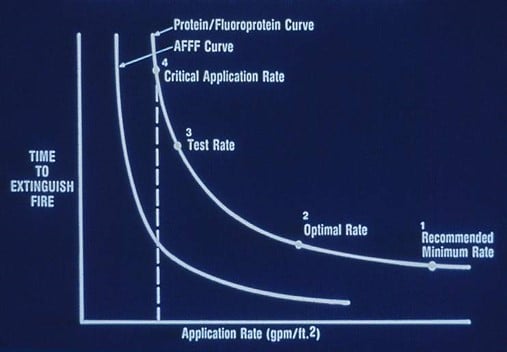
Figure 1 dates back 30 years to when I started in the foam business and illustrates one of the fundamental basics relating to the use of foam, which is there is an amount of foam that must be applied to a Class B fuel fire before it will extinguish. If we then increase the application density the extinguishing time decreases.

Test data over 50 years with PFAS containing foams allowed organisations such as UL, FM and EN to establish test rates and then advise on recommended minimum application rates. It is worth noting that the figure also shows that even 30 years ago we recognised that non film forming foams performed differently to our AFFF’s, FFFP’s and their AR versions.

The figure however still does not address the variables we see in real world missions, but as SFFF is non-film forming it is a reasonable assumption that the curve for an SFFF would be similar to that of the protein/fluoroprotein curve.

Considering the variables that could impact the curves we must start with the foams from different manufacturers and here it could be argued that a test protocol such as EN 1568-3 and EN 1568-4 is a suitable test protocol for this comparison as the only variables involved are the foam concentrate used and the foam qualities achieved with the foam solution through the UNI 86 nozzle.

This is conversely one of the weaknesses with this particular test protocol as the UNI 86 nozzle is a test nozzle and foam qualities achieved with discharge devices used in the field maybe very different, leading to different extinguishing times and reflash protection.

There is a strong argument therefore that different expansion ratios should be considered as part of the EN 1568-3 and EN 1568-4 test protocols, but this variable alone ignores the 25% drain time. Both UL 162 and FM 5130 consider a range of expansion ratio and 25% drain time when testing top side fire performance of a foam, and these must be matches to achieving those foam qualities based the operating parameters of a defined discharge device.

Discharge devices

The link between the foam concentrate and the discharge devices is even stronger when considering standard sprinklers as the discharge device. Here the EN approach is currently to ask the manufacturer for recommendations without giving any additional guidance on what data an end user or specifier should request. UL and FM, and now VdS now have test protocols using the heads that will upon successful testing be approved with the tested foam concentrate.

The impact of different fuels with SFFF’s has been discussed for some time and testing has been carried out by a number of organisations such as NRL, NFPA Research Group, and LASTFIRE. As a result of some of these tests we have already seen from the May 2021 edition of NFPA 5130 that under section 4.2 – Low Expansion Foam Concentrate Extinguishing Performance, within section 4.2.2.3 it states:

“When testing SFFF concentrates, Heptane is considered representative of hydrocarbon liquids with the following characteristics:

  • Flash point equal to, or greater than, Heptane.
  • Vapour pressure equal to, or less than, Heptance
  • Pure liquids (i.e. not blended such as gasoline / alcohol combinations”

Wording in FM approvals has been changed such that approvals now state “heptane” rather than “hydrocarbons”. At Fomtec we see on a weekly basis lists of chemicals being submitted with the questions asked about what application densities should be used for these chemicals. In many cases we just don’t have the test data with those chemicals so are having to advise our clients when what we are responding is “an opinion”.

For emergency response and the fire and rescue services the situation with some many different fuels and different discharge devices does see a tendency to favour use of following an EN 1568-3 and EN 1568-4 based analysis. As stated previously, hand lines are not equipped with UNI 86 test nozzles and typically a foam/water hand line nozzle will generate lower expansion and 25% drain times than that achieved with the test nozzle suggesting that greater application densities (and hence greater flow rates) will be required than should be indicated in the test.

Testing protocols

Operator techniques will also impact firefighting performance. Now test protocol exists to prove this in a quantitative way but the reports from the NFPA Research Group, and the FAA following their evaluation testing of SFFF’s both reported that their test engineers developed different operation techniques and improved extinguishing times.

It is clear from the more than 1500 fire tests that Fomtec has carried out, and supported by test data from third party organisations mentioned that the variables of fuel, foam qualities, application density and operator experience/techniques all contribute to the performance of the foam. Whilst finished foam qualities are partly due to the foam concentrate they are also due to the discharge devices and small changes with the discharge device can have a significant impact on the fire performance of the finished foam.

Extrapolation of data to predict the performance of foam if a variable is changed means giving an opinion and of course as soon as a different product, whether manufactured by Fomtec, or by another manufacturer, is introduced into the evaluation then the potential for a larger error with the opinion is greater.

Returning to our figure of extinguishing time versus application density it is clear that if operational application densities are required we must also take into account how these curves vary when the variables change. Here at Fomtec we are committed to our test programme called “The Enviro Programme” to establish the limits of performance for our SFFF products as the variables are changed, as decisions need to be based on Data, rather than opinions.

Boxout—

The list provided below is NOT exhaustive but the variables more directly relating to the fire performance of the SFFF concentrate are covered:

SFFF Foam Concentrate 
What type of foamSuitable for hydrocarbon fuels or hydrocarbon + water miscible fuels.
Proportioning ratioTypically 1%, 3% or 6% but can be different ratios of foam concentrate to water to generate the foam solution.
Expansion ratio of finished foamSuitable for LOW, MEDIUM or HIGH Expansion finished foam?
International Listings / ApprovalsWhat listings/approvals does the foam hold and are these appropriate for the application/mission.
Testing / Approvals with discharge devicesProvides confirmation that fire performance has been achieved with finished foam produced with the discharge device.
Testing / Approvals with fuels in hazardDifferent fuels even within group types can require different application densities.
Testing / Approvals with type II and type III applicationEmergency response with handlines or monitor response should use foam concentrates with type III listing / approval on hydrocarbon fuels.
Compatibility with dry chemicalLimited data available in impact of dry chemicals onto SFFF foam blankets.
Hardware 
Material compatibilityConsult manufacturers technical data to confirm that storage tanks and transfer pipework etc is suitable for the foam concentrate and solution.
Proportioning equipment compatibilityHas the proportioning equipment been tested / approved with the foam concentrate.
Discharge devicesWhat testing / approvals are available with the foam. Are there constraints on pressures and flow rates?
Operator Related 
Training in use of discharge devices – handline + nozzles, monitorsBest mission performance will require training in the use of equipment with SFFF’s
Knowledge of tested and approved foam qualitiesOptimum performance in manual firefighting will require knowledge of the foam qualities from the discharge devices.

This article was originally published in the January edition of IFSJ. To read your FREE digital copy, click here.

Fomtec gains GreenScreen certification

Firefighting foam manufacturer Fomtec has received GreenScreen certification for several products.

GreenScreen Certified is an independent, non-profit certification standard that promotes the use of PFAS-free and preferred chemicals in products and manufacturing.

PFAS-free is defined as zero intentionally added PFAS to the product and PFAS contamination in the product must be less than 0.0001 percent by weight of the product (1 part per million) total organic fluorine as measured by combustion ion chromatography.

Fomtec’s Enviro ARK, Enviro USP, Enviro ERS and Enviro Ultra are all not GreenScreen certified.

Industry Expert: The reinvention of firefighting foam

John-Olav Ottesen, Managing Director and Founder of Dafo Fomtec AB, spoke to IFSJ about the ban on forever chemicals, data vs opinion, and the future of firefighting foam

There is currently a proposal to ban ‘forever chemical’ (PFAS) in firefighting foam across the EU. Why has this happened and what impact will it have?

This is the culmination of a long process in EU and legislators want to eliminate the use of PFAS, plain and simple. You use the term forever chemicals and PFAS molecules does not biodegrade in the environment and that is the main concern.

The transition to SFFF requires a holistic approach by end users – they must understand that this transition is not just about changing the concentrate. There is a wish for drop-in replacements among end users, but this is seldom achievable as the transition will often require, new storage tanks, new or recalibrated proportioning systems and the discharge device must be able to generate foam within the performance criteria of the individual foam concentrates. In many cases the application density as well as the operational tactics must be changed.

The finished foam fighting the fire is a product of foam concentrate as a part of a system, with tested and approved proportioning, and a foam quality generated by the discharge device that matches foam qualities proven by testing.

Why, when it comes to foam, is data more important than opinion?

It has always been the case that data is vital to enable correct design. With fluorinated foam, there was a higher degree of safety margin, they were simply more forgiving when it comes to issues like varying fuels and equipment. This is not the case with SFFF just now. We are still in the infancy with these products, so to base your fire protection on opinions can be disastrous, even fatal. We need to keep on gathering data and define the limitations of these products and base our fire protection on data collected through rigorous testing.

There has been a huge evolvement in performance of SFFF over the past 10 years, but as we reinvent foam, we understand that many old truths must be reconfirmed. We see that SFFF products are more fuel sensitive, and they must be used within the limitations that is defined by real test data and approvals. To use the words of the NFPA report on SFFF, the products must be deployed strictly within the listed parameter.

How have foam and fire suppression systems and solutions changed and evolved in recent years?

 Foam systems have been more or less the same during my 30 years in the industry. Compressed air foam systems have been introduced during this period and concentrates and equipment have evolved, but fundamentally they have not changed. With the move to SFFF, we see perhaps a need for more application specific approach. In some cases we will need higher application densities and change of discharge devices to accommodate for the use of SFFF foam, where a foam blanket plays a more vital role than with fluorinated foam.

With the inevitable move away from PFAS, and towards fluorine free foam, what are the main challenges that are a result of this transition and how can these be overcome?

First of all, the need for test data when designing systems. This puts a lot of responsibility on foam manufacturers but also on standards developers, designers, and end users. There is no way around it, we just need to keep on gathering data. The standards must adopt new insight and implement this going forwards. Designers and users must embrace the holistic approach and require real data.

Secondly, I would say that the cleaning of systems and handling of old concentrate is a real challenge, as we still do not know enough about the best way of doing this. The test methods for PFAS content are still being developed and refined, and the industry and laboratories are taking big steps to enable better methods. Methods for cleaning are available but the efficacy not yet 100% clear. The handling of old PFAS foam is also a challenge as questions are raised if high temperature incineration is effective enough. This is being discussed among regulators and industry right now.

What does the future hold for firefighting foam?

 For as long as there are flammable liquids in use, foam will play a central role in fire protection. We see a constant development towards ever more effective PFAS free foams, and this will carry on going forwards. I see this as a very exciting and innovative part of the industry and the next decade is going to be both challenging and interesting.

What are Fomtec’s core values and how do these impact its products and its customers?

Our core values are: Performance, Trust and Sustainability. In fire protection, Performance is driving us to keep on innovating and testing. Trust is essential for Fomtec and our products, and you build trust through all your interactions with partners and clients, and most of all trust in our products based on the data that we provide.

Sustainability for Fomtec starts with the way we conduct our own business and strive to reduce our environmental footprint. We have no emissions of process water, we recycle our waste and we develop our products based on environmentally responsible chemistry. This will at the end bring high performance and future proof products to our clients.

IFSJ Exclusive: Setting suppression standards with Fomtec

As the industry transitions towards Fluorine Free Foams, John Olav Ottesen, Managing Director and founder of Dafo Fomtec AB, examines the deficiencies in recognised design and testing standards

When the serious discussions started around 2010 about high performance Fluorine Free Foams, one of the common lines we heard from the industry was that foams without fluorochemicals were ‘nothing new’.

Since the 1960s, firefighting foams have been manufactured based on PFAS containing fluorochemicals. By 2000 these PFAS containing foams would make up more than 90% of foam sales globally. Two characteristics of the fluorochemicals made them particularly attractive to the foam manufacturers.

Firstly these chemicals were Oleophobic which basically meant that they did not want to “mix” with the hydrocarbon chemicals in the fuels, and tended to resist or repel the fuel from the outer wall of the bubbles. In firefighting terms this meant that the bubbles did not pick up the fuel when the foam was directed onto a burning fuel surface.

Secondly, the fluorosurfactants in the foams impacted what is known as the interfacial tension at the fuel/foam interface and this lead to the creation of an aqueous layer being created between the fuel and the foam bubbles. Foams that were able to create this layer became known as “Film Forming Foams”, or FFF.

With many years of development and a limited number of foam manufacturers and manufacturing foam products following a similar formulation, it is understandable that the fire performance standards and associated design standards were based on the PFAS containing foams.

Different standards

When you consider what could be called geographically based standards from UL and FM, over EN, then EN 1568 adopted a rating system and EN 13565-2 (the foam system design standard) applied correction factors on the minimum application rates depending on the fire performance rating achieved in the EN 1568 fire test.

UL and FM adopted a pass/fail approach but tied the fire performance test into foam qualities (expansion ratio and 25% drain time) achieved with real world discharge devices. UL and FM also had specific test criteria for foam sprinklers whereas EN just stated that foam agents needed IA, IB or IC rating to be used in non-aspirated sprinklers.

Foam manufacturers, end users and the standards bodies had 50 years of experience and the knowledge that manufacturers were basically following the same basic recipe when formulating their foams. PFAS containing foams were regarded as forgiving and with good tolerances for different fuels and different discharge devices.

Where strict adherence to a UL or FM system was not required it was commonplace to see suppliers and consultants accepting hardware and foam that was not necessarily tested and approved together. Under EN 13565-2 this was not a necessary requirement as the standard was based on the assumption that one foam with a top side performance rating would perform the same as another foam with the same top side performance rating.

The transition to fluorine free

Unlike PFAS containing foams, manufacturers are not currently following the same basic recipe. Current commercialised synthetic fluorine free foams (SFFFs) are based on each manufacturers’ formulations of chemicals, have different physiochemical properties, and exhibit very different performance across different fuels and with different application techniques. As SFFFs started to be marketed there was a lot negative marketing that went beyond questioning the difference in performance to actually questioning whether or not SFFF’s ‘actually worked’. 

This has led to end users, specifiers and consultants questioning the ability of the foam for their application. At Fomtec we welcome these questions as this allows us to discuss the holistic approach to the transition away from PFA containing foams, whereby the foam concentrate is part of the solution and needs to have been tested and approved with the foam proportioning and discharge devices.

Pass the test

Whether a new requirement or planning the transition away from PFAS containing foams the end user is looking for answers on what foam to purchase/specify based on specification, suitability for their mission and of course price and availability.

Test standards are mostly written around the knowledge of the performance of PFAS containing foams. Although in their infancy, we see that SFFF’s currently exhibit more sensitivity to different fuels, to the type of water used to create the foam solution, to the foam qualities generated by the discharge devices, and to the type of discharge device.

We see that end users and consultants are now asking whether the approvals on the foam they are now being offered are relevant for their real-world applications. For Fomtec we believe that the tolerances with SFFF’s are currently smaller than we saw with PFAS containing foams and this is part of the reason that the Enviro Programme includes more than 1500 fire performance tests (so far).

Applying the right standards

Sometimes when deciding which standard to apply when choosing an SFFF, the end user is not going to be given a choice because of the legal or insurance requirements of the location or the mission/application.

In general the ideal situation is to apply and request the test standard that most closely mimics the real world application of the end user. It is completely impractical to expect all applications to be covered but we can look at some areas that are covered in some of the common test standards.

Fuel type

Most standards currently work on a grouping system or have a set fuel that is used in the fire testing. When we look at hydrocarbons this is most commonly heptane, although under ICAO it is Jet A-1 or Kerosene, and currently for Mil Spec it is Gasoline (Under the proposals for a new fluorine free Mil Spec for land based facilities two fire tests will be carried out on Gasoline and Jet A-1).

When water miscible fuels are considered the usual fuels used to represent the fuel groups are IPA (for alcohols) and Acetone (for ketones), although under UL and FM it is quite common to see additional fuels being added by different manufacturers.

Application type

For a topside device such as hoselines, monitors and foam makers, water immiscible (hydrocarbons) always start their test programmes with a direct (forceful) Type III application, whereas for water miscible (polar solvents) the programmes use an indirect (gentle) Type II application.

For EN 1568-3, ICAO and IMO the nozzle is fixed for the duration of the application, whereas for UL and FM once 90% control is achieved an operator is allowed to pick up the nozzle and to move around 2 sides of the test pan. For the DOD Mil Spec the operator manual fights the fire immediately and is allowed to move all the way around the circular test pan. For the water miscible fuel fires under all the fire performance test standards the application uses a fixed nozzle and the foam is directed at a backboard on the test pan and allowed to slide down the board onto the fuel surface.

Standard (non-aspirated) and foam/water sprinklers (aspirated) test protocols such as UL 162, FM 5130 and VdS require that a grid is arranged over the test pan and the test protocols define nozzle spacing, elevations and flow rates per nozzle.

Test standard deficiencies

Performance on different fuels with SFFF’s is a major issue as even on hydrocarbons the question of just allowing heptane as a representative fuel is being asked by the standard bodies. The latest FM 5130 standard (May 2021) already states under 4.2.2.3: “When testing SFFF concentrate, Heptane is considered representative of hydrocarbon liquids with the following characteristics: Flash point equal to, or greater than, heptane, Vapor pressure equal to, or less than, heptane, Pure liquids (i.e. not blended such as gasoline/alcohol combinations)”.

Data from the testing at Fomtec would indicate that grouping of the polar solvents and working with the reference fuels of IPA, for alcohols, and Acetone, for ketones is just as problematic.

Finished foam qualities of expansion ratio and 25% drain time are important with SFFF’s but many of the test protocols use a set nozzle and pressure as part of their approval that variations in foam qualities are not taken into consideration. UL and FM for their top side approval testing do require that foam qualities used in successful fire performance testing are matched to foam discharge devices.

At the other end of the scale the current EN design standard for foam systems EN 13565-2 has the statement when considering non aspirated discharge devices: ‘Consult manufacturer’. It is certainly arguable that the foam manufacturer should be able to provide good advice, but there are no standards or test protocols mentioned.

The future of foam

Anything we say here is an opinion, but we would like to say it as a ‘considered opinion’. Expect standards and testing that expands the hydrocarbon fuel testing required, and potentially some more fuels as test fuels in the water miscible.

The EN 1568-3 committee is looking at adding some variation in expansion ratio into the test protocol. We hope they will also consider the importance of 25% drain time and replace the ‘consult manufacturer’ guidance is with an internationally recognised test.

Here at Fomtec the development programme we named the ‘Enviro Programme’ continues and we are well over 1500 fire tests now as we add data for different fuels, different foam qualities, different discharge devices and operational techniques. When a client asks questions about SFFF our responses will be based on data not opinion.

This article was originally published in the November edition of IFSJ. To read your FREE digital copy, click here.

Exclusive: Flourine Free Foam Solutions from Fomtec

John Olav Ottesen, CEO and founder of firefighting foam developer and manufacturer Fomtec, talks foam, fluorine and INTERSCHUTZ 2022

In 2001 I founded Dafo Fomtec AB with the goal of producing and supplying high quality firefighting foam agents and associated foam hardware. 21 years on our main manufacturing location remains in Helsingborg, Sweden. I have a small dedicated team of industry professionals as we maintain our strong customer focus and I am proud to say that we supply our products to over 65 countries around the world. Fomtec will again be exhibiting at Interschutz 2022 and we are looking forward to welcoming our existing customers and potential new clients to Stand C17, in Hall 13.

Why use foam?

Since humans started to use liquid hydrocarbons as an energy source we have strived to find a more effective extinguishing agent than water. Whilst other agents such as water, dry chemical powder and gaseous agents are also effective with liquid hydrocarbon fuel fires, foam adds the additional life safety factor of providing a foam ‘blanket’ that prevents vapour escaping thereby preventing re-ignition post extinguishment. The water draining from the foam also has a cooling effect on the fuel and surrounding structure, aiding the extinguishment process.  Compared to DCP and gaseous, agents foam is also relatively inexpensive.

Offering high performance foam concentrates and tested systems of hardware with foam are critical for our clients to be truly protected. Performance extends to Fomtec manufacturing and delivering our products when we promise we will and in our current fiscal year we have achieved a better than 95% on-time delivery.

Trust is closely linked to performance and Fomtec invests heavily in fire performance testing and then having our products approved through independent third parties to the appropriate international standards. We also make our approval data readily available to all who visit our website, and Fomtec remains one of the few foam manufacturers who do this.

With the transition away from PFAS based foams based on the environmental impact of the PFAS chemicals, it is vital that sustainability is part of our business. Starting with the selection of raw materials and the evaluation of all our suppliers, through to the treatment of water used in our facility, through to the evaluation of travel needs for supporting the business.

Fomtec at INTERSCHUTZ

At the last Interschutz in 2015 all the talk in the firefighting foam world was about the transition to shorter chain C6 PFAS containing foam, and now 7 short years later those discussions will now be about the transition away from these foams to fluorine free foams. This transition is not being driven by the foam manufacturers and it is certainly not because the new fluorine free foams outperform the fluorinated foams. Nor is it because the fluorine free foams are lower cost that their fluorinated alternatives. The transition away from fluorinated foams is entirely due to environmental restrictions and legislation in relation to a family of chemicals know as PFAS.

In the last 20 years we have seen the PFAS chemicals PFOS and PFOA, which were used in fluorinated foams, declared Persistent Organic Pollutants and use of foams containing these chemicals are banned or are restricted with defined periods to stop using the foams. As stated above in 2015 all foam manufacturers were talking about their new C6 foams at Interschutz, but the PFAS chemicals in these foams are now scheduled for restriction and eventually will no longer allowed to be used.

The Enviro Programme

There is no doubt that the addition of the fluorine-based chemicals in firefighting foams played an important part in their performance. As we always like to point out fluorine free foam agents have been around for many years including protein foams, as well as many Class A and synthetic detergent foams. Developing high performance Class B fluorine free foams is a challenge and since 2014 nearly all of Fomtec’s research and development money has been invested in the Enviro Programme.

This is the name that Fomtec gave to the project to develop high performance Class B fluorine free foams. Fomtec quickly realized that expansion ratio, drain time and bubble structure are even more important with fluorine free foam agents, and achieving positive results against fires means that the foam agents need to the tested and approved with the associated foam hardware to ensure that the finished foam has foam qualities that match those that were used to successfully meet the requirements of UL 162 and FM 5130.

At Interschutz 2022 we will be promoting our range of Synthetic Fluorine Free Foams (SFFF), which are marketed under the Enviro (by Fomtec) brand name. The Enviro by Fomtec range is a range of foam concentrates which are a direct result of Fomtec determining that foams needed to be designed and formulated for the different firefighting missions. Extensive research and development, including more than 1500 fire performance tests, has led to Fomtec offering a range of Enviro branded products. These products are supported by international approvals within relevant sectors: industrial (UL/FM), marine (IMO), aviation (ICAO), military (US Mil Spec), emergency response (EN/UL) and wildland (US Forest service).

In May 2021 Enviro USP and Enviro ARK achieved FM approval for use with non-aspirated sprinklers, with Enviro ARK being the first SFFF to achieve this approval for use on polar solvent fuels. Enviro USP and Enviro ARK have class leading FM approvals with non-aspirated sprinklers from 6’ (1.8m) up to 45’ (14m).

Fomtec has always held the belief that decisions should be based on information. These independent approvals mean that the information Fomtec supplies can be considered as solid data and not just an opinion. For many end-users making the transition from PFAS containing foams this data provides peace of mind that they can make this transition without compromising the safety of their personnel or increasing the risk to their facility or business.

Fomtec will also exhibit and have information available on our foam solutions for multiple applications based on our C6 PFAS containing foams and foam hardware. After the extended period between the shows the Fomtec team look forward to welcoming our existing customers and all who want more information on the Enviro range, or other Fomtec solutions.

This article was originally published in the June edition of IFSJ. To read your FREE digital copy, click here.