FPA Australia has negotiated with the Building Commission NSW for a one-year extension to the Fire Protection Accreditation Scheme (FPAS) transition period. Additionally, FPA Australia’s approval to act as an accreditation authority under the Building and Development Certifiers Act 2018 has been extended until 30 June, 2026.
The extension means all transitional practitioners will have an additional year to complete the training required to transition to qualified accreditation. Once transitioned, practitioners will still need to renew their accreditation and participate in CPD.
Our approach to the Building Commission NSW was based on feedback from members regarding hurdles experienced to achieve the required competencies. As FPA Australia will not be seeking any further extensions to the FPAS transitional period, to ensure you retain your accreditation moving forward we strongly recommend transitioning to qualified by the new deadline.
FPA Australia recognises the efforts of those who have already attained qualified accreditation. We have revised our FSA and FSD registers to indicate whether a measure/category held by the practitioner is transitional or qualified. We’re also enhancing certificates for qualified practitioners by adding the term “Qualified” and exploring options for providing marketing materials that highlight their qualified accreditation status to clients.
The extension of the approval for FPA Australia to act as an accreditation authority indicates the trust Building Commission NSW has in the Fire Protection Accreditation Scheme and our commitment to professionalism within the industry. We aspire to continue administering the FPAS in NSW as an accreditation authority for many years to come.
Program supported 655 scholarships during the 2023-2024 school year and helped students kickstart thousands of careers
Johnson Controls the global leader for smart, healthy and sustainable buildings, today announced renewed grants to 30 community colleges in North America as part of the companies Community College Partnership Program. Launched in 2021 to help students from historically underrepresented groups prepare for and embark on career paths in sustainable building practices, the program will, for the fourth consecutive year, provide each college a grant to support programming in HVAC, fire, security or digital fields valued up to $100,000.
“For four years, the Community College Partnership Program has helped forward-thinking community colleges equip thousands of future leaders for successful careers in this growing industry,” said Julie Brandt, president of Building Solutions North America at Johnson Controls. “Our collaboration with these innovative institutions creates real job opportunities for students while making real progress in closing the skilled trades gap across North America.”
Impact of the Community College Partnership Program
During the 2023-2024 school year, the Johnson Controls Community College Partnership Program created significant impacts in North American communities:
3,868 students enrolled in educational programs
655 scholarships awarded to students
428 volunteer hours tracked by Johnson Controls team members
Recipient community colleges are located in areas where the company operates, encouraging Johnson Controls employees to volunteer and share real-world experiences with students. Students have shared their appreciation for the industry exposure and mentorship, which have contributed to their academic success and career readiness. Additionally, participants have reported that the program alleviated financial stress and equipped them with essential workplace skills through coaching sessions, ultimately boosting their confidence in their job search.
“I have gone from someone who had absolutely zero idea what an energy management controls technician does, to someone who has had the opportunity to get my foot into the industry and continue developing within my career,” said one student in the program. “The Johnson Controls scholarship grant I received when I came into the program helped me financially and served as motivation because it showed that there is a company out there that truly cares for the industry and provides that additional help to motivate individuals to pursue their careers.”
Through the Community College Partnership Program, Johnson Controls is on track to donate up to $15 million by the end of 2026 to expand access to educational programs in the HVAC, fire, security and digital disciplines.
Environmental regulations are driving the European HVAC industry to switch from synthetic to natural refrigerants, such as R290. To ensure safe operation with this highly flammable refrigerant, Senseair, a Swedish subsidiary of Asahi Kasei Microdevices (AKM), has developed “Sunlight R290,” a gas sensor featuring high measurement accuracy and operating range while minimizing heat generation, packaging space, and power consumption. High-volume shipments of Sunlight R290 are scheduled to begin in September 2024.
Existing and upcoming regulations in regard to PFAS (per- and polyfluoroalkyl substances, also called “forever chemicals”) and F-gases (fluorinated greenhouse gases) are severely restricting the use of conventional synthetic refrigerants in air conditioning, heat pumps, and other HVAC systems. The natural refrigerant R290 is propane gas, which is considered to be a more sustainable alternative to conventional solutions. However, due to its high flammability, reliable and highly accurate leakage detection measures are required to ensure safe operation.
Senseair’s newly developed gas sensor Sunlight R290 employs the latest NDIR (non-dispersive infrared) technology, utilizing LED light sources and photodiode sensors. Due to its minimal heat generation, the sensor can be safely operated with R290. Additionally, due to the characteristics of the NDIR method, the detection is less affected by vibrations or interfering gases, enabling robust and reliable measurements that meet the stringent leak detection requirements of the IEC 60335-2-40 safety standard for electric heat pumps, sanitary hot water heat pumps, and air conditioners.
With a measurement range of 0-100% LFL (lower flammable limit) – the concentration of a combustible material in air below which ignition will not occur – the sensor features a high measurement accuracy of +/- 2.5% LFL.
Low power consumption and superior service life With an operating temperature range of -40°C to 70°C, and a relative humidity (RH) range from 0 to 95%, Sunlight R290 can stably operate in challenging environments and covers a broad range of applications, including air conditioning units, heat pumps, dehumidifiers, and control panel coolers. Operated under normal environmental conditions, a service life of over 15 years can be expected. In addition, the sensor features an automatic baseline correction (ABC) algorithm, enabling maintenance free use over extended periods. All of this is achieved within a small packaging size of 34 mm × 21 mm × 12 mm and a power consumption of 94 μA.
Sunlight R290 is also available in a standalone refrigerant detection system, the RDS R290, which allows for leak detection without the need for integration into equipment.
The National Fire Protection Association® (NFPA®) and Mike Holt Enterprises announced their collaboration in publishing a book that explains the key changes in the next edition of NFPA 70®,National Electrical Code® (NEC®). The book, titled Changes to the National Electrical Code®, 2026 edition, is the latest project following their collaboration on the publication of the 2023 NEC changes book. This new book will feature full color illustrations and photos, insightful commentary, technical clarifications, and a general review of the code. Electrical professionals, including electricians, electrical contractors, engineers, and inspectors, will find it a valuable resource for understanding the NEC.
“This book will absolutely be the best resource for understanding the changes in the revised 2026 edition of the NEC. It’s the only NEC changes book officially recognized by NFPA,” said Jim Pauley, NFPA president and CEO. “We are excited to partner with Mike Holt Enterprises once again to advance NFPA’s safety mission and bring this information to professionals responsible for understanding and applying NEC requirements.”
The NEC is the most widely used code in the United States and is used extensively across the globe to safeguard people and property from electrical hazards. To incorporate the latest technologies, research, and learnings, the NEC is updated every three years.
“The NEC remains the essential resource for everyone who works in the electrical industry,” said Mike Holt, president of Mike Holt Enterprises. “We are thrilled to be partnering once again with NFPA to meet today’s electrical safety challenges and to help electrical professionals understand the changes in the 2026 edition. It is an honor to develop products based on the NEC that help individuals understand and apply the code easily to their work. The new edition will include hundreds of detailed graphics and photos, and in-depth analysis on the changes.”
Holt has devoted his career to studying and understanding theNational Electrical Code and has published his Illustrated Guide to Changes to the NEC for over 40 years.
The Changes to the National Electrical Code®, 2026 edition book will be available in Fall 2025 through NFPA and Mike Holt Enterprises. The 2023 edition, Changes to the National Electrical Code®, is currently available to purchase on the NFPA website and Mike Holt Enterprises website.
About the National Fire Protection Association® (NFPA®)
Founded in 1896, NFPA® is a global, self-funded, nonprofit organization devoted to eliminating death, injury, property and economic loss due to fire, electrical and related hazards. The association delivers information and knowledge through more than 300 consensus codes and standards, research, training, education, outreach and advocacy; and by partnering with others who share an interest in furthering the NFPA mission. For more information, visit www.nfpa.org. All NFPA codes and standards can be viewed online for free at www.nfpa.org/freeaccess.
Mike Holt Enterprises has been serving the electrical industry for over 50 years, creating and publishing books, videos, online training, and curriculum support for electrical trainers, students, organizations, and electrical professionals. Mike Holt is an author, businessman, educator, speaker, publisher, and National Electrical Code® expert. He has written hundreds of electrical training books and articles, founded three successful businesses, and has taught thousands of electrical code seminars across the US and internationally.
We are excited to invite you to the Fire Service Cultural Competency Certificate Program in Washington, D.C., presented by FSPA and the DC Fire & EMS Department. This UNIQUE and immersive program offers 7 Continuing Education (CE) credits, making it an invaluable opportunity for psychologists and masters-level mental health clinicians to gain unique insights into the world of firefighting and emergency medical services. The program will take place in conjunction with FSPA’s 7th Annual Conference, but attendance at the conference is not required for enrolment in this comprehensive training.
The program will take place in conjunction with FSPA’s 7th Annual Conference on October 3&4, but attendance at the conference is not required for enrolment in this comprehensive training.
Program Schedule:
Day 1: Fire Operations 101 • Date: October 2nd • Location: DC Fire & EMS Training Facility • Time: 0800-1600 hrs. EDT Participants will experience realistic firefighting scenarios, including live fire, search and rescue, aerial ladder operations, and medical emergencies such as overdose response.
Day 2: Understanding Fire Service Culture • Date: October 5th • Location: DC Fire & EMS Training Facility • Time: 0800-1600 hrs. EDT This classroom session will provide a deeper understanding of the unique cultural aspects of the fire service, including performance standards, trauma exposure, and psychological demands.
Participants will also have the opportunity to complete 40 hours of ride-alongs with DC Fire & EMS and receive additional consultation hours to ensure proficiency in fire service psychology.
FSPA’s Cultural Competency Training is unique from other programs because participants will also have the opportunity to complete 40 hours of ride-alongs with fire departments near their practice and receive additional consultation hours to ensure proper support and proficiency as they learn to work with firefighters.
Space is limited! Click Here to sign up today and secure your spot. For any questions or special accommodation requests, please contact us at info@firepsychology.org.
We look forward to seeing you in D.C.!
Best regards, Kristen Wheldon Founder, Fire Service Psychology Association
Tyne and Wear Fire and Rescue Service is proud to announce the renewal of its welfare partnership with The Salvation Army.
The Memorandum of Understanding was signed at Marley Park Community Fire Station representatives from both organisations. This agreement cements an invaluable relationship that has been in place for the past four years.
The memorandum ensures that the welfare of firefighters and crews, who are working on the ground at incidents, is in safe hands, as The Salvation Army helps to provide essential support in the form of on-site food and drink supplies.
Deputy Chief Fire Officer Stewart Nicholson of Tyne and Wear Fire and Rescue Service, said: “This vital renewed relationship with The Salvation Army is one part of the Service’s welfare package.
“The Salvation Army is a superb partner that provides essential and flexible welfare provisions at operational incidents for our operational crews. Supplies include much-needed food-on-the-ground and hydration facilities during some quite challenging situations.
“Their dedication and devotion to the community cause highly complements our diverse workforce.”
The emergencies can vary from prolonged incidents like wildfires through to relatively short-term events in the community. But those welfare facilities will be available for all crews with the short-term duration being up to eight hours or less.
Adrian Clee, Territorial Emergency Response Officer at The Salvation Army, said: “We think this is a real worthwhile investment as we look to work alongside Tyne and Wear Fire and Rescue Service during what can be quite traumatic circumstances.
“We signed our first agreement just before COVID and have invested a lot of time and resources into purchasing the right vehicle to support Tyne and Wear crews when they need us the most.
“Our catering vehicle will be dispatched to major and prolonged incidents across the region with our volunteers giving out welcomed food and drink, and they can even provide support and a listening ear if needed.”
The catering vehicle based in Tyne and Wear is one of twenty-seven similar vehicles that The Salvation Army has up and down the country to support several other blue light organisations.
Phil Sowerby, Head of Operations at Tyne and Wear Fire and Rescue Service, said: “When The Salvation Army turns up to any of our major incidents, all of the firefighters know just how important they are, as crews are always grateful to the volunteers who serve out food and hot drinks.
“The volunteers are welcome sight, especially if the firefighters have been working hard and are looking for that little bit of respite after experiencing some difficult circumstances. The food and drink provide sustenance to keep them going throughout the incident.
“Our welfare provision is an essential element within our national operational guidance, and here in Tyne and Wear we take that very seriously. We have just invested to extensively upgrade our welfare provision for areas like sanitation and washing facilities where contaminants are involved: and the work that we are doing with The Salvation Army will help to harmonise that welfare provision.”
Over the coming weeks TWFRS officers will be receiving awareness relating to the new welfare unit and the offering being provided by The Salvation Army. This will ensure the facilities are available to fire fighters at operational incidents, training events and exercises.
For further information about the work of Tyne and Wear Fire and Rescue Service, please visit our website www.twfire.gov.uk or social media platforms.
Science to the Station partners with the First Responder Center of Excellence in conjunction with the U.S. Fire Administrator’s Summit on Fire Prevention and Control for their 2nd annual conference on firefighter health, wellness and science.
In only its second year, the Science to the Station firefighter health and wellness conference will be co-located with the U.S. Fire Administrator’s Summit at the National Fire Academy in Emmitsburg, Md. The conference runs Oct. 5-6. A meeting of currently funded FEMA researchers is Oct. 7; it is open to the public. The USFA Summit is Oct. 8.
Science to the Station, Powered by FRCE will feature more than 25 recognized fire service health and wellness experts covering a variety of topics including health messaging, concussions, reproductive health, personal protective equipment, lithium ion batteries, heat stress and more.
“When we started Science to the Station, we knew there was a need to better disseminate health and wellness information to the fire service,” says Kepra Jack, owner of HeartFit for Duty and vice president and founding member of Science to the Station. “We just didn’t know if the fire service understood that need. But our membership numbers, our conference attendance and now this co-location with the Summit shows that the fire service does get it. There’s a real hunger out there for evidence-driven information on how to stay healthy in this job.”
Yet, organizers see this as a victory, not as a victory lap.
“We are living through an exciting and crucial moment in fire service history,” says Sara Jahnke, Science to the Station founder and president. “Health and wellness research and outcomes matter. This conference will be bigger and better than our maiden voyage last year. We couldn’t be more grateful to USFA and the First Responder Center for Excellence for giving Science to the Station such a huge gust of wind in our sails. We will build on this momentum to keep bringing the best scientific information to firefighters using regional and national platforms.”
Use this link to register for either Nerdstock, the Summit or both. USFA is making free housing available on the NFA campus. Space is limited with more than a third of the spots already taken. Registration is free.
“This is a tremendous opportunity to learn about how research is changing firefighter wellness, and do it at such a beautiful and historic setting,” Jahnke says. “as well as attend the Summit, one of the most important fire service events of the year.”
About Science to the Station
Science to the Station is a membership-driven group with a mission to foster collaboration and communication between subject matter experts and frontline public safety personnel to translate and disseminate evidence-informed health, wellness, and safety education and interventions. The group aims to become the key resource where science informs practice and practice informs science for public safety. Learn more about the group and how to join here.
Responding to the report, Matt Wrack, Fire Brigades Union general secretary, said:
“Today is a sobering reminder of the tragic deaths of 72 people, and the deep scar that the Grenfell Tower fire has left on the community. The FBU shares the grief and anger of the bereaved, survivors and residents, and we call for justice for those who were killed by this entirely preventable fire.
“The FBU has always argued that the fire was the result of decades of failure by central government to regulate the building industry – the prioritisation of private profit over human life.
“This report completely vindicates that position, demonstrating beyond doubt that an agenda of deregulation cost lives. Construction companies gamed the system to maximise their profits. A system of semi-privatised building control put commercial interests ahead of regulatory duties.
“Firefighters and fire control staff were put in an impossible position, forced to respond to a fire in a high rise building effectively wrapped in petrol. Again and again, residents and firefighters warned of the dangers of combustible cladding but were ignored.
“The FBU is still digesting the report’s recommendations, but the government must go further than what is set out in this report. The deregulation of recent decades must be comprehensively reversed. The systems for delivering building safety must be brought under public ownership and must be given the resources they need.
“The lessons of the Grenfell Tower fire are relevant to fire and rescue services across the UK. To implement them, we need national standards set by a statutory advisory body on fire policy, giving a voice to firefighters and control staff and drawing on the best expert advice.
“Seven years on from this horrific event, our thoughts and solidarity are with the victims of the fire.”
Leading uniform provider, Burlington Uniforms will be unveiling an own brand launch at The Emergency Services Show (18-19 September at NEC, Birmingham). The Burlington Technical Range is the first clothing collection to be produced under the Burlington Uniforms brand and features 12 specialist garments.
The range comprises tactical flex trousers, a polo shirt, ¼ zip top and a shirt, each available in elite, premium, and performance options.
Display garments will feature on stand 5/E162 with additional items available for handling and closer inspection. Swing tags will detail the product specification, features and benefits.
Exceptional standards
Burlington Uniforms has harnessed more than 49 years’ experience in developing and curating bespoke garments and wardrobes for its emergency services and blue light clients, plus its knowledge of mass production, customisation and personalisation to produce this high-performance range.
Each garment is designed so that the specification can be adjusted to meet certain requirements and various price points. This capsule range showcases the exceptionally high spec to which these items can be produced. For example, the elite and premium options use durable Cordura fabric and revolutionary odour absorbing fabric, Odegon.
Feedback for further development
Throughout the event Burlington Uniforms will be encouraging visitors to stand 5/E162 to offer honest and meaningful feedback on the specialist range. The Emergency Services Show presents a unique opportunity for delegates to influence further product development.
Underpinned by outstanding customer service
The Burlington Uniforms team will also be on-hand with guidance and advice, and to explain the company’s extraordinary approach to customer care, including its fully managed service, innovative Wardrobe Management System, bespoke clothing and personalisation offers.
These services set Burlington Uniforms apart from ordinary uniform providers. Coupled with the new Burlington Technical Range, stand 5/E162 is a must-visit for buyers and procurement teams working in the emergency services and blue light industries.
Visitors to the stand will also be entered into a prize draw to win a pair of safety boots.
To find out more about Burlington Uniforms please visit our webhttps://www.burlington-uniforms.co.uk/site. To arrange a meeting at The Emergency Services Show, please call 0208 443 6920. In the meantime, stay up to date through social media, follow us on LinkedIn and Instagram.
Firefighting is the most dangerous job in the UK, with the highest injury rate
However, on average, Brits overestimate firefighters’ salaries by £7,000 a year
Construction work is the deadliest industry overall, although none of the individual jobs rank in the top 10
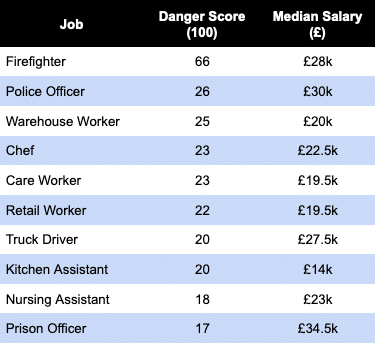
Police officer and warehouse workers rank second and third on the dangerous jobs index
Chefs and care workers are among the most hazardous jobs – filling out the top five
Most dangerous jobs typically only pay between £20-£30,000k
Over a third (35%) of those with a dangerous jobs don’t have life insurance
A new study by Forbes Advisor finds being a firefighter is the most dangerous job of all, with over 47,000 injuries over the past five years.
Using government data, experts at Forbes Advisor have compiled a list of the most dangerous jobs in the UK based on the number of deaths and injuries over five years in each profession.
Forbes Advisor also conducted a survey of 2,000 UK adults to ask Brits what they thought the most dangerous jobs were, as well as what they pay.
The median salary for a firefighter in the UK is £28,000, but, on average, most respondents thought a firefighter made £35,000 annually, overestimating their salary by £7,000.
Following firefighters, the study shows that the second and third dangerous jobs are police officer and storage worker, followed by chefs and care workers in fourth and fifth position.
Source: Forbes Advisor
Forbes Advisor’s study looked through data from the Health and Safety Executive and the Home Office to determine which job is the most dangerous, giving the highest weighting to deaths, followed by injuries and injury rate, between 2015 and 2020.
With regards to dangerous industries, construction heads the list, although specific professions within the sector do not feature in the top 10 dangerous jobs table, as each one separately scores less than jobs in other areas.
The three most dangerous jobs in the construction industry are tradespeople, builders, and civil engineers, totaling 181 deaths between 2015 and 2020.
While most Brits agree that people in dangerous professions should be paid more, most of the jobs that are considered dangerous do not pay above £30,000 a year, sometimes under £20,000, and lower than the national median wage of £33,000.
This is confirmed by Forbes Advisor’s survey, which asked respondents what their yearly salary was, and whether or not they considered their jobs to be dangerous.
The most common wage response (35%), for those who consider their jobs to be dangerous, was between £20,000 and £40,000 a year. Of those who made over £100,000 a year, 6% said they had a dangerous job, in contrast to 10% who said their line of work was not dangerous.
When asked what salary they would demand in order to accept a job where they have a one in four chance of getting seriously hurt or injured, the average Brit would not accept an offer under £94,000 a year, with nearly one in four (24%) saying they would not take such a risk in the first place.
For those with jobs where one might get seriously hurt or die while on the job, a life insurance policy is a good idea to make sure one’s family receives support after they die. However, more than a third (35%) of those who said their job was dangerous admitted not having life insurance.
Kevin Pratt, personal finance expert at Forbes Advisor, said: “Anyone with dependants should have life insurance, and it makes particular sense for those with high-risk occupations, whether that is a firefighter, someone on a building site, or a chef in a hectic kitchen.
“If you die without life insurance in place, your family will likely struggle with the burden of the rent or mortgage and all the other bills and expenses that families encounter. But the proceeds of a life insurance policy can make up for the loss of your income, providing a financial safety net at a time of deep distress.
“No-one likes to think of their own death, but those in high-risk occupations are reminded every day of the dangers they face. Arranging insurance cover is straightforward and relatively inexpensive – premiums reflect your age and occupation, starting at around £20 a month.
“Whatever your line of work, and even if you don’t have a traditional job beyond looking after the home and family, you should ask yourself a question: Am I guaranteed not to die before everyone who depends on me is financially self-sufficient? The answer, of course, is no. That is why life insurance is a good idea for everyone.”