Fire protection system market to grow 6.7%

The global fire protection system market size, which was valued at USD 72.72 billion in 2021, is expected to expand at a compound annual growth rate (CAGR) of 6.7% from 2022 to 2030.

In recent years, the market was negatively impacted by the Covid-19 pandemic and knock on supply chain disruption across countries and regions. However, the post-pandemic market is expected to grow as the rising urban population which will likely boost demand for fire protection systems.

Fire protection systems include equipment such as fire detectors, fire response systems, fire analysis software, fire suppression systems, and fire sprinkler systems. These systems are installed in various infrastructures, including industrial buildings, residential buildings, and commercial buildings, to safeguard people and reduce the loss of destruction from fire hazards.

The adoption of fire protection systems in several developing countries was initially slow compared to developed nations due to the lack of awareness among consumers regarding the product as well as reduced regulatory pressure. However, the launch of fire safety programs and the use of targeted marketing explaining the benefits of a fire protection system have drawn the attention of large as well as small and medium enterprises, leading to steady market growth in recent years.

Construction of new properties, including residential and non-residential, is expected to offer new opportunities for installing fire alarm and detection systems. An increase in the number of property damage due to fire accidents is also driving the market.

The market for fire protection systems is also being driven by the regulations, standards, and codes imposed by different regulatory bodies as the growing standard has resulted in organisations installing up-to-date fire protection systems. These factors are expected to boost the growth of the market over the forecast period.

Detection

The fire detection segment accounted for more than 50.0% share of the global revenue in 2021. A fire detection system comprises various devices working collectively, which help detect and warn people through video and audio equipment during an incident involving smoke, carbon monoxide, fire, or other emergencies.

The fire analysis segment is expected to register the highest CAGR of 13.6% from 2022 to 2030. The segment growth can be attributed to the increasing need for fire analysis, which helps make proper decisions during fire prevention.

Installation and maintenance

The installation and design service segment accounted for more than 40.0% share of the global revenue in 2021. This refers to the practice of outsourcing the solution for design, development, upgrades documentation and installing processes of the fire protection system. Fire protection systems are being installed across buildings of all sizes as inhabitants increasingly understand the benefits they offer in small, mid-size, and large buildings.

The maintenance services segment is expected to register the highest CAGR of 6.8% from 2022 to 2030. Fire protection systems play a vital role in detecting and alerting people in the event of smoke or fire; however, any fault in the system may lead to accidents and asset losses.

Application Insights

The commercial application segment dominated the market and accounted for more than 45.0% share of the global revenue in 2021, which includes applications for retail, BFSI, government, healthcare, and telecom and IT educational institutions. The demand for fire protection systems in commercial applications is increasing due to the formulation of stricter government rules for fire prevention and control being put in place across the globe.

The industrial application segment is expected to register the highest CAGR of 7.8% from 2022 to 2030. The industrial application covers major sectors such as oil and gas, mining, energy and power, and manufacturing. The need to safeguard automated systems from fire accidents is expected to fuel the growth of the segment.

Regional Insights

North America dominated the market for fire protection systems and accounted for over 35.0% share of the global revenue in 2021, which can be attributed to the rising demand for intelligent houses and smart buildings.

Asia Pacific is expected to register the highest CAGR over the forecast period, with countries including as India, China, and Japan expected to drive the regional market. Growing urbanisation and rising awareness among the consumers are also expected to contribute to the growth of the market in this region over the forecast period.

National Fire Protection Association announced theme for Fire Prevention Week

The National Fire Protection Association (NFPA) has announced “Fire Won’t Wait. Plan Your Escape” as the theme for Fire Prevention Week which takes place on 9-15 October. The initiative is designed to reinforce the critical importance of developing a home escape plan with all members of the household and practicing it regularly.

According to NFPA data, home is where people are at greatest risk, with three-quarters (74 percent) of all US fire deaths occurring in homes. When a home fire does occur, it’s more likely to be serious; people are more likely to die in a home fire today than they were in 1980.

“Today’s homes burn faster and hotter than they used to, minimizing the amount of time they have to escape safely,” aid Lorraine Carli, vice president of the NFPA Outreach and Advocacy division. “In a typical home fire, you may have as little as two minutes to get out from the time the smoke alarms sounds.”

The Fire Prevention Week 2022 theme, “Fire Won’t Wait. Plan Your Escape,” promotes messages that the NFPA said could mean the difference between life and death in a fire. Developing a home escape plan with all members of the household and practicing it regularly ensures that everyone knows what to do when the smoke alarm sounds and uses that time wisely.

Following are key messages behind this year’s “Fire Won’t Wait. Plan Your Escape” theme:

  • Make sure your home escape plan meets the needs of all your family members, including those with sensory or physical disabilities.
  • Smoke alarms should be installed inside every sleeping room, outside each separate sleeping area, and on every level of your home. Smoke alarms should be interconnected so when one sounds, they all sound.
  • Know at least two ways out of every room, if possible. Make sure all doors and windows open easily.
  • Have an outside meeting place a safe distance from your home where everyone should meet.
  • Practice your home fire drill at least twice a year with everyone in the household, including guests. Practice at least once during the day and at night.

As the biggest annual campaign at NFPA, Fire Prevention Week works to educate people about the leading risks to home fires and ways they can better protect themselves and their loved ones. Local fire departments are invited to play a key role in bringing Fire Prevention Week to life in their communities each year and spreading basic but critical fire safety messages.

To learn more about Fire Prevention Week, its 100th anniversary, and this year’s theme, “Fire Won’t Wait. Plan Your Escape,” visit www.nfpa.org/fpw.

LFRS urges people to take fire safety precautions at home

The National Fire Chiefs Council (NFCC) and Lancashire Fire and Rescue Service (LFRS) are urging people to take fire safety precautions in the home to stay safe as the cost of living rises across the UK. The advice has been issued as part of of NFCC’s national Home Fire Safety Week taking place between this week (13-19 June), which aims to keep people safer from fire in their homes.

NFCC is concerned that people may put themselves at additional risk as the cost of living increases and remind people to buy, charge and run electrical products safely and ensure they keep warm safely as taking a few simple steps can reduce the risk of fire in the home. NFCC is also urging people not to take additional risks and be alert to how simple measures could save lives and reduce injuries.

The week of action covers a range of areas such as electrical safety, the dangers of illegal cigarettes and the offer of home safety fire checks and fire safety advice. People are being urged to buy electrical products from reputable retailers, to register appliances and always sign up to the national product safety alerts and recalls: https://www.gov.uk/product-safety-alerts-reports-recalls

With rising energy costs and many people look to reduce heating bills, LFRS want to ensure people are keeping warm safely. It is encouraging residents to ensure they have smoke and carbon monoxide alarms fitted and to ensure portable heaters and electric blankets are in good working order, not subject to any recalls and used correctly.

With older relatives and neighbours thought to be particularly vulnerable and at a higher risk in the home and, LFRS is offering a home fire safety check, vital safety help, advice and solutions, as well as help from a range of organisations. Registering for personalised fire safety advice can be done here.

LFRS Prevention lead Kirsty McCreesh said “As the cost of living increases across the entire UK, we are offering help and advice to help people stay safer in their homes. This ranges from simple steps such as smoke detection and checking electrical items to how fire services can assist people who are more vulnerable.

“While we understand the pressures people are currently facing and affordability is a major factor for many, I am hoping that by giving practical help and advice, we can raise awareness and offer useful assistance. Prevention work is at the heart of all fire and rescue service work and we are here to help.”

Quelfire: Building Safety Act brings ‘air of hope’

Fire Protection System supplier Quelfire looks at The Building Safety Act and what it means for the fire industry

It has been nearly five years since the devastating fire that destroyed Grenfell Tower, which saw the loss of 72 lives. Others lost their homes, possessions and loved ones, which changed the course of their lives forever. Since the tragic event, a public inquiry was conducted into the cause of the fire, leading the construction industry to come under heavy scrutiny.

In May 2018, Dame Judith Hackitt’s Independent Review of Building Regulations and Fire Safety found that “the regulatory system for high-rise and complex buildings was not fit for purpose.” 53 recommendations were put forward to change the way the industry works and create a safer living space for residents. But more importantly, Dame Judith Hackitt looks to drive a cultural change to make sure something this catastrophic never happens again.

After being introduced to parliament in July 2020, the Building Safety Bill was published a year later in July 2021 and was summarised by then-Housing Secretary Robert Jenrick as a “key step in an extensive overhaul to building safety legislation.”

On the 28th of April 2022, the Bill received Royal Assent meaning that now it has passed all the parliamentary stages in the House of Commons and the House of Lords, it will take a more prominent stance in the built industry as The Building Safety Act.

The Act will be directly responsible for buildings that are at least 18 metres tall or have seven storeys, with at least two residential units. It will also cover hospitals and care homes if they meet the specification.

The Building Safety Act (BSA) has named the Health and Safety Executive (HSE) as the Building Safety Regulator (BSR) to oversee the safety and performance of all buildings. With this, comes the duty to assist and encourage improvements in the built environment industry, holding powers of enforcement and sanctions.

Introduction of Gateways two and three will establish new requirements at key stages of design and construction. They are vital decision points within a project that must be passed before it can progress to the next stage, therefore, enabling a rigorous process where each stage of design and construction is monitored.

The Golden Thread, which is a live digital document that allows someone to understand a building and ensure that all information is up-to-date and accurate, will guarantee that any person responsible for any aspect of a project or building – dutyholders – work and findings are handed to the building’s owner upon completion. This will enable the right person to have the correct information regarding the safety of residents and building; ensuring risks are managed effectively. Failure to comply will see that those who are responsible for the safety of a building – the Accountable Person – are charged by criminal offence.

Finally, the introduction of The New Home Ombudsman, which will offer dispute resolution for buyers of new build homes against developers, enables the creation of a Construction Product Regulator (CPR), who will confront poor practice early on in a project and help guarantee that all construction products on the UK market are safe. They will work closely with the BSR to ensure the system of product testing and certification is being followed.

Both parties will assist in advising The Secretary of State on which products should be considered as safety-critical and consequently, remove products from the market that present any safety risks.

 So, what does this mean for the fire industry?

The government are working to ensure that the Fire Safety Order 2005 (FSO), which places duty on individuals in an organisation – the Responsible Person – to identify, control and reduce the risk of fire, and the new building safety regime work effectively together. The Fire Safety Clause in the BSA amends the FSO to further strengthen fire safety measures for non-domestic premises, which include common parts of high-rise residential buildings subject to the BSA. The FSO and BSA will overlap in some respects, but through the cross-work of the government, by aligning these essential regimes it will ultimately work to further protect residents in high-rise residential buildings.

In a typical safety case report, the Accountable Person will ensure that they have a preventative approach for managing building safety risks. An aspect of this report will cover major fire and structural hazards for example, compartmentation. This includes key areas of passive fire protection: linear gaps and cavity fire stops, service penetrations and fire doors. HSE is urging anyone involved in the design or construction of a building to act now, at the earliest stage, and become proactive in the process of ‘building a safer future.’ The work the fire industry does now can help comply with this by raising more awareness of what early engagement in firestopping is; conducting CPDS to educate the industry; providing more tested details and technical support and offering on-site support.

Despite the Building Safety Act being law, many of the requirements will not come into force until 12-18 months after the Royal Assent as the industry prepares for the new regime. The government’s transition plan can be found here.

The risk of fire has decreased considerably over the years. However, the tragedy of Grenfell has shown that there is too much scope for “poor practice, poor culture, poor accountability and poor management.” The Building Safety Act brings an air of hope to survivors and their family members but ultimately, pays respect to the 72 victims. Without the Act, there would be no push for government reform and the risk of Grenfell happening again would be inevitable.

Detection: Evolving to meet the UL 7th edition standard

Underwriters Laboratories (UL) have introduced challenging new requirements for smoke detectors. Apollo have responded by building the most solid, stable, and dependable fire detector yet based on our decades of experience and innovation in fire detection.

The Challenge

We know that one of the biggest challenges our customers face is false alarms. UL know this too, and through research conducted by National Institute of Standards and Technology (NIST) have introduced new requirements on smoke detector manufacturers, like us, to reduce the risk of false alarms. At the same time, UL have responded to the evolution of construction methods and materials that can change how fire behaves in a building. This has led to the introduction of a new fire test that requires faster and earlier detection of flaming fires than ever before.

Solution

We like to get the basics right. To Apollo this starts with the performance characteristics of the smoke sensors.

An optical smoke sensor must be protected from stray light, dust, and insects. These roles are all fulfilled by the enclosure, which we call the optical chamber. Whilst blocking these potential nuisances, the chamber must freely admit smoke allowing it to be measured by the optical sensor. A surprising amount of fluid-dynamics know-how is required to achieve this; since smoke from a fire tends to move relatively slowly with little energy to push it along. This has led to the unique chamber design of Soteria UL that collects smoke form the outer edges of the detector, removing any impediment to airflow, and achieving a particularly fast detection of fires without airflow delays.

Smouldering fires, in particular, tend to generate vast amounts of smoke, but due to the lack of heat in the fire, that smoke doesn’t have the energy to reach the optical chamber; and this problem worsens when the stack effect is introduced. Stack effect is when tiny pressure differentials, between ceiling cavity and a room, cause clean air from the ceiling to be forced through a detector and out of the smoke inlet, preventing smoke from a room fire entering the detector.

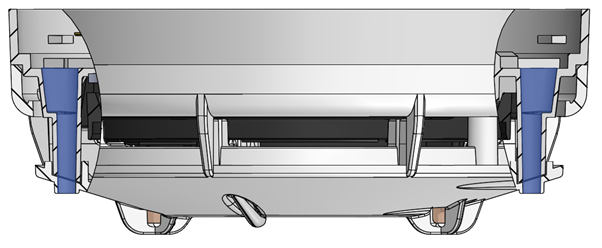
Soteria UL overcomes this issue through its patented vent design. These vents allow pressure differentials to be exhausted through a carefully positioned hole in the lid, so that is does not impede the flow of smoke into the smoke inlet or deeper into the optical chamber. Further, the vents allow any condensation that may occur in the cavity behind the detector, or in cable conduits, to escape without harm.

The drains, highlighted in blue, allow water and air to pass from the rear of the detector without affecting the smoke entry paths.

An often-overlooked characteristic of smoke sensors is their ability to operate uniformly no matter which direction the smoke is coming from. UL test detectors for this parameter in four different orientations and allows a variation of +/-50%. To ensure the most stable operation, we exceed this requirement and measure our detector at 360 orientations and achieve a variation of less than 10%/ft.

Why should a user care that Soteria UL’s directionality is so good? Well, if we had just one angle that was less receptive than others, then we would be forced to increase the overall sensitivity of the detector to ensure it can detect fire when tested in the poor orientation. By avoiding this pitfall, we can offer a detector with a perfectly balanced sensitivity.

Once smoke gets into the chamber, then it’s the job of the optical sensor to measure it, whilst discounting false readings from any foreign materials. The optical sensor consists of an industrially rated InfraRed (IR) light source. When smoke is present, light is scattered onto the light sensor. This sensor is a highly integrated Application Specific Integrated Circuit (ASIC), custom to Apollo, that combines the light sensitive element and electronic amplification.

Smoke is an aerosol – a mixture of air and tiny smoke particles. Because these tiny particles are similar in size to the wavelength of IR light, then they send that light scattering off in many directions via a quantum mechanical process that is described by Mie theory. Smoke from fires have precise characteristics; for example, it tends to scatter most light in the forward direction, rather than ‘reflecting’ it backwards.

We use this knowledge in the design of our optics, positioning the smoke sensor so it is more sensitive to the angles of scattering smoke, than the pattern of aerosols produced by cooking, for example. This is achieved with our unique patented optical sensor design.

The next nuisance that might trick our sensor is dust and insects. Traditional detectors suffer from the IR light source illuminating parts of the optical chamber, rather than just the scattering region in front of the light sensor. Because the light sensor is looking for only a tiny quantity of light to be scattered by smoke, then it can easily be fooled by light reflecting off chamber walls when dust or insects are present in the chamber.

Our first line of defence is stopping such things getting into the chamber. The Soteria UL uses a unique serpentine air inlet to prevent the ingress of dust. A fine nylon mesh prevents insects over a certain size from entering the chamber, but not all can be stopped is we still wish smoke to enter the chamber. Instead, we design the chamber to be robust to these smaller insects and accumulation of dust.

Firstly, a unique patented light absorbing surface of the chamber prevents the IR light being reflected around the chamber. This means that dust and insects on other surfaces of the chamber are less illuminated. Secondly, and this step takes some effort, all possible surfaces where an insect could stand and spread its wings, whilst being in the view of the light sensor, are eliminated. That means that even when an insect smaller than the screen finds its way into the chamber, it is very unlikely to be able to cause a false alarm. The same advantage is experienced when dust accumulates inside the chamber – there are no surfaces where dust can gather to cause stray light and trigger a false alarm.

And it’s not just our lab that this high performance is achieved. Every Soteria UL detector is produced and certified to conform to the same narrow range of sensitivity. This means that every product you install will behave the same as the last, it will not be more sensitive to common nuisances, or less sensitive to the attributes of fire. This is achieved in our factory with a blend of skilled hand assembly and highly automated modern manufacturing processes. Every single product is measured and calibrated for smoke sensitivity.

Once we have crafted the best smoke sensor, our next focus is the intelligent signal processing that determines when there is a real fire. Because the basics are right, we don’t need a highly complex, unpredictable, and opaque artificial intelligence algorithm. We simply add the right amount of smoothing, the right amount of delay, and a little enhanced detection of fast flaming fires. False alarms are avoided, not only by getting the basic smoke sensor right, but by reducing the response to slowly developing nuisance signals like cooking. The detector is constantly processing information, and if it decides there’s a fire, this is signalled to the panel via Core-Protocol with exceptional speed.

Keeping you safe from fire, every second of every day.

For more information on Soteria UL, Apollo’s 268 7th edition solution, contact enquries@apollo-fire.com or visit www.apollo-fire.co.uk/

This article was originally published in the May edition of IFSJ. To read your FREE digital copy, click here

Jersey Fire and Rescue Service expand home fire safety checks

​Jersey Fire and Rescue Service (JFRS) has expanded its current home fire safety checks to offer further safety advice to islanders in their homes.

Called Safe & Well, the initiative will see that when Fire Safety officers visit Islanders to conduct a home fire safety check, they will also assess other safety concerns such as slips, trips, and falls, winter warmth (when relevant) and areas such as potential loneliness and isolation.

The idea behind the initiative is to help reduce the number of accidents and injuries in the home and subsequent visits to the hospital, as well as reducing the number of emergency calls to the Ambulance Service, Police and Fire & Rescue Service.

JFRS have partnered with agencies such as the British Red Cross, Eye Can and the cardiology department, to develop the guidance and signs to look out for. If Fire officers see anything of concern, they can either provide some advice immediately, or refer them to one of the partner agencies for help.

Fire Officer Mark Bailey-Walker said “We’re delighted to be expanding our current home fire safety check service to include a wider safety assessment, particularly for the more vulnerable members of our community, such as the elderly and sight impaired. The aim is to provide a person-centred safety visit that focuses on the individuals’ needs”.

Marketing Manager from Island Insurance, Gary Kelly said: “Islands have been supporting Jersey Fire and Rescue to deliver their prevention initiatives for several years now, so we are delighted to be involved with the Safe and Well initiative.

“This service is not only designed to help islanders stay safe in their homes, but also to help them recognise potential health concerns that could severely impact their lives, such as sight loss, mental wellbeing, and cardiac concerns linked to stroke”.