National blueprint for safety launched by Fire Sector Federation

The Fire Sector Federation has launched an initiative calling for wider discussion to create a national fire safety strategy, which goes beyond current legislative proposals, to comprehensively address measures to mitigate fire risk in the UK.

The Federation has published a white paper, Developing a National Strategy for Fire Safety, setting out a possible pathway for the fire sector and government to work together to create a safer society from fire.

The white paper seeks government support to ensure that fire remains a priority, to integrate policy across departments and devolved administrations, and to make full use of the technical expertise within the specialised fire sector to achieve success.

The Federation has suggested three areas for immediate priority: raising competency; mitigating fire risk in modular and other buildings using mass timber; together with partnering the construction sector to raise awareness of fire risk from innovative new products and methodologies.

The proposals were developed by a new Fire Sector Federation Fire Safety Strategy Board, chaired by the Federation’s Policy and Strategy Lead, Jonathan O’Neill, with leadership expertise drawn  from across a diverse range of sectors including, fire safety, fire and rescue, construction, insurance and building control.

Fire Sector Federation Chair, John Spencer, said: “While we have seen significant new legislation introduced in the wake of the Grenfell Tower tragedy, it is incumbent upon everyone in the built environment to avoid further complacency and address problems we know continue to exist and may evolve in future. Industry is well placed to understand these problems, and just as importantly, some of their solutions.

“Engaging positively and supportively with government, we believe a National Fire Strategy is the most effective way to achieve the shared aim of a fire safe society. Our desire is to have a road map to deliver an effective and resilient fire safety agenda aligned within a secure and sustainable environment and that requires collective actions in both industry and government.”

Jonathan O’Neill, Chair of the Federation Fire Safety Strategy Board, said: “The Board’s vision is to create a single voice to support the management of fire risk and achieve a safer and sustainable solution with a clear, integrated pathway to success.  As an industry, we can use our unrivalled knowledge and experience to define the route to better fire safety. 

“We need to break the cycle of stable door legislation following major tragedies and replace it with a proactive approach that secures for government and the sector a holistic solution to prevent and protect society and the economy from foreseen losses”.

“A new strategy will address the current gaps in fire safety and in doing so will enable the industry to help government set appropriate policy priorities for success. The white paper highlights the need for ‘fire’ to be a priority for government with a better understanding of the complex factors involved and for better integration of policy across ministerial portfolios. The fire sector promotes professional understanding in a responsible industry and wants a vibrant and successful UK. Awaiting another tragedy as the precursor to moving fire safety up the policy agenda would only represent  failure and suffering.”

The current membership of the Federation Fire Safety Strategy Board comprises a wide range of recognised leaders and experts in fire safety from the following organisations:

  • Fire Sector Federation
  • Association for Specialist Fire Protection
  • Fire Industry Association
  • AXA Insurance
  • Local Authority Building Control
  • Construction Products Association Marketing Group
  • Institution of Fire Engineers
  • National Fire Chiefs Council
  • Construction Industry Council
  • Royal Institution of Chartered Surveyors
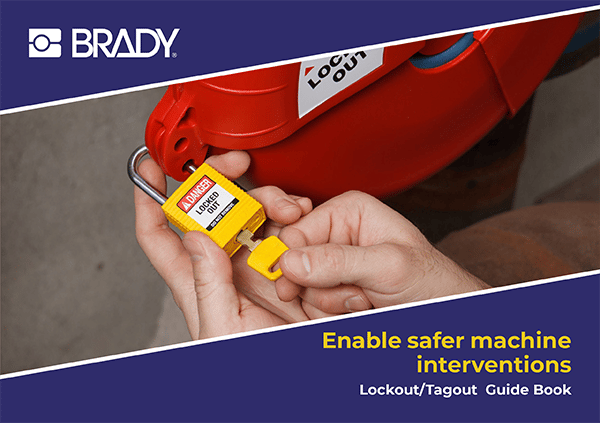
Smart ways to make machine interventions safer

Brady has unveiled a guide to increase workplace safety with a world-class Lockout/Tagout solution from a single supplier.

Lockout/Tagout is a safety procedure that temporarily isolates machinery from all energy sources, and that secures this de-energised state while machine interventions are ongoing. It enables safer machine interventions and helps avoid accidents caused by moving parts or premature machine energisation.

The main principle of Lockout/Tagout is “one person, one lock, one key”. Every padlock in a Lockout/Tagout programme has a unique key, which is kept by the person intervening on a machine. This effectively enables relevant employees to protect their own safety. Master and Grandmaster keys are possible, however their use is best restricted and usually part of strict procedures performed by Safety or Site managers.

An experienced, global partner

Brady Corporation is one of the largest suppliers of Lockout/Tagout solutions. It works with large and nimble companies to advance Go for Zero ambitions and compliance in workplace safety anywhere in the world.

Brody offers global experience back to our customers by harnessing all worldwide best practices and custom solutions in our Lockout/Tagout offer to help prevent any maintenance accident caused by machine energy or moving machine parts.

A complete Lockout/Tagout implementation from A to Z with Brady:

Best-in-class lockout procedures: No time to set up safe Lockout/Tagout procedures? Invite a Brady Safety Engineer to identify all machine energy isolation points and create illustrated, machine specific, world-wide best practice Lockout/Tagout procedures for your approval.

Optimal procedure management: The process of managing, creating, updating, reviewing, scaling and communicating visually instructive lockout procedures becomes a matter of clicks.

Block access to any energy control point: Temporarily block access to valves, buttons, fuses and any energy isolation point with our complete range of dedicated Lockout/Tagout devices.

Best safety padlocks in the world: Effectively secure the isolated state of your machines during maintenance with our unique SafeKey padlocks that offer 700% more lock and key options for elaborate, futureproof lockout programmes.

Reliably identify every lockout: Easily communicate about ongoing maintenance interventions with reliable Lockout/Tagout tags that can be delivered to, or created at your premises with our safety printers.

Practical lockouts: make Lockout/Tagout even more practical and efficient using our wide range of clever accessories.

Easily distribute lockout tools: Highlight the right solutions for specific lockouts, and encourage tool returns to the right location with our custom shadow boards.

Draw inspiration from Brady’s free guidebook “Enable safer machine interventions

Lockout/Tagout prevents workplace accidents by completely and temporarily isolating machinery from its energy sources. When implemented well, it stops machine movement and machine energisation while interventions are ongoing.

Use this guide for ideas on how to implement or strengthen your Lockout/Tagout programme, or contact Brady for answers to any questions you may have.

Home fire deaths hit 14 year high in the US across 2021

The latest Fire Loss in the US report released by the National Fire Protection Association (NFPA) has revealed that 2021 saw the largest number of home fire deaths since 2007, reflecting a 14-year high.

According to the report, people are more likely to die in a reported home fire today than they were in 1980. While the number of US home fires has continued to decline over time, the home fire death rate has stagnated in recent years, with annual spikes like the most recent one seen in 2021. 

According to NFPA data, home is where people are at greatest risk of fire, with three-quarters (75 percent) of all US fire deaths occurring in homes.

Lorraine Carli, vice president of the Outreach and Advocacy division at NFPA, commented: “While we’ve made great strides in reducing the public’s risk to fire on many fronts, the latest number of home fire deaths reinforces that today’s home fires present real challenges.

“Educating the public about the increased speed at which today’s home fires grow, along with the importance of knowing how to escape quickly and safely, is critical to reducing that risk.”

This week the NFPA celebrates the 100th anniversary of Fire Prevention Week  with the theme, “Fire won’t wait. Plan your escape.” which reinforces the potentially life-saving importance of home escape planning and practice.

Carli continued: “To many, the concepts of home escape planning and practice may sound so simple that their value is underestimated, but the reality is that these advance preparations can truly mean the difference between life and death in a home fire – now more than ever.

“Ask anyone who’s experienced a home fire and they will tell you how dark, scary, and disorienting a home fire can become within moments. Having a practiced plan with all members of the household builds the muscle memory needed to get out as quickly and safely as possible.”

The following are key messages behind this year’s Fire Prevention Week theme:

  • Make sure your home escape plan meets the needs of all your family members, including those with sensory or physical disabilities.
  • Smoke alarms should be installed inside every sleeping room, outside each separate sleeping area, and on every level of your home. Smoke alarms should be interconnected so when one sounds, they all sound.
  • Know at least two ways out of every room, if possible. Make sure all doors and windows open easily.
  • Have an outside meeting place a safe distance from your home where everyone should meet.
  • Practice your home fire drill at least twice a year with everyone in the household, including guests. Practice at least once during the day and at night.

To learn more about Fire Prevention Week, visit www.firepreventionweek.org

International Brand Group to distribute Totectors safety footwear

International Brands Group (IBG) has agreed nationwide distribution for Totectors brand of safety footwear brand through Travis Perkins the Nationwide Timber and Builders Merchants.

Totectors has been synonymous with safety footwear since 1944. The original safety toe boots worn by military, industrial and construction personnel across the world. The boots are made to be strong and dependable, just like the men and women and women that wear them.

75 years on Totectors has been designed to Challenge Status Quo, gone are the heavy, bulky, old-school styles, replaced with sleek, lightweight styles you’ll be happy to keep on your feet at the end of the working day.

Glen Richards, Commercial Director of IBG commented: “It was our plan to make Totectors available to Tradespeople up and down the country, we recognise Travis Perkins as the most reputable timber and building merchants, so we are therefore delighted to have secured Nationwide Distribution through their extensive branch network.”

Reactec teams up with Levitt-Safety for international expansion

Workplace health risk prevention experts Reactec has announced that it has teamed up with Levitt-Safety, a leading equipment and service supplier, to offer safety products throughout Canada.

Levitt-Safety operates from 18 locations across Canada with a vision to make the country a safer place to live and work by offering a complete range of products, services, training and equipment rental to businesses.

This partnership will ensure that Reactec’s newly launched third-generation smart watch, R-Link, will be available to workplaces nationwide to help solve their Hand-Arm Vibration, Proximity, Lone Worker, and Environmental Monitoring challenges.

Jacqui McLaughlin, Chief Executive Officer of Reactec said: “We are excited about our trade agreement with Levitt-Safety in Canada. The company is a strong strategic fit with Reactec due to their impressive range of safety product lines which are supported by their highly trained sales and technical support staff.

“There are at least two of Canada’s provinces that recognise HAVS as an issue and this is an area where we see an even greater opportunity for the advanced capability of our newly launched R-Link device. Our team travelled to Canada earlier this month to meet the country’s regulators and host business development meetings.”

“Our customers rely on us to provide innovative solutions to complex health and safety problems. This partnership with Reactec will allow Levitt-Safety to introduce a leading solution for HAVS prevention with an intuitive analytics platform to Canadian workplaces.”

Register early interest for £90 million Asset Safety and Compliance framework

Fire safety experts and consultancies are being encouraged to register their early interest for an upcoming £90m public sector asset safety and compliance framework launching next year.

The Asset Safety and Compliance (ASC1) framework from not-for-profit public sector framework provider LHC will cover all five LHC Group areas including Scottish Procurement Alliance (SPA), Welsh Procurement Alliance (WPA) and South West Procurement Alliance (SWPA), Consortium Procurement Construction (CPC) and London and South East (LSE).

The framework will give all public sector bodies, including local authorities and housing associations, the opportunity to source expertise in a wide range of fire, gas and building safety, property protection and maintenance services for their asset stock under one framework. It is now open for suppliers to register their interest and participate in early market engagement.

ASC1 brings together LHC’s existing Asbestos (AS2), Fire Safety (FS1), Vacant Property Protection (V7) frameworks under one umbrella, as well as introducing additional workstreams, to make it easier for contracting authorities to procure a variety of compliance services.

Dean Fazackerley, LHC Head of Technical Procurement, said: “Our ASC1 framework arrives in response to public sector clients telling us they needed a comprehensive option covering safety, property protection and maintenance for their asset stock. As well as offering a more concise route to market, it is there to help drive time and cost efficiencies by making their procurement process easier and more streamlined for these services.

“ASC1 will offer clients access to broad compliance testing and maintenance expertise, including fire, gas and HVAC, asbestos, water management, vacant property management and security, passenger lifts and lifting equipment, electrical safety testing and radon gas management.”

LHC will hold engagement webinars with interested parties on 6 and 20 September to discuss initial proposals and to gain feedback, before finalising the framework and issuing the tender.

Suppliers are encouraged to register interest for the framework and participate in the early market engagement before the tender opens for applications in November 2022.

To register interest in the ASC1 framework, visit LHC’s In-Tend Portal.

Bristol flats gain approval despite fire safety concerns

Donard developers now have permission to build 221 apartments in Bristol between York Street and Mead Street despite serious fire safety concerns, including one block featuring a single escape route, leading to official calls for major design changes.

The apartments are a part of the Mead Street development project which plans to construct around 1,500 new homes in the area. The development brief was signed off by the council earlier in August after a long delay.

Both local residents and council planning officers campaigned for the plans to be refused by the development control committee ahead of the decision being made on Wednesday 24 August. However, as Councillors said the need for housing outweighed the issues with the designs.”

The HSE highlighted the need for changes to the current designs, due to fire safety concerns. One block currently will only have a single escape staircase, which is in breach of fire safety standards.

Council officers have said that the current designs could be altered to address the fire safety concerns without making a new application to the council. Building control will also need to sign off the new build’s safety before potential residents could move in.

Residents and councillors are also against the proposed builds due to a lack of windows in the apartments, giving residents a limited amount of natural light, and disruption to the views and character of the area.

John Geater, a councillor for Avonmouth & Lawrence Weston, said: “My concern is if we refuse this, what will happen is we’ll get a reduced height in a planning application that comes back, so that it gets around all the design rules and the places will be bigger.

“But there’ll be 10 percent affordable housing because they’ll knock off all the affordable housing in order to make it compliant and a lovely design.”

Ed Plowden, a Green councillor for Windmill Hill, said: “When you’re reliant on things like shiny paint to get your light levels up, I don’t think that’s great. I really worry about the quality of accommodation for people who will be living here. This has been rushed through and there are loose ends about whether it’s safe to live in.”

Connected safety program announced by Blackline Safety

Blackline Safety Corp. a leader in connected safety technology, has announced a $2 million (£1.3 million) deal with Coventry, England-based Severn Trent Water – UK’s second largest water company – for connected personal gas detection devices to protect its employees and support its digital transformation.

With this new deal, Blackline Safety will protect more than 10,000 workers across six of the 12 UK water and wastewater authorities that now use Blackline’s industry-leading technology.

Earlier this month, Severn Trent began the deployment of the first 1,650 Blackline G7c wearable devices.  Over the coming months, the water authority will replace their existing gas detection units with more than 2,600 Blackline Safety G7c wearable devices and associated services.

The three-year investment, secured via Blackline Verwood, UK-based distribution partner Breathe Safety, includes an option to extend for an additional five years of service, which would bring the total value to more than $4.2 million (£2.7 million). Breathe Safety is leading the implementation and device rollout with Severn Trent.

Julian Jarvis, UK Zone Manager, Blackline Safety, said: “The value of real-time cloud-connected data, paired with scalable technology that adapts to changing work environments, allows Blackline to continue to see strong adoption of our connected safety solutions across the water and wastewater industry, providing water and wastewater services to over 26.6 million customers – almost 40% of the population of the UK.”

Surge in demand ahead for fire protection systems

The global fire protection systems market is expected to grow at a compound annual growth rate (CAGR) of 6.3%, reaching a valuation of US$ 138 Billion in 2032. This is a rise on the 6% CAGR seen across the 2015 to 2021 period.

The implementation of stringent fire safety norms across the globe has already contributed significantly to growth and the surging adoption of targeted marketing by renowned companies to explain the benefits of a fire protection system is expected to further attract the attention of small, medium and large enterprises.

Ongoing construction of new properties globally both non-residential and residential projects are anticipated to create growth opportunities for the installation of fire alarms and detection systems. The incorporation of modern technologies such as artificial intelligence, the internet of things, and smart sensors are also expected to drive the market.

The use of fire protection systems is also growing in industries such as oil and gas, manufacturing, and mining, where fire safety norms are followed mandatorily. Growing concerns about safety and better understanding of precautionary measures are also driving the use of fire protection systems in a wide range of end-use sectors.

Commercial application is predicted to dominate and generate a fire protection systems market share of more than 45% by the end of 2032. Asia Pacific fire protection systems market is estimated to hold more than two fifth of the revenue in the assessment period.

North America is predicted to lead the market for fire protection systems, with a share of more than 40% in the forecast period. And the global fire protection systems market is likely to reach a valuation of US$ 75 Billion by the end of 2022.

The NFPA gears up for Campus Fire Safety Month

The annual “Campus Fire Safety for Students” campaign is set to launch this September as schools across the US return to in-person learning with the National Fire Protection Association (NFPA) and The Center for Campus Fire Safety (CCFS) working together to help ensure living spaces are as safe as possible for students.

Campus Fire Safety Month raises awareness about the threat of fires in both on and off-campus housing, highlighting relevant information to students, their parents, and campus housing staff and administrators who are encouraged to take proactive measures to protect themselves, their family, and peers from fires and make living spaces as safe as possible upon a student’s return to school.

According to data from CCFS, from January 2000 to April 2022, 94 fatal fires have been documented that occurred on a college campus, in Greek housing, or in off-campus housing within three miles of the campus and claimed 134 lives.

Of the 94 fires documented, 38 were accidental and involved cooking, candles, smoking, or electrical equipment, and took the lives of 51 students. NFPA research shows that September and October are the peak months for campus fires, particularly during the evening between 5:00 p.m. and 9:00 p.m.

Lorraine Carli, NFPA Vice president of Outreach and Advocacy and CCFS Advisory Council member, commented: “As students return to college life this fall, we encourage them to review fire safety tips to learn how to prevent fires. The more prepared we are, the more we can do to reduce fire risk.

She added: “Campus Fire Safety Month provides a great opportunity to share materials and action steps and foster a culture of awareness and preparedness about fire safety on our college campuses.”

Campus Fire Safety Tips

Know and practice the building’s evacuation plan, as well as alternate routes out of the building.

Cook in intended areas only, and never leave cooking equipment unattended when in use, even briefly.

Test smoke alarms monthly in an apartment or a house. Ensure smoke alarms are installed in all sleeping areas, outside of all sleeping areas, and on every level of the apartment or house. Never remove or disable smoke alarms.

Keep combustible items away from heat sources and never overload electrical outlets, extension cords, or power strips. Many fires are caused by portable light and heat sources, like space heaters and halogen lamps.

Keep common areas and hallways free of possessions and debris. Never block exit routes.