Texas on high alert as temperatures soar

Wildfires have been seen across in the weeks following Texas Govenor Abbott declaring a drought disaster for 164 counties across the state.

As of 20 July, 254 of Texas counties were put under a burn ban as drought and rising temperatures, fuels, or grasses, have become drought stressed and vulnerable to sparking wildfires.

About 99% of Texas had some level of drought conditions as of 20 July. The lower the fuel moisture, the more likely it is for a wildfire to start and spread, according to the National Centers for Environmental Information.

Heather Gonzales, a program specialist who focuses on wildfire prevention for the Texas A&M Forest Service, warned Texans against  doing any activities that may cause sparks such as welding, cutting and grinding materials outdoors.

This year has been a “much drier year than average,” Gonzales said, and the state has not had this many active burn bans since 2011.

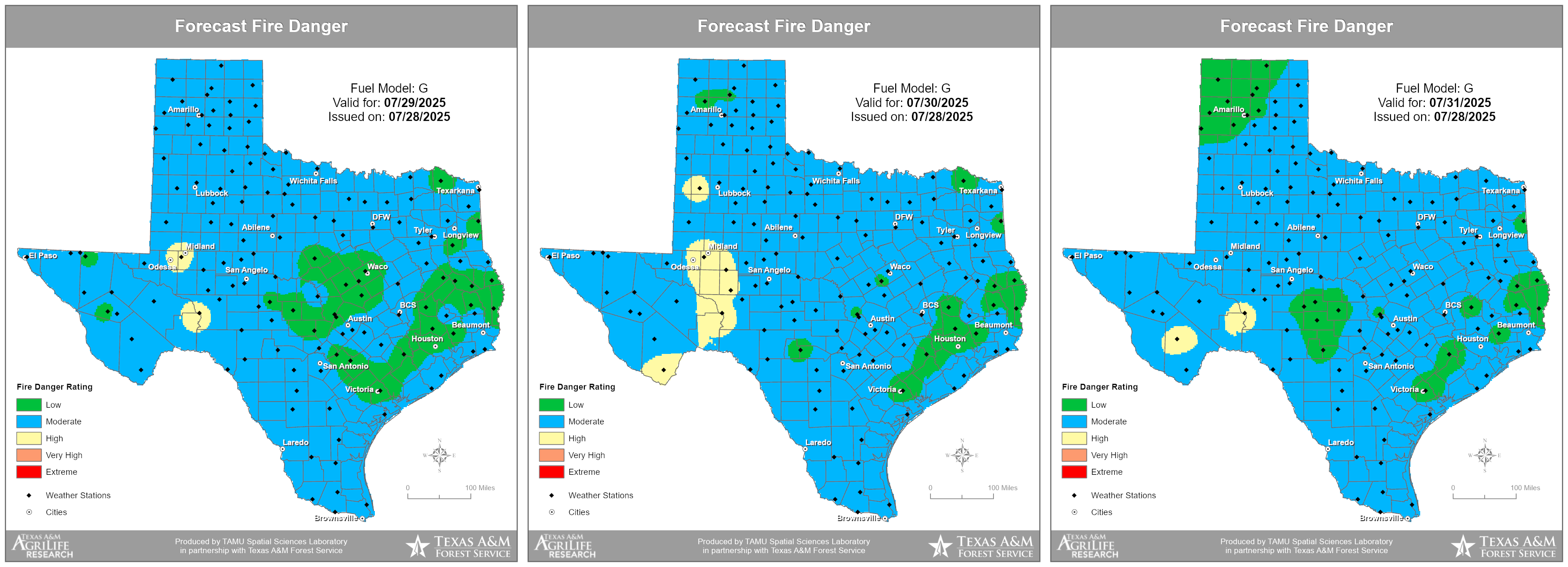
By Saturday, fire danger is expected to increase across the state, according to the TFS’ forecasting tool.

Active fires

As of 7 am 21 July 21, there were 10 active wildfires over an estimated 16,426 acres of land.

Two two-day-old North Texas wildfires continued to resist containment Wednesday after destroying 21 homes, officials said.

The Chalk Mountain Fire near Glen Rose, Texas, destroyed 16 homes and damaged five others as it remained on the move Wednesday after scorching almost 10 square miles (26 square kilometers) of mostly short grass, brush and juniper as of midday Wednesday, said Alexandra Schwier, a Texas A&M Forest Service spokeswoman.

A fire at Possum Kingdom Lake destroyed five homes as it spread along its western shore, charring 500 (200 hectares) acres about 70 miles (113 kilometers) west of Fort Worth. That fire was 15% contained Wednesday, the Forest Service said.

Success for NPFA community wildfire safety prevention programme

The National Fire Protection Association (NFPA) has released a new report, Residents Reducing Wildfire Risks: Findings from the NFPA® Firewise® Sites of Excellence Pilot, 2019–2020, showcasing the work of seven active Firewise USA communities to build wildfire-ignition resistance and avert wildfire disasters.

The report is the result of an NFPA two-year pilot, “Sites of Excellence,” in collaboration with the USDA Forest Service and state forestry agencies.

Michele Steinberg, wildfire division director at NFPA, said the pilot program underscores the true power and impact of Firewise communities working together to reduce their collective risk to wildfire.

“Individuals taking steps to protect their own homes can only accomplish so much,” said Steinberg. “The results of this pilot program show that the greatest potential for wildfire risk reduction lies with entire neighborhoods working in lock step with one another.”

According to the report, seven sites in Arizona, Colorado, Texas, Utah, Virginia, Washington, and Wisconsin saw higher levels of engagement and interest in the Firewise program and wildfire mitigation efforts; in six of the seven sites, more than 80 percent of adjacent households achieved the goal of mitigation in the home ignition zone.

Their work demonstrated that community wildfire resilience is achievable and that such a program can also foster improved community cohesion and better communication among residents, emergency responders, and land managers.

Developed for NFPA by postdoctoral scholar Dr. Rebecca Miller, the report and corresponding story map shows the challenges, successes, and best practices discovered during the pilot. Its findings will help direct future Firewise program changes and inform policy to support increased implementation of risk reduction practices in communities facing wildfire threats to life and property.

Wildfires rage across Europe as heatwave strengthens

Wildfires have continued to burn across Portugal, Spain, France and Croatia as large parts of Europe face a persistent heatwave pushing temperatures into the mid-40Cs.

In Portugal’s central Leiria district firefighters battled to control blazes that have been fanned by strong winds. Portuguese Prime Minister Antonio Costa said during a briefing with the national meteorological institute IPMA: “It is absolutely crucial we avoid new events because it leads to the exhaustion of firefighters and all others … who are doing their best to control the situation.”

In western Spain a fire that started in the Extremadura region on Tuesday crossed into Salamanca province in the region of Castile and Leon, forcing the evacuation of 49 children from a summer camp on Thursday. Regional authorities said more than 4,000 hectares (9,900 acres) of land had been burned.

On Croatia’s Adriatic Coast, firefighting planes were called in to dispense water over burning forests whilst troops were enlisted in to help firefighters in the battle to contain three major wildfires around Zadar and Sibenek.

In southwestern France more than 1,000 firefighters backed by nine water-dropping planes battled two wildfires that started on Tuesday and have already burnt 5,300 hectares.

Thousands of people were also evacuated from homes on Turkey’s southwestern Datca peninsula due to a fire that started on Wednesday which was hit with strong winds overnight and threatened residential areas.

A study in the journal Nature found that the number of heatwaves in Europe has increased three-to-four times faster than in the rest of the northern mid-latitudes, such as the United States and Canada, due in large part to the jet stream air current splitting into two parts for longer periods.

The study’s co-author Kai Kornhuber, a climate scientist at Columbia University, told Reuters: “Europe is very much affected by changes in atmospheric circulation. It’s a heatwave hotspot.”

Greece introduces rescEU firefighting fleet

Following an extreme wildfire season 2021, Greece has announced a new initiative to help prevent a reoccurrence of last year´s disastrous fire season with the introduction of the rescEU firefighting fleet. 

The EU has pre-positioned some heavy duty fire fighting forces to Greece from six member countries: Bulgaria, Finland, France, Germany, Norway and Romania. These countries are a part of the Union Civil Protection Mechanism (UCPM) and are deploying more than 200 firefighters to Greece in total,.

The firefighters will be stationed in Greece with their equipment for the two most dangerous months of the fire season, July and August.

The European mechanism has also announced the rescEU firefighting fleet for the 2022 summer season. Croatia, France, Greece, Italy, Spain and Sweden are hosting the aerial firefighting fleet and they stand ready to fight ever stronger fires in Europe.

The pre-installation program that started within the framework of the European Civil Protection Mechanism was a Greek initiative.

The missions will be based in three main regions:  Athens, Larissa and Tripoli in order to assist in the fire protection of the country and to exchange know-how, knowledge and experience with Greek firefighters.

Higher temperatures for Greece

Fire season 2021 in Greece was one of the least windy fire seasons in the last 20 years, however the the average temperature was 1.6 °C higher than normal. 

The rainfall of the winter and the summer season was down and two heat waves with high intensity and and great duration occurred during the season, leading to the relative humidity levels falling below 10% from the beginning of July, which in turn created extreme wildfire events. The forest fire season 2021 burned with very high intensity and destroyed more than 101.000 hectares.

During the forest fires in Greece, the European Union mobilized one of the largest ever European deployments of firefighters and aircrafts in history. In total, 24 firefighting aircrafts, 1301 firefighters and 277 vehicles from 22 countries around the world participated in the efforts to tackle the wildfires in Greece.

Forest fire threatens ancient sequoia trees in Yosemite National Park

A grove of ancient sequoia trees in Yosemite National Park are in danger as the Washburn Fire grew to more than 2,300 acres the US Forest Service has said. Firefighters are working in difficult terrain to protect some of the largest and oldest redwood trees in the world.

Firefighters on scene have been using a 4-foot tall sprinkler system to tackle the fire and maintain air-moisture to prevent extensive damage to the area.

The fire, which started on 7 July, is threatening around 500 giant sequoias in the Mariposa Grove, including a famed ‘Grizzly Giant’ which is thought to be around 3,000 years old.

The Washburn Fire has already caused nearly 1,600 people to evacuate the area, including the Wawona community located inside the national park and hundreds of campers staying close to Wawona.

The cause of the fire is still being investigated. Fire officials have said that warm and dry weather conditions are making it difficult to control the flames.

Mariposa Grove and Yosemite Valley have been protected since President Abraham Lincoln signed legislation in 1864. It has a long history of prescribed burning to reduce the negative impacts of high-severity fires, the National Park Service said in a statement.

The fire was downgraded from 25% contained to 22% containted on Monday night. Stanley Bercovitz, a spokesman with the US Forest Service, said: “We don’t want to say everything’s fine and we’re getting a good handle on this fire and it’s downhill from here on out, because all it’s going to take is one hour of wind.”

EU mobilises firefighting fleet as Portugal declares state of alert

Portugal activated the European Civil Protection Mechanism to request emergency assistance for the fires in the central part of the country the European Commission said in a statement. It noted that as an immediate response, the European Commission sent two Canadair fire-fighting aircraft from its fleet in Spain.

Portugal and Spain have been affected by high temperatures that have increased the risk of fire, which is expected to worsen in the coming days. Forest fires in Portugal have left 29 people injured as temperatures are predicted to reach up to 45C in parts of the country from Tuesday. On Saturday, the country recorded 125 fires, the highest number in a single day this year with around 1,500 firefighters fighting three big blazes. The government declared a state of alert across the country, from Monday to Friday 15 July as the weather has caused further concerns due to expected high temperatures.

Commissioner for Crisis Management Janez Lenarčič said: “With our quick response to the Portuguese request for assistance, the EU demonstrates its full solidarity in facing the destructive forest fires in central Portugal. I thank Spain for swiftly mobilising two firefighting planes via the RescEU this morning. Our thoughts are with those affected, and with the fire fighters and other first responders on the ground. We stand ready to provide further assistance.”

In addition, the EU’s Copernicus Emergency Mapping Service was activated by Portugal on 8 July for the forest fires affecting Leiria and Santarem districts in Ourém municipality. These maps support first responders with an assessment of the impact and damage of the fires. 

The EU Civil Protection Mechanism exists to strengthens cooperation between and among Member States and Participating States in the field of civil protection, with a view to improving prevention, preparedness and response to disasters. Through the Mechanism, the European Commission plays a key role in coordinating the response to disasters in Europe and beyond.

When the scale of an emergency overwhelms the response capabilities of a country, it can request assistance via the Mechanism. Once activated, the Emergency Response Coordination Centre coordinates assistance made available by its Participating States through spontaneous offers. Should the emergency require additional assistance, the rescEU reserve can be activated.

To date, all EU Member States participate in the Mechanism, as well as Iceland, Norway, Serbia, North Macedonia, Montenegro and Turkey. Since its inception in 2001, the EU Civil Protection Mechanism has responded to over 600 requests for assistance inside and outside the EU.

Electra fire reaches over 4000 acres in Northern California

The Electra fire in Northern California’s Amador and Calaveras counties reached 4,112 acres on Wednesday as firefighters increased containment to 40%, according to the California Department of Forestry and Fire Protection.

The fire, which has been active for two days, was moderated by cool temperatures and higher humidity, but remained active where wind and slope aligned. Firefighters continue strengthening control lines and mopping-up hot spots.

The Electra fire is one of of the largest wildfires this season. It ignited on Monday afternoon near the North Fork of the Mokelumne River and spread quickly through dry brush and steep terrain, according to Cal Fire officials. The fire was active for the first half of the night, but humidity in the early morning hours helped limit its activity, officials said. The cause of the fire remains under investigation.

More than 1,300 firefighters continue to battle the blaze, as of Wednesday morning. Electra fire spokesperson Chris Dargan said on Wednesday morning that the biggest issue in fighting the fire is the terrain and topography.

Mandatory evacuation orders and warnings combined impacted 700 residents in Amador county and 300 to 400 people in Calaveras county, officials said. Evacuation centres have been set up for people and animals. CalFire said the number of threatened structures remained at 1,217 but there were no reports of structures destroyed or damaged. 8,000 Pacific Gas & Electric customers in Amador and Calaveras counties remained without power Wednesday due to the fire, and many were still under mandatory evacuation orders.

Wildfire breaks out in Somalia’s Sanaag region

A wildfire in the Gaacidh forest in the eastern Sanaag region of Somaliland in Somalia has broken out from an undetermined cause, according to official reports. The fire in the forest which is home to unique trees and dozens of fauna started two days ago near the Daalo mountain and has not been contained. No casualties have been reported, according to officials.

Special Presidential Envoy for Drought Response for Somalia, Abdirahman Abdishakur, wrote on Twitter that the fire “is deadly both to the environment and the animals. Sanaag mountains are known for their variety and rare trees that are not found (anywhere else in) the rest of the country. Somalia is currently under serious threat from global climate change and deforestation. We must all, the administration and the public take action to control and extinguish fires to save the environment, animals and people.”

Gaacidh village chairman Salad Salah Mohamed told state-run television that the fire started on Sunday at 5:00 pm, and that the village has been on high alert since Sunday. He said: “Storms are present in the summer. A fire alarm has been transmitted to the government authorities but the fire still exists.”

Somali environmentalist, botanist and author Ahmed Ibrahim Awale said the forest: “Is the best preserved Juniperus procera-Dracaena schizantha mixed woodland in the Horn of Africa and it well deserves to be declared a World Heritage Natural Site.”

The spread of the fire is accelerated by strong winds and dry vegetation. The cause is yet to be determined but climatic conditions are said to play a major role in the spread of the blaze that is growing daily.

Wildfire: Human activity has ‘reduced the natural resilience of some ecosystems to fire’

New research led by the University of East Anglia (UEA) has highlighted how the risk of wildfire is rising globally due to climate change and how human actions and policies can play a critical role in regulating regional impacts.

The article, published in the journal Reviews of Geophysics, involved scientists from UEA, Swansea University, the University of Exeter and Met Office in the UK, CSIRO Climate Science Centre in Australia, together with colleagues from the US, Germany, Spain and the Netherlands.

The study assessed 500 previous research papers and carries out a re-analysis of state-of-the-art datasets from satellite observations and models and includes analyses of trends in fire weather and burned area for world regions covering all countries, continental-scale macroregions, and key regional ecosystems for fire activity or impact. 

It explores the relationship between fire trends and a range of controls on fire activity, including climate but also human activity, land use and changing vegetation productivity, which have with important impacts on the ignition of wildfires and their spread across landscapes.

The authors highlight that humans have important regional effects on wildfire activity in a warming world, such as having increased fire ignitions and reduced the natural resilience of some ecosystems to fire, most notably in major tropical deforestation zones of Amazonia and Indonesia.

In contrast, however, human activity has also reduced the spread of wildfire through naturally fire-prone landscapes by converting land to agriculture and fragmenting the natural vegetation, as seen in savannah grasslands in Africa, Brazil and Northern Australia during recent decades.

Lead author Dr Matthew Jones, of the Tyndall Centre for Climate Change Research at UEA, said: “Wildfires can have massive detrimental impacts on society, the economy, human health and livelihoods, biodiversity and carbon storage. These impacts are generally magnified in the case of forest wildfires.

“Clarifying the link between forest wildfire trends and climate change is critical to understanding wildfire threats in future climates. Societies can either push with or pull against the rising risks of fire under of climate change, and regional actions and policies can certainly be important for preventing wildfires or reducing their severity.

“Ultimately, though, we will be fighting the tide of escalating fire risks as the world warms further. Doubling down on efforts to cut greenhouse gas emissions and limiting warming to below 2°C is the most effective thing we can do to avoid the worst risks of wildfire on the global scale.”

Key findings from the analyses include

The length of the annual fire weather season has increased by 14 days per year (27%) during 1979-2019 on average globally and the frequency of days with extreme fire weather has increased by 10 days per year (54%) during 1979-2019 on average globally.

Fire weather has risen significantly in most world regions since the 1980s. Increases have been particularly pronounced in western North America, Amazonia and the Mediterranean.

At 2°C this will also be the case in the boreal forests of Siberia, Canada and Alaska and the temperate forests of the western US. At 3°C, virtually all world regions will experience unprecedented fire weather.

Globally, the area burned by fires has decreased by around one-quarter – or 1.1 million km2 – during 2001-2019. Much of the decrease – 590,000 km2 – has been in African savannahs, where 60-70% of the area burned by fire occurs annually. Local/regional human impacts have reduced the area burned by fire in tropical savannahs, in combination with lower grassland productivity during (increasingly drier) wet seasons.

Large increases in burned area have been observed elsewhere, and especially in temperate and boreal forests. For example, the area burned by fire has increased by 21,400 km2 (93%) in east Siberian forests and by 3,400 km2 (54%) in the forests of western North America (Pacific Canada and US combined).

Co-author Dr Cristina Santín, from Swansea University and the Spanish National Research Council, added: “Despite the fact that weather conditions promoting wildfire have already increased in nearly in every region the globe and will continue to do so, human factors still mediate or override the climatic ones in many regions.

“We hope this research helps to resolve the entrenched and conflicting views on climate change versus land management being the root cause of these catastrophic fires.”
Rising wildfires a growth catalyst for firefighting aircraft market

The global firefighting aircraft market size is expected to grow from $7.11 billion in 2021 to $7.73 billion in 2022 at a compound annual growth rate (CAGR) of 8.8 according to a new report from The Business Research Company that provides firefighting aircraft market statistics. The market size is expected to grow to $9.60 billion in 2026 at a CAGR of 5.6%.

The growing number of wildfires is expected to drive growth in the firefighting aircraft market going forward. Firefighting aircraft are used to stop the spread of fire in the forests and minimize the damage. As a result, a growing number of wildfires will increase the demand for firefighting aircraft.

New product innovations have emerged as the key trend gaining popularity in the firefighting aircraft market. Major companies operating in the firefighting aircraft market are focused on new product innovations to meet consumer demand.

Major players in the firefighting aircraft market are Airbus SE, Coulson Aircrane Ltd, Kaman Corporation, Lockheed Martin Corporation, ShinMaywa Industries Ltd., Textron Inc., Viking Air Ltd., Rockwell Automation Inc., Boeing Commercial Airplanes, Bombardier Inc., Siemens AG, Conair Group Inc., Sabena Technics, AeroFlite, and Canadair.

Asia-Pacific was the largest region in the firefighting aircraft market in 2021. North America was the second largest region in the global firefighting aircraft market. The regions covered in the global firefighting aircrafts market report are Asia-Pacific, Western Europe, Eastern Europe, North America, South America, Middle East and Africa.