NFPA releases Drone Knowledgebase to help departments improve drone programs

The National Fire Protection Association (NFPA) has created a Drone Knowledgebase to help more than 29,000 fire departments in the United States improve existing public safety drone programs or to establish new drone initiatives.

Drones have become a key instrument for public safety efforts in recent years with first responders increasingly deploying aerial technology to achieve greater situational awareness during structural fires, wildfires, natural disasters, rescue efforts, and large public gatherings. However, many U.S. fire departments find themselves without the proper information, knowledge, and experience needed to establish, administer, operate, and maintain a cohesive public safety drone program.

To help with this issue, NFPA has developed a Drone Knowledgebase as part of the Association’s broader public safety drone educational program. The interactive public safety tool was created with information-sharing and collaboration in mind so that U.S. public safety entities are apprised of what other fire departments across the nation are doing in terms of drone technology, staffing, and processes as they look to establish or revisit departmental drone programs.

U.S. fire departments are encouraged to contribute to the NFPA Drone Knowledgebase so that the tool provides the greatest value to all users. As with another popular NFPA crowd-sharing tool, Codefinder™, the Drone Knowledgebase is only as strong as the information received from stakeholders. The new response resource is expected to become more robust as fire departments learn about the resource, contribute local information, and invite neighboring jurisdictions to add their program details.

The NFPA Drone Knowledgebase was made possible by a FEMA Fire Prevention and Safety Grant that also paved the way for new online drone training from NFPA. The training, which was released in September, was designed to help fire service administrators and operators create, manage, and maintain drone programs that are in sync with proper public safety protocols.

NFPA has established a dedicated landing page, nfpa.org/drones, so that members of the fire service can access the 4-hour training, NFPA 2400, Standard for Small Unmanned Aircraft Systems (sUAS) Used for Public Safety Operations, a training teaser video, research, related content, and the Knowledgebase in one convenient location.

Exclusive: A new beginning for the National Volunteer Fire Council

Sarah Lee, CEO of the National Volunteer Fire Council discusses her recent appointment  

Tell us about your career to date in the fire industry 

I grew up in a fire service family so I’ve always witnessed that feeling of family that comes with the fire service. After discovering the sense of fulfillment that comes with working in the nonprofit sector right out of college, I began working at the Commission on Fire Accreditation International (now CPSE) managing the Chief Fire Officer Program, knowing that any job in the fire industry would surely come with this same sense of family while still fulfilling my desire to work in the nonprofit world. 

I was able to combine my passion for the nonprofit sector with my love for the fire service family and was afforded an opportunity to really grow and thrive. I moved to the Executive Director position at CFAI for several years before joining the NVFC in 2005.  

How did your appointment as NVFC CEO come about? 

It certainly wasn’t expected. I had worked with Heather Schafer as her Deputy CEO for over 15 years before her untimely passing in March of 2021. We worked very closely together in that time, and she was a great mentor and friend to me. Upon her passing, NVFC First Vice Chair, Kevin Quinn stepped in as Acting CEO while our organisation worked through the shock and grief we were experiencing and determined the next steps for the Council. In May, the board appointed me the Interim CEO and then my position was confirmed by the board in October.  

What are the main priorities now that your appointment has been announced? 

Ensuring that we have a solid foundation to serve our members is always a priority, and this means having a strong team, strong partnerships, and active, engaged members. The volunteer fire and emergency services continue to face several challenges affecting their health and safety, their ability to recruit and retain volunteers, and their ability to stay abreast of current technology and trends that can help them in their work. 

Our priorities as an organisation are to provide the volunteer fire and emergency services with the tools and information they need to overcome challenges while also sharing and celebrating their successes. We want to highlight the important role volunteers play in their communities and the many, many reasons others may wish to get involved as volunteers themselves.  

The NVFC looks to provide a voice for volunteer firefighters. How are you aiming to amplify that voice during your tenure? 

Everything we do at the NVFC is for emergency service volunteers, and our job as an organisation is to elevate their voices to the national arena and ensure that they are fairly and adequately represented in legislation, standards, regulations, and codes. 

Advocacy is a big part of what we do, and we will continue to advocate by monitoring and acting upon federal legislation that affects volunteers and by ensuring that we are representing volunteers in all places where decisions are made that impact their health, safety, and the critical resources they need to succeed. We also want to amplify all of the good that volunteers do in their communities, not just in saving lives but also in the small, daily actions and interactions with their neighbors, friends, and colleagues that can leave long-lasting, positive impressions.  

The relationship between the NVFC and your members has always been critical. How will you look to strengthen this in the future? 

Our members are the NVFC. When I started with the NVFC almost 16 years ago, we had around 1,000 members. Today we have over 27,500 members and this number continues to grow. This growth has been achieved by listening to what members need and want from us as an organization and by meeting these needs through our programs, tools, resources, and advocacy efforts. 

A large part of our success is also attributed to our great working relationship with the 47 state fire associations that serve on our board and that provide a critical link to thousands of smaller, rural departments that need our help and support. As we move forward, it is critically important to foster this connection with the local level and provide opportunities for our members to engage with the NVFC and become part of the solutions they are seeking.  

What are the main challenges you are looking to tackle in the initial months? 

There are a number of important issues that disproportionally affect first responders such as behavioral health concerns, suicide, firefighter cancer, heart attacks, and other preventable health risks. Recruitment and retention have also become increasingly difficult in the face of COVID-19 and families are simply struggling to balance more with increasingly limited time. These are issues we are actively addressing through our national programs, ongoing training opportunities, and by providing resources to increase the support network our members need, whether that support is through their peers, medical professionals, or even their own friends and families.  

Have you had a chance to speak to members since your appointment?  

We really have the best members and I feel like I’ve found that fire service family I witnessed as a child. Our members have been so supportive and have reached out with positive messages and encouragement. The really great thing is that our membership is so diverse – our members are doctors, teachers, elected officials, farmers, and small business owners and they come from all areas of the country and all walks of life. In spite of these differences, they all share a common love for volunteering and giving back to their community, and it really is this commonality that unites our members and the volunteer fire and emergency service as a whole.   

You are carrying on the excellent work carried out by Heather Schafer over a long period of time. How important will the foundations she has helped to build be to the NVFC in the future? 

Heather led the NVFC for 27 years so she was truly instrumental in laying the strong foundation the NVFC has today. I’m so grateful that I had 15 years to work so closely with her, learn from her, and watch her build the great team and organisation that the NVFC is today. She left behind a legacy of great leadership and visionary thinking that has benefited the NVFC and our members in many ways. 

The best way to honor her is to carry on her legacy and continue to build upon this foundation she created so that we can continue to meet and exceed the expectations of our members and help the volunteer fire and emergency services grow and thrive.  

Can we expect to see much change or are you looking to solidify what is already in place? 

The NVFC is in a period of growth, and member feedback indicates the positive impact our organisation has already made on so many of our members, their departments, and even their families. The NVFC thrived under Heather’s visionary leadership, and I am looking forward to both continuing and expanding upon what she and I worked on together as a team in concert with our fantastic board and staff. 

As we move forward, I expect our members will find increased training opportunities, additional resources addressing health and safety as well as recruitment and retention, and even more opportunities to engage with the NVFC – a vision I know Heather would have shared for the organisation.  

Looking to the future, what goals are you setting for both yourself and the NVFC? 

Meeting the needs of the volunteer sector is a team effort and will require a strong community of diverse individuals to succeed. Solving the challenges faced by our members is a long-game strategy – it’s not going to happen overnight; it will take hard work, commitment, and persistence and I’m excited to be a part of the team that will make this happen. 

As we move forward, our goals are to continue to grow our membership, develop enduring relationships with our partners and allies, and ensure that first responders have the tools, resources, and information they need to conduct their job safely and go home to their families at the end of every call and every shift. 

We want to make volunteer recruitment as easy as possible for departments who are struggling, help departments retain the great volunteers they have now, and really showcase all of the tangible and intrinsic benefits to be gained by volunteering and serving your community. Volunteer first responders are some of the most caring, selfless, and community-oriented people you’ll ever meet, and I feel so fortunate to work with and for such a remarkable group of individuals.  

Exclusive: Meeting the challenges of today

Greg Young, Vice President of Performance Advantage Company discusses how overcoming modern challenges has become a key priority across the globe

In any organisation, a budget will affect how goals are met.  Whether we are talking about the budget of money, people, resources or time, there can only be so much available at a given time.  To fill the needs of our customers we must focus on what is important and we must draw on the budget responsibly.  Requiring massive amounts of attention, watching these budgets is becoming a job unto itself; new challenges seem to arise daily.

The COVID pandemic has, in many ways, upended what many industry leaders believed to be under their control.  The actions and reactions of governments around the world are out of our control, for instance.  Lockdowns, however, took most people by surprise.  Few would ever think an open, democratic society would be forced to close for an indefinite amount of time.  How will the lights stay on?  How will the food be put on the table?  

Some effects of government reaction to the pandemic were immediate and apparent; others were not.  And now, almost two years later, the pandemic continues to affect us in ways that multiply on an almost daily basis.  The pandemic continues to make apparent the unforeseen ways we are not in control.  All manufacturers are facing challenges like they never have before.  Stress and burnout threaten productivity as we yearn for a return to normal in our personal and professional lives.

Global product shortages

You may have heard about the global shortages of shipping containers.  Understaffed ports are clogged with goods.  There are not enough drivers, nor enough hours in a day, to move the goods.  Yard capacity is beyond full, too.  These are some factors that are driving the cost of freight higher.  Inside those unloaded container ships, there is not only toys and televisions.  There are also textiles, chemicals, and plasticizers.  These raw materials and components are vital to production of products used in the emergency markets and elsewhere.

Product shortages are again roiling supermarkets.  Retailers are scrambling to meet holiday demand.  Restaurants and small shops, which contribute greatly to our economies, are struggling to bring in revenue.  They face unprecedented difficulties like keeping the shelves stocked and finding a qualified workforce, too.   All employers, already facing staffing issues, now are facing even more issues including rising wages.  A global “great resignation” is causing people of all walks of life to rethink their careers and life balance.  Recent vaccine mandates are forcing some health care and public safety providers to resign, too.  Our health care systems and our public safety are being squeezed in unforeseen ways.

Fuel shortages and price surges are affecting both the public and private sectors.  Wage pressures continue and inflation is on the rise.  Not to forget that there are bad actors determined to undermine our infrastructure.  Ransomware attacks are pushing the need for investment in network security.

Shuddered manufacturing plants and the work-from-home revolution highlighted an issue no one was expecting.  The disrupted manufacturing of microchips, tiny processors used to power all our electronic devices have become difficult to source.  This is choking the output of every industry that uses these chips in their products.  These industries include automotive, computer and industrial machinery.  The emergency market is essential, but not immune to these shortages.  The emergency market is being impacted by the stalled production of new emergency vehicles as well electronic monitoring devices.

Rise to the challenge

What does this all mean?  This is certainly a lot to ponder.  Bringing the idea back to control – some things are out of your control, and they are certainly not inconsequential.  But all is not lost! Lives depend on us to rise to the challenge and keep the emergency services running.  We must first look at what our organisations can control.  Start by looking at the critical tasks your organisation performs.  From that starting point, we must continuously innovate to meet the needs of today.

It is never a bad time to plan for tomorrow, as our experience shows us.  When looking to tomorrow there are other questions you could ask yourself, but for the sake of this topic: When time comes to look at your budget again, what changes will you make to succeed? Again, this is not always about budgeting of money.  This could also mean a change in availability of people, resources, gear and even emergency vehicles.

Some ways you could do more with less could include using technology that you already have.  With little to no expense there are many ways to enhance productivity and communication.  Perhaps one of your new hires has experience with technology in a way that could benefit your team. Why is the manufacturer of tool mounting brackets talking about such extraneous things?  As a manufacturer, we face the same challenges today and into the foreseeable future, too.  We stand with the businesses, large and small, who are facing this rapidly changing economic climate.  

Also, we are reminded that this company was born of specific industry needs and values.  Those values, coupled with our collective experience, continue to drive spirited innovation.  Innovation is what will allow all of us to survive and to continue to serve those who need us. Now, and at our company’s founding, manufacturers of fire apparatus rely on our tool mounting systems as ready to mount products.  This saves time and overhead for the truck manufacturers who are not always prepared to design tool mounts for various needs of their customers.  Now more than ever the need to save resources is very clear.  Having experience building fire trucks, PAC customer service will always be available to support our partners.  We will always have product ready to ship.  

We are proud to stand strongly in the emergency industry.  It is an industry with the highest purpose.  Performance Advantage Company has a long and active history in the fire industry and our future looks bright and very busy, too!  Notwithstanding, the pandemic continues to cause us to pivot and innovate to navigate these difficult times. 

We are stronger for it in many ways.  For instance, our supply chain is now scrutinised and reviewed with more vigour.  Also, our communications and internal processes have been strengthened using technology that we were not previously capitalising on.  We will continue to innovate and roll out new improvements that help us succeed!

Our core values embody being innovative and being prepared.  We firmly believe that you must always protect what has already been invested in.  The people in your organisation and the gear they depend on are all investments.  They must be protected.  Let us talk about how tool mounting and tool organisation can protect your investments.

Don’t risk time searching for a tool  

Uniformity is the practice of organising tools on different trucks in the same manner.  Larger fire departments use this as a policy to benefit their customers.  Following uniformity, all similar trucks should have the same tools mounted similarly in the same place.  Responders can quickly join any engine crew and perform to the same high standards.  Uniformity lends to familiarity and allows the best crew response.

In your organisation, you may have several trucks spread over many districts or departments.  Some departments have a ladder truck while others do not.  With a uniform fleet, your team will have instant familiarity.  This means that firemen will know exactly which compartment has, for example, the nozzle adapters or bolt cutters.  Remove the guesswork and wasted time looking for a tool (in all the unforeseen environments at the fire scene).  Uniformity leads to familiarity.  Responders know exactly where to find a tool on any truck in the fleet.  When your new truck goes on a call your crew can instantly find the tools they need.  Allow the Fire professionals to provide the quickest response – saving lives and property – by allowing your members to have common familiarity with the gear they need.  

An organised rig can be one of the most effective tools to have when providing training to your crew.  With an organised truck, new recruits and veterans alike become familiar with the truck layout.  With familiarity, one person can find, retrieve, and deploy equipment with the highest efficiency.  This performance is repeatable regardless of responder or shift.  This improved performance is scalable across a fleet of vehicles.

Familiarity leads to accountability.  Tools are often lost or misplaced.  They can be left behind at a scene, mistakenly placed in another compartment or worse: taken by another responding company!  Accountable crews have everything in their place before and after the call. Inventory can be quickly surveyed after each scene ensuring tools have been returned to their proper storage location.  When a truck is at the station it can be quickly surveyed for missing equipment.   

Minimising the risk of tool damage

Supply chain issues are causing long lead-times on key equipment like helmets and other gear.  A secured tool will provide a longer tool life; not subject to wear, breakage, damage or being misplaced. This is at a critical time when saving crucial dollars for other expenses is necessary. This also saves potentially months waiting for a backordered piece of equipment or worse: settling for available, but inferior, replacement tool or gear.

For the longest service life of your equipment, PAC mounting brackets only use special composite materials.  These materials were selected for strength under heavy loads, impact, and resistance to chemicals, conductivity and corrosion. Unsecured tools can fall against the inside of a roll-up door.  This causes an avoidable situation where the door cannot be safely rolled up.  Additionally, unsecured firefighting tools can become tangled and interwoven.  These are examples where unsecured tools lends to lost critical response time.

Don’t risk workplace injury because of unsecured tools

Due to staffing shortages, fire departments must mitigate the risks to their firefighters.  Staff shortages caused by injuries in the line of duty are at the most difficult time to manage and overcome. Muscle injuries, overexertion, and accidental contact account for most injuries.  Tool mounting and tool storage can help with these concerns.  Not only does proper tool mounting keep gear working longer but it also can eliminate operator injuries from hazards such as tools falling from high truck compartments.

Any Department must prevent injuries from happening.  Tools should not fall out of compartments when the door is opened – this is a preventable hazard!  Do not become one of those Departments that have sustained workplace injuries.  Falling nozzles, adapters and even rescue tools have caused severe injuries and have needlessly taken responders away from serving the public.  Avoid injuries by organising and securing your tools.  

Many factors contribute to the performance of a Fire Department.  Dispatchers, responders, vehicles, communication systems and equipment are crucial elements.  Providing the public efficient, effective service is demonstrable and measurable.  Under your control, tool mounting and organisation should not be overlooked.  Tool mounting and organisation can be considered on current in-service trucks, when designing a new truck or when putting a truck into service.  Successful organisation of gear lends to better performance with lower operating costs.  It should never take an incident or injury for a Fire Department to rally around the cause of proper tool mounting. 

NFPA calls for caution as Thanksgiving Day approaches

As Thanksgiving fast approaches, the National Fire Protection Association (NFPA) is urging everyone to use added caution when celebrating the holiday, as Thanksgiving Day represents the leading day for home cooking fires. More than three times as many cooking fires occur on Thanksgiving Day as a typical day of the year.

Thanksgiving is a hectic holiday that involves lots of cooking and distractions, which can make it easy to lose sight of what’s on the stove and in the oven,” said Lorraine Carli, NFPA’s vice president of Outreach and Advocacy. “Unattended cooking is the leading cause of home cooking fires, so we strongly encourage people keep a close eye on what they’re cooking and to minimise the likelihood of getting distracted.”

According to NFPA data, cooking was the leading cause of reported home structure fires and civilian fire injuries and the second-leading cause of civilian fire deaths and direct property damage, on annual average from 2015 to 2019. On Thanksgiving Day alone, an estimated 1,400 home cooking fires were reported to U.S. fire departments in 2019, reflecting a 228 percent increase over the daily average.

“The good news is that the vast majority of cooking fires are preventable with a little added awareness,” said Carli. “By taking simple steps and precautions to minimise the likelihood of having a cooking fire, everyone can enjoy a festive, fire-safe Thanksgiving.”

Following are tips and recommendations from NFPA for cooking safely this Thanksgiving:

  • Never leave the kitchen while cooking on the stovetop. Some types of cooking, especially those that involve frying or sautéing with oil, need continuous attention.
  • When cooking a turkey, remain at home and check it regularly.
  • Make use of timers to keep track of cooking times, particularly for foods that require longer cook times.
  • Keep things that can catch fire like oven mitts, wooden utensils, food wrappers, and towels at least three feet away from the cooking area.
  •  Avoid long sleeves and hanging fabrics that can come in contact with a heat source.
  • Always cook with a lid beside your pan. If you have a fire, slide the lid over the pan and turn off the burner. Do not remove the cover because the fire could start again. Let the pan cool for a long time. Never throw water or use a fire extinguisher on the fire.
  • For an oven fire, turn off the heat and keep the door closed. Only open the door once you’re confident the fire is completely out, standing to the side as you do. If you have any doubts or concerns, contact the fire department for assistance.
  • Keep children at least three feet away from the stove. Kids should also stay away from hot foods and liquids, as steam or splash from these items could cause severe burns.

In addition, NFPA strongly discourages the use of turkey fryers, as these can lead to severe burns, injuries, and property damage. For a safe alternative, NFPA recommends grocery stores, food retailers, and restaurants that sell deep-fried turkey.

Houston concert tragedy casts crowd management into the spotlight

Over the weekend, tragedy unfolded at NRG Park in Houston, Texas when eight young concert goers, between the ages of 14 and 27, were killed when reported crowd surges occurred during the Astroworld festival which attracted an estimated 50,000 attendees.

In addition to the loss of young lives, more than 300 attendees sought assistance at an onsite medical tent. News reports indicate that 25 were transported to the hospital and 13 remain hospitalized. The mass casualty event, considered to be one of the deadliest concerts in US history, is now being criminally investigated to determine what prompted pandemonium as eight-time Grammy nominated rapper Travis Scott, a Houston native, took to the stage.

The level of chaos that ensued on Friday night may seem rare, but we need only look back to April 30of this year when a celebration turned into tragedy as 45 people were killed and more than 150 were injured at a religious festival in Israel that attracted nearly 100,000 people. On the heels of that event, NFPA Building and Life Safety Tech Lead Kristin Bigda wrote a blog about crowd management safety. That piece serves as a great resource today as people search for answers in Houston and around the world. Bigda summarizes some of the code requirements from NFPA 101, Life Safety Code which are unique to assembly occupancies with large crowds. In part, Bigda explains:

  • Occupant Load is determined by utilizing factors that are based on how the space is used or is determined by using the maximum probable population of the space under consideration, whichever is greater. In areas of assembly occupancies more than 10,000 ft2 (930 m2), the occupant load cannot exceed a density of one person in every 7ft2 (0.65 m2).This occupant load limit exists to avoid overcrowding.
  • Life Safety Evaluations (LSEs) are required where the occupant load of an assembly occupancy exceeds 6,000. The LSE recognizes that fixed protection and suppression systems alone do not ensure safe egress where large numbers of people are present. Expected crowd behavior and techniques to manage any behavioral problems are also considered. The evaluation must include an assessment of all the following conditions and related appropriate safety measures:
    • Nature of the events and the participants and attendees
    • Access and egress movement, including crowd density problems
    • Medical emergencies
    • Fire hazards
    • Permanent and temporary structural systems
    • Severe weather conditions
    • Earthquakes
    • Civil or other disturbances
    • Hazardous materials incidents within and near the facility
    • Relationships among facility management, event participants, emergency response agencies, and others having a role in the events accommodated in the facility

  • Main Entrances/Exits are required in every assembly occupancy, new or existing, to accommodate for occupants that are likely to egress the facility via the same door(s)/opening they used to enter. In some types of new assembly occupancies, the main entrance/exit must accommodate up to two-thirds of the total egress capacity, while in other assembly occupancies it can account for 50 percent. In assembly occupancies where there is no well-defined main entrance/exit, exits are permitted to be distributed around the perimeter of the building, provided that the total exit width is not less than 100 percent of the width needed to accommodate the permitted occupant load.
  • Auditorium and Arena Floors need to be considered in new assembly occupancies where the floor area of auditoriums and arenas is used for assembly occupancy activities/events. Not less than 50 percent of the occupant load can have means of egress provided without passing through adjacent fixed seating areas.
  • Emergency Action Plans (EAPs) must be provided in assembly occupancies and are a critical component of assuring life safety in buildings. Plans must include a minimum of 18 different considerations including:
    • Building details
    • Designated building staff responsible for emergency duties
    • Identification of events that are considered life safety hazards and the specific procedures for each type of emergency
    • Staff training
    • Documentations
    • Inspection, testing, and maintenance of building facilities that provide for the safety of occupants
    • Conducting drills
    • Evacuation procedures
  • Crowd Managers are required for assembly occupancies. Where the occupant load exceeds 250, additional trained crowd managers or crowd manager supervisors are to be provided at a ratio of one crowd manager or crowd manager supervisor for every 250 occupants in most facilities.

Bigda also penned an In Compliance column for NFPA Journal this fall, reinforcing the fact that when safety protocols and crowd management features are neglected, it can have a drastic impact on the efficiency of egress response during large events like the one in Houston.

In that same issue, NFPA Journal also ran an Op-ed called In My Tribe by Steve Adelman, principal author of the authoritative crowd-management standard in the United States (ANSI ES1.9-2020) and vice president of the Event Safety Alliance, an industry group that was established after seven people were killed at the Indiana State Fair in 2011. Adelman writes, “In the context of events where participants are passionately engaged, a risk identity of situational invulnerability causes them to either downplay of not even perceive otherwise apparent hazards.”

While it is too early to know definitively what transpired in Houston, the incident reminds us just how important it is for citizens to have a keen level of situational awareness and for venue security and safety personnel to understand and apply the guidance found within NFPA 101.

This article originally appeared as an NFPA Today blog

FireGrid – Protecting and managing collected data

Data collection and transparency are critical during an active fire scene, but also after it has been concluded. With MSA’s FireGrid, powered by MSA’s software subsidiary Safety io, which has recently achieved  ISO/IEC 27001 certification, fire departments have gained an additional layer of information security management.

Data collection process

FireGrid is an easily accessible cloud-based software platform that helps improve firefighter safety by increasing a department’s capability for managing people, products,  and processes. On-scene information is aggregated from products and is available for immediate usage or stored for post-scene data reporting. So, it could be used by a department’s incident commander, someone monitoring off-scene in a remote manner, a fleet maintenance manager, or even a training officer. The FireGrid applications enable monitoring, maintenance, reporting, and inventory management. 

Independent audit for certification

Obtaining the ISO27001 certification was preceded by an extensive, independent, external audit provided by Bureau Veritas, an accredited independent body. The certificate is an internationally recognized information security management system standard (ISMS) published by the International Organization for Standardization (ISO) and the International Electrotechnical Commission (IEC). The ISO certification, according to ISO/IEC 27001:2013, guarantees that FireGrid is a comprehensive information security software that manages and maintains customers’ data.

Keeping data confidential and secure

To help ensure that information remains confidential and safe, we maintain a rigorous data privacy policy and deploy robust  protection systems that cover:

  • Data Storage – services and infrastructure are hosted in data centers managed by Amazon Web Services (AWS) – recognized as one of the most secure infrastructures in the world.
  • Data Privacy Policy – Safety io has a public privacy policy, which details the types of personal information collected, how this information is handled, and customers’ privacy rights.
  • Access Controls and Authentication – in order to upload or access data, verified user authentication is required.
  • Data Access and Usage – Safety io provides an advanced set of access, encryption, and logging features to help customers access and control their data more effectively.
  • Backups and Recovery – customer data is backed up and encrypted daily.
  • Incident Response – a plan consisting of responsibilities and procedures in case of an actual or suspected security incident.​
  • Annual Penetration Tests on applications, infrastructure, and APIs conducted by a qualified third party with the agreement in place.

Advanced technologies to secure data

From the moment a firefighter jumps off the rig, FireGrid Cloud-Connected Software feeds incident and firefighter data to on-scene officers and remote personnel in real-time, ensuring everyone back at the station knows what’s happening on the ground. For this reason, helping to keep workers safe means keeping sensitive data safe, too. To find out more about how FireGrid can protect your data click here

Exclusive interview with Jim Everett, President of PAC Tool Mounts

Speaking exclusively with International Fire and Safety Journal, Jim Everett, President of PAC Tool Mounts evaluates the last year for the company 

Q – How has the last year been for PAC Tool Mounts?

I am happy to report that demand for PAC products held strong through 2020 and into the first half of 2021.  We are cautiously optimistic as we move forward through the rest of this year, keeping in mind that some reductions in apparatus sales in late 2020 may have a negative impact going forward.

This may have a delayed effect on purchases from our OEM customers that would not be realized on our end, until the end of 2021 and into the first half of 2022.  In the final analysis, we are very happy with the continued level of support from all our customers who have continued to actively promote the PAC line of products over the last 18 months, and we are very optimistic about what the future holds for PAC’s position in the emergency services industry going forward.

Q – What gaps in the market have you seen developing in the past year?

Probably the most notable to date has been the drop in direct sales to fire departments themselves.  Municipalities both large and small throughout the U.S. have reacted quickly to the effects of the Pandemic by tightening the purse strings regarding their capital spending accounts. 

Not knowing how long the Pandemic would have things shut down, along with potential reductions in additional government subsidies going forward, has put many local governments on alert when it comes to their spending process.  We are confident these “gaps” will work themselves out over time, it’s just a question of what that time frame will be.

Q – Have you managed to bring any new products to market?

This is an easy one to answer … YES.  Typically, we look to introduce a couple new products, or create improvements to existing products every year. In evaluating the potential impact Covid-19 may have on demand of PAC products going forward, we made a conscious decision to up our game in coming up with multiple new designs for products that have been on our radar for a while now. One grouping of new products we’re very excited about is our SuperFlex bracket kits. This style of positive locking bracket represents a new direction in design and functionality, and addresses securing items such as extinguishers and oxygen tanks that we really didn’t have an effective option for previously.  

When the economy starts to come back and the fire market buyers get their feet back on solid ground, we are confident that the demand for products, both new and existing, will be stronger than ever.  When that change starts to take hold, PAC will be ready with the answers to our customer needs.

Q – Tell us a bit more about your new SuperFlex Kits

We are extremely excited about the potential for this new product.  The SuperFlex bracket currently is available in two grip range sizes. The SuperFlex3 has a grip range of 2 ½” – 3 ½”, and the SuperFlex4 has a larger range of 3 ½” – 4 ½”.  Primarily sold in pairs to achieve maximum stability for longer cylindrical items, the SuperFlex brackets combine the flexibility and quick release element of a friction style mount with the increased holding power of a positive locking style bracket. 

In addition to the standard pair kits, SuperFlex also comes in a 3lb Extinguisher Mount design to provide a secure mount for 3lb extinguishers up to 3 ½” in diameter, and the Oxygen Bottle / 5lb Extinguisher Mount designed to provide secure mounting for a D style oxygen bottle, 5lb extinguishers, or other cylindrical items up to 4 ½” in diameter.  Each of these kits include a pair of SuperFlex mounts mounted to an anodized aluminum mounting channel and cylinder base rest. T

his complete kit allows for quick and easy installation in the cab or compartment of any emergency vehicle.  As what PAC is known for, the SuperFlex brackets are made from an extremely durable composite material that affords the user years of safe and secure performance, even in the toughest of conditions. Finally, our new style strap is an adjustable lock strap that allows for just the right amount of tension in securing items and has a new larger open-faced locking handle for ease in engaging and disengaging, even when wearing gloves.

Q – What common issues within the fire departments do the kits solve?

First and foremost we feel confident that these brackets, as included in the two cylinder mounting kits, will be a great asset to mounting items such as fire extinguishers and oxygen cylinders in the occupied areas of a vehicle.  Both these bracket kits have been tested and certified to meet and exceed NFPA 1901 impact testing standards, making them the perfect option for mounting these cylindrical items in the cab of a vehicle. 

In addition, The SuperFlex kits offer the user a smaller mounting footprint when looking to secure different types of cylindrical items in a confined or tightly spaced area.  As with all PAC products, the SuperFlex kits come with PAC’s Standard Limited Lifetime Warranty.  Recently unveiled at the FDIC Show in Indianapolis, the SuperFlex Kits received extremely positive reviews by those who visited our display booth. 

Q – What do you believe is the future of tool storage?

We couldn’t be more excited about the future potential when it comes to tool and equipment storage.  Every year more and more tools are introduced into the fire market.  More tools increase the need for better organization and accountability for these expensive pieces of equipment.  Also, the market seems to be gradually moving towards smaller, more maneuverable vehicles. As with the vehicles used in the European market as well as other countries around the world, smaller trucks result in having to really maximize the storage space a vehicle has available. 

This is where PAC’s expertise can be a huge asset to these fire departments and OEM’s.  We are already starting to work with certain truck manufacturing operations in establishing standardized kits of tool mounting boards and brackets for inclusion into the established compartments of those builders’ trucks.  Simply put, more and more tools with less available space, results in a need for better organization of tools and equipment allocated to those vehicles.  PAC and our team of professional support staff are excited at the opportunity the future holds. 

Great products are obviously a key component in PAC’s long-term success in the industry.  Just as important however is our dedication to giving our customers the absolute best in customer service. We embrace the need that our customers rely on our products and service to be the best available in assisting them in their service to their customers and their communities.

Pierce Manufacturing completes ownership interest in Boise Mobile Equipment

Pierce Manufacturing Inc have announced that it has completed the purchase of an ownership interest in Boise Mobile Equipment (BME). This investment will facilitate greater collaboration between Pierce and BME within the wildland fire market. Furthermore, Pierce will support BME as the business moves from a factory-direct model to an independent dealer distribution model, with a focus on the West Coast, which will provide new and existing BME customers with comprehensive service, parts inventory, and support.

“This is an important day for both Pierce and BME customers,” said Jim Johnson, Oshkosh Corporation executive vice president and president, Fire & Emergency. “We understand that fire and rescue departments face special challenges related to wildland environments. With this investment, Pierce will work with BME to provide the best possible wildland offerings to meet these unique challenges. And of equal importance is our ability to create an unmatched network of highly trained dealer organisations who are prepared to provide best-in-class service and support for the wildland customers.”

BME has served fire and emergency professionals for over thirty years and is considered a premier fire apparatus manufacturer with wildland products including the Model 34, Tactical Tender, and Type 6 Xtreme. BME’s quality fabrication and service align closely with Pierce’s manufacturing and aftermarket standards, featuring individualised design options, exceptional craftsmanship, and rugged durability.

“Boise Mobile Equipment opened its doors in 1990 and has been manufacturing and serving firefighters since then,” said Chad Moffat, president of Boise Mobile Equipment. “We believe the fire service will benefit from the high-quality wildland products that Pierce and BME will be working together to market and develop. We look forward to leveraging Pierce’s expertise as we transition from a direct sales model to a dealer distribution model.”

BME wildland products are renowned for equipping firefighters with a high-quality apparatus providing durability, serviceability, and longevity. Pierce Manufacturing and its parent company, Oshkosh Corporation, complement BME’s reputation with a rich history of innovation and advanced mobility solutions, ideal for addressing the harsh wildland environments.

“For those departments who respond to wildland situations, the BME product line is well-known for its versatility in the most challenging environments,” added Johnson. “Moreover, Boise Mobile Equipment is a highly reputable and proven brand. When combined with our experience in developing a market-leading dealer support network and unmatched innovation track record, fire departments and those they protect will be the biggest beneficiaries of this new relationship.”

To learn more about Pierce Manufacturing and the company’s ownership interest in BME, visit www.piercemfg.com.

Exclusive: Blinded by the LED lighting era

As lighting solutions are becoming a priority, departments are now finding that brighter doesn’t mean better  

Heading up Loveland Fire Rescue Authority and an ancillary fire station in the Big Thompson Canyon, Erv Weinmeister and his crew were no strangers to responding to one of Colorado’s most dangerous canyons with it stretches of plummeting ravines and craggy mountainsides. Fifty years later, Weinmeister still recalls how perilous those canyons were at night.  

It was that lack of lighting that led to Weinmeister’s founding of Command Light. Tinkering to get more light on his rig, he began mounting light poles to elevate light. But that wasn’t good enough. Weinmeister wanted to angle and rotate the fixtures, so by the 1970s, he invented the industry’s first hydraulically operated light tower, followed by Command Light’s patented electric tower in the 1990s. Needless to say, over the decades, the family-owned company has witnessed many lighting evolutions, including the advent of LEDs (light-emitting diodes).  

But with all these innovations, Roger Weinmeister, Erv’s son and Command Light President, will be the first to admit too many departments are still operating in the dark.  

In fact, he says the evolution of brighter LEDs has become a blinding detriment to departments. Swept up by the influence of lighting manufacturers constantly vying to outshine each other with more lumens, the fire industry has fallen back to the long-ago days of inadequate scene lighting, losing sight of the most basic lighting principles. The result? In some instances, personnel are being inundated with TOO MUCH LIGHT, and in turn, NOT ENOUGH LIGHT where it matters most.  

So, let’s start with this notion of TOO MUCH LIGHT 

Back when LEDs were first introduced, we saw fixtures in the 10,000-lumen range. Then, 15,000. 20,000. And now, some lighting manufacturers tout 30,000 lumens. That’s great if those 30,000 lumens aren’t pointed directly in your eyes. But in some cases, that’s exactly what’s happening. Motorists are being blinded as they approach an accident. Firefighters are battling glare on the fireground. All that bright light is usually wasted, inefficiently directed upon the scene thanks to today’s trend of fixed LED lighting. We’ll talk more about fixed lighting in the NOT ENOUGH section, but first let’s delve into some forgotten principles, starting with lumens. 

svcasset-5198

Think of “Lumens” as a total power rating. Measured at the fixture itself, this number does NOT reflect how much usable light is being directed at the target, making this arguably the more important factor. That measurement is called “Lux” and can be affected by many variables, like target distance, light grouping and fixture degradation. If we were flowing water, “Lumens” would be equated to GPM, while the amount of water on target is “Lux.” This is your working light, and it’s important to disperse this light evenly throughout the scene. Why? Basic lighting principles … 

A firefighter’s eyes must work harder to adjust when he or she moves from dark to almost-blinding areas of the scene. We could get into the science behind the breakdown of rhodopsin, a light-sensitive protein in the eye that activates the retina’s rod cells, but we don’t need to remind you how it feels like when your eyes adjust to lighting extremes. And then there’s the issue of glare created by all these super LEDs. 

In fact, this blinding effect has international apparatus standard organizations discussing whether limits should be set on the brightness of LEDs or if more dimming fixtures should be mandated in the future. 

One simple fix is to use smaller fixtures, spaced evenly around the truck to create uniformed lighting. The cost of this is comparable to the purchase of a high-output fixture. In short, you don’t have to have max lumens to be effective. On the downside, though, your fixtures are fixed, which brings us to … 

The issue of NOT ENOUGH LIGHT 

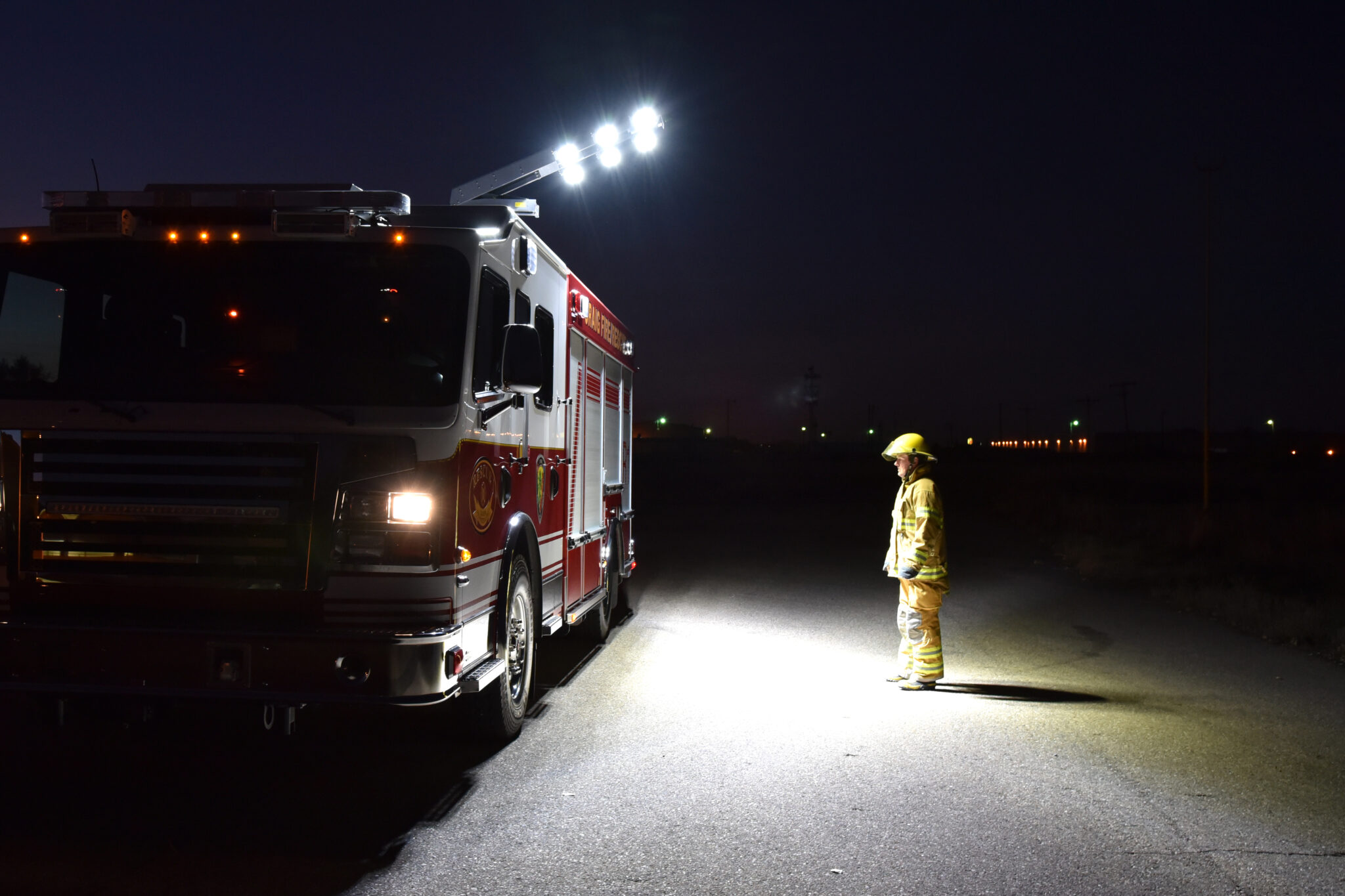
Over the last decade, departments decided to forgo light towers on their apparatus, believing that if they bought enough bright LEDs they’d get the job done, but if we go back to the basic lighting principles that Command Light stumbled upon in the 1970s, gathering, directing and elevating light with a tower is essential to turning bright light into usable light. 

Let’s start with the principle of gathering light. Think of stadium lighting at your favorite sports arena. Arena lights are clustered to gather and create uniform lighting. A light tower acts in the same manner, but with an extra advantage over arena lights and truck-mounted fixtures — tower lighting is not fixed. Instead, that beautiful, uniform swath of light can be directed virtually anywhere thanks to a tower’s ability to angle and rotate. Some towers feature optional backlighting, which allows dual scenes to be eliminated, creating even more usable light. 

And remember that glare we were just talking about earlier? Well, elevated lighting helps to position the fixtures well overhead, allowing human anatomy — and more specifically, the supraorbital bone above your eyebrows — to shield your eyes from glare. In addition, some light tower manufacturers, like Command Light, feature designs that allow the tower to overhang the side of a vehicle in a streetlight position to illuminate work areas and prevent shadows — all without the blinding glow of today’s super bright LEDs. And when we say “super bright LEDs,” we shouldn’t forget to add “expensive, super bright LEDs.” 

During the last decade, the cost of LEDs has continued to grow as lumens climbed, which resulted in departments cutting the tower to salvage budget. But now, the industry is seeing a different trend — the importance of usable light over bright light, which has led to the push for economical, yet effective LEDs placed on light towers. In 2020, the FireTech team at HiViz LED Lighting introduced the Helios LED fixture to the market. These lights shave the cost of a new light tower by 33% while delivering 14,000 lumens per fixture, bringing us back to the earlier lumen days but with a renewed focus on light placement, and more importantly … 

The perfect amount of light

So as your department considers its scene lighting needs, don’t forget to think about your environment. What is the usual topography that your crews face? Rocky terrain? Neck-breaking slopes? Plummeting Big Thompson River ravines? Lighting that can be angled certainly has its advantages in these environments.  

For the Township of Langley in British Columbia, Canada, the department faces a variety of challenges that require versatile lighting — so versatile in fact, Langley spec’ed two light towers on its 2019-built heavy rescue. “We’re located near the Trans-Canada Highway,” Deputy Fire Chief Monty Armstrong explains, “and we have several vehicles involved in accidents at one time, but we can’t have multiple trucks located in two to three places to provide lighting. That’s where these towers allow us to position the light where we need it, and when it gets cold up here, we can even hang our quartz-halogen towers over the truck to create a warming area for rehab.” 

The Township of Langely also responds to large rural areas and numerous hard-to-reach large animal rescues, which require elevated lighting.    

Even urban environments are filled with numerous hazards, so it’s important to have adequate scene lighting to help crews perform a proper 360 size-up to anticipate scene hazards, like downed lines, missing stairwells, flammable fluids, in-ground pools and more.  

Ample scene lighting can also help crews monitor changing conditions, like a building’s structural integrity or evolving smoke colour, density, volume and velocity, all which can help incident commanders predict fire behavior. Light can also also be used to illuminate doorways, windows and other openings, alerting personnel inside to alternative escape paths. 

In short, your scene poses a myriad of challenges, and in the end, it’s not always about how much light you shine on the obstacle. Sometimes, it’s just a matter of directing your LEDs there. That, alone, can be the perfect amount of light — enough to save and protect life. 

NVFC Chairman releases statement on 9/11 anniversary

The Chairman of the National Volunteer Fire Council (NVFC) has released a statement following the anniversary of 9/11. Of the 2,977 victims killed in the September 11 attacks, 412 were emergency workers. 343 firefighters were killed during the disaster.

A statement on the NVFC website read: “To many of us, September 11, 2001, is very vivid and real. We remember where we were and what we were doing on that day. We geared up for what we knew was an attack on the homeland, not knowing if more were coming from a bunch of terrorists that killed innocent civilians and hundreds of first responders. We repeat the phrase “never forget,” and we emblazon it on our equipment, on T-shirts and on our web sites.

“I was born in January of 1962. Pearl Harbor was just 20 years before that. I don’t remember my parents talking about Pearl Harbor even though my father was a veteran of World War II. I don’t recall it being mentioned in school as a recent event. I mention all this because we are now 20 years from the events of that terrible day in 2001. I often hear news reporters talk about things that are horrific. If only they knew. Many of the things they talk about, while bad, aren’t necessarily horrific. September 11 was horrific.

“It caused us, as a nation, to rethink the way we go about our daily business. It caused us to limit our freedoms in many ways. We were fearful. I suspect my parents and grandparents were fearful too of the events of December 7, 1941, but their fear did not overwhelm their faith in this nation and the ideals that it stood for. Firefighters were killed on December 7 – not as many as on September 11, but they gave the ultimate sacrifice. Many don’t even know that firefighters were killed at Pearl Harbor, and I am afraid that we are fast approaching a time when we may indeed forget the details of September 11 as a society.

“If you do nothing else this September 11, try and educate a young person about what it was like to live through that day. It isn’t because they want to forget, it is because no one is telling them of those events. Make sure to tell them about the first responders that rushed into danger while others were trying to get away from it. And make sure you tell them about the first responders that have died since that day due to the physical and psychological health issues involved with the response in New York City.

“On the day that I am writing this statement, news sources are reporting that first responders are not being allowed in to attend the memorial service at ground zero on September 11, 2021 – this being just another way of forgetting the events of that day.

“I, for one, and I believe millions of Americans are keeping September 11 in our collective consciousness. We will continue to remember the hundreds of first responders killed that day, and we will remember our citizens that died when the buildings in New York City and Washington, DC, came down and when the plane crashed into the ground in Pennsylvania. We will remember those men and women who serve their communities as first responders who have died since 9/11, and we will work diligently to make sure the survivors are taken care of.

“It was a terrible day. It’s been a terrible 20 years. It gets worse when we forget – and when we allow others to forget, or when the new generations aren’t told of the heroism of firefighters, EMS workers, and law enforcement personnel that fateful day. I think about them every time I see the American flag. I think about them when I see servicemen and women. I think about them every time I see a story about the FDNY.

“I can’t forget. I also can’t stop having faith in our nation, that those brave people didn’t die on that day so that our freedoms would collapse. In fact, just the opposite. That’s how we can really remember and honor the folks that died that day – by celebrating the freedoms that we have as Americans. That is why we were attacked – that is why we must never forget – and that is why we must cherish our freedoms even more.

“God Bless the United States of America, and may God stretch out his protective hand over our first responders from coast to coast as they do the job of protecting their neighbors and our homeland.”