HCIS was established by the Kingdom of Saudi Arabia (KSA) to set policies overseeing areas of security, safety, and fire protection for the industrial sectors. As of August 2021, NFPA trainings and certifications are now required by HCIS for fire protection contractors and consultants seeking license renewals. HCIS provides strategic supervision and is the approval body for all projects across the 12 industries that fall under its jurisdiction (petroleum, electricity, petrochemicals, water, industrial services, communications, mining, gas, civil explosives, chemical manufacturing, metal manufacturing, and port sectors).
NFPA offers online learning to help people prepare for their required certifications but online learning completions are not accepted as compliance for the following HCIS training requirements. The required HCIS in-person trainings include:
Certified Water-Based Systems Professional (CWBSP)
During the webinar a panel of global industry experts will provide in depth information and discuss the collaboration between NFPA and HCIS in fulfilling HCIS Licensing Requirements. Panel participants include:
Falah Sultan Abuthnain – HCIS 1st Lieutenant
Abdulsalam Fahad Alghamdi – HCIS 1st Lieutenant
Khaled Mohammed Alshamrani – HCIS 1st Lieutenant
Anas A. Alzaid – Middle East and Northern Africa Director for NFPA
Jonathan Hart – NFPA Technical Lead
Bartholomew Jae – NFPA Director of Education and Development
“NFPA and HCIS are adamant about raising the fire protection design and implementation quality in Saudi Arabia’s industrial sectors. This will be done through ensuring engineering offices and contractors’ staff are versatile in fire prevention codes and standards. By mandating NFPA codes and standards trainings and certifications, HCIS can proactively protect Saudi Arabia’s industrial infrastructure. Our objective during the informational webinar is to help those working in engineering and contracting to understand the process of training, certifications, and eventually licensing to meet HCIS expectations,” Alzaid said.
The following topics will be addressed during the webinar with time allotted for questions and answers:
Costly mistakes inspired HCIS requirements
Importance of consulting and contracting compliance
The National Volunteer Fire Council (NVFC) have announced the winners of its 2021 annual fire service achievement awards. Theodore Schroll Jr. will receive the Lifetime Achievement Award, sponsored by ADT; Robert James will receive the Chief James P. Seavey Sr. Health and Wellness Leadership Award, co-sponsored by VFIS and Ward Diesel Filter Systems; Paige Davis will receive the Junior Firefighter of the Year Award, sponsored by California Casualty; and the Colonia Volunteer Fire Department Explorer Program will receive the Junior Firefighter Program of the Year Award, sponsored by California Casualty.
“The past year has tested our nation in many ways, but one thing we can always rely on is the dedication, resilience, and exceptional service provided by our nation’s volunteer firefighters and EMS providers,” said NVFC chair Steve Hirsh. “It is with great pleasure that we recognize the incredible work of our 2021 award winners and highlight the amazing achievements of those who give so much to help their communities.”
A celebration luncheon to honor the recipients of the Lifetime Achievement, Chief James P. Seavey Sr. Health and Wellness Leadership, and Junior Firefighter of the Year awards will take place during the NVFC’s fall meeting on October 15 in Jackson, WY. The recipient of the Junior Firefighter Program of the Year will be presented with their award at their department this fall so that all their junior firefighters may attend.
The recipients of the NVFC’s 2021 fire service achievement awards are as follows:
The NVFC Lifetime Achievement Award, Sponsored by ADT is awarded to Ret. Asst. Chief Theodore “Ted” Schroll Jr.
The NVFC Chief James P. Seavey Sr. Health and Wellness Leadership Award, Co-sponsored by VFIS and Ward Diesel Filter Systems is awarded to Captain Robert “RJ” James.
The NVFC Junior Firefighter of the Year, Sponsored by California Casualty is awarded to Paige Davis.
The NVFC Junior Firefighter Program of the Year, Sponsored by California Casualty is awarded to Colonia Fire Department Explorer Program.
Frontline Communications, a division of Pierce Manufacturing, Inc., and a subsidiary of Oshkosh Corporation (NYSE:OSK), announced today that it has secured a purchase order for two highly customized vehicles from Pasco County Fire Rescue in Florida including a C-45 Velocity® mobile decontamination (decon) unit, and a C-45X-2 Velocity mobile rehabilitation (rehab) unit. These specialized vehicles will provide critical support at structural fires and long-duration deployments to aid with the removal of harmful carcinogens from gear and equipment. Additionally, they will provide respite to avoid overexertion from heat and weather with access to fluids, energy snacks, medical evaluations, and more.
Industry standard is to issue every firefighter two sets of turnout gear, so after one is soiled, it can be bagged and stored on the truck, with another set available in the event the crew needs to go immediately to another scene. According to Chief of Pasco County Fire Rescue, Scott Cassin, the cost and storage of two sets of gear was prohibitive and a challenge they aimed to solve.
“We turned our sights to selecting purpose-built vehicles that would handle the on-site decontamination of gear and rehabilitation needs our dedicated team of firefighters require during complex structural fires or long-duration deployments,” said Chief Cassin. “We worked with Frontline Communications to design a custom decon unit that is an industry first configuration and will help us save time and energy cleaning equipment. We also collaborated with Frontline Communications on the design of a custom rehab unit that will provide necessary aid. Our biggest return on investment is knowing we are protecting our firefighters from as many risks as possible.”
According to the Centers for Disease Control and Prevention and the National Institute for Occupational Health and Safety, firefighters have a nine percent higher risk of being diagnosed with cancer and a 14-percent higher risk of dying from cancer than the general U.S. population. Additionally, the physical and emotional demands of the job put firefighters at an increased risk for cardiovascular events, which are responsible for 45-percent of on-duty deaths. Mobile decon and rehab units help manage carcinogen exposure and offer a reprieve by providing vital on-site decontamination and recovery resources for firefighters at a fire scene.
Pasco County Fire Rescue’s new vehicles feature:
C-45 Velocity Mobile Decontamination Unit
Pierce® Velocity® chassis
Cummins 450 hp engine
Command Zone™ electrical system
Two Meiko decontamination wash units designed for structure fire decontamination. The units are supported by dual 100-gallon water tanks and storage bins
Onboard generator (Lima-Mac 40kW PTO-driven generator for Meiko decon equipment)
Four custom swing-out tool boards
Dual-side hose bibs with an on-board water pump and 100-feet of heavy-duty hose on an electric reel
C-45X-2 Velocity Mobile Rehabilitation Unit
Pierce Velocity chassis
Cummins 450 hp engine
Command Zone™ electrical system
Bauer SCBA 6,000 PSI compressor and fill station with three additional air cylinders to supply breathing air for air tanks
Two lavatories on the front side of the body accessible from either side
Onboard generator (20kW diesel generator for rehabilitation elements, communication gear, and other accessories)
Rehabilitation area with oversized slide-outs to maximize interior space. Features include bench seating with recline capabilities and storage, equipment rack for communications gear, large 20 cu ft refrigerator, and a handwashing sink
Rest area/kitchen with two 20 cu ft refrigerators, one freezer, two coffee makers, sink, and a large pass-through window to service/supply crew members outside the vehicle
Exterior monitor compartment with area for exterior viewing under a full-size electric awning
Equipped with two DirecTV HD receivers to view local programming
On-board wi-fi, perimeter security cameras with network video recorder, and an Extron video router that sends video to monitors located throughout the vehicle
Pasco County is located on the west-central coast of Florida, with its fire rescue department operating out of 29 stations with over 600 personnel serving a population of nearly 500,000. The department provides fire protection covering all unincorporated Pasco County, including the cities of Dade City, San Antonio, and Saint Leo.
“We’re honored to have the opportunity to expand our longstanding relationship with Pasco County Fire Rescue to include apparatus that supports the crucial work of their dedicated team,” said Dustin Bouwer, Pierce apparatus representative with Ten-8 Fire Equipment. “The design of these vehicles will integrate Frontline Communications’ extensive experience in the development of specialty vehicles. We know these custom vehicles will be an essential and efficient health and safety resource for many years to come.”
To learn more about Frontline Communications and the latest mobile decontamination and rehabilitation vehicle developments, visit www.frontlinecomm.com.
MSA’s passion for safety and commitment to supporting the communities in which we live and work has remained unchanged for more than a century. It means not only supplying workers of these communities with safety solutions to help keep them safe, but also building local partnerships for the social betterment of that community.
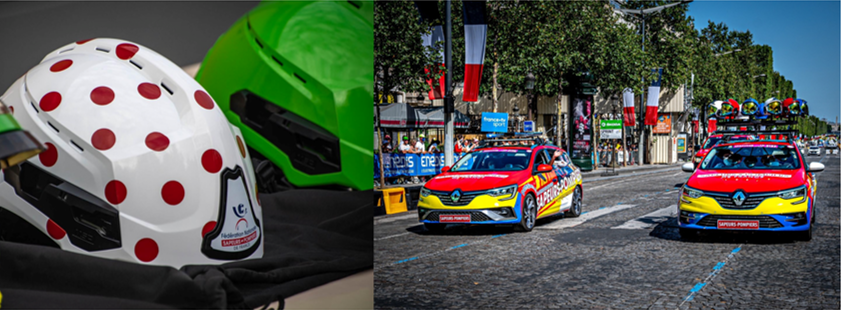
During this year’s Tour de France, MSA joined forces with the French Federation of Firefighters, for the third consecutive year, to raise awareness about the important work done by firefighters and the need for volunteerism in the fire service, as well as share the importance of first aid.
The design of the signature “Tour” helmet incorporates the famous yellow found on cyclists’ jerseys
The Tour de France is one of the most prestigious cycling races in the world, attracting millions of spectators annually. The Tour has a long history, and so do the MSA helmets that are issued in a limited edition capacity honouring the occasion. The design of the signature “Tour” helmet incorporates the famous yellow found on cyclists’ jerseys.
The iconic GALLET F1XF and newly launched GALLET F2XR accompanied 21 firefighters, 5 vehicles and a special “Vaccibus” of the French Federation along a special caravan, which follows Tour de France cyclists in case of an emergency through almost 3,500 kilometres, where cyclists from around the world complete 21 stages, passing through six regions in France. In addition, the firefighters also carried out risk prevention missions and vaccinations in the technical area at the start and finish of the various stages.
Fire Department of New York Fire Commissioner Daniel A. Nigro has announced that Fire Marshals have arrested Caleb Ganzer, 35, for allegedly setting fire to outdoor dining structures and rubbish in Manhattan in January, June, and July of this year.
“Every act of arson has the potential to spread rapidly, endangering the lives of New Yorkers and FDNY members,” said Fire Commissioner Daniel A. Nigro. “Thankfully in these incidents there were no injuries and the suspect has been apprehended before another fire could be set.”
Locations and date of fires allegedly set by Caleb Ganzer:
July 13, 2021 at 2:55 a.m. – outdoor dining structure owned by Prince Street Pizza (27 Prince St)
June 26, 2021 at 4:35 a.m. – rubbish on fire at the corner of Broome St and Centre St
January 8, 2021 at 11:52 p.m. – outdoor dining structure owned by Forsythia Restaurant (9 Stanton St)
After a thorough investigation and apprehension of Mr. Ganzer for the July 13th fire, FDNY Fire Marshals established a connection to earlier occurrences in lower Manhattan that fit the same pattern. Fire Marshals then arrested him for the fires on June 26th and January 8th. Ganzer is charged with two counts of Arson in the third degree; two counts of Criminal Mischief in the third degree; and three counts of Reckless Endangerment in the second degree. The case will be prosecuted by the Manhattan District Attorney’s Office.
REV Group have announced today its multi-year agreement with Consus Global, the global procurement solutions integrator and services provider, to further drive supply base optimisation, automation, productivity, and working capital value from the REV Supply Chain.
REV Group embarked on its sourcing and procurement transformation earlier this year, which included four appointments to REV’s global sourcing and supply chain team, representing the Fire & Emergency, Commercial and Recreation segments. As part of the partnership with Consus, REV has implemented Ivalua, a leading provider of global Spend Management Cloud solutions, to achieve a more focused and faster source-to-contract cycle.
“Partnering with Consus Global and our successful deployment of Ivalua will accelerate our progress in supply chain optimisation at REV Group by applying a powerful toolset of data, supplier management, and competitive bidding capabilities to our team,” says Rob Vislosky, Chief Supply Officer of REV Group. “We are excited about the sizable improvements in productivity, customer delivery, and efficiency that will occur as a result of this strategy.”
Benefits include:
Shortened sourcing cycle times
100% visibility of sourcing processes
Adoption of best-in-class strategic sourcing practices
Competitive bidding to drive cost savings
Enforcement of procurement compliances
“Recent supply chain disruptions have highlighted the need for high-performing organisations such as REV Group to implement a world-class strategic sourcing program,” said Shantanu Bhowmick, Chairman & CEO of Consus Global. “With this engagement, we are bringing together our two organisations with the explicit goal of achieving automation and spend visibility which will lead to multi-year cost savings for REV Group and its shareholders.”
“REV Group is renowned for connecting and protecting communities across the country. We’re excited to support REV Group on their digital transformation journey and accelerate their end-to-end sourcing for all spend types. Enhancing collaboration by providing increased visibility and insight is critical to achieving a more focused and faster source-to-contract cycle,” said Dan Amzallag, Chief Operating Officer at Ivalua.
The National Fire Protection Association (NFPA) has announced the official launch of CRAIG 1300™, an innovative community risk assessment (CRA) dashboard powered by mySidewalk, a leading technology company. CRAIG 1300 helps fire departments and safety officials collect community data, enabling them to identify, assess and share local demographic, geographic and economic needs.
“NFPA is excited to partner with mySidewalk to deliver CRAIG 1300 – a critical community tool for 21st century prevention – that reflects a natural next step in meeting the needs of community leaders, planners, developers, firefighters, and others in today’s digitally centered world,” said Jim Pauley, NFPA president and CEO.
Community Risk Reduction, or CRR, has continued to gain recognition in recent years as an effective approach to mitigating community risks; conducting a CRA that utilizes community data is a critical first step in the CRR process. CRAIG 1300 was developed to give fire departments, prevention advocates, and safety officials the tools and data resources to successfully execute these efforts.
“Time and again, we’ve heard from fire departments and community leaders that aggregating and analysing data is a challenge,” said Karen Berard-Reed, community risk reduction strategist at NFPA. “By developing CRAIG 1300, our ultimate goal is to break down those hurdles and help communities leverage the information they need to mitigate public safety risks and hazards.”
Learn about the people, places, and conditions that are at-risk in the community.
Activate teams in the development and management of CRR initiatives informed by NFPA 1300 with regularly updated data sources.
Engage stakeholders, grantors, and partners in cross-community initiatives with easy-to-use visualisation tools.
Communicate the effectiveness of initiatives with stakeholders, grantors, and partners.
“We couldn’t be more excited to be partnering with the NFPA to provide the powerful new CRAIG 1300 tool,” said Stephen Hardy, mySidewalk CEO. “By combining expertise from NFPA, our one-of-a-kind community data, and local fire service teams’ knowledge of the communities they serve, CRAIG 1300 will completely change the way the fire service assesses risk, makes equitable and holistic decisions, and builds informed stakeholders.”
Over the past two years, NFPA has worked in collaboration with mySidewalk and more than 300 communities who pilot-tested the digital platform, providing insights that helped maximise its usability and value.
CRAIG 1300 is available as a product suite with three dashboard options: CRAIG 1300 PRO, CRAIG 1300 PLUS, and CRAIG 1300 FLEX. To learn more about CRAIG 1300 and its offerings, visit www.nfpa.org/CRAIG1300.
Follow NFPA’s CRR efforts on social media using #itstartswithinsights, or for more information online, visit www.nfpa.org/crr.
Streamlight Inc, a leading provider of high-performance lighting devices, explains how to effectively deployscene lighting in emergency scenarios when failure is not an option
Most of us can walk around our own homes in the dark with relative ease, but when you’re navigating somewhere you have never been before it’s a whole different story – especially if you’re against the clock and lives are at risk. For those tasked with protecting and saving individuals from accidents and disasters, from road traffic incidents to floods and fires, getting lighting to the right places quickly is vital. What you can’t see can hurt you and others. Shedding light on the task at hand can put professional and emergency services at a big advantage.
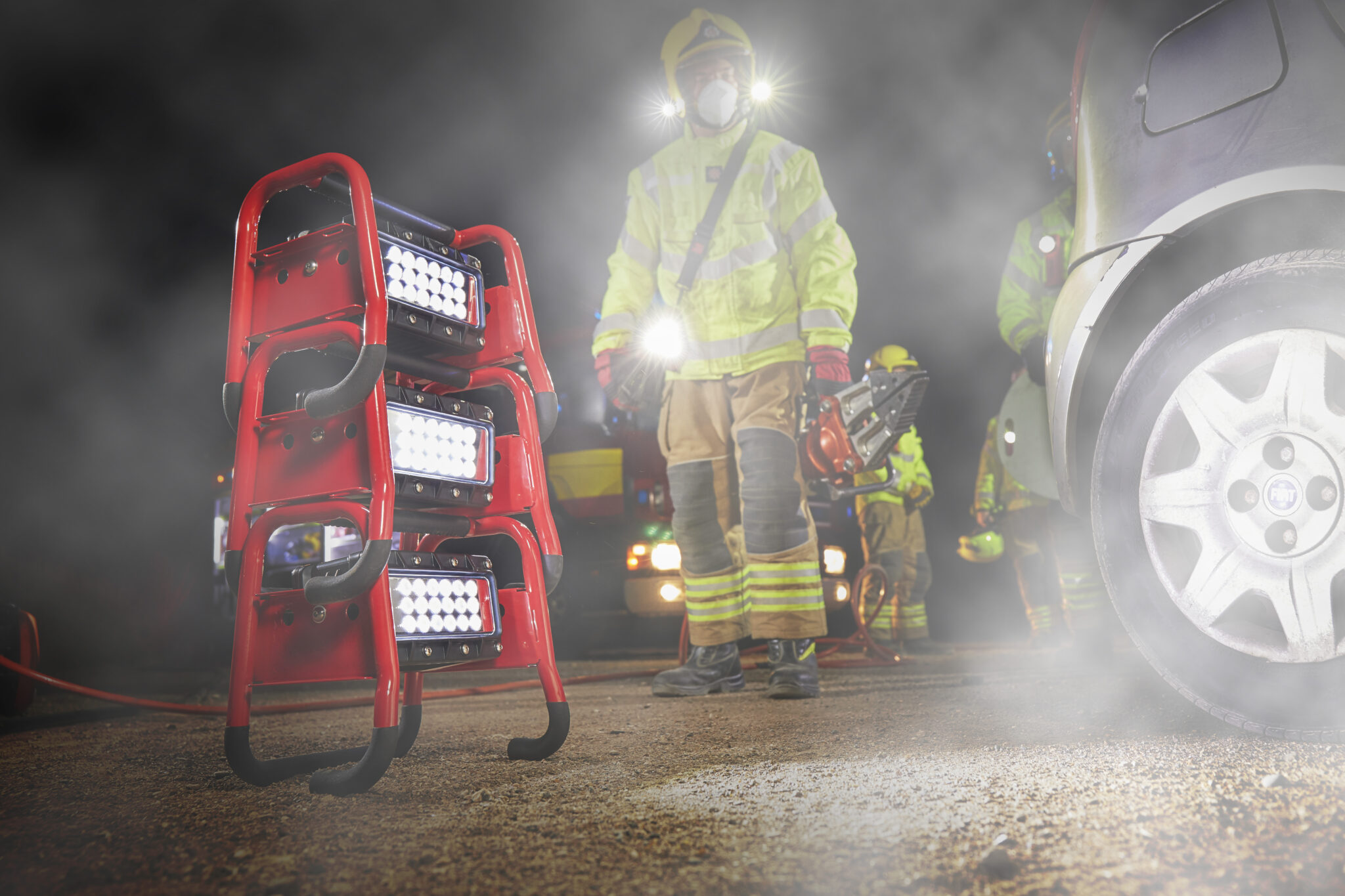
During night-time operations, professional lighting allows firefighters and other emergency services to work around the scene fast, alleviating the potential for secondary incidents from otherwise hidden obstacles and trip hazards like fire hoses. In fact, the benefits of scene lighting are endless, including highlighting potential structural failures, smoke conditions, and alerting the general public to keep their distance in a dangerous situation.
Whether you’re in the fire service, law enforcement or other first response services, potential hazards need to be recognised at a scene as quickly as possible. A common misconception about lighting is that deploying as many lights as possible at a scene will make things clearer, but in practice, this approach can cause confusion. Different lighting types have different roles to play and too many of them can be highly disorientating.
If you take into account the functionality of LED beams, for instance, some will have focused beam patterns for highlighting specific areas. Others will have more diffused beam patterns, better suited to illuminating wide areas. Some scene lights are adjustable and capable of both, but it’s important to understand how they function and the basic principles of lighting before rushing to a scene.
www.matthowell.co.uk 07740 583906
Imagine you’re at the scene of a car accident whereby police have deployed floodlights on one side of the incident, while ambulance services have deployed focused spotlights on the opposite side. The combination of different beams aimed in various directions, mixed with the flashing vehicle lights can be distracting and confusing. While spot beams offer intense light in a particular area, they can also produce shadows, sometimes causing more harm than good. Utilising area lights with an extendable pole, like the Streamlight Portable Scene Light, in this type of scenario would allow responders to properly direct the light to illuminate the scene with less shadows and distractions. Decisions could be made more quickly, and potential hazards may be averted, ultimately helping to save lives.
The combination of different beams aimed in various directions, mixed with the flashing vehicle lights can be distracting and confusing
In smaller spaces, including building interiors, scene lighting can be more effective than multiple handheld flashlights. For example, a tool like the Streamlight Portable Scene Light II is lightweight, cordless and compact, making it easy to transport and store. Additionally, this light can be stacked tightly up to three lights high to form a light tower. These can be used by firefighters to throw a large amount of elevated light onto the target area of interest. The rapid deployment of multiple devices like the Streamlight Portable Scene Light and Scene Light II can help further illuminate the zone for critical site exploitation and analysis.
Scene lights can vary considerably and should be deployed in different ways depending on the scenario, so personnel should work out what’s relevant to the task in hand. When choosing the right scene light, consider these factors:
• Deployment time
• Stability
• Size and weight
• Beam type
• Water resistance
• Recharge time
• Brightness vs run time
• Reliability
• Illumination height
• Versatility
• External power source facility
For professional users of scene lighting, the above factors can be critical in certain circumstances and can influence the success or failure of an operation. Indeed, one important factor for the firefighting community is the waterproof rating of lighting and other devices. Defined by their innovation in delivering effective, efficient and high-performance lighting tools, Streamlight’s research and development team puts in the necessary time and effort to make sure their products help save lives and protect firefighters on the job. As such, the Portable Scene Light and Portable Scene Light II are IP67 and IPX7 certified respectively.
The importance of IP ratings
What do the ratings actually mean? IP stands for International or Ingress Protection and classifies and rates the degree of protection provided by mechanical casings and electrical enclosures against intrusion (e.g. someone purposefully sticking a paper clip into their device for whatever reason), dust, accidental contact, and of course water. As the name suggests the system is used internationally and, in this case, for flashlights or lanterns.
IP rating denotes three key metrics:
• Resistance to ingress, accidental or otherwise, by the user
• Resistance to ingress from foreign bodies (dust, dirt etc.)
• Resistance to moisture ingress
In general, an IP rating will consist of two digits, occasionally followed by a letter denoting specific materials, hazards or testing scenarios. The most common way you’ll see such a rating given will be in the format ‘IP43’, ‘IP67’, or similar.
The X factor
If the rating uses an ‘X’ instead of a digit, this signifies that the manufacturer considers that rating is not important to the user, for example where a radio is designed to be used in a wet setting, the rating for solid particle ingress is largely irrelevant, so that number may be replaced with an X, e.g. IPX7.
The first digit
This will be a number between 0-6, and indicates the degree of protection from ingress of solid objects (the user themselves, and other potentially harmful particulates such as dust or dirt).
The second digit
This is a number between 0-9, denoting the quality of resistance to moisture ingress at varying intensities, angles, depths and pressures of exposure or immersion, the higher the number the better protection.
Thus, when purchasing lighting tools for use in life and death scenarios, IP ratings are very important. The Portable Scene Light (IP67) is certified for full protecting against dust and other particulates, including a vacuum seal, tested against continuous airflow and is fully waterproof for up to 30 minutes at depths of up to one metre. The Portable Scene Light II (IPX7) is not considered necessary to be tested for particle ingress to effect performance but will withstand being submerged in water for up to 30 minutes at depths of up to one metre. As such, both devices will more than cater for the rigours of firefighters and other emergency services.
Portable Scene Light
A bright 5,300 lumen, portable and collapsible flood light that is available in either a 72” or 84” extension pole which can be rapidly deployed and easily stowed. The device features a 90° swivel neck to shine light into the most out-of-the-way places and a narrow footprint that lets you bring the light almost anywhere. It offers a run time of 4 hours when set to high intensity and 18 hours when operating on low. It can also withstand 40mph wind speeds when fully extended and is fitted with stabilisation legs for deployment on uneven surfaces. This can be powered by a zero maintenance, sealed lead acid rechargeable battery or AC/DC power source.
Portable Scene Light II
18 LEDs produce 10,000 lumens to light up an entire scene. With a zero-deployment time, compact footprint, 360° rotating head and hooked feet for hanging on door frames, fences, ARMCO barriers etc. the PSL II is a highly versatile lighting tool for emergency service operatives. It also benefits from a high impact thermo plastic housing and virtually indestructible alloy steel frame making it very durable. It is powered by lithium-ion rechargeable battery with five intensity settings with a run time of 2 hours on high.
Lighting has evolved at an exponential rate over recent years and with such evolution comes the need for better understanding. Strategy plays a huge part in firefighting operations, and dependable lighting should be a big consideration that is never overlooked. Tested, certified products, like Streamlight flashlights and lanterns, will provide you with the confidence and trust needed to save lives.
Rosenbauer America and FESCO Emergency Sales announced today they will expand their partnership to Maryland and Delaware territories. This announcement comes on the heels of a previous expansion in Virginia and Washington, DC.
“Rosenbauer is eager to further expand with FESCO Emergency Sales in Maryland and Delaware,” said Mark Fusco, Vice President of Sales & Marketing for Rosenbauer America. “FESCO is well known for strong family values with best-in-class sales, customer service and support, and parts availability throughout the greater Mid-Atlantic region. FESCO’s two service facilities in Elkridge, MD and Ashland, VA, along with their mobile capabilities and talented organization provide necessary resources to properly support fire departments throughout the area.”
FESCO is a third-generation, family-owned and operated fire apparatus and EMS industry dealership. FESCO was founded in 1953 by Walter “Ed” Laake.
“We are excited to increase our partnership with Rosenbauer in the Mid-Atlantic,” added Pete Laake Jr., President of FESCO Emergency Sales. “We have established a team that is ready and eager to support this great opportunity. We represent the highest quality products and focus every day on providing exemplary customer service.”
FESCO is a leader in the market and are well known for their responsiveness, reliability, quality, ingenuity, excellence, and integrity. Their energized and talented associates are committed to quality standards through a team approach that, in combination with our competitive pricing, provides outstanding opportunities.
Greg Young, Vice President of Pac Tool Mounts reveals the role customer interaction plays in delivering solutions
Pac Tool Mounts has built a strong reputation within the North American market. Having started out 30 years ago, they work with law enforcement, military and fire departments and have historically driven tool mount innovation. However, Greg Young, Vice President of the company explains how their relationship with those within the industry has shaped how they deliver solutions to the fire industry: “At Pac Tool Mounts, we are well connected with fire personnel here in the U.S and I would like to thank them for the services they provide because this has been a difficult period given the circumstances we have been going through.
“With regards to what we do with the fire services, we base our understanding of the fire industry on 70 years of building custom fire apparatus through the previous owners of this company which was then known as Young Fire Equipment. This was an extremely innovative truck manufacturer which operated mainly in North and South America. Manufacturing of that stopped in 1991 but in working with all those buyers and fire departments we really managed to grasp what the needs and challenges are as well as what the industry standards are.
“Because of that we develop and test products for the requirements of the fire industry. Our products always align with what we know to be the expectations of the industry. Most importantly, we actively support the fire industry and offer a lifetime warranty.”
A reliable solution
Since its inception, the companyhas grown its product base. The target customer was originally other truck manufacturers, however, Young believes other industries quickly saw the benefits of their products: “The secondary loose equipment dealer market quickly saw the value of pairing tool mounts with the tools that they were selling because if you are buying something brand new on a truck that wasn’t there before, you would need to mount that, so our product fitted nicely.
“What we are seeing now is manufacturers of thermal imagers, nozzles, struts and other search and rescue equipment coming to us to supply our brackets as an OEM part to go with their equipment. They rely on us, and not only are we able to handle it, but we are also honoured to help them.”
A dedication to innovation
The company workswith its customer base to continue its drive for innovation. As equipment changes, so too must the mounts that are used. Young explains the importance of the relationship the team at PAC Tool Mounts have with tool manufacturers: “Most of our innovations are internal. Our team of engineers and customer service closely monitor the needs of the industry. We are very close with other tool manufacturers, so we understand the new hand tools and power rescue tools, whether it is hydraulic or electric. As a company we follow the trends and latest innovations closely and we develop our products accordingly. For example, the recent switch to electric rescue tools that prompted us to review and update our line of products accordingly.”
Using the right materials is key
When it comes to how they manufacture brackets, it would be easy to focus on a more cost-effective material that would focus on profit. Young reveals how the material they use prioritises quality and not cost and ensures that the product is fit for purpose: “We use mainly a proprietary blend of composites developed for industrial and military applications. Some of our brackets have a lockable strap that can hold tools in a friction type of a bracket, and some of them are positive locking where there are stretchable lock straps snaps closed and keeps that product locked into the bracket. Those straps are from a urethane blend.
“We always get the question about rubber, but we don’t use any rubber in our products. The materials we use are selected for their proper environment that they are going to be used, not for cost. Shock resistance, UV, oil resistance and conductivity are all considered when developing PAC products.”
How tool boards work with mounts
For users, ease of use, maintenance and installation can be key when decidingtheirperfect solution. On this, Young explains the importance of choosing the right combination of equipment: “We do advocate PAC tool boards as the perfect foundation for tool mounts. The reason for this is they are made of aluminium, they allow fast installation with only front panel access required, which means once our tool board is installed our brackets can be installed right to the face of the product and removed or adjusted in space from the front quickly and easily. Other systems require drilling, tapping, or removal of panels when you are placing the brackets. However, mounting a bracket to any type of strut or rail is more favourable than drilling through a compartment wall.”
Challenges for penetration in international markets
The company has worked within the North American market since its founding; however, Young explains the reasons why they believe they have built such a solid reputation and foundation in the region: “We are well established in North America with representation by both the manufacturers and the secondary dealer markets. In the thirty years we have been a company, we have managed to gain a very strong reputation in the fire industry, and we have become well known. Part of that is down to the fact that the fire industry has changed.
An increase in electrical vehicles, increased awareness of hygiene has driven change in department policies. We have worked with the departments to help them adapt and organise their trucks to suit their needs. We are here to help affix, secure and organise all equipment. For contamination and hygiene, we want to be part of the solution.
One thing to note is that fire departments outside of the U.S tend to vary in the way in which they organise equipment. Young explains the key differences between the American and international market: “American apparatus are large vehicles, are very tall and have very large compartments. From what we’ve seen from the international market they are more compact and are a smaller chassis type vehicle, however, the organisation from inside these vehicles are top notch. Precious volume is well utilised. From our perspective it looks like storage has been thought about and developed as part of the vehicle, not developed afterwards to fit. In the U.S the tool storage is often developed after the fire truck.”
Looking to the future
With the industry beginning to open up to trade shows, and along with some new product releases, it promises to be a busy year for the company, however, this is something the team at Pac Tool Mounts are embracing: “We are growing in many markets such as law enforcement, military, landscaping and utility, and we’re developing specific products for those markets. Later this year we will be releasing new products in the fields of utility and agriculture.
“For us, the tools keep changing and evolving, and as they do, we continue to innovate to help the customer. As a company we are very excited to be in this industry. There is always new things to develop and there is always a need for us to innovate.
This year we will be displaying at FDIC and Interschutz USA, and in the future we are planning to go to Interschutz Germany. The future for us means we will continue to collaborate and deliver innovative solutions for all the markets that we serve. PAC is looking to develop its network of international dealers and distributors.”
This article was originally published in issue 6 of International Fire and Safety Journal.