MSA Safety to introduce new firefighter protective clothing at Intersec

Global leader in firefighter safety equipment and technology, MSA Safety Incorporated, is set to introduce a new line of firefighter protective clothing for the Middle East fire market at Intersec 2023.  

The MSA® Bristol X4 uses the very latest fabric and fibre technology alongside modern streamlined styling to provide enhanced comfort, ergonomics and protection.

The Bristol X4 design, originally launched at Interschutz for firefighters on the continent, has been adapted to suit the various needs and preferences of fire services in the Middle East. It features premium materials such as Hainsworth Titan outer fabric with a Gore Parallon moisture barrier for ultimate comfort and breathability, along with reflective taping in specific figurations favoured by Civil Service firefighters.

The new line meets European CEN standard EN469:2020 Level 2 for firefighter protective clothing, as well as EN1149:2018 for anti-static properties.  It is available in a wide range of colour combinations to suit regional preferences and can be customized with a selection of optional pockets and loops to accommodate specific equipment. 

The Bristol X4 also offers full compatibility with MSA’s suite of state-of-the art firefighter equipment, from helmets and self-contained breathing apparatus (SCBA), to the very latest in monitoring accountability and communication devices.

Dave Howells, Vice President Business Leader EMEA, said: “We’re excited to be showcasing the latest version of the MSA Bristol X4 line, which has been strategically adapted to suit fire services in the Middle East.  Visitors to Intersec will be able to see first-hand how the design integrates with other MSA products to provide superior comfort and protection.” 

Connected Firefighter Platform

MSA Safety will also be showcasing its Connected Firefighter Platform – a suite of advanced safety technologies, which includes the LUNAR® Connected Device and FireGrid® software services, that work in collaboration to improve firefighter monitoring, accountability and communication. 

LUNAR is a multifunctional handheld device, combining personal thermal imaging capabilities with Firefighting Assisting Search Technology (F.A.S.T.), for alerting and guiding firefighters to teammates in difficulty. 

In addition, cloud connectivity provides incident command with an overview of on-scene operations by aggregating data from other MSA devices, such as the M1 breathing apparatus, transmitting key SCBA information such as cylinder air pressure, battery status and various alarm indicators. In turn, FireGrid gives incident commanders the ability to evaluate and manage multiple situations in real time and from any location.

Visitors to Intersec invited to experience this innovative technology for themselves with demonstrations on the MSA stand at Intersec (stand number 2-F12).

Alongside these latest innovations, a host of MSA PPE and equipment for the fire industry will be on display, suitable for a wide range of first responder roles and applications, including:

  • Structural firefighting:
    • High quality, ergonomic protective clothing lines including XFlex and the new Bristol X4.
    • Industry-leading fire helmets such as the iconic Gallet F1XF.
    • The modular and versatile M1 SCBA which can be upgraded to accommodate advancing technologies.
  • Technical Rescue
    • RescueFlex protective clothing, designed for Urban Search and Rescue operations, confined space operations and road traffic accidents.
    • The recently launched, modular rescue helmet, Gallet F2XR which is particularly versatile with accessories to suit a variety of operations.
  • Wildland Firefighting
    • MSA’s Wildland Firefighting protective clothingrange is constructed from a single layer of flame retardant fabric, meaning that it’s lightweight, cool and effective when fighting wildfires.

MSA’s Middle East Sales Manager, Yassin Afroukh, commented: “With such an extensive portfolio of safety solutions, MSA is uniquely placed to provide the Middle East’s industrial and Civil Defence fire services with a full suite of protection for their firefighters, from helmets, clothing, and advanced SCBA, to gas detection and innovative safety monitoring.  We have identified significant opportunities to further serve these markets and are demonstrating our commitment to the region by expanding our sales team to help meet demand.”

To stay up to date with the latest news from MSA at Intersec, visit the company’s stand at 2-F12.

IFSJ Exclusive: Strategies for winning fire safety tenders

Jason Cooney, Director of Tsaks Consulting, a global bid and tender writing consultancy based in London, talks fire safety tender strategy.

For fire safety professionals looking to secure private or public-sector contracts, the process of writing a winning bid submission can be both time consuming and costly. We outline below some useful strategies and tips to help your company win more fire safety tenders.

Understanding the client’s needs and requirements

When you’re looking to secure a fire safety tender, or any tender for that matter, it is important to understand the clients needs and meet all requirements set out in the tender documentation. What specific need do they have or problem do they need solved?

For example, do they need adequate fire safety training for staff, for better protection of site guests. Or do they require something more technical, like the provision and installation of fire sprinkler systems, fire extinguishers and ancillary products.

If their concern is with location or accessibility, study schematics or diagrams to plan and suggest how you will meet and exceed all requirements and concerns. You may also spot some new or potential concerns which you can bring to light.

It is also important to read between the lines when it comes to the requirements of a fire safety tender. For example, does the fire maintenance service need to integrate with the whole of building facilities management service? Another point to consider with a fire maintenance tender is whether or not it is complex enough to warrant appointing a specialist fire maintenance company or is it designed for an electrician to be able to deliver?

Accreditation and equipment

It is assumed that all fire safety providers applying for fire safety tenders are accredited and certified by relevant fire industry bodies. That being said, it is important to list, in detail, all relevant certifications (e.g., LPS 1197, ISO 9001, LPS 1048, and BAFE).

Ensure all accreditations are up to date and documented correctly. Even if the tender documentation doesn’t recommend adding them to your response, it is recommended that you have them ready and organised should they be asked for by the client during the tender process.

List all the latest technology and equipment you use, detailing how you store and maintain it. Where there is a strategic advantage in adopting the technology you use, ensure this is clearly communicated in the tender response.

For example, you may use a fire panel with a 45 second alarm verification facility to address the issue of false alarms. This can be an advantage to clients who have a large amount of false alarms and call outs. It is important to illustrate how you will adopt this innovation and if so, how you will do it in a manner that doesn’t compromise safety.

Training and qualifications of staff

Provide details of what qualifications and experience your staff have. Include evidence of licenses and certificates, ensuring they are all up to date. Detail the commitment you have to the ongoing training and professionalism of you staff, including regular upskilling and courses you have scheduled throughout the year.

When you list your staff qualifications, it is also important to illustrate your team’s experience and present them as fire safety specialists. There is a difference between a tradesperson who specialises in fire safety and a generalist tradesperson.

It is one thing to have your sprinkler fitters licence, and another to have your licence as well as ten years experience fitting sprinklers. Make sure when you present your team, you present a team of highly experience fire industry professionals with the correct licences and know-how to deliver the project.

Commitment to health, safety, and environment

Robust WHS processes are critical and the right supporting documentation is just as important. When putting forward WHS risk assessments, it is important to tailor your proposed assessment and system for the proposed project. List the risks you have identified based on what you know about the project so far – thereby demonstrating that you and your team have thought through the project.

Clients want to ensure that workers on both sides will be safe, with the safe execution of services throughout the lifespan of the project. Also you have the opportunity to leave behind a set of safety procedures and a culture for continued safe work practices once you have finished the project — enhancing your company’s reputation and chances of securing future tenders.

Articulating your claims in a well-written bid document

Once you have considered all requirements of the documentation and are satisfied you not only meet them, but can fulfil them, it’s time to develop a quality bid submission.

You’re applying for a service which, if not done to the highest standards, can have enormous health, environmental, and legal repercussions. Evaluators want to be sure they have the most qualified and suitable fire safety service provider.

Not only is it important to demonstrate your professionalism through your experience, equipment, staff, and qualifications. It is also important to strengthen your submission with high quality bid writing strategies and techniques which will put you ahead at every stage of the bidding process. Particularly when competing against companies with similar services and prices.

The writing you use is important, and it should be concise and positive. Furthermore, it should be customised to the project you are tendering for and backed up by relevant information and evidence.

Congress passes bipartisan Bill to protect firefighters from PFAS chemicals

A bipartisan bill to provide guidance for federal, state, and local fire departments to prevent firefighters from being exposed to harmful PFAS chemicals that are frequently used in firefighting equipment has been passed by the US House of Representatives.

The bill passed the Senate last summer, where it was authored by Sen. Gary Peters (D-MI), and co-sponsored by Sens. Dan Sullivan (R-AK), Maggie Hassan (D-NH) and Thom Tillis (R-NC). The Protecting Firefighters from Adverse Substances (PFAS) Act, sponsored by Rep. Debbie Dingell (D-MI), now awaits President Joe Biden’s signature.

Once this legislation is signed into law, the Department of Homeland Security (DHS) and the United States Fire Administration (USFA) will have one year to publish training guidance.

The curriculum is required to include ways to reduce or eliminate exposure to PFAS from firefighting foam and PPE, strategies for preventing the release of PFAS from firefighting foam into the environment, and provide emergency personnel with information on alternatives to PFAS equipment and foams.

The International Association of Fire Fighters (IAFF) expressed its support for all efforts to reduce exposures to PFAS and other carcinogens. IAFF General President Edward Kelly said: “PFAS is all around us. It is in our bunker gear, our PPE, and training foam. Until PFAS can be removed and replaced with safer alternatives, we must incorporate all preventative measures. I am grateful that our elected officials are taking action and look forward to continuing to work with them to extinguish cancer from the fire service.”

The Environmental Working Group (EWG) applauded the House for passing the bill. Jay Lucey, EWG’s legislative director for government affairs commented: “Firefighters are among those most exposed to harms from PFAS, but many local fire departments lack the resources and guidance to switch to PFAS-free alternatives.”

Fire Door Market to reach $24bn by 2032

The Fire Door Market is expected to cross a valuation of USD 24 billion by 2032, according to the latest research report by Global Market Insights Inc.

An increase in fire accidents is expected to hasten the development of fire-resistant doors for residential and commercial buildings.

In 2021, nearly 486,500 fire accidents were reported across the US. As a result, the adoption of efficient fire security strategies has become increasingly vital for public buildings, offices, and other facilities to protect occupants against hazardous accidents. Growing concerns regarding security and safety will also escalate fire door installations to confine the fire to one area during emergencies.

Steel fire doors

The fire door market value from the steel segment will be nearly USD 11 billion by 2032, owing to the shifting preference toward rigid and strong doors for commercial establishments.

Steel doors come with unique characteristics such as heat, smoke, and toxin resistance, durability, and superior safety. Steel honeycomb has also become a preferred fire door material for interior applications, due to its excellent impact resistance and uniform crushing strength, further fostering product usage.

Sliding fire doors

The industry size from the sliding product type is set to exhibit 5% CAGR from 2023 to 2032, considering its airtight insulation, aesthetic design, and soundproof ability, among other key features. Factory development funding has also increased over the years to boost productivity and growth. These factors will contribute to the production of sliding doors, given their application scope in warehouses, shopping malls, and large public spaces for fire protection

EI60 fire-rated doors in industrial spaces

The fire door market from the EI60 fire resistance type will cross USD 9 billion by 2032, due to its usage in moderately crowded spaces including warehouses, parking lots, and industrial plants.

EI60 fire resistance class doors are equipped with self-supporting systems and safety sensors to increase building accessibility through automation. The increasing delivery of products in compliance with fire safety standards will support the growth opportunities for the manufacturers.

Safety standards

The commercial applications of fire door are projected to reach 5.5% gains through 2032, influenced by the rise in repair and refurbishment projects for commercial infrastructure. There has been a growing recognition about the improvement of facility management and the imposition of fire safety standards in commercial buildings. These factors, alongside the need for practical and innovative solutions to reduce fire risks, will augment the installation of fire doors, the report reveals.

Regulatory guidelines

The external fire door market surpassed USD 11.5 billion in 2022. Various regulatory guidelines associated with external fire door locations have been introduced to ensure rapid evacuation during fire outbreaks. The number of fire incidents has also surged in many developing nations.

Based on a report by Accidental Deaths and Suicides in India, fire-related accidents killed approximately 35 people per day between 2016 and 2020. The necessity for ensuring building safety will therefore surge and promote external fire door espousal.

Rapid urbanisation in the APAC region

The Asia Pacific fire door industry expected to witness 7.5% growth between 2023 and 2032, due to the growing population and rapid urbanisation. As a result, the rate of spending on domestic manufacturing and construction is rising steadily in the region. These factors, along with an increase in smart city projects, will encourage building owners to install fire-resistant doors for the safety and protection of residents against fire outbreaks.

Product range expansion

Nihon Funen Co., Ltd, ASSA ABLOY, Hörmann Beteiligungs GmbH, Rapp Bomek AS, Chase Doors, VISTA PANELS LIMITED, UK Fire Doors Ltd., Republic Doors and Frames, Mesker Openings Group, and China Buyang Co., Ltd. are some of the key players profiled in the report. These companies are adopting product range expansions and other strategies to increase their footprint fire door market.

IFSJ Exclusive: Magirus gives The Last Word on Next Generation Firefighting

Julian Mueller, Marketing Manager & Spokesperson at Magirus, talks Next Generation Firefighting

What was the idea behind Magirus’ Next Generation Firefighting?

For Magirus striving for innovation is and has always been a core motivation. With our Next Generation Firefighting (NGFF) portfolio we want to give the answers of tomorrow’s challenges already today. Those are mainly driven by climate change, urbanisation, and digitalisation. Wildfires and other natural disasters will increase dramatically and have a massive impact on all our lives. We need the right strategies and new technologies to battle those threats effectively. This we can and will deliver as Magirus with this series of innovative products and solutions that build the basis for a new era in firefighting.

What vehicles make up the range?

There are two major technological areas that are essential to our NGFF portfolio, connectivity and robotics. And this of course in the context of digitalisation and always with intuitive operations. This means you find robots as well as more traditional firefighting vehicles in the portfolio. What they all have in common is that they are smart and connected.

The binding element is Magirus TacticNet, our tactical operations network which connects all vehicles and robots or drones as part of a highly effective eco-system and provides before unknown possibilities in terms of tactics and coordination. Particularly in complex operations such as rapidly spreading building fires, extensive forest fires or large fires in industrial plants, TacticNet offers a completely new quality of situation assessment and provides an extremely valuable basis for quick, targeted decisions, thus enabling even more successful operations.

What is the newest addition to the line up?

The latest solution is the Magirus Wolf C1, which is basically a flexible and supportive transport and logistics robot with a universal swap body system. The easy-to-use lift table design ensures simple lifting and picking up of various loads. The application possibilities are versatile and simple due to its adaptability and the connection possibility with modular accessories, from pure transport tasks, to a mobile lighting mast, as large mobile fans support in hose laying.

The Wolf C1 can also be used for for rescue operations, because it can transport injured people safely and gently with its spring[1]mounted chassis and the sairline slides that allow fix and easy-to-use installation of up to two basket stretchers. This is the next generation of mission support and logistics.

Are there plans to further develop the Next Generation Firefighting portfolio?

Next Generation Firefighting is a core philosophy for us and the foundation for all our products in the years to come. The context and the challenges will gain importance and the need for a product portfolio with intelligent networking of all relevant areas will be even bigger in the future. Smart robotics and connectivity will be key features to succeed and to enable firefighters around the world to save lives and to stay safe themselves.

Does Magirus have anything else in the pipeline?

The next year will be very important for us. We will focus on our totally new generation of turntable ladders with Magirus SmartControl technology. Those fully connected and intuitively operated can be seamlessly integrated into digitals systems like our Magirus FleetConnect and therefore part of our Next Generation Firefighting Portfolio.

This article was originally published in the November edition of IFSJ. To read your FREE digital copy, click here.
IFSJ Exclusive: An inside looks at Teledyne FLIR’s SIRAS drone

Michael Walters, Vice President Product Management LWIR Uncooled Cameras, Teledyne FLIR, talks about the SIRAS drone designed for search and rescue

The unmanned aerial vehicle market is continuously evolving as use and related benefits become more integral to professionals’ daily lives. SIRAS is a purpose-built drone providing pilots with a flexible, data secure, non-geofenced, airframe that features a swappable, high-performance payload.

SIRAS has been designed for professional drone pilots in public safety and industrial inspection roles who must respond quickly and fly when and where they need to, without risk to their data. It is also a platform that through its quick-connect swappable payload can grow along with the pilot and their organization. This makes the drone a perfect solution for the newly trained as well as the most demanding experienced pilots.

Search and rescue

Drones, particularly those equipped with thermal-visible sensors, are useful for firefighting and search and rescue missions in that they provide operational flexibility, whether at night or in challenging lighting conditions, so operators can keep a safe standoff distance when surveilling an area, looking for missing people, or identifying hot spots in structure or wildfires.  Thermal cameras can see through smoke and when equipped on a drone, provide increased visual awareness and operator safety which helps to decrease flight and mission time.

SIRAS provides an aerial perspective unique to drones, supplementing the use of handheld thermal imagers on the ground. Furthermore, with no geofencing capabilities, public safety professionals can have peace-of-mind knowing they can fly the airframe to where it needs to be to complete the mission.

Special features

SIRAS includes a thermal and visible sensor and is built for improved data security (does not include Wi-Fi or cellular capability). The existing SIRAS dual thermal and visible payload includes a visible 16MP camera with up to 128x zoom to pinpoint details. The companion 640×512 pixel high-resolution FLIR Boson infrared thermal camera provides clear imagery, 5x digital zoom, and temperature-measuring capabilities. It is the only drone that offers the patented FLIR MSX technology, adding visible edges and outlines to thermal imagery and providing critical information in real time.

The airframe provides high quality imagery, mission flexibility, secure data, and compatibility with FLIR Thermal Studio and photogrammetry software such as Pix4D enable professionals to get the job done. 

Secure recording

Public safety budget constraints and mission profiles drove specific features including the IP-54 rating and hot-swappable batteries put in place to maximize efficiency. SIRAS was primarily designed for ease of use, to quickly get up in the air, and for improved security. It does not connect to the internet, local Wi-Fi networks, or cellular networks, other than to comply with future RemoteID regulations.

This is to prevent pathways that may enable third parties to view or upload data and images. All data is stored in high resolution on the aircraft SD card where low resolution data can be stored on the controller SD card. Its capabilities make it a difficult airframe to hack remotely while protecting the drone data.

Also, SIRAS is not subject to geo-fencing, so control remains in the hands of the pilot. Public safety personnel especially need to launch quickly and get the mission completed wherever they are, as lives and property are often on the line. They cannot wait precious seconds to get permission from an entity in a foreign country to fly where and when they need to.

SIRAS enables pilots to launch within a minute of power up but it is the responsibility of the pilot to know where and when it is safe to fly. It is designed for first responders looking for a reliable, high-performance, data secure airframe with dual visible-thermal payloads from a trusted USA-based brand.  

Software

The quick-connect Vue TV128 payload features patented MSX technology, adding visible-light outlines to thermal imagery to provide critical information in real time. The visible 16MP resolution camera zooms up to 128x to pinpoint details, offering 30 percent more pixels on target at max zoom in comparison to the leading China-based brand. A companion 640×512-pixel, radiometric FLIR Boson provides sharp thermal imagery, 5x digital zoom, accurate temperature-measurement, and compatibility with FLIR Thermal Studio analysis software.

The onboard processing capabilities of SIRAS enable pilots to use multispectral dynamic imaging, known as MSX. This feature adds visible light details to thermal images in real time for greater clarity, embedding edge and outline detail from the visible camera onto thermal readings. Unlike image fusing (merging of a visible light and thermal image), MSX does not dilute the thermal image or decrease thermal transparency. In search and rescue and fire scenarios, being able to read signs and labels within full thermal imaging provides greater clarity and context for the pilot to complete the mission.

The SIRAS controller includes the Go Fly application that allows pilots to manually fly, plan missions, map missions, and control the aircraft payload. The imagery is compatible with FLIR Thermal Studio and is or will be compatible with industry-leading photogrammetry software such as Pix4D.  

Industrial applications

SIRAS represents is a full-feature airframe for FAA Part 107-certified pilots who require a reliable, secure, easy-to-fly platform for commercial/industrial and public safety missions. All Teledyne FLIR tools work as independent devices or as part of an ecosystem tied together through the use of software including FLIR Thermal Studio.

SIRAS is no different and provides additional, valuable data from the air to complement the Teledyne FLIR line of handheld inspection tools from thermal to acoustic imagers.  SIRAS offers an alternative to the current market leading professional drones with all the professional grade features and security pilots have come to expect from Teledyne FLIR.

This article was originally published in the November edition of IFSJ. To read your FREE digital copy, click here.
IFSJ Exclusive: Keeping evacuation protocols up to date with Advanced

Ken Bullock, Business Development Manager at Advanced, speaks to IFSJ about the new requirement for evacuation alert systems in England

Tell me about Advanced – who you are and what you do?

Advanced is a global provider of fire and life safety solutions dedicated to creating a safer future. Established in the UK in 1999, we’ve developed an extensive product range that offers performance, quality and ease of use and Advanced solutions are now used in over 80 countries around the world. In 2013 we joined Halma, a FTSE 100 global group of life-saving technology companies. As part of that group, we’re able to tap into a wide array of expertise, helping us to grow and constantly improve.

What is your role at Advanced?

I’ve worked in fire and security sector for most of my working life, starting off on tools, progressing to commissioning and maintaining systems before moving into tech support and then over to sales 15 years ago. I joined Advanced in 2017 as their Southern Regional Sales Manager.

With the publication of BS 8629, Advanced sought to play a key role in developing a solution and I took the opportunity to be part of this emerging area of fire safety, becoming the Business Development Manager for Evacuation and Alert Systems. Now I spend my time educating end users, trade customers, housing associations and fire and rescue services on the benefits of having these solutions in place to create a safer future for people in high-rise residential blocks today.

What are the impending changes concerning evacuation to the building regulations and why are they happening?

The why comes back to what is the largest fire tragedy the UK has ever seen: Grenfell Tower. The reports that came out of that found that building regulations were lacking in certain areas. One of the things highlighted was that the Stay Put policy needed to have a Plan B: the fire and rescue service had to have a means of doing something beyond running round knocking on doors to alert people to leave the building in an emergency. The response from industry experts and the fire and rescue service was to create BS 8629, a code of practice for an evacuation alert system for use by the fire and rescue service.

Building industry regulations move much faster than Government regulations. The BSI was able to act quickly and published the new code of practice in 2019. Now the building regulations are being updated and the code of practice is being included. The new building regulations call for the evacuation alert systems to be mandatory in all new-build residential blocks over 18m in England. In Scotland, the systems are already included in their technical handbook, and we expect the other devolved nations to follow.

What is the intended impact of these changes?

From our perspective, the installation of evacuation alert systems should give residents in high-rise, residential buildings reassurance that if the fire and rescue service need to tell them to leave the building, the instruction will be communicated clearly and safely, whether by an external alarm or flashing beacons.

With a BS 8629 system, evacuation is controlled and targeted, enabling the fire and rescue service’s main commander to evacuate specific areas of the building effectively using toggle switches on the panel. They can ensure staircases are not overwhelmed, control the evacuation and get firefighters into the building where necessary.

What is Advanced’s view of these changes and the work that has been done around this area?

These are important steps that need to be taken to protect residents’ lives. We are concerned about the height factor and believe solutions should be risk-based because the risk might be just as real at 10m or 11m as it is at 18m. Residential safety should be risk-based.

How involved have you been in the development process?

We were at the forefront of the development of a BS 8629 solution and first to market with an evacuation alert system. My role for the last 18 months has been education – we’ve been working to inform everyone through the buying cycle to ensure they’re buying the right solution for their needs.

We would like to see evacuation alert systems being included in the early phases of the design. Even if a building is being built without a housing association in mind, the electrical design should now have an evacuation alert system built into it, along with other solutions called for within the building regulations.

Have you found people to be responsive to these changes and are there any challenges surrounding them?

The biggest challenge until now has been that these systems have not been mandated This is an area we’ve been trying to address as an industry for some time – it shouldn’t be about a minimum or a bottom line, it should be about risk-based solutions that are going to give residents the right level of protection.

What solutions does Advanced offer for these changes?

We launched EvacGo, the solution to BS 8629, just over two years ago. We brought this to market with partners – the robust tamper-proof enclosure being a specific requirement for evacuation alert control and indicating equipment. We’ve also just produced a handy pocket guide to BS 8629 – with all materials available to be download from our website at www.advancedco.com. You can also email questions to the EvacGo team using evacgo@advancedco.com.

In addition, we run a free one-hour FIA-certified CPD course twice a month which allows you to learn more about BS 8629 and how evacuation alert systems differ from fire detection and alarm systems. We also cover how they are installed differently, as well as some of the key questions that we come across on a day-to-day basis.

What are the key takeaways around the new evacuation regulations?

We don’t want people to miss the fact that this change is coming. It has big implications for the people who will need to design and install these systems so it’s important they understand what they need to do to comply.

Finally, the people who are installing fire alarm systems need to understand that evacuation alert systems must operate entirely independently of them; you cannot integrate any element with a fire system if you are going to fully comply with the standard. These points can cause problems and compromise safety if missed, so we will continue in our quest to create a safer future by making sure that people understand how the actions they take need to meet the new requirements.

Ken Bullock, Business Development Manager at Advanced, speaks to IFSJ about the new requirement for evacuation alert systems in England

Tell me about Advanced – who you are and what you do?

Advanced is a global provider of fire and life safety solutions dedicated to creating a safer future. Established in the UK in 1999, we’ve developed an extensive product range that offers performance, quality and ease of use and Advanced solutions are now used in over 80 countries around the world. In 2013 we joined Halma, a FTSE 100 global group of life-saving technology companies. As part of that group, we’re able to tap into a wide array of expertise, helping us to grow and constantly improve.

What is your role at Advanced?

I’ve worked in fire and security sector for most of my working life, starting off on tools, progressing to commissioning and maintaining systems before moving into tech support and then over to sales 15 years ago. I joined Advanced in 2017 as their Southern Regional Sales Manager.

With the publication of BS 8629, Advanced sought to play a key role in developing a solution and I took the opportunity to be part of this emerging area of fire safety, becoming the Business Development Manager for Evacuation and Alert Systems. Now I spend my time educating end users, trade customers, housing associations and fire and rescue services on the benefits of having these solutions in place to create a safer future for people in high-rise residential blocks today.

What are the impending changes concerning evacuation to the building regulations and why are they happening?

The why comes back to what is the largest fire tragedy the UK has ever seen: Grenfell Tower. The reports that came out of that found that building regulations were lacking in certain areas. One of the things highlighted was that the Stay Put policy needed to have a Plan B: the fire and rescue service had to have a means of doing something beyond running round knocking on doors to alert people to leave the building in an emergency. The response from industry experts and the fire and rescue service was to create BS 8629, a code of practice for an evacuation alert system for use by the fire and rescue service.

Building industry regulations move much faster than Government regulations. The BSI was able to act quickly and published the new code of practice in 2019. Now the building regulations are being updated and the code of practice is being included. The new building regulations call for the evacuation alert systems to be mandatory in all new-build residential blocks over 18m in England. In Scotland, the systems are already included in their technical handbook, and we expect the other devolved nations to follow.

What is the intended impact of these changes?

From our perspective, the installation of evacuation alert systems should give residents in high-rise, residential buildings reassurance that if the fire and rescue service need to tell them to leave the building, the instruction will be communicated clearly and safely, whether by an external alarm or flashing beacons.

With a BS 8629 system, evacuation is controlled and targeted, enabling the fire and rescue service’s main commander to evacuate specific areas of the building effectively using toggle switches on the panel. They can ensure staircases are not overwhelmed, control the evacuation and get firefighters into the building where necessary.

What is Advanced’s view of these changes and the work that has been done around this area?

These are important steps that need to be taken to protect residents’ lives. We are concerned about the height factor and believe solutions should be risk-based because the risk might be just as real at 10m or 11m as it is at 18m. Residential safety should be risk-based.

How involved have you been in the development process?

We were at the forefront of the development of a BS 8629 solution and first to market with an evacuation alert system. My role for the last 18 months has been education – we’ve been working to inform everyone through the buying cycle to ensure they’re buying the right solution for their needs.

We would like to see evacuation alert systems being included in the early phases of the design. Even if a building is being built without a housing association in mind, the electrical design should now have an evacuation alert system built into it, along with other solutions called for within the building regulations.

Have you found people to be responsive to these changes and are there any challenges surrounding them?

The biggest challenge until now has been that these systems have not been mandated This is an area we’ve been trying to address as an industry for some time – it shouldn’t be about a minimum or a bottom line, it should be about risk-based solutions that are going to give residents the right level of protection.

What solutions does Advanced offer for these changes?

We launched EvacGo, the solution to BS 8629, just over two years ago. We brought this to market with partners – the robust tamper-proof enclosure being a specific requirement for evacuation alert control and indicating equipment. We’ve also just produced a handy pocket guide to BS 8629 – with all materials available to be download from our website at www.advancedco.com. You can also email questions to the EvacGo team using evacgo@advancedco.com.

In addition, we run a free one-hour FIA-certified CPD course twice a month which allows you to learn more about BS 8629 and how evacuation alert systems differ from fire detection and alarm systems. We also cover how they are installed differently, as well as some of the key questions that we come across on a day-to-day basis.

What are the key takeaways around the new evacuation regulations?

We don’t want people to miss the fact that this change is coming. It has big implications for the people who will need to design and install these systems so it’s important they understand what they need to do to comply.

Finally, the people who are installing fire alarm systems need to understand that evacuation alert systems must operate entirely independently of them; you cannot integrate any element with a fire system if you are going to fully comply with the standard. These points can cause problems and compromise safety if missed, so we will continue in our quest to create a safer future by making sure that people understand how the actions they take need to meet the new requirements.

This article was originally published in the November edition of IFSJ. To read your FREE digital copy, click here.

IFSJ Exclusive: A safer approach to wind-driven fires with Cold Cut Systems

Bernie Higgins, Head of Strategic Business Development at Cold Cut Systems UK, discusses a safer approach to wind-driven fires

Many of you will have seen, either in person or online, a demonstration of Cobra Ultra High Pressure Lance (UHPL) firefighting equipment. These demonstrations were usually undertaken using fire behaviour containers with a time and temperature indicator clearly visible, this enabled observers to see how quickly the temperature within the container dropped. This type of demonstration emphasised the value of using the Cobra Method also known as SAVE Scan Attack Ventilate Enter involving use of a Thermal Imaging Camera to scan, use of Cobra to cool and use of a Positive Pressure Ventilation – PPV – fan to clear away the residual steam and fire gases. This enables firefighting crews to gain safe access to a compartment fire.

It is also a very useful method for showing how Cobra works and the effect gained by the water droplets turning to steam within the fire gas plume.

However, Cold Cut Systems have been looking at more cost effective ways of both demonstrating Cobra and evaluating it against the types of firefighting risks that our customers (predominantly Fire and Rescue Services) want to protect Firefighters from.

To that end, we have been working closely with West Midlands Fire and Rescue Service (WMFRS), firstly to understand their risks, their response model and their success criteria and then to offer them the opportunity to evaluate Cobra UHPL as a risk mitigation tool. In undertaking this, we make it clear that Cobra is a tool in the modern-day Firefighters’ toolbox and it can be used to great effect in conjunction with other tools to enhance Firefighter safety as well as reduce water consumption and water damage.  However it will not do everything and its effectiveness is, in many ways, down to the knowledge skills and attitudes of the operators/crews.

The Evaluation

We undertook these evaluations at WMFRS’ Oldbury Training Centre – an excellent training facility where a significant range of fire conditions can be created in firehouses rather than in fire behaviour containers. Oldbury has very accurate and reliable temperature monitoring facilities for the safety of site users, and these were used during the evaluations as a means of measuring the effect of firefighting using the Cobra Method.

Initially, we ran some initial evaluations on ventilated and under ventilated compartment fires as well as a high rise fire scenario where Cobra was used from an aerial appliance cage to very good effect.

We wanted to give Cobra a bit more of a test and broaden our own understanding of what it can do so we decided to evaluate Cobra on a simulated wind driven fire. A wind driven fire is described in UK National Operational Guidance (NOG) as:

 ”….one where external wind or ventilation-forced pressure causes strong air movements, affecting the severity of firespread.”

Whilst wind driven fires can occur anywhere where there is a strong prevailing wind, they are particularly hazardous when they occur in high rise buildings. Many firefighters will have experienced the fierce fire spread at a high rise fire where an external window or opening has failed allowing the wind to blow into the fire compartment. These conditions are very hazardous for firefighters and the advice from the National Institute for Science and Technology (NIST) in the USA is:

”…. in a wind-driven fire, it is most important to use the wind to your advantage and attack the fire from the upwind side of the structure, especially if the upwind side is the burned side. Interior operations need to be aware of potentially rapidly changing conditions.”

We felt that Cobra could be used to good effect on a wind driven fire as a means for facilitating a window of opportunity for Firefighters to enter the fire compartment under safer conditions.

We planned the event with WMFRS carefully, undertaking site visits as well as individual and joint risk assessments and ensuring that we had plans in place to deal with any emergency situations that might arise for real on the day. Safety crews and radio communications were all in place and tested before the evaluation commenced.

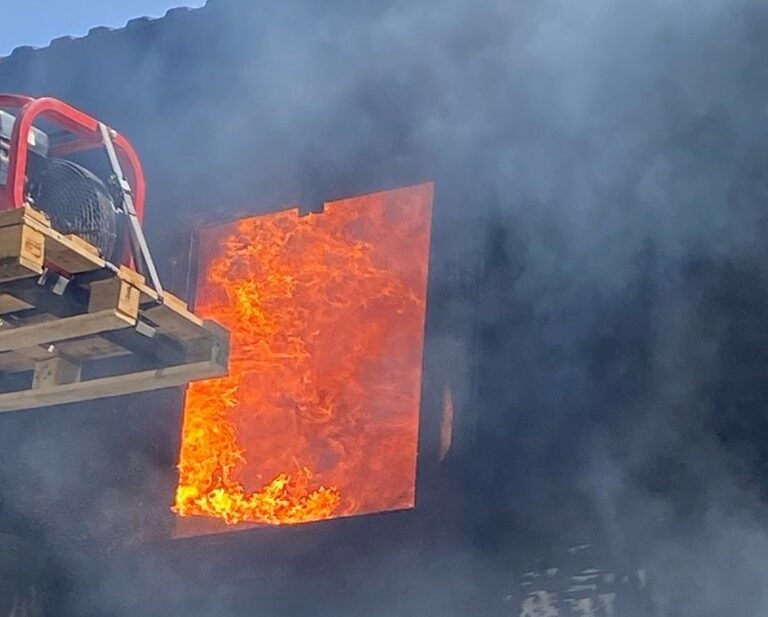
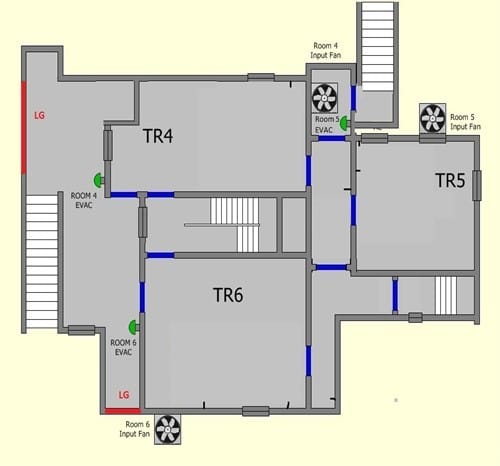
As can be seen from the picture below (figure 1), the wind driven fire was created using a PPV fan through a window into a fire compartment. Figure 2 shows the floor plan for the top floor of the firehouse. The window in TR6 was open to allow an outlet (exhaust) for the fire gases, (as shown by the red arrows). The firefighting crew, supplied by Cold Cut Systems, consisted of one Cobra Operator and one Cobra Senior Instructor with a further Cobra Operator acting as Cobra pump operator.

Figure 1

The fire compartment was room TR5 on the floor plan below (figure 2) with the fan going in through the window to the right of the compartment as you look at it on the plan. (Pale blue arrow)

Figure 1

The crew undertook a scan using a thermal imaging camera (TIC) before entering the building and decided to attack the fire using Cobra from the staircase adjacent to room TR5 (see the yellow arrow which is the Cobra access point on the plan at Figure 2). This gave the crew a high level of protection from the severe heat from the fire which was measured at 581 degrees centigrade before Cobra was used. It also gave protection against contamination from the fire gases and products of combustion. As can be seen from the temperature graph below, the temperature drop was quite dramatic going down to around 280 degrees quite quickly before briefly increasing and then dropping down to roughly around 160 degrees – a much better temperature to enter in order to fully extinguish the fire. It was interesting to note also, the change in temperature in the adjacent room (TR4) which showed a very similar temperature pattern to the fire compartment. The layout of the building offered few opportunities for a safe internal attack on this fire away from the flow path of the super-heated gases. Cobra was used for around eight minutes in total (including piercing) giving total water used at around 480 litres.

There were two key reasons for the success of Cobra in this scenario – firstly the skill and knowledge of the Cobra Senior Instructor and Cobra Operator which was used to good effect in deciding where to make the attack. Secondly, the over-pressurisation of the compartment as the water mist turned to steam – this worked well against the wind to allow the water mist to stay in the compartment for longer and so effectively cool the fire gases rather than being forced out along the flow path.

Please see the temperature readouts from the first floor rooms – Figures 3, 4 & 5 for details. Please note that there is an acknowledged discrepancy in the timings for the temperature readings, however the actual temperatures within the rooms were accurately measured.

The Cobra crew came out of the building and closed down their BA sets, they were able to report that they had not had to work in any high temperatures or in the presence of smoke/fire gases.

If you would like to discuss this article further or if you require further information on Cobra Ultra High Pressure Lance firefighting equipment, please contact Bernie Higgins on bernie.higgins@coldcutsystems.com

This article was originally published in the November edition of IFSJ. To read your FREE digital copy, click here.

Industry Expert: The reinvention of firefighting foam

John-Olav Ottesen, Managing Director and Founder of Dafo Fomtec AB, spoke to IFSJ about the ban on forever chemicals, data vs opinion, and the future of firefighting foam

There is currently a proposal to ban ‘forever chemical’ (PFAS) in firefighting foam across the EU. Why has this happened and what impact will it have?

This is the culmination of a long process in EU and legislators want to eliminate the use of PFAS, plain and simple. You use the term forever chemicals and PFAS molecules does not biodegrade in the environment and that is the main concern.

The transition to SFFF requires a holistic approach by end users – they must understand that this transition is not just about changing the concentrate. There is a wish for drop-in replacements among end users, but this is seldom achievable as the transition will often require, new storage tanks, new or recalibrated proportioning systems and the discharge device must be able to generate foam within the performance criteria of the individual foam concentrates. In many cases the application density as well as the operational tactics must be changed.

The finished foam fighting the fire is a product of foam concentrate as a part of a system, with tested and approved proportioning, and a foam quality generated by the discharge device that matches foam qualities proven by testing.

Why, when it comes to foam, is data more important than opinion?

It has always been the case that data is vital to enable correct design. With fluorinated foam, there was a higher degree of safety margin, they were simply more forgiving when it comes to issues like varying fuels and equipment. This is not the case with SFFF just now. We are still in the infancy with these products, so to base your fire protection on opinions can be disastrous, even fatal. We need to keep on gathering data and define the limitations of these products and base our fire protection on data collected through rigorous testing.

There has been a huge evolvement in performance of SFFF over the past 10 years, but as we reinvent foam, we understand that many old truths must be reconfirmed. We see that SFFF products are more fuel sensitive, and they must be used within the limitations that is defined by real test data and approvals. To use the words of the NFPA report on SFFF, the products must be deployed strictly within the listed parameter.

How have foam and fire suppression systems and solutions changed and evolved in recent years?

 Foam systems have been more or less the same during my 30 years in the industry. Compressed air foam systems have been introduced during this period and concentrates and equipment have evolved, but fundamentally they have not changed. With the move to SFFF, we see perhaps a need for more application specific approach. In some cases we will need higher application densities and change of discharge devices to accommodate for the use of SFFF foam, where a foam blanket plays a more vital role than with fluorinated foam.

With the inevitable move away from PFAS, and towards fluorine free foam, what are the main challenges that are a result of this transition and how can these be overcome?

First of all, the need for test data when designing systems. This puts a lot of responsibility on foam manufacturers but also on standards developers, designers, and end users. There is no way around it, we just need to keep on gathering data. The standards must adopt new insight and implement this going forwards. Designers and users must embrace the holistic approach and require real data.

Secondly, I would say that the cleaning of systems and handling of old concentrate is a real challenge, as we still do not know enough about the best way of doing this. The test methods for PFAS content are still being developed and refined, and the industry and laboratories are taking big steps to enable better methods. Methods for cleaning are available but the efficacy not yet 100% clear. The handling of old PFAS foam is also a challenge as questions are raised if high temperature incineration is effective enough. This is being discussed among regulators and industry right now.

What does the future hold for firefighting foam?

 For as long as there are flammable liquids in use, foam will play a central role in fire protection. We see a constant development towards ever more effective PFAS free foams, and this will carry on going forwards. I see this as a very exciting and innovative part of the industry and the next decade is going to be both challenging and interesting.

What are Fomtec’s core values and how do these impact its products and its customers?

Our core values are: Performance, Trust and Sustainability. In fire protection, Performance is driving us to keep on innovating and testing. Trust is essential for Fomtec and our products, and you build trust through all your interactions with partners and clients, and most of all trust in our products based on the data that we provide.

Sustainability for Fomtec starts with the way we conduct our own business and strive to reduce our environmental footprint. We have no emissions of process water, we recycle our waste and we develop our products based on environmentally responsible chemistry. This will at the end bring high performance and future proof products to our clients.

IFSJ Exclusive: Quelfire talks firestopping compliance

IFSJ spoke to Craig Wells, Sales Director at Quelfire, to discuss firestopping compliance

Tell me a little about Quelfire?

Quelfire is a manufacturer and supplier of passive fire protection with a primary focus on service penetration seals. We were established in 1977 as a family business and are still family[1]managed today. Since then, we have grown into one of the key providers of passive fire protection solutions and influencers of the market. Along with the products we manufacture and distribute, we put a huge emphasis on both technical support and education.

The culture within the organisation is very much: If we’ve got a tested solution we can sell it, if we don’t then we have to walk away. A large proportion of our annual investment goes into testing our products to achieve a larger scope of application based on feedback from our customers and the industry at large.

We supply specialist fire stop contractors, main contractors, builders, and all the trades in between – from dry-lining contractors to mechanical electrical contractors, anyone with an interest in passive fire protection we’re willing to engage with.

What exactly is firestopping compliance and why is it important?

Building regulations Approved Document B essentially states that all gaps and all penetrations must be suitably sealed. Compliance as a minimum is meeting the requirements of Approved Document B: to install and maintain products which have been tested to the correct standard for the particular application.

 It is important because it quite literally saves lives. A lot of people will be familiar with the Stay Put policy. There has been some criticism around that because of the events at Grenfell, but the policy is effective if the compartmentation is maintained using the correct products, installed in the correct way.

What recent developments have you seen around compliance?

The Grenfell Tower fire first raised the issue of compliance and consequently, this has raised the standards the industry must work to. The Building Safety Act, which received Royal Assent in April, has changed things certainly from the main contractor perspective. We hope this will continue. Fire stopping has historically been regarded as one of the smaller value packages that is implemented on a project towards the end. They will build walls and floors, run all the services through and then ask the fire stopper to come and firestop using the products.

What we’re seeing now is a change in the right direction. People are asking: what do we want to build, how do we want to build it, and is there a tested solution available. They’re now identifying the tested solution, working out what the parameters of that test evidence are and designing around it. The key thing then is sticking to the plan as we move through the installation stage.

There are some very positive changes which are being spring boarded by the introduction of the Building Safety Act, but also just a strong desire within organisations to do the right thing and we are glad to support this.

What should be done to improve compliance throughout the design and installation process?

The buzzwords, and rightly so, are early engagement and cross-party communication. These have got to be encouraged. The fire stop itself is only ever as good as the installation, as the substrate that it’s installed into, and as the actual services that are installed. You’ve got dry liners, mechanical contractors, electricians – maybe other specialist installation trades as well as the wall manufacturers and installers. All these things directly impact the effectiveness of the whole system, so it is important that we’re bringing everyone together at an early stage and designing the building using the tested solutions that are available.

How can parties work together to ensure compliance?

An early engagement meeting is critical. We get everyone together on the same page right from the start, making sure that everyone is involved from the early stages so there are no hiccups along the way. It requires regular meetings with all parties as the slightest change from one party could have quite a massive impact on another. There are also practical steps that we can take, such as Toolbox Talk training sessions. These are on-the-job training sessions conducted by manufacturers like ourselves.

The construction industry can be fairly complacent in terms of thinking that everyone is competent. If we take simple things like installing putty pads into electric socket boxes – you’ve got a qualified electrician that’s used to wiring up socket boxes and is then being asked to put a fire stopping device into the socket. It’s not hard to install a putty pad, but does that individual know why they are installing it? Do they just think it’s a gasket and regard it as a nuisance getting in the way of their wiring? Or do they understand that this is a life[1]safety critical element?

The other suggestion is to install physical sample walls. What you establish at that stage is exactly what is expected in terms of the installation; the writing can be on the wall in terms of expectations. From then on it becomes the benchmark. Anyone onsite can see what’s expected and can measure their work against this benchmark. There can also be that cross-party scrutiny, where one party can say ‘shouldn’t X be doing this because that’s what the demo wall shows?’

How do you make sure that the correct products are being installed?

 By promoting the message that help is available. Competency is knowing what you don’t know and it is really important for people to understand that there are manufacturers and system suppliers like ourselves who are willing to help and provide support. People should not think that they have to go it alone.

Technical support services in the construction industry have tended to be an email address that is monitored once every couple of weeks. We aim to respond to emails within one working day. People should understand that help is available and it’s not wrong to not know the answer to your solution.

There are people out there that can support you and provide you with an evidence-based solution. This has been a challenge in the industry – people have been afraid to go into the level of detail that’s required at an early stage because they think it is going to be hard work to get it out of the manufacturer. But, as I say, things are changing and for us that is one of the main reasons why persons choose to work with us along with our huge, tested scope of application of products.

Quelfire is hosting a panel discussion at London Build this month*, what is its focus and why should people attend?

The discussion is called ‘The Journey to Achieving Fire Stopping Compliance’. There are two strands to the journey aspect of it. One is understanding that it is a journey – from the early stages working out what is needed to achieve compliance and then the various stops along the way which need to be introduced to ultimately achieve compliance at the end of the project.

The other side is that for a lot of people, this is a massive cultural change, and cultural change does not happen overnight. There has been a historic attitude of ‘leave it to the end, leave it to the installers’ but really to achieve compliance it is a case of ‘take control and work out what’s needed, and dictate to the relevant people that this is what we need along the way.’

The discussion will focus on the importance of early engagement, designing the building using tested solutions and all the steps and tools that can be used along the way to make sure that all the parties are aligned and, ultimately, the building is constructed compliant and safe. We’ll also touch on the things that can be done to meet the requirements of the changing legislation and the emphasis on the Golden Thread.

*The Journey to Achieving Firestopping Compliance, led by Quelfire, took place at London Build on 16th November at 2.30pm on the Fire Safety Stage.

This article was originally published in the November edition of IFSJ. To read your FREE digital copy, click here.