What Extinguisher Should Be Used for Electrical Fires?

Fires can start unexpectedly and spread quickly. 

Knowing how to respond is essential. 

One common type of fire is an electrical fire. 

These fires involve electrical equipment and wiring. 

Knowing what extinguisher should be used for an electrical fire can prevent injuries and save property. 

This article will guide you on which extinguisher to use for electrical fires, how to use it, and how to handle electrical fire emergencies.

What Types of Fire Extinguishers are There?

fire extinguisher types

There are 5 main types of fire extinguishers, each used for different classes of fire

Water

Water fire extinguishers are designed for Class A fires, which involve ordinary combustibles like wood, paper, and textiles. 

They work by cooling the burning material, which helps to extinguish the fire. 

Some water extinguishers are not suitable for electrical fires or fires involving flammable liquids and gases, as water can spread the fire or cause electric shock.

Foam

Foam fire extinguishers are suitable for Class A and Class B fires. 

They work by forming a blanket over the burning material, cutting off the fire’s oxygen supply and cooling the material. 

Foam extinguishers are effective on flammable liquids like petrol and oil, but they should not be used on electrical fires, as foam can conduct electricity and cause hazards.

Dry Powder

Dry powder fire extinguishers are versatile and can be used on Class A, B, and C fires. 

They contain a powder that smothers the fire, cutting off its oxygen supply. 

These extinguishers are suitable for flammable liquids, gases, and electrical fires. 

However, they leave a residue that can damage sensitive equipment and create a mess.

CO2

Carbon dioxide (CO2) fire extinguishers are primarily used for Class B and electrical fires. 

They work by displacing the oxygen around the fire and cooling it. CO2 extinguishers are ideal for electrical fires because they leave no residue and do not damage electrical equipment. 

However, they are not effective on Class A fires and should not be used in confined spaces due to the risk of asphyxiation.

Wet Chemical

Wet chemical fire extinguishers are specifically designed for Class F fires, which involve cooking oils and fats. 

They contain a solution that reacts with the burning oil to form a thick, soapy layer on the surface, cutting off the oxygen supply and cooling the oil. 

Wet chemical extinguishers are highly effective in commercial kitchens but are not suitable for other types of fires.

What Extinguisher Should Be Used for Electrical Fires?

what extinguisher used for electrical fire image
Source: Amazon

For electrical fires, which are one of the most dangerous types of fire, the safest and most effective fire extinguishers are Dry Powder and CO2 (carbon dioxide) extinguishers.

Dry Powder Extinguishers

Dry Powder extinguishers are specifically designed for electrical fires. 

They contain non-conductive agents like dry chemicals, such as monoammonium phosphate or sodium bicarbonate

These agents interrupt the chemical reaction of the fire and do not conduct electricity, making them safe for use on electrical equipment.

CO2 Extinguishers

CO2 extinguishers are also suitable for electrical fires. 

Carbon dioxide is a non-conductive gas that displaces oxygen around the fire, suffocating it. 

Additionally, CO2 extinguishers cool the equipment, helping to prevent re-ignition. 

Since CO2 leaves no residue, it is ideal for use on sensitive electronic devices and machinery.

Certain Water-Based Fire Extinguishers

An approved water-based extinguisher or one that has passed a di-electrical test is safe to use on live electrical equipment up to 1000V, provided you maintain a distance of at least 1 meter.

This safety standard is recognized internationally and is outlined in the BS EN 3-7 product standard, ensuring its reliability and effectiveness.

What are the Dangers of Using the Wrong Fire Extinguisher Type on an Electrical Fire?

electrical fire wrong extinguisher dangers

Using the wrong type of fire extinguisher on an electrical fire can pose several serious dangers.

Electric Shock

Water-based and foam extinguishers can conduct electricity. 

Using these on an electrical fire can result in electric shock to the person operating the extinguisher. 

This can lead to severe injury or even death.

Fire Spread

Some water and foam extinguishers are ineffective on electrical fires and can cause the fire to spread. 

Non-dielectric tested water extinguishers can cause the fire to spread to other areas by dripping into electrical systems and creating short circuits. 

Foam can have a similar effect by spreading conductive materials.

Equipment Damage

Using incorrect extinguishing agents can damage electrical equipment irreparably. 

For instance, dry powder extinguishers leave a residue that can harm sensitive electronics. 

This residue is difficult to clean and can cause long-term damage.

Ineffective Fire Suppression

Using an inappropriate extinguisher may provide ineffective fire suppression, leaving it to grow and become more dangerous. 

This inefficacy wastes critical time during an emergency, allowing the fire to spread and cause more damage.

Toxic Fumes

Using the wrong extinguisher can produce toxic fumes, especially if the extinguishing agent reacts with the burning materials. 

These fumes can be harmful if inhaled and pose additional health risks.

How to Use a Fire Extinguisher 

how to use a fire extinguisher

Knowing how to use a fire extinguisher properly is crucial for effectively combating small fires. 

The PASS technique is a simple method to remember:

Pull the Pin

Pull the pin at the top of the extinguisher. 

This action breaks the tamper seal and allows you to discharge the extinguisher.

Aim at the Base

Aim the nozzle or hose at the base of the fire. 

Focusing on the base, where the fuel source is, helps to extinguish the flames more effectively.

Squeeze the Handle

Squeeze the handle or lever slowly and evenly. 

This releases the extinguishing agent. 

Make sure to control the discharge by applying steady pressure.

Sweep Side to Side

Sweep the nozzle or hose from side to side at the base of the fire. 

Continue this motion until the fire is completely out. 

Be thorough and ensure the fire doesn’t reignite.

Safety Precautions

  • Stay Alert: Always keep an eye on the fire, even after it seems to be extinguished.
  • Maintain Distance: Stand at a safe distance from the fire, typically about 8-10 feet, and move closer as the fire diminishes.
  • Know When to Evacuate: If the fire becomes uncontrollable or spreads rapidly, evacuate immediately and call emergency services.

What are the Main Causes of Electrical Fires?
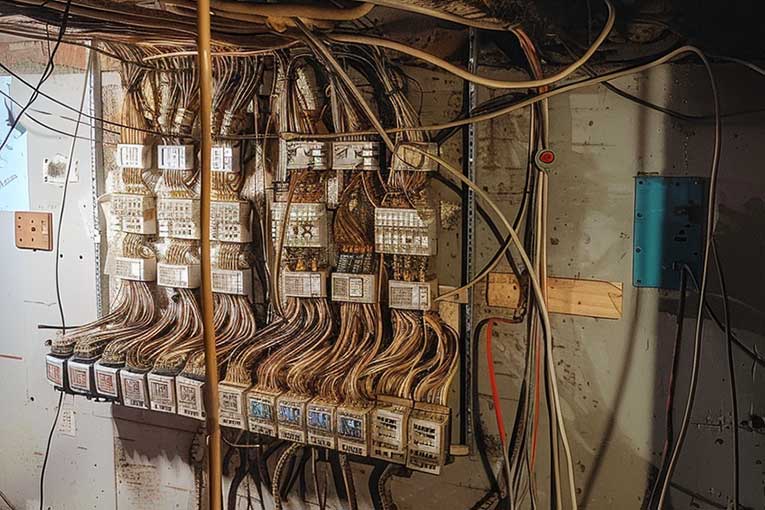
electrical fire causes

Electrical fires are a common and dangerous type of household fire. 

Understanding their causes can help in preventing them.

Faulty Wiring

Old, damaged, or improperly installed wiring is a leading cause of electrical fires. 

Over time, wires can degrade, leading to exposed or frayed wires that can spark and ignite surrounding materials. 

Additionally, amateur electrical work can create unsafe conditions that may result in fires.

Overloaded Circuits

Plugging too many devices into a single outlet or power strip can overload circuits. 

This overload causes excessive heat, which can melt the wiring and start a fire. 

Using high-wattage appliances on circuits not designed to handle them is particularly risky.

Faulty Appliances

Defective or poorly maintained appliances can also spark electrical fires. 

Appliances with damaged cords or internal electrical faults can overheat and ignite. 

Regular maintenance and prompt repairs are essential to keep appliances safe.

Extension Cords

Improper use of extension cords is another common cause. 

Extension cords can overheat if used to power high-wattage appliances or if they are used for long periods. 

Running extension cords under carpets or through doorways can damage them, increasing the fire risk.

Space Heaters

Space heaters are often used to provide additional warmth but can be dangerous if not used correctly. 

Placing them too close to flammable materials or leaving them unattended can cause fires. 

Heaters with faulty thermostats or those left on for too long are particularly hazardous.

Light Fixtures

Using incorrect bulb wattage in light fixtures can lead to overheating. 

Exceeding the recommended wattage can cause the light fixture to overheat, melt, and potentially ignite surrounding materials. 

Ensure all bulbs match the recommended wattage for your fixtures.

Electrical Outlets

Loose or worn-out electrical outlets can cause arcing, where electricity jumps from one connection to another. 

This arcing can generate heat and ignite nearby materials. 

Ensuring outlets are securely fitted and in good condition helps prevent this risk.

What to do if There is an Electrical Fire?

electrical fire what to do

If there is an electrical fire, use these steps to stay as safe as possible: 

Stay Calm and Assess the Situation

If an electrical fire starts, staying calm is crucial. 

Panicking can lead to mistakes and make the situation worse. 

Quickly assess the severity of the fire. If it is small and manageable, you might be able to extinguish it safely.

Disconnect Power

If it is safe to do so, disconnect the power source to the electrical device causing the fire. 

This can often be done by unplugging the device or turning off the power at the circuit breaker. 

Cutting off the power source can help stop the fire from spreading.

Use the Right Extinguisher

Use a Dry Powder or CO2 fire extinguisher, which is designed for electrical fires. 

Remember to use the PASS technique: Pull the pin, Aim at the base of the fire, Squeeze the handle, and Sweep from side to side.

Evacuate if Necessary

If the fire is too large or out of control, evacuate immediately. 

Do not try to extinguish a fire that is spreading rapidly or producing a lot of smoke. 

Make sure everyone in the building is aware of the fire and evacuates safely. 

Close doors behind you as you leave to help contain the fire.

Call Emergency Services

Once you are safely outside, call the emergency services number. 

Provide the dispatcher with your location and details about the fire. 

Do not assume someone else has already called. 

Emergency responders have the equipment and expertise to handle electrical fires safely.

Do Not Use Water

Never use water to extinguish an electrical fire. 

Water conducts electricity, which can cause electric shock and make the fire worse. 

It is essential to use only the appropriate fire extinguishers.

Wait for Professionals

Wait for the fire department to handle the situation. 

They have the necessary training and equipment to extinguish electrical fires safely and prevent them from reigniting.

Conclusion

Electrical fires can be dangerous, but knowing how to prevent and respond to them can save lives and property. 

Use CO2 extinguishers for electrical fires and follow the PASS technique for effective use. 

Regularly inspect your home for potential fire hazards, maintain electrical equipment, and never use water on an electrical fire. 

By staying informed and prepared, you can protect your home and loved ones from the dangers of electrical fires.

Composite fire doors: The importance of third party certification

Owen Jones, Technical Director at Distinction Doors, explains the role third party certification plays in the UK composite fire door market

While the new Prime Minister settles in and takes up the mantle of leadership, the British public and many businesses will be eager for proactive decision-making and action.

As a stockist and distributor of composite fire doors we are more than aware of how hesitancy and inaction can impact progress.

 I’m talking more specifically about the former government’s reluctance to mandate quality standards for the UK fire door market.

We believe the right direction for fire protection and safety in new build and refurbishment projects is mandatory use of third party certification schemes to provide additional assurances.

Legal requirements

Currently, the only legal requirement is to meet the standards outlined in the associated Building Regulations.

 A high-performance composite fire doorset must be independently tested to BS 476-22:1987 or the more demanding European test method BS EN 1634-1:2014 – both are currently accepted for Building Regulation compliance and prove 30-minutes minimum integrity.

 The onus is then on building inspectors and clients to approve and manage the use of compliant composite fire doorsets.

Third party certification schemes are not a legal requirement.

 They are simply recommended by the Government and Building Regulations.

We firmly believe there is sufficient evidence and backing to support the formalisation of the belt and braces approach afforded by UKAS accredited third party certification schemes.

Above and beyond

These schemes exceed the basic legal requirements and offer additional assurances of consistent quality and performance, through regular audit of manufacturing facilities and audit testing.

 There are many recognised third party certification schemes operating in the UK fire industry, including UL, IFC, Blue Sky Certification, and Q-Mark (BM Trada), each one independent and without bias.

As an organisation we insist that  our manufacturing partners  meet the non-mandatory requirements of BM Trada’s Q-Mark Composite Fire Door schemes STD 170 and STD 50.

 Also, we encourage the use of Q-Mark STD 052 fire door installers wherever possible.

 We do this to promote confidence and provide greater assurance.

 The certification is held in the public domain, for example and can be accessed by anyone online.

 It is also proof of an ongoing vow to quality and excellence – the certificate can be withdrawn or suspended if there is proof of non-conformance or a lack of testing.

 Again, the information is shared publicly.

 This level of scrutiny makes for a very compelling product offering.

External and internal fire doorsets

Beyond Building Regulations there is now also the minimum mandatory requirement under Construction Products Regulation (CPR) in England, Scotland and Wales for component parts under a harmonised or designated standard to carry a UK Conformity Assessed (UKCA) mark.

 Currently, the requirement only applies to fire doorsets for external applications.

 Internal fire doorsets are exempt, although we anticipate that this will change in the future (dependent on the adoption of EN14351-2 as a UK approved standard)

Under new legislation to legally supply fire doorsets for external use i.e., locations that are open to the elements such as external flat entrances, the manufacturer must first be UKCA accredited.

 This authorises them to produce a UKCA marked external fire doorset and issue a Declaration of Performance (DoP) that references both BS EN 14351-1, the external pedestrian doorset standard and BS EN 16034, the standard for fire resisting and/or smoke control pedestrian doorsets proving compliance.

These tests must be conducted by a third-party and certificated using an independent UKAS accredited test house and certification body.

Importance of regular checks

However, while mandatory it is widely recognised that UKCA mark conformity is not as powerful, nor does it have the same level of control as a third party certification scheme.

 This is due, in part, to a general lack of regular external auditing which allows non-conformance to go unchecked.

As a member of the Association of Composite Door Manufacturers (ACDM), we are encouraged by the recent actions of the Office for Product Safety and Standards (OPSS) whose primary purpose is to protect people and places from product-related harm.

The OPSS has been auditing some fire door manufacturers against the requirements set by the UKCA mark.

 This includes control systems, training records and technical documentation.

 While this may not be as comprehensive as the audit conducted by BM Trada, we welcome the proactive scrutiny.

Many modern composite fire door manufacturers and suppliers strive to exceed standards and expectations to deliver the most robust and proven fire door solutions on the market.

 We do this through independent and verified test results proving consistent performance, compliance, and certifying manufacturers and where possible, installers.

About Distinction Doors

Established in 2004, Distinction Doors is the UK’s largest supplier of composite doors and was the first to launch to the UK market.

As the UK’s leading entrance door supplier for over 10 years, Distinction Doors has formed an unrivalled pedigree for providing premium quality products, thanks to its renowned GRP composite door slab, complementary glazing cassette system and triple glazed, laminated as standard Distinction Glass range.

 Today Distinction Doors operates from two distribution centres in South Yorkshire.

An increased portfolio of superior products and continued business investment will ensure customers’ growth plans are fully supported and that Distinction Doors continues to lead the way.

This article was originally published in the July 2024 issue of International Fire & Safety Journal. To read your FREE digital copy, click here.

Fire safety compliance enhanced with JELD-WEN’s new data pin solution

New data pin solution launched by JELD-WEN

JELD-WEN, one of the UK’s doorset manufacturers, has introduced a new data pin solution aimed at improving fire safety compliance.

As reported by JELD-WEN, this new feature, provided by Door Data Systems, will be incorporated into every Certifire doorset produced by the company.

The data pin system enables the Golden Thread of information to be established from the outset.

It offers advanced digital recording and data collection capabilities for fire doorsets in commercial and multi-occupancy buildings.

This innovation aims to enhance traceability and allow responsible parties to demonstrate comprehensive fire door compliance.

Features and benefits of the data pin system

The data pins are installed on the hinge side of the doors during manufacturing.

They provide immediate access to certification, technical documentation, installation guides, warranties, and inspection reports.

This information is stored in a state-of-the-art system accessible via a free app.

The system’s user-friendly central dashboard presents data clearly, requiring no specialist training.

Features like scheduled reminders aid in future fire door maintenance, supporting building management efforts.

Glyn Hauser, R&D Senior Group Manager at JELD-WEN, commented on the system’s impact: “As one of the first manufacturers to introduce this advanced data pin system, we’re advocates for greater transparency throughout the supply chain, which we believe is needed to improve modern fire door practice.”

Commitment to best practices

JELD-WEN emphasises its dedication to providing comprehensive support throughout the lifecycle of their doorsets.

To ensure best practices during the installation stage of the Golden Thread process, the company has produced several easy-to-follow videos.

These resources aim to guide customers and ensure the correct implementation of the data pin system.

Hauser added: “Compliance is in the DNA of every JELD-WEN product, and launching the data pin is an important step in ensuring the Golden Thread can be implemented at the very first opportunity.

“We believe this capability will allow for better facility management of a building and, ultimately, a safer environment for the people within it.”

Call for urgent action to enhance fire door standards in UK education buildings

163 out of 164 fire doors not compliant says Door Group MD Brian Sofley

Door Group, a unit of ASSA ABLOY Opening Solutions UK & Ireland, is calling for urgent action to improve fire door standards in educational environments.

This follows new Home Office figures showing a concerning lack of fire safety systems in UK schools, colleges, and universities.

Between the financial year 2022/23, 673 educational buildings in the United Kingdom were affected by fires.

Additionally, 627 of these establishments did not have a fire safety system in place.

Fire doors are essential for safety in buildings, and regular inspections are crucial to meet health and safety measures.

The importance of compliant fire doors

Educational institutions face high traffic levels, leading to misuse and functional issues with doors, resulting in non-compliance.

Door Group emphasises the need for enhanced fire door standards to protect students, educators, and staff.

Robust fire door systems are vital for containing fires, limiting their spread, and ensuring safe evacuations during emergencies.

Brian Sofley, Managing Director at Door Group, highlighted the importance of comprehensive fire safety measures: “Through our fire door inspections service, our BRE qualified engineers have found the level of compliancy in schools to be extremely low.

“In one school, for example, we inspected 164 fire doors and reported that 163 were not fire compliant.”

Fire safety statistics and concerns

Fire Rescue Services attended over 622,000 incidents in the year ending March 2023, a 7.8% increase from the previous year.

Alarmingly, over 1,000 school buildings are believed to contain combustible materials similar to those used in Grenfell, including 923 school buildings and 80 university buildings.

Brian Sofley stated: “The concerning presence of fires in schools stresses the necessity for comprehensive fire safety measures with a holistic approach.

“It’s not just about specifying compliant solutions, they need to be managed correctly with regular inspections and maintenance.

“This information should be accurately recorded, in line with the ‘Golden Thread’ approach outlined in the Building Safety Act.”

Door Group’s commitment to fire safety

Door Group is dedicated to raising the standard of fire door safety in schools, offering comprehensive inspections every three, four, six, or twelve months.

Following inspections, Door Group provides detailed reports with advice and recommendations for necessary improvements to ensure safety and product performance.

If any issues are identified, a tailored repair proposal is issued, which can include replacement doors or a regular maintenance program.

Door Group inspectors, who are BRE-certified, ensure that all fire doors inspected meet necessary standards and regulations.

Briton unveils comprehensive new exit hardware catalogue for trade professionals

Briton introduces user-friendly exit hardware guide

As reported by Briton, the company has launched a new exit hardware catalogue, providing specifiers and trade professionals with a comprehensive guide and product selection resource.

The 28-page catalogue features Briton’s flagship range of panic and emergency exit hardware systems, including detailed product specifications, EN classifications, and certified application information.

The new catalogue also offers a first look at the updated Briton 370 Series.

This series includes high-performance, Certifire-approved exit hardware devices designed to ensure immediate escape without compromising building security.

Comprehensive details for ease of specification

Briton has compiled extensive technical details, product illustrations, spare parts, and fixing kits into the new catalogue to support customers throughout the specification process.

The catalogue includes valuable advice and tools, such as detailed safety and compliance information and a practical three-step product selector guide.

These features are designed to simplify product selection and enhance fire door safety standards across the built environment.

Sue Corrick, product marketing manager at Allegion UK, commented: “We’re proud to announce the launch of our new exit hardware catalogue as we aim to support customers in making informed decisions with Briton products.

“The new catalogue is our most clear and concise yet and has been carefully designed to provide customers with accessible information on Briton’s latest range of dependable exit hardware solutions, including the newly updated Briton 370 Series.”

Addressing evolving fire safety standards

Briton’s new catalogue comes at a time when fire safety standards are evolving.

The company is dedicated to raising awareness and developing knowledge on the critical components of fire door safety.

According to Sue Corrick: “As our customers face evolving fire safety standards, Briton remains dedicated to raising awareness and developing knowledge on the vital components of fire door safety.

“Our new exit hardware catalogue extends its use as an invaluable guide and specification resource for specifiers and trade professionals.

“By including detailed illustrations, specification tools and fixing kits alongside our products, we aim to simplify exit hardware specification and offer true peace of mind in the process.”

Doorway dilemmas: Addressing the critical gaps in fire door installation

Richard Kowalski, Technical Manager for Doors at Stairways Midland, discusses the critical gaps in fire door installation and the urgent need for regulation

Is it time fire door installation became a regulated profession? Richard Kowalski, Technical Manager for Doors at Stairways Midlands, an expert in his field with more than 25 years’ experience and a member of the British Woodworking Federation Council, sets out his argument.

Fire doors are a carefully engineered fire safety device required by law in many circumstances to help safeguard life in the event of the fire. It is not enough that they are compliant in themselves – to work effectively, it is essential they are fitted correctly. Yet, there is no formal qualification required to be able to fit a fire door, and the profession remains unregulated. Kowalski is among the leading figures in the sector calling for that to change.

What is the status quo?

While there is no mandatory qualification needed to install a fire door a level of expertise and competency is required: the Regulatory Reform (Fire Safety) Order 2005 (RRO/FSO) sets out that fire doors should be installed by a “competent person” however a question mark remains over ‘what competency means in this context,’ explains Kowalski.

There are voluntary third-party certification schemes for installation contractors such FIRAS run by Q-Mark for example, or Certifire certification. Adds Kowalski: “These schemes mean that the installation company has to have processes and procedures in place – they need to be ISO certificated, attending training courses, inspected both on site and within their offices and in their processes, and know how a fire door works.

“The trouble is each scheme is run differently. The schemes are not mandatory, and they can be very expensive to both be a member of and to manage.

“There is a real mixed bag out there, with some contractors having have achieved this high standard, and others who think finding a course online makes them a competent person – especially, in my experience, when it comes to small residential developments outside of big cities.

“A gas engineer couldn’t install a boiler legally unless they are registered with Gas Safe, with all the requirements and training that entails. Yet any joiner can turn up on site and install a fire door. The implications for safety can be just as serious.”

Leaving the door open for mistakes

While there are examples of good practice, without proper regulation, the door is left open for serious mistakes, believes Kowalski: “While awareness has improved, we are still turning up on sites and seeing big gaps around doors, doors in the wrong openings or the use of the wrong mastic, because the installer doesn’t know to check the fire certificate and look at the minimum and maximum gaps for that product to make sure it is compatible with that specific door set.

“With the new regulatory requirements around ongoing inspection and maintenance of fire doors, we are seeing a number of projects from the past ten years revisited – uncovering fire doors that were never installed correctly and would never have been viable or compliant, which goes to show the extent of this problem.

“We’ve even seen inspectors go in and pull off the architrave and find there was no mastic at all between the frame and the structural opening in any of the doors. You can have the best possible fire door which is 100% compliant – but fire will find the weakest point. In this case, they almost might as well have left it open!

Taking responsibility

New legislation also demands more from those specifying, installing and responsible for maintaining fire doors – there is a golden thread of responsibility for ensuring the door is compliant and safe.

Kowalski adds: “There is a misapprehension that installers don’t have responsibility once they’re off site – but they can be held liable for up to 30 years under changes to the Defective Premises Act brought in under Building Safety Act 2022 – and that applies to all dwellings.

“There is a lot for them to do, especially in the case of traditional hung doors. Installers have a responsibility for ensuring the door leaf is compliant and compatible with all the components, from the intumescent, to the ironmongery, to the closer, as well as getting the fitting right.

Unfortunately, there is “a massive education gap,” adds Kowalski: “Not just among joiners and installers, but also site managers, buyers, the housebuilders themselves. Everyone has responsibility to get this right, but it often comes down to NHBC or building control inspectors when they come on site to uncover the issues.

“As manufacturers we take our responsibility very seriously. We send out installation instructions with every order acknowledgement and at call off. Every door has a QR code which links to installation instructions, and we have luggage tags on the bottom of every door to make people aware that the undercut might need adjusting – again with a QR code linking to instructions. Our toolbox talks and training are also always available to joiners and contractors.

“It’s not enough to think ‘I’ve been a chippy for 25 years so I’m competent’, or ‘we’ve done it this way for years and never had a problem’. You might have been doing it wrong for years unfortunately.

“While this remains an unregulated profession, we are still going to see mistakes that mean fire doors fail inspection, or even worse, fail in the event of a fire and cost someone’s life.

“That is why it’s so important that we resolve this issue of competency in legislature and ensure that every fire door is fitted correctly first time.”

This article was originally published in the May 2024 issue of International Fire & Safety Journal. To read your FREE digital copy, click here.

UL Solutions and Efectis Era Avrasya team up to advance fire door safety standards

Expansion of fire door testing capabilities

UL Solutions has announced a collaboration with Efectis Era Avrasya to expand fire door testing capabilities at the Efectis Era Avrasya facility in Dilovasi, Turkey.

As reported by the UL Solutions, this partnership aims to address the increasing testing needs of fire door manufacturers in Southeast Europe and the Middle East.

The local testing laboratory, assessed by UL Solutions, is expected to reduce costs and time for regional customers.

Through the UL Solutions Witnessed Test Data Program (WTDP), Efectis Era Avrasya will generate product test data with UL Solutions engineers on site to observe testing.

The data from WTDP testing will be reviewed by UL Solutions, and if it demonstrates conformity, UL Solutions can issue a product certification.

Patrick Abgrall, director and regional general manager of Built Environment, Europe, Middle East and Africa at UL Solutions, stated: “We are pleased to collaborate with Efectis Era Avrasya to support local and regional fire door manufacturers in bringing safer products to market.”

Support for the construction industry growth

The collaboration between UL Solutions and Efectis Era Avrasya is timely, considering the growth in the construction industry.

A recent report by Research and Markets estimated that the Turkish construction industry grew by 5.1% in 2023, largely due to reconstruction efforts following the February 2023 earthquake.

Furthermore, the Middle East construction materials market is projected to grow at a compound annual growth rate of 8% between 2024 and 2030, according to 6Wresearch.

Ilker Ibik, CEO of Efectis Era Avrasya, commented on the partnership: “The UL Solutions Witnessed Test Data Program enables us to better serve fire door manufacturers as a local testing laboratory in the region and provide test data to UL Solutions.

“Our collaboration with UL Solutions is a significant step in the advancement of built environment fire safety in Turkey and our neighboring countries and regions.”

Historical context and program details

The WTDP was introduced in 2007 to enable product testing at third-party laboratories while a UL Solutions representative is on-site to witness the testing.

UL 10, the Standard for Fire Doors, was established in 1903, laying the foundation for UL Solutions’ long-standing expertise in testing, certifying, and inspecting fire doors.

This collaboration reinforces UL Solutions‘ commitment to maintaining high safety standards and supporting manufacturers in meeting regulatory requirements.

IFSJ Comment

By expanding local testing capabilities, the partnership addresses the growing demand for fire safety compliance in these regions.

This initiative is particularly important given the recent growth in the construction industry, driven by reconstruction efforts in Turkey and ongoing development in the Middle East.

The UL Solutions Witnessed Test Data Program offers a robust framework for ensuring that fire doors meet stringent safety standards, enhancing trust among manufacturers, code authorities, and building occupants.

As the construction industry continues to evolve, collaborations like this will be crucial in maintaining high safety standards and supporting manufacturers in navigating regulatory landscapes.

The commitment of UL Solutions and Efectis Era Avrasya to advancing fire safety is commendable and will likely have a lasting impact on the industry.

High-performance replacement fire doorsets introduced by Dorplan under new brand SignetFire

SignetFire fire doorsets to enhance building safety

Dorplan has announced the launch of SignetFire, a new brand dedicated to high-performance replacement fire doorsets.

As reported by Dorplan, SignetFire aims to meet and exceed industry standards by providing optimal fire safety combined with exceptional functionality and aesthetic appeal.

The Grenfell Tower fire in 2017 exposed critical flaws in fire safety, prompting significant reforms.

The Building Safety Act, a response to this tragedy, mandates robust fire door regulations to enhance building safety.

SignetFire addresses these requirements, ensuring compliance and preventing the spread of fire.

Features and benefits of SignetFire

Quentin Evershed, SignetFire Sales Manager, highlighted the importance of these new doorsets in light of current regulations: “With the Building Safety Act high on the agenda, replacement fire doorsets for non-compliant buildings is a high priority.

“We’ve listened to the industry’s concerns about inconsistent quote turnaround, inconsistent lead times, lack of technical expertise, and insufficient project management support.

“SignetFire addresses these challenges with fast quote turnaround, a reliable 4-week lead time, and in-house exceptional technical and project management support.”

SignetFire aims to support clients with fast and reliable service.

Evershed added: “Our new line of high-performance fire doorsets is designed not only to meet but exceed the rigorous standards set by the industry.

“We are committed to supporting our clients with fast and reliable service, ensuring that every project is completed with the highest level of safety and efficiency.”

Achieving ISO 14001 certification

In addition to launching SignetFire, Dorplan has achieved ISO 14001 certification, marking a step towards sustainability and responsible business practices.

ISO 14001 is an international standard providing a framework for establishing, implementing, maintaining, and improving environmental management systems.

For Dorplan, achieving this certification involves aspects such as material sourcing, manufacturing processes, waste management, and energy consumption.

The certification demonstrates Dorplan’s commitment to reducing their environmental footprint and improving their environmental performance.

The process of obtaining ISO 14001 certification

Dorplan followed a structured approach to achieve ISO 14001 certification.

This included conducting an initial environmental review, setting environmental objectives and targets, developing an Environmental Management System (EMS), implementing and monitoring the EMS, undergoing a certification audit, and committing to continuous improvement.

Achieving ISO 14001 certification reflects Dorplan’s dedication to sustainability and environmental responsibility.

By following this structured approach, Dorplan contributes positively to the environment and society.

IFSJ comment

The launch of SignetFire by Dorplan addresses a crucial need in the construction industry for high-performance fire doorsets.

This initiative is particularly relevant in the context of the Building Safety Act, which seeks to prevent tragedies similar to the Grenfell Tower fire by enforcing stricter safety measures.

The emphasis on fast quote turnaround, reliable lead times, and robust project management support highlights Dorplan’s commitment to addressing industry concerns effectively.

Additionally, Dorplan’s achievement of ISO 14001 certification underscores their commitment to sustainability and environmental responsibility.

This certification process, which involves a thorough review and continuous improvement of environmental practices, positions Dorplan as a responsible player in the industry.

Briton marks 25 years of accurate installation with updated Accufit template

Briton launches enhanced Accufit template for accurate installation

Briton, a specialist in door controls and exit hardware, has introduced an enhanced version of its popular self-adhesive Accufit template.

The newly updated template aims to aid in the easy and accurate installation of Briton’s trusted door closers.

For 25 years, Briton’s Accufit system has allowed installers to fit door closers quickly and accurately on the first attempt.

The self-adhesive templates are designed to be stuck to the door and frame, allowing all fixing points to be pre-drilled accurately, ensuring correct positioning in all applications.

New features of the Accufit template

The updated Accufit templates now include the fixing dimensions of the door closer and user-friendly images of the fixing application.

This additional illustrative guidance helps installers position the template accurately.

Fixing instructions have also been simplified, with the edge, face, and inside edge frame of the door clearly marked.

This enhancement aims to reduce installation time, improve fitting accuracy, and enhance the product’s longevity.

Briton’s goals for the updated templates

Briton aims to save installers time and eliminate uncertainties in door closer installation with the new Accufit templates.

This update helps ensure the closers function effectively and maintain fire safety integrity.

Pete Hancox, country manager at Allegion UK, said: “An appropriately specified, installed, and maintained door closer is a prerequisite when it comes to fire door safety.

Briton Accufit templates are designed to facilitate correct installation, and for 25 years they have been a proven support tool for installers.”

Availability and further information

The updated Accufit templates are now available with Briton 2003 and 2003V door closers.

The launch will expand across the Briton door closer range in the coming months.

Briton provides complete product information, certification, and fitting instructions on their website, where the updated Accufit templates are also available.

For more information about Briton, visit: www.briton.co.uk.

To find out more about Allegion UK, visit: www.allegion.co.uk.

IFSJ comment

Briton’s introduction of the enhanced Accufit template reflects the company’s commitment to improving installation efficiency and accuracy.

By simplifying the process and providing clear, user-friendly instructions, Briton aims to address common installation issues that can compromise door closer functionality and fire safety.

The inclusion of detailed fixing dimensions and illustrative guidance marks a significant step towards ensuring that door closers are correctly installed, aligning with the renewed focus on competency in the industry.

The updated templates are expected to support installers in meeting evolving fire safety standards.

As Briton celebrates 25 years of the Accufit system, the enhancements demonstrate the company’s dedication to supporting installers and enhancing product performance.

The availability of the updated templates online further underscores Briton’s commitment to accessibility and comprehensive support for their products.

ASSA ABLOY Door Group announces strategic partnership in EMEIA Door Business Segment

ASSA ABLOY Door Group enhances global operations with new partnership

ASSA ABLOY Door Group has recently revealed a significant internal restructuring with the formation of the ASSA ABLOY EMEIA Door Business Segment.

This initiative consolidates the company’s door business units across Europe, the Middle East, India, and Africa into a unified global division.

This restructuring aims to strengthen the company’s market position and focus on key objectives.

Brian Sofley, Managing Director of Door Group, expressed enthusiasm for the new opportunities presented by this alliance: “We are delighted to now be part of the ASSA ABLOY EMEIA Door Business Segment, and are excited about the new opportunities this union will offer us.”

Benefits of the new partnership

The partnership is set to deliver numerous benefits, including the introduction of innovative products designed to enhance the company’s competitive edge.

These products, which draw on advancements from other regions, are expected to be unveiled in the UK and Ireland in the forthcoming months.

Sofley also highlighted the advantages of the partnership: “One of the advantages we are keen to promote is the potential for us to tap into a wealth of groundbreaking products already available in other regions and bring them to the market in the UK and Ireland.”

Expanded customer service and support

The collaboration within the ASSA ABLOY EMEIA Door Business Segment will also enhance customer support services.

By leveraging resources across various divisions, Door Group aims to provide comprehensive solutions throughout the lifecycle of their products, from specification to installation and beyond.

“The ability to collaborate with other divisions within the ASSA ABLOY EMEIA Door Business Segment will not only help us serve our customers more effectively but also strengthen our brand and unique position in the marketplace,” Sofley added.