Streamlight introduces upgraded LiteBox and FireBox lantern models
Streamlight, Inc. has introduced upgraded versions of its LiteBox and FireBox rechargeable lanterns, now available in both E-Spot and E-Flood models.
The new versions boast improvements in brightness, weight, and battery longevity.
The upgraded lanterns offer up to 1,500 lumens and 110,000 candela on the high setting, with a battery life extending to nearly 18 hours on the low setting.
Features and benefits of the new lantern models
The newly introduced models include the E-Flood FireBox, the E-Spot FireBox, the E-Flood LiteBox, and the E-Spot LiteBox.
These models are designed to serve a wide range of lighting needs, from emergency services to industrial applications.
Michael F. Dineen, Streamlight’s Chief Revenue Officer, highlighted the versatility and enhanced performance of these lanterns: “These rugged, dependable lanterns provide extreme brightness for a wide variety of emergency lighting applications, from navigating through smoke-filled rooms to illuminating outside plant repairs when working under low light conditions,” Dineen said.
Enhanced design and functionality
The upgrades include a more compact design, making the lanterns over 50% lighter than their predecessors.
They also feature a large, tactile push-button switch with a built-in battery status indicator.
The E-Spot models are particularly noted for their deep parabolic reflectors which produce a long-range spot beam, ideal for detailed tasks like fire scene investigations or intricate repair work.
Conversely, the E-Flood models use shallow reflectors to create a broad flood beam, suitable for lighting larger areas.
Availability and specifications
All models are equipped with a 7.4-volt, 5200 mAh lithium-ion battery, rechargeable up to 500 times.
The lanterns are available in orange or high-visibility yellow, come with both standard and vehicle mount systems, and fit existing LiteBox/FireBox chargers.
Each unit features high-impact, ABS thermoplastic housing and is water-resistant to IPX4 standards.
The length of each lantern is 28.45 cm, and they weigh 1389 grams.
Jonathan Gordon, Marketing Manager – Fire & Rescue at Nightstick, looks at sustainable LED lighting in fire safety
The fusion of LED lighting into fire safety marks a significant leap in both efficiency and environmental responsibility. Smarter tech raises the bar for the whole industry.
By focusing on powerhouse manufacturing materials aluminum and polycarbonate, Nightstick highlights a journey of innovation aimed at safeguarding our planet’s future.
This evolution in fire safety tech is a testament to Nightstick’s collective effort to continually hunt for solutions that enhance safety, optimise the first responder, and support a sustainable environment.
Aluminum: The sustainable vanguard
Aluminum stands as a pivotal element in sustainable efforts within the LED lighting industry, particularly for fire safety applications.
Its exceptional blend of durability and environmental benefits makes aluminum the material of choice for innovative designs.
The material’s lightweight yet strong nature not only extends the lifespan of LED portable lighting but also significantly reduces carbon emissions associated with transportation.
For instance, using aluminum can decrease the weight of lighting equipment by up to 40%, leading to an approximate 20% reduction in emissions compared to heavier materials.
Aluminum’s recycling process stands out for its energy efficiency, requiring only 5% of the energy necessary for its initial production.
This showcases aluminum’s eco-friendliness and emphasises its role in promoting a circular economy.
Remarkably, about 75% of all aluminum ever produced is still in use today, contributing substantially to waste reduction and resource conservation.
In 2020 alone, recycling aluminum helped to avoid approximately 90 million tons of CO2 emissions, equivalent to removing over 19 million cars from the roads for a year.
This demonstrates a strong commitment to sustainability and highlights aluminum’s importance in reducing the environmental footprint of LED lighting products.
Aluminum’s superior thermal management capabilities enhance the operational efficiency of LED lights, leading to energy savings and supporting a reduction in carbon emissions throughout the product’s lifecycle.
For example, aluminum-based LED lighting can improve energy efficiency by up to 20% due to better heat dissipation, extending the lifespan of LEDs and reducing the frequency of replacements.
Integrating aluminum into our product line, Nightstick commits to offering high-quality, durable products and promoting eco-friendly practices that benefit the environment.
Products such as Nightstick helmet lights FORGE™ and FORTEM® (XPP-5466 & XPP-5465), Tactical Fire Light W/ Multi-Angle Helmet Mount (FDL-300R-K01), and Rechargeable LED Scene Light W/ Magnetic Base (NSR-1516) exemplify strategic material choices that align with our dedication to sustainability.
Polycarbonate: A beacon of eco-innovation
Polycarbonate stands out as a high-performance thermoplastic polymer, distinguished by its clarity, strength, and impact resistance—key attributes for LED portable lighting in fire safety.
Its production process is eco-friendly, emitting 40% less greenhouse gas than conventional materials like glass or acrylic.
This represents a significant reduction, equating to approximately 250,000 tons of CO2 annually for the industry, highlighting polycarbonate’s role in minimising the ecological footprint of LED lighting.
Advancements in recycling techniques for polycarbonate have been pivotal in promoting sustainability.
Mechanical recycling, which processes used polycarbonate back into a raw material without altering its chemical structure, has seen an efficiency improvement of up to 30% over the past five years.
This method conserves resources and reduces waste, contributing to a more sustainable production cycle.
Chemical recycling, on the other hand, breaks down polycarbonate into its monomers, which can then be repurposed to produce new polymers.
This approach has been enhanced to achieve a recovery rate of over 90%, showcasing a commitment to sustainability by offering a second life to plastic materials and advancing towards a circular economy where waste and resource depletion are minimised.
The focus on innovative recycling methods and the quantifiable reduction in greenhouse gas emissions reinforce the critical role of polycarbonate in sustainable development.
By incorporating polycarbonate in products like the INTRANT® (XPR-5568), INTEGRITAS™ (XPR-5582RX), and DICATA® USB IS Dual-Light Headlamp (XPR-5562GX), Nightstick not only showcases the material’s versatility but also its substantial contribution to reducing the environmental impact of fire safety LED lighting and its manufacturing processes.
Certified green
In the critical domain of fire and rescue, where precision is paramount, the choice of materials in equipment transcends its functionality—it contains a profound commitment to a greener planet.
ATEX and UL 913, while commonly recognised for their safety benchmarks, also embody principles of environmental sustainability.
These certifications are not just procedural milestones but serve as the gold standards that join safety with eco-consciousness.
Aluminum, a central player in LED lighting, excels in meeting these standards due to its inherent non-sparking properties and exceptional thermal conductivity.
These features not only align with the stringent safety criteria of ATEX and UL 913 certifications, ensuring that LED lights meet the most rigorous safety standards, but also contribute significantly to energy conservation.
For instance, ATEX and UL 913 include requirements for energy efficiency and reduced environmental impact in their assessment protocols.
This is especially crucial in settings where the margin for error is nonexistent, helping to mitigate ignition risks while promoting the principles of intrinsic safety and sustainability.
The lifecycle of aluminum, celebrated for its high recyclability, considerably lowers its environmental footprint, directly reflecting the ethos of UL 913’s guidelines for sustainable product design.
Similarly, polycarbonate stands as its perfect counterpart.
It offers a robust, lightweight alternative to traditional materials like glass and aligns with ATEX directives that encourage the reduction of environmental hazards through material choices.
It meets the most stringent safety protocols while minimising both thermal and chemical risks, and its production slashes greenhouse gas emissions, supporting the collective drive towards sustainability.
When these materials are used in LED portable lights, they do more than just save energy and cut carbon emissions.
They also support the goal of creating a more sustainable world, which is reflected in certifications like ATEX and UL 913, which focus on environmental standards throughout the product’s life cycle.
Aluminum and polycarbonate, by meeting these environmentally-focused standards, distinguish themselves as pioneers of sustainable innovation, ensuring that the tools used in hazardous conditions also conserve our planet.
Blending rigorous safety standards with environmentally conscious materials like aluminum and polycarbonate reflects a responsible approach to our planet’s well-being while ensuring the utmost safety for firefighters and public safety officials.
This integration represents a meaningful stride towards a future where our equipment not only protects you but also honors environmental commitments.
Nightstick is proactive in championing sustainable practices, actively collaborating with recycling organisations worldwide to lead by example in product lifecycle management.
This makes sure our products are not merely used and discarded, but rather given a new purpose through recycling.
In our role as battery manufacturers, we recognise the importance of proper disposal and recycling.
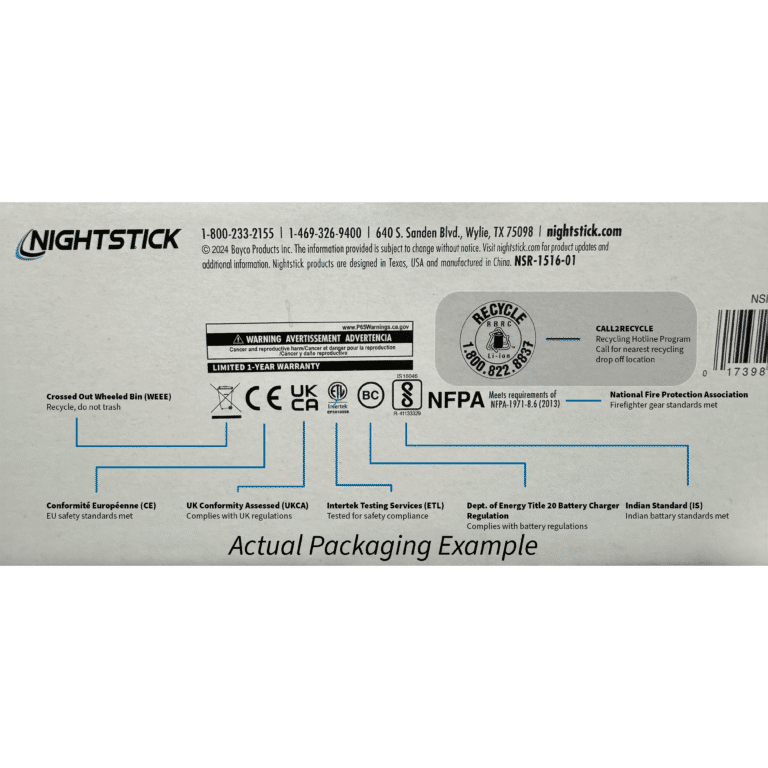
That’s why we’ve partnered with Call2Recycle, a non-profit organisation dedicated to responsible battery recycling.
The Call2Recycle icon on all Nightstick products is your guide to doing right by the environment.
A quick call to the number provided on the icon will direct you to the closest recycling facility, allowing you to easily participate in the shared goal of sustainability.
Navigating the path to sustainability
The fire safety industry’s embrace of LED lighting, powered by eco-friendly materials like aluminum and polycarbonate, marks a critical step towards a more sustainable future.
Yet, achieving true environmental stewardship within this field is not without its challenges.
The energy required to recycle aluminum, approximately 14,000 kWh per ton, emphasises the need for a shift towards renewable energy sources to ease the ecological footprint of such processes.
The landscape of sustainability is brightened by the recent advent of bio-based polymers and advanced composites, which not only promise a lower environmental impact but also superior performance.
Research into bio-polymer composites, for example, indicates a potential to halve the energy needed for production when compared to traditional materials, offering a glimmer of light for both eco-efficiency and the demanding requirements of fire safety applications.
Nightstick uses the advanced composite, glass-filled nylon polymer, in products like ATEX ZONE 0 XPP-5418 IS Helmet Light Flashlight.
It’s also used in the brand new ATEX, IS angle light, SAVIOR™.
While its tensile strength rivals that of aluminum, glass-filled nylon polymer reduces the need for frequent replacement through enhancing durability and longevity.
The energy consumption also is reduced contributing to lower greenhouse gas emissions.
Brighter horizons
In the quest for an eco-friendly future, the combination of aluminum and polycarbonate into LED lighting for fire safety goes beyond technological advancement; it reflects a deep dedication to environmental protectionism.
A comprehensive lifecycle analysis of these materials—from the extraction of bauxite and crude oil, through their transformation into durable and recyclable materials, to their eventual repurposing or recycling—reveals the nuanced balance between operational efficiency and ecological responsibility.
Aluminum, celebrated for its lightweight strength and superior recyclability, lessens environmental impacts at every stage of its lifecycle, reducing the demand for virgin materials and lowering CO2 emissions through its energy-efficient recycling process.
Polycarbonate, on the other hand, offers a stark example of innovation in reducing ecological footprints, with its production emitting significantly less greenhouse gas compared to traditional materials, and advancements in recycling techniques promising a future where waste is minimised, and resources are conserved.
As we navigate towards brighter horizons, the sustainable impact of these choices becomes increasingly clear.
The fire safety industry’s embrace of LED lighting, powered by eco-friendly materials like aluminum and polycarbonate, is not just a nod to the present but a pledge for the future—a future where every product is a testament to the possibility of harmonising human safety with our planet’s health.
The journey towards sustainability is packed with challenges, yet filled with opportunities for innovation and improvement.
By focusing on the entire lifecycle of materials used in fire safety equipment, we focus our commitment to not only protecting lives but also preserving the environment for generations to come.
In this light, each beam cast by an LED light is a step forward on the path to sustainability, illuminating the way towards a legacy of conservation leadership that honors the heroes who protect us, and pledges to leave behind a world that is safer, cleaner, and greener.
This article was originally published in the April 2024 issue of International Fire & Safety Journal. To read your FREE digital copy, click here.
IFSJ delves into the market of emergency lighting solutions and the latest innovations for frontline firefighters
This analysis delves into the latest trends and technologies in emergency lighting tools specifically used by firefighters, including handheld torches and scene lighting.
These tools are vital for ensuring firefighters’ efficiency and safety during operations.
Effective lighting is crucial for firefighters to have complete situational awareness, enabling them to respond effectively to crises and save lives.
This analysis will cover different types of lighting tools, such as right angle lights, helmet lights, and portable scene lights, and their applications in firefighting scenarios.
Market drivers and growth factors
Technological evolution: Emergency lighting systems have evolved significantly, transitioning from basic handheld torches to advanced LED lights.
This evolution is driven by the need to adapt to the continually changing requirements of emergency services, especially in challenging visibility conditions.
LED lighting: The shift to LED technology marks a significant breakthrough in emergency scene lighting.
LEDs offer better energy efficiency compared to traditional incandescent lights and are safer, with lower fire risks and longer lifespans.
This advancement contributes to both the safety of responders and the effectiveness of emergency response.
Portable lighting solutions: Innovations in portable lighting, such as handheld or helmet-mounted lights, have provided firefighters with more flexibility.
These portable solutions allow for quick and easy movement of lights to enhance visibility in dark or hard-to-reach areas.
Smart lighting technology: The emergence of smart lighting in emergency response offers the ability to remotely control brightness and colour temperature.
Smart lights can be programmed to respond to various criteria, enhancing scene illumination without manual intervention, thereby improving safety.
Regulatory requirements: Compliance with regulatory standards is a key driver in the development of emergency scene lighting.
Different regions have specific regulations that guide the implementation of emergency lighting systems, including lumens requirements and durability standards.
Specific trends in firefighter emergency lighting tools
Right angle lights: A mainstay in fire services for decades, these lights feature a powerful, tight beam, ideal for long-range searches and penetrating thick smoke.
They have a compact, easy-to-hold design, even when wearing fire gloves.
Helmet lights: Essential for task lighting and directional focus, helmet lights are lightweight and compact, improving situational awareness in dark environments.
They come in front-mounted and side-mounted varieties to suit different needs.
Portable scene lights: These battery-powered lights offer fast deployment and repositioning flexibility.
They can be staged around fire scenes to illuminate hazards and provide overall scene lighting, enhancing safety and operational efficiency.
Key features of lighting tools include: high light output with ranges from 3,000 to 16,000 lumens for effective scene illumination, beam adjustability offering both area/flood beams and focused spot beams; waterproof design which is essential for fire scenes with water or in water rescue scenarios; and speed of deployment ensuring quick and easy setup without the need for generators or cords.
Durability and compact design: Right angle lights must withstand extreme conditions, including heat, impact, and water.
They should be made of materials like heavy-duty nylon for durability and have a compact design for ease of use.
Helmet light features: They provide a bright, broad beam for close-range task lighting and situational awareness.
The fit of the light on the helmet is critical for stability and effectiveness in stressful situations.
Lumens based on task: The brightness requirement varies based on the task, with different lumen ranges specified for short-range tasks, mid-range searches, and area scene lighting.
Water and impact resistance: Lights must be waterproof and able to withstand the rigorous conditions typical in firefighting, including water exposure and physical impacts.
Challenges in developing firefighter emergency lighting tools
The development of firefighter emergency lighting tools faces several challenges, primarily concerning the transition to LED technology.
LED lighting intensity and distraction risks: The shift to LED emergency vehicle lighting has raised concerns about its intensity and the potential blinding and distracting effects on drivers and other individuals in the vicinity.
This has necessitated a reevaluation of fire apparatus lighting standards to mitigate these risks.
Environmental and operational durability: Firefighter lighting tools must withstand extreme conditions, including high temperatures, water exposure, and physical impacts.
Developing materials and designs that can endure such harsh environments without compromising functionality is a significant challenge.
Battery life and performance: Ensuring long battery life and consistent performance in emergency situations is critical.
Developing battery-powered tools that can operate for extended periods, especially in situations where access to power sources is limited, remains a challenge.
User-Friendly design and ergonomics: Creating tools that are easy to handle, even with limited dexterity due to fire gloves, and ensuring that they do not interfere with the movement or become entanglement hazards is crucial.
The design must balance compactness, ease of use, and effective illumination.
Future outlook and trends
Advancements in LED Technology: Ongoing research and development in LED technology will continue to address challenges such as light intensity control and power efficiency.
Integration of smart technologies: The future may see the integration of smart technologies in lighting tools, enabling features like remote control, adjustable intensity, and automated response based on environmental conditions.
Enhanced durability and battery life: Continuous improvements in materials and battery technology will aim to enhance the durability and operational life of lighting tools, making them more reliable in prolonged emergency scenarios.
Ergonomic and user-friendly designs: Future designs are expected to focus on ergonomics, ensuring that lights are comfortable to use over extended periods and do not hinder firefighters’ movements or operations.
Expert comment
The firefighting lighting market has seen a move towards LED technology over the last decade.
“LED lights are preferred for their energy efficiency, durability, and brightness,” says Donato Sasso, Director of International Business Development at Streamlight.
Another important aspect is the weight and portability in close spaces.
“There’s an increasing focus on lightweight and portable lighting solutions to enhance mobility for firefighters in challenging environments,” Sasso notes.
The most sought-after features in lighting tools today are the need for durable products, with a long battery life and quick charging capability, alongside products with different levels of brightness to adapt in different firefighting scenarios.
The main challenges facing manufacturers in the firefighting lighting market, says Sasso, include meeting stringent international industry standards for durability, safety, and performance: “The opportunities for a company like Streamlight lie in its strong and well-established distribution network with relationships in every fire department all over the world.
“Regulations and standards (like ATEX and IECEx) have influenced the firefighting lighting market.
“Some standards can limit performance of a light such as brightness of the light while meeting the stringent testing of the light.
“Streamlight is staying abreast of any upcoming regulatory changes to ensure compliance and by doing so adapt our products accordingly.”
This article was originally published in the February 2024 issue of International Fire & Safety Journal. To read your FREE digital copy, click here.
The Survivor® X ATEX is an upgraded version of Streamlight’s compact Survivor® right-angle torch, now offering 250 lumens, new features for improved operation, and multiple power options to suit user needs and budgets.
The low-profile, Zone 0-rated light is available as a Rechargeable System or as an Alkaline model.
Also available is the Survivor X® USB, a budget-friendly USB rechargeable option for use in Division 2 conditions.
“The Survivor® personal light, known for its toughness, compact size and reliability, just got even better with the new Survivor® X ATEX, which not only offers enhanced brightness and added features but also multiple power options,” said Streamlight Chief Revenue Officer Michael F. Dineen.
“Fire and rescue personnel, industrial firefighters, utility workers and others now have an even more powerful and versatile tool to use when operating in the trying conditions they often face.”
The newest torch to the series features several improvements in response to user feedback, including:
An easy-to-operate battery door that provides a dust-tight seal
A battery status indicator in the switch that turns red when the battery is nearing low voltage, flashes continuously when there is 15 minutes of battery life left and turns green when the battery is fully charged
An improved charge cradle design that locks the light securely in place, while also featuring a quick release latch to permit one-handed “grab and go” removal, even with gloved hands.
In addition to energising the new Survivor® X ATEX, the new charger also charges all existing Survivor models.
The Survivor® X ATEX features the latest in power technology for extreme brightness, and offers microprocessor-controlled high and low intensity and emergency flash modes.
The Rechargeable System model operates on a 2.6Ahr Lithium-Ion battery pack, which can be recharged up to 1,000 times, while the Survivor® X ATEX Alkaline uses three AA alkaline batteries.
On high, all models deliver 250 lumens and 50,000 candela over a beam distance of 447 metres.
The torch’s custom optic produces a narrow beam, ideal for cutting through smoke, fog and mist, while also providing optimum peripheral illumination to aid in navigation.
Operating run times for all three models range from 3.75 hours on high to 15 hours on low, with 8 hours on the flash setting.
Rechargeable System models are available with AC and DC chargers.
An indicator in the charger turns red when charging and green when the light is fully charged.
A bank charger accessory that charges five units simultaneously is also available.
An eight-unit SL-B26® Li-Ion USB battery bank charger that charges eight USB battery packs simultaneously is available as an accessory for the Survivor® X USB model
The Survivor® X ATEX features a low-profile, compact bezel designed to eliminate snagging when putting on equipment or other gear.
The torch’s reinforced, built-in attachment D-ring and updated spring-loaded clip offer superior retention, ensuring the torch consistently hangs forward, and conveniently latches to belts and harnesses.
Its rubber dome push-button translucent switch is easy to use, even with gloves, and its super-tough nylon housing provides exceptional durability.
All openings are O-ring sealed to resist moisture, including the torch’s unbreakable polycarbonate lens with silicone anti-scratch coating, assembled in a heavy-duty bezel.
The torch has an IP67-rated design for dust-tight use and waterproof operation to 1 metre for 30 minutes; it also is impact resistance-tested to 2 metres.
In addition to the Division 2 Survivor® X USB, Streamlight also offers a Survivor X model that is Class 1, Division 1 rated.
This article was originally published in the February 2024 issue of International Fire & Safety Journal. To read your FREE digital copy, click here.
Exploring Streamlight Inc.’s dedication to safety, innovation and feedback-driven advancements in firefighting lighting solutions
Streamlight’s commitment to advancing firefighter safety is reflected through their adherence to ATEX certification and continual innovation.
ATEX, which stands for ATmosphère EXplosibles, represents a set of European Union directives that define environments with potential atmospheric explosion hazards.
This certification is essential for equipment intended for use in such explosive atmospheres within the European Union, ensuring that these products meet specific safety requirements.
Streamlight’s approach to meeting these rigorous standards involves meticulous design and testing.
Their products undergo thorough evaluation to ensure they are safe and effective in explosive environments.
The ATEX certification process includes comprehensive testing as outlined by European Union directives, confirming the safety of these products in designated explosive zones.
This dedication to safety is paired with Streamlight’s innovative approach to product development.
The company actively seeks feedback from firefighters, incorporating their real-world experiences into the design and functionality of their lighting tools.
This feedback-driven process ensures that their products are not only technologically sophisticated but also practical and resilient, catering effectively to the everyday challenges faced by firefighters.
As Streamlight continues to pioneer in the firefighting lighting industry, their focus remains on creating durable, reliable products that align with the needs of the firefighting community.
This ongoing commitment underpins their reputation for producing ‘Tools Not Toys®’, embodying a balance of innovation, safety, and practicality in their quest to support and protect firefighters globally.
ATEX and IECEx certification standards
From initial conception, Streamlight products destined for use in hazardous locations are designed with the ATEX and IECEx requirements in mind.
“Our engineering team has been trained by Underwriters Laboratories (UL) on the intrinsically safe (“I.S.”) protection methodology commonly used in Streamlight HAZ-LO® and ATEX products,” says Donato Sasso, Director of International Business Development at Streamlight.
Years of experience in I.S. product design led to carefully planned safety features inherent to each HAZ-LO® product.
Streamlight works closely with internationally recognised partner labs to validate all new HAZ-LO® and ATEX product designs.
Its products are tested mechanically to ensure that they will withstand years of service in the field with no degradation to the integrity of the enclosure.
“This includes thermal endurance to heat and cold, impact, drop, ingress protection (“IP”), and UV exposure testing,” says Sasso.
“Electrically, circuits are evaluated to ensure that, even under extreme fault conditions, no component of the circuit could spark or get hot enough to ignite a potentially hazardous environment.” Streamlight does not stop after ATEX/IECEx approval of the product design, however.
“Our products are 100% inspected during production to ensure proper function as well as to validate critical safety features such as proper sealing of O-rings and gaskets,” Sasso tells.
“Engineering and Quality Control work closely with the Streamlight production team to ensure that each product going out is made with the same high-quality components that our customers have come to expect for years of dependable service.”
Firefighter feedback
“It’s crucial to gather feedback from active firefighters regarding the strengths, weaknesses, and potential improvements of equipment during use,” says Sasso.
This input has enabled Streamlight to enhance the strength, resilience, and repairability of its products as needed: “We are always improving our products to meet the needs of our customers.”
Feedback and real-world experiences from firefighters play a crucial role in influencing Streamlight’s product innovations: “We conduct testing programs and send new product samples to firefighters so that our lights can be tested in real-world firefighter activities,” Sasso explains.
This feedback-driven approach ensures that Streamlight’s products are not only technologically advanced but also effective for the day-by-day challenges faced by firefighters in the field.
Upgrading your lighting equipment
When a fire department is choosing to upgrade its lighting equipment, Sasso says that first and foremost, product durability should be a priority, along with key product performances such as beam pattern, run time and rechargeability.
After-sales service for repairs is also crucial to maintaining the light’s capabilities and extending its working life.
“Firefighting departments looking to upgrade their lighting equipment should seek collaboration with a manufacturer that offers energy[1]efficient and durable products and are committed to sustainable practices,” he says.
“Training programs should be included in this relationship, ensuring that firefighters are well-prepared to use the advanced lighting tools tailored to their needs.”
Streamlight has built up a reputation based on trust and reliability over their 50 years, creating ‘Tools Not Toys®’ for firefighters, built to help save lives.
Innovating firefighter safety
Looking ahead, Sasso says that Streamlight will continue its legacy of innovation by staying at the forefront of technology: “We are always researching new materials, technologies, and sustainable practices to maintain our commitment to the planet and the firefighting community all over the world.
“We maintain a continuous feedback loop, actively interacting with firefighters to gather input, keeping open lines of communication and listening attentively to our customers.
Streamlight stands behind our product and our warranty, and investing in technology and striving to produce the most durable, reliable products in the marketplace.” “Over our half-century in operations, Streamlight has been a stalwart of innovation in the lighting industry.
In 1980 the LiteBox®, the first halogen rechargeable lantern, was introduced.
Evolution over the years has seen this original industry standard progress to a lighter weight model with the Vulcan® and Fire Vulcan® with blue taillights, to the now, lightweight, multi-functional Vulcan Clutch® with a clamping handle in 2023 – a first in emergency lighting.
“Another recent milestone has come in the form of the Survivor® X in 2022, showcasing our enduring commitment to innovative and practical lighting solutions.
“The timeline showcases just some of the key firefighting products that have led to Streamlight being pioneers in the industry.”
This article was originally published in the February 2024 issue of International Fire & Safety Journal. To read your FREE digital copy, click here.
Donato Sasso, Director of International Business Development at Streamlight® Inc., looks at technical advancements and challenges in emergency lighting solutions
Streamlight® Inc., a company synonymous with resilience and innovation, marked its golden jubilee in 2023, with a remarkable journey beginning in the suburbs of Philadelphia, Pennsylvania, USA – a starting point that set the stage for an evolutionary tale of a modest enterprise blossoming into a globally recognised manufacturer.
Since its inception in 1973, Streamlight has expanded geographically whilst continually broadening its technological horizons.
The company’s pioneering spirit is most notably reflected in its early and continuous embrace of rechargeable flashlights, lanterns, and LED lighting technology, utilised every single day by firefighters on the front lines.
This foresight has positioned Streamlight at the vanguard of the industry, leading with products characterised by exceptional brightness, durability, and practicality.
Today, Streamlight designs, manufactures, and markets a full line of flashlights, headlamps, lanterns, and accessories, which are sought after by users in the US and in over 90 countries worldwide.
What began as a small operation with several employees has grown into a 240,000 square foot manufacturing and office space in Eagleville, Pennsylvania, USA with more than 350 employees.
The company now holds over 525 US and foreign patents, and over 135 US and Foreign Trademarks.
IFSJ caught up with Donato Sasso, Director of International Business Development at Streamlight, who highlights the importance of collaboration with emergency service professionals in shaping product designs that truly cater to real-world demands.
From navigating smoke-filled environments to balancing brightness with battery life, we explore the innovations tailored to these heroes’ needs.
How does Streamlight adapt its products for modern urban firefighting?
Lights have evolved to be smaller, lighter, and brighter.
We consistently work with emergency service professionals and rescue teams to grasp the unique challenges of contemporary firefighting.
As cities and urban landscapes evolve, we adapt our products to meet these changing needs.
Our focus on research and development enables us to stay abreast of technological advancements.
A flashlight’s design is specifically tailored to complement firefighters’ clothing and equipment.
This ensures ergonomic compatibility during use, including features like quick-release straps, a sturdy clip for attachment to SCBA or turncoats, and blue taillight LEDs.
Lights like the Survivor® X ATEX clip securely onto gear, and the Portable Scene Light II can hang over guard rails or on fire engines, offering hands[1]free solutions.
These features allow firefighters to navigate hostile environments effectively, with essential tools and equipment readily accessible for reaching hazardous areas.
During our design process, we consider all the gear a firefighter must wear.
Our goal is to create lights that are lighter and easier to handle, ensuring they don’t hinder a firefighter’s performance.
Additionally, as the landscape changes, it is important to note that we have recognised low battery indication as a key feature, and we have added battery indicators to many of our firefighting products.
Concentrating on candela also allows us to create a tighter beam, which reduces glare and the bounce-back effect from white smoke.
Some products not only have primary LEDs but also have blue taillight LEDs that are visible in smoke.
This is an added benefit as it is a neutral signal and allows a firefighter to see their fellow firefighters in front of them, or the light can be used to mark an entrance or exit.
How does Streamlight balance brightness with battery life effectively?
Most products offer different levels of brightness so that users can choose the appropriate level to meet the needs of their environment or current situation.
Lower brightness will allow for additional battery run time as opposed to a higher setting that may utilise more of the battery in a shorter time.
In some cases, we may initially increase lumen output for a very short time, then quickly ramp down the output for both thermal reasons and run time purposes.
This is dependent on the product and application.
For example, with a tactical application, short bursts of extreme lumen output could be beneficial.
On the other hand, an eight-hour shift application requires long run time, so brightness is not as critical.
The type of battery, cost of battery, and ease of replaceability of the battery is also important.
The ProTac® HL-X is intended to use two CR123A batteries or one Streamlight SL-B26® rechargeable battery pack, which both provide slightly different run times.
For this light and others, we also provide a TEN-TAP® feature to allow the customer to choose their preferred output upon the first tap of the tail switch (usually high versus low), depending on what their application is.
How do collaborations shape Streamlight’s product design and functionality?
Our collaborations involve a direct relationship with firefighters in different parts of the world to understand the challenges they face in real-world scenarios.
Their feedback is crucial in shaping the design and functionality of our products.
Streamlight’s design process often includes beta testing in the field, ensuring that the final products are not only technologically advanced but also practical and tailored to the specific needs of firefighters.
We meet with top departments within the fire industry to discuss current and future product offerings to obtain feedback on products – what is working, what is not, new challenges to address.
We utilise these relationships to provide new product testing to be certain that new products are up to the rigors of structural firefighting environments.
How does Streamlight support training for advanced lighting tools?
Streamlight organise or participate in workshops and seminars, providing hands-on training with our advanced lighting tools.
Collaborative training initiatives with firefighting academies help integrate Streamlight’s products into training courses, ensuring that firefighters are well-prepared to use our lights in an effective way.
We sponsor international fire bodies and organisations like OBA (Organización de Bomberos Americanos) to support the firefighting community and exhibit at key fire events at a worldwide level (Interschutz, FDIC), national level (Thematic Days, SICUR, ESS, RETTmobil), and at local trade shows and open days.
Our team also participates in live firefighting exercises at training facilities to gain a deeper understanding of the challenges faced in structural firefighting environments.
How does Streamlight approach environmental responsibility in production?
We incorporate eco-friendly practices into our manufacturing processes and product design.
This includes the use of recyclable materials and the development of flashlights with energy-efficient LEDs and rechargeable batteries.
Another important aspect is understanding and ensuring that our products are in compliance with environmental regulations all over the world.
Whenever possible, we lead with rechargeable products.
Rechargeable batteries last much longer than disposable ones, and many can be recharged over 500 times.
Products that use these rechargeable batteries can reduce downstream waste and ultimately save the consumer money on battery replacement costs.
While disposable batteries are initially cheaper, one should consider the savings on operating costs when opting for rechargeable batteries.
What initiatives does Streamlight have for product longevity and reducing waste?
Streamlight designs products with rugged construction, high-quality materials, and modular components that can be repaired or replaced if needed.
By creating durable lighting solutions and by having a Limited Lifetime Warranty Program, we hope to extend the life of our flashlights and reduce the need for full product replacements, contributing to waste reduction.
How do you envision the future of firefighting lighting solutions in terms of sustainability and eco-friendliness?
Our company foresee a future where firefighting lighting solutions become increasingly sustainable and eco-friendly.
This involves advancements in materials, new energy efficient technologies and the integration of renewable energy sources as well as environmentally friendly packaging.
This article was originally published in the February 2024 issue of International Fire & Safety Journal. To read your FREE digital copy, click here.
The Survivor® X ATEX is an upgraded version of Streamlight’s compact Survivor® right-angle torch, now offering 250 lumens, new features for improved operation, and multiple power options to suit user needs and budgets.
The low-profile, Zone 0-rated light is available as a Rechargeable System or as an Alkaline model.
Also available is the Survivor X® USB, a budget-friendly USB rechargeable option for use in Division 2 conditions.
“The Survivor personal light, known for its toughness, compact size and reliability, just got even better with the new Survivor X ATEX, which not only offers enhanced brightness and added features but also multiple power options, including the Survivor X ATEX Alkaline model as well as the Survivor X USB which offers an economical USB rechargeable alternative and also accepts alkaline batteries,” said Streamlight Chief Revenue Officer Michael F. Dineen.
“Fire and rescue personnel, industrial firefighters, utility workers and others now have an even more powerful and versatile tool to use when operating in the trying conditions they often face.”
The Vantage® II range from Streamlight is the next generation of reliable hands-free lighting tools for fire helmets and hard hats.
These lights are compact, powerful, shock-proof, and virtually indestructible.
The Fire Service Model of the Vantage® II Helmet Light easily attaches/detaches above or below the brim of fire helmets, and the Vantage® II Gallet Helmet Light securely attaches to Gallet helmets.
Both models feature a maximum run time of 5 hours with 350 lumens on high mode and 135 lumens on low power mode.
They feature a large push-button switch for easy on/off, even with gloved hands for enhanced practicality, feature reflective strips on the side of the switch housing for enhanced visibility, and are IPX7 waterproof to 1 metre for 30 minutes to ensure optimum usability in wet weather conditions.
The safety features of both the Helmet Light and Gallet Helmet Light models include a blue taillight LED so you can be seen from behind, even in smoke-filled environments, which can be configured to flash or be turned off if required.
The “safe-off” feature prevents accidental activation and saves battery life, ensuring that the light is readily available when it matters the most.
Streamlight have introduced their newest addition to the Stylus® line of slim, everyday carry penlights, with the Stylus Pro® HAZ-LO®, an intrinsically safe and extremely durable alkaline battery-powered light.
Streamlined shape
“With its Class 1, Division 1 rating, the Stylus Pro HAZ-LO is ideal for professionals working in hazardous environments,” said Michael F. Dineen, Streamlight Chief Revenue Officer.
“Its streamlined shape for proper pocket fit and its replaceable metal pocket clip make it very easy to access bright light at any time.
“And, it uses easily sourced alkaline batteries.”
The Stylus Pro HAZ-LO features a push-button tail cap switch for momentary and constant on operation.
Battery powered
Powered by two AAA alkaline batteries, it is exceptionally bright for a light of its size.
It uses a high-power white LED to deliver 105 lumens, 380 candela over a beam distance of 39 metres and a run time of 2.25 hours.
The Stylus Pro HAZ-LO includes a removeable metal clip that aids in Foreign Object Debris (FOD) reduction and is easily replaceable if needed.
The Stylus Pro HAZ-LO measures 15.04cm in length and its slim body diameter ranges in size from 1.6cm to 2cm.
Lightweight
It weighs just 53.9g with two included AAA batteries.
It features an unbreakable polycarbonate lens, and it is made of impact and chemical-resistant engineered polymer resin, which is non-conductive, sealed, and vented.
Available in high-visibility yellow, the Stylus Pro HAZ-LO is IPX7-rated for waterproof operation to 1 metre for 30 minutes, and it is 2-metre impact resistance tested.
Read IFSJ’s recent rundown of Streamlight’s top lighting products for the fire industry.
Jonathan Gordon, Marketing Manager, Fire & Rescue at Nightstick, sheds light on visibility in firefighting
Light and vision are tightly linked.
Our eyes have adapted over time to develop ways to see in various lighting conditions.
Low-light environments create special difficulties, especially in high-pressure situations like firefighting.
Staying safe and effective in these scenarios require an understanding of how our eyes work.
How light behaves, or fundamental light behavior, guides advanced lighting system’s design.
It is crucial to see how these systems are influenced by, and how they enhance, the human eye’s structure.
This column takes a dive into how our eyes function in low-light conditions and modern LED lights in fire safety.
By explaining how our eyes and light work, we journey through the science-backed reasons for the development and effectiveness of tools like Nightstick’s exclusive Dual-Light™.
As we stand at the intersection of biology and technology, let’s explore how optimised LED lighting strengthens not only visual clarity but also the overall safety of firefighting operations.
Human vision in low-light conditions
When lighting is not ideal, our eyes work hard to see using the little light that is available.
This incredible feat relies heavily on the complex design of the visual system.
Rods in our eyes help us see in low-light.
They are special light-sensitive cells around the edge of our retinas.
Unlike their cousins, the cones, which help us recognise colors under bright conditions, rods are exceptionally sensitive to dim light.
When light strikes these rods, a pigment called rhodopsin undergoes a transformation, initiating a stream of reactions that send electrical signals to our brain.
It’s because of rhodopsin that we can see at night, but only in shades of gray.
Vision in dark and smoky environments
In low-light situations, our eyes rely on peripheral vision—the edges of our sight—to detect movement and give a wider view of our surroundings.
This is especially crucial for firefighters, as it helps them spot potential hazards or sudden movements when they’re focused on a task.
Another essential skill in these conditions is being able to distinguish objects from their background, such as seeing a squad member in a smoke-filled room or identifying a fallen item.
Known as contrast sensitivity, this ability aids firefighters to act quickly when each moment counts.
The dark adaptation process
Transitioning from a well-lit environment to darkness is no small feat for the visual system.
As we move to dimmer surroundings, the eyes undergo a process known as dark adaptation.
During this phase, the amount of the restored rhodopsin in the rods increases, gradually enhancing our sensitivity to low light.
However, this transition isn’t immediate.
It’s why firefighters, when moving from a bright exterior to a dimly lit building, might initially struggle with visibility, only to find their vision improving over the span of a few minutes.
The science of LED lighting
Light isn’t just what our eyes see—it’s part of a bigger picture.
Light can behave in different ways:
Reflection: Think of how light bounces off a mirror.
That’s reflection.
Refraction: When light passes through water and seems to bend, that’s refraction.
It’s why a straw looks bent in a glass of water.
Dispersion: sometimes, light splits into different colors, like the way we see a rainbow after rain.
That’s dispersion at work.
Knowing these rules are critical in making effective LED lights.
They’re designed with these behaviors in mind, making sure we see well, even in tough situations.
A key point: our eyes are especially good at picking up the color green when it’s not very bright around.
That’s why Nightstick uses a green “Find Me” feature on the rear of LED lights.
In smoky, hazy conditions, this green light stands out above others, helping firefighters spot their team more easily.
Precision and spread in light management
The lighting tools we deploy can mean the difference between safety and hazard.
The two primary players in this narrative are spotlights and floodlights, each with its unique approach.
The duality between spotlights and floodlights emerges from the way they manage light.
Spotlights: These lighting tools project a focused, narrow beam of light.
The core of a spotlight lies in its ability to minimise the spread or divergence of light rays.
By using parabolic reflectors (curved mirrors), spotlights concentrate the light, guaranteeing it travels mostly in parallel rays.
This setup ensures that the light is intense and can cover long distances effectively, cutting through obstacles like smoke or haze.
Given their penetrative nature, spotlights are irreplacable in scenarios where pinpoint accuracy and reach are paramount.
In contrast, floodlights cast softer light over a large area.
They operate by spreading light rays rather than focusing them.
The wide-angle dispersion of light projecting from floodlights is achieved through specially designed reflectors or diffusers that scatter light in multiple directions.
This scattering confirms that while the light covers a broad area, it won’t be as intense at any specific point as a spotlight would be.
Floodlights excel in situations where an overall view of a close-range area is more critical than distance or intensity.
The angles and intensities in LED lighting aren’t mere design choices; they’re grounded in optical physics.
When floodlights are placed at a 45-degree angle in Nightstick’s Intrant® angle light, for instance, it isn’t without purpose.
This specific angle minimises the chances of light reflecting directly into the eyes, reducing glare.
Furthermore, by illuminating the ground, it highlights potential obstacles, thereby preventing mishaps like trips, slips, and falls.
Spreading light can also reduce shadows that may otherwise hide potential hazards, key for firefighter safety.
Through harnessing these principles of light, certain innovative systems like the Dual-Light™ are making strides in the firefighting field.
Banishing shadows and balancing vision
In the fast-paced world of firefighting, where split-second decisions can be life-altering, the cross play between vision and light becomes vital.
The Dual-Light™ system blends how light behaves using lines and angles with the natural abilities of the human eye for a balanced effect.
The Dual-Light™ system uses both focused spotlight and wide, unfocused floodlight.
By emitting light in two distinct directions – a focused beam for distance and an unfocused one for a broader view – it provides comprehensive coverage of the environment.
The system provides a surge of confidence from visibility while staying protected from surrounding hazards.
When both the spotlight and floodlight function simultaneously, the outcome isn’t merely doubling the light; it’s synergistic.
The focused beam from the spotlight draws attention to specific points of interest, while the floodlight bathes the surrounding area in light.
It’s like having natural light with a bright center and clear edges, thereby enhancing situational awareness.
One of the innate challenges with focused spot lighting is the creation of sharp shadows around the illuminated area.
These shadows, particularly in high-pressure environments, can be misleading and dangerous.
When the floodlight complements the spotlight, it fills in these shadows, reducing contrast and providing a uniform illumination.
By harmonising these two sources, the Dual-Light™ system makes sure that objects close to the target, which might otherwise be obscured, are easily visible.
This harmony plays an important role in environments where the ability to tell apart different shades of color becomes essential.
The Dual-Light™ system doesn’t merely light up an environment; it does so in a manner that is customised to human vision.
By providing both detailed and peripheral views, it caters to the eye’s natural strengths in low-light conditions.
This intentional design, built on the foundation of both optics and biology, enables the firefighter to remain focused, prepared, and safe during operations.
Illuminating the path forward
In the firefighting arena, every tool, strategy, and piece of knowledge is a lifeline, and light stands at the forefront of this arsenal.
The connection between the human eye and man-made LED lighting is as complex as it is essential, covering the landscapes of biology, physics, and technology.
The dive into human vision under low-light conditions unveils an astounding interplay of cells, pigments, and neural pathways, all fine-tuned over time to draw clarity from obscurity.
By comparing our eyes to how light behaves, we see why spotlights are narrow and floodlights are wide.
With modern advancements like the Dual-Light™ system, a harmonious marriage of these two realms is formed, illustrating a testament to human ingenuity – the ability to spot our natural strengths and design gadgets that take us to new levels.
As with all fields driven by innovation and need, being passive is not an option.
Nightstick’s effective Dual-Light™ system signifies just one milestone in the ongoing journey of enhancing fire safety.
The path forward calls for a continued commitment to research and study of how vision and light work together.
Every ray of light engineered, every shadow diminished, and every issue understood, inches us closer to ensuring the safety of those who stand as our protectors against the flames.
After all, in the quest to enhance tools and technologies, we aim to safeguard every firefighter – the valiant guardian facing the inferno.
This article was originally published in the November 2023 issue of International Fire & Safety Journal. To read your FREE digital copy, click here.