Lieutenant General L. Scott Rice, former director, Air National Guard, the Pentagon, Washington, D.C. recently joined Darley’s Defense Advisory Board.
He was responsible for formulating, developing and coordinating all policies, plans and programs affecting more than 105,500 Guard members and civilians. Before assuming his current
position, General Rice served as the adjutant general and commander, Massachusetts Air National Guard.
Darley also added two new members to our Fire Advisory Board. Chief Dan Eggleston began his fire service career in 1978 and is currently the career fire rescue chief with the Albemarle County (VA) Department of Fire Rescue.
Chief Eggleston is a past president and chairman of the board for the International Association of Fire Chiefs and currently serves as a board member for the National Association of Counties.
Chief Kim Zagaris, or ‘Chief Z’ as some call him, is currently the wildfire policy and technology advisor for the Westen Fire Chiefs Association. His position is new, created in response to the destructive
wildfires that have. unfolded across the West.
Chief Zagaris retired as state fire and rescue chief for the State of California, Governor’s Office of Emergency Services (Cal OES), a position he held for 18 years. Chie Zagaris has extensive background in fire service, emergency management and homeland security which includes working with local, state federal and international agencies over his 42-year fire service career.
During his tenure in California, he served under six governors. and has been actively involved in every major and catastrophic emergency in California as well several in the nation. During his time with Cal OES he was able to expand the fire apparatus fleet from 106 fire apparatus to 300 fire apparatus most with Darley pumps.
Ever since coming into existence, the Fire Fighters Charity has been assisting and aiding firefighters. Along with the frontmen, the charity’s services are also aimed towards employees of the Ministry of Defence Fire and Rescue Service, chaplains or faith leaders, and volunteers.
Many of you will be eligible for the Fire Fighters Charity’s support – and it’s helping thousands of people just like you every year. The Fire Fighters Charity supports all UK fire and rescue service personnel, working and retired – as well as their spouses, partners, and dependants – with their health and wellbeing needs now and throughout their lives.
With that in mind, we are now working with the Charity to share a few people’s stories of how they’ve been helped with their physical health, mental health and social wellbeing. Watch this space as IFSJ will focus on more real-life stories of firefighters that have benefitted from charity’s efforts.
In this feature, we take a look at the life and career of Guy Pedliham, a station officer with London Fire Brigade, who was helped by The Fire Fighters Charity with both his physical and mental health on a number of occasions.
Guy first visited Jubilee House in Cumbria, one of the Charity’s three residential centres, in 1997. “It was following an accident at work in 1996,” says Guy. “I fractured my vertebrae and had a large disc bulge after falling out of an appliance whilst dismounting it.”
After speaking to the Fire Fighters Charity, Guy was offered a place at Jubilee House to help him regain some strength and movement in his back.
“Before going there, in the two weeks building up to it, I actually felt quite anxious, partly because I didn’t know what to expect, partly because I tend to get anxious when I go away from home for any length of time anyway,” says Guy.
“But when I got there, that was very quickly dispelled. The staff are fantastic, there’s just such a great atmosphere, they’re so friendly and approachable, always smiling – and that’s the whole of the staff, the therapy staff through to the housekeeping staff and the kitchen staff.
“Then once you get into your groups and meet others, I very quickly adjusted to being there – to the point you don’t want to come home again! You’re mixing with people that are either firefighters, families or other personnel, so you all instantly have that bond. The banter is the same everywhere.”
Guy remained in touch with the Fire Fighters Charity following his initial stay, receiving support in the years that followed, including a return to Jubilee House.
“These visits make a huge difference,” says Guy. “I’m in my 60s now and I’ve been in the fire service for 33 years… without the help that I’ve had from The Fire Fighters Charity, I’m certain that wouldn’t be the case – I wouldn’t be an operational firefighter still now.
“There’s not many people riding in the front of appliances in their 60s.”
It wasn’t until 2014, however, that Guy realised the Fire Fighters Charity may be able to help him with his mental health too. He had been struggling following an incident at work for several years but had largely tried to move on without taking the time to come to terms with how he was feeling.
“I spoke to our occupational health team in 2014, as I realised I’d begun really struggling with my mental health following a bombing incident in London several years before,” says Guy.
“They suggested I get in touch with the Charity, and I was offered a place at Jubilee House again, as I felt so comfortable after my previous visits. There were talks and workshops as a group which were helpful.
“The key thing for me is, I asked for help as soon as I felt I was getting to a point where I was at risk of not coping.
“I think there’s a general tendency in the fire service not to do that, for people keep going until it does reach crisis, in a mistaken belief that it’s weak to say you have any sort of mental health issue, which is something I absolutely disagree with…
“I think it’s a strength to realise you need help and to ask for help. I’d really recommend people at least pick up the phone and talk to someone in the first instance or speak to someone who’s received the Charity’s support.”
Guy was later supported by the Charity in the years that followed that visit, as he continued to come to terms with struggles with his mental health – some of which went back years.
He has continued to support the Charity through regular monthly donations since, having seen how much support it can offer, and he more recently received support both online and face-to-face following a neck injury at work.
The Fire Fighters Charity recently launched My Fire Fighters Charity (MyFFC), a health, wellbeing and social space for the UK’s fire family, helping all its members to live healthier and happier through great content, easy access to support and a thriving online community.
Available as an app or through your desktop computer, MyFFC features a huge and growing library of health and wellbeing information, as well as information on fundraising, a wealth of groups for members to join and a means to connect with friends and colleagues across the UK.
“I’ve also downloaded MyFFC, The Fire Fighters Charity’s social space for the UK’s fire services community and tried some of the videos on there which have been great,” he adds.
Guy now has an important message, following his own experiences, that he wants to pass on to anyone else who may feel they’re struggling with their mental health.
He says: “I think primarily the key message is to reach out and talk, even before you reach out to the Fire Fighters Charity, talk to your workmates, family or friends… Don’t hesitate. The Charity is there, it’s helped me and, as I said earlier, I wouldn’t be doing the job I’m still doing without it.”
If something is affecting your physical health, mental health or social wellbeing, let The Fire Fighters Charity help. Call its Support Line on 0800 389 8820 or make an enquiry online at www.firefighterscharity.org.uk/support
Telgian Fire Safety recently announced the promotion of Jeff Schaid to Vice President, Field Operations. In his new role, Schaid will be responsible for the overall leadership, direction, and development of Field Operations.
This includes the creation and implementation of strategic and operational initiatives for both internal and external inspections, as well as data analysis and headcount evaluation. He will also provide indirect oversight of Field Support consisting of post-inspection document review processes, logistics systems, compliance, and all vendor related operations.
In addition to managing multiple work teams across the country, Schaid will be responsible for the direction, mentorship, and support of all departmental associates. He will set both individual and work team goals and provide training to accomplish overall goals and objectives.
“Jeff’s extensive experience and success at Telgian have made him an invaluable team member,” says Telgian Fire Safety President Larry Lacefield. “As the company continues to expand and diversify in 2022, more than ever, we value his innovation, vision and leadership.”
With more than 10 years of experience, Schaid specializes in the establishment of business objectives and the development and maintenance of both departmental metrics and associated KPIs. Schaid is also adept at streamlining workflows, identifying areas for improvement, and developing initiatives for improving delivery of services.
Formerly the Senior Director of Operations, Schaid has been part of the Telgian team for over six years.
BSI, the business improvement and standards company, has announced the launch of a collaboration with the FIA (Fire Industry Association) at FIREX International on 17 May 2022.
The partnership will provide members of the FIA with discounts on certification to the BSI Kitemark for IoT Devices, which is designed to help consumers confidently and easily identify the IoT devices they can trust to be safe, secure and functional. As part of this launch and to provide more support to organizations in this sector, BSI will also be implementing a platform for members of the FIA to benefit from discounts on fire safety training modules.
The collaboration follows the successful launch of the BSI Fire Safety and IoT Masters Academy where BSI and the FIA offered insights and a panel discussion on the IoT (Internet of Things) and its involvement in the fire industry.
Rob Hine, Head of Commercial Partnerships at BSI comments: “We are delighted to be launching our partnership with the FIA at such a renowned industry event to better support their members. Certification and training will benefit organizations looking to develop, test or launch fire safety products into the market, and for those wanting to train their teams on fire safety.
“This collaboration builds on BSI’s existing relationship with the FIA and we look forward to continuing our work with the trade association to bring benefits to its members in the future.”
Ian Moore, CEO at the FIA comments: “The FIA is excited to be collaborating with BSI. Our partnership will offer FIA members a worthwhile discount on the BSI IoT Kitemark which is great step forward in incentivising the IoT in the fire safety industry. We look forward to continuing our work with BSI to bring more benefits to the UK fire safety industry.”
This Heather Schafer Memorial Scholarship is set to recognise exemplary emerging leaders in public safety who are committed to improving the fire and emergency services in the areas of health, safety, recruitment and retention, department culture, and emergency response. Four recipients will each receive up to $1,500 to attend one of the NVFC’s training conferences in 2022.
This scholarship honors the legacy of longtime NVFC CEO Heather Schafer and is designed to assist the recipient’s professional growth as an emergency volunteer fire and emergency service leader through educational and networking opportunities offered through the NVFC’s training events and conferences.
Candidates must have made an exemplary impact at their local level by demonstrating leadership in one of the following ways:
Promoting and supporting projects or activities that have positively impacted health and safety within their department.
Assisting in the development of a sound recruitment/retention plan for their department or region.
Participating in actions or activities that have measurably improved the emergency response capability of their department.
Contributed to an innovative solution that has improved the culture of the department in ways that relate to improved health, safety, recruitment and/or retention, and emergency response.
The scholarship covers the cost of the registration fee, airfare (or mileage), meals, and lodging, up to $1,500, to a designated NVFC training event. In 2022, two scholarships will be awarded for the Health & Safety Training Summit and two scholarships will be awarded for the Recruitment and Retention Experience.
Eligible candidates must meet the following criteria:
Candidate must be 18 or older.
Candidate must be a member of the National Volunteer Fire Council.
Candidate must be an active volunteer fire or emergency service responder or have served a significant role in the volunteer fire and emergency service community.
A candidate for the Heather Schafer Memorial Scholarship cannot nominate him/herself. An application must be submitted by an individual who possesses a strong understanding of the candidate’s contributions to the fire and emergency services at their local level.
Candidate cannot be a previous recipient of the Heather Schafer Memorial Scholarship.
Nominations for the Heather Schafer Memorial Scholarship should be submitted online and include:
Letter of Nomination: The nomination letter must demonstrate how the actions or achievements of the candidate have made an exemplary, positive impact at the local level in advancing the capabilities of the department in health, safety, recruitment, retention, department culture, or emergency response. This statement should focus on specific activities and outcomes, including metrics when available, and specifically address the scholarship goals that are met by this candidate. Max length: 1000 words.
Letter of Support: A letter of support signed by the department president and/or chief is required.
Additional Materials (optional): Accompanying materials, such as additional letters of support, can be included in the application; however, the selection committee will place special emphasis on the aforementioned letters of nomination and support, which should convey how the candidate’s contributions have addressed any of the four goals described above.
Martin Joosen, Managing Director EMEA, Lion EMEA sheds light on the company’s roots, and the latest trends in fire training.
Tell us a bit of Lion, and how you’ll got to where you are in the market as a fire training specialist.
Lion EMEA was a Dutch company formed 30 years ago, we were founded by firefighter for firefighters. The mission was to offer better products and training scenarios. The desire was born out of the fact that the founder, Jac Haagen, was not happy with the quality of the smoke generators that were being using used, which were like the ones used in theatres / night clubs. He created his own products, small generators to begin with.
We then progressed, sold our products to other fire brigades in the Netherlands, followed by Belgium, France, UK, Germany. Eventually, we got into the Middle East and into the USA. In 2012, we were bought by the Lion Group, which gave them the opportunity to broaden their portfolio beyond PPE. The benefits of the takeover were mutual, giving us the opportunity to expand as well. Lion also bought one of our competitors in America, that continues to provide training products in the USA.
How did the takeover benefit Lion’s operations?
The takeover allowed us to grow our footprint, we were able to attract larger projects. Along with our purpose-built firehouses and containers, we were able to build complete fire training skyscrapers in Shanghai and Melbourne. These are fully functional buildings, residential / office blocks whose sole purpose is to be set on fire.
The facility in Melbourne includes scenarios that replicate everything that can catch fire such as a boat, car, helicopter, building, and a house. We are the biggest company in the market in our sector. We offer everything from the smallest training products, such as smoke generators and fire trainers, to delivering training centres.
Since our centres involve burning gas, wood, and other components it requires the highest standard of maintenance. Ultimately, the training we impart is lifesaving in critical situations, which is paramount to firefighters and the industry. Well imparted training makes all the difference in critical situations where lives and property are at risk.
The EMEA is a massive region, what are a few complexities of the different regions?
Absolutely, the Europe Midde East and Africa is a broad region. The European market is different from the Middle East or Asia for that matter. Meanwhile the African market is still developing, and we are not there yet in terms of competition. We have an appetite to increase our market share in all these regions, but it needs to be done strategically, without loss of quality or standards.
When we talk about our competition in the market, there aren’t too many companies that offer what we do. Some of our peers, for instance, cater to a specific market segment.
Ultimately, in the fire training business it all comes down to the expertise of a company. The trainers you employ, methods and techniques they use, and standards we follow. For example, our competitors might focus on smoke generators in sewage extraction or night clubs, which is their remit. On the other hand, we are one of the only companies that’s looks at it from a firefighter’s point of view, and not from a product perspective.
To what extent are Lion’s training regiments customisable?
We always start with a blank canvas and paint the picture with our clients. We have more than 30 years expertise in the field, we are able to offer insight at different points throughout the journey. We want to be in a position, where we handover the keys to a client and they can get started straight away.
Tell us about your other training facilities.
Fire departments have a different thinking process across different regions. Each country tends to have its own set of training requirements. We don’t have many projects (in Europe) the size of our China or Australia facilities. We have several smaller purpose-built training facilities based on container systems, or a firehouse, kitted out to the requirements of the client. The most recent one was a facility we set up in Cardiff, Wales. A firehouse can be purpose built to any fire technology required by the client, wood, or gas fires, and so forth.
What costs are involved in building training facilities?
A fire training facility is resource intensive, after all we are burning critical components and resources, then you need to consider rising costs of natural gas and other non-renewable materials. You also need to go through the props that will catch fire for a period of 45 minutes. The costs tend to stack up a fair bit.
Before training, we need to decide whether we are going to train in the defence or attack of firefighting or tracking fire dynamics. In Western Europe, clients are extremely precise about each training facility, geared to tackle each vertical within the industry. In France, there are approximately 95 to 99 fire departments, and we are present in 80 of them. Each region tends to have its own training facilities, which are based on the budget of their councils.
Martin Joosen.
How receptive is the market in general towards making new investments?
Budgets constraints usually impact negatively on training-related spends. Clients tend to invest more in PPE protection, which is critical because you need to have good tools for intervention and rescue. However, if firefighters are better trained, which also means better techniques to equipment, it would lead to saving a lot more lives. Compromising on training can be fatal.
For instance, with the tragic Thailand bus disaster in 2018; there was a lack of training to rescue people from that situation. In the aftermath, within six months of the incident, authorities set up a bus simulator to help stay prepared.
It’s a paradox when there are no catastrophes it’s hard to justify expenses towards training. On the flip side, without adequate training the results of an accident could be a lot worse. Slashing training budgets could also lead to more expenses in the form of compensations, use of hospital resources, and so forth.
What new techniques are being introduced in firefighting?
We are incorporating digital technology in our training centres. We have introduced screens within the training centres, along with sensory devices such as heat and smoke generators to replicate an emergency scenario. Having said that, these additions are nothing more than training aides for firefighters, which will never replace traditional techniques. That’s something we want to assure your readers. We are cautious when adding new technology to our facilities. It does have its benefits, they go a long way in helping firefighters drill repeat scenarios, helping them create muscle memory to specific situations.
On one hand veteran firefighters love to deal with the actual fire, replicating the stress and tension of an emergency. This is also extremely important for newly qualified fire fighters as they need to experience 1,000 degrees Celsius environments where it’s nearly impossible to humanly function. It’s a fine balancing act to get the best training, in the most effective way.
What new products are you’ll working on to meet different requirements?
We will launch a range of seven fully customisable container systems, which can be easily transported on site, and ready for use. Due to the high costs, it’s also important that our client’s get maximum ROI. Our containers and fire houses usually last for about 10 years, which is industry benchmark, which is a tried and tested tenure from our side. A few of our customers train in a London facility that has been in operation non-stop, day-after-day for more than 10 years. That’s testament to the quality and ingenuity of our products.
Tell us about your initiatives to make your offerings more environment friendly.
Burning non-renewable resources such as natural gas and wood are not the best for the environment, and we are extremely conscious about that. We try our best and use eco-friendly materials wherever we can. The inherent nature of fire means it’s always going to be a challenge to cut down on the pollution created by burning different components. That’s where our digital and technological offerings play a huge part.
With the goal of creating healthier firehouse environments, EvaClean Infection Prevention Solutions aligns with Boston’s top firefighter Joseph Finn as First Responder Safety Advisor.
First responders are a close-knit community, and most everyone knows the name, Joseph E. Finn. During a life-long career with the Boston Fire Department spanning close to four decades, Finn worked his way through the ranks to Fire Commissioner / Chief of Department, earning the moniker of Boston’s top firefighter.
He is credited with making numerous enhancements to the fire safety and EMS fields, and has received many prestigious honors, including Fire Chief of the Year. But, Finn is most known for introducing wellness programs to reduce epidemic level cancer rates among firefighters.
Although recently retired from his position as Boston Fire Commissioner, Finn continues to advocate for ways to minimize carcinogen exposure for fire service personnel. Along similar lines, Finn also spearheaded a movement toward creating healthier firehouse environments. Driven by a passion to protect fellow firefighters and EMTs from viral pathogens, Finn has now assumed the role of First Responder Safety Advisor to EvaClean Infection Prevention Solutions.
Finn said, “The more I learned about EvaClean, the more benefits I could see from using the best technologies and safer disinfectants to mitigate pathogens in firehouse settings. The biggest benefit is protecting firefighters and EMTs from illness and disease, as well as reducing the loss of critical man-hours when emergency personnel get sick.”
Most firefighters spend 48 hours a week living and working in firehouses, treating them much like second homes. In such close quarters, any illness has the potential to impact everyone in the station, as well as EMTs in the field. Inevitably, when Covid-19 arrived on the scene, it impacted firehouses all across the country.
“The advent of Covid magnified how important cleaning and disinfection is,” said Finn. “We need to ensure our firefighters are protected against viruses and bacteria before firehouses become incubators for contagious diseases.”
In an advisory capacity, Finn will help guide EvaClean’s first responder safety initiatives. He will also facilitate relationships with firefighter and EMS organizations, consult on outreach programs, support conference exhibitions, and liaison with public safety leadership.
Dan Clifford, EvaClean CMO said, “Our solution was designed specifically to address the kind of harmful pathogens found in most firehouse environments. Under Joe’s stewardship, our efforts to protect the health and safety of first responders will be infinitely more successful.”
Antony Bholah, FRS station manager, Dorset & Wiltshire and Ed Sullivan NCEC Hazmat Academy manager put their highly sought-after expertise together as they go in detail analysing the importance of non-technical skills for emergency responders
Training for emergency responders (ERs), specifically technical training, is centred around ensuring responders in the public and private sectors are safe, effective, competent, and confident in their response to incidents.
But what about the skills that aren’t ‘technical’? After reviewing training requirements of more than 800 learners, experts at the Hazmat Academy, NCEC’s training platform, have found that there is still a lack of focus on developing and practising non-technical skills, which can fundamentally affect the management and outcome of an incident. Dorset and Wiltshire Fire and Rescue Service has already identified the benefits of such training and included it in its training programme.
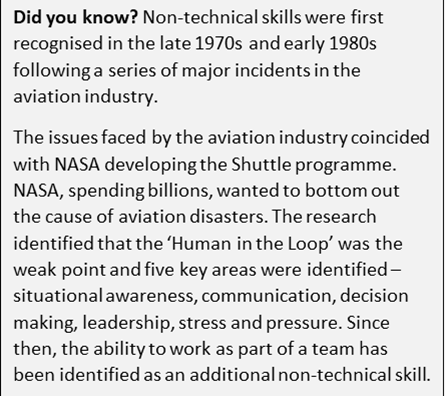
Non-technical skills can be defined as ‘the cognitive and social skills that complement a workers’ technical skills and, as such, contribute to safe and efficient task performance’ (Flin, O’Connor and Crichton 2008) and can be developed to complement an ER’s everyday skill set. These skills are include situational awareness, communication, decision making, leadership, stress and pressure, and teamwork.
Situational awareness
The three stages of situational awareness are: the ability to know what is going on around you by gathering information; making sense of this information and anticipating what could happen next.
ERs need to be able to demonstrate strong situational awareness in all three stages to fully understand the implications of acting on information received. They also need to consider that everyone perceives information differently based on the context and their own subconscious bias and experiences. The danger with situational awareness is that it can be affected by several components, which include lack of awareness in training, human limitations, stress, fatigue, and bias. ERs need to be trained to recognise these components to have a better chance of making the right decision.
It can be difficult for ERs to develop situational awareness while dealing with low-frequency incidents, such as those involving hazardous materials, which are known to be high risk. There is little that can be done about the level of risk. However, by increasing the frequency of high-quality training, ERs can develop mental models to refer to during high-pressure response situations.
Communication
Communication is vitally important when responding to incidents. It must be of a suitable style and frequency for each situation. When reviewing lessons learned or case studies of incidents, communication is highlighted, but is usually focused on the technical aspects. Factors that are technical by their nature could include battery failings, radio dead spots or an individual failing to select the appropriate radio channel – but should there be more focus on communicating effectively during an incident? For maximum effectiveness, non-technical skills training should develop an ER’s ability to communicate effectively in a style suitable for the stakeholder and at an appropriate frequency.
The following should be considered: Do you communicate effectively in 360 degrees? Do you consider the required frequency and most effective style of communications for each stakeholder? Do you communicate well under pressure?
If the answer to any of the above is no or if you’re unsure, then you need to review your communication skill set.
Decision making This is defined as the process of reaching a judgement or making the choice between options, perhaps better understood as a course of action to deal with the incident. In a pressured situation, the cognitive capacity of even the most resilient responders can become overloaded and compromised. Cognitive capacity can be affected by: too much information, habit, biases, health, groupthink, distractions, levels of experience, emotions, and pressure.
Applying learnt controls and tools is necessary to enable the decision maker to reach a successful outcome when dealing with incidents.
Leadership
When leading a response team, ERs need to reflect on how their leadership style in an emergency is interdependent on their leadership style in a non-emergency situation. At any incident, the lead responder must enable and empower ERs to approach them with new information. The leadership style before the emergency sets the tone of how team members react during the emergency.
Leaders must have the ability to be flexible in their leadership style in response to dynamic situations, taking on a more directive style when managing incidents and being more consultative in times of less risk.
Stress and pressure
There are many different factors to be considered regarding an individual’s ability to work in a stressful environment. Through self-awareness, training, utilising stress reduction techniques, being physically fit and being able to ask for support, responders can reduce the risk of negative impact from stress. When dealing with dynamic incidents, responders can manage the associated stress in the preparation phase by carrying out relevant training, which can assist them in becoming more familiar with that incident type.
Teamwork
When developing teamwork skills, responders must be mindful that they won’t always be part of the same team. They must reflect on how they are perceived by and respond to other team members, how they behave within a team and the impact of their behaviour. Within every highly effective team, there is a culture in which feedback is routinely given and accepted.
Developing and practicing non-technical skills
When reflecting on case studies of incidents where responders have been killed or seriously injured, there is usually an element of human error involved. To reduce the chance of this, ERs need to develop their non-technical skills.
It is necessary to continue to train and test technical skills to enable responders to be safe, effective, competent, and confident. Non-technical and technical skills training can occur simultaneously to assist with the time constraints placed upon response teams and organisations.
It is recommended that if training leads want to reduce the risk of human error and improve the safety of responders, they should look to integrate non-technical skills into training programmes at the earliest opportunity. Responders should continue to develop and practise these skills regularly.
NCEC’s training platform, Hazmat Academy, is a hazardous materials (hazmat) training model. It has revolutionised hazmat training by providing a contemporary solution that meets the needs of individuals and takes account of the modern-day challenges that emergency services and commercial organisations are facing.
The Hazmat Academy’s off-the-shelf courses cover non-technical skills, emergency response, chemical response training and detection, identification, and monitoring. They also offer distance learning modules on different topics such as waste fires, hydrogen fluoride and refrigerant gases and can cater to bespoke requirements.
All courses are accredited by the International Organisation for Industrial Emergency Services Management (JOIFF) and the hazmat courses are delivered in partnership with the Fire Service College.
The following schedule has been announced for this year’s emergency response courses:
Hazardous materials adviser initial: 27 June, 5 September, and 21 November
Hazardous materials first responder: 23 May
Hazardous materials instructor: 12 September
Hazardous materials adviser revalidation: 7 November
The academy’s distance learning courses are available to book all year around. You can find out more about the hazmat and chemical training courses through their website www.thehazmatacademy.co.uk. If you would like to speak with one of the hazmat academy experts for a more bespoke requirement, please contact them at support@hazmatacademy.co.uk.
The National Examination Board in Occupational Safety and Health (NEBOSH) has joined the OneWISH Coalition, which unites organisations and women’s networks. These networks are all working towards the aim of improving the prominence and influence of women in health and safety.
Women make up 60% of NEBOSH’s senior leadership team and 65% of the all employees. Julia Whiting, Director of Marketing and Communications said: “Here at NEBOSH we have great female representation; I’m proud to work alongside some passionate and tenacious women that share the same determination I do to be the best they can be.
“By joining OneWISH it is my hope that NEBOSH will be able to amplify this message of inclusivity. We want to encourage and enable even more women – and people of all gender identities – to achieve their ambitions and contribute towards the progress of the health and safety profession.”
Anne Gardner-Aston, Chair of OneWISH added; “We are delighted that NEBOSH are becoming part of the OneWISH Coalition to support women in the health and safety profession. We look forward to working with them and supporting their efforts to improve inclusivity in our profession.”
The International Fire Chiefs Association has opened nominations for the IAFC Ben Franklin Award for Valor. Since 1970, the IAFC’s most prestigious award has recognized the spirit of service, courage and heroism that is a proud tradition among the world’s fire and emergency service. The program is named for one of the first fire chiefs in the United States, Benjamin Franklin. An inventor, statesman and humanitarian, Mr. Franklin was a prime contributor to the wealth of tradition that symbolizes the fire and emergency service worldwide.
Presented annually at Fire-Rescue International (FRI) by the IAFC and Motorola Solutions, the award honors a firefighter(s) for their expert training, professional service and dedication to duty displayed in saving human life. More than that, the program helps raise public awareness and support for the fire and emergency service.
“We look forward to honoring the award recipients at FRI 2022 and every firefighter nominated for their heroic actions,” said Chris Lonnett, vice president of Central Region Sales, Motorola Solutions. “Motorola Solutions takes great pride in supporting the Ben Franklin Award for Valor.”
All active firefighters, career or volunteer, are eligible for award consideration, whether the event occurred while on or off duty. They need only to be nominated by their fire chief for an incident in which they saved a human life.
An individual or a team of up to four may be nominated. The chief must submit the nomination via the nomination link. The incident must have occurred between April 1, 2020, and December 31, 2021, to qualify for consideration. All nominations are reviewed by a committee of IAFC members.
The 2022 nomination period closes June 15 at 11:59 PM ET. Winner and regret notifications will be issued in July.
The winners will be announced Monday, August 22, 2022 and honored on Thursday, August, 25, 2022 at Fire-Rescue International in San Antonio, Texas.