ROCKWOOL introduces insulation to improve fire resistance in industrial plants

ROCKWOOL Technical Insulation has introduced its ProRox PS 680 with FR-Tech insulation designed for pipework systems of various sizes to improve fire resistance in industrial plants.

The insulation technology provides proven fire resistance to a plant’s piping network, giving additional time to stop the spread of a fire and get to a safe location.

ProRox PS 680 with FR-Tech is the latest offering in ROCKWOOL Technical Insulation’s line of ProRox stone wool insulation products. It works by slowing the transfer of a fire’s heat to steel pipework. The insulation adds critical time to a plant’s fire response and evacuation plans.

ProRox PS 680 was tested to the UL 1709 fire curve for optimized fire performance in 1- and 2-hour ratings on Schedule 40 and 80 pipe sections. It was also certified by internationally recognized organizations such as SWRI, Intertek, and SGH to deliver proven fire resistance for steam and pipe systems operating at high temperatures.

ProRox PS 680 is available as mandrel-wound, stone wool insulation pipe sections. The insulation sections are applied at typically half the thickness of conventional insulation materials and install easily, without the need for sealants or offsite cutting.

The insulation’s thinner application profile makes it easy to install around tight pipe bends and areas with limited clearance space. It is also removable and reusable and so the insulation optimises maintenance costs and allows for cost-effective, simplified inspection.

ProRox 680 with FR-Tech also incorporates ROCKWOOL’s proven WR-Tech technology, a revolutionary binder that coats each individual insulation fiber to combat corrosion under insulation (CUI). This gives the insulation an improved water repellency. The patented WR-Tech makes the insulation five times more water repellent (at 482°F/250°C) than standard EN-compliant stone wool, even after heating and aging.

Daniel Aiken, Business Unit Director of Americas for ROCKWOOL Technical Insulation, said: “When it comes to fires in an industrial plant, even mere seconds are critical to containing localized fire damage and preventing serious injuries.

“While it’s not possible to completely fireproof any plant, ProRox PS 680 with FR-Tech provides a cost-effective, proven solution to significantly increase your plant’s fire resistance. Plant operators are moving quickly to install this insulation solution on their piping systems, in less time, at lower costs, and with less effort than conventional insulation systems. And with the addition of WR-Tech for CUI mitigation, PS 680 helps extend plant operations and protect against two processing risks—fire and water.”

ProRox PS 680 is currently made in North America for North American customers who need proven passive fire protection for their plant piping systems.

Exclusive: The Lifecycle of a Fire Door

Mark Alton, Fire Door Product Manager at Winkhaus UK, explains the latest changes to fire doorset legislation

Fire doorset legislation has improved significantly in the recent years, with changes made at every stage in the lifecycle of a fire doorset, from design and testing to inspection and maintenance. For social housing fire doorset specifications, this means that all the stages in the lifecycle of a fire doorset, need to not just be included in the specification, but reviewed to ensure compliance with the new legislation.

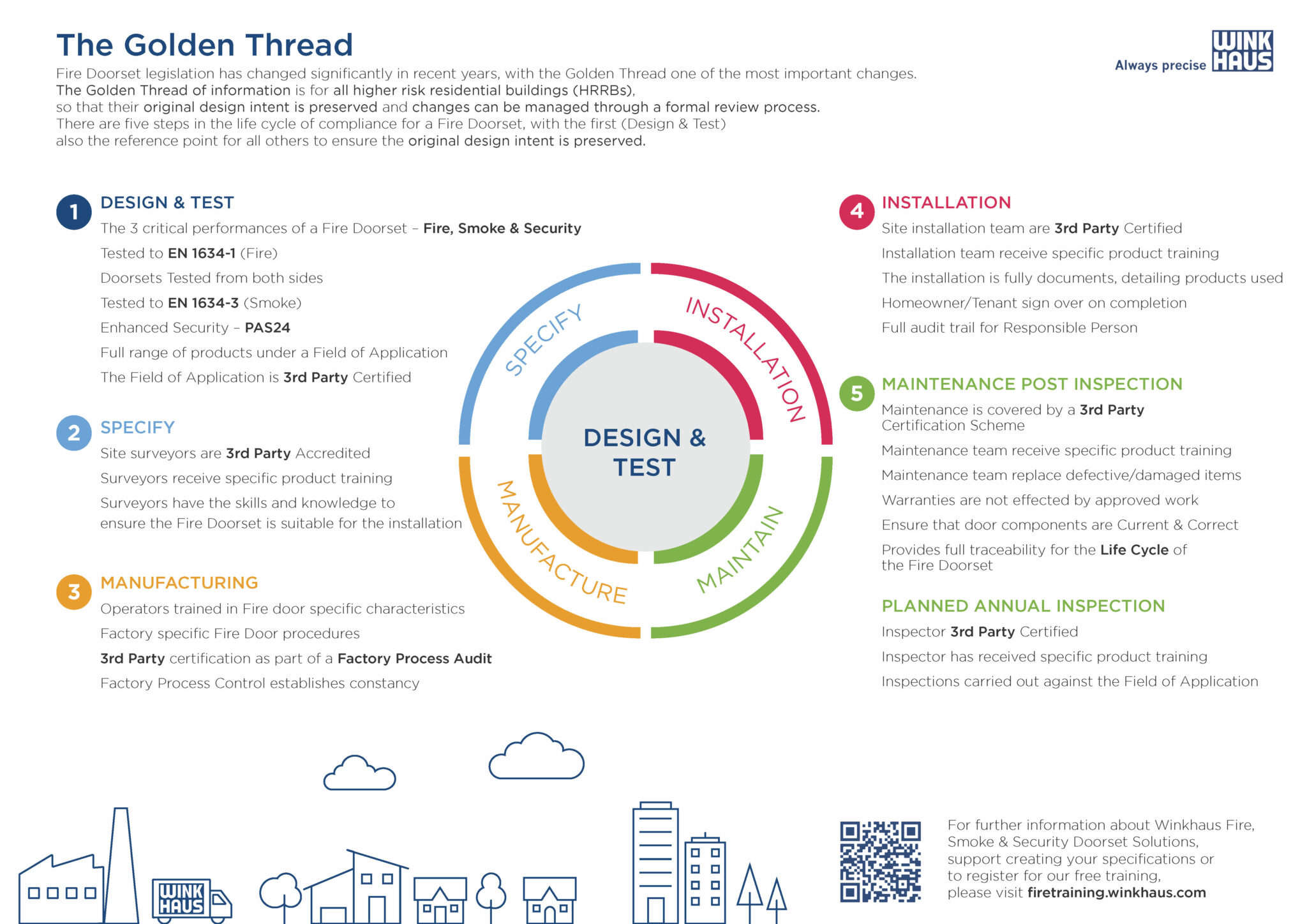
One of the most important changes to legislation is The Golden Thread, created to link all stages in the lifecycle of a fire doorset. It is required for all high-risk residential buildings to ensure that the original design intent of the fire doorset is preserved, that any changes must be made through a formal review process and the data for lifecycle is visible to responsible person(s) and tenants.

There are five steps in the lifecycle of compliance for a fire doorset. The first is design and test which is the key reference point for all other steps to ensure the original design intent is preserved. The others are: specifying, manufacturing, installation and maintenance post inspection, with a recommended planned annual inspection.

Certifiably safe

It is of paramount importance that maintenance teams are fully trained and have knowledge of the individual aspects of a fire doorset. This should include tested performance knowledge and product composition to ensure what was tested is the same as what is surveyed, manufactured, installed and maintained.

As an example, if a fire doorset has a damaged or broken piece of glazing, the maintenance team will need to have been trained and have the knowledge of how the doorset was constructed. They must be able to replace components like for like and know what components should be replaced as part of this repair. This will ensure the fire doorset remains compliant and its performance is maintained as per original design intent.

We are seeing an increasing number of report cases where components are being replaced during maintenance with components that are not part of the original test data and even where non-fire rated components have been used.

When specifications are changed and aren’t reviewed to ensure compliance with legislation, this brings significant personal risk to you as the responsible person(s). Under the new legislation the responsible person(s) is both legally and financially at risk if The Golden Thread is not adhered to at every stage of the lifecycle.

Over the past decade the Winkhaus UK technical team has been involved in the creation and implementation of the latest standards and guidance. All its fire doorset solutions are compliant with the latest MHCLG guidance and are triple Q Mark independent 3rd Party audited.

Winkhaus UK Composite Fire Doorset solutions were the first to attain the new Q Mark 3rd Party Audited Certification for Smoke and become the first company to attain Q Mark certification for all three critical performance requirements Fire, Smoke & Security. Winkhaus UK Timber Fire Doorset solutions are also currently completing accreditation.

If you are unsure whether your specification is complaint or unsure about what compliance is, Winkhaus UK can do a specification health check or even write your fire doorset specification. We have also expanded our free training to aid the understanding of the new requirements for a compliant fire doorset specification. We offer three different levels of training which can be tailored to the audience to ensure it meets your requirements.

To further aid in adoption and understanding of the new legislation we have created The Golden Thread for Fire Doors Checklist which provides you with a definitive list of key things that you are required to include in your specification at every stage of The Golden Thread.

To register for Winkaus’ free training, to receive a specification health check or a copy of the specification checklist, visit www.firetraining.winkhaus.com

This article was originally published in the August edition of IFSJ. To read your FREE digital copy, click here.

France’s agriculture minister calls for investment in wildfire firefighting

Marc Fesneua, Agriculture Minister for France, has called for greater investment into fighting wildfires after the Gironde region saw destructive breakouts of fire.

Mr Fesneau said the government had already earmarked 850 million euros to upgrade its fleet of fire-fighting planes, as well as 1 billion euros used for re-planting trees.

“We are having to confront a quite exceptional situation, we are talking about more than 20,000 hectares affected in Gironde, 1,500 in Finistere and 1,500 in the Bouches du Rhone,” he told France 2 Television.

The wine-growing Gironde region in southwestern France saw its biggest wildfires in over 30 years. Authorities said a man had been detained on suspicion of arson.

The fire spread across 19,300 hectares (about 75 square miles) in the countryside surrounding Bordeaux since July 12, forcing 34,000 people to evacuate their homes. About 2,000 firefighters, supported by eight water-bomber aircraft, were battling the blazes.

Sprinkler systems: How watertight are they?

This year, the UK government reduced the height threshold for new residential buildings requiring sprinkler systems, in a bid to make housing safer. But how effective are sprinklers really? Ian King, COO, Zeroignition explains in this exclusive article.

With the anniversary of Grenfell back in media headlines, the construction industry is once again thinking about fire safety. Sadly, since the tragedy, not enough has been done to safeguard high-rise buildings, yet the introduction of the Building Safety Act, offers hope of change. It’s an important time for the sector – making the right changes now could create safer structures for generations. Get it wrong, and we could have another disaster on our hands. 

Yet as it stands fire safety in construction is still falling short of the mark. Protocols around safety checks are lacking and knowledge about products and systems is far from satisfactory.

An obvious example are sprinkler systems – well known for their effectiveness in suppressing fire when deployed correctly, yet evidence suggests that inspection processes lack a robust enough framework to ensure their reliability.

According to the FPA, by law, in the UK only 20 sprinkler heads out of every 5,000 are required to be examined yet an estimated 40 million sprinklers are fitted worldwide each year. By comparison, in the U.S., all sprinkler heads have to be checked annually with additional monthly inspections.

In short, we have no idea exactly how many will work in the event of an emergency, presenting an unacceptable threat to life.

Seeing the bigger picture

This isn’t to say that sprinkler systems aren’t an effective method of fire protection – we know that when deployed correctly, they’re one of the best forms of defence. In fact, Fire Safety Advice Centre statistics show that not a single person has died in the UK where a working sprinkler system has been present in a building. What’s more, research by The National Fire Chiefs Council (NFCC) shows that sprinklers are effective almost 100% of the time when helping to extinguish or control fires as well as prevent further damage. So long as they work.

However, we’d be wise to avoid using them as a one-size-fits-all protection strategy. Instead, we should view and include them a part of a diverse mix of passive and active fire protection options – think fire-resistant walls and floors (passive) and fire blankets and extinguishers (active). Especially given the UK’s track record for safety checks and evaluation. The NFCC for example, reported over 1,000 ‘failures to operate’ in a corporate context from 2011 to 2016 and a recent U.S. study by the NFPA reported that 10% of sprinkler failures result from a lack of maintenance.

Understanding the bottom line

The hard truth is that we know construction industry thinking is strongly driven by profit margins, and sprinkler systems initially come with a hefty price tag. Taking into account the cost of setup, supplying and maintaining high water pressures and energy for a functional system, prices can quickly escalate. That’s not accounting for the costs to maintain and check systems in-person. Of course, money shouldn’t be a factor when risk to life is involved but there’s no denying that cost implications can sway the level of safety within a build.

Relying on sprinkler systems can also side line other fire safety options, allowing housebuilders to treat fire safety as a ‘tick this box exercise’ rather than treat it with the holistic approach it needs. For example, we know that good passive protection reduces or removes the need for active fire suppression – with broader considerations, we can ensure multiple safeguards.

We’ve also seen uncertainty around fire safety terminology, which needs to improve if we’re to make future structures safe and highlights the need for legislation that benchmarks industry best practice.

For example, in one of our research studies, we found that just over half of all architects couldn’t give an accurate definition of passive fire protection – ‘built-in’ fire protection. What’s more, 58% of architects were unable to explain what ‘reaction to fire’ is – a measure of flammability. Almost three-quarters (71%) were unable to define fire resistance – the ability of products and technologies to resist and prevent the spread of fire.

Encouraging innovation

Relying on a one-system approach to fire safety also stifles innovation. Without room to introduce new strategies, the industry could be missing out on more effective, less expensive options. It isn’t about abandoning sprinkler systems entirely – we know that they work and, when properly maintained, have been proven to save lives. However, in order to move forward, we need to see them considered as part of a more well-rounded approach to fire safety – one that brings both passive and active solutions into the mix.

By doing so, occupants will receive improved levels of safety in the properties they purchase. Beyond this, for contractors and developers, it shows that they are doing all they can to invest properly in fire safety – which is exactly where the industry needs to be.

Sentry Doors secures accreditation for FD30S range

Fire safety door supplier Sentry Doors has announced that it now offers UKCA accreditation on its entire range of FD30S flush and glazed doorsets following a bi-directional burn test of its double-glazed range, including its double glazed doorsets complete with double glazed and panel sidelight.

The United Kingdom Conformity Assessment mark (UKCA) replaces the CE mark used in the European Union, for mainland UK and serves as a declaration of performance to the essential characteristics in accordance with the harmonised standards. The UKCA marking came into effect in January 2021 with businesses granted an extension until the 1 of January 2023 to transition to the UKCA marking from CE marking.

The UKAS accredited lab tested doorsets comprising of the door leaf and a glazed panel sidelight, alongside a door leaf with a range of Sentry’s glazing combinations, to ensure all variations were compliant. Each test exceeded the minimum 30-minute time requirement for an FD30S doorsets, demonstrating the overall integrity of the doorset and the superiority of the product. This accreditation offers customers complete confidence in these products.

Ty Aziz, Managing Director, Sentry Doors said: ‘We are pleased to announce the success of our recent fire test for bi-directional FD30S UKCA Double Glazed doorset complete with double glazed and panel sidelight. We reacted quickly to the changes in the market last year and are happy to share that we were the fire UK fire door manufacturer to obtain the UKCA marking with approved body BM TRADA.

“We now offer our entire range of FD30S flat entrance door styles in a range of combinations to suit our customers and their project requirements. As Sentry grow, we are constantly making efforts to remain a market leader and be at the forefront of compliance’.

Discover Sentry Door’s full range of FD30S external UKCA doorsets now. For complete confidence in compliance, you can be secure with Sentry. Contact marketing@sentrydoors.co.uk for more information.

Exclusive: Avoiding catastrophe with vehicle fire suppression

Johan Balstad, vice president, Dafo Vehicle Fire Protection, considers the new risks arising from the increased uptake of EVs

In an increasingly environmentally conscious world, the number of electric vehicles (EVs) is growing, meaning it’s time for recognition and understanding of how to mitigate the unique fire risks they pose.

A sustainable future

The number of EVs in use has been rapidly increasing, at 40% year and year, reflecting sustainability by encouraging better air quality, in addition to offering lower fuel costs by reducing the reliance on fossil fuels. This growth is only set to increase further, with improved battery technology and affordability supporting the shift for individuals, and EVs providing certain industries with cost effective, environmental solutions.

Moving forward, battery manufacturers are looking to improve the battery efficiency to cost ratio, in the hope of increasing adoption across the world. It’s predicted that battery technology is likely to increase the amount of energy density within the battery, as well as bringing about faster charging, to improve the consumer experience.

Rising risks

However, although EVs with higher energy density and reduced charging time are desirable, this can increase already rising the fire risks that EVs present.

Although much safer for the environment, EVs present their own unique fire risks that need to be understood in order to be effectively mitigated. Fires in these vehicles are less likely to occur than internal combustion engine (ICE) vehicles, however, due to the chemistry of the battery and the type of fire that can occur, they present more intense fire risks, which can be catastrophic for passengers and operations.

There have been various reports of EV fires causing safety concerns to life and operations. For example, a crash turned fire, which killed three passengers in China and the destruction of 25 EV buses in a bus depot in Germany.

More recently, an EV bus caught fire in Paris, with the cause of the fire unknown and the reasoning for the successful evacuation attributed to passers-by, rather than a fire detection system.

Battery chemistry

The most common battery powering the shift to EVs is the lithium-ion (li-ion) battery, and it’s the chemistry within these batteries that’s causing rising fire risks.

Within the li-ion battery, there is a cathode covered in a sliver of aluminium and mixed-metal oxide ink and an anode covered in copper coated in graphite. Between these poles is a plastic separator in solvent, and during charge or discharge, lithium ions will move from or to the anode or cathode.

Should li-ion batteries experience increased heat, mechanical failure, overcharging or physical damage, this can cause the battery to short circuit. A short circuit will create excess heat, leading to a dangerous state called thermal runaway due to a reaction between the cathode and the flammable electrolyte within the battery.

Reducing fire risks

With EVs being picked up in almost every industry in the near future, there’s a necessity to understand the risks and how industries can protect against them.

  1. Equipment

Installing a fire detection and suppression system that is able to recognise that the battery is at risk of thermal runaway in its earliest stage can help to reduce the likelihood of extreme consequences to life and operations.

  • Battery management

Battery management systems are great for monitoring temperature, voltage and current in a li-ion battery. However, they can’t prevent thermal runaway should it occur suddenly, such as from a damaged battery due to a crash, for example.

  • Educating users

To prevent the catastrophic consequences of a li-ion battery fire, it’s important to educate all of those using an EV on its potential risks. By educating people on the ‘dos and don’ts’ of EV battery safety, fires are less likely to occur due to overcharging, poor management or insufficient suppression measures.

Detection and suppression

If thermal runaway is allowed to fully take hold, reignition is extremely common, and EV fires can burn for days, reigniting after the fire seems to have been defeated. Currently, the only way to make sure a fire is out completely, is total immersion within a pool of water.

This makes early detection and suppression key to reducing fire risk. Extensive research and testing from an EU-funded initiative, in collaboration with Research Institutes of Sweden (RISE) and Dafo Vehicle Fire Protection, found that a battery suppression solution can be installed during the manufacturing process to provide an early fire warning system, in addition to spot cooling to prevent a battery reaching thermal runaway.

During this research, spot cooling was found to be the most effective technique to suppress thermal runaway following the detection of defects. Spot cooling should use a suitable suppression agent. Although fluorine foams have been used for years in fire-fighting due to their suitability, modern environmental concerns have led to bans on suppression agents containing fluorine, which are spreading across the globe.

Moving forward with EV safety

With the increase of EVs happening across almost every industry around the world, it’s important to fully understand fire risks. In addition to managing batteries and educating those about battery safety, installing appropriate fire suppression solutions is key to reduce risks and ensure a safe and sustainable future.

For more information, visit Dafo Vehicle Fire Protection.

This article was originally published in the May edition of IFSJ. To read your FREE digital copy, click here
Exclusive: TLX Technologies talk adding value to suppression systems

With an approach towards product development to add value to suppression systems, TLX Technologies highlights some key innovations from the firm

As the fire protection industry gathers this summer for Interschutz 2022 in Germany, it is interesting to look back on how much has changed since the last event was held seven years ago.

While there has been development and growth across all aspects of the industry, TLX Fire & Security, a division of TLX Technologies, has been focused on the changes in standards as well as the adoption of better security features on fire suppression systems worldwide.

In January 2016, shortly after the last Interschutz show, NFPA 2001: Sec. 4.3.4.1 (a standard for supervision on actuation devices for fixed gaseous fire suppression systems) went to effect. The goal behind the introduction of this standard was to provide a means for ensuring that the actuating device would be correctly installed on the system, at both initial installation and also after periodic maintenance, by providing a visible and audible signal at the fire panel when the actuator was either disconnected or not installed properly.   

TLX showcased its first product that met this new standard for supervision at Interschutz 2015. Since that time, system manufacturers across the globe have been adopting this standard for their actuating devices to ensure proper installation, especially for those systems that would be sold into areas where the NFPA guidelines are observed. Additionally, other regions have seen the benefit of updating their own standards in like manner. For example, later this year the European standard (EN 15004) will be changing to require supervision of actuating devices to better align with the NFPA standard that has been in effect for the last six years. While the initial NFPA standard was designated specifically for fixed gaseous fire suppression systems, NFPA recently expanded that standard to water systems with the update to standard NFPA 13: Sec. 8.3.1.2.1 that went into effect in January of last year.

Although TLX has been designing and producing actuation devices for fixed gaseous fire suppression systems for over 20 years, they have seen marked growth since developing their first product that met NFPA standards for supervision. They expect that growth to continue in the coming years as regulatory standards further align globally across the fire suppression industry.

Since their first product introduction, TLX has added several additional actuators to their portfolio to meet the requirements of suppression systems with higher operating pressures. They also added manual actuation and reset options for their actuators along with a pneumatic actuator that pairs with their electric actuators to provide customers with a full system solution. All their electric actuators are UL 864 Recognized and meet the NFPA requirements for supervision. 

New Products Showcased

TLX approaches product development with the goal of giving system manufacturers access to solutions that will add value to their suppression systems. This year TLX Fire & Security will be showcasing their new patented Explosion Proof Actuator with Supervision and their Liquid Level Sensor at both the NFPA and Interschutz shows in June. 

Fire suppression systems for hazardous environments typically rely on an actuation device and additional tubing between the actuation device and the storage tank to route discharge pressure through the system. This creates the potential for a number of leak points. Additionally, such systems require an enclosure so that if flammable gas were to make its way into the actuation device and ignite, any fire would be contained within the enclosure and would not cause combustion of any flammable substances in the atmosphere.

TLX had received numerous inquiries about possible solutions that would satisfy safety requirements for hazardous locations. Their team decided to develop a top-mounted linear actuator that acted as its own enclosure. The result was the Explosion Proof Actuator with Supervision, which is UL HazLoc, ATEX, and IECEx certified for use in hazardous locations and meets NFPA requirements for supervision.

The actuator’s top-mounted design means that it does not act as a pressure vessel on the discharge valve. This eliminates the extra connections that other solutions rely on to connect the actuator to the storage tank and route discharge pressure through the system. As a result, the only potential leak point at the tank is at the top of the discharge valve. Additionally, special design features and material grade selection allow the actuator to act as its own enclosure. All potential flame paths are specifically designed to prevent flame egress in the event a spark were to ignite any gas found in the actuator.

Because every system is unique, the actuator can be customized to fit any system. The internal components can be configured during production to match any operating pressure up to 300 bar. The interface can also be fully customized: mounting thread, connection type (male or female), firing pin stick out, and firing pin geometry can all be configured according to the customer’s specifications.

The Explosion Proof Actuator with Supervision provides an all-in-one solution for hazardous locations that simplifies installation and maintenance and helps improve system reliability.

While TLX has long specialized in producing the most innovative actuation devices, they have taken their technological expertise and applied it to integrated sensing to satisfy other needs in the fire suppression industry. Most recently, they developed a liquid level measuring device that offers a better alternative to current methods of determining the level of extinguishing agent in a system’s storage tanks.

Most solutions for measuring the level of extinguishing agent require a technician to take a manual reading and calculate the weight using a conversion table. Accurately calculating the weight of the extinguishing agent is crucial for keeping the system operating, and manually calculating conversion table data creates the potential for errors.

TLX Fire & Security developed a solution that would eliminate the potential for human error that is inherent in many of the methods currently being used. The Liquid Level Sensor automatically provides a thermally compensated weight reading of the extinguishing agent in the fire suppression system’s storage tanks. The sensor is comprised of a sealed tube with a magnetic float mounted on the outside of the tube. This tube is installed in each tank prior to being filled with the extinguishing agent. There is another magnetic float inside the tube that interlocks with the float outside the tube, providing an accurate measurement of the fluid level inside the tank. At the end of the tube at the top of the tank is a sensor that sends float position and temperature data to a microcontroller that is preprogrammed with a conversion table for that specific tank and extinguishing agent configuration. The microcontroller then automatically calculates the weight of the extinguishing agent inside the storage tank.

The weight of the extinguishing agent can be displayed directly at the tank on a digital display or transmitted to the fire control panel via hardwired or wireless connection. Data can also be accessed remotely or downloaded using a USB connection. Additionally, a simple GO/NO-GO status can be displayed with a green/red LED to indicate the status of the storage tank.

While the Liquid Level Sensor is an ideal solution for many fire suppression systems, some systems require the tanks to be weighed. For such systems, TLX is currently developing the Hanging Weight Sensor and Platform Weighing Sensor. These sensors will feature continuous monitoring, high accuracy (100 g resolution), and 500 kg maximum capacity. These weighing sensors are scheduled to be available to the market in the second half of 2022. 

The Future of the Industry

Data collection and the Internet of Things (IoT) has revolutionized the way businesses operate in nearly every industry. Everything from warehouses to manufacturing has used this technology to add value and improve efficiency. Warehouses have dramatically improved inventory accuracy and pick and ship times. Data can be collected and analyzed on manufacturing equipment for predictive and preventative maintenance, minimizing downtime.

However, the fire suppression industry has been slow to explore the ways that data collection and remote monitoring can improve safety and efficiency and bring value to their fire suppression systems. The changes brought to the world by the COVID-19 pandemic, often resulting in fewer people on-site and the explosion of remote work, has caused the industry to more seriously consider how IoT can be best used.

Data collection and IoT can make fire suppression systems safer and more efficient than they have ever been. Typically, fire suppression systems are only inspected biannually. If there is a fault in the system, it may not be detected until one of these inspections. But with remote monitoring, system faults can be detected almost immediately and addressed in the most efficient manner possible. This makes for a safer, more valuable system.

This technology promises to bring considerable value to all stakeholders. It is critical that the industry begins considering how data collection and IoT can be deployed. As customers begin to realize how this technology is benefitting other systems they rely on, they will look to the fire suppression industry for similar solutions for their fire suppression systems. If the industry fails to seize the opportunity to utilize this technology, another industry may step in and fill the void. The HVAC industry is already using this technology, and they may begin to include fire suppression data collection in their monitoring systems. By investing in this technology, the fire suppression industry can take an important step to ensure its growth and profitability.

This article was originally published in the May edition of IFSJ. To read your FREE digital copy, click here

The rise of water mist in firefighting

Bettina McDowell, general manager, International Water Mist Association talks about the latest developments in the growing solution

Over the last couple of years, things have progressed well for the water mist technology. On the one hand, there is a growing market for eco-friendly and sustainable products like water mist. On the other hand, the publication of the European Standard – which has been long overdue – has and will help further advance the technology. What has been growing longer already over the years is the list of applications. And a project which is in the pipeline could become a quite game changer for water mist.  

When it comes to fire protection, water mist is an eco-friendly alternative to other more traditional ways of keeping fires under control or extinguishing them. And here we are talking about sprinkler as well as foam or gaseous systems. Why use chemical additives or gases that incorporate a fear factor when it comes to human lives when you can use a system that combines many advantages and at the same time eliminates many disadvantages? 

The first standards for water mist were developed well over a quarter of a century ago. Factory Mutual published FM 5560 in 1995 and the National Fire Protection Association (NFPA) published NFPA 750 in 1996. Since then, the list of applications has been getting longer, both vertically as well as horizontally. Water mist – which was an off-shore technology in the very beginning – was further developed, and it has been many years since the first land projects were added to the list of applications. This growing list has most probably got a lot to do with the diversity of water mist systems. Water mist systems produce very smaller droplets. Water mist is thus a suppressant agent that is applicable on a broad range of fire types. In fact, water mist ticks nearly all the boxes, indeed more boxes than other of fire suppression system. This has been proven in an endless number of real-scale fire tests that water mist manufacturers have carried out in fire laboratories over the last three decades.  

When it comes to the protection of the environment, water mist goes back a long way. In the 1980s the world acted to save the ozone layer by signing the Montreal Protocol. One of the substances that was then banned was halon, a chemical used as a fire suppression agent that had caused ozone depletion. Regarding fire protection, the eradication of halon left a gap which was filled by water mist. “There are basically two ways to look at it. You could either say that halon was banned to protect the ozone layer or you could say that water mist was promoted to save the ozone layer”, says Bettina McDowell, general manager of the International Water Mist Association (IWMA). And important factor here was obviously the use of water instead of a chemical substance.  

Water-based fire extinguishing systems make up by far the largest share of the extinguishing technology sector and using a natural resource like water is always a good idea. However, water mist systems use up to 85% less water than traditional sprinkler systems which is an even better idea. Water is a natural resource, but it is also a precious resource especially like places in the Middle East where it is scarce.  

Many ask how less water can do the job. The answer to this is quite simple: a fire triangle consists of three elements, i.e. the combustible material, the heat and the oxygen, and water mist reduces the heat and the oxygen. In fact, water mist also wets the surroundings thus also affects the 3rd side of the triangle although not as much as traditional sprinklers. But there are other benefits: since water mist systems use less water, their components are smaller which means they need less space. Then there is the local inerting effect: Due to the enormous increase in the volume of the evaporating water droplets, the oxygen is displaced at the source of the fire and the fire is extinguished. During this process, the oxygen content around the fire (and only there) is below 21 %. And it is this low oxygen content that suffocates the fire. Further away from the fire the oxygen content is higher which means that there is enough oxygen available for humans. And then there is also the cooling effect that prevents reignition.  

When it comes to the longevity of systems, stainless steel components are often the best choice. Their use is not mandatory, but stainless steel prevents corrosion which is beneficial for the conservation of the systems and also lowers the risk of contamination. Plus: stainless steel can be re-used and thus be re-integrated into the life circle.  

A special challenge is fire protection in hazardous environments. When a fire breaks out in such areas this can result in the release of many different toxins and chemicals from the fuel of the fire or gases. The firewater gathers these substances and has to be picked up and disposed of afterwards which is a difficult job that becomes easier the less water there is. Mentionable is also the reduced water damage. After a fire there is less debris that has to be disposed of, plus in consequence there might well be less down time for businesses. 

All these benefits – some inside, others outside the eco-box – are now backed by the European Standards. EN 14972 is – as mentioned – by no means the first water mist standard, but  manufacturers in Europe have been waiting for it.  

This document specifies requirements and gives recommendations for the design, installation, inspection and maintenance of all types of fixed land-based water mist systems. It is intended to apply to water mist automatic nozzle systems and water mist deluge systems supplied by stand alone or pumped systems. It covers applications and occupancies which are covered by the fire test protocols of the EN 14972 series. What is important to know is that standards are not retrospective so anything in place (planned or contractual) before publication and implementation in any specific country can remain in place. And: The EN 14972 series are voluntary standards so standards like NFPA 750 can of course still be used. 

The work started two decades ago and on 23rd December 2020, EN 14972-1:2020 was finally published. And although it may be a European Standard, it could well have a worldwide impact. Based on the Vienna Agreement – which stipulates the exchange of information and increased transparency – standardization bodies can adopt standards which have been created in other parts of the world which means that the European Standard could be used globally.  

A project that is about to start and which could change the perspective on sprinkler and consequently water mist systems is a research project on the performance of sprinkler systems. IWMA and the Fire Research and Innovation Centre (FRIC) in Norway have agreed to collaborate to take a closer look at this issue. The main aim is to gather information on the performance of sprinklers in order to quantify the consistency of their extinguishing performance. For this purpose, IWMA will collect data which will then be made available to FRIC. FRIC will then organize, process and analyse the data and publish an open report.  

Bettina McDowell explains: “Our aim is to collect data from as many suppliers as possible that have conducted comparison testing between sprinklers and other alternative extinguishing systems. To ensure the quality of the results the tests have to come from accredited laboratories and approved sprinkler nozzles had to be used.” 

As far as the schedule is concerned, IWMA and FRIC are planning to finish the work with a year. The collection of the data will commence during the second quarter of 2022. The report will be published during the first or second quarter of 2023.  

It is no wonder that the list of applications is continuously growing. There are marine-based applications, there are land-based applications. There is a hall of fame which includs buildings like La Scala in Milan, the Elbphilharmonie in Hamburg, Windsor Castle, the Clock Tower in Mecca, Saudi Arabia, and the Eurotunnel between Great Britain and the continent. Even the ISS International Space Station carries portable water mist extinguishers.  

Water mist is a performance-based technology, and all systems are bespoke systems based on real-scale fire tests, because water mist is not a one-fits-all concept. So far, not everybody seems to understand this concept, but more and more end customers, insurers and authorities having jurisdiction do. Bettina McDowell adds: “This is – first of all – not about a bigger market share. This is – first of all – about safety, about lives, about jobs, about property. The best fire protection system has to be chosen for any one application so it can actually do the job.”  

Those who want to learn more about this technology can attend the 21st International Water Mist Conference, which in 2022 will take place in Madrid, Spain, on 9th and 10th November. Every year, manufacturers, scientists and other stakeholders come together to network and exchange the latest knowledge.  

Fire protection supplier Ardent enters partnership with Leeds Beckett University

Fire protection manufacturer Ardent has entered a partnership with North Yorkshire-based Ardent to help boost its management capabilities and develop strategies to break into new international markets.

The team of academics, all based within Leeds Business School, will work with Ardent on the Management Knowledge Transfer Partnership (mKTP) project, that’s funded in part by the UK government through Innovate UK.

Ardent is a supplier of fire protection and electronic safety systems for people and businesses using plant, public transport, and specialised vehicles – in the UK and overseas.

The project will run for 30 months and focus on building long-term marketing and internationalisation strategies for Ardent as it continues to grow.

The mKTP’s goal is to embed permanent transformations in leadership, management, and culture across the business.

Dr Catherine Ashworth, senior lecturer in strategic marketing at Leeds Beckett, is leading the partnership.

She said: “Through our new partnership we aim to create strategic growth within Ardent. We will do this by embedding new management capabilities across the value chain – and a new leadership model across the organisation.

“We will also focus on improving Ardent’s capabilities in gathering expert market intelligence, strategically assessing overseas market opportunities, developing internal and stakeholder communications, and by delivering strategic decision-making.”

Neil Crowther, managing director of Ardent, said: “Since our founding in 1993, we have always aimed to continually improve our offering and service. We always prioritise challenging ourselves and encourage collaboration across the company. This partnership is a natural fit for us and we look forward to it being a productive relationship that will help us provide even better service to all our customers around the world.”

Firefly reports strong showing at Fire Safety Event

The combination of well-established flexible fire barrier systems and brand-new products developed to complement their performance, brought a steady flow of new and existing customers to the stand of TBA Firefly, as the specialist manufacturer returned to the Fire Safety Event at the NEC (5th 7th April).

Firefly was showcasing its recently introduced Access Panel FR120 that has been developed to facilitate routine entry to lofts and other spaces compartmentalised using the manufacturer’s fire barriers. The 600 x 600mm lockable Zintec steel door and frame are IFC certified and supplied as a kit for a straightforward installation offering two hours’ fire protection.

Also debuting on the stand was Penowrap, a lightweight and flexible silica wrap which works with Firefly barriers like Athena by being able to protect steel or timber structural elements at their most vulnerable points.

Firefly Marketing Manager, Simon James commented: “After last September’s really positive show, it was expected this year’s Fire Safety Event would be a success, but we were very pleased with the number and profile of people who visited our stand over the three days.   

Shows like The Fire Safety Event are important to our brand and it was a good opportunity to let architects, engineers and other fire safety professionals look at, feel and discuss our passive fire protection products.  It is, after all, everything we are about – with FIREFLY being the first certified flexible fire barrier system and a manufacturer which continues to invest significantly in testing and developing new products which enhance our offer to specifiers and specialist installers.”   

Firefly’s expert technical staff were on hand to offer advice and support on all aspects of compartmentation when specifying the company’s products for both new-build and retrofit applications – within roof spaces, floor voids or for protecting partitions in warehouses and other structures.