Charleston Fire Department orders three new Pierce pumpers

Pierce Manufacturing Inc., an Oshkosh Corporation company, will be supplying the Charleston Fire Department in South Carolina. The order includes two Arrow XT pumpers and one Saber pumper. The department purchased the fire apparatus through Pierce’s dealer Spartan Fire and Emergency Apparatus, and delivery is expected in August 2022.

The Pierce Arrow XT pumpers feature a heavy-duty design with a short overall length of 29 feet and will be stationed in Charleston’s historic downtown district. The Saber pumper will support Charleston Fire Department’s suburban and rural service areas.

Joseph Roberts, assistant chief of technical services, Charleston Fire Department said: “The Charleston Fire Department has several fire stations built in the 1880’s and 1910 with height and length restrictions. Working with Pierce and their dealer, Spartan Fire, we were able to develop specifications for apparatus to fit into these older stations and maneuver through Charleston’s narrow historic streets. We purchased our first Pierce fire engine from Spartan Fire and Emergency Apparatus in 1983 and we’re confident in our continued relationship.”

The Pierce Arrow XT Pumpers will feature Arrow XT chassis, 500-gallon water tank, Hale 1500 gpm pump, Cummins L9 450 hp engine, and Side roll and frontal impact protection. Meanwhile the Pierce Saber Pumper will be built on the Saber chassis, and have a 1000-gallon water tank, Hale 1500 gpm pump, Cummins L9 450 hp engine bolted to the Allison 3000 EVS transmission

Robby Fore, president of Spartan Fire and Emergency Apparatus said: “We appreciate the long-standing relationship we have with the department which has a fleet made up almost entirely of Pierce vehicles. We are familiar with the challenges the department faces, including its historic fire stations and narrow city streets, and are proud to be able to provide the customized solutions and ongoing support they need to best serve the City of Charleston.”

The Charleston Fire Department serves a growing, thriving, and historic port city. The department includes four battalions from 17 fire stations with 401 personnel who responded to 21,165 calls for service in 2021 across a 134 square-mile radius. Charleston is known for its historic architecture, cobblestone streets, and oak tree-lined neighborhoods. The community requires fire apparatus with superior maneuverability for easy navigation on narrow residential and city roadways.
Euralarm releases guidance on integrated fire protection for batteries

The Extinguishing Section of Euralarm has published a guidance document on integrated fire protection solutions for lithium-ion batteries. This new guideline provides information on the issues related to the use of lithium-ion batteries, how fires start in batteries and on how they may be detected, controlled, suppressed, and extinguished. It also provides guidance on post fire management. Excluded from the scope are explosion and ventilation issues.

Lithium-Ion batteries have become the battery technology of choice in a variety of areas, including amongst others, power generation, communications, industrial, vehicles and many other applications. Active control of the energy being stored and extracted from lithium-ion batteries has been the foundation of their increasing popularity. The relatively low frequency of major incidents is testament to the effort and successful design applied to the critical aspect of using such high-density energy products. However, active control of the battery energy is not sufficient to prevent safety-critical situations and multiple levels of defence are needed to minimize the serious consequences of a failure in a lithium-ion battery.

The increasing number of lithium-ion batteries and an increasing amount of stored energy in different energy storage applications present a new type of fire hazard where fire protection is challenging. Key issues in any fire protection system are the selection of the most appropriate agent for the specific hazard, system layout, the correct discharge of the extinguishing agent, as well as correct installation, the use of approved systems and constant maintenance by appropriately trained staff.

The guidance document ‘Integrated fire protection solutions for lithium-ion batteries’ is intended as guidance for all professionals dealing with fire safety, fire protection, extinguishing and fire suppression in connection with the use, storage or transport of lithium-ion batteries and their fire risks. Aspects of consumers products are not covered in this guidance.

The document is intended as general guidance and is not a substitute for detailed advice in specific circumstances. It represents the current understanding of the industry and will be updated as more information becomes available.

RoSPA launches safety guidance for zero emission light-powered vehicles

The Royal Society for the Prevention of Accidents (RoSPA) has produced new safety guidance for users of zero emission light powered vehicles (ZELPVs).
 
Zero emission light powered vehicles (ZELPVs), also known as powered light vehicles (PLVs), are vehicles with two, three or four wheels that are smaller and lighter than traditional vehicles, and produce zero exhaust emissions. Examples of ZELPVs include small electric mopeds, tricycles and quadricycles (small cars). Electric bicycles and electric scooters are not considered to be ZELPVs.
 
Rebecca Needham, Road Safety Officer at RoSPA said: “For 105 years, RoSPA has been striving to make our roads safer for all. In that time, the nature of the risks on the road have changed partly due to emerging technology and people making journeys with different modes of transport such as ZELPVs and other electric vehicles.”
 
“As the use of ZELPVs in the UK increases, RoSPA would like to see health and safety at the heart of every stage of their development, from their design and manufacturing to their testing and licensing.”
 
At present, all ZELPVs can be legally classified as “L-category” vehicles. Within this category, vehicles are separated into groups depending on characteristics such as their size, engine capacity and speed, and different licence entitlements are required depending on the vehicle.
 
ZELPVs are smaller and lighter than traditional vehicles, individuals who use them are more vulnerable to harm on the road. However, ZELPVs sit across several vehicle categories this means collision data is not readily available
 
Rebecca continued: “RoSPA would also like to see a government-led campaign which helps to raise awareness about ZELPVs and provides guidance for their safe use. It is particularly important that workers who use ZELPVs as part of their job are given clear instructions for safe use. Looking ahead, RoSPA recommends that ZELPVs should be given their own category when road safety collision data is being collected to allow for a clearer safety analysis.”

ZF and ZIEGLER agree strategic partnership

Technology company ZF has received a major order for its digital connectivity solution ZF Rescue Connect from Albert Ziegler GmbH, one of the leading manufacturers of firefighting vehicles. The deal, worth several million euros, is one of the largest framework contracts for digital services ever awarded to ZF.

From the beginning of 2022, ZIEGLER will equip new vehicles with ZF Rescue Connect as an option and offer digital services to its end customers. In addition, ZF and ZIEGLER have agreed a strategic partnership for the digitalisation and networking of ZIEGLER firefighting vehicles.

With more than 130 years of experience in the industry, ZIEGLER possesses a vast wealth of professional knowledge and expertise, making it a perfect partner. Both companies are committed to developing the best possible solutions for customers worldwide in order to make the world a safer place. ZIEGLER’s production knowledge and fire know-how mean it is ideally placed to create the firefighting vehicles of the future.

“This major order from ZIEGLER affirms that with ZF Rescue Connect we have created a convincing solution for networking rescue services,” said Florian Freund, responsible for ZF Rescue Connect. “At the same time, ZF Rescue Connect is an example of ZF’s innovative strength as a developer of new digital services.”

“The strategic partnership with ZF is an important building block for us in the ongoing digitalisation of our firefighting vehicles, and enables us to offer our customers cloud-based services with high added value,” said Bernd Geiselmann, CFO at ZIEGLER. “In addition, we can make over-the-air software updates to firefighting appliances throughout their entire service life, regardless of location.”

Connectivity for rescue services

ZF Rescue Connect digitally connects rescue services with one another during operations and provides them with all important status information relating to the vehicles and equipment deployed in real time. The digital connectivity solution is based on an Internet of Things (IoT) cloud platform driven by technology group ZF.

This is where all data from the relevant emergency vehicles converge and can be accessed by the operations center via a digital dashboard. Using this overall view, the incident commander and the services involved can see, for example, whether heavy equipment such as spreaders and rescue shears are on site for rescuing accident victims from vehicles, how much of which extinguishing agent is available to the fire department at the scene, whether the emergency physician and ambulance have already arrived or to which hospital the injured have been taken.

Small electronic transmitters and receivers network accident victims and the rescue forces deployed, and provide essential information from other rescue equipment via mobile communications and the IoT cloud.

The real-time availability of such data gives emergency response leaders unprecedented access to the information required to successfully and quickly complete operations with the best possible outcomes.

More information: www.zf.com/rescue-connect

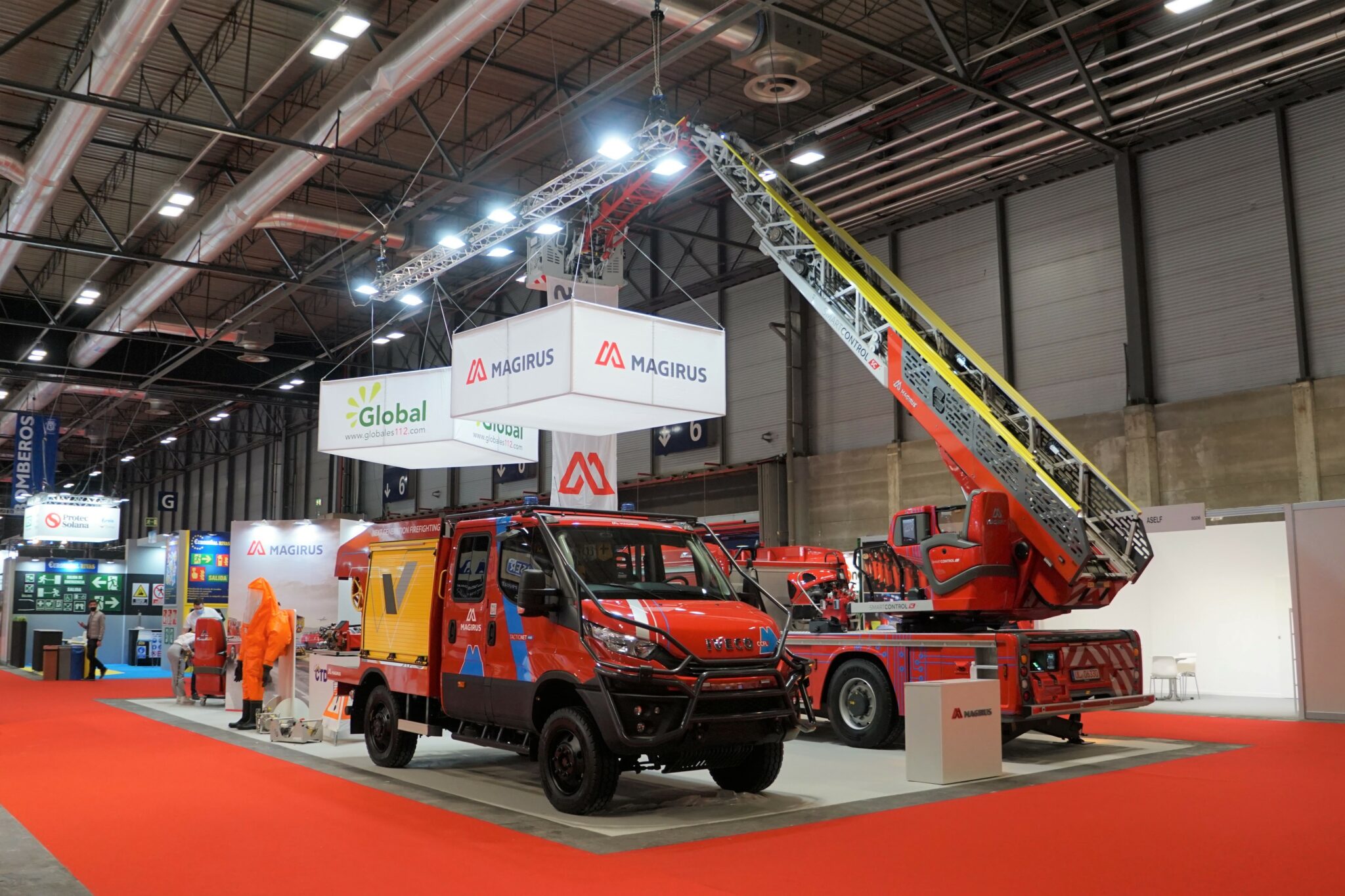
Major order: Dortmund professional fire brigade converts complete turntable ladder fleet to Magirus

During a small, festive ceremony in front of the Westfalenhalle on Tuesday, representatives of Magirus handed over 13 identical Magirus turntable ladders to the Dortmund Fire Department.

In the course of this delivery, Dortmund is replacing all existing turntable ladders for its professional fire brigades as well as one volunteer fire brigade with new vehicles from Magirus. This means that in future the fire brigade will not only have a pure Magirus turntable ladder fleet but will also use M32L-AT articulated turntable ladders across the board.

Dipl.-Ing. Dirk Aschenbrenner, Director of the Dortmund Fire Department, explains this extraordinary step as follows: “We have discussed things in detail and see decisive advantages in the joint training on a uniform firefighting technology. With around 2,200 professional and volunteer firefighters and more than 150,000 operations per year, it must be ensured that all machinists can handle every turntable ladder perfectly. In addition to the high quality and reliability of Magirus turntable ladders, we also appreciate their ease of operation.”

The Dortmund firefighters were able to convince themselves of these advantages via a pre-built prototype, which they tested intensively for four weeks. Norbert Schilff, the 1st Mayor of the City of Dortmund, and Torsten Wandel, Head of Sales Germany at Magirus, were also present at the ceremonial handover of the keys.

Torsten Wandel is particularly pleased about the major order for the Dortmund Fire Department: “We are proud to have won this important tender for Magirus. At the same time, it was also an obligation for us to be able to deliver our highly reliable turntable ladder technology for all vehicles to the Dortmund Fire Brigade within one year.”

When the city of Dortmund launched the tender approximately one year ago, Magirus was able to prevail against all competitors. In addition to the service and maintenance costs, it was, among other things, the uncompromisingly high qualitative and technical criteria with which the articulated turntable ladders from Magirus were able to convince.

All 13 vehicles are built on Mercedes-Benz Atego 1530 F chassis and were completed and delivered in only 12 months after receiving the order. During the development phase, special emphasis was placed on safe operation, maximum ease of use and multifunctional equipment.

The Magirus RC500 rescue cage for 5 persons or 500 kg is equipped with a water and foam monitor with a capacity of up to 2,500 litres per minute as well as self-protection nozzles. Furthermore, in addition to a video support system and the specially developed direct entry with camera, all vehicles are also equipped with the Magirus SkyBeam safety function.

With its automatic headlight positioning, it helps to detect possible sources of danger such as overhangs or overhead lines even in the dark or in poor visibility which can also help to avoid a time-consuming repositioning of the vehicle. The scope of the contract also includes a service and maintenance contract for 10 years for the superstructure as well as the delivery of a Magirus RescueLoader RL500, which has been especially designed for the rescue of obese persons.

The RescueLoader thus represents an important support for the emergency services and, thanks to its unique levelling system as well as special transport functions, enables a safe and gentle rescue of persons without any improvisation.

Harrisburg Fire Department purchases first 107’ Smart Reach from Spartan

Spartan Emergency Response, a subsidiary of REV Group has announced it is building a 107’ Rear Mount Aerial with Smart Reach Multi-Stance technology for the Harrisburg Fire Department in North Carolina.

Smart Reach Multi-Stance™ is the patented new Smeal ladder and outrigger control system that offers increased versatility and functionality for today’s firefighters, including a 360-degree, no dead-zone functionality that can be adapted to the scene while maintaining full reach, and access to real-time data. The Multi-Stance technology allows the operator to set up the outriggers to any reach that the fire scene will accommodate. In addition, the Smart Reach control console offers the next generation of electric and hydraulic aerial controls, giving users the ultimate in smooth operation.

Harrisburg spent many hours researching and testing aerial products before deciding on the Smart Reach Aerial. “It wasn’t until we tested the Smart Reach Aerial that we came to appreciate all the technical innovations, functionality and capabilities this apparatus offers,” said Harrisburg Fire Chief Bryan Dunn. “Coupled with Smeal’s pedigree of aerial safety and stability, we immediately knew this apparatus would be a perfect fit that will effectively and efficiently meet the rigorous operational demands of our department.”

A loyal Spartan Chassis customer since 1993 and a Smeal customer since 2004, Harrisburg worked with the Smeal team and Atlantic Coast Fire Trucks in receiving real time drawings and 3D Cad schematics of previous apparatus to maintain safety and effectiveness continuity among its fleet. The latest safety features include the Spartan Advanced Protection System (APS), the Active Air Purification System, EZ Clean Cab Interior Surface, enhanced scene, and ground lighting, Bostrom Durawear washable seat covers and more.

“Spartan Emergency Response is honored to continue our long relationship with the Harrisburg Fire Department in serving their community,” said Chris Wade, Director of Sales at Spartan Emergency Response. “The department’s hands-on approach and feedback was a key part of our final design. Their trust in us has created an exciting partnership with the launch of our leading-edge Smart Reach Aerial and continuing our service to the town for another generation.”

London continues to be hit with fire engine shortages due to reduction in staff numbers

London has had over a third of its fire engines unavailable as Omicron hits staffing numbers, new London Fire Brigade data shows.

Shortages reached 50 fire engines during the day shift of the 25th of December, and reached 42 for the day shift of the day before. There are 142 fire engines in the capital.

This marks a worsened problem after data for the 10th to 16th of December had previously revealed that shortages were running at a maximum of forty.

The new data, for the 24-27 December, shows that shortages were constantly close high across this period, with a majority of shifts seeing shortages of at least 40 fire engines.

The shortages also include a new 64 meter ladder appliance, bought after the Grenfell Tower disaster, being unavailable on the night of the 24th and the day of the 25th. 

These shortages come as Omicron has hit the capital and its fire and rescue service. Figures for the 27th December revealed that Covid had left 740 operational firefighters either having tested positive or having to self-isolate, meaning that over 15% were unavailable for work.

This is up from 10% for the 16th of December, and a level of at least 14% unavailability was present across 24-27 December.

FBU London regional secretary Jon Lambe said:“Omicron is directly affecting the level of fire and rescue cover Londoners receive: over a third of fire engines being unavailable is a huge shortage that could have serious impacts.

However, Omicron should not be having an effect on this scale – the reason it is is that London Fire Brigade has been left in a terrible state by years of government cuts, with almost one in five of London firefighters having been cut since 2010.

At the start of the pandemic our members in London helped in any way possible, volunteering to drive ambulances and working in multi-agency teams dealing with Covid-related fatalities. In some cases members spent weeks away from their loved ones for fear of transmitting the virus. But now the tables have turned and the London Fire Brigade itself is in real difficulty.

Now, we are seeing the real impact of the pandemic on our own service and it’s reached a critical point. London and Londoners pay their taxes for a level of service and fire cover that they are being denied due to Governmental cuts and mismanagement.

As a union we are highlighting this because it’s simply not right and it’s not safe”.

Fire Brigades Union data [1] shows that since 2010 London has lost almost one in five of its firefighters – just over 1,110 – and an operational firefighter recruitment freeze in the service has only just been lifted.

Furthermore, there are fears that the levels of staffing could grow even worse, with a potential “mass exodus” of hundreds of staff ahead of pension changes in the new year. 

Isle of Man Government receives three Oshkosh Striker 6×6 ARFF vehicles

Oshkosh Airport Products, LLC have announced that the Isle of Man Government has received three Oshkosh Striker 6×6 ARFF vehicles. The Isle of Man is a British Crown Dependency in the Irish Sea between Great Britain and Northern Ireland. The new Oshkosh Strikers were delivered in early December 2021, and support operations at the Isle of Man Airport (IOM). Extensive training has commenced in preparation for the vehicles to enter front line service in the first quarter of 2022.

“This delivery represents the first Oshkosh Strikers for the Isle of Man Government and the vehicles will provide essential advancements in acceleration, maneuverability, firefighting capabilities, and safety technology for the fleet,” said Jack Bermingham, business unit director for Oshkosh Airport Products. “Supported by Terberg DTS UK, IOM will have convenient access to critical service support for the aftermarket care of their Striker ARFF vehicles.”

Features of Isle of Man Airport’s Striker 6×6 ARFF vehicles:

  • Scania DC16 V8 700 HP Engines
  • 50-foot (15 meters) Snozzle® High Reach Extendable Turret (HRET)
  • Water capacity: 3,170 gallons (12,000 liters)
  • Foam capacity: 444 gallons (1,680 liters)
  • Dry chemical capacity: 550 Ibs (250 kg)
  • Eco-EFP™ Foam Measurement System 

Isle of Man Airport’s new Striker 6×6 ARFF vehicles are also equipped with a Snozzle HRET strobe light, dual LED tip spotlights, mounted thermal camera, piercing tip color camera, and an air aspirated bumper turret with a discharge rate of 1,585 gpm (6,000 L/m).

Also known as Ronaldsway Airport, IOM Airport is located in the island’s southern region and southwest of Douglas, the island’s capital. Along with the Isle of Man Sea Terminal, it is one of two main gateways to the island and services over 800,000 passengers yearly.

Rosenbauer builds Custom Cobra Aerial Fire Truck for NASA’s Langley Research Center

Rosenbauer, the world’s leading manufacturer of firefighting vehicles and equipment, announced the delivery of a custom Rosenbauer 101’ Cobra Aerial to NASA’s Langley Research Center.

“The Langley Center was in need of an apparatus that could reach multiple locations on the grounds quickly, while also covering for aeronautical tests, trainings and simulations,” said George Bergamini, Rosenbauer Government Sales Manager. “NASA was seeking a custom apparatus that would be used to keep employees and contractors safe, while also ensuring the Center’s investments and research could quickly be saved if a fire occurred.”

“We knew NASA’s Langley Research Center needed a very specific, custom fire apparatus that could be active at any of their facilities on campus,” continued Bergamini.

By working directly with the team at NASA, Rosenbauer was able to create a custom apparatus that was tailored with the most cutting-edge technology available.

The Langley Research Center’s Rosenbauer 101’ Cobra Aerial fire truck features:

  •       Custom Commander chassis
  •       101’ RM Cobra Platform
  •       IDEX SAM Pump Control System
  •       Hot-dipped galvanized steel
  •       500-gallon water tank
  •       Hale 8FG 200 GPM pump

While this is Rosenbauer’s first apparatus delivery for NASA, the two entities have very similar missions of protecting people, property and the planet. This made Rosenbauer a natural partner in building a custom apparatus for the Langley Research Center.

NASA’s Langley Research Center was the training site for the first crews of astronauts, and was also home of the Lunar Landing Facility, which provided the simulation of lunar gravity, and the home of the Viking program for Mars exploration.

Rosenbauer has more than 150 years in the fire equipment industry, and is a global provider in firefighting technology and resources. Rosenbauer is the world’s largest firetruck manufacturer, with 11 manufacturing plants worldwide, three of which are in North America.

Rosenbauer delivered the custom apparatus to NASA’s Langley Center in mid-July. This ladder will also serve the City of Hampton as a first due ALS Ladder.

To learn more about Rosenbauer America, visit https://www.rosenbaueramerica.com/