James Morrison, Regional Sales Manager at Hochiki Middle East FZE, explains how advanced certification, rigorous testing, and regional expertise are shaping dependable life safety solutions
Earth Fire Alliance wildfire detection project promises faster response
Brian Collins, Executive Director of Earth Fire Alliance discusses the future of wildfire detection and monitoring
Kidde Commercial adds new fire alarm devices
Kidde Commercial has announced new outdoor models and low frequency horn-strobes for its Genesis LED fire alarm series.
Where accuracy meets application: Sensitron’s approach to gas detection across complex environments
Emanuele Barbieri, Key Account Manager HVAC-R at Sensitron, explains how gas detection systems help safeguard lives, workplaces, and infrastructure across complex and hazardous environments
Hochiki provides fire safety for Iceland’s Fjarðargata development
Hochiki Europe has reported that it has supplied a fire safety system for the Fjarðargata development in Hafnarfjörður, Iceland.
How to Test Smoke Alarms Properly
A smoke alarm is one of the most important safety devices in the home, yet they’re often overlooked until it’s too late.
If you have one installed, testing your smoke alarm regularly is a simple task that can save lives.
To test a smoke alarm, press and hold the test button on the front panel until you hear a loud, continuous sound.
If the alarm does not sound, replace the battery. If it’s a sealed unit, speak to a specialist to replace the alarm.
You can also use a smoke detector test spray or safe smoke source to check the sensor, following the manufacturer’s guidance.
Our article explains exactly how to test your smoke alarm properly, how often you should test it, what to look out for, and what to do if something’s not right.
Whether you’re a homeowner, renter, or responsible for a business premises, this guide will leave you better informed and safer.
What is a smoke alarm and do I need one?
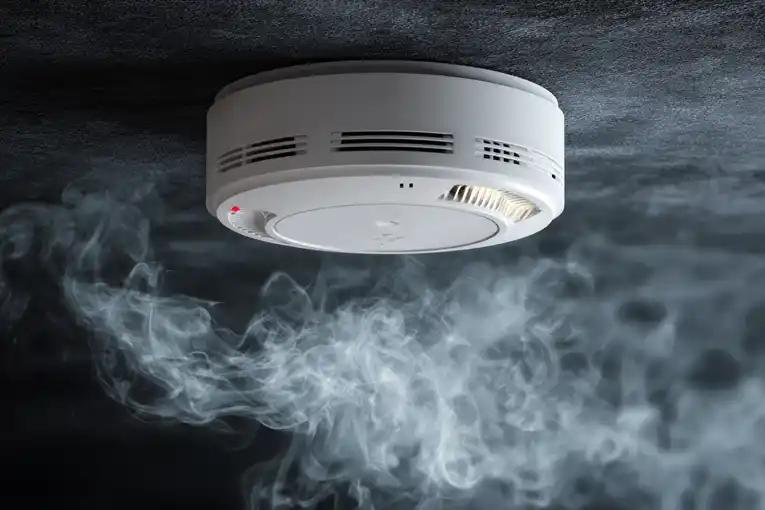
Smoke alarms are devices specifically designed to detect smoke (a primary indicator of fire), and sound an audible warning to alert people in the building.
Most smoke alarms operate using either ionization sensors, which respond to fast, spreading fires, or photoelectric sensors, which are better at detecting slow, smoldering fires.
Some units combine both technologies for a more comprehensive coverage.
Every single building, residential or commercial, needs a smoke alarm – bar none!
In most countries, having at least one working smoke alarm on every level of a home is a legal requirement.
In the United States for example, the National Fire Protection Association (NFPA) recommends smoke alarms are fitted inside each bedroom, outside each sleeping area, and on every level of the home, including the basement.
In the UK, Australia, and many other countries, similar laws and recommendations also exist.
Why Test Your Smoke Alarms?
Testing your smoke alarm is the only way to know its working properly.
Even if the unit appears in good working order, components inside can degrade over time.
Batteries can die. Dust or insects can clog the sensors. Wiring can loosen.
A malfunctioning smoke alarm is essentially useless in an emergency.
Fire statistics consistently show that the risk of dying in a home fire is cut in half when working smoke alarms are present.
Regular testing ensures you and your family are alerted in time to escape.
How Often Should I Test My Smoke Alarms?

Experts recommend testing your smoke alarms once a month.
This frequency ensures that any battery issues, sensor faults, or connectivity problems are identified before a real emergency happens.
Here’s some additional maintenance recommendations to remember:
- Battery-powered alarms: Replace batteries at least once a year, unless the alarm uses a 10-year sealed battery.
- Hardwired alarms: These are connected to your home’s electricity supply but typically still have a backup battery that needs yearly replacement.
- All smoke alarms: Replace the entire unit every 10 years, or sooner if the manufacturer recommends it or if the unit fails testing.
Marking these tests on your calendar or making them a part of your monthly routine is an easy way to stay safe.
How to Test a Smoke Alarm

Testing a smoke alarm is a very straightforward process, but it varies slightly depending on the type of smoke detection unit you have installed.
Battery Units
- Locate the test button: This is usually visible on the front face of the alarm.
- Press and hold the button: After a few seconds, the alarm should emit a loud, high-pitched sound.
- Listen for consistency: The sound should be continuous and strong. If it’s weak or erratic, replace the battery immediately.
- No sound? Replace the battery first, then test again. If there’s still no response, replace the entire unit.
Hardwired Units
- Locate the test button: Press and hold the test button exactly as you would on a battery-operated alarm.
- Interconnected alarms: If your home has interconnected alarms, pressing the test button on one unit should cause all the alarms to sound. This is normal and confirms they’re correctly linked.
- Backup battery: Even though these alarms are connected to mains power, always check the battery backup. If the alarm fails the test and replacing the battery doesn’t fix it, call an electrician to inspect the wiring or replace the unit.
Optional Sensor testing
If you want to test the smoke sensor itself (not just the loudspeaker or battery), you can use a smoke detector test spray.
This creates a safe, simulated smoke environment.
Unless advised by the manufacturer, avoid using real smoke such as candles or matches, as this can contaminate and damage the sensor.
Troubleshooting
If your alarm fails the test or behaves strangely, here’s what to do:
- Weak or chirping sound: This usually indicates a low battery. Replace it and retest.
- No sound at all: Try a brand new battery. If still silent, the unit may be faulty.
- Frequent false alarms: Dust, steam, cooking fumes, or insects can all cause false triggers. Clean the alarm with a vacuum cleaner or soft brush. Avoid using sprays or solvents.
- Random beeps: Some units beep to signal end-of-life, often every 30 to 60 seconds. Check the label on the back for the recommended replacement date.
Safety Tips
- Always test your alarms after a vacation or extended period away.
- If you’re hearing impaired, install smoke alarms with strobe lights or vibration alerts.
- Avoid painting over smoke alarms since this can block sensors.
- For rental properties, landlords are usually responsible for installing alarms, but tenants should still test them regularly.
- Don’t ignore chirps or unusual sounds, since they’re indicators telling you something’s wrong.
Key Takeaways
Testing your smoke alarms is one of the simplest ways to protect everyone in your home.
It takes less than a minute, but it could be the difference between life and death in the event of a fire.
Make it a habit, stay informed, and stay safe.
When testing, press and hold the test button monthly to check your smoke alarm’s function.
Replace all batteries at least annually, or sooner as needed.
Alarms should be fully replaced every 10 years, even if they seem to function properly.
Use some test spray for a more thorough check of the smoke sensor if desired.
And address any beeping, silence, or false alarms promptly. Don’t ignore them.
The Last Word with FFE: Fire detection for large open spaces
Liam Arstall, FFE’s Head of Product Marketing, discusses fire detection in open spaces and the push for reduced installation time, cost and maintenance
Hyfire and Hertek announce partnership in the Netherlands
Hyfire expands wireless fire safety into the Dutch market
Hyfire has announced a new partnership with Dutch company Hertek to expand the use of wireless fire detection technology in the Netherlands.
According to Hyfire, the collaboration builds on Hertek’s established market presence and combines it with Hyfire’s wireless systems, including the Taurus platform.
The company explained that the agreement is part of a wider European expansion strategy and reflects a focus on technology, customer requirements, and compliance.
Ollie Murray, Hyfire’s International Director, said the partnership strengthens both parties’ ability to provide scalable and regulation-compliant fire safety solutions across a range of projects.
Murray added that Hertek’s expertise in Dutch regulations and customer needs will ensure that the technology is applied effectively in the local market.
Partnership goals and strategy
Hyfire reported that the Netherlands is a market with high potential for wireless adoption, particularly in renovation and commercial construction projects.
It stated that the partnership will allow both companies to bring wireless technology to a wider audience of installers, consultants, and end users.
Murray said: “As Hyfire continually establishes and grows our brand globally, selecting a partner whose own values mirror ours and shares the desire to move life safety systems forward through the power of technology is an exciting opportunity.
“Hertek as the market leading brand in the Netherlands is the perfect fit for our market leading products of today and the future.”
According to Hyfire, the collaboration allows each company to focus on its strengths: Hyfire in product development and international growth, and Hertek in local knowledge and customer focus.
Technology integration and product application
Hyfire noted that its Taurus system will complement Hertek’s existing portfolio of addressable and conventional systems.
It explained that Taurus will integrate with Hertek’s Penta control panel and Hertek Connect platform to deliver a combined solution that requires minimal disruption to buildings.
The company stated that this approach will be especially relevant for renovation projects and sites with complex building layouts.
Murray commented: “Hertek is a household name in the Dutch market. With Hyfire’s global success we are able to share the benefits of wireless technology to Installers, Consultants and End Users.”
Standards and compliance
Hyfire reported that Taurus meets European CPR standards and Dutch NEN 2535 requirements.
It confirmed that EN 54-13 certification is also in progress.
The company stated that future product development will continue to align with Dutch regulatory demands and incorporate feedback from customers.
It added that maintaining compliance across multiple jurisdictions is a core focus of the partnership.
Hertek’s position in the Dutch market
According to Hertek, the agreement strengthens its ability to serve Dutch customers with flexible wireless solutions.
The company explained that the systems can be installed without invasive building work, offering advantages where time constraints or structural conditions make traditional systems more challenging.
It reported that combining Hyfire technology with Hertek’s established portfolio gives the business an enhanced position in the market.
Murray concluded: “For those that see the benefits in Wireless already and those who are yet to experience the power of Hyfire – our collaboration with Hertek will provide you the opportunity to experience the power our Taurus products offer first hand.
“You will not be disappointed!”
Relevance for fire and safety professionals
This development is relevant for fire and safety professionals because it highlights the increasing adoption of wireless detection systems in European markets.
The partnership shows how international technology providers and local specialists are working together to meet both technical standards and customer needs.
For professionals, the collaboration demonstrates how compliance requirements and system integration shape the selection of fire detection technologies.
It also reflects broader trends in applying wireless systems to renovation and large-scale construction projects.
Hyfire and Hertek announce partnership in the Netherlands: Summary
Hyfire has announced a partnership with Hertek in the Netherlands.
The company reported that the agreement will expand the use of wireless fire detection technology in the Dutch market.
Hyfire confirmed that its Taurus system will be introduced as part of the collaboration.
The system will integrate with Hertek’s Penta control panel and Hertek Connect platform.
Hyfire stated that Taurus meets European CPR standards and Dutch NEN 2535 requirements.
EN 54-13 certification is currently in progress.
Hertek reported that the partnership strengthens its ability to provide flexible solutions.
The company explained that wireless systems can be installed without invasive work, saving time in renovation projects.
Hyfire noted that the Netherlands is a key market for wireless adoption.
It added that the collaboration builds on Hertek’s knowledge of regulations and customer needs.
Murray said the companies share values and focus on technology.
The partnership aims to bring wireless solutions to installers, consultants, and end users.
Hyfire reported that ongoing product development will reflect customer input and Dutch regulations.
The company confirmed that compliance across jurisdictions is a continuing priority.
The collaboration marks a step in Hyfire’s European expansion strategy.
Zelim partners with US Navy on AI detection research
Agreement enables joint trials with US Navy
Zelim has announced a Cooperative Research and Development Agreement (CRADA) with the US Navy’s Naval Undersea Warfare Center (NUWC) Division Newport to test its AI detection system, ZOE Shield.
According to Zelim, the agreement allows the company to participate in BlueTIDE 2025, a demonstration event organised by 401 Tech Bridge, NavalX and the Northeast Tech Bridge.
The company explained that the event will conclude with a full-scale in-water trial on 28 August in Narragansett Bay, Rhode Island.
Zelim said it is one of a small number of international companies selected for the 2025 BlueTIDE Prize Challenge following a competitive review process.
The company stated that this year’s mission scenario focuses on protecting subsea infrastructure from threats posed by small crewed and uncrewed autonomous systems.
ZOE Shield trial and operational role
Zelim reported that its role in the scenario is to detect small remotely operated surface vessels operating covertly in sensitive areas.
It said these craft may present a potential threat to subsea infrastructure by serving as a precursor to sabotage.
The company explained that its ZOE Shield system is based on the same AI engine used in its ZOE man overboard system, which is deployed in the cruise and offshore sectors.
It added that ZOE Shield extends these functions by providing situational awareness of small surface craft not using AIS.
The developer outlined that the system introduces automated classification and alerting, helping operators with early detection and response measures.
Features of the AI detection system
According to Zelim, ZOE Shield is designed to function in environments where GPS denial or radar jamming could limit conventional surveillance methods.
It stated that this makes the system relevant for security operations requiring layered detection and resilience against interference.
The company noted that the US Navy is evaluating the system as part of its assessment of intelligent surveillance technologies.
Zelim explained that this evaluation will take place in live operational scenarios during BlueTIDE.
It added that the data will be used to support the Navy’s capability review and potential future development.
CEO comments on defence scenario
Sam Mayall, CEO and co-founder of Zelim, said: “This agreement gives us a unique opportunity to trial ZOE Shield in an operational defence scenario at a US Navy facility, where multiple assets, including USVs will be deployed on the mission.
“This is about closing the gap between detection and decision, especially in domains where the threat is small, fast-moving and unpredictable.
“Our mission is to help operators identify anomalous behaviour earlier, whether the goal is rescue or protection.
“This demo is a vital step toward deploying ZOE for real-world defence scenarios.”
Role of CRADAs in research collaboration
Zelim stated that CRADAs enable non-federal organisations to work directly with US Navy personnel and facilities.
It said this framework allows research partners to collaborate outside of federal acquisition rules.
The company explained that the structure also protects intellectual property and proprietary data.
According to Zelim, this mechanism is being used to facilitate the ZOE Shield trial in Rhode Island.
It added that further information will be released in line with CRADA requirements after the demonstration.
Relevance for fire and safety professionals
AI detection technologies such as ZOE Shield have potential applications in safety-critical fields beyond defence.
The system’s ability to function without reliance on radar or GPS may inform the design of fire and rescue monitoring technologies in environments subject to interference.
The early classification and alerting features under test may also have relevance to operators seeking to improve situational awareness in complex emergency scenarios.
Zelim partners with US Navy on AI detection research: Summary
Zelim has signed a CRADA with the US Navy’s NUWC Division Newport to test its AI detection system ZOE Shield.
The agreement enables Zelim’s participation in BlueTIDE 2025, a demonstration event scheduled to conclude on 28 August in Narragansett Bay, Rhode Island.
Zelim is one of a small number of international companies selected for the 2025 BlueTIDE Prize Challenge.
The company will trial ZOE Shield to detect small surface vessels operating covertly near subsea infrastructure.
The AI engine used in ZOE Shield is also employed in Zelim’s ZOE man overboard system, which is already deployed in maritime industries.
ZOE Shield provides automated classification and alerting functions and is resistant to GPS denial and radar jamming.
The system is being evaluated by the US Navy for its role in layered maritime surveillance and response.
Sam Mayall, CEO and co-founder of Zelim, said the demonstration is an opportunity to test ZOE Shield in a live defence scenario.
CRADAs enable collaboration with the US Navy while protecting intellectual property and removing federal acquisition requirements.
Further details will be made available after the demonstration in line with the CRADA framework.
Bull Products to exhibit at UK Construction Week 2025
Bull Products confirms debut at Birmingham event
Bull Products has announced it will be exhibiting at UK Construction Week Birmingham for the first time.
According to Bull Products, the company will be at stand D112 from 30 September to 2 October 2025.
It said the stand will showcase safety systems designed for the construction sector and related applications.
The company added that its Fire 360° service will be a central focus, along with its SITENET, SITEPROTECT and SITEEVAC+ alarm and detection systems.
Fire 360° service and carbon reduction focus
Bull Products reported that its Fire 360° service is designed as a complete compliance solution.
The company explained that the service covers design, installation, commissioning and maintenance across sites of different sizes in the UK.
It added that Fire 360° also includes asset collection, storage, cleaning and inspection, preparing equipment for reuse on future projects.
According to Bull Products, Fire 360° supports the Green Bull initiative by helping customers address carbon reduction requirements while maintaining site efficiency.
SITENET fire detection and alarm system
Bull Products stated that SITENET will be featured at the event as part of its system range.
The company explained that SITENET is a fully EN 54 certified wireless intelligent fire detection and alarm system.
It added that SITENET can link up to 511 devices from one panel across 32 zones.
The system uses radio devices and wireless mesh technology with network redundancy and channel hopping, the company said.
It reported that SITENET meets JCoP and HSG168 compliance requirements and can be used in both internal and external environments.
SITEPROTECT system applications
Bull Products confirmed that SITEPROTECT will also be on display.
The organisation stated that SITEPROTECT is a temporary wireless mesh fire detection and alarm system designed for the construction industry.
It explained that SITEPROTECT supports up to 480 devices across 15 zones using EN 54-5 and EN 54-7 certified detector heads.
The system also incorporates wireless emergency fire, first aid, intruder and lockdown alarms.
The company added that the lockdown alarm has been developed primarily for the education sector but can also be deployed in public settings such as shopping centres.
SITEEVAC+ system for cost-sensitive projects
Bull Products noted that SITEEVAC+ is the third system in its product line to be displayed at the exhibition.
The company explained that SITEEVAC+ is a wireless mesh fire detection and alarm system supporting up to 50 devices in 3 zones.
It said the system is intended for projects working within lower budgets while still requiring essential fire detection capability.
According to Bull Products, SITEEVAC+ is particularly suited to housebuilding and development sites.
It added that the system uses EN 54-5 and EN 54-7 certified detector heads.
Company statement on exhibition
Carl Leeson, Head of Sales at Bull Products, said: “We’re excited to be exhibiting at UK Construction Week Birmingham after the success of the London event in May.
“We invite attendees to visit us at stand D112 to discover how Bull Products has a cutting-edge solution for every application with SITENET, SITEPROTECT and SITEEVAC+.”
Relevance for fire and safety professionals
The exhibition of Bull Products at UK Construction Week provides sector professionals with an opportunity to assess compliance-focused fire detection and alarm systems designed for construction environments.
The presence of SITENET, SITEPROTECT and SITEEVAC+ demonstrates the range of wireless mesh systems available across different project budgets and operational scales.
For safety managers, the integration of temporary and permanent detection systems into site operations is relevant to meeting regulatory standards such as JCoP and HSG168.
The addition of services such as Fire 360° also links fire safety provision with sustainability objectives, reflecting operational and compliance requirements within the sector.
Bull Products to exhibit at UK Construction Week 2025: Summary
Bull Products has announced its first appearance at UK Construction Week Birmingham.
The company will be at stand D112 from 30 September to 2 October 2025.
It will present its Fire 360° service and fire detection systems SITENET, SITEPROTECT and SITEEVAC+.
Fire 360° includes design, installation, commissioning, maintenance, asset collection, cleaning and inspection.
The service supports the Green Bull initiative for carbon reduction.
SITENET is EN 54 certified and supports up to 511 devices across 32 zones.
It uses wireless mesh technology with network redundancy and channel hopping.
SITEPROTECT supports up to 480 devices in 15 zones and includes fire, first aid, intruder and lockdown alarms.
The SITEPROTECT lockdown system was developed for education and can be applied in public sites.
SITEEVAC+ supports up to 50 devices in 3 zones and is intended for cost-sensitive projects.
It uses EN 54-5 and EN 54-7 certified detector heads.
Carl Leeson, Head of Sales at Bull Products, confirmed the company’s invitation for attendees to visit the stand.