Tailored training systems supporting brigades: FireGo’s answer to aircraft, tunnel and EV fire risks

Jochen Schuergers, General Manager at FireGo, explains how modular live training systems support brigades across vehicles, tunnels, structures and hazardous materials

Fire brigades have long relied on one command that brings an operation to life: “Water ON!” At Fire Go GmbH, we design our training systems to prepare firefighters for that moment in a controlled and repeatable environment.

Our role is to support the safe practice of live fire skills.

When we complete maintenance or deliver a new facility, our internal signal of readiness is the same each time: “Fire GO!”

We specialise in gas fired and solid fuel fired fire simulation systems that support training centres in many different operational settings.

Our work covers design, planning and production, along with the long term service and maintenance needed to keep complex systems running.

This includes inspections, repairs, technical upgrades and extensions carried out by qualified technicians.

All control software is developed in-house so that every installation can follow the customer’s training approach.

Since our foundation, we have grown steadily and supported an increasing number of fire brigades in Germany and abroad.

From the beginning, our aim has been to create training environments that reflect real operational demands.

Fire training systems allow firefighters to work with real heat, real flame behaviour and real smoke conditions.

These elements help firefighters develop skills that cannot be gained through theory alone.

Live fire practice supports situational awareness, improves coordination and strengthens confidence during real incidents.

Fire Go was founded in August 2016 by a small team with specialist experience in fire training technology.

As demand increased, we moved to larger premises in 2018.

Today, Fire Go operates as a medium sized organisation with a team whose individual experience extends up to 30 years in this field.

This knowledge influences every installation we build, from compact units to large multi-module structures.

We supply fire training systems in many forms.

Some are designed for regular use at regional fire brigades.

Others are built for specialised locations such as airports, industrial facilities or tunnel authorities.

Our guiding principle remains consistent.

We can recreate anything that can burn in real life.

Aircraft fire training systems

Aviation incidents demand careful preparation, and we develop systems that allow these scenarios to be trained safely.

Our Mobile Aircraft Fire Trainer is constructed from ten container based modules that recreate the outline and dimensions of an Airbus A320 or a Boeing B737.

The assembled structure is around 40 metres long with a height of ten metres and a wingspan of roughly 20 metres.

Inside and around the aircraft, firefighters can work with 28 controllable fireplaces along with a fuel spill area of approximately 120 square metres.

These points allow the practice of cabin and cockpit fires, undercarriage incidents and fuel-fed external scenarios.

The modules can be assembled, dismantled and transported within a single day.

This flexibility is suited to airports and training centres that require high intensity training without keeping a permanent full-scale aircraft onsite.

Training for new vehicle risks

Changes in vehicle technology have altered the nature of emergency response.

Electric vehicles behave differently in fire conditions, and our Electric Car Fire Trainer E H2 is designed to support practical training for these incidents.

It can simulate thermal runaway within a battery module.

It can generate white or black smoke.

It can reproduce fire in the engine bay, passenger compartment or boot.

Hydrogen powered vehicles present their own challenges.

The trainer includes a hydrogen fire feature in which the flame is invisible to the naked eye.

A thermal imaging camera is needed to identify it, which helps firefighters recognise how these fires behave and how they can be approached safely.

Tunnel environments and restricted access

Tunnel operations require training in controlled but realistic surroundings.

To support this, we build tunnel fire trainers that allow responders to work with long enclosed spaces and limited access routes.

In our tunnel systems, structures such as a truck tractor, a flatbed truck and a passenger car can be fixed at set points along the tunnel.

Each mock-up contains fireplaces that can be activated independently or in sequence.

Heat protection panels enclose the fire areas to protect the tunnel walls and the technical systems behind them.

These environments are used to practise navigation, hose handling, breathing protection, rescue techniques and coordinated extinguishment.

Mobile training facilities

Many customers need the option to train across several locations.

Our trailer based fire training units were developed for this purpose.

Each unit is built on a semi-trailer with a fixed steel structure, creating a fully usable training space that can be transported as needed.

A hydraulically extendable side section increases the interior volume by roughly 40 percent.

The roof can also be adjusted hydraulically to create additional training opportunities and access points.

The fireplaces installed inside each trailer follow the training concept requested by the customer, which helps brigades tailor exercises to their region or operational profile.

Customised structural fire trainers

Some brigades require training environments that reflect the buildings they encounter most often.

We design structural fire trainers that can include residential layouts, industrial spaces or commercial areas.

Any combination of fireplaces can be integrated.

This approach supports detailed scenario based exercises and allows instructors to guide firefighters through settings that resemble their local built environment.

Training for public fire safety

We also develop systems for organisations that teach civil fire safety.

The Hand Extinguisher Fire Trainer FLT10 is widely used by fire safety officers who train employees, students or other building users in the proper use of handheld extinguishers.

The unit provides safe, repeatable live fire demonstrations suitable for introductory courses.

Specialist systems for aviation and hazardous materials

For emergency services operating in aviation settings, we produce a Helicopter Fire Trainer equipped with fireplaces in the engine area and cockpit, along with an external fuel spill simulation.

A stretcher in the rear section allows practical rescue training through the rear doors.

For hazardous materials response, we supply a tank wagon trainer.

It includes simulated leaks on the tank body, pipework and valves.

Additional fireplaces can be added according to the training plan.

The version described includes a flange fire and a dome shaft fire.

Alongside this, the mobile fuel spill fire trainer can be produced in sizes from one square metre to one hundred square metres to support realistic spill scenarios.

Our approach

Every system we build is intended to support structured, repeatable and realistic live fire training.

We place emphasis on reliable burner performance, consistent heat development and control systems that respond intuitively to instructor input.

By focusing on operational detail and practical use, we create environments that allow firefighters to train with confidence.

Since our foundation, our aim has been to support fire brigades with dependable live fire training solutions.

We continue to refine our methods, expand our capabilities and work closely with customers who need training systems that reflect the conditions they face.

This was originally published in the January 2026 Edition of International Fire & Safety Journal. To read your FREE copy, click here.

Skills for Security expands fire technician training through C-TEC partnership

New partnership targets competence in apprentice fire and security technicians

Skills for Security has partnered with C-TEC to strengthen training opportunities for apprentice fire and security technicians through access to current technologies and direct engagement with industry expertise.

C-TEC will support the programme by providing equipment for training, technical resources and access to its engineering and product development expertise.

The organisations said the aim is to give apprentices more direct exposure to the technologies they are expected to work with in the field.

Hands-on work with fire systems

Apprentices will work with fire alarm, evacuation alert and lockdown systems used across the UK.

Skills for Security said the training is intended to build understanding of how these systems are designed, installed and maintained in line with relevant British Standards and industry regulations.

The programme will also include demonstrations and discussions focused on how design choices affect performance, usability and long-term maintenance.

C-TEC outlines workforce expectations

Andy Green, Marketing Director at C-TEC, said: “C-TEC recognises the importance of ensuring new technicians are trained using equipment they will encounter throughout their careers.

“By supporting Skills for Security, we can help apprentices develop the confidence and technical understanding needed to work with life-safety systems responsibly and competently.

“Our aim is to contribute to a well-prepared workforce that can maintain the standards to ensure compliance.”

Skills for Security on competence focus

Skills for Security said the partnership aligns with an increasing focus on competence, as technology changes and regulations continue to develop.

The organisation added that collaboration between manufacturers and training providers can help apprentices meet expectations around understanding and accountability.

David Scott, Managing Director at Skills for Security, added: “Partnering with C-TEC gives our apprentices hands-on experience with current systems while combining technical expertise and training to develop knowledgeable, confident fire and security professionals.

“This collaboration highlights our shared commitment to practical learning, industry standards, and the continued commitment to a skilled, safety-focused workforce.”

What this means for training and compliance

Fire-protection contractors, system installers and training officers can use partnerships of this type to align apprentice learning with the equipment and system categories used in live projects.

Manufacturers contributing training equipment and technical input can help training providers show how design decisions affect installation practice, usability during commissioning and maintenance requirements over time.

For organisations responsible for competence management, the focus on working to relevant British Standards and industry regulations provides a direct link between practical training and compliance expectations.

For facility managers and building services engineers, a workforce trained on fire alarm, evacuation alert and lockdown systems supports clearer handover conversations and more consistent maintenance planning once systems are in service.

Delhi Fire Service trains women in basic firefighting techniques

Delhi Fire Service has launched an initiative that trains women in JJ clusters to assist its firefighters in controlling emergency situations.

The Fire Department, BSES and Mehar Charitable Trust, an NGO, signed a Memorandum of Understanding with an idea to create awareness and train people to control fire incidents using the available resources at home.

Upon completing the training, the participating women were given a ‘Main bhi firefighter hoon’ (I too am a firefighter) certificate. The DFS has so far trained two batches of 200 women each from two JJ colonies.

Delhi Fire Service (DFS) Chief Atul Garg, said a detailed record of every woman trained in basic firefighting techniques will be maintained by the DFS so that they can be called for help during emergencies.

He added: “The purpose is to make the women feel confident and help fire tenders reach the spot by guiding them about alternate routes in case of emergencies. The trained women can also help by clearing the roads for DFS vehicles and also apprise the firefighters of the nearest sources of water.”

Nargis Begam, who undertook the training programme, said she enrolled myself in a training programme by Delhi Fire Service to assist firefighters when fires break out. “I can now teach others how to tackle such situations,” she said.

The NGO, in coordination with the DFS, plans to reach out to women through Residential Welfare Associations in all the JJ clusters across the city.

ThoroughTec exhbits hi-fidelty ARFF at INTERSCHUTZ

ThoroughTec Simulation, a leader in heavy equipment simulators and workforce performance optimisation solutions, is demonstrating its new, hi-fidelity CYBERDRIVE ARFF Operator Training Simulator at INTERSCHUTZ this week.

Firefighters that visit hall 12, stand B35 will be able to test drive the simulator, under a wide range of conditions, fighting fires on various aircraft types, from helicopters to multi-engine passenger jets.

Visitors will be able to and experience how, at the click of a button, instructors enjoy complete control over simulated incidents, controlling everything from the weather and time of day to location and difficulty of the scenario.

The simulators exercises are designed to be real and challenging that even the most experienced firefighters will be challenged.

ThoroughTec’s product provides the ability to train in the application of various extinguishing agents, many of which are now prohibited for use in training. In the simulator, ARFF crews face no restrictions perfecting application techniques without safety or environmental concerns and critically, without any of the associated wear-and-tear costs on your prime mission equipment.

CYBERDRIVE hi-fidelity full-mission simulators incorporate a 6 Degree-of-Freedom, military-grade motion platform; panoramic, 270° high-definition projected displays; a full replicated vehicle cabin including all OEM instruments and controls.

A dual-screen instructor station and intuitive software training tools allow instructors to create highly customisable exercises, monitor operator performance in real time and automatically record the sessions for post-mission debriefing.

Being able to review the vehicle’s sub-systems, situation parameters and view a ‘live’ 3D After-Action Review (AAR) of events can be crucial to help operators understand where mistakes were made and how they might be remedied.

NEBOSH Diploma scholarship returns for 2022

NEBOSH has opened applications for its 2022 scholarship programme and this year it’s offering even more opportunities for aspiring health and safety professionals.

After attracting more than 500 applicants in its first year, the 2022 programme will now award ten scholarships to study for a NEBOSH Diploma. Three National (UK) and seven International learners will be awarded paid-for online study for the NEBOSH National or International Diploma for Occupational Health and Safety Management Professionals.

The Michael Adamson NEBOSH Diploma Scholarship is named in memory of Michael Adamson who lost his life in a preventable workplace incident. The Diploma and scholarship are designed to help learners develop the knowledge and practical skills they need to succeed in the workplace, advance their careers and keep people safe from harm.

Tran Duy Thanh Truc works for Oxford University Clinical Research Unit Vietnam as Health and Safety Manager and is one of the winners of the 2021 scholarship. She says: “This is a great opportunity to improve your health and safety competencies. NEBOSH is offering us the chance to create better workplaces in the world, not only in the rich countries but for everyone. All workers in the world have the right to access better working conditions – the scholarship can help you to progress your education and help make safer workplaces.”

Applications are open from 3-24 May 2022 and must be submitted through a form on NEBOSH’s website. Those who meet the minimum criteria will be reviewed by an expert judging panel who will select the winners. Judges include:

  • Dee Arp, NEBOSH Chief Operating Officer
  • Matt Powell-Howard, NEBOSH Head of Product Development
  • Louise Adamson, Michael’s sister and NEBOSH Ambassador
  • Khansa Burai, NEBOSH Diploma holder and HSE Engineer for the Sudanese Electricity Distribution Company
  • Robert Jukes, NEBOSH Diploma holder and HSEQ Manager for Northwood Tissue

The importance of fire doorset inspection training

Independent Fire Training Ltd.’s range of fire training courses have been tailored to varying levels of experience and training outcomes, Ben Freeman talks to IFSJ 

Fire safety has never been more of a focus than it is currently within facilities, construction, and maintenance. It is at the forefront of media following the unnecessary loss of life at the Grenfell Tower and further-more in relation to the subsequent ongoing enquiry. 

Independent Fire Training Ltd (IFI) are passionate about developing knowledge and competency to ensure that the buildings of the future are safer than the past. 

Fire doorsets, their importance and compliance has been a focus point for discussion and opinion in the Fire Safety Industry recently. Brought to the attention of the world following the tragedies at Grenfell and the failures in compartmentation, the importance of fire doors in life safety has never been more relevant.  

The purpose of fire doorsets is to restrict the spread of fire and smoke by maintaining the fire separation of compartmentation, to protect escape routes and to restrict the initial development of fire.  Fire resisting doorsets are generally required along escape routes, staircases, at the principal entrance to flats and in locations where fires are expected to occur. A fire doorset and its importance is often overlooked, and that is why it is paramount that fire door training isn’t just limited to those people within the industry who are looking to develop their wealth of knowledge and is made more accessible to the wider audience.

It is important to recognise that not all candidates require the same level of training. Many will not require to become a Fire Door Inspector but do need to understand the properties of a fire doorset and the tell-tale signs of a poor installation or maintenance. Those candidates who are manufacturing, installing, maintaining, repairing, and inspecting fire doorsets should be held to a higher standard of training. 

IFI pride themselves on providing a range of courses suitable for varying levels of experience and training outcomes, assisting the varying levels of candidate looking to continue their professional development and support competency within the industry. 

The company’s fire doorset training portfolio includes a variety of training formats such as classroom-based, e-Learning and virtual training to suit any training preference and availability. The classroom-based courses include the Level 3 Award in the Inspection and Testing of Fire Resisting Door Installations (a formal inspection qualification), Timber Fire Doorsets and Fire Door Maintenance & Repair Modules with options for additional practical on-site training, and the BWF Fire Door Installation and Awareness Course. Recently launched, The Fire Doorset Inspection Course is an e-Learning training option. 

Training courses dates are pre-booked for throughout 2022 and any candidate can join these courses by contacting the Training team to reserve their place. IFI also conducts training for clients at a site of their choosing for groups of candidates where this is more suitable.  

The Level 3 Award in the Inspection and Testing of Fire Resisting Door Installation offers a formal qualification in the inspection of fire doorsets. This is a ProQual qualification regulated by Ofqual, the governments office for examination and qualifications. The qualification is best suited to site managers, supervisors, inspectors and to anyone else who works directly with fire doors. However, one of the major benefits of this qualification is that a 3-day theory and practical course is ran prior to their respective assessments which details all the information and knowledge required for the assessment. For those candidates lacking prior experience and learning with inspecting fire resisting doorsets, the Fire Doorset Inspection e-Learning Course will provide a comprehensive foundation of knowledge to enable them to progress to the qualification in the future. 

Launched in March 2022, The Fire Doorset Inspection e-Learning Course is the newest addition to IFI.’s course portfolio. This course was developed in response to the ever-increasing demand for comprehensive fire doorset training. This would include key topics such as inspection, installation, maintenance, specification and testing but in a more accessible format. This course also consolidates the importance of a fire doorset and its upkeep with in-depth information on the Building Regulations and associated legislation that is specific to fire doors. A major benefit of this course is that once purchased, the candidate will have access to the training material via the Independent Fire Training website for 3 years, allowing them to refer to the course material as required. This e-Learning course is accredited by the Institute of Fire Safety Managers (IFSM), meaning a well-respected and recognised body within the Fire Safety Industry has reviewed the course content and are happy that it is up to a standard that they approve of. 

It is important to mention that IFI’s trainers and assessors are Senior Fire Door and Fire Stopping Inspectors by trade, meaning that the training is being delivered by an expert within the industry and allows delegates to ask specific questions and promotes a wealth of active discussion throughout the training.  

IFI is a registered delivery centre of the National Open College Network (NOCN) an Ofqual regulated Awarding Organisation and licensed by the British Woodworking Federation (BWF). As an approved NOCN training provider IFI are approved to deliver the SiteRight assured BWF Fire Door Installation Awareness 2-day course. The course has been developed in collaboration between NOCN Group and the British Woodworking Federation to promote awareness in the construction and manufacturing industries of the factors involved in the appropriate installation of timber fire doors and doors sets. IFI hold this course publicly at a central location throughout the year and it can also be delivered at a customer’s premises for a minimum number of participants.  

IFI take fire doorset training very seriously and aim to make their training accessible to everyone. By providing top quality, recognised and accredited training IFI ensure that they uphold the integrity that should be seen across the industry. All training courses are continually reviewed and amended in line with current best practice, Building Regulations, and associated Legislation.  

IFI’s overall course portfolio covers all aspects of passive fire protection, such as fire stopping, cavity barriers, linear gap seals, structural steel protection, fire rated partitions and ceilings, fire dampers and fire rated ductwork and many other courses at varying levels of expertise. 

IFI are committed to maintaining the integrity of the industry and the high standards outlined Regulation and Legislation. IFI makes a promise to stay current within this developing industry so that everyone taking part in our training receives informative relevant learning and excellent service. 

Ben Freeman, MD, IFI Group Ltd and Founder of IFI says; “As a leading training provider, our focus is on increasing the knowledge and competency of all those who are involved in the delivery and management of fire safety within buildings. We ensure that our training is fit for purpose regardless of what level of experience the training is aimed at and deliver training that covers varying levels of expertise. We work in an industry where you can certainly be under qualified, but never overqualified.” 

For further information around the courses available, please contact info@thefiretraining.co.uk or visit our website for further details.

Developing non-technical skills in emergency response with Hazmat Academy

Antony Bholah, FRS station manager, Dorset & Wiltshire and Ed Sullivan NCEC Hazmat Academy manager put their highly sought-after expertise together as they go in detail analysing the importance of non-technical skills for emergency responders 

Training for emergency responders (ERs), specifically technical training, is centred around ensuring responders in the public and private sectors are safe, effective, competent, and confident in their response to incidents.  

But what about the skills that aren’t ‘technical’? After reviewing training requirements of more than 800 learners, experts at the Hazmat Academy, NCEC’s training platform, have found that there is still a lack of focus on developing and practising non-technical skills, which can fundamentally affect the management and outcome of an incident. Dorset and Wiltshire Fire and Rescue Service has already identified the benefits of such training and included it in its training programme. 

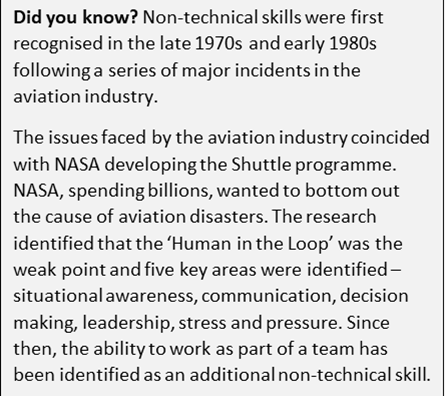
Non-technical skills can be defined as ‘the cognitive and social skills that complement a workers’ technical skills and, as such, contribute to safe and efficient task performance’ (Flin, O’Connor and Crichton 2008) and can be developed to complement an ER’s everyday skill set. These skills are include situational awareness, communication, decision making, leadership​, stress​ and pressure, and teamwork. 

Situational awareness 

The three stages of situational awareness are: the ability to know what is going on around you by gathering information; making sense of this information and anticipating what could happen next.  

ERs need to be able to demonstrate strong situational awareness in all three stages to fully understand the implications of acting on information received. They also need to consider that everyone perceives information differently based on the context and their own subconscious bias and experiences. The danger with situational awareness is that it can be affected by several components, which include lack of awareness in training, human limitations, stress, fatigue, and bias. ERs need to be trained to recognise these components to have a better chance of making the right decision.  

It can be difficult for ERs to develop situational awareness while dealing with low-frequency incidents, such as those involving hazardous materials, which are known to be high risk. There is little that can be done about the level of risk. However, by increasing the frequency of high-quality training, ERs can develop mental models to refer to during high-pressure response situations.  

Communication 

Communication is vitally important when responding to incidents. It must be of a suitable style and frequency for each situation. When reviewing lessons learned or case studies of incidents, communication is highlighted, but is usually focused on the technical aspects. Factors that are technical by their nature could include battery failings, radio dead spots or an individual failing to select the appropriate radio channel – but should there be more focus on communicating effectively during an incident? For maximum effectiveness, non-technical skills training should develop an ER’s ability to communicate effectively in a style suitable for the stakeholder and at an appropriate frequency. 

The following should be considered: Do you communicate effectively in 360 degrees? Do you consider the required frequency and most effective style of communications for each stakeholder? Do you communicate well under pressure? 

If the answer to any of the above is no or if you’re unsure, then you need to review your communication skill set. 

Decision making 
This is defined as the process of reaching a judgement or making the choice between options, perhaps better understood as a course of action to deal with the incident. In a pressured situation, the cognitive capacity of even the most resilient responders can become overloaded and compromised. Cognitive capacity can be affected by: too much information, habit, biases, health, groupthink, distractions, levels of experience, emotions, and pressure.  

Applying learnt controls and tools is necessary to enable the decision maker to reach a successful outcome when dealing with incidents.  

Leadership 

When leading a response team, ERs need to reflect on how their leadership style in an emergency is interdependent on their leadership style in a non-emergency situation. At any incident, the lead responder must enable and empower ERs to approach them with new information. The leadership style before the emergency sets the tone of how team members react during the emergency.  

Leaders must have the ability to be flexible in their leadership style in response to dynamic situations, taking on a more directive style when managing incidents and being more consultative in times of less risk. 

Stress and pressure 

There are many different factors to be considered regarding an individual’s ability to work in a stressful environment. Through self-awareness, training, utilising stress reduction techniques, being physically fit and being able to ask for support, responders can reduce the risk of negative impact from stress. When dealing with dynamic incidents, responders can manage the associated stress in the preparation phase by carrying out relevant training, which can assist them in becoming more familiar with that incident type. 

Teamwork 

When developing teamwork skills, responders must be mindful that they won’t always be part of the same team. They must reflect on how they are perceived by and respond to other team members, how they behave within a team and the impact of their behaviour. Within every highly effective team, there is a culture in which feedback is routinely given and accepted.  

Developing and practicing non-technical skills 

When reflecting on case studies of incidents where responders have been killed or seriously injured, there is usually an element of human error involved. To reduce the chance of this, ERs need to develop their non-technical skills. 

It is necessary to continue to train and test technical skills to enable responders to be safe, effective, competent, and confident. Non-technical and technical skills training can occur simultaneously to assist with the time constraints placed upon response teams and organisations.   

It is recommended that if training leads want to reduce the risk of human error and improve the safety of responders, they should look to integrate non-technical skills into training programmes at the earliest opportunity. Responders should continue to develop and practise these skills regularly. 

NCEC’s training platform, Hazmat Academy, is a hazardous materials (hazmat) training model. It has revolutionised hazmat training by providing a contemporary solution that meets the needs of individuals and takes account of the modern-day challenges that emergency services and commercial organisations are facing. 

The Hazmat Academy’s off-the-shelf courses cover non-technical skills, emergency response, chemical response training and detection, identification, and monitoring. They also offer distance learning modules on different topics such as waste fires, hydrogen fluoride and refrigerant gases and can cater to bespoke requirements.  

All courses are accredited by the International Organisation for Industrial Emergency Services Management (JOIFF) and the hazmat courses are delivered in partnership with the Fire Service College. 

The following schedule has been announced for this year’s emergency response courses: 

  • Hazardous materials adviser initial: 27 June, 5 September, and 21 November 
  • Hazardous materials first responder: 23 May 
  • Hazardous materials instructor: 12 September 
  • Hazardous materials adviser revalidation: 7 November 

Text BoxText Box

The academy’s distance learning courses are available to book all year around. You can find out more about the hazmat and chemical training courses through their website www.thehazmatacademy.co.uk. If you would like to speak with one of the hazmat academy experts for a more bespoke requirement, please contact them at support@hazmatacademy.co.uk.  

FPA’s Jonathan O’Neill to address The Fire Safety Event 2022

Fire Protection Association’s managing director Jonathan O’Neill OBE will be addressing the audience in the Fire Safety Theatre with the Fire Protection Association’s concerns about the forthcoming Building Safety Bill. O’Neill will address audiences on Wednesday, April 6, from 10:15 to 11:00am

On Thursday 7 April, 14:00 – 15:00, the FPA’s Senior Fire Safety Trainer Alan Emms will be co-presenting a CPD session in the Training and Competency workshop taking place in the Fire Safety Theatre which will provide practical guidance and an insight into all aspects of fire safety training whilst focusing on the role of the Responsible Person.

Launched in 2016, The Fire Safety Event is one of the UK’s important industry events which has been on the radar of several professionals and manufacturers over the last six years. During its time, it has become the UK’s largest fire and safety show, with more than 100 leading manufacturers and service providers showcasing the most cutting-edge fire safety products and solutions in active and passive fire protection.

The Fire Safety Event is run alongside The Security Event, The Workplace Event, and The Health & Safety Event. Collectively known as ‘The Safety & Security Series’ that is set to welcome more than 700 exhibiting businesses and visitor numbers surpassing 28,000 attendees.  

O’Neill began his career in the insurance industry and was appointed Managing Director of the FPA in 1999. During his time as MD, he has overseen two relocations and has managed the organisation to financial independence from insurers. 

O’Neill has served on numerous government, ministerial, and sector advisory bodies and was part of the strategic advisory group on the Fire Futures Review. He represents UK insurers on the Prevention Forum of Insurance Europe, is the UK’s representative at the General Assemblies of CFPA Europe and CFPA International, and sits on the Executive of the Fire Sector Federation. 

In 2017, he was awarded in the Queen’s Birthday Honours for services to fire safety and received his OBE from Prince William, Duke of Cambridge on Tuesday 31 October at Buckingham Palace. 

RECOM to open new fire training academy

RECOM Solutions is set to open a new training academy, as part of a significant investment from the Trafford Park fire protection services firm.

The move is in response to huge growth in demand for its fire protection services, which has seen the firm increase its specialist operatives from five to 30 in the past 18 months, the BusinessDesk.com reproted.

This is in addition to its team of surveyors, contract supervisors and project managers in its fire protection arm. The academy will offer a live environment for training staff in the latest fire protection measures, legislation and products which are new to the market, such as new laws concerning cladding on structures of multiple occupancy, including high rise apartment blocks.

RECOM, a UK-based firm, works with a range of clients, ranging from the residential, to care home, healthcare, commercial, leisure, education, heritage buildings and industrial sectors.

The business is an approved contractor under the UK’s Fire Accreditation Scheme (FIRAS), and director, Jason McKnight, said the academy is due to be launched in the spring ahead of the implementation of the Fire Safety Act in England, which seeks to improve fire safety in multi-occupancy buildings.

McKnight said: “We have positioned ourselves ahead of the field by being able to provide a holistic approach to projects, linked to the new legislation.

“We act in both client side and contractor roles, utilising innovative cloud-based software to ensure clients have up to date relevant information on fire safety. This is the ‘golden thread’ of information that will become a legal requirement for building owners, developers and the like.”

He added: “The new academy will further demonstrate our commitment to retaining our leading market position in the provision of fire safety services.”

RECOM acts as a construction project manager and main contractor in addition to its role as a fire protection and cladding replacement specialist.

“The need for robust fire protection measures in buildings has been brought into sharp focus in recent years, and we are proud to be playing our part in helping to improve building safety and create smart, safe and sustainable places where people thrive, across the North West and beyond,” McKnight added.

The academy will enable RECOM to train and develop new employees and to educate its clients on the importance of fire protection measures within buildings. “We fully expect that the Fire Safety Act will lead to further expansion of our fire protection operations.”