Swedish firefighters call for exemptions to ban on 24-hour shifts

Over 2,700 Swedish firefighters have signed a petition in protest against new working hour rules that will come into effect this autumn. The European Union’s decision means the end of the 24-hour shift that firefighters in Sweden have traditionally worked.

The directive mandates that employees must have 11 hours of rest during a 24-hour period. This could mean that schedules change for firefighters and that they are prohibited from working 24-hour shifts. Instead, they will have to work more shifts per month.

According to one of the proposals that have been put forward, firefighters must work Friday, Saturday, and Sunday night, from 19:00 to 07:00, resulting in a difficult schedule for firefighters, with three consecutive overnight shifts.

A group of independent firefighters has now started a petition targeting the country’s 5,000 full-time firefighters. So far, almost 3,000 firefighters have signed the petition, demanding exemptions for emergency services. Firefighters warn that the new rules will lead to worsening working conditions and an increased risk of mass redundancies.

According to Magnus Krantz, ombudsman for the National Association of Firefighters, the parties must try to negotiate an exception for community-supporting functions, including the rescue service. However, SKR, which represents the employers, said that an exception is not possible, with head of negotiations Jeanette Hedberg saying that it is not a free choice to follow the directive.

Patrick Falck, a firefighter at Ekerö fire station and petition signee, said he believes that the new working hours make it more difficult to combine the profession with parenthood.

Falck also said that he is considering changing professions, and he is confident that many of his colleagues will follow the same path. The new rules may have disastrous consequences on the firefighters’ profession, and negotiations between parties continue as they try to find a way to address the firefighters’ concerns.

Firefighters have the most dangerous job in the UK

  • Firefighting is the most dangerous job in the UK, with the highest injury rate
  • However, on average, Brits overestimate firefighters’ salaries by £7,000 a year
  • Construction work is the deadliest industry overall, although none of the individual jobs rank in the top 10
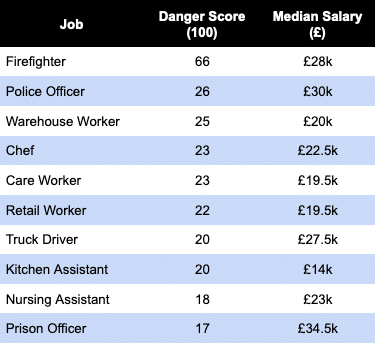
  • Police officer and warehouse workers rank second and third on the dangerous jobs index
  • Chefs and care workers are among the most hazardous jobs – filling out the top five
  • Most dangerous jobs typically only pay between £20-£30,000k
  • Over a third (35%) of those with a dangerous jobs don’t have life insurance

A new study by Forbes Advisor finds being a firefighter is the most dangerous job of all, with over 47,000 injuries over the past five years.

Using government data, experts at Forbes Advisor have compiled a list of the most dangerous jobs in the UK based on the number of deaths and injuries over five years in each profession.

Forbes Advisor also conducted a survey of 2,000 UK adults to ask Brits what they thought the most dangerous jobs were, as well as what they pay.

The median salary for a firefighter in the UK is £28,000, but, on average, most respondents thought a firefighter made £35,000 annually, overestimating their salary by £7,000.

Following firefighters, the study shows that the second and third dangerous jobs are police officer and storage worker, followed by chefs and care workers in fourth and fifth position.

Source: Forbes Advisor

Forbes Advisor’s study looked through data from the Health and Safety Executive and the Home Office to determine which job is the most dangerous, giving the highest weighting to deaths, followed by injuries and injury rate, between 2015 and 2020.

With regards to dangerous industries, construction heads the list, although specific professions within the sector do not feature in the top 10 dangerous jobs table, as each one separately scores less than jobs in other areas. 

The three most dangerous jobs in the construction industry are tradespeople, builders, and civil engineers, totaling 181 deaths between 2015 and 2020.

While most Brits agree that people in dangerous professions should be paid more, most of the jobs that are considered dangerous do not pay above £30,000 a year, sometimes under £20,000, and lower than the national median wage of £33,000.

This is confirmed by Forbes Advisor’s survey, which asked respondents what their yearly salary was, and whether or not they considered their jobs to be dangerous.

The most common wage response (35%), for those who consider their jobs to be dangerous, was between £20,000 and £40,000 a year. Of those who made over £100,000 a year, 6% said they had a dangerous job, in contrast to 10% who said their line of work was not dangerous.

When asked what salary they would demand in order to accept a job where they have a one in four chance of getting seriously hurt or injured, the average Brit would not accept an offer under £94,000 a year, with nearly one in four (24%) saying they would not take such a risk in the first place.

For those with jobs where one might get seriously hurt or die while on the job, a life insurance policy is a good idea to make sure one’s family receives support after they die. However, more than a third (35%) of those who said their job was dangerous admitted not having life insurance.

Kevin Pratt, personal finance expert at Forbes Advisor, said: “Anyone with dependants should have life insurance, and it makes particular sense for those with high-risk occupations, whether that is a firefighter, someone on a building site, or a chef in a hectic kitchen.

“If you die without life insurance in place, your family will likely struggle with the burden of the rent or mortgage and all the other bills and expenses that families encounter. But the proceeds of a life insurance policy can make up for the loss of your income, providing a financial safety net at a time of deep distress.

“No-one likes to think of their own death, but those in high-risk occupations are reminded every day of the dangers they face. Arranging insurance cover is straightforward and relatively inexpensive – premiums reflect your age and occupation, starting at around £20 a month.

“Whatever your line of work, and even if you don’t have a traditional job beyond looking after the home and family, you should ask yourself a question: Am I guaranteed not to die before everyone who depends on me is financially self-sufficient? The answer, of course, is no. That is why life insurance is a good idea for everyone.”

Dräger calls for increased use of fire escape hoods in evacuation safety.

Dräger, an international leader in the fields of medical and safety technology, is calling for fire escape hoods to become part of any fire safety plan where evacuation takes more than a couple of minutes – including educational facilities, hospitals, hotels and high-rise buildings.

Fire escape hoods are designed to provide wearers with crucial minutes of protection from fire-related vapours, particles and gases, including carbon-monoxide. Dräger’s PARAT smoke hood range provide wearers with up to 15 minutes of protection.  According to the UK Government, nearly one in three (30%) of fire-related fatalities are the result of being ‘overcome by gas or smoke’[1], which makes fumes a fire’s most deadly killer.

Dräger therefore believes it is essential that fire escape hoods are used as a supplementary support to other fire safety evacuation measures, e.g., fire doors and disabled refuge areas.

Indeed, the Fire Door Inspection Scheme (FDIS) recently found in a study of more than 100,000 fire door inspections that three in four, or 75% of all fire doors failed to meet required standards[2]. Buildings that had the highest number of fire door inspection failures included healthcare buildings, local authorities and housing associations, and private housing, but across the board the research supports the need for supplementary fire safety measures.

Ian Gil-Rodriguez of Dräger Safety UK says the Industry has a responsibility to promote the increased use of fire escape hoods “The fact that Fire and Rescue Services globally and in the UK are now using fire escape hoods is evidence of their critical importance,” he says. “Our Industry needs to come together and join forces to push this change, for the good of public safety. Fire Escape Hoods should be a standard component of evacuation plans, a complementary part of the complicated puzzle, as opposed to a standalone solution.”

For more information on Dräger or its product offering, please visit www.draeger.com  

[1] https://www.gov.uk/government/statistics/detailed-analysis-of-fires-attended-by-fire-and-rescue-services-england-april-2021-to-march-2022/detailed-analysis-of-fires-attended-by-fire-and-rescue-services-england-april-2021-to-march-2022#:~:text=2.4%20Causes%20of%20deaths%20and%20injuries&text=In%20the%20year%20ending%20March%202022%2C%20where%20known%2C%20the%20most,of%20fire%2Drelated%20fatalities).

[2] https://www.ifsecglobal.com/fire-news/three-quarters-of-fire-doors-fail-inspections-according-to-fdis/

FBU advises UK firefighters to accept renewed pay offer

The UK’s Fire Brigades Union has recommended that firefighters accept the revised pay offer that was issued on Wednesday (8 February) by fire service employers.

The new pay offer follows the proposal for strike action by firefighters with 88% of FBU members voting Yes to strike action on a 73% turnout, with 94% voting Yes in Northern Ireland.

The FBU had already agreed not to name strike dates while members are consulted on the offer and has set out a timetable to consult members. A hybrid online and postal ballot will open on Monday 20 February and close on Monday 6 March at 2pm.

In an email to FBU members on friday, FBU General Secretary Matt Wrack wrote: “We should all be proud of the campaign we have run to get this far. We have now moved our employers from 2% in June last year, to 5% in November, and now to 7% plus 5%.

“This achievement was only possible because of our overwhelming mandate for strike action. It is clear evidence of the value of collective bargaining and negotiation as opposed to so-called “independent” pay review bodies.”

However, he stressed that the union leadership would not “sugar-coat” the offer: “Given the current rate of inflation, 7% is another real terms pay cut for the current pay round (which runs from July 2022 to July 2023). For the following year (July 2023 to July 2024), when inflation is forecast to be lower, 5% may amount to a slight increase in real terms pay.

“The Executive Council has weighed up the positives and negatives and decided that, on balance, we recommend that members vote to accept this offer. It was honest and sober in its assessment, but it was also unanimous.

“This is your union, and it is now for you to decide whether this offer represents a good enough improvement for us to resolve this dispute.”

Training course on lithium ion batteries for firefighters launched by UL

UL Solutions’ Fire Safety Research Institute (FSRI) has developed “The Science of Fire and Explosion Hazards from Lithium-ion Batteries” online training course to provide actionable insights from the foundational research conducted to date, including a review of lithium-ion battery components, thermal runaway, and how fire and explosion hazards can develop.

The course is designed to help firefighters better understand the physical phenomena that determine how hazards develop during lithium-ion battery incidents and develop strategies to mitigate the associated risks.

The course is designed so that those who undertake it will be able to: describe the construction of lithium-ion cells and identify the unique characteristics of lithium-ion batteries; list the reasons lithium-ion batteries fail and explain the process of thermal runaway; describe the fire and explosion hazards resulting from thermal runaway propagation in lithium-ion batteries; and develop strategies to reduce the risk associated with thermal runaway, including fire and explosion hazards.

Adam Barowy, research engineer, FSRI commented: “We believe one of the most effective ways to combat risks to life safety and minimise sensationalisation of lithium-ion battery thermal runaways is to inform the general public and the fire service about thermal runaway causes, how fire and explosion hazards can develop, and what can be done before and after thermal runaways to minimize the consequences.”

The course can be accessed here.

IFSJ Exclusive: Available when needed and off duty when possible with Fire Service Rota

Cor Klaasse Bos, Managing Director at Fire Service Rota talks about the scheduling software that is improving the work-life balance for firefighters

As a child, Cor Klaasse Bos was interested in two things: firefighting and technology. He became a self-taught programmer at the age of 12 which set him on a trajectory for a Masters in Physics at Eindhoven University after which he became a technological consultant. Whilst he was finishing his studies, he took on work at a musical instrument shop whose owner Richard Boerstra also happened to be a manager at the local fire station. This connection would prove instrumental in the creation of what is known today at Fire Service Rota.

During his time at the store, Klaasse Bos had created a spreadsheet which showed the availability of everyone working at the shop. His employer then asked if he could put together a similar organisational system for the local volunteer fire department. Having finished his studies, Klaasse Bos used his self-taught programming skills to invest in a few hundred hours developing a dedicated online tool in 2006. After a few weeks, the first version of Dutch name brand Brandweerrooster, which literally translates to Fire Service Rota, was created.

The platform was designed to allow firefighters to manage their own availability and have a system check whether there would be enough people available to crew a pump of six. It would also allow firefighters to book on when needed and book off when there are enough firefighters available in their station. “That is, in a nutshell, still Fire Service Rota,” says Klaasse Bos.

Expansion

After its initial success and rollout, the system designed for on call firefighters began to grow, spreading from 10s to 100s of stations in the Netherlands. Six years after starting the company, Klaasse Bos decided to quit his job as a technology consultant and commit to Fire Service Rota full time. His friend Ruben Stranders joined the company and they decided to take it to the next level with plans for international expansion.

“We had a few hundred stations in the Netherlands and we could see the market potential,” he tells. “We wanted to grow outside the Netherlands, and we really wanted to focus on the fire service.” He says they initially considered working with ambulance service and police but ultimately decided to make the fire and rescue service their sole focus.

Their first step into the UK came from a meeting with Mark Woods, a fulltime firefighter in Hampshire who recognised the potential in the software and the flexibility it could provide his team whilst keeping fire engines running. Shropshire Fire and Rescue became the first UK customer for Fire Service Rota. Then came the challenge: adapting the tool designed for on call firefighters for a fulltime fire service.

Shropshire presented the problem that at the end of the year they were faced with a higher demand for firefighters where they needed to cover sick leave and holiday. They wanted to have a tool which would carry over some of the excess capacity from the start of the year to the end of the year and avoid allocating unnecessary overtime.

Building the platform was an ongoing process: “We had to validate what we were building so every two weeks we delivered a new version of our software and they would test it against reality. They would come back with feedback and we would adjust the system,” tells Klaasse Bos. In less than a year they had a product that worked.

Evolution

In 2018, Fire Service Rota took its first step into Denmark where they worked with Falck, a world-wide company providing Fire and Rescue Services in public and industrial environments. Part of the project was to develop a backup alerting system which over time became the primary alerting facility by offering an alternative way to alert firefighters via smartphone. “Generally it worked really well and has been just as reliable if not more reliable than the old fashioned radio data network,” Klaasse Bos says.

The system works by alerting a select number of on call firefighters to check if they are available. Firefighters have 30-45 seconds to confirm whether they are able to attend. If there is not enough response, the system will contact more qualified on call staff until there is a full team. Fire control can make an informed decision whether to wait for this appliance to go out or to start alerting backup.

The magic happens, he says, when you tie it all together: “You know who is available at on call stations and fulltime stations and can allow for these stations to arrange crew in times of need. The system has the ability to know who is on call, who is skilled in what area, and is who is best suited for each call. When we have 12 firefighters on call and we only need four firefighters, why do we alert 12? Why do we keep people from their sleep? Why do we get them out of their primary jobs when we know we don’t need them?”

Falck agreed with this idea, recognising that paying to call out an unnecessary number of staff is an irresponsible use of public money. They wanted a smart process which would fairly select firefighters, wait for confirmation and if there are not enough confirmations then start re-alerting other people.

“You always make sure you have enough people, but you don’t have to alert too many people. That is something that has been really innovative in Denmark and I believe will one day also come in the Netherlands and the UK,” says Klaasse Bos. “Firefighters want to have the chance to be on the fire engine but they hate being woken up or rushed out of their primary employment for nothing. Somewhere in the middle there is a balance to strike.”

He adds: “If you dissect all of that and concentrate on what we’re doing, we’re trying to help save lives, helping firefighters be as flexible as possible, and alerting them when they are needed. We keep fire engines on the run. I’m convinced that somewhere someday we have already saved lives by streamlining that process.”

Made for firefighters

Klaasse Bos tells that the response for the system has been incredibly positive because firefighters recognise the fact that the platform is purely focused on the fire and rescue service and industry. “We’ve come into an area where we replace software that was never designed for firefighters,” says Klaasse Bos. “Immediately fire services recognise that this is a platform that was built by firefighters for firefighters. We have firefighters on the team who tell me when something works and when something doesn’t. We use our own software on our team. That instant feedback helps us create something that does what it is supposed to do.”

He says that managers in fire and rescue services have loved it because they can go hands free: “Once you’ve rolled out planning, the system can allow them to exchange shifts freely or within the policies of the organisation. We have a flexible system of requesting people to pick up an extra shift when needed, allocating those shifts on a fair basis and streamlining communications around it.”

A common response from users of the platform, he says, has been the high level of service. This, he believes is because of how responsive they are to any questions users have: “We really want to know why certain things are needed. We believe asking why a few times helps us create better solutions, better understand the customer and help us offer an alternative that works better for them.”

Future plans

As a technology-minded person, Klaasse Bos says that he sometimes misses having moved away from being a software developer. He speaks of himself as someone who never trained to be come a leader or manager: “One day you’re tinkering with technology the next you’re being interviewed by an international magazine about something you have developed.

“As a leader I would now say that we are on a mission to support a safer world and happier first responders. We do that through world class software and service. If we achieve that then we are done. That’s our mission.”

Right now, that means further expansion: “We have good software, we have flexible processes, tools to improve the lives of firefighters to be available when needed and keep them off duty when possible – so why not supply these good tools to what has basically been an underserved market for decades. Fire and rescue services across the globe have not been served with the best technology has to offer and we are there to do just that.”

Secure platform

In terms of the development of the technology, Klaasse Bos says this could involve artificial intelligence . He believes that AI can help planners to make more informed decisions and improve automation as well as fine-tuning the fairness process of selecting firefighters to respond to callouts and shifts allocation. His business partner Ruben happens to be a Professor in artificial intelligence, which he says will come in handy if they are to go down that route.

More important, he says, are keeping ahead of the game regarding information security and remaining user friendly. Fire Service Rota just received its ISO 27001 certification. “We have seen that high level cyber security threats are grow significantly,” says Klaasse Bos. “We have responded to that by increasingly securing our software. It’s starting to pay off as Governments become more aware of information security.”

In terms of user-friendliness, he says they are rolling out a new smartphone app in the next year: “We held interviews with users telling us what we like about the current app and what they struggle with. The new app will be built from the ground up and focus on usability and ease of use.”

Lastly, he says they are streamlining our rollout processes. Klaasse Bos says that many of their prospective customers are switching from one system for planning and alerting to another. For them it’s a massive job, involved in a lot of risk. “We want to make the process easy and painless for fire and rescue services and we can do that. All you need is a smartphone or a browser and you’re good to go.”

At Warwickshire, for example, the fire service was confronted by their old contract expiring in a matter of weeks. Fire Service Rota was tasked to take over in that short period. “I remember the phone call and I said ‘we can do this. I will mobilise my team. We can roll out in a matter of weeks’,” says Klaasse Bos.

“We rolled out tens of stations with our software, they ran with it for one or two weeks and several station managers said ‘yes, we tried it, it works, let’s go live’. That is the story I want to repeat more often. We want to make it painless for fire and rescue services to switch from what is usually an antiquated outdated system to a modern and secure and user-friendly fire service rota system.”

This article was originally published in the January edition of IFSJ. To read your FREE digital copy, click here.
IAFF marks Fire Fighter Cancer Awareness Month

The International Association of Fire Fighters (IAFF) has marked Fire Fighter Cancer Awareness Month by raising awareness of the risk of occupational cancer among firefighters.

At the 2022 IAFF Fallen Fire Fighter Memorial, almost three quarters of the names added (348 out of 469) were of members who had died from occupational cancer.

In partnership with the Firefighter Cancer Support Network (FCSN), the IAFF has designated January as Fire Fighter Cancer Awareness Month to provide fire fighters the necessary tools and guidance to develop life-saving protocols for cancer prevention and to support those with a cancer diagnosis within their departments.

The IAFF said it hopes bringing increased public awareness to occupational cancer in the fire service will help generate greater legislative support for states and provinces to establish presumptive disabilities for all cancers affecting fire fighters.

The association has created an online resource designed to educate IAFF leaders, members, and their fire departments on why fire fighters are getting cancer and provide best practices on how to limit day-to-day exposures to carcinogens.

Each week will focus on a specific theme with the aim that by the end of January, members, locals, and fire departments will have the knowledge and resources to understand how fire fighters are exposed to carcinogens, what happens when they are exposed, how to prevent exposures, make culture changes in their department, and assist those who are diagnosed with cancer.

IAFF said: “All resources are available to review at your convenience, but we encourage you to hold a weekly safety stand down in your department. In addition to weekly content, the training briefs should be used as discussion tools to educate fire fighters on reducing the risk of occupational cancer.

“Fire Fighter Cancer Awareness Month takes place in January, but these resources can be shared throughout the year. We encourage you to check back frequently for more information about specific topics.”

London Fire Commissioner sets agenda for 2023 in New Year Message

London Fire Commissioner Andy Roe has delivered a New Year Message outlining the agenda for London Fire Brigade in 2023, including the start of its new Community Risk Management Plan, Your London Fire Brigade which he said sets out how they will change to help keep London safe in the coming years.

Roe said: “The plan has been updated based on the feedback of over 2,000 people and organisations that the Brigade engaged with last year. The plan has also been updated to reflect a key focus for me in 2023: changing our workplace culture.

“I have already taken action to improve the culture at the Brigade but there will be much more progress this year. This includes starting the pilot of our staff using body worn cameras when they engage with the public. I will be accountable to staff, stakeholders and communities as we change our culture over the coming year.”

He also said that 2023 will see an increase in improving how the brigade helps people to reduce risk in their homes: “We will be targeting the most vulnerable and at risk people with visits from firefighters as part of our Home Fire Safety Visits. For people who face less risk, our online safety checker will give you helpful support to make positive changes to your safety at home. If you haven’t completed our free Home Fire Safety Checker recently, I encourage you to do so by clicking here.”

Reflecting on the changes London Fire Brigade delivered in 2022, he said: “I welcomed the Mayor of London to a training exercise in May which showed how we had transformed our approach to tackling fires in high rise buildings.

“An important part of the exercise is using our new Fire Survival Guidance app which improves the flow of information between the incident ground and Brigade Control. Improving our response to high rise fires is an outcome from the 26 recommendations that we have completed in response to the first phase of the Grenfell Tower Inquiry.

“Our three 64 metre ladders – the tallest in Europe – and our eight 32 metre ladders are another important part of how we tackle fires in high rise buildings. They are part of a £40m investment in new equipment which also includes our new fire boats.

“The Mayor welcomed the boats to the Thames in September and following the completion of training, the boats enter service this year. They join our replacement Command Units which enter service this year. I’m committed to ensuring we have the right equipment we need to meet the challenges London faces.

“The heatwaves of 2022 meant we faced our busiest day since World War II. Firefighters, Control staff and support staff worked tirelessly to tackle significant fires, the likes of which had not been seen before in the United Kingdom. The climate emergency presents the Brigade with new challenges which we are committed to addressing.”

He added: “I am certain that 2023 will bring new challenges but as your London Fire Commissioner, I remain dedicated to ensuring that London Fire Brigade will be there for you. I’m proud to lead this organisation as we change for you.”

FBU calls out high salaries as firefighters use foodbanks

The Fire Brigades Union has released new data showing disparity between fire bosses on six figure sums and firefighters forced to foodbanks.

Chief fire officers are paid an average pay of £148,000, with the highest being £206,000 – over six times more than an ordinary firefighter. A competent wholetime firefighter is paid £32,244.

Meanwhile, firefighters and control staff working under senior management are being forced into a ballot for industrial action. Firefighters and control staff have rejected a 5% offer, with inflation currently at 10.7%. This most recent pay offer, a ‘real terms pay cut’, has led to a ballot for strike action.

After a decade of below or at-inflation pay settlements, the Fire Brigades Union has had reports of firefighters and control staff being forced to foodbanks and struggling to pay their bills.

The news comes against a background of fire bosses undertaking a number of activities on the pay dispute including meetings and written communications to FBU members.

Matt Wrack, Fire Brigades Union general secretary, commenting on the findings, said: “Firefighters and control staff are facing yet another real terms pay cut while fire chiefs rake in huge salaries. FBU members are increasingly facing real ‘In Work’ poverty, with firefighters having to rely on foodbanks and take on additional jobs to afford the basics.

“At the same time, some fire chiefs are also trying to persuade firefighters and control staff to step back from industrial action, to simply shut up about salaries that are several times smaller than their bosses.

“It’s insulting and stinks of hypocrisy of some chief officers who refuse to make the case for better pay for their workers. Chief fire officers are not worth six times more than firefighters, it was the latter who were called key workers during the pandemic delivering vital services including moving the bodies of the deceased. Firefighters and control staff are being left with no other choice but to take action.”

Merseyside firefighters take industrial action

Merseyside firefighters, control members and Green Book staff have commenced industrial action in the form of refusing to undertake pre-arranged overtime on Thursday 1st December for a period of up to 6 months.

The action follows the ballot of Merseyside Fire Brigades Union members. The ballot returned an overwhelming result in favour of not undertaking pre-arranged overtime.

The Merseyside ballot and subsequent action is entirely separate from the national ballot or action which may take place in relation to pay.

The issues which led to Merseyside members voting overwhelmingly in favour of industrial action includes the imposed reduction in night-time staffing numbers in Merseyside Fire Control Room from the agreed level of six to five.

Other factors were The introduction of new duty shift systems – without negotiation – which essentially require new firefighters to work both wholetime and retained and breach nationally agreed terms and conditions in relation to overtime rates of pay; The non-agreed expansion of the firefighter role in contracts for all new entrants; and firefighter apprentices being required to attend the workplace outside of core hours to undertake training sessions, assessments, charity days and exams.

Since the close of the ballot, local FBU officials have sought resolution on all issues, however sufficient movement has not been made to allay the concerns of Merseyside Fire Brigades Union Members.

Ian Hibbert, Brigade Secretary for Merseyside Fire Brigades Union, said: “Merseyside Fire and Rescue Services’ continued refusal to abide by locally and nationally agreed negotiation procedures has left Merseyside FBU members with little choice but to take industrial action. Like many workers, our members are suffering through the worst cost of living crisis in decades, whilst simultaneously having to fend off attacks on our terms and conditions of service, perpetrated by our local fire authority.

“The FBU in Merseyside have always sought to resolve issues through constructive dialogue and negotiation. However, by seeking to alter the terms and conditions and even the very job role of a firefighter at point of entry, Merseyside Fire and Rescue Service have left us in no doubt that it is their intention to cut the FBU out of discussions entirely.

“Let me be clear on this, Merseyside FBU has made no demands which could result in less fire engines, less fire stations, slower response times or fewer staff in our fire control room. The Fire Brigades union has always fought to maintain fire cover, campaigns such as the one led by the Fire Brigades Union in 2018 to save night-time fire cover at Liverpool City Centre and Wallasey fire stations stand as testament to this.

“FBU members are not asking for a lot, in fact the vast majority of the issues which have led us to this point could be resolved at no cost to Merseyside Fire and Rescue Authority or the public whom we serve. All we are seeking is that Merseyside Fire and Rescue Service honour our nationally agreed terms and conditions and enter into negotiation and reach agreement with the Fire Brigades Union on all issues.”