Southern Colorado establishes Interagency Wildland Fire Team

In response to the increase in fire activity a group called the Southern Colorado Interagency Wildland Fire Team has been established led by Superintendent Shane Coyne.

The ‘South Group’ is made up of people from Security Fire Protection District, Hanover Fire Protection District, Fountain Fire Department, Stratmoor Hills Fire Protection District, Fort Carson Fire and Emergency Services, and Southwest Highway 115 Fire Protection District.

This newly formed team will consist of highly trained, motivated, and experienced wildland firefighters from across the region.

“I am sober to the work that continues ahead but honoured and excited by this opportunity to create a new wildland fire team,” said superintendent Shane Coyne of the Southern Colorado Interagency Wildland Fire Team.

“On these red flag days were actually manning extra apparatus or combining it with apparatus that are already down here. So that when the fire call does come out, we’re on scene way quicker and we’re not trying to respond from various locations throughout the county to get here.”

Chief Robert Fisher, Fort Carson Fire and Emergency Services said the formalising the partnership will allow them to cut the number of calls they will need to make to agencies to source available emergency responders.

Coyne continued: “In the big picture we just have to realise that fire season is all year long and that we can get a big fire anytime of the year. We can’t let our guard down, there’s no time to rest really. We always have to think that even if it’s December and we think there’s snow on the ground, we think it’s cold that fire could get up and move.

“Every time we’ve had a challenge or something to work through, we’ve made it through that and it has come together actually very quickly.” He added: “This team’s journey will always be a mountain with no top but we are driven by the desire to serve others.”
California firefighters slow the spread of Oak Fire near Yosemite

According to the latest update from Cal Fire, Monday was a successful day for aircraft and firefighters, resulting in minimal growth of the Oak Fire that that began on Friday and has since spread rapidly in forcing thousands of evacuations in the nearby area.

Helicopters dropped 300,000 gallons of water on the fire and crews continued to construct control lines and extinguish hot spots along existing lines. Cal Fire said fire is moving in a northeast direction and fire crews are working aggressively using bulldozers, hand crews and aircraft. Evacuation orders were reduced to fire advisements in some areas.

Fire restrictions and closures near the fire area are in place on the Sierra National Forest. This closure will support public safety by keeping public members out of hazardous burn areas and will allow firefighting resources to combat the Fire without public interference. 

The Oak Fire that closed within half a mile (0.8 km) from the town of Mariposa Pines, 10 miles (16 km) from Yosemite. By Monday evening, the fire had consumed 17,241 Acres and was 16 per cent contained.

More than 2,000 first responders from state and federal agencies were reportedly battling the blaze, attacking it both from the ground and the air. Fire officials said at least 21 homes and 34 other structures have been destroyed.

Around 3,800 people were under evacuation orders, Mariposa County Sheriff Jeremy Briese told a public briefing at a crowded auditorium in the town of Mariposa, the county seat. Cal Fire officials said they had robust firefighting teams on scene early on, but the fire progressed atypically and overran their best efforts.

California wildfire: Thousands evacuate as Governor declares state of emergency

Fuelled by extreme heat, dry forests and underbrush, the Oak Fire that began on Friday has spread rapidly in California forcing thousands of evacuations in the nearby area, with more than 400 firefighters battling the blaze

Governor of California Gavin Newsom declared a state of emergency for Mariposa County on Saturday due to the effects of the Oak Fire. He said the state has secured a grant from the Federal Emergency Management Agency to help ensure the availability of vital resources to suppress the fire.

Firefighters have deployed air tankers, bulldozers and hand crews to battle a fast-moving wildfire just west of Yosemite National Park on Sunday that suddenly and unpredictably grew into what has become one of the largest fires of the year.

The Oak Fire that closed within half a mile (0.8 km) from the town of Mariposa Pines, 10 miles (16 km) from Yosemite. By Sunday evening, the fire had consumed 15,603 acres (6,314 hectares) and was zero percent contained, according to the latest update from California Department of Forestry and Fire Protection (Cal Fire).

Around 3,800 people were under evacuation orders, Mariposa County Sheriff Jeremy Briese told a public briefing at a crowded auditorium in the town of Mariposa, the county seat. Cal Fire officials said they had robust firefighting teams on scene early on, but the fire progressed atypically and overran their best efforts.

The fire was moving east up into the sierra, toward the town of Mariposa Pines and in the direction of Yosemite, Justin Macomb, a Cal Fire operations section chief, told the public meeting.

“The fire quickly outflanked us. We couldn’t even attack it with the resources that we had on hand,” Macomb said. “In my career, I haven’t seen fire behaviour like that.”

Daniel Patterson, a spokesman for the Sierra National Forest, said that climate change has made the region much warmer and drier over the past 30 years which has led to California experiencing increasingly large and deadly wildfires.

Patterson said: “The fire is moving quickly. This fire was throwing embers out in front of itself for up to two miles yesterday. These are exceptional fire conditions.”

The cause of the fire remains under investigation.

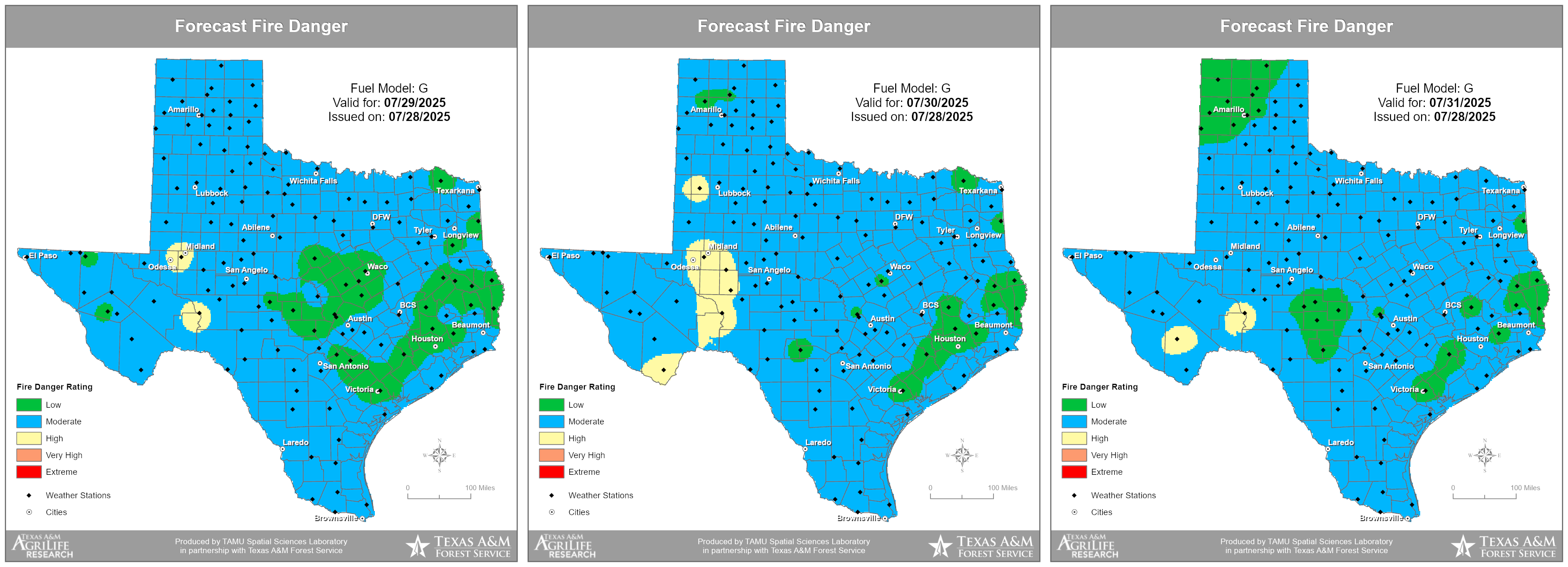
Texas on high alert as temperatures soar

Wildfires have been seen across in the weeks following Texas Govenor Abbott declaring a drought disaster for 164 counties across the state.

As of 20 July, 254 of Texas counties were put under a burn ban as drought and rising temperatures, fuels, or grasses, have become drought stressed and vulnerable to sparking wildfires.

About 99% of Texas had some level of drought conditions as of 20 July. The lower the fuel moisture, the more likely it is for a wildfire to start and spread, according to the National Centers for Environmental Information.

Heather Gonzales, a program specialist who focuses on wildfire prevention for the Texas A&M Forest Service, warned Texans against  doing any activities that may cause sparks such as welding, cutting and grinding materials outdoors.

This year has been a “much drier year than average,” Gonzales said, and the state has not had this many active burn bans since 2011.

By Saturday, fire danger is expected to increase across the state, according to the TFS’ forecasting tool.

Active fires

As of 7 am 21 July 21, there were 10 active wildfires over an estimated 16,426 acres of land.

Two two-day-old North Texas wildfires continued to resist containment Wednesday after destroying 21 homes, officials said.

The Chalk Mountain Fire near Glen Rose, Texas, destroyed 16 homes and damaged five others as it remained on the move Wednesday after scorching almost 10 square miles (26 square kilometers) of mostly short grass, brush and juniper as of midday Wednesday, said Alexandra Schwier, a Texas A&M Forest Service spokeswoman.

A fire at Possum Kingdom Lake destroyed five homes as it spread along its western shore, charring 500 (200 hectares) acres about 70 miles (113 kilometers) west of Fort Worth. That fire was 15% contained Wednesday, the Forest Service said.

Slovenia calls in assistance as forest fires break out near Italian border

Slovenia has requested assistance to tackle forest fires in the Karst of Gorica region of the Miren Kostanjevica municipality. The fires forced the evacuation of three villages.

The EU Civil Protection Mechanism is providing Slovenia with 3 firefighting helicopters, (one from Austria, one from Croatia, and one from Slovakia), and a Croatian forest fire fighting team, consisting of 4 trucks and 9 firefighters.

an amphibious firefighting plane from the rescEU reserve stationed in Croatia has been deployed.

Commissioner for Crisis Management, Janez Lenarčič, said: “This is, no doubt, one of the biggest wildfires in the history of Slovenia. I would like to express my sincere gratitude to Croatia, Austria, and Slovakia. Their help via the EU Civil Protection Mechanism to Slovenia, my home country, is deeply appreciated. This is EU solidarity at its best.

“At the same time and in view of ever more devastating impacts of climate change, which we are currently witnessing across Europe, I reiterate the need for immediate action at every level across the sectors in every Member State, with support of the EU, as to strengthen our response capacities but foremost preparedness to prevent the worst.”

EU Civil Protection Mechanism

The EU Civil Protection Mechanism strengthens cooperation between and among Member States and Participating States in the field of civil protection, with a view to improving prevention, preparedness, and response to disasters.

When the scale of an emergency overwhelms the response capabilities of a country, it can request assistance via the Mechanism. 

To date, all EU Member States participate in the Mechanism, as well as Iceland, Norway, Serbia, North Macedonia, Montenegro, and Turkey. 

Wildfires rage across Europe as heatwave strengthens

Wildfires have continued to burn across Portugal, Spain, France and Croatia as large parts of Europe face a persistent heatwave pushing temperatures into the mid-40Cs.

In Portugal’s central Leiria district firefighters battled to control blazes that have been fanned by strong winds. Portuguese Prime Minister Antonio Costa said during a briefing with the national meteorological institute IPMA: “It is absolutely crucial we avoid new events because it leads to the exhaustion of firefighters and all others … who are doing their best to control the situation.”

In western Spain a fire that started in the Extremadura region on Tuesday crossed into Salamanca province in the region of Castile and Leon, forcing the evacuation of 49 children from a summer camp on Thursday. Regional authorities said more than 4,000 hectares (9,900 acres) of land had been burned.

On Croatia’s Adriatic Coast, firefighting planes were called in to dispense water over burning forests whilst troops were enlisted in to help firefighters in the battle to contain three major wildfires around Zadar and Sibenek.

In southwestern France more than 1,000 firefighters backed by nine water-dropping planes battled two wildfires that started on Tuesday and have already burnt 5,300 hectares.

Thousands of people were also evacuated from homes on Turkey’s southwestern Datca peninsula due to a fire that started on Wednesday which was hit with strong winds overnight and threatened residential areas.

A study in the journal Nature found that the number of heatwaves in Europe has increased three-to-four times faster than in the rest of the northern mid-latitudes, such as the United States and Canada, due in large part to the jet stream air current splitting into two parts for longer periods.

The study’s co-author Kai Kornhuber, a climate scientist at Columbia University, told Reuters: “Europe is very much affected by changes in atmospheric circulation. It’s a heatwave hotspot.”

Greece introduces rescEU firefighting fleet

Following an extreme wildfire season 2021, Greece has announced a new initiative to help prevent a reoccurrence of last year´s disastrous fire season with the introduction of the rescEU firefighting fleet. 

The EU has pre-positioned some heavy duty fire fighting forces to Greece from six member countries: Bulgaria, Finland, France, Germany, Norway and Romania. These countries are a part of the Union Civil Protection Mechanism (UCPM) and are deploying more than 200 firefighters to Greece in total,.

The firefighters will be stationed in Greece with their equipment for the two most dangerous months of the fire season, July and August.

The European mechanism has also announced the rescEU firefighting fleet for the 2022 summer season. Croatia, France, Greece, Italy, Spain and Sweden are hosting the aerial firefighting fleet and they stand ready to fight ever stronger fires in Europe.

The pre-installation program that started within the framework of the European Civil Protection Mechanism was a Greek initiative.

The missions will be based in three main regions:  Athens, Larissa and Tripoli in order to assist in the fire protection of the country and to exchange know-how, knowledge and experience with Greek firefighters.

Higher temperatures for Greece

Fire season 2021 in Greece was one of the least windy fire seasons in the last 20 years, however the the average temperature was 1.6 °C higher than normal. 

The rainfall of the winter and the summer season was down and two heat waves with high intensity and and great duration occurred during the season, leading to the relative humidity levels falling below 10% from the beginning of July, which in turn created extreme wildfire events. The forest fire season 2021 burned with very high intensity and destroyed more than 101.000 hectares.

During the forest fires in Greece, the European Union mobilized one of the largest ever European deployments of firefighters and aircrafts in history. In total, 24 firefighting aircrafts, 1301 firefighters and 277 vehicles from 22 countries around the world participated in the efforts to tackle the wildfires in Greece.

Forest fire threatens ancient sequoia trees in Yosemite National Park

A grove of ancient sequoia trees in Yosemite National Park are in danger as the Washburn Fire grew to more than 2,300 acres the US Forest Service has said. Firefighters are working in difficult terrain to protect some of the largest and oldest redwood trees in the world.

Firefighters on scene have been using a 4-foot tall sprinkler system to tackle the fire and maintain air-moisture to prevent extensive damage to the area.

The fire, which started on 7 July, is threatening around 500 giant sequoias in the Mariposa Grove, including a famed ‘Grizzly Giant’ which is thought to be around 3,000 years old.

The Washburn Fire has already caused nearly 1,600 people to evacuate the area, including the Wawona community located inside the national park and hundreds of campers staying close to Wawona.

The cause of the fire is still being investigated. Fire officials have said that warm and dry weather conditions are making it difficult to control the flames.

Mariposa Grove and Yosemite Valley have been protected since President Abraham Lincoln signed legislation in 1864. It has a long history of prescribed burning to reduce the negative impacts of high-severity fires, the National Park Service said in a statement.

The fire was downgraded from 25% contained to 22% containted on Monday night. Stanley Bercovitz, a spokesman with the US Forest Service, said: “We don’t want to say everything’s fine and we’re getting a good handle on this fire and it’s downhill from here on out, because all it’s going to take is one hour of wind.”

EU mobilises firefighting fleet as Portugal declares state of alert

Portugal activated the European Civil Protection Mechanism to request emergency assistance for the fires in the central part of the country the European Commission said in a statement. It noted that as an immediate response, the European Commission sent two Canadair fire-fighting aircraft from its fleet in Spain.

Portugal and Spain have been affected by high temperatures that have increased the risk of fire, which is expected to worsen in the coming days. Forest fires in Portugal have left 29 people injured as temperatures are predicted to reach up to 45C in parts of the country from Tuesday. On Saturday, the country recorded 125 fires, the highest number in a single day this year with around 1,500 firefighters fighting three big blazes. The government declared a state of alert across the country, from Monday to Friday 15 July as the weather has caused further concerns due to expected high temperatures.

Commissioner for Crisis Management Janez Lenarčič said: “With our quick response to the Portuguese request for assistance, the EU demonstrates its full solidarity in facing the destructive forest fires in central Portugal. I thank Spain for swiftly mobilising two firefighting planes via the RescEU this morning. Our thoughts are with those affected, and with the fire fighters and other first responders on the ground. We stand ready to provide further assistance.”

In addition, the EU’s Copernicus Emergency Mapping Service was activated by Portugal on 8 July for the forest fires affecting Leiria and Santarem districts in Ourém municipality. These maps support first responders with an assessment of the impact and damage of the fires. 

The EU Civil Protection Mechanism exists to strengthens cooperation between and among Member States and Participating States in the field of civil protection, with a view to improving prevention, preparedness and response to disasters. Through the Mechanism, the European Commission plays a key role in coordinating the response to disasters in Europe and beyond.

When the scale of an emergency overwhelms the response capabilities of a country, it can request assistance via the Mechanism. Once activated, the Emergency Response Coordination Centre coordinates assistance made available by its Participating States through spontaneous offers. Should the emergency require additional assistance, the rescEU reserve can be activated.

To date, all EU Member States participate in the Mechanism, as well as Iceland, Norway, Serbia, North Macedonia, Montenegro and Turkey. Since its inception in 2001, the EU Civil Protection Mechanism has responded to over 600 requests for assistance inside and outside the EU.

Rosenbauer to present Fireboat for Wildland Firefighting at INTERSCHUTZ

Firefighting vehicle manufacturer Rosenbauer is set to show off its jet-powered rescue and fireboat, developed in collaboration with PALFINGER MARINE, at INTERSCHUTZ in Hannover, Germany later this month.

The boat is designed for fire departments to fight forest fires near the coast or shore from the water, providing an advantage wherever the scene of the fire is difficult to access over land or access with forest fire vehicles is not possible.

It can also serve as a rescue vehicle of choice when people have to be rescued from beaches because a burning forest edge has reached the coast or shore and is blocking the escape route over land.

The fireboat is equipped with the Rosenbauer N55 high-performance pump, which has a capacity of up to 5,500 l/min at 10 bar, and is also suitable for use with seawater due to the robust, corrosion-resistant design.

In addition, the boat can be connected to the Rosenbauer operations management system RDS Connected Command allowing integration into the central mission command and making it visible to all responders, also enabling the boat crew to be provided with mission-relevant information in the same way as their colleagues in the vehicles on land.

The new fireboat from Rosenbauer and PALFINGER  is made of seawater-resistant aluminum (marine grade aluminum), is 8.50 m long and 3.10 m wide and has a jet drive (water jet propulsion) with which it can reach a speed of up to 38 knots (approx. 70 km/h). The jet drive is powered by two 6-cylinder diesel engines, each with an output of 215 kW (292 hp). Three crew members are usually on the boat, up to 12 additional people can be transported.

The vehicle will be presented for the first time at INTERSCHUTZ 2022 from June 20-25 June in Hanover (Hall 27/Booth B58) as part of the Rosenbauer forest fire exhibition alongside various forest fire vehicles and personal protective equipment.