Expert Insight: Weaving protection into the fabric of firefighting

IFSJ sat down with Amanda McLaren, Managing Director at Hainsworth Protective Fabrics to find out about the technical side of its flame-resistant fabrics

Let’s start at the beginning: can you tell me about the history of Hainsworth?

Hainsworth Protective Fabrics is a leading manufacturer of PPE fabrics, based at our Mill in West Yorkshire. Its parent company AW Hainsworth & Sons was established in 1783 as a manufacturer of protective woollen uniform cloth for the British army. Hainsworth cloth is synonymous with UK military history, and the iconic scarlet fabric is still worn by the Queen’s Guards outside Buckingham Palace today. Hainsworth now manufactures premium woollen textiles for a wide range of markets, including fashion, leisure and transport interiors, but it is through our Protective Fabrics brand that we continue to develop our expertise designing and developing world-class flame-retardant textiles for emergency services professionals.

At what point during its extensive history did Hainsworth become involved with the fire industry?

Hainsworth has been supplying fabric for firefighter uniforms since the earliest days of the fire service. In the 19th century, the most flame-retardant fabric on the market was Wool Melton, which was manufactured by Hainsworth for the British army. Naturally, when Eyre Massey Shaw established the London Fire Brigade in the late 1800s he selected Wool Melton to be used for the firefighters’ protective uniforms.

We continued to supply Wool Melton to UK fire brigades throughout the early 20th century up until the 1970s, when we introduced PPE textiles woven using man-made flame-resistant fibres to the market. From there we continued to develop fabrics that delivered greater and greater levels of flame protection, working closely with firefighters to make sure we understood the changing requirements of their role. Today Hainsworth Protective Fabrics are worn by firefighters around the World, and our amazing Product Development Team continue to push the boundaries of innovative fabric technology.

What are the main uses for Hainsworth fabrics in the fire market?

We have designed and developed fabrics for use across multiple firefighting scenarios, including: structural; wildland; electric arc; urban search and rescue; water rescue; and road traffic collisions.

Our hero product is our TITAN fabric system. TITAN is a fibre structure from which we have developed a range of outer shell fabrics for garments across the emergency services. TITAN fabrics range from TITAN 1241 – a lightweight textile for use in technical rescue and riot police coveralls, where flexibility is paramount – to TITAN 1220, a highly breathable yet strong fabric designed to reduce the risk of heat stress for structural firefighters. Our TITAN 1260 is a premium outer shell fabric woven using Aramids and PBI fibres, increasing thermal integrity while remaining flexible and wearable, and is worn by today’s London Fire Brigade – a far cry from the Wool Melton they started out with.

We also offer a pioneering fabric solution for wildland firefighting PPE – ECO-DRY Shield. The fabric was developed following the introduction of new wildland standards in Australia, and is designed to provide the high mobility and flexibility needed for prolonged call-outs in external environments. ECO-DRY Shield is now the fabric of choice for wildland firefighters in South Australia, which sees some of the harshest firefighting conditions in the World. We recently also started supplying the fabric to firefighters in the UK for the first time.

All of our fabrics are created with the specific needs of the end user in mind and we take the time to listen to firefighters when developing any new products. For example, our AGILE fabric structure was developed in response to firefighter concerns about chemical contamination and exposure to carcinogens. AGILE weaves together protective fibres in a tight structure that provides maximum resistance to liquid penetration and prevents harmful particles from being absorbed into the garment. It is also incredibly strong and durable, allowing for the firefighter to wash their kit over 100 times and still have it perform as well as if it were new.

Can you talk a little about the technical aspects of Hainsworth fabrics?

At Hainsworth we have an unrivalled knowledge of the unique qualities of different fibres and how they can be woven together to maximise their benefits, built up over 250 years of textile manufacturing.

An example of this would be the AGILE fabric structure I described above. We used our long history of fabric knowledge to weave together flame-retardant fibres in a structure inspired by the twill used in classic raincoats, resulting in a fabric that allows for maximum water runoff and protects from harmful liquid chemicals.

We call our approach to textile development Fibre Positioning Technology – the unique placement of fibres resulting in fabric greater than the sum of its parts.

This methodology applies to every product we develop. TITAN was designed as an open and breathable structure that allows for the flow of perspiration moisture, helping the wearer to stay cool and clear-headed. The insulating pockets of air created as a result of this process also increase the wearer’s protection from heat and flame.

In addition to knowing where to position fibres, we also have an innate understanding of how to combine different materials to meet the specific requirements of the wearer. ECO-DRY Shield, for example, is a unique mixture of synthetic flame-resistant fibres and premium merino wool. Nomex and Lenzing FR provide thermal stability, keeping the wearer protected, while wool wicks away moisture and allows for a consistent body temperature. The different fibres combine to create a flexible, comfortable, yet flame retardant textile perfect for the modern wildland firefighter.

Finally: tell me little about your own background and your future plans for Hainsworth?

Since 1989, I have been working within the Engineering Sector; focusing on my chosen career path – Operations and Supply Chain Management. During 1999, I took my first step into the Textile Sector, working as a Supply Chain Manager and subsequently as the Operations Director, for James Heal & Company – a Global Leader of Textile Testing Equipment.

In 2008, I left the Business in to explore Directorship positions within larger Manufacturing environments – covering both the Automotive and Leisure Sectors., each one of them a leading UK Brand. However, I missed Textiles and returned to James Heal in 2014, to support the Owner to complete a Business Sale – subsequently succeeding him as the new Managing Director of James Heal in 2014, under the ownership of Battery Ventures – a VC Company based in Boston, USA. During the following 6 years’, I was fortunate enough to travel to many Countries, visiting our Agents and end Customers’ – which of course, were often Textile Mills. The top and bottom line grew to plan and I learned a lot about running a successful Business.

In late 2020, I noted AW Hainsworth were looking for a new Managing Director for their Business – AWH was actually a Customer and Supplier to James Heal, so I was more than familiar with the Mill and the amazing Products produced. It was ‘hand in glove’ as a fit and as such, given the challenging post-pandemic and Brexit environment, I was thrilled to be appointed into this exciting role, in April 2021.

Since then, with the support of both the shareholders and a highly competent and experienced Team, I have been able to redefine our growth strategy and determine a number of new opportunities for the Business. We exceeded last year’s Business Plan and have set out a new 3-year plan, which demonstrates growth through an ongoing investment programme. We have already invested in a state-of-the-art R&D and Quality Control Laboratory and have placed orders for new Raising & Cropping Machinery, along with a new Loom for our Leisure Business. We have full commitment to a Sustainable Business Model; putting our people at the centre of investment strategy – this includes a newly defined Apprenticeship Model and investment in existing skills, to ensure a multi-skilled workforce for the future. All in all, it is a very exciting time for the company and I am thoroughly enjoying steering the ship.

This article was originally published in the September edition of IFSJ. To read your FREE digital copy, click here.
The Emergency Service Show returns to Birmingham

Take a look at what’s on the agenda at the Emergency Services Show which returns to the NEC Birmingham today.

Fire and safety professionals and industrial brigades from around the world are invited to the award-winning The Emergency Services Show, taking place at the NEC, Birmingham from 21-22 September. The event offers the perfect opportunity to meet and collaborate with the entire UK emergency services community, as well as to discover innovative technologies, handle the latest kit, share experiences, and exchange best practice.

Showcasing how technology and innovation are transforming emergency response for all first responders and blue light services, The Emergency Services Show features more than 450 exhibitors. Extensive learning opportunities are on offer with over 90 free CPD accredited seminar sessions, while visitors can also see skill in action as fire and rescue teams from across the UK compete in the Extrication and Trauma Challenges.

The free-to-attend Emergency Services Show will be the biggest yet, with 20% more floor space than ever before. Visitors can source new technology and products from the leading names in the industry. Well-known brands on the exhibition floor include Angloco, Draeger, Emergency One, Excelerate, Firenet Systems, Flamepro, Ford Motor Company, Hunter Apparel Solutions, Interspiro, MAN Truck & Bus, MSA Safety, PBI Performance Products, PGI Safety, Rosenbauer, Venari, Vimpex, Wolf Safety and more.

Fire safety exhibitors include MSA Safety, displaying its range of firefighter safety equipment, while leading PPE suppliers showcasing their latest product ranges include Agentis Workwear, Delta Fire, Draeger, FlamePro, Godiva, Interspiro, and Goliath Footwear.

Emergency One, Rosenbauer, Terberg, and Volvo Trucks are among manufacturers bringing their latest fire appliances to the show. Angloco will demonstrate its aerial ladder platform and other fire fighting vehicles in the Outside Area. Emergency One will be showing its new fully electric fire vehicle, the E1 EV0 fire appliance, built for the Scottish Fire and Rescue Service. The zero-emission electric vehicle has the same capability and equipment as a diesel model and is the first to feature an innovative all-electric rear drive axle installation. It has a range of approximately 220 miles with an 80% charge, while the optional onboard smart charger provides resilience at protracted incidents.

Leading designer and manufacturer of vehicle propulsion solutions for commercial and emergency service vehicles Allison Transmission will showcase its heavy duty fully automatic transmissions, and its latest electrified propulsion systems.

Other leading vehicle suppliers at the show include Ford Motor Company, Venari, Mercedes Benz Trucks, Volvo Trucks and Yamaha Motor Europe as well as a wide range of chassis manufacturers and specialist vehicle converters including Cartwright Vehicle Conversions and Wilker UK Ltd. Isuzu will be displaying its new pick-up, the All-New Isuzu D-Max.

The show also features providers of all types of in and on-vehicle ancillary equipment and systems including lightbars; vehicle livery; battery management and driver training. Standby RSG will display its lighting, hazard warning systems products and solutions and VUE will be showcasing its fleet risk management solutions – CCTV and telematics hardware and easy-to-use software systems.

Emergency and rescue vehicles of virtually every other type, including search and rescue appliances, fleet cars, motorbikes, boats and UAVs or drones will all be on display. Survitec will be unveiling their new 420 GP/GPM Fast Rescue Boat. Featuring a one-of-a-kind rapid single-point inflation via one 9L Cylinder used in self-contained breathing apparatus (SCBA), it is designed to meet unique operational demands and is the only 4.2M boat that can inflate this way.

New technology on display will include connected and smart vehicles, satellite communications, GIS and mapping technologies, UAVs/drones, ruggedised mobile computers, tablets and phones, data management and security, wearable tech, connectivity solutions, body-worn cameras, and other video capture systems, as well as the latest hybrid and electric vehicles. Visitors will be able to immerse themselves in the technology and experience how these solutions can improve the efficiency and effectiveness of operational response.

Further innovations on show will include the latest protective fabrics, medical equipment, firefighting equipment, and rescue tools. Delta Fire will be launching its new Delta DF-7X Variable Foam Branchpipe along with new additions to their Pro-Series branch range. Point South will be showcasing the Airstar Sirocco lighting balloons – scene lighting for emergency teams. Keela will be displaying its new maternity panel that can be zipped into PPE for wear during pregnancy.

The Extrication and Trauma Challenges return as an interactive experience for participants and visitors. Hosted by West Midlands Fire Service, they showcase the latest rescue technology and trauma response equipment in action.

In the Trauma Challenge, teams of two will experience visual and audio inputs from a trauma scenario that has been set up and filmed especially, in an ‘immersive’ tent. In the Extrication Challenge competing teams from across the country will perform extrications from a series of realistic RTC scenarios featuring heavy and complex damage. Action will be captured from a variety of camera angles and broadcast live to a large display screen at the show. Both challenges will be judged on best safe working practices, command and control, safety and scene assessment, extrication, professional pre-hospital care and expert use of rescue equipment.

The Emerging Technologies Theatre will showcase how fire and rescue services can manage and leverage data and technology more efficiently and effectively. Leicestershire Fire and Rescue Service will run immersive VR training exercises. Paul Christensen, Senior Advisor to the National Fire Chiefs Council, and Professor at Newcastle University will examine the risks of RTC EVs to first responders. How the IoT is improving domestic fire safety is the subject of a session presented by Aico UK.

In the Lessons Learnt Theatre experiences of, and responses to, real-life UK and International incidents and emergencies will be shared, ranging from the COVID-19 pandemic to the Grenfell Tower fire and the Manchester Arena bombing. In addition, representatives from FIRE AID, The National Fire Chiefs Council and the FIA will discuss their collaboration to support fire and emergency services in Ukraine. Further sessions will examine the impact of the record-breaking summer temperatures.

New for 2022, the First Responder Theatre aims to improve the collaboration between the emergency services and security industries and is themed around the actions necessary to optimise emergency services response. With topics including the Assaults on Emergency Workers (Offences) Act 2018 and Martyn’s Law, leading security associations will be presenting key findings and strategies meant to strengthen the relationship between the two sectors.

The popular Health & Wellbeing Theatre will address physical and mental health for firefighters. A panel of first responders and experts will share their expertise of mental wellness, health and nutrition, workforce diversity, equality and inclusion, and the latest digital support platforms, whilst providing key practical takeaways. Wellness and Behaviour Change Coach at The Fire Fighters Charity, AJ Whitaker, will explore ageing and associated life transitions such as menopause and retirement in a session entitled ‘Maturing Healthily’. She will share ways in which fire and rescue workers can plan and manage their personal health choices as well as finances.

In the networking hub of the show, The Collaboration Zone, over 80 emergency services, voluntary groups, charities, and NGOs will be sharing details of the support they offer. Organisations involved include The Fire Fighters Charity, British Cave Rescue Council, Institution of Fire Engineers, British Fire Services Association, British Firefighter Challenge, UK Firefighter Sailing Challenge, the Fire Industry Association, MTB Search & Rescue, and Fire Aid. Visitors to The Fire Fighters Charity stand can experience five minutes of relaxation in its wellbeing area.

Entry to The Emergency Services Show and parking at the NEC are both free. Registration for the event is at www.emergencyuk.com

This article was originally published in the September edition of IFSJ. To read your FREE digital copy, click here.

MSA Safety to showcase cutting edge PPE at the Emergency Services Show

MSA Safety Incorporated, a global leader in firefighter safety equipment and technology, will be demonstrating its full suite of cutting-edge, compatible personal protective equipment (PPE) for the first responder market at the upcoming Emergency Services Show (ESS) in Birmingham this week on 21-22 September. 

The MSA team will demonstrate how its fire protective clothing, helmets, breathing apparatus, advanced communications, and gas detection systems work seamlessly together in range of different applications.

Show attendees will be invited to experience MSA’s Connected Firefighter Platform, a new suite of advanced safety technologies that work in concert to significantly improve firefighter monitoring, accountability and communication.  Two key components of the Platform are the LUNAR Connected Device and MSA’s FireGrid software services.

A multifunctional handheld device, LUNAR provides personal thermal imaging and several other innovative features that are designed to enhance firefighter safety and accountability.  The innovations include MSA’s proprietary Firefighting Assisting Search Technology (F.A.S.T.) network, which alerts and guides teammates to downed team members. 

LUNAR also features cloud connectivity providing incident command with an overview of on-scene operations by aggregating data from other MSA devices, such as the M1 self-contained breathing apparatus (SCBA), which was recently selected by the London Fire Brigade as its new respiratory protection system of choice. 

In use, LUNAR can transmit vital SCBA data such as cylinder air pressure, battery status and various alarm indicators. The FireGrid component enables incident commanders to evaluate and manage multiple situations, in real time, and from any location.

Also on show from MSA Safety at the Emergency Services Show

At this year’s ESS, MSA will be introducing several enhancements to these leading-edge technologies, and other innovative products, including:

  • M1 Control Module – LUNAR Compatibility: which leverages the integrated Bluetooth capabilities of the M1 Control Module, cylinder air pressure and other alarm indicators can be aggregated by LUNAR and transmitted to FireGrid to provide incident commanders with real time fireground information.  Additionally, incoming alerts from incident command (such as evacuation requests) can be relayed through LUNAR to the M1 Control Module to alert firefighters to immediately exit the structure.  The M1 Control Module and LUNAR® devices are designed to work together as one system – when paired, LUNAR’s motion alarm capabilities will default to the M1 Control Module to not distract firefighters with have to managing two motion sensing devices.
  • Map View: Leveraging the GPS capability in devices such as LUNAR, incident commanders will now be able to monitor their crew’s location in the FireGrid application.
  • Fotokite Partnership: Tethered drone technology from Fotokite will be on display, featuring its aerial video capabilities that will be integrated into MSA’s Connected Firefighter Platform through future development projects to help increase situational awareness.
  • MSA Bristol’s lines of protective clothing: EOS, the structural firefighting kit designed for ultimate particulate protection, and the brand-new Bristol X4, developed to meet the requirements of firefighters in continental Europe, will be on display.  Both lines have been manufactured with the latest high quality fabric combinations from leading fiber and fabric manufacturers such as WL Gore, PBI Performance Products and Hainsworth. Designed to meet the requirements of CEN standard EN469 Level 2, they feature ergonomic shaping and a streamlined fit, reducing bulk and weight, all while maintaining full range of motion.
  • Fire helmets: MSA will be exhibiting a selection of helmets for firefighters, such as the iconic Gallet F1XF, as well as recently developed helmet solutions for a wider range of emergency personnel, including the police and ambulance services.  The Gallet F2XR is a modular and versatile design, with a variety of accessories, that can be adapted for use in a wide range of first responder applications including wildland firefighting, technical rescue, police operations and medical emergencies.

According to Jason Traynor, General Manager of MSA’s Global Fire Service Products, MSA Safety’s presence at ESS will be the biggest and boldest to date.  Traynor said: “It’s exciting to be back at the Emergency Services Show with so much to share and demonstrate to attendees.

“This includes the latest protective clothing designs, a new range of versatile helmets and SCBA tailored specifically to the UK market, and our extensive line of advanced connected solutions – all of which work in concert to enhance firefighter safety.”

He added: “Emergency services personnel face challenges and highly dangerous situations every single day and must be able to put their trust in their protective clothing and equipment.

“At MSA we take our responsibility as a leader and innovator in this field very seriously.  We listen carefully to our customers’ needs and develop solutions that give them confidence to face these challenges, always keeping safety at the heart of what we do.”

During the conference, MSA Safety experts will participate in a panel discussion on Technology Innovation and Fire Ground Use.  The event is scheduled for 10.30am on Wednesday 21st September, and will include an interactive LUNAR experience session at 11:00 am on Thursday 22nd September. 

To stay up to date with the latest news from MSA at the Emergency Services Show, visit the MSA Stand D40, visit www.msasafety.com or follow MSA Fire’s Facebook, Instagram and LinkedIn pages. 

Exclusive: The WFCA is putting wildfire on the map

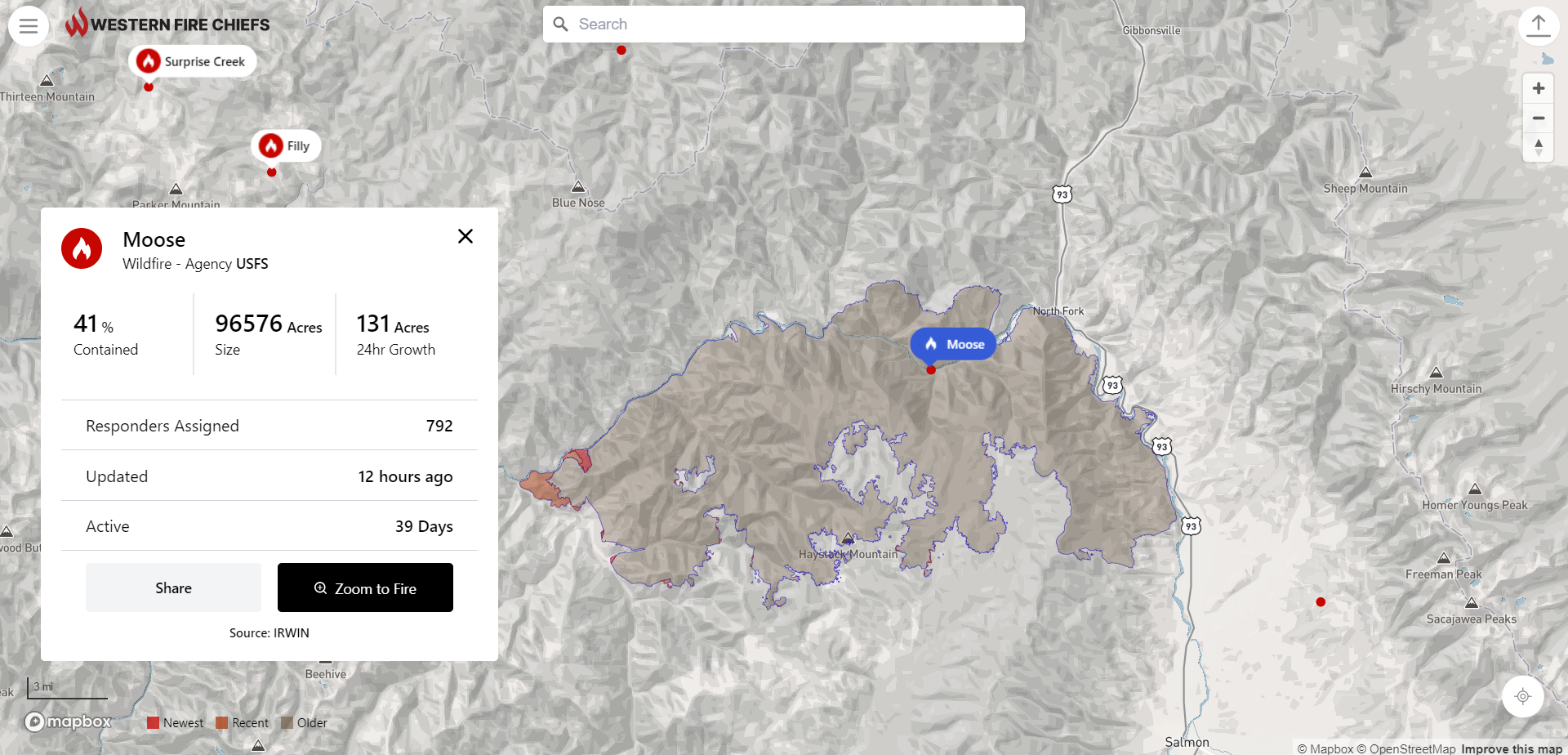
Take an inside look at the Western Fire Chiefs Association’s new Fire Map which provides near real-time information about active wildfires

Whilst they are no new phenomenon, with the number of wildfires increasing across the world the danger is closer to home for many. The mounting wildfire crisis in the US presents a very real and significant danger to people, homes, and communities – particularly those in wildfire urban interface settings.

Fires are most likely to take hold when moisture levels and humidity are low and temperatures are high. These conditions can be exacerbated by climate change and when environmental conditions reach a certain threshold in terms of available fuel and dryness, the risk of intense and dangerous fires can increase quickly. In response to the rising temperatures and increased risk of fire the Western Fire Chiefs Association (WFCA) introduces its Fire Map to provide near real-time information about active wildfires.

The WFCA Fire Map pulls data from the US Forest Service via National Interagency Fire Centre IRWIN feed and 911 Dispatch data via PulsePoint to track the location of the wildfire as they start and while they are burning. The WFCA Fire Map is the first map of its kind to pull this data from 911 Dispatch in relevant areas.

“The current climate situation is incredibly scary,” says Chief Mark Niemeyer, Vice President of the WFCA and Fire Chief of the Boise Fire Department. “The WFCA is providing public access to definitive information around the paths of wildfires so that communities can quickly take action.”

He continues: “The WFCA is committed to provide an even deeper level of intelligence around wildfires as they happen.” As the WFCA looks to the future, it is creating a development path in the next year which will include 3D and predictive mapping models, air quality and weather data, as well as text message notifications.

The Fire Map

The WFCA Fire Map was launched to provide near real-time information about active wildfires in a mobile[1]friendly platform. Brent VanKeulen, Deputy Director of the Western Fire Chiefs Association says the WFCA is providing the map to everyone free of cost, as a resource to save lives, land and property. He explains: “By providing public access to definitive information around the paths of wildfires, we are hopeful that communities can take quicker action to stay safe.”

 The WFCA Fire Map pulls together data supplied by the US Forest Service via National Interagency Fire Center IRWIN feed and combines it with 911 Dispatch data via PulsePoint. Together, this information is used to track the location of the wildfire both as it starts and whilst it is burning.

 The fire map was developed by Gartrell Group for the WFCA. Users can search for a fire by name, zoom to a location or zoom to their location and explore the area nearby. Where larger fires are mapped these will display the perimeter as changes are reported. Along with the map visualisation, the app provides details including fire size in acres, 24-hour growth, percent containment, number of personnel assigned, how long the fire has been active, and when the information was last updated.

The app features a share button and clicking this allows users to easily share information about a fire. There is also an embed option to link to a live map of the McKinney Fire. Users can click the fire symbol on the map to view information about the fire, and to share to social media. Other features such as weather and wind information are in the pipeline.

Looking ahead, the fire map in its current state is just the beginning. VanKeulen adds: “Wildfires will be a part of our lives for the foreseeable future. We will always have areas where people live in the forest. We need to focus on building adaptive communities so that we can be safe in the presence of fires. The WFCA and many other organizations are working towards solutions that help us adapt. The fire map is one of several initiatives.

PulsePoint

PulsePoint is a 501(c)(3) public non-profit foundation building applications created to help public safety agencies inform and engage their citizens. The development of the PulsePoint app began in June 2009 as a partnership between the San Ramon Valley Fire Protection District (SRVFPD), where its founder Richard Price was the chief, and the College of Informatics at Northern Kentucky University (NKU).

The application was released in the Apple App Store in April 2010. At a meeting almost a year later the Board of Directors of the San Ramon Valley Fire Protection District established a committee to address the affairs related to the application, including the transfer of responsibility for the software to an independent and external non-profit foundation. This resulted in the formation of the PulsePoint Foundation to oversee the future direction of the application.

In September 2013 the PulsePoint Foundation entered into a strategic partnership with Physio-Control, Inc. to expand the availability of PulsePoint to public safety agencies and on January 1, 2017, these responsibilities transitioned back to the foundation. Physio-Control became an invaluable partner that helped establish a presence in the market and helped prove the value of using mobile technology to activate early bystander response in sudden cardiac emergencies.

As the WFCA looks to the future, it is creating a development path in the next year which will include 3D and predictive mapping models, air quality and weather data, as well as text message notifications. “The addition of text notifications will be a game changer.” Richard Price, Founder PulsePoint.

“We are excited to offer the opportunity for PulsePoint[1]connected agencies to seamlessly display fire incidents within the WFCA Fire Map.”

This article was originally published in the September edition of IFSJ. To read your FREE digital copy, click here.

Market Analysis: Personal Protective Equipment

International Fire and Safety Journal analyses the current state of the firefighter protective clothing market

A s the challenges which face firefighting teams day-to-day are changing across the world, the safety of firefighters on the front lines remains a key concern for the industry. The rise of wildfire emergencies in regions where such incidents were rare if non-existent and the recognition by the World Health Organisation of the profession of firefighting as being carcinogenic are driving the firefighter protective clothing market around the world as the industry looks for new and improved ways to protect its first responders.

As the demand to increase the safety of firefighters grows, many manufacturers have been focused on the production of firefighter personal protective equipment (PPE) with better washability characteristics to limit the decontamination or spread of infection. As wildfires have become more common, manufacturers have been responding by introducing PPE kits that are lightweight and comfortable to wear for extended periods. To encourage the usage of such PPE, next-generation networked PPE is being introduced with better analytical capabilities.

The rising number of fire incidents has resulted in a greater demand for firefighters, which is projected to drive the sales of firefighter PPE in the years ahead. Government mandates are expected to impact the safety of firefighters and create additional growth to this expanding market. As a result, the firefighter PPE market is likely to grow at a compound annual growth rate of 4.9%, in the long run, to reach a value of US$ 2.2 Billion in 2027, according to a market research report from Stratview Research.

Market segments

Based on the product type, the firefighter PPE market is segmented into apparel or wearable gear and helmets. According to Stratview research, the apparel segment is expected to witness faster growth during the forecast period as it is replaced more frequently compared to helmets. That said, helmets form the dominant segment, accounting for more than half of the market, and are expected to sustain their dominance throughout the forecast period.

In terms of regional demand, North America is expected to remain the largest market for firefighter PPE during the forecast period. The USA remains the world’s largest market for firefighter safety equipment, supported by a huge expenditure of the country on firefighter safety equipment.

Europe is also likely to create sizeable opportunities in the coming five years and is also estimated to remain the second-largest market by 2027. Meanwhile, the Asia[1]Pacific region is estimated to remain the fastest-growing market in the years to come, propelled by China, India, and Japan.

Regional forecast

With the increase in the global population and urbanisation, the demand for firefighting PPE is also increasing. On a regional basis, the market is broken down into North America, Latin America, Europe, Asia Pacific, and Middle East & Africa.

In North America, the region has a large number of industrial and commercial establishments, which are the major end-users of fire protective clothing. In addition, the presence of stringent government regulations regarding fire safety is also driving the growth of this market in North America.

Latin America has seen an increase in the number of industrial and commercial establishments in recent years which has led to an increased demand for firefighting protective clothing from these sectors. The growing awareness about fire safety is also contributing to the growth of this market in Latin America.

In Europe, the market in is expected to grow at a moderate rate in the years ahead. This can be attributed to the stringent government regulations regarding fire safety in this region. The presence of a large number of industrial and commercial establishments is also driving the growth of this market in Europe. In addition, the increasing presence of wildfires is likely to create a shift towards fire brigades adopting alternative firefighting suits for different scenarios.

Marko de Klein, Executive Sales Manager at MSA Bristol, said that different countries within Europe are facing heightened wildfire scenarios which will factor into the development of firefighter protective clothing.

For the Asia Pacific region, the fire protective clothing market is expected to witness significant growth in the years ahead due to the increasing incidences of fires and other accidents in this region. In addition, the growing awareness about fire safety is also contributing to the growth of this market in the Asia Pacific.

In the Middle East and Africa region, a moderate growth rate is anticipated during the coming years. This can be attributed to the presence of a large number of industrial and commercial establishments in this region. As with all other regions, the growing awareness about fire safety is also contributing to the growth of this market in the region.

This article was originally published in the September edition of IFSJ. To read your FREE digital copy, click here.

Exclusive: Suppressing the spread of wildfire

IFSJ sat down with Perimeter Solutions’ new President of Global Fire Safety, Jeff Emery, to discuss wildland fire suppression

Earlier this year Perimeter Solutions announced Jeff Emery as its President of Global Fire Safety, a newly created role which put him in charge of Fire Suppressant and Wildfire businesses at Perimeter Solutions. IFSJ sat down with Jeff to learn about his new role and talk about one of the biggest global issues in fire: wildland firefighting.

What drew you to the role of President of Global Fire Safety?

I have a long history in both aviation and the fire services, so when I looked at what Perimeter does and the focus on aerial and ground-based fire safety – it was a natural fit. We’re working in many cases with those airborne applications of retardants to help slow and stop the progress of wildfires and protect the firefighters on the ground.

The portfolio of Perimeter is terrific, but I really appreciated the service component. I think that’s a piece of Perimeter’s offering that oftentimes doesn’t get as noticed, but we have a large staff of dedicated employees that are working throughout wildfire season any time of the day any day of the week responding to the airbases with mixing and loading of our retardant onto the aircraft to keep them in operation and help our customers be as effective as they can be when fighting wildfire.

Tell me about the role Perimeter Solutions plays in Wildland firefighting?

Perimeter Solutions has nearly 60 years of history in wildland firefighting. We have a number of different solutions and each of them has a unique application, including aerial fire retardants, ground applied fire retardants, Class A foam and mobile foam and mixing equipment. They all play a part of the portfolio and the broader solutions that we provide for our customers on the wildfire protection side.

What are aerial fire retardants and their main applications?

The retardant products that we provide today are mostly ammonium phosphate-based. We have added components to that over the years and a lot of the innovation is to do with accurate deployment and product weight and viscosity.

Accuracy is important because the aircraft is going to want to hit the target whether it’s at 200 feet or 400 feet – you want as straight of a line and as accurate of a drop as possible. The idea is to get a solid and consistent perimeter around the fire with no line breaks that would allow a fire to escape through and you need to make sure it avoids and protects the firefighters on the ground.

When would ground applied fire retardants be used?

In certain cases when a fire is taking hold you will often have times where there are high winds and smoke and it is unsafe to fly the aircraft. In those cases, one of the best tools that are available to those on the ground are ground-based retardants. It’s essentially the same composition of product and works the same as the aerial retardants that would be dropped.

We have a service team that’s available to deploy to any situation. The McKinney Fire is the latest example where we’ve had teams on the ground since the beginning. You look over the first few days of that fire and there were some wet conditions and significant smoke and then some blowing occurred that made it impossible to fly in. Our teams on the ground played a part in that fight in those early days to slow the spread of the fire.

Another ground-based application would be the prevention and protection side of our business. For example, there are roadside applications where you have a history of vehicles overheating going through an uphill section of a highway causing ignitions at the side of the road. These areas we can treat through our ground[1]based technology to keep that area protected throughout the fire season. This same approach can be taken around railroads, utilities infrastructure, or even personal homes, to prevent ignitions or protect those areas from existing fires.

What are the differences between retardants and Class A foams?

The idea of Class A foam is that it is water dependent. It is mixed with foam and effectively makes that water more effective at penetrating, holding, and prohibiting evaporation to allow water to seep in, doing its job more effectively for a longer period of time. Foam is strictly a suppressant. It’s used to put on the fire to help seep into the fuel to help the water do its job better.

Retardants are mixed with water predominantly to help the distribution and application of the product, but even after that the water has evaporated out the product is still doing its job to be able to provide that retardant capability. Typically, about half of the retardant is put into the fire line to suppress it and half outside to keep the fire from spreading

You’re quite involved in the firefighting process beyond foam production, what else do you offer firefighters?

To support our Class A & B foam products, we do produce bladder tanks, equipment to produce, dilute and distribute that foam, making sure its diluted to the right ratios and applied in a way that’s going to be most effective to get that water to do its job.

In the US we supply about 45 full services bases where we supply perimeter employees, equipment and product for those aircrafts and their missions every day. We also supply equipment to a lot of customer staffed bases, which we maintain over time to keep those in good working order to make sure that they are getting the servicing and maintenance they need to remain effective.

Can you tell me about any recent developments in your wildland firefighting solutions?

Europe has seen an unprecedented wildfire season this year and you have a lot of countries that historically did not have the aircraft assets or the history of using retardants in their operations. We are investing in countries across the region in helping to fight that fight. France has been at the forefront with more progressive applications and coordination of wildfire mitigation over the years.

We’ve seen that model now replicated across the region with many countries now conducting trials and putting their aircraft to use with retardants. We also see a lot of work happening in some of these emerging areas like Greece, Portugal, and Croatia. We’re working hand in hand with governments in those countries to enhance their capabilities.

The second piece we’re focusing on is our prevention and protection business which is why we acquired a company called LaderaTech. Prevention is an under-tapped portion of the portfolio and can truly help communities in preventing a small ignition from becoming a large mega fire.

Finally, can you tell me about Perimeter Solutions’ recent contact with San Diego County Board of Supervisors for Roadside Vegetation Management?

 We worked with them on some trials last year on an area stretch from Wildcat Canyon just outside the city of San Diego. The stretch of road is a strong uphill drive that’s seen a history of vehicles overheating, or brake pads coming off and igniting roadside vegetation. When you look at options to prevent that, one method is clearing the vegetation and giving a defensible space and spraying it down with herbicide to keep that regrowth in check. Our application is more efficient and sustainable, where a truck travels up the road and sprays our product to provide lasting protection.

We’ve worked on the area for a couple of years and after the trial year saw multiple ignitions, which were all put out within a matter of square feet. This year we’re extending that mileage, working hand in hand with San Diego country and their Cal Fire units and water tenders to be able to apply our retardant across a broader swath of that highway to protect those communities.

This article was originally published in the September edition of IFSJ. To read your FREE digital copy, click here.

Intersec Saudi Arabia returns

After a three year gap, Intersec Saudi Arabia, the Kingdom’s largest trade fair for security, safety, and fire protection prepares for its long-awaited return in Riyadh this month. Taking place from 13-15 September 2022 at the Riyadh International Convention & Exhibition Centre, Intersec Saudi Arabia’s 4th edition will feature more 150 exhibitors from 20 countries, covering the four key pillars of Fire and Safety, Commercial Security, Homeland Security, and Cybersecurity.

The momentum of what has been a highlight on the annual events calendar for security and safety professionals across the Kingdom has been building since the trade show last took place in 2019 and now the annual three-day trade fair is set to be back in full force, with organisers turning away prospective exhibitor enquiries, having put up the ‘sold out’ sign on available exhibition space several months ago.

There is a clear pent-up demand to tap into the Middle East’s largest market, with Saudi’s Vision 2030, and the corresponding opportunities in securing infrastructure, people and assets a central talking point.

Intersec Saudi Arabia is organised by Saudi-based Al-Harithy Company for Exhibitions (ACE) Group under licence from UAE-headquartered Messe Frankfurt Middle East, which organises Intersec, the world’s leading exhibition for security, safety, and fire protection.

Safety in focus

Alex Nicholl, Intersec’s Director said that safety and security are high on the agenda of Saudi’s Vision 2030 and that there is a perennial requirement for safety and security products, fire protection and the accompanying innovations, all of which will be on display this year at Intersec Saudi Arabia 2022.

“Exhibitors are fully aware of the likes of NEOM, Amaala, Red Sea Project, and Qiddiya, and the immense opportunities these provide,” said Nicholls. “They’re accordingly tailoring their stand designs and solutions to target these ‘giga’ projects specifically and this will only ramp up in intensity every year as each project phase nears completion.”

Headline international exhibitors returning to the spotlight include Axis Communications, Hikvision, Genetec, Toshiba, and Milestone Systems, Nedap, Draeger, and Gatekeeper, while SAFE (National Security Services Company), Al-Alameya Group, Al Rajhi Telecom Company, Saudi Sicli Company, Abana Enterprises Group, and Al Aswad Fire Fighting System are flying the Saudi flag proudly.

NFSSP (National Factory for Safety and Security Products) is among those launching new products in Saudi Arabia, with the UAE company set to unveil its Hoods brand of tactical and safety footwear.

The UAE-made range of footwear, of which there are 41 models, are made of innovative materials including leather-tech air flow systems, fibre glass and Kevlar, offering lightweight, breathable, and durable footwear ideally suited to harsh Middle East climates. 

“Our company has been manufacturing in the UAE for more than 12 years, producing high quality tactical and safety shoes for many categories including military, police, security, oil & gas, construction and general factories,” said Jaime Ramirez, EMEA Sales and Marketing Manager at NFFSP.

“Saudi Arabia is a hugely important market for us and is continuously growing.  We see massive opportunity in particular in the construction and oil & gas sectors. We estimate we can contribute around 200,000 pairs of shoes to the market in 2023, growing 10 percent over the next five years.”

Elsewhere, SB Group International will showcase its Netix and Teknoware brands of IoT and cloud-enabled building automation and life safety solutions at Intersec Saudi Arabia 2022. SB Group’s Chairman Sanjeev Bhatia said the company is eager to connect digitalization and optimization savvy clients with its wide range of smart solutions, including control panels, luminaires, IoT controllers, and its AI-powered Netix Konnect platform.

“Saudi Arabia is a prime focus of our emerging business markets growth plan,” said Bhatia.  “Teknoware, being a global leader in the manufacturing of emergency lighting solutions, and Netix, driving Environmental, Social and Governance (ESG), is fully aligned with and compliments the growth and technology implementations of Vision 2030.

Security and fire protection

Intersec Saudi Arabia 2022 takes place amid rising national demand for security and fire protection.  Saudi has announced multiple infrastructure projects backed by the government sector, highlighting strong potential growth for the security industry.

According to consultancy 6Wresearch, Saudi’s spend on commercial security (CCTV, access control, and intrusion detection), safety, fire systems and equipment will reach nearly US$1 billion in 2022, and increasing to US$1.16 billion annually by 2025. 

“Growth is driven in part by government regulation of compulsory installation of fire safety, detection, and alarm systems in buildings and the opportunities emerging from new measures aimed at ensuring the security and safety for both citizens and visitors to the Kingdom,” explained Nicholl. 

“Intersec Saudi Arabia’s strategic location of Riyadh also means that exhibitors will have easier access to key decision makers and government and ministerial delegates based in the Saudi Arabia capital, which will enhance the sustainability of the event.”

Prevention and mitigation

In addition to a packed exhibition floor, a three-day Intersec Saudi Arabia Forum 2022 will gather security, safety and fire protection professionals with equipment manufacturers, integrators, consultants, and government authorities to navigate the future of the Kingdom’s integrated vision for safety, security, prevention and mitigation.

Saudi’s Vision 2030 will form the central theme for day one, revolving around core topics such as the implications of aligning security and safety strategies with some of the boldest ‘giga projects’ the world has ever seen. 

Speakers and panellists will address the challenges from land, maritime, air, and space in a multi-domain approach that is essential in securing the multitude of related vision 2030 projects that are expected to attract hundreds of billions of dollars of investment in the coming years.  

Day two of the conference will shine the spotlight on cybersecurity, including an opening keynote on Saudi’s National Cybersecurity Strategy, while safeguarding critical infrastructure, oil and gas, and energy assets from costly digital attacks will also be under scrutiny. 

The conference will wrap up on day three with key government partner sessions and regulatory framework updates from the Saudi Civil Defence and the Saudi Standards, Metrology and Quality Organization (SASO), along with an afternoon session of fire protection. 

“While serving as a vital knowledge-sharing platform, the forum will bring together key government leaders, agencies and organisational heads with outstanding world-class speakers, innovative products, technology and solutions across all key sectors,” said Nicholl.

“The program will present a veritable ‘Think Tank’ for regional leaders in the security industry, bringing together stakeholders from policy makers, law enforcement, civil defence and private organisations to define the future of security.  Our advisory board of seasoned industry experts have crafted an engaging conference program.”

Saudi Arabia has also seen a boom in the cybersecurity sector, prioritising AI and digitisation as key pillars of its economic development in-line with its Vision 2030 initiative.  Nicholl said cybersecurity is likewise a key focus area for Intersec Saudi Arabia, with the objective to present those providers of cyber solutions for IP-based systems and networks at enterprise level across all sectors. 

“As technology advances and evolves, so too do risks associated with harmful breaches and costly downtimes of integrated networks,” he said.  “It’s important therefore that IT professionals and system integrators are aware and armed with the latest solutions that leading industry names are bringing to Intersec Saudi Arabia 2022.”

Back to business

Upon speaking to key exhibitors and government partners, Nicholl said the anticipation is building fast ahead the final countdown of what will be a welcome return to business for Intersec Saudi Arabia. 

“It’s been three years since the last Intersec Saudi Arabia, and we know our exhibitors are immensely excited to showcase their latest innovations and developments in Saudi’s security, safety, and fire protection market, that will reach nearly US$1 billion in revenues this year,” he concluded. 

“Aside from the conference, plenty of new product launches will be displayed in the Kingdom for the first time, targeting key sectors such as energy, healthcare, education, transportation and infrastructure.

“Safety and security is all around us, in everything we do, but in line with the Saudi Vision 2030 and its 24 key projects supporting the vision, we’re keen to drive the agenda of urban environments, tourism, residential, arts and culture.”

Intersec Saudi Arabia is supported by key government entities including the Saudi Ministry of Interior, and the Saudi Civil Defense.  More information for Intersec Saudi Arabia is available at www.intersec-ksa.com.

This article was originally published in the September edition of IFSJ. To read your FREE digital copy, click here.

Exclusive: The Rural Firefighting Challenge

Joel Wright, President and Co-Owner at FOL-DA-TANK, speaks exclusively with IFSJ about the company’s portable water tanks and the challenge to supply water for firefighting in rural areas.

Manufacturer of portable water tanks and tank accessories for firefighters and environmental first responders, FOL-DA-TANK, was founded in 1954. Its founder Giles Eldred worked in the business loan department of a small bank in Rock Island, Illinois, in the early 1950s, when he met a customer who was applying for a loan to start a company that repaired fire trucks.

In the conversations that Eldred had with this customer regarding the firefighting industry, the issue of providing water was a common topic. In some rural areas where fire hydrants were not available, firefighters were staging water in temporary water reservoirs fashioned out of extension ladders tied together in a square with a canvas tarp draped over them.

The problem faced by these emergency responders stuck in Eldred’s mind, and he began to wonder if there was a more efficient way to create a temporary water storage container. One day, when he was folding his daughter’s playpen, he got the idea for a folding tank that could easily be stored on a ladder rack in a fire truck. He started the company under the name FOL-DA-TANK.

After 68 years in business, the company makes several styles of portable water tanks and specialty water moving strainers and fittings needed to move large volumes of water at rural structural and remote wildland fire scenes. IFSJ caught up with Joel Wright, FOL-DA-TANK’s President and Co-Owner to discuss the rural firefighting challenge that is water supply.

Prior to acquiring FOL-DA-TANK in 2020, Wright was the CEO of MoboTrex, Inc. which manufactures and distributes equipment for traffic signal intersections throughout North America. “My engineering background and early career experiences as a project manager and process engineer formed my foundation for the leadership and business skills I have built throughout my career,” Wright tells.

Wildland firefighting

Mobile water supply systems assist rural, structural and remote wildland firefighters by containing water at the fire scene. Rural structure fires are often miles from the nearest hydrant and tankers cannot carry enough water to extinguish a large fire. Instead, portable drop tanks need to supplement the water supply which can be refilled by shuttle tankers. A growing issue is that remote wildland fires are fast moving and far away from municipal water sources.

“A recent use case involves protecting high voltage transmission lines in a remote and mountainous area of Utah with nearby wildfires,” tells Wright. “The power company purchased several 1360-litre helicopter tanks which will be flown full of water directly to a staging area near each tower. Crews will use the water to create a fire line around the tower thus protecting it from damage. As the fire moves, the tanks can be re-filled and staged at towers where the fire may potentially burn.”

As rural fire departments are staffed by volunteers who have regular fulltime jobs, he points out that finding time to train volunteers on the best practices for complicated fire trucks and the related mobile water supply equipment is a huge challenge for the industry: “Manufacturers are always on the lookout for ways to add value by making the equipment easier and safer to use. “One thing FOL-DA-TANK has invested in recently is creating ‘how-to’ videos for the products we manufacture,” he says.

Rural concerns

Rural settings often have narrow roads and other limiting space constraints which is why FOL-DATANK offers a single lane tank kit for use in these locations. “The standard single lane tank is rectangular in shape compared to the original square folding frame tanks,” describes Wright. “A 9500-liter tank is typically 4m by 4m square whereas our diamond shaped second generation single lane tank is 6.7m long by 2.4m wide.

“The 1.6m width savings clears valuable roadway allowing emergency vehicles to pass in and out of the fire scene. Single lane tank users couple the tank with an aluminium 90 degree elbow attached to the suction inlet on the fire truck and to a hard suction hose which runs to the single lane tank.

“The hard suction hose is connected to a low-level drafting system permanently mounted to the tank. The flange mount plate is designed to stabilise the inner/outer flange set. The plate mounts to the tank frame and the flange set goes through the tank wall. Inside the tank and fastened to the inner flange is a low flow strainer which can maintain maximum pumping capacity down to 40mm-50mm water depth.”

Increasing fire activity

Global demand for mobile water supply systems is on the rise because of an increase in wildfires and the desire to protect land and property. The length of the annual fire weather season has increased on average globally as has the frequency of days with extreme fire. While hotter, dryer weather can facilitate increased fire activity, human fire management policy of past decades is also a root cause.

Wright says that land use, fire mitigation and prevention policies have increased the fuel available for wildfires causing them to burn hotter and over larger areas. “As we learned at Interschutz, truck builders outside of North America are just beginning to offer auxiliary water tanks on new truck builds,” he says. “Firefighters in Europe who visited our stand were eager to understand how this system could deliver more water to rural structure fire scenes. We expect international growth as the word spreads.”

Driving innovation

When FOL-DA-TANK was purchased from the founding family in late 2020, Wright says the new owners and management team brought some fresh perspective. “As we were meeting customers, conversations naturally led to stories about how our products were used and what worked well and what didn’t. We made a series of improvements to our original folding frame tank design including: the Rapid Release mechanism; Hi-Vis drain sleeves, the Jumbo Drain; and the flange mount plate.”

The Rapid Release mechanism is a slim profile device built into the tank frame. It firmly holds the drain sleeve in place and releases easily with one swift motion. “It was important to firefighters that this mechanism could be operated with gloves on,” he explains. “Hi-Vis drain sleeves are made from the same heavy duty PVC vinyl as the tank liner, but with a contrasting color. The problem solved is much better visibility at night.”

FOL-DA-TANK’s jumbo drains are bigger versions of its standard drain sleeves and drain leftover water from the tank six times faster than the standard size sleeve. “This can be vital in grass fires when a wind shift demands a fast relocation of equipment,” says Wright. “The flange mount plate is a permanent through wall flange set on a folding frame tank. The device connects two tanks or a low flow strainer which eliminates running a hard suction hose over the tank frame.”

Looking ahead

Since the ownership transition and changes in management took place in November 2020, Wright says that FOL-DA-TANK has focused on three areas in our core firefighting market: providing reliable supply; winning at the point of sale; and driving demand for innovation.

“One of our favourite success stories is reducing lead time from 45 days to less than 10 days and then sustaining it for 10 consecutive months so far,” he tells. “Another is the introduction of our Rapid Release mechanism for the drain sleeves on frame tanks. The device has been very well received by experienced firefighters who have used our products for decades.”

On future plans, he reveals this includes growth through acquisition into the first responder market: “We have an excellent operating team and manufacturing infrastructure with capacity to do more. Our ideal target is to purchase a company that manufactures lose equipment sold through our existing distributor network.”

Finally, Wright talks about the importance of durability and functionality, something he says the company’s founder understood well when he first designed the folding frame tanks. “A nearby customer recently replaced their department’s two 30-year-old tanks which were still functioning but in need of patches and other repairs,” he tells.

“While the local government was thankful the tanks had outlasted the original fire trucks on which they were originally supplied, the fire chief was even more appreciative of the design enhancements made over the 30 years.

“He liked the new Rapid Release mechanism for the drain sleeves, hinge guards at the pinch points on the frame, lift handles in the liner to move residual water to the drains, and our hi-vis drain sleeves made from contrasting colours of vinyl. FOL-DATANK has a solid design concept and culture of innovation. We welcome the voice of the customer and are thrilled when our team makes improvements to an already outstanding product.”

This article was originally published in the September edition of IFSJ. To read your FREE digital copy, click here.

HM Queen Elizabeth II has died

We are saddened to hear of the passing of Her Majesty Queen Elizabeth II, a strong and truly inspirational figure who will be greatly missed and fondly remembered for generations to come.

We offer our sincere condolences to members of the Royal Family, those close to her from around the world, the Commonwealth and a country in mourning.

We welcome our new monarch King Charles lll. Long live The King.

1926 – 2022

European Commission discusses future Wildfire Preparedness plans

In the wake of forest fires in Southern and Central Europe, the European Commissioner for Crisis Management, in close cooperation with the Czech Presidency of the Council, held an Informal Ministerial Meeting on Reinforcing Wildfire Preparedness and Response in Brussels on 5 September 2022.

Ministers, State Secretaries and Directors-General for Civil Protection of the EU Member States and Participating States to the Union Civil Protection Mechanism (UCPM) discussed rapid coordinated European action, within the framework of the UCPM, to better protect the Union and its citizens from fires in 2023 and beyond.

The participants gave their tributes to the work of the many firefighters who engaged in responding to fires across the Union and welcomed the European solidarity shown through the UCPM throughout the summer and the effective coordination ensured by the Emergency Response Coordination Centre (ERCC).

The meeting confirmed the shared understanding of all EU Member States and Participating States that climate change is rapidly altering the wildfire risk in Europe. The scientific projections for the next years and the operational experience of the EU’s fire services depict a dire situation for the future of European forests and the livelihoods of citizens across the EU.

The occurrence of large forest fires in Central and Northern Europe, witnessed this year in the Czech Republic, Slovenia and Germany and complementing a trend of previous years that saw fire emergencies also in Austria and Sweden, has raised particular concern among the leaders. T

he absence of sufficient firefighting planes and helicopters in these countries puts additional strain on the already established seasonal European safety net of firefighting aircraft, co-financed by the European Commission and meant to temporarily bridge gaps until the permanent new European fleet of firefighting aircraft (called rescEU and composed of 14 medium and light amphibious planes and 9 medium helicopters to complement national fleets) will have been produced between 2026 and 2030.

It was agreed that the intensification of wildfires in Southern Europe exhausts all existing firefighting capacities at national and European level, making European solidarity in a situation of simultaneous large-scale fires in several countries a particular challenge.

The pre-positioning of firefighters, for the first time operationalised this summer in a European pilot project in Greece, was identified as a good practice to not only share aerial capacities in the EU, but to also to exchange expertise, share knowledge and pre-plan the mobilisation of ground teams from countries less affected by fires to those in need of assistance.

The EU Member States and the Commission reached broad consensus on four concrete actions points:

  1. Accelerate the establishment of the new permanent rescEU fleet of aerial firefighting capacities by exploring an advanced procurement of helicopters;
  2. Expand the existing seasonal European safety net of firefighting airplanes by financing the inclusion of additional helicopters and light aircraft in particular in Central and Northern Europe, as of summer 2023;
  3. Reinforce the seasonal pre-positioning of ground teams to wildfires hot spots;
  4. Operationalise a plan of action for fire prevention and preparedness.

These actions are subject to additional EU budgetary resources being made available. The European Commission invited countries interested in hosting additional rescEU capacities or prepositioning ground teams to inform the European Commission of their intentions before the end of September 2022.